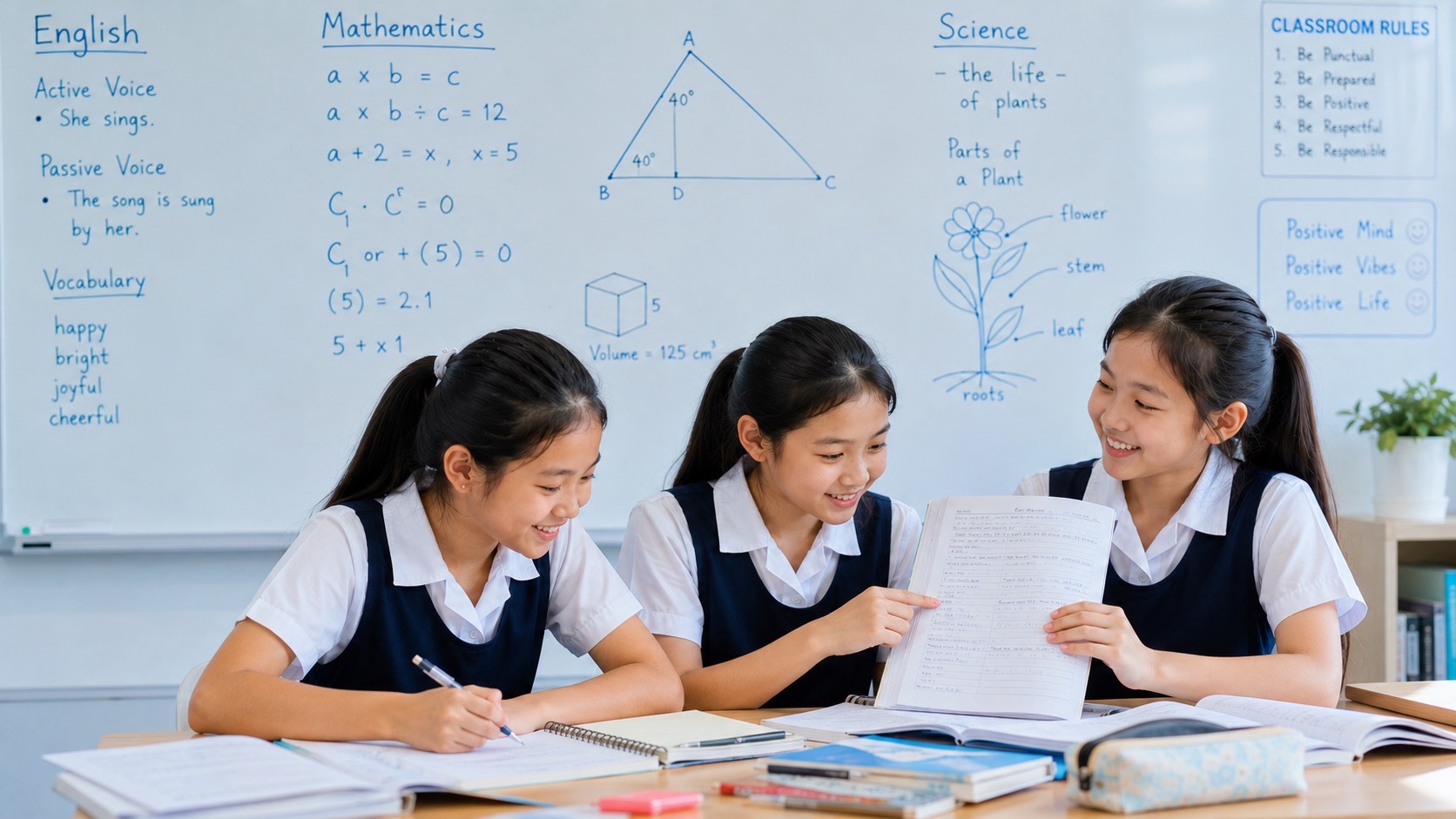
Primary 1 Mathematics shapes and picture graphs become easier when a child can handle the objects, explain what the pictures mean and check an answer independently. For Bukit Timah parents considering small groups tuition, the useful question is whether teaching develops these abilities. A child should have opportunities to recognise a triangle after it is turned, build a larger shape from smaller pieces, copy a simple arrangement carefully and read a graph without confusing the pictures with the things they represent.
This guide shows how to teach those ideas through original examples, short conversations and manageable practice. It also explains what to notice when a child gives a wrong answer: the difficulty may be the shape, counting, a question word or organising the work. A three-pupil setting can provide opportunities for explanation and feedback, but the group still needs suitable tasks and individual checks. Parents can use the activities at home or discuss them with a tutor when deciding what support would help.
- Start with a small selection of shapes that the child can touch, move and describe.
- Change the size, colour and position so recognition does not depend on one familiar picture.
- Connect pieces and outlines before asking for a copied drawing.
- For the picture graphs here, let one symbol represent one item and state that rule clearly.
- Ask separately about an individual group, the total and the difference between two groups.
- Listen to the explanation before deciding which part needs correction.
- Check independence with a fresh example after guided practice.
- Choose support by the quality of teaching, feedback and fit with the child's current learning.
Find your next learning step
Choose the part that matches your child’s current question. The full teaching guide follows.
Chapters 1–4
Recognise shapes
Notice the features that remain when a shape is turned.
Chapters 5–7
Build and copy
Join pieces, check a drawing and explore a simple pattern.
Chapters 8–10
Read the graph
Connect a key, the categories and the question.
Chapters 11–14
Practise and decide
Give each learner a turn and use errors to plan support.
Contents
Curriculum sources checked on 16 November 2026. Activities and examples are original teaching suggestions.
Recognise shapes · Chapters 1–4
Build and copy · Chapters 5–7
Read the graph · Chapters 8–10
Practise and decide · Chapters 11–14
MOE's current Mathematics syllabus places 2D-shape recognition, composition and copying, plus simple picture graphs, in Primary 1. Formal shape patterns, 3D shapes and scaled picture graphs appear in Primary 2. The optional pattern activity below is exploration, not a claimed Primary 1 requirement.
That distinction helps a parent choose what to practise today. A child who is uncertain about three-sided figures benefits from comparing several triangles. Introducing a long list of unfamiliar solids would answer a different question. Likewise, someone who loses count while reading five pictures needs a reliable way to track those five pictures before encountering a graph in which each picture represents several objects.
This article's exercises are teaching examples. They are not school examination questions, official marking schemes or a claim about a particular school's lesson sequence. Match the examples to what the child has encountered, and ask the teacher which language and representations the class currently uses.
MOE states that Primary 1 and Primary 2 have no weighted assessments or examinations. Classroom observations and feedback can still guide the next learning step.
Parents can therefore look for evidence of understanding without turning each activity into a score. After a short conversation, note one specific observation: “Recognised the triangle when turned, but counted a corner twice.” That tells an adult what to revisit. “Bad at shapes” tells us very little and gives the child an unnecessarily broad label.
Before selecting a worksheet, offer three small tasks. Show a triangle and ask the child to describe it. Arrange four counters beside a label and ask how many there are. Then ask a simple question about two groups: “Which group has more?” These tasks examine different things. A child may count accurately while misunderstanding the comparison word, or know a shape's name while being unable to explain what makes it that shape.
Keep the first attempt free from hints. Adults often point at the correct feature, stress the important word or move the child's finger towards the answer. Those prompts can help teaching, but they also hide what the learner could do independently. Listen first, then decide which prompt would be useful.
For example, a child calls a turned square a “diamond”. Ask, “What changed when I turned it?” Put the same card upright again and turn it slowly. The child can see that no side was added and no corner disappeared. This conversation identifies an orientation issue. It does not require a lecture about every quadrilateral.
Another child reads a row of five symbols as six. Ask for a second count with one finger touching each symbol once. If the answer becomes five, the problem may be tracking rather than understanding the quantity. If the child still counts a symbol twice, place a counter over each counted picture and try again.
A third child correctly states that one group has six and another has four, but answers “six” when asked how many more. The individual quantities are understood. The teaching should now make the difference visible through matching. Repeating a page of basic counting would spend time on a skill the child has already demonstrated.
CHAPTER 3 OF 14 · Recognise shapes
3. Recognise a shape beyond its familiar appearance
Begin with flat paper cards. Include triangles that look different: one tall and narrow, one broad, and one with a point facing sideways. Include figures that are not triangles, such as an open three-segment line and a closed four-sided figure. Ask the child to choose the triangles and explain a choice.
The useful reasoning is that a triangle is a closed shape with three straight sides. A familiar colour, a pointed top or a position on the page does not determine its name. The open figure matters because a child may count three line segments and overlook the gap. Trace the boundary together, stopping at the opening, then compare it with a closed triangle.
For a rectangle, turn the card and ask whether it has become something else. Let the child place a small paper corner against each corner of the shape. The purpose is to notice the structure, not to demand a technical speech. “The corners are still the same when we turn it” is a useful observation from a young learner.
Keep colour separate from shape. Put a blue triangle beside a blue circle and a red triangle. Ask which two belong together if the rule is shape. Then change the rule to colour. Both answers can be sensible because the sorting question has changed. Say the rule aloud before sorting, so the child is not expected to guess what the adult has in mind.
When a child hesitates, reduce the comparison. Two carefully chosen cards can teach more than a crowded page. Once the idea is secure, vary the appearance again. A fresh triangle on a different page gives better evidence of flexible recognition than another copy of the same picture in the same place.
CHAPTER 4 OF 14 · Recognise shapes
4. Explain squares, rectangles and circle parts accurately
A square has four equal sides and four right angles. A rectangle has four right angles, so a square is a particular kind of rectangle. Children can first explore this with paper shapes and matching corners; they do not need to memorise a formal definition before doing anything useful.
Avoid explaining a square as “anything with four sides”. A rectangle that is longer in one direction also has four sides. So does a slanted four-sided figure. Put these shapes together and ask what else needs checking. This turns an inaccurate shortcut into a question the child can investigate.
Some sorting activities use separate groups labelled “squares” and “rectangles”. Read the intended rule carefully. If the task means squares and rectangles that are not squares, explain that distinction in simple language. There is no need to tell a child that a square can never be a rectangle to make a worksheet easier to complete.
For circle parts, start with matching cut-outs. Two equal semicircular pieces can be joined along their straight edges to form a circle. Four equal quarter-circle pieces can also make a circle. Let the child rotate the pieces and check that the outside boundary is smooth. A gap or overlap gives immediate feedback about the arrangement.
Draw attention to both straight and curved boundaries. A semicircle has a curved boundary and a straight edge. It is not a triangle simply because the child notices places where lines meet. Comparing the pieces directly is clearer than relying on a quick glance at a tiny printed drawing.
If cutting is difficult, an adult can prepare the pieces. The mathematical task is choosing, turning, joining and explaining. Accurate scissor work need not become an unintended condition for understanding the shapes.
Offer two matching right-angled triangles cut from a square along one diagonal. Ask the child to rebuild the original square. First allow free movement. If the child becomes stuck, show the square's outline and invite the pieces to fit inside it without gaps or overlaps.
Discuss the check: “Does the outside match the outline? Is any space uncovered? Is one piece lying on another?” These questions make the goal visible. An adult who immediately pushes the pieces into place completes the puzzle but learns little about the child's thinking.
Next, separate the same pieces and try a different arrangement. Ask the child to describe the outside boundary rather than assume that the result must still be a square. The pieces have retained their individual shapes, while the outline of the combined figure may have changed. This is a useful distinction between the parts and the whole.
A second task uses two matching rectangles. Place them next to each other along matching edges and discuss the larger shape. Then slide one away slightly. Ask why the arrangement with a gap is different from one continuous filled shape. The child is checking how the pieces connect, not merely counting how many cards are present.
Use language that supports the action: beside, above, below, turn, join, edge, gap and overlap. Ask for one complete instruction: “Put the triangle beside the square.” Another learner can follow it and check whether the result matches the speaker's intention.
For a child ready for more depth, invite two different constructions using the same pieces. Ask what stayed the same and what changed. This extends reasoning without requiring a larger vocabulary list or a race through later topics.
CHAPTER 6 OF 14 · Build and copy
6. Copy shapes and arrangements with a clear checking method
Copying is easier when the child knows what to attend to. A complicated picture can overload the task: there may be shape, size, position and spacing to consider at once. Start with a single simple shape on a large square grid, then move to two shapes arranged beside each other.
Use a clear starting point. For a rectangle drawn along grid lines, the child can identify one corner, count the spaces across, then count the spaces down. Counting spaces matters: the marks at the boundaries are not extra units of length. Ask the child to show the spaces with a finger before drawing.
Separate planning from pencil control. If the child identifies the correct corners but draws a wobbly side, the mathematical plan may be sound. Offer a larger grid or a ruler if appropriate to the task. Avoid treating every untidy line as a failure to understand the arrangement.
For a two-shape copy, ask three questions. Are the shapes correct? Are they in the right places? Is the spacing the same? A child who checks only the names may miss that the circle belongs above the triangle. A child who checks only placement may reproduce a square where the model has a longer rectangle.
Try an oral planning sentence before the second attempt: “I will draw the square first, then put the circle one space to its right.” After drawing, compare the result with that plan. The learner now has a method for checking rather than the vague instruction to “look properly”.
End with a different arrangement, not an immediate tracing of the first. If the child can plan and check a new example, the method is becoming usable beyond the original drawing.
A repeating arrangement can provide a pleasant way to discuss sameness and change. Place a circle, a triangle, a circle and a triangle in a row. Ask the child what might come next and why. Treat this as a small exploration, stopping before it becomes a new worksheet burden.
If the child chooses a circle, ask which part repeats. Move the first circle and triangle slightly apart from the rest to make the pair visible. Then put them back. The aim is to see a repeating unit, not to guess from the last picture alone.
There can also be more than one possible rule when too little information is given. Two shapes by themselves do not establish a unique pattern. An adult can say, “I intended these two to repeat. Let me show another pair.” This models the useful habit of checking a rule instead of pretending that every short sequence has only one possible continuation.
Keep the activity connected to the child's current comfort with shapes. If naming the shapes is still effortful, return to matching and describing them. Extra challenge is useful when it deepens understanding; it need not be added simply because an activity can be made harder.
A graph starts with something worth finding out. Use an original example: eight children each choose one favourite fruit from apples, bananas and oranges. Suppose three choose apples, four choose bananas and one chooses oranges. These are invented teaching data, not a report about an actual class.
Write the three category labels and place one identical counter beside the chosen category for each child. Count the counters before replacing them with drawn symbols. The physical model makes it easier to see why each child contributes exactly one symbol and why the total is eight.
Give the graph a title, such as “Favourite Fruit in Our Example”. Add a key saying that one symbol represents one child. Use the same-sized symbol throughout and leave regular spacing. A row should not appear longer merely because its pictures have been stretched or spread out.
| Fruit | Choices: each ● represents one child |
|---|---|
| Apples | ● ● ● |
| Bananas | ● ● ● ● |
| Oranges | ● |
An empty category can also be meaningful. Suppose pears were offered as a fourth choice and nobody selected them. Keep the pears label and show no symbols beside it. The quantity is zero. Do not add a symbol merely to make the row look complete. Ask the child to explain the difference between an empty row with a clear label and a missing category that was never offered. This is a useful conversation about what was recorded; it does not require introducing a more complicated scale.
Explain the category rule before collecting responses. If each child may choose one fruit, someone who likes both apples and bananas still needs to select one for this question. A different question could allow several choices, but then the total of the symbols would no longer necessarily equal the number of children. The question and the recording rule belong together.
Invite the child to check the graph against the original counters. There should be three symbols for apples, four for bananas and one for oranges. Then ask what the graph helps us see. “Bananas have the most choices” is supported by this example. “Everyone likes bananas” is not established. The graph records first choices; it does not tell us every fruit each child likes.
The useful habit is modest interpretation: describe what these data show, with the labels and question still in view.
Use the same fruit example to introduce three different questions. “How many children chose apples?” asks for one category: three. “How many children made a choice altogether?” asks for the total: three plus four plus one equals eight. “How many more chose bananas than apples?” asks for a comparison: four minus three equals one.
These questions use the same graph, but they require different reasoning. Ask the child to point to the information needed before calculating. For the apples question, there is no reason to count every row. For the total, stopping after the longest row leaves out the other choices.
Make a difference visible by matching. Place four counters for bananas above three for apples, one above another in pairs. Three pairs match, leaving one unmatched banana counter. That extra counter is the difference. The explanation connects the subtraction to the comparison instead of relying on a memorised keyword.
Now reverse the wording: “How many fewer children chose apples than bananas?” The difference remains one. Ask the child to identify which group is smaller and explain what is missing to make the two quantities equal. The answer does not change because the comparison is described from the other direction.
For an equal comparison, change the example so two categories each contain four symbols. “How many more?” is then zero. A child may expect every question to have a positive answer; pairing the counters shows why no unmatched item remains.
Then change the order of the rows while keeping their labels and quantities together. Put oranges first and bananas last. Ask whether the most popular choice has changed. It has not: the positions have changed, but the recorded choices remain the same. This helps a child attend to the data instead of assuming that the first row must be the largest or most important. The same checking habit applies when a familiar graph appears in a different arrangement.
Finish by asking the child to make a question that the graph can answer. Then ask for a question it cannot answer, such as the children's ages. Learning where the information stops is part of reading a graph accurately.
Words such as most, least, altogether, more and fewer can carry much of the difficulty. Rather than giving a definition in isolation, connect each word to a specific action. For “most”, compare the quantities. For “altogether”, combine the relevant groups. For “how many more”, find the difference between the two named groups.
Be careful with automatic keyword rules. The word “more” can appear in a story about adding something, but it can also appear in a comparison. Read the whole question and identify the relationship. In the fruit example, “How many more chose bananas than apples?” compares existing quantities; nobody is receiving extra fruit.
Ask the child to restate the question in everyday language. “I need to find the extra ones after I match these two rows” is a useful explanation. If the child can say that but writes the wrong number, check counting or recording. If the child cannot identify the two rows, return to the labels and the question.
A parent can also offer two possible actions and ask the child to choose. “Should we count only apples, or all three groups?” After the choice, ask why. Reduce that support on the next question so the child eventually selects the relevant information without being offered alternatives.
Avoid correcting the entire spoken sentence while the child is explaining a new mathematical idea. Clarify the meaning first. Then model a clean sentence: “Four children chose bananas. Three chose apples. One more child chose bananas.” The language should help make the reasoning visible, not become another obstacle to participation.
An illustrative three-pupil activity can make individual reasoning easier to observe. Give the learners temporary roles: builder, explainer and checker. The builder makes a shape arrangement, the explainer describes the rule or construction, and the checker looks for a gap, overlap or mismatch. Rotate the roles so each learner practises every job.
The roles should not become ability labels. The fastest pupil need not always explain, and the quietest pupil should not always handle the materials silently. A tutor can give thinking time before inviting any response. Each child can first choose a shape or write a number privately, then compare answers.
For a graph activity, one pupil records the example data, another counts each category and the third checks the total against the number of responses. If they disagree, return to the original record. The goal is to resolve the evidence together, not to vote for whichever answer has the most supporters.
A useful discussion includes a deliberate error. The adult might draw five symbols for a category that should contain four. Ask the group to check the graph against the source counts. A child who spots the mismatch should explain the correction, while the others verify it. This makes checking a normal mathematical action.
End with an individual task using different quantities or a different arrangement. Group participation can be encouraging, but it does not prove that every learner can complete the work independently. A short private response shows whether a child understood, followed a friend's answer or needs another explanation.
Parents considering a small group can ask how this individual evidence is gathered and used. Class size creates an opportunity; thoughtful teaching determines what happens within it.
CHAPTER 12 OF 14 · Practise and decide
12. Try these original questions and discuss the answers
Use these questions selectively. They are a menu of teaching examples, not a test that must be completed in one sitting. Offer paper shapes or counters whenever the child needs to make the relationship visible.
Question one: A closed figure has three straight sides. It is turned so that one point faces left. Is it still a triangle? Explain your answer.
Answer: Yes. Turning the figure changes its position, but it still has three straight sides and remains closed. Ask the child to trace each side once. The explanation should refer to the figure's structure, not whether it looks like the triangle in a familiar book.
Question two: A child says, “This shape has four sides, so it must be a square.” What else should be checked?
Answer: Check that all four sides are equal and that all four corners are right angles. Four sides alone are not sufficient. Show a long rectangle as a counterexample. The purpose is to improve the rule, not merely tell the child that the statement is wrong.
Question three: Two equal semicircular pieces are joined along their straight edges with no gap or overlap. What whole shape can they make?
Answer: A circle. Let the child move the pieces to confirm that the outer boundary makes the complete circle. If the pieces do not fit, check that they are matching halves and that their straight edges are aligned.
Question four: In an example graph, one symbol represents one book. Aisha has five symbols, Ben has three and Chen has four. How many books do they have altogether?
Answer: Twelve, because five plus three plus four equals twelve. A child can count all twelve symbols or combine the category totals. Ask why all three groups are included: the question concerns the books belonging to all three children.
Question five: Using the same graph, how many more books does Aisha have than Ben?
Answer: Two. Match three of Aisha's five books with Ben's three books. Two remain unmatched. The total of eight answers a different question about their combined books.
Question six: Can this graph tell us which child read the most pages?
Answer: No. It records numbers of books, not pages read. The books may have different lengths, and the graph provides no reading record. Accept a clear explanation that identifies the missing information.
Question seven: Chen receives one more book. What should change in the graph?
Answer: Add one symbol to Chen's row, making five. The new total becomes thirteen. Aisha and Chen now have equal numbers of books. Update the record before drawing conclusions, so the answer matches the changed situation.
CHAPTER 13 OF 14 · Practise and decide
13. Turn mistakes into a precise next lesson
When several answers are wrong, resist the temptation to practise everything at once. Choose the earliest point that prevents the child from completing the task. If the labels are unreadable to the child, read them aloud and see whether the mathematics becomes manageable. That separates reading demand from counting and comparison.
If the child counts accurately but loses track across rows, cover the rows not currently needed with a sheet of paper. Then uncover them for a total question. This is a temporary support for organising attention. Remove it when the learner can select the relevant row independently.
If “how many more” remains unclear, return to paired objects. Do not simply repeat the same wording more loudly. Show six counters and four counters, match four pairs, and point to the two extras. Then use different quantities. A method that only works with the first example has not yet become dependable.
For shape errors, compare a correct example with a carefully chosen non-example. A closed triangle beside an open three-line figure highlights closure. A square beside a non-square rectangle highlights equal side lengths while preserving the shared right angles. Too many unrelated figures can obscure the distinction being taught.
Record progress in a small, descriptive way. One note might say, “Identified new triangles without a prompt; needed a reminder to check a graph's key.” Next time, change the pictures and see whether the reminder is still needed. The aim is a growing ability to choose and check a method, not a perfect-looking page created through continuous adult direction.
If confusion persists, bring a few dated examples to the teacher or tutor. Ask which concept should come first and what a successful independent attempt would look like. A narrow question is easier to answer than a general request for “harder work”.
CHAPTER 14 OF 14 · Practise and decide
14. Plan practice and choose support by its purpose
A manageable home routine can use one idea at a time. On one occasion, compare and turn shape cards. On another, build a simple figure from two pieces. Later, make a graph from a small invented data set. The activities can be brief; their value comes from the conversation and the independent check.
For each activity, use a simple sequence: let the child attempt it, discuss the difficult point, model a useful action, and offer a fresh example. Stop when the central idea has been explored and the child has had a fair chance to use it. Continuing until fatigue produces errors can make the final result less informative.
A child who needs repair may work with fewer shapes and physical objects. A child who is becoming consistent can explain a new example without touching every object. A child ready for greater depth can invent a question, identify an ambiguous rule or explain why a graph cannot answer something. These are different routes through the same learning area, not fixed descriptions of the child.
When considering Bukit Timah tuition, bring a small sample of current work and describe what happens during an attempt. Ask how the tutor distinguishes conceptual confusion, language difficulty and tracking errors. Ask how learners receive individual feedback in a group, how school learning is taken into account, and when the support plan is reviewed.
Practical fit also matters: the journey, lesson timing, the child's comfort and the amount of follow-up work. Confirm actual arrangements directly with the provider. A useful programme should be able to explain what it is teaching and what evidence would show that the child can use it independently.
The next step can remain small. Choose one uncertain idea, make it visible with materials, and listen to the child's explanation. When the learner can recognise, build, read and check with less prompting, the lesson has produced something more useful than another completed worksheet.
Contents · Previous chapter · Primary 1 Mathematics syllabus guide
Continue learning
For the wider curriculum, use the Primary 1 Mathematics syllabus guide. For choosing relevant support across the eduKate network, visit the Bukit Timah learning network and parent decision guide.