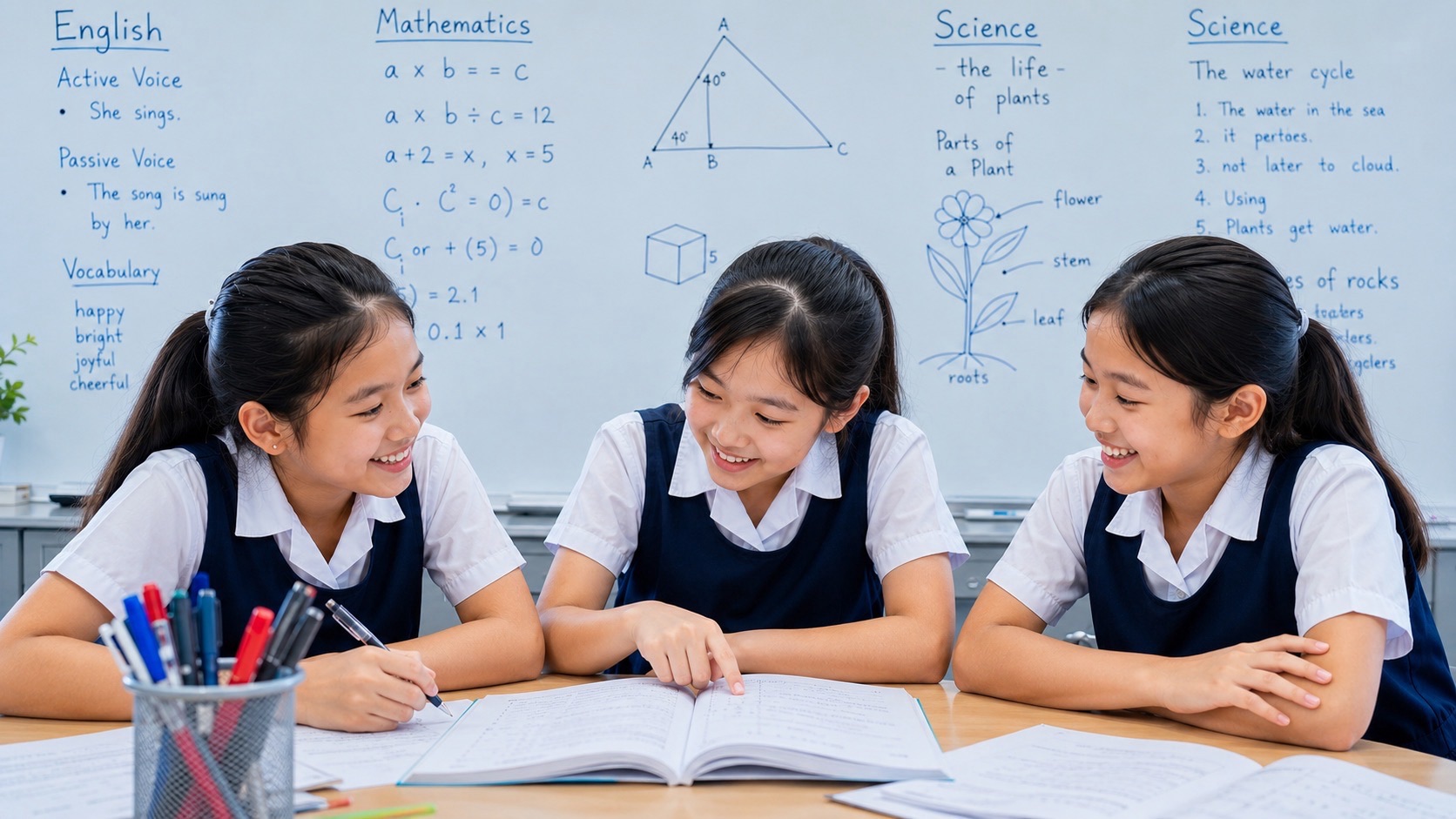
If your child says, “I failed Primary 2 Science,” first clarify that formal Primary Science in Singapore normally begins in Primary 3. There is no weighted P2 examination and no P2 PSLE. A P2 pupil may have struggled with an observation, a picture, a classroom activity or the language used to explain an idea, but that is not a failed national Science paper. Parents should find out what the activity was designed to assess and use the coming holiday to build observation, comparison and explanation skills.
For a child completing P2 in November 2026, the transition into P3 in January 2027 is the important timeline. The MOE Primary Science Syllabus 2023 introduces P3 topics including living and non-living things, materials, life cycles and magnets. Parents do not need to teach the entire syllabus in advance. This guide explains how to prepare a child to notice, describe, classify, ask questions and explain evidence safely, while keeping the school’s own teaching sequence as the final reference.
- There is no formal P2 Science PSLE or weighted examination; P3 is the usual start of formal primary Science.
- P3 syllabus areas include diversity of living and non-living things, materials, life cycles and magnets.
- Build observation, classification, vocabulary, diagram reading and evidence-based explanation.
- Use safe everyday objects and supervised learning; avoid unsafe experiments and loose small magnets.
- Check the school’s actual P3 teaching sequence and assessment notices in January 2027.
- A Science gap may actually involve reading, language or numeracy; diagnose the barrier before buying tuition.
P2 does not have a formal PSLE Science paper
In Singapore’s mainstream primary curriculum, formal Primary Science begins in Primary 3. A P2 child may encounter nature, materials, living things and simple investigations through everyday learning, but should not be described as having failed a formal P2 Science examination. P1 and P2 have no weighted assessments or examinations, although teachers still use classroom tasks and formative feedback to understand learning. Parents should ask what the actual P2 activity was intended to observe.
This correction does not mean that the child’s difficulty should be ignored. A pupil may struggle to describe an object, compare two materials, interpret a picture or explain a simple observation. Those habits matter as formal Science begins. The right response is to identify the language, observation or reasoning skill involved, then prepare calmly for P3 instead of buying a P6 Science package for an eight-year-old.
What Primary 3 Science introduces
The MOE Primary Science Syllabus 2023 organises P3 around the theme of Diversity. The topics include diversity of living and non-living things, diversity of materials, life cycles in plants and animals, and interaction of forces through magnets. The syllabus is designed for P3 to P6 and builds concepts progressively. Parents should use the official syllabus as the reference while recognising that the child’s school determines the lesson sequence and local assessment plan.
The aim of holiday readiness is not to teach all the P3 topics in advance. It is to help the child notice features, describe accurately, group things by a stated rule, ask a sensible question and explain what an observation suggests. These habits support formal Science lessons when they begin. An enjoyable encounter with a leaf, a safe object comparison or a story about an animal can provide a suitable starting point.
Observation and inference are different
An observation describes what can be seen, heard or measured. An inference offers a possible explanation. ‘The leaf has a brown patch’ is an observation; ‘the leaf is unhealthy because it lacks water’ is a possible inference that needs more evidence. Teach the child to separate what they noticed from what they think may explain it. This habit prevents guesses from being presented as facts.
Use a safe familiar object, such as a leaf or a cup, and ask the child to list observable features before offering an explanation. Then ask what extra information would help test the explanation. The child does not need technical terms immediately. The important step is recognising that a claim should be supported by something observable and that the first explanation may need to change when new evidence appears.
Classification needs a clear rule
Classification means grouping items according to a shared characteristic. Put several safe household objects together and ask the child to group them by material, shape or another observable feature. Then ask the learner to state the rule. A group is meaningful when its members share the stated feature, not because the adult silently expects a particular answer.
Invite a second way to classify the same objects. A plastic bottle and a plastic lid may belong together by material, but can be grouped differently by shape or function. The exercise shows that a classification depends on the rule selected. Later, P3 Science uses classification in the study of living and non-living things and materials. The child should understand the reasoning behind a grouping, not only memorise category names.
Living and non-living things
P3 introduces the diversity of living and non-living things. Children can begin with familiar examples such as plants, animals, rocks and toys. Ask what makes a living thing different from a non-living object. Movement alone is not enough: a toy car can move when pushed, while a plant does not move from place to place like an animal. The child needs to consider a range of characteristics rather than one superficial clue.
Use books, classroom materials and supervised observations rather than disturbing wildlife. Discuss how plants grow and need suitable conditions, and how animals have life processes. Do not require a P2 pupil to memorise every classification detail from the future syllabus. The purpose is to build curiosity and careful reasoning so that formal P3 explanations have something familiar to connect to.
Diversity of materials
P3 Science includes diversity of materials. Begin by comparing common safe objects made from wood, plastic, metal, fabric or paper. Ask what each is made of, how its surface feels and what it is used for. A raincoat, towel and window need different material properties because they perform different functions. Connect a property to a use rather than teaching a long vocabulary list in isolation.
Try a simple comparison such as whether small drops of water remain on a surface or are absorbed. Use safe, clean objects and adult supervision. Ask the child to describe what happened, not merely choose the answer they think the adult wants. Avoid dangerous experiments with chemicals, fire, electricity, boiling liquids, sharp objects or unknown substances. Scientific readiness includes safe habits and respect for materials.
Life cycles of plants and animals
P3 introduces life cycles. Children can begin to notice that living things change through stages. A supervised seed-growing activity may allow the child to record a seed, germination and later growth using dated drawings. Alternatively, compare suitable pictures of a butterfly or frog life cycle from a trusted book. Ask what changed, what remained recognisable and what sequence the pictures show.
Do not handle wild animals or disturb nests to complete a home activity. Books, teacher-approved videos and safe observation are sufficient. A dated picture record can show that a living thing changes over time. Ask what conditions are needed for growth, but keep explanations within the child’s current knowledge. The goal is to develop observation, sequence and curiosity, not to memorise advanced biological terms before formal teaching.
Magnets: observe and stay safe
Magnets are part of P3 Science. A child can observe whether a large, securely encased household magnet attracts selected safe objects. Ask the pupil to predict, test and record what happened. Compare an object that is attracted with one that is not. Discuss why appearance alone may not predict the result. A shiny object is not automatically magnetic, and a magnet does not attract every material.
Keep small or loose magnets away from young children because swallowing magnets can cause serious internal injury. Do not dismantle magnetic toys or allow unsupervised experiments. Use a suitable classroom resource or demonstration if the physical objects are not safe. The early learning objective is to notice an interaction and describe evidence accurately, not to build a complicated kit.
Use language to explain observations
A pupil may notice a feature but struggle to express it clearly. Offer descriptive words such as smooth, rough, flexible, transparent, heavier or lighter when appropriate to the object and level. Ask the child to point to the feature and use it in a complete sentence. Correct meaning before demanding technical vocabulary. The purpose is to help the learner describe what is actually observed.
A useful response could be: ‘The plastic sheet is flexible because it bends.’ Ask what evidence supports the statement and whether another object behaves in the same way. If the child simply repeats a definition, change the object and invite a new description. Language is part of Science learning because pupils need to communicate observations and explanations to teachers and classmates.
Reading diagrams and simple tables
Science often uses pictures, labels, arrows and tables to represent information. Help the child identify the title, the objects shown and what each arrow or label refers to. Ask what the diagram shows and what it leaves out. A diagram is a simplified representation, not necessarily a photograph. Children should learn to move between a real object, a picture and a short explanation.
Use a simple observation table with two columns, such as object and material, or item and whether a magnet attracts it. The child can record a word, tick or drawing according to the task. Ask whether the entries match what was actually observed. This builds attention to evidence and prepares the learner for more formal recording in P3 without turning the holiday into an examination exercise.
The difference between fair comparisons and guesses
A comparison is more useful when the conditions are similar. If a child compares how much water two materials absorb, using very different amounts of water may make the result difficult to interpret. Keep the activity simple and supervised; explain that a fair comparison changes one feature while keeping other relevant conditions similar. Formal terms can be introduced later when the school teaches them.
Ask the child what was changed and what stayed the same. If the conditions differ, discuss how that might affect the observation. The pupil does not need a long list of variables at P2. The important idea is that evidence can be misleading when a comparison is not controlled. Encourage children to say ‘I am not sure yet’ when the evidence is incomplete.
A four-week Science readiness plan
Week 1: ask the teacher what the P2 task revealed and observe whether the child can describe an object. Week 2: practise grouping safe objects by one clear property and explain the rule. Week 3: use a book or supervised activity to describe a change or comparison. Week 4: ask the child to explain a fresh observation and separate what was seen from what is guessed.
If the child can observe but cannot explain, build language before adding more Science facts. If the pupil can use vocabulary but cannot decide on a grouping rule, practise comparing and classifying. If reading instructions is the barrier, discuss English support with the school. One generic Science worksheet cannot fix all these different needs.
The P3 transition and school assessment
When P3 begins in January 2027, ask for the school’s Science learning sequence, textbook or approved resources and assessment notices. P3 is the usual start of formal Science, but schools may sequence classroom topics and assessment activities differently. School-based assessment is not PSLE. Parents should rely on current communication from the child’s school rather than assume a particular topic will be tested in a particular term.
In the first weeks, check whether the child can follow safe activity instructions, describe an observation, read a simple diagram and explain a grouping. If a difficulty persists, work with the teacher on one priority. Do not use P6 past-year Science papers as a diagnostic for P2 readiness. Those papers demand content and question styles that are several years ahead of the child’s current learning.
Why Science readiness depends on other subjects
Science explanations use reading, vocabulary, oral communication, measurement and sometimes mathematical recording. A child may understand a physical observation but be unable to read the task. Another may read the instruction but struggle to organise a comparison. Separate the scientific idea from the literacy or numeracy barrier by letting the child demonstrate understanding in a different way, then teach the missing communication skill.
If the pupil can classify objects when instructions are spoken but not when written, share that difference with both the Science and English teacher. If number recording is the barrier, ask for the school’s advice about foundational numeracy. This avoids adding a broad Science tuition programme where the first useful intervention may be language or Mathematics support.
The role of curiosity and questions
Children learn Science by noticing, wondering and testing ideas safely. Encourage questions such as ‘Why are these leaves different?’ or ‘Which objects does this magnet attract?’ Help the child narrow a broad question into something they can observe. An adult should be comfortable saying that an answer is not yet known and explaining how reliable information could be found.
Do not reward only a polished answer. A thoughtful question, a careful observation or a correction made after new evidence can be a strong learning behaviour. Keep experiments safe and simple, and let the child stop when interest fades. Curiosity should be protected; a P2 holiday should not become an extended examination boot camp.
Official scope and the correct horizon
The MOE Primary Science Syllabus 2023 organises P3 to P6 content progressively, with P3 introducing diversity and related topics such as living and non-living things, materials, life cycles and magnets. The syllabus is a reference for formal P3 teaching, not proof that a P2 child must already master every P3 concept. Families should check their school’s current sequence as the new year begins.
A P2 child in 2026 would ordinarily reach P6 in 2030 if progressing year by year. PSLE is normally taken at the end of P6, and the cohort’s future examination materials must be checked closer to the time. The practical priority is to prepare for P3 Science learning by building observation, comparison, language and safe inquiry. That is a sounder foundation than rushing to memorise upper-primary content.
The right meaning of a P2 setback
A disappointing class task is information about what the child can currently demonstrate. It is not a permanent judgement about intelligence, effort or future PSLE performance. In Singapore, P1 and P2 do not have weighted assessments or formal year-end examinations, but teachers continue to use classroom work and formative activities to understand learning progress. Parents should therefore ask what the work sample reveals rather than treating it as a national examination result.
This distinction matters because the word ‘failed’ can frighten a young child and prompt adults to choose unsuitable interventions. A pupil may be developing well in most areas but need more help with one skill. Another may have misunderstood instructions or become anxious during an activity. Translate the worry into a specific learning target, such as constructing a complete sentence, explaining an observation or retrieving a number fact.
Start with the child’s actual work
Collect one example the child completed independently, one that required help and one that remained difficult. Ask the child to explain what they were trying to do. Do not begin by assigning a full examination paper. The first incorrect step often reveals more than the final answer. For example, an incomplete sentence may reflect difficulty planning an idea, while a wrong answer to a spoken instruction may reflect unfamiliar vocabulary rather than unwillingness to listen.
Write down what support was needed. Did an adult rephrase the instruction, supply a word, demonstrate a method or remind the child to continue? If the pupil succeeds after a small hint, the next lesson may focus on retrieving the strategy. If the child remains confused after modelling, the target may be too advanced or a prerequisite may be missing. This kind of observation gives the teacher a clearer starting point.
Work with the teacher, not around the teacher
Ask the class teacher to identify one strength, one priority and one example of each. Clarify what the child can demonstrate without help, what becomes possible after modelling and what still remains difficult. These three levels are more useful than a general comment such as weak, average or careless. Ask which school materials, vocabulary or methods should be used at home to reinforce instruction.
A short, respectful conversation can prevent parents from buying several workbooks or enrolling in overlapping tuition classes. The school sees classroom participation, peer interaction and responses to instructions that may not appear at home. Ask whether a school support programme is relevant, what it targets and how parents can reinforce the same skill. Agree on a realistic review point rather than leaving with a vague instruction to practise more.
Set a target the child can demonstrate
A useful goal describes an observable action. ‘Improve English’ is too broad; ‘write two complete sentences about a familiar event and reread them’ is clearer. ‘Become better at Science’ is too broad; ‘describe three observable features and explain one grouping rule’ is teachable. Choose one target that is slightly challenging but within reach with appropriate support. Too many targets at once make it difficult to tell which teaching action helped.
Keep the target stable long enough to practise it. If it changes every day, the child never has a chance to consolidate. When the pupil can complete a fresh example independently on more than one occasion, move to the next related skill. If the same task remains difficult, adjust the explanation or reduce the complexity. The goal is not to force a child through a timetable regardless of evidence; it is to respond to what learning shows.
Model, practise together, then release
A useful teaching sequence is to show one clear example, complete another one together and then invite the child to try a fresh task independently. While modelling, the adult explains the thinking behind each step. During guided practice, the child does more of the work while the adult gives brief prompts. During independent practice, the adult waits and observes rather than supplying the next answer immediately.
When the learner becomes stuck, give the smallest hint that makes the next move visible. Do not take over and complete the task. Once the child succeeds, ask what helped and try a different example after a short gap. This gradual release of support applies to language, numeracy and Science readiness. It allows parents to see whether the pupil understands a method or merely follows an adult’s instructions.
Practise briefly and revisit after a gap
Young children often benefit from short, focused opportunities to use a skill. Ten to fifteen minutes may be sufficient for one activity, although the right duration depends on the child’s attention, wellbeing and task. Revisit a target after a gap rather than repeating the same worksheet in one sitting. This helps show whether the child can retrieve and apply the idea later.
Change the surface details while keeping the underlying learning objective. Use a new story sentence, another picture, a different set of counters or a new everyday example. If the child succeeds only on the exact question they have memorised, the learning may not yet transfer. If a fresh context causes difficulty, simplify it and show how the same idea applies. A varied example is a better check than simply copying an answer.
The four-week recovery cycle
Week 1: gather evidence and choose the first priority. Week 2: explicitly teach the concept or skill with a model and supported practice. Week 3: revisit it after a gap and apply it in a different context. Week 4: use a fresh independent task and review the evidence with the teacher if needed. Some children may need longer; four weeks is a review cycle, not a promise of full recovery.
At the end of the cycle, decide whether to continue, make the target smaller or seek another kind of support. If the child can show the skill without help, move forward gradually. If the skill remains difficult, ask whether the explanation was clear, the material was appropriately matched and an earlier prerequisite is secure. Do not treat more pages as an automatic solution.
Protect the child’s dignity and motivation
Avoid comparisons with siblings, cousins or classmates. Do not use the child’s difficulty as a family joke or announce it publicly. Replace identity labels with precise observations: ‘This sentence needs a clearer ending’ or ‘We need to practise how to follow the steps in the instruction.’ Children should hear that adults are taking the problem seriously without suggesting that the problem defines them.
Praise the strategy rather than offering exaggerated praise for every correct answer. Acknowledge rereading, checking, asking for clarification, explaining a reason or trying again after a mistake. The child should understand what action can be repeated. If learning has become a source of daily conflict, reduce the pressure and discuss the pattern with the teacher. Emotional safety does not replace teaching, but it makes it easier for children to participate in it.
Sleep, movement and play are part of recovery
A holiday recovery plan should not fill every free hour. Sleep, movement, friendship, play and unstructured time support a child’s wellbeing and readiness to concentrate. Avoid placing remedial work or tuition so late that the child cannot recover. A tired pupil may appear inattentive or incapable when the real difficulty is overload.
Use ordinary experiences as learning opportunities without converting every activity into a worksheet. Cooking, playing a board game, walking in a park, reading a sign or discussing a story may develop language, number sense and observation. Let the child enjoy the experience. Choose a short explicit practice session when it is useful, then return to ordinary family life.
School support is not a punishment
MOE schools provide support routes for selected pupils who need additional help in foundational areas. The English Learning Support Programme and Mathematics Learning Support arrangements are examples for eligible pupils at lower primary levels. Selection, eligibility and implementation should be confirmed with the child’s school. A child should not be assumed to qualify solely because of one poor classroom activity.
Ask what skill the support targets and how the school will monitor progress. A pupil receiving learning support is not being labelled unsuccessful. The purpose is to strengthen foundations so that the child can participate more confidently in regular learning. Parents can help by reinforcing agreed strategies without adding a separate, heavy programme that conflicts with school instruction.
When more support may be needed
If the child repeatedly struggles despite appropriate teaching, share dated examples with the school. Ask whether hearing, vision, speech and language, attention, motor coordination or another factor may need consideration. Parents should not diagnose a condition from an online checklist or one examination-style activity. Teachers can describe patterns across classroom tasks and advise on relevant school-based routes.
Seek professional advice when a difficulty is persistent, affects several settings or causes significant distress. If the child avoids school, experiences repeated physical complaints, loses sleep or becomes intensely fearful around learning, discuss this with school staff and an appropriate health professional. Academic support and wellbeing support can be arranged together. The aim is to understand what the child needs, not to wait for the next result.
Choose tuition by the teaching process
Ask a prospective tutor how the first lesson identifies the child’s starting point, what exact skill will be taught and how independent progress will be checked. Ask whether the tutor follows the current school syllabus and communicates observations to parents. A responsible tutor should be willing to recommend school support or another specialist if the child’s need is outside the tutor’s scope.
In a small group, ask how every pupil gets opportunities to explain their thinking, receive feedback and practise independently. A small class size alone does not guarantee effective instruction. Look for careful diagnosis, clear modelling, gradual release of support and honest progress reporting. Avoid guaranteed PSLE grades, claims that an eight-year-old must already prepare for P6 examinations, or packages based mainly on completing large amounts of work.
November and December 2026: the bridge to P3
For a child finishing P2 in November 2026, the immediate timeline is the holiday bridge into Primary 3 in January 2027. The goal is to make one or two important foundations more secure and reduce the fear surrounding the subject. Three or four short focused sessions each week may be a workable starting point for some families. Adjust the plan to the child’s energy, other commitments and school advice.
In the final fortnight before school begins, establish a manageable bedtime and homework routine, prepare school materials and practise asking for clarification. Do not attempt to pre-teach the entire P3 syllabus. A child who enters the new year willing to ask for help and able to demonstrate a repaired prerequisite is better prepared than one who has completed many advanced worksheets without understanding them.
P3 assessment is not the same as P2 assessment
P1 and P2 have no weighted assessments or examinations, but teachers still use non-weighted classroom tasks and formative feedback. Primary 3 introduces a different assessment environment, and individual schools publish their assessment arrangements. These are school-based assessments, not the PSLE. Parents should check the child’s own school notices for subjects, schedules, topics and weightings rather than assuming that every school uses an identical calendar.
Explain the transition calmly. The child will have new learning expectations, but does not need to treat every lesson as a high-stakes test. Keep checking whether the repaired P2 skill is being used in class. If it is not, talk to the teacher before increasing the workload. A small, targeted repair early in P3 can prevent a misunderstanding from becoming a larger barrier.
The long horizon towards PSLE
A child in P2 in 2026 would ordinarily progress to P3 in 2027, P4 in 2028, P5 in 2029 and P6 in 2030, when PSLE is normally taken. This is a progression illustration, not a guarantee about future school placement or examination rules. The format applicable to the child’s cohort should be checked with MOE and SEAB closer to the time. Today’s task is not a last-minute PSLE rescue.
The foundations developed now—language, reading, number sense, observation, explanation and learning from feedback—remain useful across the primary years. Examination-specific formats and timed practice can be introduced when the pupil is older, the relevant content has been taught and readiness justifies it. For a P2 child, mastering the next learning step and retaining curiosity matter more than rehearsing distant examination papers.
Parent checklist for the next four weeks
- Save one starting work sample and describe the difficulty neutrally.
- Ask the teacher to identify the first priority skill and suitable materials.
- Practise that skill in short sessions and give the child enough rest.
- Revisit the skill after a gap using a fresh example without showing the answer.
- Review independent progress with the teacher and adjust support if necessary.
Official references and the eduKate learning pathway
Use the MOE Primary Science Teaching and Learning Syllabus 2023 for the official P3–P6 topic framework, and MOE assessment policy information for P1–P2. The school remains the source for the individual child’s P3 sequence and assessment notices. Continue with the P2 Science readiness overview, the P3 Science preparation guide, and the P2 English recovery guide. The practical next step is to identify one skill, teach it clearly, practise briefly and check whether the child can use it independently. A difficult P2 experience is information for adults to act on, not a permanent label for the child.