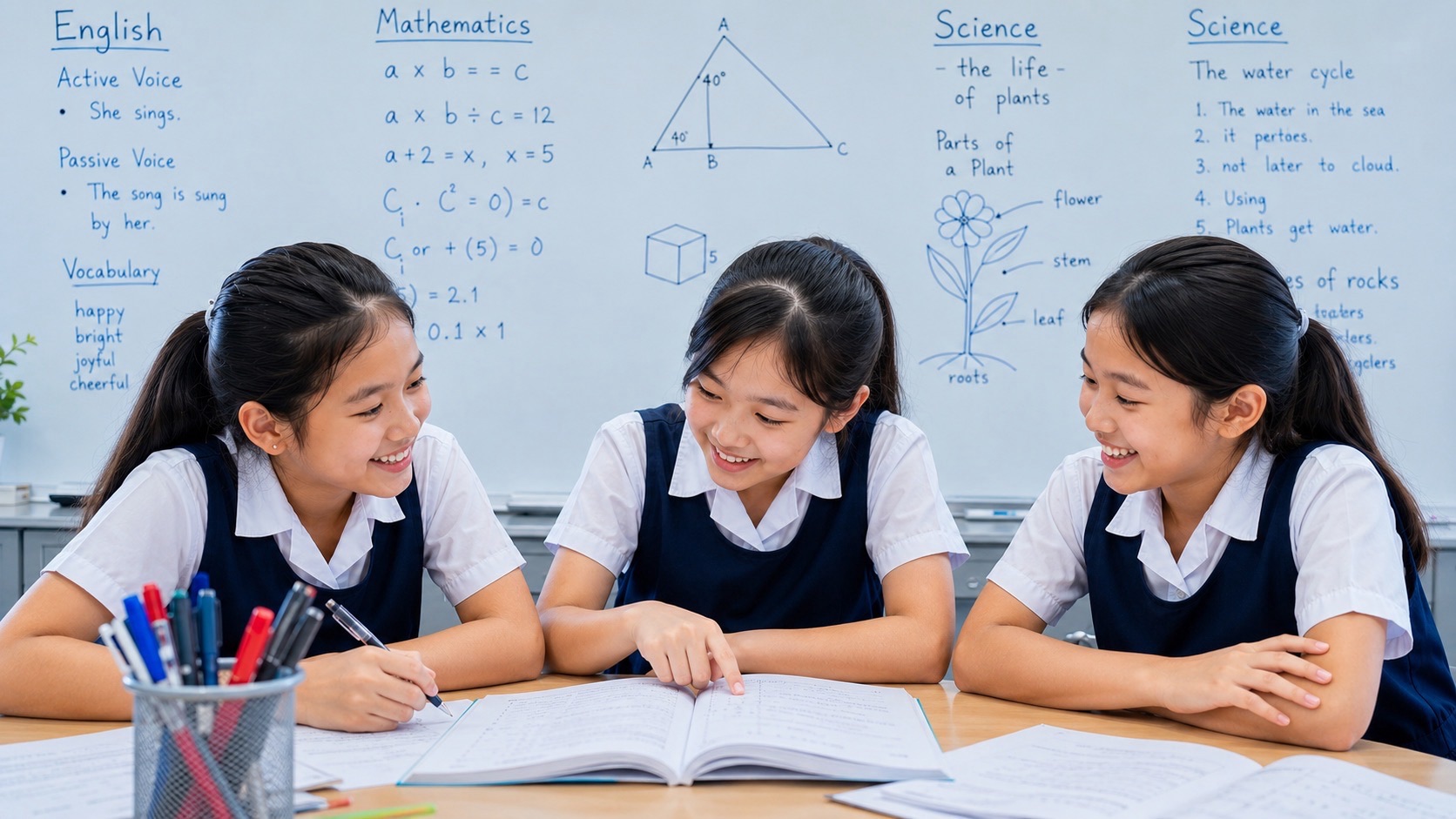
If your child says, “I failed Primary 2 Science,” the first correction is important: Science is normally introduced as a formal primary-school subject in Primary 3, and there is no weighted P2 examination or P2 PSLE. A Primary 2 child can still struggle with observation, vocabulary, reading a diagram or explaining an activity, but this is not a failed national Science paper. Parents can help by identifying the particular difficulty, building curiosity through safe everyday investigations and preparing calmly for the transition to P3 rather than drilling PSLE Science questions four years early.
For a child completing P2 in November 2026, the limited preparation window before January 2027 is best spent strengthening the habits Science needs: look closely, describe accurately, group things by an observable property, compare evidence and explain a simple reason. Use books, nature walks and safe household objects, then write or speak a few clear observations. The P3 curriculum introduces living and non-living things, materials, life cycles and magnets, but your child’s school will decide its teaching sequence. This guide shows an achievable family timeline and the support options to consider if language, reasoning or anxiety is getting in the way.
- Reality check: no formal P2 Science syllabus examination, no weighted P2 examinations and no P2 PSLE.
- A worrying P2 activity is a clue about vocabulary, reading, observation, explanation or confidence—not proof of scientific inability.
- First 48 hours: talk to the child, collect the actual task, ask the teacher what it was designed to assess and identify a starting skill.
- November–December 2026: develop observation, classification, question-asking and evidence through safe age-appropriate activities.
- P3 official Science areas include living/non-living things, materials, life cycles and magnets; school sequencing can differ.
- Use a cycle of notice → describe → compare → explain → check, with ordinary objects rather than costly equipment.
- If English reading or other foundational learning barriers are present, coordinate with teachers before adding more Science drills.
- P3 in 2027 brings formal Science learning; PSLE is generally at the end of P6, normally 2030 for this cohort.
The essential correction: there is no P2 Science examination to fail
In Singapore’s mainstream primary curriculum, Science becomes a formal subject in Primary 3. P1 and P2 develop curiosity, literacy, numeracy and understanding of the world through a range of classroom experiences; children may encounter science-like activities across subjects. But a parent should not interpret a disappointing P2 worksheet as a national Science examination failure. MOE also removed P1 and P2 weighted assessments and examinations. This policy is intended to leave room for learning and meaningful feedback in the early years.
The situation still deserves attention. A child may find it hard to distinguish an observation from a guess, follow a verbal instruction, recognise simple words such as ‘rough’ or ‘transparent’, or explain how objects differ. Those are learning tasks that can be developed before P3. The correct next step is to find what blocked the child. It would be misleading to set a target for ‘passing P2 Science’ as if an official P2 Science paper exists.
What parents should say after a discouraging classroom task
Use a straightforward message: ‘That activity was difficult, but it shows us what to learn next. Science begins with questions, and nobody knows everything before learning it.’ Ask what the child remembers, whether they felt embarrassed and which instruction was confusing. Children may need time before they can describe a mistake. Give them the opportunity without cross-examination or a lecture about future examinations.
Do not demand an apology for ‘failing Science’ or compare the child with a sibling. Praise a meaningful action when it happens: looking carefully again, checking an observation or changing an explanation when new evidence appears. These are the habits scientists need. Make room for playful curiosity; a child’s willingness to ask ‘why?’ is a resource, not a distraction from examination success.
First 48 hours: find the task and the missing skill
Look at the actual schoolwork or ask the teacher for an example. Was the child asked to sort items, name a material, compare pictures, follow directions, read labels or justify a choice? Recreate only a small part using familiar objects. Ask the child to describe what they see without help. Listen for whether the problem is conceptual, linguistic, attentional or emotional. A child who can sort real objects but cannot read worksheet labels needs a different response from one who does not understand sorting.
Choose one clear observation to record: ‘Can group spoons and cups by material but cannot explain the rule’, for example. Then decide one action such as naming the property in a sentence. Avoid assigning a full Science assessment book before you know what the task was for. A short successful investigation can generate better evidence and restore enthusiasm more effectively than a page of unfamiliar upper-primary terminology.
Ask the class teacher about readiness, not PSLE predictions
A useful teacher conversation begins with: ‘What did this activity tell you about my child’s learning?’ Follow up with whether the child understood instructions, could describe an observation or needed help using precise vocabulary. Ask what Science-related thinking, if any, is expected at this stage and what learning outcome will matter when the pupil enters P3. The teacher can also explain the child’s language strengths and whether English comprehension needs separate support.
Ask the P3 school or teacher for the actual curriculum and assessment notices when available. Avoid claiming that every school will teach magnets in a particular month or use an identical test format. Formal P3 Science is school-based, not national PSLE, and assessment schedules vary. If a child is anxious, ask how classroom tasks can remain low-stakes while the relevant skills are taught and practised.
The most valuable Science skill is careful observation
Start with something safe and familiar: a leaf, a spoon, a plastic container or a stone. Ask the child to say only what can be observed: shape, colour, surface texture, size or how the object behaves in a simple test. Then distinguish observations from inferences. ‘The leaf has dark green patches’ is an observation. ‘The leaf was damaged by insects’ is a possible explanation that would need further evidence.
Invite the child to notice three details, then compare with an object of the same general type. They might discover differences in shape or flexibility that first escaped attention. Make a quick drawing and label it with the child’s own words. This kind of looking supports the future use of diagrams, tables and descriptions. It also teaches that changing an initial claim after noticing something new is a positive scientific habit.
Describe, compare and classify with a reason
Put out a wooden spoon, a plastic lid and a metal spoon. Ask the child to sort them in more than one way. They may begin by colour, then material, then whether the objects bend easily. Encourage them to state the rule: ‘These are grouped because they are made of metal.’ The critical step is explaining the grouping, because otherwise sorting can be done by guessing what answer an adult wants.
Change one object and ask if the classification still works. A classification rule should depend on a shared observable feature, not arbitrary preference. Avoid teaching every advanced Science category at once. The value of a P2 activity is the mental action—recognise similarities and differences, state a rule and apply it consistently. Those habits will make P3 classification of living things and materials easier to understand.
Scientific vocabulary: words should point to real properties
Children often use ‘hard’, ‘strong’, ‘heavy’, ‘rough’ and ‘smooth’ as if they mean the same thing. Give examples that separate properties. A rough surface is about texture; a heavy object is about mass in everyday description; a strong material resists breaking under suitable loads. Keep explanations age-appropriate and tied to observable examples. Do not ask the child to memorise definitions without seeing what they describe.
Choose two useful terms each week and reuse them in different settings. For example, compare materials that are flexible with those that are stiff, then revisit the words during a walk or when handling safe household objects. Ask for an original sentence: ‘The rubber band bends and stretches.’ Clarify if necessary that properties depend on material and circumstances. Precision grows when language is connected to evidence, not when a notebook contains more technical words.
Question asking is a learning skill, not a challenge to authority
Invite children to ask questions such as ‘Which material is easier to bend?’, ‘Why do these seeds grow differently?’ or ‘Which objects does a magnet attract?’ Help them turn an enormous ‘Why does nature work?’ into something observable. A good early inquiry can be simple enough to examine with one or two objects, a drawing and an explanation. Learning to ask a clear question prepares children to decide what evidence they would need.
Sometimes the correct response is ‘We do not know yet.’ Adults should model this without embarrassment. Ask where they might find reliable information and whether a safe observation could help. If an answer changes after evidence appears, explain why. This builds intellectual humility and resilience. Children do not need to be rewarded only for getting a polished answer on the first attempt.
Living and non-living things: build from familiar examples
P3 Science includes distinguishing and classifying living and non-living things. Before P3, explore ordinary examples: a plant, a dog, a rock, a toy and a piece of wood. Ask what makes a living thing different and whether appearance alone gives a reliable answer. Children may say something is alive because it moves, but many non-living things can move when pushed or powered. Use the conversation to show why a single clue is insufficient.
Avoid turning this into memorisation of long classification lists. At the introductory stage, ask children to describe how a plant grows, responds to conditions and requires resources. Point out that some living things do not move from place to place in the way animals do. The objective is to discover how observations and general characteristics help us organise knowledge. The teacher can formalise the vocabulary when P3 begins.
Diversity of materials: test a property safely
Materials are part of the P3 Science scope, and children can start with simple comparisons. Place a plastic ruler, a piece of fabric and a metal spoon on a table. Ask what each is made of, how it feels and which property makes it useful for its job. A raincoat needs properties different from a towel. A window needs different properties from a curtain. Connecting material and function gives the activity a reason.
Use adult-supervised comparisons with safe, clean, non-sharp objects. Do not ask children to test unknown chemicals, electricity, boiling water or glass breakage. If comparing how surfaces respond to water, keep the quantities small, protect furniture and observe whether water stays on the surface or is absorbed. Discuss what the evidence shows and what remains uncertain. Safe habits are part of scientific education from the beginning.
Life cycles: observe change over time rather than copying diagrams
P3 Science also introduces life cycles of plants and animals. A P2 child can begin by observing a suitable seed germinating under an adult’s supervision, taking photographs or drawing dated changes. Ask what remained similar, what changed and what conditions were provided. The lesson is that a life cycle involves ordered stages and change, not merely that plants ‘get bigger’. Use common classroom-safe seeds and appropriate care instructions.
A child could compare two dated drawings, describe the appearance of roots and shoots, and ask a question about the next stage. Explain gently that living things need suitable conditions and must be treated responsibly. Avoid handling wild animals or disturbing nests to ‘complete’ a Science activity. Books and teacher-approved pictures can provide evidence for life cycles that are not practical to observe at home.
Magnets: observe what happens and avoid unsafe demonstrations
Magnets are another P3 Science topic. Use one large, securely encased household magnet with adult supervision and a small selection of safe objects. Ask which objects are attracted and which are not, recording observations in a simple table. The child may predict that all shiny objects are attracted; testing an object gives a chance to revise that idea. The important outcome is learning to distinguish appearance from evidence.
Keep small or loose magnets and magnetic pieces away from young children because swallowing magnets can cause severe injury. Do not dismantle magnetic toys, and follow device and medical safety guidance. A parent does not need an elaborate experiment kit; an illustrated demonstration from a trusted school resource may be safer and just as effective. The early goal is observing a physical interaction and describing the result accurately.
Read a diagram: Science is also a literacy task
A child may understand a plant in a garden yet fail a worksheet showing a labelled diagram. Teach how to read a title, identify the object, follow arrows and match labels to parts. Ask what the diagram shows and what it does not show. A diagram is a simplified representation, not a photograph. Children should become comfortable moving between a real object, a drawing and a written explanation.
For a picture sequence, discuss which image comes first and what changed between stages. Ask the learner to provide a sentence for each arrow. This links observation, sequence and language. If the child repeatedly misreads ordinary written instructions across subjects, discuss English literacy and learning-support options with the school. Additional Science facts will not solve a reading barrier on their own.
Science explanation: answer with observation and reason
At this age, an explanation can be simple and accurate. Ask: ‘Why is this material useful for a raincoat?’ The child might say: ‘It does not let water pass through easily, so it can help keep the wearer dry.’ Help them connect a property to a use. This is stronger than ‘Because it is good’ and more appropriate than forcing advanced scientific vocabulary that the child cannot explain.
Distinguish a claim from evidence. ‘The metal spoon was attracted by our magnet’ reports a particular observation. ‘All metal objects will be attracted’ overgeneralises beyond it. Ask what further test might be needed and whether the conclusion is too broad. The learner develops a habit of reasoning without being made to feel that each incomplete answer is a failure.
From everyday questions to a simple fair comparison
A child may ask whether a towel or a plastic sheet absorbs more water. An adult can plan a small, tidy demonstration using the same amount of water on each sample and observe what happens. The point is to keep relevant conditions similar so the comparison makes sense. At P2, families do not need to introduce a long formal glossary of independent, dependent and controlled variables.
Ask what changed and what stayed the same. If the amount of water was different for each object, explain that the observation might not support a fair conclusion. This ability to notice the conditions of a comparison becomes increasingly important in upper-primary Science. Keep every task safe, quick and supervised, and stop when the child’s interest fades rather than adding complexity to achieve a ‘proper experiment’.
Separate a Science gap from a language or numeracy gap
A child may know that an object floats in a familiar demonstration but be unable to understand a written question about it. That is partly a language-access problem. Another child may be able to read the question but struggle to count observations or record them in a table. That may involve numerical organisation. Recognising cross-subject links helps parents choose the right support instead of asking a P3 Science tutor to reteach all of English and Mathematics simultaneously.
Try reading the instruction aloud. If understanding improves greatly, share that evidence with the teacher. Invite the child to show an idea with objects before requiring full written sentences. If a mathematical comparison is causing confusion, simplify the numbers. These accommodations are diagnostic teaching steps, not ways to avoid learning. The aim is to see the scientific idea clearly and then build the missing communication or recording skill.
A gentle ten-minute Science-readiness check
Choose three ordinary objects and ask for one observable property of each. Ask the child to group two of them and explain the rule. Read a very short informational paragraph and invite a summary. Show two pictures of a plant at different stages and ask what changed. Use a safe magnet demonstration or video if appropriate, and ask what the evidence showed. These activities test thinking rather than conformity to an invented P2 Science examination.
Record whether the child can observe, describe, compare and explain independently. If the child asks thoughtful questions but cannot write them, note writing separately. If the child describes objects accurately but cannot justify a grouping, teach the language of ‘because’. A small baseline is sufficient. Turn it into a plan for one skill at a time rather than announcing another score or class rank.
Four weeks to rebuild confidence and curiosity
Week 1: talk with the teacher, identify a language or observation difficulty, and choose a familiar topic. Week 2: practise describing and sorting with safe household objects or books. Week 3: repeat the habit in a different context, using words and pictures. Week 4: invite one new independent explanation and compare it with the starting work sample. The goal is clearer reasoning, not examination speed.
If progress stalls, make the task smaller or revisit the missing prerequisite. If the child can describe what happened but cannot write a sentence, let them speak first and then build the sentence together. If an activity is too easy, add one more feature to compare rather than jumping to P6 questions. Teaching should follow evidence of readiness. A short successful activity is a better foundation than exhausting an anxious child.
November 2026: do not turn a P2 activity into a crisis
The first part of the holiday can focus on recovering from discouragement, reading a few enjoyable information books and noticing the natural world. A walk through a park can offer opportunities to compare leaves, materials and observed changes without buying a specialised worksheet bundle. Let the child ask questions and choose one thing to investigate safely. The objective is positive participation in learning, which formal P3 lessons can later build upon.
If there are genuine reading or numeracy concerns, prioritise those in consultation with the teacher. Science knowledge is carried through language, diagrams and measurement, so foundational gaps may need attention first. It is unnecessary to complete every P3 Science chapter before January. Use a dated notebook for a handful of observations, not a daily ‘exam’ record.
December 2026: a manageable Primary 3 Science bridge
Plan three or four short sessions a week, each using a different mode: observe something real, read a short text, make a labelled drawing or explain a comparison. Include time for play and family commitments. A holiday should not become a prolonged rehearsal of a national paper the child will not sit for years. If a child is tired, reduce the number and length of tasks. Curiosity is not measured by the number of worksheets finished.
Near the end of December, revisit the four P3 areas at a very introductory level: living things, materials, life cycles and magnets. Use these as conversation themes, not as a claim to have taught the whole syllabus. Note which topics interest the child and which require more reading support. Share the observations with the new teacher if a concern is significant. That information is more useful than an unsupported claim that the child ‘passed P2 Science’.
January 2027: the actual beginning of formal Primary 3 Science
When P3 begins, ask the school for the Science learning outcomes, textbooks or official resources and assessment information. Different schools may sequence lessons and checks differently, so confirm before purchasing additional materials. P3 school assessments, if weighted under policy, are not the national PSLE. The first priority is helping the child understand classroom explanations, participate safely in activities and respond with evidence that matches the question.
Keep a brief folder of observations and marked work. Check whether the child can read a diagram, state a property, classify by a clear rule and explain what an activity demonstrates. Where a teacher identifies a genuine gap, agree on one targeted home activity and review it in a month. Do not let commercial PSLE timetables displace the actual P3 school programme.
Primary 3 Term 2: move from noticing to explaining
By the next stage of the school year, gradually expect more complete explanations. A child might first say ‘It floats.’ Later they could say what was tested and how the result was observed. Ask ‘What is your evidence?’ as a friendly prompt. This practice helps children avoid answers based entirely on memorised slogans. A correct scientific word is useful only when attached to the right observation and relationship.
This term-by-term guidance is a family learning plan, not a statement that every school teaches an identical topic in Term 2. Use actual teacher feedback to decide whether to revisit classification, materials, life cycles or magnetism. Keep written practice proportionate to the child’s reading and attention capacity. Independent thinking should increase gradually without abandoning diagrams and real objects when they help.
Primary 3 Terms 3 and 4: consolidate a thinking method
As the year progresses, offer mixed questions that ask the child to choose a relevant observation or comparison. When revising school tasks, ask them to explain what was wrong with the first answer and why the corrected statement is better. In the last term, review what has become independent and what still requires scaffolding before Primary 4. This progression prepares for later demands without relying on premature timed PSLE papers.
A good Science learner is not someone who has memorised the longest list of facts. They can use taught concepts accurately, interpret a new diagram, recognise what a question asks and support a claim with appropriate evidence. Practice in unfamiliar contexts is especially useful because memorised wording can break down when a picture or object looks different. Celebrate careful rethinking and justified corrections as part of progress.
A simple weekly home routine for school-term Science
Monday can be five minutes of recalling one classroom idea in the child’s own words. Wednesday might involve reading a short paragraph or labelling a picture. Friday can be an observation or comparison using safe materials. At the weekend, ask for one explanation that connects the activity to the idea taught in school. A child who finds writing difficult may speak the explanation first, then write a small part independently.
Keep sessions short enough that they can continue around homework, sports and family routines. If a week is busy, one well-chosen conversation is better than a guilt-driven make-up marathon. Store a small number of dated samples, and ask the child what question they would like to explore next. This gives them some ownership and makes scientific thinking part of ordinary life.
How to handle anxiety about unfamiliar Science questions
An anxious child may freeze when a worksheet includes words they have not met, even though the underlying observation is familiar. Practise a calm start: read the question aloud, identify what is shown, name the familiar idea and point to evidence. Begin without a timer. Give a hint only after the child has had enough thinking time, and use the next question to test independent understanding. Confidence should be earned through visible small successes.
If the child has persistent severe distress, school refusal, frequent physical complaints around learning or major disruptions to sleep and daily activities, speak with the school and healthcare professionals. A parent cannot diagnose anxiety or a learning condition from one activity. Equally, a child who struggles consistently with reading or reasoning may need more direct teaching rather than reassurance alone. Protect wellbeing and address the real skill gap together.
School support, parent options and the tuition decision
Talk to the class and future Science teacher first. If the child’s main difficulty is foundational English literacy or numeracy, ask about the school’s relevant learning support and whether additional assessment is needed. If the child enjoys exploring but needs help organizing explanations, a guided reading-and-reasoning routine may be enough. Parents do not have to buy specialist equipment or tutoring simply because the child had one disappointing classroom experience.
Small-group tuition becomes an option when the learner needs explicit subject teaching, frequent feedback and help transferring concepts into explanations once P3 begins. Ask how the tutor observes a student’s reasoning, corrects misconceptions and coordinates with school scope. eduKate’s three-student tutorial approach aims to make each child’s thinking visible, but it should be judged by real learning progress, not marketing claims about a guaranteed future PSLE score.
Measure readiness without inventing a P2 Science grade
Compare two dated activities of similar difficulty. Can the child describe more properties independently? Can they group items with a defensible rule? Can they distinguish what was observed from what they guessed? Can they read a simple diagram and connect it to a real object? These are better early signs than the number of pages completed. Ask the learner which strategy helped and use that answer to plan the next task.
Recognise partial progress. A child may be more willing to talk and ask questions before their written explanations improve. That is valuable but still leaves writing to develop. A good record separates observation, vocabulary, reasoning and written communication, so the family knows what has changed. If improvement is limited, change the teaching method and ask for school feedback instead of silently raising the workload.
PSLE Science is later: the chronology parents must keep clear
A child in Primary 2 in 2026 would ordinarily reach Primary 3 in 2027, Primary 4 in 2028, Primary 5 in 2029 and Primary 6 in 2030. PSLE is taken at the end of Primary 6, and future SEAB documents for that cohort should be consulted closer to the examination. The immediate P2-to-P3 transition is worth preparing for because it introduces formal Science teaching, not because PSLE is a few weeks away.
Primary Science develops across levels. The 2023 MOE syllabus places diversity of living and non-living things, materials, life cycles and magnets at P3; later levels add further topics and depth. A good sequence lets children revisit ideas and refine explanations over time. Forcing a P2 learner to memorise P6 energy conversions or long examination answers now is likely to obscure the more useful foundations of observation, evidence and vocabulary.
Frequently asked parent questions
My child says they failed Science in P2. Is that possible?
Not as a formal national P2 Science examination. The child may have done badly in a classroom activity that involved Science-like knowledge or thinking. Ask what the task measured, and offer accurate language: ‘This activity was difficult’ rather than ‘You failed Science’. Identify the skill and follow it up. P3, not P2, is the usual starting year for formal Primary Science.
Should we pre-teach all four P3 Science topics over the holiday?
No. Introductory exposure can make the subject familiar, but it should not crowd out rest, play and other foundational learning. Read an age-appropriate book, talk about everyday objects, observe a life cycle or watch a safe teacher-recommended demonstration. Concentrate on curiosity, language and thinking. The school will provide the actual teaching sequence and formal instruction when P3 begins.
Do we need an experiment kit to recover?
No. Safe common objects, plants, pictures and school resources are enough for early observation and comparison. Avoid activities involving fire, mains electricity, strong chemicals, unsafe biological materials, sharp objects or small loose magnets. Adult supervision and common sense matter more than novelty. A well-designed discussion of one spoon or leaf can be more educational than a complicated experiment the child does not understand.
What if English comprehension is the real problem?
Tell the teacher what you observed: perhaps the child can sort objects correctly when instructions are explained aloud but cannot understand written questions. Focus on reading, vocabulary and sentence comprehension, while allowing the pupil to show scientific reasoning with pictures or objects. Consult school literacy support if the difficulty persists. Adding facts without repairing access to the question may create more anxiety.
What is the one thing I should do this weekend?
Take the child for a short walk or choose three safe objects at home. Ask what they notice, which two things are alike and what evidence supports their choice. Write down one clear observation together. End before the child is tired. This creates a calm starting point, gives the parent evidence of actual ability and makes the next school conversation easier.
Official references and the eduKate P3 learning route
The primary reference is the MOE Primary Science Teaching and Learning Syllabus, which identifies P3 topics and the inquiry emphasis. See also MOE’s explanation of the removal of weighted P1–P2 assessments and exams and the SEAB explanation of PSLE as the final-year primary examination. These official documents give the family an accurate destination without inventing a P2 Science test.
For related parent guidance, read the P2 Science readiness guide, the P3 Science transition guide, and the P3 Science tutor selection guide if targeted teaching is being considered. Start with observation, language and one small success; the rest can grow through school teaching and steady practice.