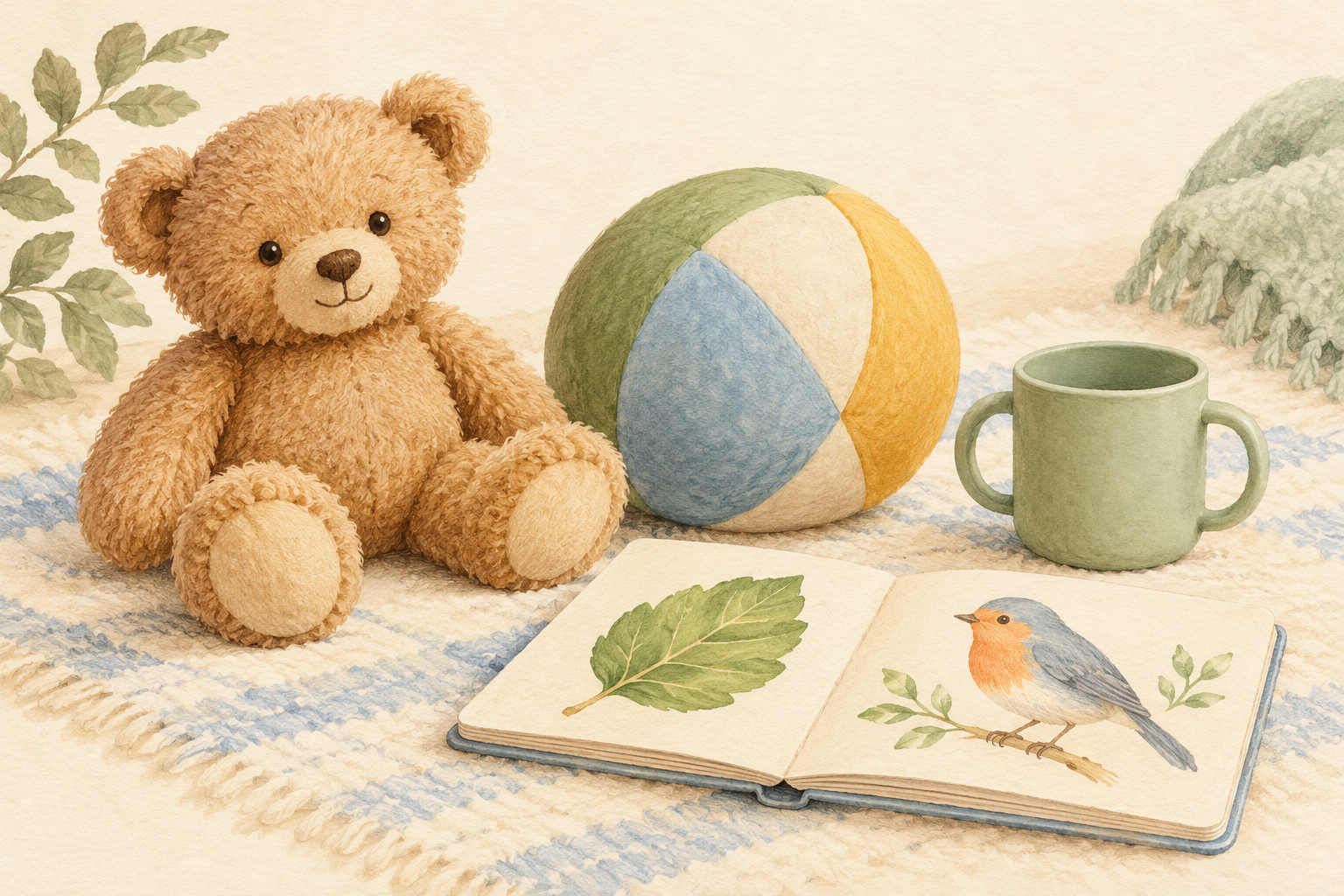
Everyday Vocabulary Age 1: six responsive conversations using first useful words
The Top 100 Vocabulary Words for Children | Age 1 reference is designed for parents and caregivers supporting children between their first and second birthdays. The most useful vocabulary lesson at this stage often looks like an ordinary conversation: a child points, looks, reaches, makes a sound, uses a family-language word or offers an emerging English word, and an adult responds with meaning and care. These six new micro-scripts use first words from the existing list—more, finished, help, cup, water, open, in, out, dog, rain, wet, dry, tired—without turning them into obligatory milestones. Each includes a practical adult model, a meaningful child contribution and a way to record the experience honestly. Development varies; this list is an adult resource, not a test or clinical screen.
More or finished? A favourite song can become a real choice
The moment: During a familiar, gentle song, the caregiver reaches a natural ending and pauses. The child looks expectantly towards the adult and bounces. The adult says, “Again? More song?” and repeats the song if the child seems interested. This connects the words more and again to a real response without demanding the child reproduce them.
Watch the child’s message: If the child reaches towards the caregiver or vocalises when the song stops, that may be a request to continue. The adult can interpret it aloud: “You want more music.” If the child turns away or shifts attention to another activity, the adult might say, “Finished. We can stop.” The adult respects the child’s changing interest.
Distinguish two different ideas: More means an additional amount or continuation; again often means repeating a particular action; finished communicates that the activity has ended. These words overlap in a song game, but do not need to be taught as abstract definitions. A caregiver can name the relationship naturally at the moment it matters.
Don’t manufacture a performance demand: A young child should not be made to repeat “more, please” before an enjoyable response. An emerging gesture or sign can be an effective message. If the adult cannot repeat the song, a simple truthful reply—“All finished now; I will hold you”—models a boundary without pretending to offer a choice.
Handover example: “Looked at caregiver and bounced after song ended; caregiver said ‘again?’ and repeated it. Later turned away and joined another activity.” This is more informative than “Knows more, again and finished.”
Help, open and close: make a request work before practising a word
The scene: A favourite board book is closed, and a child brings it to an adult. They may hold out the book, touch the cover or say something like “Book.” The adult replies, “You want the book open. I can help,” then opens it together with the child. The words help and open describe a useful shared action.
Follow the child’s pace: If the child wants to turn a sturdy page, allow an appropriate safe action. The adult can say “Open the page” or “Close the book” as those events occur. A very young child may not understand the contrasting verbs as abstract vocabulary yet; hearing them in a predictable routine is sufficient.
Make a short model natural: Child: points to the book. Adult: “Help open?” Child: touches the cover. Adult opens it and says, “Here is the dog.” The adult might then add a fuller sentence once: “We opened the book together.” The language grows from the action rather than interrupting it.
Respect refusal: If the child closes the book and pushes it away, that may mean they are finished. Do not reopen it repeatedly to test close. An adult can say “You closed it. We can read another time.” Children need their messages recognised more than they need a perfect spoken imitation.
Observe honestly: “Brought closed book to adult, then watched as it was opened” is a supported description. It does not prove the child independently understands help or can distinguish open from close without context. The next adult can continue with another ordinary book exchange.
Cup, water and drink: join familiar objects to care
The everyday need: At an ordinary mealtime, the child points towards a cup. An adult may ask, “Water?” then prepare and offer the drink according to the child’s usual safe feeding needs. The words cup, water and drink have immediate practical referents. Meeting hydration and care needs comes before any language demonstration.
Describe without a quiz: “Here is your cup. You can drink some water.” The sentence connects an object, a substance and an action. If the child says “Cup” or uses a family-language name, the caregiver can answer naturally. There is no need to withhold the drink to elicit “I want water.”
Know what is being requested: Pointing at a cup may mean the child wants water, wants to hold the cup or wants the adult to move it. The adult can use context, a gentle question and observation to clarify rather than assuming a single meaning. “Do you want a drink?” accompanied by the ordinary offer may be enough.
Safety remains adult-led: Use drinking vessels and food appropriate to the child, and supervise as needed. Do not use small loose items, unsafe temperatures or drink challenges to teach vocabulary. If a child is ill, struggling to swallow or refusing fluids unusually, a vocabulary activity is not a substitute for appropriate care.
Record the interaction: “Pointed towards the cup before the usual drink; adult named water and offered it” shows how the word was modelled. It does not warrant a broad claim that every mealtime or quantity word has been acquired.
In, out, on and off: a toy journey on a mat
The simple play idea: A large age-appropriate toy bus sits next to a broad, stable play box on a floor mat. The adult places the bus inside and says “Bus in.” Then the bus comes out: “Bus out.” The visible relationship changes, which helps the two small words carry meaning beyond mere repetition.
Add a second contrast: The adult places a large toy hat on a teddy bear’s head and then takes it off. “Hat on. Hat off.” These are short, natural models. On and off are not identical to in and out: the first pair can describe contact or attachment, while the second often describes crossing a boundary into or out of a space.
Don’t turn the child into the prop: The toddler need not climb into a container, stand on furniture or squeeze into a narrow space. Pictures and large toys are safer and can display the relationships clearly. Avoid small loose parts and any toys not suitable for the child’s age.
Respond to the child’s own play: If the child moves the bus beside the box instead, the caregiver can say “Bus beside the box” or simply “Bus there.” The child may be creating a different play relationship. A responsive adult narrates what actually happened rather than demanding the planned in/out sequence.
Try another day: During normal packing, the adult may say “Book in the bag” while placing a board book inside a suitable bag. A handover note can distinguish the adult demonstration from the child’s independent action: “Child put toy bus into the box after seeing an adult model; adult said in.”
Bird, dog, tree and rain: shared looking is enough
The safe scene: A caregiver and child look at an illustrated outdoor scene or through a properly secured window from a safe distance. A bird is visible near a tree. The adult notices the child’s gaze and says “Bird. The bird is in the tree.” The adult can pause to let the child look again.
Follow the chosen referent: If the child points instead towards a dog in the picture, the adult says “Dog. You found the dog.” Naming the object the child selected creates a genuine shared-attention exchange. A caregiver does not have to keep drawing attention back to the originally planned bird.
Introduce a weather word truthfully: If rain is actually falling outside or clearly shown in an illustration, the adult can say “Rain. It is raining.” If the sky is only cloudy, the statement “It is raining” is not justified by the scene. Even early word modelling benefits from accurate descriptions, though there is no need to lecture a toddler about weather evidence.
Protect the child physically: Do not open an unsecured window or let a toddler climb furniture to reach a better view. A board book is a complete alternative. Avoid approaching unfamiliar dogs or birds for a language lesson; adults remain responsible for animal safety and the child’s boundaries.
Handover example: “Looked at a bird picture, then pointed to a dog; adult named both.” This records shared attention without inferring that the child can produce the words independently. Later, a caregiver may add “big dog” or “small bird” when those descriptions fit the image.
Wet, dry, tired and bed: care routines are communication, not tests
An ordinary care moment: After washing, the caregiver uses a towel suitable for the child’s skin. The adult says “Your hands are wet. We will dry them.” The change from wet to dry is part of care, not a reason to prolong washing, keep a child cold or make them repeat the words.
Make the contrast concrete: The towel removes some surface moisture, and the hands gradually become drier. An adult can say “All dry now” when that is true. A child may look at their hands, reach for the towel or simply move on. These are different possible responses and do not require an explanation.
Notice tiredness carefully: If the child seems ready for rest, an adult may say “You look tired. Let’s get ready for bed.” The word tired can model a possible state, but the child’s needs are understood through the whole situation, not by a vocabulary label. Comfort, sleep arrangements and safe sleep practices remain adult responsibilities.
A child’s refusal still counts: If the child pulls away from the towel, the adult can slow down, reassure and adapt the routine appropriately. The child’s movement is communication even without the word no. A caregiver can say “You don’t like that. I will be gentle.” Do not make essential washing or rest contingent on using a particular phrase.
Transfer into a useful note: “Held out wet hands for the towel; adult named wet and dry. Later rubbed eyes during bedtime routine.” This accurately records what happened. It does not establish mastery of adjectives or provide a clinical judgement about sleep or sensory needs.
Caregiver review: At Age 1, a word becomes useful when it helps adults share attention, interpret a need or describe something the child can see and do. A child may use gestures, sounds, signs, home-language words or emerging speech, and all of these may contribute to meaningful communication. Make the model short, respond promptly to a genuine need and stop when interest changes. A useful note preserves the actual scene and the adult’s cue without assigning a developmental score. For persistent concerns about language, hearing or loss of acquired skills, consult an appropriately qualified professional instead of relying on this 100-word list.
The complete original Top 100 Vocabulary Words for Children | Age 1 word list, age-specific routine chapters, visual guidance and family advice remain below. Browse the Children’s Vocabulary Ages 1–12 series for Everyday, Base, Connecting and Maximum Fence routes.

Explore this vocabulary series
Children’s Vocabulary Ages 1–12: series hub — choose everyday words, Base Fence meanings, Connecting Fence sentences or Maximum Fence extensions.
Age 1: Everyday Age 1 (this guide) · Base Age 1 · Connecting Age 1 · Maximum Age 1
Choose a guide that fits the child’s current needs. At early ages, longer sentences are adult models, not required spoken targets.
Header illustration: AI-generated watercolour of familiar vocabulary objects.
Did you know that a word as small as up can belong to several lovely moments: being lifted, watching a hand rise, or seeing a toy move? Top 100 Vocabulary Words for Children | Age 1 begins with words that adults can connect to things a child actually experiences. The aim is useful, warm communication in an ordinary day.
Here, Age 1 means approximately 12–23 months, from the first birthday until the second. This is a bank of 100 words for adults to choose from across that period. It is not an expectation that a one-year-old should say all 100 words. A child’s exact age, interests, languages, communication and support needs matter much more than completing a list.
Parents, grandparents, caregivers and tutors can use this guide as a reference: find a familiar routine, choose a useful word, and try the suggested language during play or care. The short word cards offer quick examples; the longer chapters explain how to adapt them. Begin wherever your child’s day gives the word a meaning.
For adults supporting children aged approximately 12–23 months. The 100 words are a practical selection, not a scientific ranking or a spoken-word target. Use the family names and languages that belong in your home.
eduKate Singapore · Vocabulary for children · Age 1
Find a useful word for today
This is a reference to dip into. Choose one word, read its example, and return when another moment invites a new idea.
Full contents · Flexible weekly plan · Vocabulary learning hub
Contents: choose a chapter
The contents groups open when selected. All teaching chapters remain expanded below, so you can read in order or go straight to one section.
Chapters 1–3 · Begin gently
Chapters 4–13 · The 100 words
Chapters 14–23 · Use the guide at home
The 100 words at a glance
Select any word to reach its practical example. The numbers keep the reference organised; they do not prescribe the order in which a child should learn. On a small screen, swipe the table sideways if needed.
| Words | Group | Word links |
|---|---|---|
| 1–10 | People and connection | mummy, daddy, baby, grandma, grandpa, hello, bye, me, you, hug |
| 11–20 | Requests and responses | more, help, up, down, yes, no, again, finished, stop, go |
| 21–30 | Food and drink | milk, water, cup, spoon, bowl, eat, drink, banana, rice, bread |
| 31–40 | Care and comfort | wash, bath, soap, towel, nappy, clean, wet, dry, sleep, bed |
| 41–50 | Body and clothing | head, hair, eyes, nose, mouth, ears, hand, foot, shoe, sock |
| 51–60 | Home and favourite things | ball, book, door, light, chair, table, bag, box, hat, teddy |
| 61–70 | Actions and positions | open, close, in, out, on, off, give, take, push, pull |
| 71–80 | Movement and play | walk, sit, stand, roll, throw, catch, kick, clap, dance, peekaboo |
| 81–90 | Animals and outdoors | dog, cat, bird, duck, fish, cow, bus, car, tree, rain |
| 91–100 | Describing and feelings | big, small, hot, cold, soft, loud, quiet, happy, sad, tired |
A long vocabulary guide is most useful when it helps you make one small decision. Perhaps your child often raises both arms to be picked up. Perhaps they carry a shoe to the door, bring you a book, or push away a cup. Start with one of these familiar moments. It gives you something real to talk about and a clear reason for the word you choose.
You do not need to work through the article from beginning to end. Read the opening guidance once, then return to the word group that matches your situation. If getting dressed is happening now, foot, sock, shoe, on and off are available. You might use only one of them. The other words can wait for another naturally occurring moment.
Choose a real reason to communicate
| What you notice | A useful starting word | A possible adult response |
|---|---|---|
| Your child holds a book towards you. | book | “Your book. Let’s look.” |
| They lift their arms near you. | up | “Up? I can lift you.” |
| They reach towards a toy they cannot manage. | help | “You want help. I’ll help.” |
| They turn away from an offered activity. | finished | “Finished. We can stop.” |
| They watch a vehicle pass. | bus or car | “A bus. There it goes.” |
These are suggested interpretations, so check the child’s response. Raised arms might mean wanting help with a sleeve rather than wanting a lift. Offer the word gently and respond to what becomes clearer. The adult’s job is to stay curious, especially when a gesture could have several meanings.
Make the starting point personal
The printed list uses mummy, daddy, grandma and grandpa, but your family’s actual names belong here. A child may call a caregiver Mama, Papa, an affectionate nickname, or a name from another language. Use the name that belongs to the relationship. If a listed relative is not part of the child’s life, choose a familiar person instead. There is no need to introduce an unfamiliar family arrangement to complete a vocabulary category.
Here is an ordinary scene. You are putting a cup on the table. Your child reaches towards it. You say, “Cup. Your cup,” and help them access their drink. A moment later, they push it away. You might say, “Finished?” and watch. If they reach again, you adjust: perhaps they wanted to hold it differently. This short exchange has room for noticing, misunderstanding and repair. No part of it requires a spoken answer.
Keep the guide in the background
Read a word card before the routine, then put the article aside. Having a phone or a checklist between you and the child can make it harder for you to follow what is happening. If another adult is taking over, share the useful context: “She has been interested in the bus outside,” is more helpful than “We are on word eighty-seven.” The context makes the next interaction easy to begin.
A sensible first choice is a word that serves the child’s current purpose. That might be a request, a refusal, a greeting, a familiar object or something interesting to share. Begin there, allow the moment to unfold, and keep the rest of the list available as a reference. There is no special equipment to buy before you can start.
A child who has just turned one and a child approaching two are both one-year-olds. They should not be given the same spoken-word expectation simply because this page has one age label. For orientation, the table below shows selected CDC communication examples at different checkpoints. The final row belongs to the second birthday, rather than the whole of Age 1.
| Checkpoint | Examples in CDC guidance | Source |
|---|---|---|
| By 12 months | Waving goodbye, using a special name for a parent, and pausing or stopping briefly at “no”. | CDC: 12 months |
| By 15 months | Trying one or two words besides “mama” or “dada”; looking at named familiar objects and pointing for help. | CDC: 15 months |
| By 18 months | Trying three or more words besides “mama” or “dada”; following a one-step instruction without a gesture. | CDC: 18 months |
| By 24 months: the next birthday | Putting at least two words together and using a wider range of gestures. | CDC: 2 years |
CDC describes these as skills at least 75% of children can do by an age. The checklists are not substitutes for validated developmental screening. These examples are neither average vocabulary sizes nor ceilings on learning. They do not establish a requirement to know this article’s particular words.
Notice understanding and expression separately
Understanding language and expressing an idea are different parts of communication. The distinction between receptive and expressive language is explained in NIDCD guidance on speech and language. In everyday notes, you can separate what your child appears to understand from what they communicate through speech, gesture, signs or a communication system.
For example, a child might bring a shoe after hearing a familiar getting-ready phrase but never say “shoe”. Another might imitate “shoe” immediately without yet using it for a request. Neither observation tells you everything about the word. Record the situation accurately: what you said, what was visible, and what the child did. Routine clues can contribute to a response, so one successful moment is not a complete test of understanding.
A recognisable spoken approximation belongs in a different note from a point, a nod or a picture selection. All can be meaningful communication. Keeping the forms distinct helps adults respond appropriately and prevents a gesture record from becoming an inflated spoken-word total. Likewise, a picture of a dog and a real dog offer different experiences; recognising one does not automatically demonstrate understanding in every setting.
Use concerns as a reason to seek help
If you are concerned about hearing, understanding, communication or a skill your child has lost, speak with their doctor promptly. CDC advises acting early when milestones are missing, skills are lost or concerns arise; NIDCD explains that assessment may include hearing and speech-language evaluation. Bring concrete examples and the Singapore Child Health Booklet. This word bank is an educational resource, not a clinical assessment, and completing it is not a step you must take before asking for help.
“Top 100” describes our practical editorial selection. It does not mean that these are the first 100 words every child acquires, the only useful English words, or an official early-years syllabus. We selected familiar people and things alongside words for actions, needs, movement, qualities and connection. This allows an adult to build several kinds of conversation from the same small collection.
Choose for usefulness before novelty
Consider what a word could do in your child’s day. Help can accompany assistance; again can belong to a favourite game; no can express refusal. A concrete label such as cup names a useful object, while open explains an action involving many objects. Neither kind of word needs to replace the other. A familiar interest can provide a comfortable way to introduce both.
| Communication purpose | Example word | Suggested model |
|---|---|---|
| Ask for something to continue | again | “Again? Another roll.” |
| Request assistance | help | “Help with the box.” |
| Share something noticed | bird | “A bird. I see it.” |
| Describe a change | off | “Sock off.” |
| Express a preference or boundary | no | “No hug. That’s okay.” |
Your model can be one useful word within ordinary speech. You might emphasise “open” while saying, “I’ll open the box.” You do not need to speak in isolated labels all day. If a child offers a word or gesture, a small addition can give the moment more language. The HSE communication guidance for 12–24 months supports responsive comments, time to respond and adding to what a child communicates, without requiring repetition.
Give the word a visible or felt meaning
Suppose you choose in. Put a large suitable toy inside an open box while saying, “In the box.” Later, a shoe goes in a bag. These are two original ways to illustrate the same relationship. There is no need to turn the experience into a series of questions about where each object belongs. You can offer the language while the action happens.
For words such as happy or tired, be especially careful with interpretation. Describe what you observe and offer a possible label: “You’re smiling. You look happy,” or “A big yawn. Maybe you’re tired.” Your wording leaves space for the child’s experience instead of treating your guess as a fact.
Use the word cards flexibly
Each card gives examples, not a script you must finish. Change the object, caregiver name or location to fit your home. A family may use “diaper” instead of “nappy”, or a different familiar word for a soft toy. Keep the useful meaning and natural family language. Alternate forms do not create extra requirements or extra entries to test.
Choose large, sturdy materials intended for your child’s age and supervise their use. Small parts, batteries, marbles and balloons do not belong in these activities; see AAP advice on small objects and toys. For safety words such as stop and hot, the adult still controls the situation. Vocabulary practice never makes a one-year-old responsible for avoiding a hazard.
You can end after one shared moment. If the child remains interested, continue the play. If the purpose has passed, move with the day. Useful language has a place in the relationship long before there is a neatly finished learning exercise.
Begin with the people and exchanges already woven into your child's day. Family names, greetings and a welcome hug can give words an immediate purpose. Use the names that belong to your own household, including names in your home languages. These notes are for adults; the child learns through the shared moment, without hearing a formal definition.
1. mummy
Mummy gives a name to a familiar caregiver and the many things you do together. Use Mama, Mum or your family's usual title where appropriate. Begin with a real person arriving, helping or sharing a favourite activity, so the name has an immediate connection.
During an ordinary arrival, say, ‘Mummy is here.’ When you are the person being named, a gentle gesture towards yourself can accompany ‘Mummy will help.’ Keep the words connected to what is happening, so the name carries a relationship as well as a sound.
Look together at a clear family photograph while everyone is relaxed. Name one familiar person, mention a small detail, and follow whichever part interests your child. If your child reaches towards the photograph or turns towards Mummy, respond warmly and continue the shared conversation.
Bring the name into another ordinary moment later: ‘Mummy has your towel’ or ‘Mummy is coming back.’ If your child uses a familiar approximation, answer with the full name and a relevant comment. Keep gestures, understanding and independently spoken words distinct in any notes.
2. daddy
Daddy is a relationship word to personalise. Use Dad, Papa or another familiar title if that is what your family says. The same approach works for another important caregiver: name the person as they join a routine your child already knows and enjoys.
Try ‘Daddy has your bag’ when that is true, or ‘Here comes Daddy’ at a genuine reunion. An adult looking after the child can name the person naturally, while the named caregiver can respond with a smile, a greeting or help with the next routine.
During shared book time, let Daddy hold the book and comment on a picture the child chooses. Another adult might say, ‘Daddy is reading.’ A regular shared activity gives the name a familiar setting, with room for the child's own sounds, gestures and interests.
Try the name during another genuine exchange: ‘Daddy has your bag’ before an outing, or ‘Daddy will help’ during dressing. Respond to a child's approximation with a clear model. ‘Yes, Daddy is sitting here’ supplies both the name and something useful about the moment.
3. baby
Baby can name a younger child in the family, a baby seen in a photograph, or a baby character in a board book. Choose a clear, familiar example first. When looking at a real baby, keep the focus on gentle observation and the baby's comfort.
Say, ‘The baby is awake’ or ‘Baby has a hat’ while pointing out what your child can see. If the baby is sleeping, a quiet comment is enough.
Open a sturdy picture book containing a baby and let your child explore the page. Name the baby, then comment on one action or object. If your child points to a different picture, follow that interest instead of bringing the activity back to the planned word.
Meet the same word in another meaningful example, perhaps a baby in a family photograph later in the week. Comment on a visible difference: ‘This baby is awake. That baby is sleeping.’ The adult supplies the fuller language while the child shares whichever detail interests them.
4. grandma
Grandma should stand for a real, familiar person where possible. Your family may use Granny, Nana, Ah Ma, Po Po or another title; use the name that carries the relationship.
At a visit, say, ‘Grandma is here.’ During a shared activity, try ‘Grandma has the book.’ If Grandma lives elsewhere, an adult can name her in an existing family photograph and talk about a recognisable detail, such as the chair where she usually sits.
Invite Grandma to join an activity the child already enjoys, perhaps looking through a book or rolling a large soft ball. The accompanying adult can use the name once or twice, then leave space for the relationship to unfold at the child’s comfortable pace.
Bring the family name into the child's own interests: ‘Grandma has your book’ or ‘Grandma is waving.’ A look towards Grandma or her photograph can start a shared conversation. Follow that invitation warmly, allowing the child to choose a comfortable way of greeting and connecting.
5. grandpa
Grandpa is useful when it names someone your child actually knows. Replace it with Grandad, Gong Gong, Ye Ye or the household's own title as needed. Familiarity matters more than completing a printed list, so an important caregiver's name can occupy this place instead.
Use a brief sentence that makes sense in the moment: ‘Grandpa is coming’ when he arrives, or ‘Grandpa has your shoe’ while he helps with dressing. Enjoy the reunion together.
Choose a predictable shared routine, such as Grandpa showing the child a favourite board book during a visit. Name him at the beginning and mention the action. If your child takes an interest in his bag or clothing, talk about that genuine discovery too.
A familiar name can combine with another useful word in adult speech: ‘Grandpa is home’ or ‘Grandpa will help.’ Use the same household title in visits, photographs and conversation. This keeps the person recognisable even when the surrounding activity or place changes.
6. hello
Hello belongs to the beginning of a social exchange. It can accompany a familiar person's arrival, a greeting to a neighbour, or the opening of an ordinary family conversation. Let the greeting fit your child’s comfort.
Say, ‘Hello, Maya’ when greeting your child, or ‘Hello, Grandma’ when she arrives. Add a small wave if it feels natural. Welcome your child's own response, whether that is a sound, a movement, a smile or simply staying close while the greeting happens.
With a sturdy toy animal already available, bring it into view and give it a simple greeting. Let your child decide whether to touch it, look towards it or continue another activity. The toy can then join whatever the child was already enjoying.
Look for your child's own ways of acknowledging someone: a change in expression, a turn, a sound, a wave or a word. You can add the person's name to hello over time, keeping greetings warm rather than compulsory.
7. bye
Bye marks an ending or departure. It may be easier to understand when the event is visible: a visitor leaves, a bus moves away, or a family member finishes an interaction. Choose genuine endings rather than repeatedly pretending to leave a child who finds separation difficult.
Try ‘Bye, Grandpa’ as he leaves, or ‘Bye, bus’ while watching from a safe place. A wave can accompany the words. If your child is upset by a departure, offer reassurance and familiar support; the language activity can wait while the child needs comfort.
At the end of a short play routine, help put a large toy into its usual storage place and say, ‘Bye, teddy. Play later.’ Keep the tone light and follow the child's response. If the child wants to continue and time allows, acknowledge that wish.
Connect bye with another real ending later, such as a neighbour leaving or a toy being put away. You can add a familiar name and explain the next event: ‘Bye, Grandma. We are going home.’ Respond to your child's own farewell in its existing form.
8. me
Me changes its reference depending on who is speaking, so real actions help make it clearer. Begin with your own perspective in an exchange the child can see. When you say ‘to me’ and receive an object, the words and the movement point to the same person.
Hold out your hands during an offered turn and say, ‘Give it to me,’ only when your child is willing to pass the object. In another moment, say, ‘Come with me,’ while accompanying your child. Use an inviting gesture.
Sit with a large soft ball within comfortable reach and take easy turns rolling it. When the child sends it towards you, you might say, ‘The ball came to me.’ Return the ball naturally. If the child prefers to keep it, choose a different shared activity.
Use the word in another real exchange with a willing adult. If Grandma says, ‘Give the book to me,’ she can receive it and open it. Your child can watch the speaker's words connect with the action, while enjoying the shared activity that follows.
9. you
You is especially useful in responsive conversation because it directs a message to the person listening. Pair it with something the child is already doing or receiving. The word becomes less abstract when the adult's action and the spoken sentence point to the same person.
During play, say, ‘You found the ball.’ While offering a familiar item, try ‘This cup is for you.’ Use a gentle gesture if helpful. Naming the child's actual action makes the sentence personal and gives them something clear to connect with your words.
Choose a small moment of helpful participation, such as your child bringing a shoe towards the dressing area. Respond to the action: ‘You brought the shoe. Thank you.’ Then continue dressing.
Balance you with the child's name when clarity helps: ‘Amir, this is for you.’ Then use it in another ordinary situation, such as ‘You have your shoe.’ The adult can move between names and pronouns naturally, keeping the message connected to the person and action present.
10. hug
Hug names a kind of close, affectionate contact, but it should always sit alongside the child's comfort and choice. Some children enjoy hugs frequently; others prefer sitting nearby, holding a hand or sharing a smile. A vocabulary activity does not create an obligation to accept touch.
An adult can ask, ‘Would you like a hug?’ and leave room for the child's response. If the child reaches towards you, respond appropriately. If the child turns away, stiffens or moves elsewhere, respect that signal. You can say, ‘You want some space. I am here.’
During awake play, an adult might gently hug a suitable toy and say, ‘A hug for teddy.’ Your child can watch, imitate or give the toy another role. Teddy might then wave or look at a book, making affection one possible part of the play.
Notice existing requests for comfort rather than waiting for hug. A reach, familiar sound or sign may carry a clear message. Model the word while meeting the need, and offer different comfort when that suits the child.
These words help adults make everyday choices, requests and endings easier to follow. They are useful because something happens after them: help arrives, a game continues, or a child has had enough. Respond to the message your child already gives. Speech is never an entry ticket to food, water, comfort, assistance or an enjoyable shared activity.
11. more
More means that an enjoyable or needed experience can continue. An extra turn, another page or another appropriate serving gives the word an immediate purpose. Notice when your child already wants something to continue, and use more as you respond to that existing message.
If your child reaches towards the book after a page turn, say, ‘More book? Let's look.’ During an enjoyable ball game, try ‘More rolling.’ The child does not have to copy the word. Continue when appropriate, following the child's interest and any practical limits of the situation.
Sing a short familiar song together, then pause naturally at its end. If your child indicates interest in another round, acknowledge the message and sing again. A look, movement, sound or sign can be enough to tell you what is wanted; avoid stretching the pause into frustration.
When a real limit exists, explain simply: ‘No more play now. Time to go home.’ Later, add the relevant noun in your own speech, such as ‘more water’, while continuing to respond to the child's existing communication.
12. help
Help names support from another person. It can belong to dressing, reaching a suitable object, opening a book or managing a toy already in use. Adults should respond early to difficulty rather than deliberately creating a problem so that the child has to request assistance.
When your child struggles with a sleeve, say, ‘I will help with your arm,’ and help gently. If a toy gets caught during ordinary play, try ‘Help with the toy.’ Keep your words close to the actual assistance, without asking the child to say help first.
Offer help during a routine your child is already trying to join. For example, support the opening of a sturdy board book while allowing the child to touch or turn a page. If the child wants to try independently, remain available and respect that wish when safe.
Notice your child's particular help signals, such as bringing an object, reaching or using a sign. Describe these accurately, separately from spoken words. Later, model a useful addition: ‘Help me open it’ or ‘I can help’.
13. up
Up can describe a direction, a movement or a familiar request to be lifted. Start with the meaning that fits the situation. An adult moving a large toy a little higher provides a clear example for a child watching from any comfortable, supported position.
If your child wants to be carried, say, ‘Up you come,’ while lifting safely in your usual way. During play, move a large toy a little higher and say, ‘The teddy goes up.’ Keep the object within a comfortable viewing area, without encouraging unsafe reaching.
Sit together and move your own hand slowly upwards while naming the direction. Bring it back to a relaxed position and follow the child's interest. You can use a brief action rhyme if the child enjoys it.
Give the surrounding sentence enough information: ‘Your sleeve is up’ differs from a request to be carried. A child raising their arms has communicated already. Respond when possible and provide the relevant word alongside your action.
14. down
Down gives language to movement towards a lower position and, sometimes, a wish to leave an adult's arms. Choose a visible movement with a clear ending, such as lowering a book onto a table. The adult controls the object and keeps the setting safe.
When putting a child down safely, say, ‘Down onto the floor.’ While lowering a book onto a table, try ‘The book goes down.’ The sentence tells your child what is moving and where, so down does not have to carry the whole meaning by itself.
During seated play, move a sturdy toy from a low stable surface onto the floor, keeping your child and fingers clear. Say down as the movement happens. Let the child explore the toy afterwards instead of repeating the demonstration until a particular response appears.
Take seriously a child's movement or gesture asking to get down, while checking that the place and timing are safe. Explain a necessary delay briefly and continue supporting the child. Later, contrast up and down within a familiar game.
15. yes
Yes is useful when an adult acknowledges something or agrees to a request. Begin by modelling it in situations with an obvious meaning, rather than asking a string of yes-or-no questions. A one-year-old's copied yes should not be treated as a reliable statement of understanding or consent.
When your child indicates a favourite book, say, ‘Yes, we can read that.’ If the child notices a dog in a picture, you might respond, ‘Yes, that is a dog.’ The word becomes part of an exchange where the adult shows what agreement or recognition means.
Offer an ordinary choice between two appropriate books already within view. Notice the child's reach or attention and acknowledge it: ‘Yes, this one.’ Then share the chosen book. Avoid repeatedly switching the choice or requiring a nod before responding to the child's clear preference.
Listen to actions and comfort even if your child says yes. When a choice seems uncertain, make the options clearer. An adult model such as ‘Yes, you want the ball’ names the object instead of relying on yes alone.
16. no
No can communicate refusal, disagreement or an adult limit. Children also express refusal through turning away, pushing something aside or moving back. Notice those messages and respond thoughtfully. Learning the spoken word does not mean a young child can manage every boundary or understand every reason behind it.
When your child rejects an optional toy, say, ‘No, you don't want that one,’ and put it aside. For an adult safety limit, use brief, clear words such as ‘No touching. I will move it.’ Then take the protective action yourself rather than relying on speech alone.
During play, offer a suitable item once and allow the child to accept or decline. If it is declined, name the response and follow a different interest. This gives no a meaningful place without teasing, insisting or repeatedly offering the same unwanted object to provoke a reaction.
During necessary care, acknowledge refusal, explain simply and offer calm support. In adult speech, distinguish ‘no more’ from ‘not that one’ when possible. Accept the child's existing communication while remaining responsible for essential care and protection.
17. again
Again means returning to something that has just happened. A repeated page, a familiar sound game or another gentle roll of a ball makes the idea visible. Begin with an activity your child enjoys and notice whether its natural ending brings an invitation for another turn.
After a short song, say, ‘Again? We can sing again,’ if your child shows interest. When a ball returns during play, try ‘Roll it again.’ You can provide the word in response to a look or movement.
Look at a favourite page in a board book, then follow your child's choice about what comes next. If the child turns back, name that decision: ‘That page again.’ Talk about a fresh detail if one catches the child's attention, while keeping the familiar picture available.
Adults can set a calm limit: ‘We did it again. Now we are leaving.’ An optional adult expansion is ‘again, please’, but politeness words should never become conditions for meeting needs or responding to a clear request.
18. finished
Finished gives a useful label to the end of an activity. It can describe a meal, a book, a wash or a short game, but an adult should look carefully at what the child actually wants. Turning away from one item may mean choosing something else rather than ending everything.
When a child clearly leaves a play activity, say, ‘You are finished with the ball.’ At the end of shared reading, try ‘The book is finished for now.’ If the child wants to return to a page, the adult can acknowledge that and continue when time allows.
Invite your child into an ordinary ending, such as placing a sturdy book beside the reading seat with your help. Use finished once, then explain the next event. Sharing the transition gives the word a practical setting while you respond to how much participation feels comfortable.
Watch for ending signals and honour them where possible, especially during optional play or food. Keep essential care in adult hands. Later, model ‘finished eating’ or ‘finished washing’, attaching the word to a specific event.
19. stop
Stop names an action coming to a halt. It is useful in gentle play and in responding to a child's wish for something to end. Adults must still provide physical protection and supervision; a one-year-old knowing or hearing stop does not make roads, heights or moving objects safe.
While slowly moving a large toy car across the floor, say, ‘Stop. The car has stopped.’ If your child signals that a playful activity is unwelcome, stop your action and say, ‘Stop. I heard you.’ Respond to the signal even when no spoken word is used.
Try a brief start-and-stop game with your own gentle clapping. Clap, pause, and describe what happened: ‘I stopped clapping.’ Let the child watch or join voluntarily. If another turn is welcome, say, ‘Here we go,’ so the adult's actions show both parts of the sequence.
If an adult must stop an unsafe action, intervene immediately and explain briefly afterwards. A useful later model is ‘stop the music’ or ‘stop pushing’, with the adult demonstrating exactly which activity is ending in that situation.
20. go
Go can begin a movement or signal that it is time to leave. Pick an action your child can comfortably watch, such as a ball starting to roll or a large toy car moving across the floor. The object makes the beginning of the movement visible.
Say, ‘Ready, go,’ before gently rolling a large soft ball across a short clear space. Before a familiar departure, use ‘Let's go home.’ Keep the object or destination in the sentence when it helps, especially because go appears in many different daily situations.
Sit facing your child at a comfortable distance and roll the ball towards an accessible place. Describe it: ‘There it goes.’ Let the child respond by touching, looking or sending it back in any way. Continue the exchange naturally rather than waiting for a spoken command before each turn.
When combining go with stop, keep the demonstration slow and predictable. Adults control movement and safety. Later, model ‘go outside’ when appropriate.
Use food words within the family's usual, safely managed meals and drinks. The examples below teach language, not dietary choices or feeding skills. Keep the child seated and supervised when eating, prepare familiar food for their needs, and follow any existing professional advice. A child can learn a food word by seeing or discussing it without eating that food.
21. milk
Milk is useful when it belongs to your child's existing feeding routine. Keep the family's usual type, amount and support unchanged, and add the word at familiar moments. Preparation, offering and finishing each give adults a different way to name the same drink.
As you prepare the familiar routine, say, ‘Here is your milk,’ or ‘Your milk is ready.’ If the child reaches or uses a familiar signal, respond to that message promptly. There is no need to hold the drink away while asking the child to produce the word.
When the child is comfortable and safely supported, name the drink once and allow the routine to proceed. Afterwards, a simple comment such as ‘You have finished your milk’ can connect the word to the same experience. Keep conversation gentle rather than interrupting active drinking with questions.
You might later model ‘milk in your cup’ when that matches the routine. This gives separate names to the drink and its container. If your child uses an approximation, reply with milk and a brief relevant comment while continuing to meet their feeding needs.
22. water
Water appears in several routines, including drinking, washing and rain. Begin with one clear context, then name it elsewhere when it naturally appears. Be specific about the situation so that water in a cup is not confused with an invitation to drink bath or play water.
During the usual drinking routine, say, ‘Water in your cup.’ While helping with handwashing, try ‘The water is running.’ These sentences connect the word to something visible. Offer needed water according to the child's routine without turning a request into a pronunciation test.
At a normal handwash, let your child observe the running tap while you remain fully responsible for water temperature, positioning and support. Name the water, complete the wash and dry the hands. The everyday sequence provides enough material; a separate water activity is unnecessary for learning this word.
Later, name rain through a window as another example. Watch which context seems familiar. Clarify meaning through surrounding words, such as ‘drinking water’, while accepting a gesture towards the cup as a useful request needing a response.
23. cup
Cup names a familiar object with a practical purpose. Your child's usual cup is a better starting point than a collection of unfamiliar containers. Use the same word when the object is empty, prepared for a drink or being put away, so the label belongs to the object itself.
Say, ‘Here is your cup’ before offering it, or ‘The cup is on the table’ when it is visible. During a usual request, you can respond, ‘You want your cup.’
At an appropriate time outside active eating, let your child look at a clean, empty, unbreakable cup while you sit nearby. Talk about the handle or where the cup belongs if that interests the child. Keep the experience simple and use an object suited to the child's current abilities.
Later, name another familiar cup in ordinary use: ‘My cup is here. Your cup is here.’ A different colour or handle gives you another detail to discuss. Observe understanding and independent naming separately, since reaching for an object and saying its name are different responses.
24. spoon
Spoon is a concrete word to use within an existing mealtime routine. Choose the familiar utensil already appropriate for your child. Whether the adult provides full support or the child joins in, the spoon appears in a clear setting with an immediately recognisable purpose.
Before the meal, say, ‘Here is the spoon.’ If the spoon rests beside a bowl, try ‘The spoon is next to your bowl.’ During eating, keep remarks brief and avoid prompting the child to talk while food is in their mouth or while they are concentrating on swallowing.
After the meal, an adult can show the cleaned spoon and place it in its usual storage location. Name the object during that ordinary sequence. If your child touches an appropriate spoon while supervised, comment on what they notice, such as its handle or position beside the bowl.
Later, say, ‘Your spoon is here. My spoon is here,’ during an ordinary routine. ‘Spoon in the bowl’ supplies another useful sentence while the adult continues managing safety and practical care.
25. bowl
Bowl names an everyday container your child may see at meals. Start with a sturdy, unbreakable bowl already familiar and suitable for the setting. Adults can name it when preparing a meal, clearing the table or putting clean items away, giving the object several everyday appearances.
Use ‘Your bowl is ready’ as you set up the usual meal, or ‘The bowl is empty’ after it has been cleared. If a child points towards it, acknowledge the object: ‘Yes, your bowl.’ Then respond to whatever need the gesture seems to communicate.
Outside mealtime, place a clean empty bowl on a stable surface and let your child look or touch with supervision. You can put a single large, age-appropriate toy inside if it fits safely, then describe ‘Teddy is in the bowl.’ Avoid small objects or food-based sensory fillers.
Name the bowl again during its ordinary use, without recreating the play activity. If your child calls several containers bowl, provide the relevant name naturally. A clear adult model is more useful here than correcting every attempt.
26. eat
Eat names an action, while rice or bread names something a person might eat. Your family's usual meal provides a clear place to hear the difference. Describe what is happening while leaving food choices, preparation and feeding support within the child's established care routine.
Before a familiar meal, say, ‘It is time to eat.’ As an adult begins their own food, they might say, ‘I am eating my lunch.’ Keep spoken models short around active eating and avoid asking the child to repeat words with food in their mouth.
A picture book can offer another calm context. Point out a character having a meal and say, ‘The bear is eating.’ Let the child explore the page or move on. There is no need for pretend feeding with small food pieces, and the child need not eat to join in.
Later, model ‘You are eating rice’ when accurate. Do not use eat to press for another bite after the child indicates they have finished. The aim is understanding an action while keeping meals responsive and comfortable.
27. drink
Drink can name an action or something offered to drink. The child's familiar routine helps make the intended meaning clear. ‘Your drink is ready’ introduces what is available, while ‘You are drinking water’ describes the action. Use whichever sentence fits the moment.
Say, ‘Here is your drink’ when offering the usual cup, or ‘You are drinking water’ during a comfortable pause. A child may request a drink by pointing, reaching or bringing a cup. Respond to the need rather than waiting for a particular spoken form.
During shared reading, notice a picture of a familiar character drinking and describe the action. You can relate it briefly to the child's cup nearby. Comment on one visible detail, such as the character holding a cup, then follow the child's next interest on the page.
If one sound seems to mean cup and drink, respond specifically: ‘Your cup. You want a drink.’ Record the child's meaning and context, without assuming one repeated sound already represents two separate independently used spoken words.
28. banana
Banana offers a recognisable food name when the fruit is already familiar in your household. The child can learn the label from seeing it, from a clear picture, or during an ordinary meal. Learning the word does not require tasting, touching or accepting the food.
An adult can hold a banana securely and say, ‘This is a banana.’ If banana is already being served in a form appropriate for the child, name it before eating begins: ‘Banana in your bowl.’ Food preparation and suitability remain part of the family's usual care decisions.
While preparing a familiar meal, let the child watch from a safe position as the adult handles the banana and disposes of the peel. Describe one visible change: ‘The peel is coming off. The banana is ready.’ Keep preparation tools and discarded peel out of reach.
A later picture-book encounter can revisit banana without another feeding task. Respond to an approximation with a clear model: ‘Banana. You saw a banana.’ Avoid turning the response into repeated requests to practise individual sounds or syllables.
29. rice
Rice is a useful household word where it appears regularly in family meals. Name it within those ordinary meals, with preparation and serving guided by the child's needs. Seeing the same familiar food in different bowls or at different meals gives adults several natural opportunities to use its name.
Before eating, say, ‘There is rice in your bowl,’ if that is what has been served. When talking about an adult's meal, try ‘I have rice too.’ Keep the conversation descriptive, without asking the child to demonstrate the meaning by taking another mouthful.
A simple mealtime comparison can be entirely verbal: the adult names the rice in one bowl, then notices it in another person's meal. After that, let the meal proceed. Do not use dry rice, loose grains or food-filled sensory trays as vocabulary materials for this age group.
Respond to a look or request with the relevant action. Model ‘more rice’ when another serving is appropriate. If the child declines, acknowledge that choice; recognising a food word and wanting the food are different things.
30. bread
Bread can be named during your family's ordinary shopping, preparation or eating routine. Choose a clear example your child can see. An adult might show a loaf while unpacking or name bread already prepared according to the child's usual feeding needs; both belong to everyday conversation.
As an adult prepares a familiar meal, say, ‘Here is the bread.’ When looking at a clear picture in a book, try ‘That is bread too.’ Use the same label across genuine examples, rather than surrounding the child with several foods and asking for repeated identification.
At the table, name bread before eating begins, then allow the child to eat or decline according to the usual routine. During shopping, an adult can point out a loaf while keeping packaging, clips and ties out of the child's reach. The item can be noticed without being handled.
Later, model ‘bread on the plate’ when accurate. Respond to an approximation with ‘Bread, yes,’ rather than demanding a perfect final sound. Access to an appropriate meal should never depend on the child naming its contents.
Daily care supplies a familiar sequence: something happens, an adult helps, and the routine ends. Choose one or two words that fit the moment instead of narrating every movement. Keep your attention on comfort and practical care. At bath time especially, language should fit around constant close supervision, with no separate game that distracts the supervising adult.
31. wash
Wash describes an action that can appear during ordinary handwashing or bathing. Choose a familiar routine with a clear purpose, such as cleaning hands before a meal. The adult manages the practical steps, while a few useful words make the sequence easier to follow.
Say, ‘We are washing your hands,’ as you help. Near the end, try ‘Your hands are washed. Time to dry.’ Keep the language calm and tied to the action.
During the usual handwash, name wash once as the adult helps with the water and cleaning. Finish the routine as you normally would. The child can participate comfortably, watch or receive assistance.
On another day, name an adult washing their own hands so the child hears the same action with a different person. ‘Daddy is washing his hands’ adds a familiar name. You can later use wash with another relevant object while keeping the action visible and clear.
32. bath
Bath can name a familiar care routine or the place where it happens. Introduce the word during preparation, when your child can see the usual setting. A short explanation of what comes next can connect bath with the familiar sequence of washing, drying and getting dressed.
Before beginning, say, ‘It is time for your bath.’ When the routine ends, try ‘Bath finished. Here is your towel.’ These models give the word a beginning and an ending, while your attention remains on the child's comfort and safe physical support.
Use the ordinary routine exactly as needed for care. Keep constant close supervision and everything necessary within the adult's reach before starting. An adult should never step away for a book, phone or vocabulary material; conversation is secondary to hands-on attention and safety.
Outside bath time, a picture book showing a bathing scene can provide another example. Your child can point, listen or move to another page. Later, model ‘bath time’ as part of a familiar transition.
33. soap
Soap belongs naturally to an adult-managed washing routine. Name the product already appropriate for your child as you prepare to use it. The adult handles the soap, while the child sees how the object and the action of washing belong in the same familiar sequence.
Say, ‘A little soap for washing,’ while following your normal care routine. As you rinse, try ‘We are washing the soap away.’ Keep bottles, dispensers and cleaning products under adult control, and avoid activities involving squeezing, tasting, spraying or exploring unfamiliar products.
At a usual handwash, point out the soap briefly before using it. Then help your child through the rest of the wash. If the child dislikes the sensation, attend to that comfort issue rather than extending the experience to obtain a word or gesture.
Revisit soap during another ordinary wash, using the same clear label in a slightly different sentence. ‘Soap on our hands’ names where it is; ‘We are washing’ names the action. The adult supplies those distinctions through the routine while helping the child stay comfortable.
34. towel
Towel names an object with an immediate job: helping dry a person or a suitable wet surface. Begin with the towel your child usually sees after washing. Its familiar place and feel can give adults something concrete to talk about.
Before drying hands, say, ‘Here is your towel.’ As you help, try ‘The towel is drying your hands.’ Let your child receive help or take part comfortably, and avoid pulling the towel away to encourage a request when drying or warmth is needed.
After an ordinary handwash, show the towel, complete the drying and return it to its normal place. If your child reaches towards it, name the object and respond. Keep the child's face uncovered as you help, and describe a familiar action such as drying hands.
Later, the child may notice another towel in the bathroom or a picture book. Name it in that setting too. You can add ‘soft towel’ or ‘your towel’ in adult speech, while keeping the main focus on a familiar object performing its usual useful job.
35. nappy
Nappy is a practical word when nappies are part of your child's care. Use diaper or a home-language equivalent if that is the familiar household term. A regular change supplies the context: an adult explains, helps and then names the next part of the day.
Before a change, say, ‘We are changing your nappy.’ When appropriate, add ‘Here is a clean nappy.’ Explain what is happening without making the child answer questions about their body, and keep the tone respectful rather than using teasing or shame around bodily care.
During the usual change, name the clean nappy briefly and continue with calm, attentive care. Maintain the support and supervision the changing location requires. If the child is uncomfortable, respond to that need; this is not a moment to prolong the routine for language practice.
An optional later phrase is ‘nappy finished’ as the change ends, followed by what happens next. Notice whether a familiar word helps signal the transition. Adults remain responsible for timely, comfortable care.
36. clean
Clean can describe something after ordinary washing or wiping. Make the reference specific: clean hands, a clean spoon or a clean towel. The word can mark the result of a familiar care action, giving adults a useful description to add at the end of the routine.
After helping with handwashing, say, ‘Your hands are clean.’ When setting out a familiar utensil, try ‘Here is a clean spoon.’ Name the result of real care, then continue with the next practical step, such as drying hands or preparing the child's usual place at the table.
Choose an everyday action the child can safely watch, such as an adult wiping their own table space with the usual appropriate materials. Say, ‘The table is clean now,’ when finished. Keep cleaning products and used cloths under adult control throughout the routine.
Later, use clean with another familiar object: ‘A clean towel for your hands.’ The change of object gives the same describing word a fresh context. If your child likes helping, include a comfortable part of the routine, with the adult providing the necessary practical support.
37. wet
Wet describes a familiar change after water touches something. Hands after washing provide a clear example, followed straight away by drying. You can also notice wet pavement through a window after rain. Choose whichever everyday example your child already happens to be observing.
Say, ‘Your hands are wet,’ just before drying them. Looking through a window after rain, you might add, ‘The path is wet.’ Keep the description tied to something visible, and let any safety action, such as avoiding a slippery area, remain an adult responsibility.
During normal handwashing, name wet at the end of the rinse, then use the towel straight away. The change from wet to dry supplies the comparison naturally. Your child can observe or participate at a comfortable level.
A later adult model might be ‘wet towel’ when that accurately describes the towel after use. Different examples help you avoid presenting wet as the name of one object. If your child dislikes damp hands or clothing, attend to comfort first and keep the commentary brief.
38. dry
Dry can describe a condition or the action of removing moisture. Begin with an everyday care sequence, such as drying hands after washing. Your usual helpful action provides a clear example, with room to name the towel, the hands and the change as it happens.
Say, ‘Let's dry your hands,’ as you use the towel. Afterwards, try ‘Your hands are dry now.’ The two sentences offer the action and its result within one familiar event, while leaving the adult free to attend to practical care.
After a normal wash, use the towel in the way your child finds comfortable and name what you are doing. Return it to its place when finished. The familiar order gives the word a useful setting: hands are washed, the towel helps, and the hands are dry.
Later, name a dry towel before a wash or dry clothing when preparing to dress. Keep explanations short and grounded in the object present. If your child uses a gesture towards the towel, respond to the request and model dry without insisting on a spoken version.
39. sleep
Sleep names a familiar part of the day. Introduce the word while your child is awake and comfortable, within an ordinary book or the family's established settling routine. A sleeping character in a picture gives adults another gentle way to describe the same idea.
Before the routine begins, say, ‘It will be time to sleep soon.’ While reading an appropriate picture book, try ‘The animal is sleeping.’ Keep the sentence calm and descriptive.
During awake book time, notice a sleeping character and mention one visible detail, then continue according to the child's interest. You might say, ‘The cat is sleeping beside the chair.’ If an earlier page showed the cat playing, that provides a natural contrast to discuss.
Bring the word into a familiar transition: ‘It will be time to sleep soon. First, our book.’ Keep responding to the child's actual needs and follow the usual settling routine. During daytime reading, ‘baby sleeping’ offers another example within a calm shared conversation.
40. bed
Bed names a familiar place in the home or in a picture book. Use the accurate word for your child's own sleeping space, including cot where appropriate. You can also name an adult's bed or a story character's bed, keeping the person and place clear.
While your child is awake, say, ‘That is the bed,’ if you are looking at one. In a story, try ‘The bear is beside the bed.’ The adult can point out the place without placing a child on furniture or encouraging climbing to demonstrate it.
Look at a clear bedroom picture during ordinary book sharing. Name bed, then follow whatever else catches your child's interest. If the family passes a familiar bed during the day, mention the word again while keeping the child safely supported in their current location.
Bed names the place; sleep names what someone may do there. Adults can make that distinction naturally: ‘The bear is sleeping in bed.’ At another time, ‘The book is beside the bed’ describes a position. Both examples keep the familiar object connected to a useful sentence.
Body and clothing words can be woven into dressing, a familiar song or quiet book sharing. Name what is present without asking a child to touch sensitive areas or perform a body-part test. Use your own body for demonstrations when helpful. Respect the child's comfort with touch, movement and mirrors, and adapt every activity to their abilities.
41. head
Head can be introduced while looking at a familiar person, a clear picture or an adult's own gesture. Choose a comfortable example your child can see. A hat on a head provides another useful connection, especially during a familiar getting-ready routine.
Point gently towards your own head and say, ‘This is my head.’ During ordinary dressing, try ‘The hat goes on your head’ if a hat is already being worn. Describe the moment as it happens.
Share a familiar action song and demonstrate the relevant movement yourself. Your child may watch, smile, move differently or choose another activity. Keep the pace comfortable and notice any contribution. A single line of the song can be enough before following the child's next interest.
Later, name head in a picture book or while an adult adjusts their own hat. A child who points somewhere nearby can still receive a clear model without correction pressure. The adult can add ‘your head’ or ‘my head’ naturally, making the person being described explicit.
42. hair
Hair is something a child may notice on familiar people or during their own grooming. Families have different textures, styles and amounts of hair, giving adults plenty to describe neutrally. Start with a person your child knows or a comfortable moment of usual care.
During comfortable usual care, say, ‘I am brushing your hair.’ Looking at an adult, try ‘Grandma has short hair’ when accurate. Use friendly, factual descriptions and follow the child's interest, whether that is the person, the brush or a familiar hairstyle in a photograph.
An adult can point towards their own hair while sitting with the child, then return to the shared activity. If using a mirror, choose one safely secured and appropriate for the setting. The child may look without touching, and adults should prevent pulling or uncomfortable contact.
A later model might add a relevant action: ‘Your hair is drying’ during ordinary care. If grooming is uncomfortable, focus on gentle practical support and postpone the vocabulary moment.
43. eyes
Eyes can be named on a clear face picture or by an adult gesturing towards their own face. Keep fingers away from the eyes themselves. The aim is a comfortable word encounter, not a request for sustained eye contact or a test of how a child looks at people.
Say, ‘These are my eyes,’ with a gesture that stops safely away from your face. In a book, try ‘The cat has eyes.’ Your child can listen or look wherever comfortable. Let the shared picture carry the conversation without directing the child's face or gaze.
Choose a familiar board book with a large, uncluttered face illustration. Name the eyes once, then comment on the character's activity. If the child focuses on another feature, follow that interest. Avoid bright lights, close objects or games involving touching another person's eyes.
Later, an adult may say, ‘My eyes are closed,’ while briefly demonstrating during awake play, then ‘My eyes are open.’ A picture of a sleeping character offers another example. Keep the movement gentle and let the child watch, respond or turn towards another interest.
44. nose
Nose is a clear body word to introduce on an adult's face, in a sturdy picture book or during ordinary gentle care. Use a visible gesture without touching inside the nostrils.
Point towards your own nose and say, ‘Here is my nose.’ While looking at a picture, try ‘The dog has a nose.’ If your child notices their own nose in a safely positioned mirror, respond to that interest without guiding their hand onto their face.
During book sharing, choose one picture with a recognisable nose and comment briefly. Then follow the story or the child's next interest. Avoid putting small objects near the face, using strong smells or asking the child to sniff products as a way to make the word memorable.
During necessary care, say, ‘I am wiping your nose,’ while providing gentle help. Respect discomfort and keep the action purposeful. Later, a book can add ‘the bear's nose’ or ‘the dog's nose’, connecting the familiar body word with another recognisable character.
45. mouth
Mouth can be named through a picture, an adult's ordinary expression or a familiar care routine. Keep the demonstration external and comfortable. A vocabulary activity should not involve putting objects into a mouth, opening the child's mouth by hand or inspecting it for a lesson.
An adult can point near their own mouth and say, ‘This is my mouth.’ In a picture book, try ‘The baby has an open mouth.’ Use the illustration to carry the example, rather than asking the child to copy an expression on command.
Look together at a clear face in a book and notice its expression. Name mouth once, then mention another detail the child finds interesting. If your child prefers an action song, model a gentle smile during the song and welcome whatever response feels comfortable.
During the child's existing oral-care routine, a brief description may help explain the next step, with practical care taking priority. In a book, ‘mouth open’ or ‘mouth closed’ can describe a character. Keep food-time conversation separate from requests to speak with food in the mouth.
46. ears
Ears can be seen on people and many familiar animal pictures. An adult's own gesture provides a simple starting point, with no need to touch the child's ears. Keep the word connected to ordinary observation rather than using it to conduct an informal hearing test.
Point near your own ears and say, ‘These are my ears.’ In a book, try ‘The rabbit has long ears’ when the illustration shows them. Avoid loud sounds, surprise noises or repeated calling from behind the child to check whether the word is understood.
Choose a clear animal picture during shared reading and notice its ears alongside another feature. If your child touches the page or looks elsewhere, follow that response. The adult can describe without asking for a correct point, and nothing needs to be placed in or near an ear.
Later, name ears on a different familiar character to vary the example. If you have concerns about hearing, seek appropriate professional advice rather than testing through this activity. For vocabulary purposes, a calm model such as ‘two ears’ is simply another sentence the adult can provide.
47. hand
Hand appears naturally in waving, washing and gentle everyday help. Name your child's hand or your own when it is visible and relevant. Choose examples that fit the child's body and movement abilities, using an adult demonstration whenever that makes the exchange more comfortable.
During a wash, say, ‘I am washing your hand.’ While showing your own, try ‘Here is my hand.’ You can also use the plural naturally: ‘Both hands are dry.’
At a familiar greeting, offer a small wave with your own hand and describe it briefly. Your child may respond with a look, a sound, another movement or no immediate response. Do not take the child's hand and move it to manufacture a wave.
Later, ‘hold my hand’ may accompany an ordinary transition, with the adult providing the physical support and protection needed. At the next handwash, return to a familiar description: ‘Your hand is wet.’ The same body word can connect greeting, movement and care across the day.
48. foot
Foot can be named during dressing or while your child is comfortably positioned for care. An adult's foot or a clear picture offers another example. Choose the setting that suits your child, and connect the word with something visible, such as a familiar sock or shoe.
While helping with a sock, say, ‘Here is your foot.’ When both are visible, use natural language: ‘Your feet are warm.’ Use foot and feet naturally as each example arises.
During dressing, name one foot briefly as you support it and put on appropriate clothing. Continue at the child's pace, responding to comfort and any wish for a pause. If touch is difficult, keep necessary care gentle and use a picture for another vocabulary opportunity later.
Another day, a book character's foot can provide a second example. During dressing, ‘foot in the shoe’ connects two familiar words. You can also describe your own action: ‘My foot is on the floor.’ Keep the child's contribution comfortable, whether it is watching, moving or communicating.
49. shoe
Shoe names a familiar object that often appears before an outing. Use the footwear already appropriate for your child's usual needs, or name an adult's shoe as they get ready. A picture-book character wearing shoes can provide a clear example during shared reading too.
Before dressing, say, ‘Here is your shoe.’ While helping, try ‘The shoe goes on your foot.’ Name the item as you provide the help needed.
Let your child see a familiar shoe during the usual getting-ready routine. They can touch it briefly when appropriate while you manage fastenings and keep laces or loose parts out of the mouth. Then continue dressing, commenting on the foot going into the shoe.
Later, notice another person's shoe and use the same label, making clear whose it is. An adult model such as ‘Daddy's shoe’ adds information. If the child points to the door after seeing shoes, describe the likely message while checking what they actually want.
50. sock
Sock fits naturally into an existing dressing routine. Begin with the child's familiar sock so the object and its purpose belong to daily life. Adults can name it before putting it on, after it comes off or while placing clean clothing in its usual place.
Say, ‘Here is your sock,’ before helping put it on. If a sock comes off, try ‘Your sock is off. I will help.’ Keep the words connected to the actual event, while checking comfort and responding to the child's preference when the situation allows.
During dressing, hold up the sock briefly, name it and continue with appropriate support. Your child may touch it or simply watch. Describe the action as the sock goes onto the foot, keeping the clothing in its ordinary role and the child comfortably supported.
Later, name socks while an adult puts away clean laundry. ‘Your sock is here’ gives the object a place, while ‘sock on’ describes the dressing action. Another familiar colour or pattern can add a detail to adult speech when it catches the child's interest.
Familiar objects give adults plenty to talk about without buying a teaching kit. Begin with something the child already notices: a favourite book, the family bag or a ball rolling across the floor. Keep the object, your words and the shared moment together. The examples below offer small conversations; they are not instructions to test every object in the room.
51. ball
A ball is a familiar object to hold, roll and watch. Choose a large, soft, age-appropriate one and follow its short journeys across the play space. The same word stays useful whether the ball is moving, resting or returning to the child.
Say, “Here is the ball,” while showing it. When it rolls, try “The ball is rolling.” If it comes towards the child, “Your ball!” can accompany an open hand. Leave a little quiet space instead of filling every movement with commentary or a question.
On a clear floor, roll the ball a short distance towards another adult or an accessible stopping point. Return it gently and repeat while the child remains interested. A child who cannot roll it can choose its direction by looking, pointing or another familiar communication method.
When the ball stops, notice whether the child looks towards you or towards it. That can open another exchange: “The ball stopped. Shall I roll it?” If you hear an approximation such as “ba”, answer naturally: “Ball. Here comes the ball.”
52. book
A book has a cover and pages to explore together. Begin by naming the whole object, then follow whichever picture or page catches the child's interest. A sturdy favourite can join floor play, a cuddle or a quiet pause in the day.
Offer, “Here is your book,” and let the child show interest in a cover or page. “Open the book” can describe what you are doing together. If the child moves away, “We can close the book” gives words to a natural ending without turning it into a failure.
Pick one appealing picture and make a short comment about it. Allow the child to return to that picture, turn several pages or linger on the cover. Keep the word connected to real actions: carrying the book, finding the book and putting the book in its usual place.
When the child brings a book or looks towards its familiar place, offer to share it. A favourite page gives the conversation somewhere to begin immediately. You might add “your book” when handing it over, or “more book” when the child wants to return.
53. door
A door opens or closes an entrance, making it useful to name when people arrive or the family moves between rooms. Choose a familiar doorway, with an adult controlling its movement and keeping fingers, feet and clothing clear.
Try “The door is open” when it is already secure, or “Daddy is at the door” when someone arrives. “I am closing the door” explains your own action. These comments supply a name within an event the child can see, without asking them to operate a heavy door.
Look together at a door in a picture book or a large toy designed for the child's age. You can describe a character going through it, then connect the picture to a familiar doorway. With the real doorway, simply name it as you pass safely together.
An arrival gives the word a social purpose: “Grandma is at the door.” Later, name the door in a familiar illustration and talk about who might be behind it. These different contexts let the same ordinary word join several interesting moments in the child's day.
54. light
A room light helps people see, so its name fits naturally into waking, dressing and evening routines. Use the light the child has already noticed, with adults managing switches and electrical items. One visible change gives you something clear to describe.
You might say, “The light is on,” as part of getting ready in the morning. When a child looks upwards, “You see the light” acknowledges their attention. “I will turn on the light” connects the word to an adult action without making the child reach for a switch.
At a familiar transition, make one brief comment before switching a room light as usual. Pause to notice the child's response. On another occasion, point out the light in a book illustration. Avoid shining torches into eyes or offering batteries, cables or electrical fittings as language props.
A point upwards can begin the conversation. Answer, “You found the light,” and follow with what is happening: “The light is on.” Another day, a lamp or a picture of a room gives a fresh example while keeping the familiar name in the exchange.
55. chair
A chair is a place to sit, and familiar people make its purpose easy to show. Name Grandma's chair, your own chair or the child's appropriate seating during a real routine. Use the support and supervision that the seating normally requires.
Say, “Grandma is on the chair,” or “Here is your chair” as part of an ordinary routine. “I am moving the chair” can explain a change in the room. Keep the description separate from a demand to sit; learning the word does not depend on staying still for an adult.
During play, a large toy figure can sit on an age-appropriate toy chair, if one is already available. A picture offers another example. Compare the picture with a real chair by naming each once, allowing the child to follow whichever example holds their interest.
If the child indicates someone's usual place, connect person and object: “Daddy's chair.” When a chair moves, explain the change in simple words. The useful next detail may be whose chair it is or where it goes, rather than another new furniture name.
56. table
A table is a surface where familiar things appear: a bowl at mealtime, a book during play or a cloth during cleaning. Name it while describing one of those events. Keep hot drinks, sharp items and breakable objects safely out of reach.
Useful comments include “Your bowl is on the table,” “I am wiping the table,” and “We are sitting at the table.” Each gives the name a job inside an understandable event. Focus on the familiar table and what is happening there, keeping the exchange close to the child’s interests.
At a child-safe play surface, place a large familiar toy where the child can comfortably see or access it. Describe the placement once, then follow the child's interest in the toy. During tidying, name the table again as you clear it together in whatever way the child can participate.
A gesture towards something on the table gives the word a practical job. “The book is on the table. Here it is.” Later, name the table in another setting, such as a picture of a family meal, and connect it with the familiar routine.
57. bag
A bag carries things from one place to another. Choose the family's familiar outing bag and name it as an adult packs or carries it. Recognisable contents, such as a cup or book, help make this everyday object part of a useful conversation.
Say, “Here is our bag,” when preparing to leave. “The cup goes in the bag” describes a safe item you are packing. “I have the bag” can be enough when the child notices it by the entrance. Keep departure comments brief.
During shared play, keep the bag in adult hands. Place one large, age-appropriate toy inside and take it out again while the child watches or directs the action. Name the bag and toy as you go. Do not offer the bag itself as a plaything or hide a needed comfort item to provoke a request.
The bag can link several small events: finding it, packing it, carrying it and bringing it home. Comment on whichever event interests the child. “Our bag is ready” adds meaning during departure, while “book in the bag” connects two familiar things during unpacking.
58. box
A box holds things and gives “in” and “out” a clear setting. Choose a sturdy, age-appropriate container with a wide opening, smooth edges and no loose packaging or small parts. One familiar toy inside makes an easy starting point for shared play.
Try “The ball is in the box” while the opening remains clear. “Here is the box” names the container itself. If the child empties it, “The box is empty” offers an adult description without expecting the child to understand or repeat every word in that sentence.
Set one large toy beside an open box and let the child explore safely. You can put the toy inside and bring it straight out again, narrating a single action. A child who prefers watching can direct another turn through a glance, gesture, sound or their usual communication aid.
If the child taps the side, describe the box's sound. If they reach inside, name what they find. Following those different interests keeps the box useful beyond one planned game. You can later add “empty box” when the last toy has come out.
59. hat
A hat is something people wear on their heads. Its name fits getting ready for an outing, noticing a family member or meeting a character in a book. Start with a familiar, comfortable example that the child can see clearly.
Say, “Here is your hat,” as you prepare. “Grandpa has a hat” points to a real person. If the child takes theirs off in a safe setting, “The hat is off” describes the action. Where a hat is needed for the situation, the adult handles that practical decision calmly.
You might put your own hat on and remove it once while the child watches. Make the change gentle and predictable, without covering the child's face. Another option is to find a familiar character's hat in a book and comment on it during a shared reading moment.
When the child offers or points towards a hat, connect it with its owner: “Your hat” or “Grandpa's hat.” If they inspect its shape or fabric, follow that interest too. The same word can accompany wearing, holding, finding and putting away.
60. teddy
“Teddy” is a familiar name for a soft bear toy, though the family's own toy name works just as well. Choose an age-appropriate toy in good condition for supervised awake play. Its familiar identity can connect several small pretend events.
You could say, “Teddy is here,” as the toy joins a game. “Teddy is on the chair” describes a visible position. “You gave Teddy a hug” can acknowledge the child's chosen action, without asking for affection or treating a cuddle as the only acceptable way to interact.
Make one simple pretend action: let Teddy wave, look at a book or sit beside a large toy cup. The child can watch, copy, change the game or choose another toy. Keep the narration small enough that the toy remains the centre of the shared moment.
When the child brings Teddy to you, offer a small continuation: “Teddy is here. Shall we read?” Follow the child's chosen story, even if Teddy spends the whole time sitting beside them. “Teddy's book” or “Teddy waves” adds one useful detail to the familiar name.
These words help adults describe what things do and where they go. Show the action clearly, use the word in the moment and allow the child to participate in a comfortable way. One familiar toy and an open container can supply several useful conversations. You do not need to practise every opposite together or wait for a spoken instruction before helping.
61. open
“Open” describes something becoming accessible: a book reveals its pages, a toy lid lifts or a doorway becomes clear. A visible, adult-controlled example lets the word accompany the change. The interesting result usually gives you something to talk about next.
Say, “I will open the book,” then do it. With an easy toy lid, “Open. Here is the ball” connects the action with its result. If the child brings something needing help, “You want it open” gives words to the request while you respond promptly.
Use a sturdy book or a suitable container that does not pinch fingers. Open it slowly enough for the action to be visible, then continue into the real activity. Do not deliberately tighten a lid, withhold a toy or create a problem simply to make the child request assistance.
When the child brings you something, their gesture may already be a clear request. Respond while naming it: “Open the book. Here we go.” After opening, follow the discovery inside. This gives the word a useful place in an exchange that moves naturally into shared play.
62. close
“Close” describes bringing a book's covers together or moving a suitable toy lid into place. The action gives an ordinary ending something clear to name. Use a gentle example with fingers clear, keeping heavier doors and drawers under adult control.
At the end of a shared book, say, “We can close the book.” If the child is still interested, keep reading instead of imposing an ending for the vocabulary exercise. “The box is closed” can describe a safe container after you have put a toy away.
During a short play sequence, open a sturdy book, look at one picture and close it together if the child wishes. Let the rhythm follow their interest. You can do the movement yourself while a child watches, makes a choice or communicates another way.
If the child closes a book, describe the action and see what comes next. They may offer another book or reopen the same one. “Close this book, open that book” is language you can supply while following the child's idea, making both changes meaningful.
63. in
“In” places something inside a space or container. A large soft ball inside an open toy box makes the relationship visible. Start with a familiar object and a clear opening, keeping the example easy for the child to watch or explore.
Say, “The ball is in,” when it is clearly inside. “In the box” adds the location. If the child prefers you to handle the object, “I am putting it in” gives a natural model while they watch. Allow a pause after the action rather than repeating the instruction rapidly.
Leave the box open and the toy easy to retrieve. Show one placement, then let the child decide whether to reach, watch, remove it or move to something else. The child can direct you through their familiar communication method.
Use the same short phrase when the situation returns: “Ball in the box.” Later, the family's bag supplies another example with a familiar book. Keeping the meaning similar while the objects change gives your conversation variety without introducing many new words at once.
64. out
“Out” describes something leaving an inside space or being outside it. A toy coming from a box gives the word a visible change to accompany. The container can remain open so the child can follow the toy's whole short journey.
With a familiar toy, say, “The ball is out.” As you unpack, “Here comes the book, out of the bag” links the word to an ordinary event. If the child wants to leave an activity, “You want to get out” can acknowledge that message while you help safely.
Put a large safe toy in an open container and bring it out without hiding it for long or making the child request it first. Let the child join if they choose. One in-and-out sequence may be enough before returning to their own idea for play.
As the toy emerges, name both the action and the discovery: “Out comes Teddy!” If the child repeats the game, reuse the phrase with the same gentle rhythm. Another day, unpacking a book gives “out” a practical place in the family's ordinary routine.
65. on
“On” can place a book on a table or a hat on a person's head. Begin with one clear relationship that the child can see. The object's position supplies the meaning, while your short phrase puts familiar words around it.
Say, “The book is on the table,” as you place it. “Hat on” may fit a getting-ready moment. For the first few examples, keep your language linked to what the child is already watching instead of adding a string of new object names and instructions.
During play, set a large soft toy on a stable, child-safe surface that the child can comfortably see. Move it only if doing so continues the shared interest. Another adult or the child can choose where it goes, using a point, look, sign, sound or familiar device.
A child who directs where a toy goes gives you a reason to describe the new position: “Teddy on the chair.” Keep following the play as the location changes. During a different routine, “light on” can introduce another everyday use of the same small word.
66. off
“Off” can describe something being removed from its place, such as a hat from an adult's head. Dressing supplies several clear examples without arranging a special activity. Name the change as it happens, keeping the movement comfortable and predictable.
You might say, “My hat is off,” while holding it where the child can see. During dressing, “Sock off” can describe your gentle action. If a toy is resting on a surface, “Teddy came off the chair” names what happened without suggesting that the child climb or jump.
For a tiny game, put your own hat on and take it off once or twice. The child can watch, point or choose whether you repeat. Follow signs of discomfort or disinterest promptly. If the child prefers the hat in their hands, supervise that exploration instead of insisting on the planned game.
When the child requests help removing something, answer the request and add the phrase that fits: “Sock off. Here it comes.” Putting the sock beside the shoe gives the conversation a natural next step. Another routine will supply a fresh example later.
67. give
“Give” describes passing something to another person. Start with your own generous action: offering a book, a safe toy or an item needed in a routine. The receiver and the object make the word's purpose easy to see in that moment.
Say, “I will give you the ball,” as you offer it. “You gave me the book” can acknowledge a spontaneous handover. If another person is waiting for an object, “I am giving Grandma her hat” shows the action without requiring the child to perform it.
During a shared game, pass one large soft toy between willing adults while the child watches or joins. Keep the pace relaxed and accept a different contribution, such as indicating who should receive it. Do not use the game to demand sharing that the child finds upsetting.
An offered object may ask you to join in, fix something or take a turn. Respond to that purpose, then name the exchange: “You gave me the book. Let's read.” Different people can join the same familiar phrase as the day goes on.
68. take
“Take” can describe receiving or picking up something available. It fits a clear offer of a suitable toy or an adult collecting the family bag. Begin with an ordinary action whose purpose the child can follow from what is happening.
Hold out a suitable toy and say, “You can take the ball.” During an outing routine, “I will take our bag” gives another concrete example. “Grandma took her book” can describe a visible action after it happens, with no need for the child to copy it.
Offer a choice between two large familiar play objects, then respond to the child's preference. You can hand over the chosen object while saying, “You chose the book. Here, take the book.” If reaching is difficult, bring it within comfortable access or support the child's usual way of choosing.
Pair the word with a real next step: “I will take the book. We can read over here.” In play, “take it out” joins the action to a visible change. Keep the object and destination familiar so the added words remain connected to the shared activity.
69. push
“Push” describes applying gentle pressure so an object moves away. A large toy vehicle or soft ball can show the action on a clear surface. The adult can demonstrate, or the child can join using a movement that is comfortable for them.
Say, “I am pushing the car,” while moving a large age-appropriate toy. “Push the ball” may describe a turn the child already wants to take. If the child watches instead, “The ball moves when I push” links your movement with the toy's new position.
Demonstrate one small push, then pause. Let the child indicate another turn or choose a new direction. An adult can carry out the movement in response to a look, gesture or communication aid. Avoid wheeled furniture, unstable objects or anything that could move into a person or down steps.
Follow the result as well as the action: “You pushed the car. It went over there.” If the child chooses a new direction, describe that turn too. “Push car” or “push again” can add a small amount of language to a game already underway.
70. pull
“Pull” describes bringing something towards you by holding it and moving it closer. Show a short, gentle movement with a large safe toy, holding the toy itself. The child's comfortable position can determine where the little demonstration happens.
Say, “I am pulling the toy closer,” while making a gentle movement. “Pull it here” may fit a shared activity if the child is already comfortable participating. During dressing, “I will pull the sock off” describes your practical help, keeping the action slow and respectful.
Place a large soft toy within comfortable reach and move it towards yourself by holding the toy itself. The child can watch, join or direct another turn. If you both hold it, release easily when the child moves it; this is a conversation, not resistance practice.
The word becomes practical during familiar care as well as play. “I will pull the sock off” explains an adult's gentle help. In a toy game, contrast the visible directions gradually: first pull it closer, then describe a push away when that action occurs.
Movement words can describe an adult, a toy character or something happening in a picture. They are not a list of physical skills a one-year-old must demonstrate. Choose activities that suit the child's body, preferences and available support. Watching, directing another person or enjoying a small shared action can all create a worthwhile conversation without a demand to perform.
71. walk
“Walk” describes moving along on feet, taking steps. An adult crossing the room or a character in a book can supply the example. Share it from the child's comfortable position, using whichever movement support belongs in their ordinary routine.
Say, “Daddy is walking,” as the action happens. “We are going for a walk” can accompany an ordinary outing with whatever support the child uses. In a book, “The dog is walking” links the same action to a picture without asking for a physical demonstration.
During play, move a suitable large toy figure slowly along the floor or another accessible surface. Make one comment, then see whether the child wants another turn. If they choose a different action, describe that instead of bringing the game back to your original plan.
When a familiar person walks towards the child, connect action and destination: “Daddy is walking here.” A toy can take a similar short journey during play. Later, “walk outside” gives the word a place in an outing, whether the child watches, rides or joins with support.
72. sit
“Sit” describes settling into a seated position, perhaps on a chair or beside a shared book. Your own movement can supply a clear example. Keep the child's usual support in place and use a position that feels comfortable for the activity.
Try “I am sitting here,” as you join the child. “Grandma sits on the chair” names a visible action. During a transition, “We can sit together” may offer companionship, provided the child has a genuine comfortable choice about joining the proposed activity.
Let a large soft toy sit beside an open book. You can move the toy into place and describe it once, then share the picture the child notices. If the child prefers to move around while listening, keep your language connected to that actual shared moment.
A familiar place adds a useful detail: “I will sit here, beside you.” A toy can sit beside the child or join a picture-book scene. Follow the child's preferred arrangement and describe it, letting the location give the word a practical purpose in play.
73. stand
“Stand” describes an upright position on the feet, as when an adult gets up beside a chair. The change is easy to show through your own movement. A child can watch, comment or direct a toy example from their comfortable supported position.
Say, “I am standing,” when the child is watching you. “Grandpa is standing by the door” adds a familiar person and place. A picture of an animal or character can also supply a quiet example when an active movement game is not suitable.
If the child enjoys a gentle change, you can sit and then stand once, describing what you do. Move predictably and allow a response. A large toy figure that stands securely offers another option, with an adult handling any awkward positioning.
The contrast between your seated and standing positions can make the word interesting. Describe one change, then follow the child's reaction. A character in a book gives another example later: “The bear is standing by the tree.” Familiar people and places keep the sentence concrete.
74. roll
“Roll” describes a round object turning as it travels along a surface. A large soft ball gives a clear example on a level, uncluttered floor. The child can watch its path, choose its direction or join the movement in a comfortable way.
Say, “The ball is rolling,” as it moves. “I will roll it to you” explains your action before a gentle turn. If the child pushes it and it rolls, “You rolled the ball” connects your words with what actually happened.
Place the ball a short distance away and roll it towards an adult's hand or another safe stopping point. Pause after it stops. Let the child influence the next turn through their usual way of communicating, and keep the ball easy to retrieve without chasing into unsafe spaces.
When the ball reaches its stopping point, describe the whole event: “The ball rolled to Grandma.” The next turn can use the same phrase with another person. This gives the moving ball a destination and lets the child influence the small story taking place.
75. throw
“Throw” describes sending an object through the air by releasing it from the hand. An adult can show a small, gentle example using a large soft ball and a clear nearby space. Keep the path away from people and breakable belongings.
Say, “I am throwing the soft ball,” just before a small demonstration. “The ball landed here” can describe the result. If the child makes an appropriate throwing movement during supervised play, “You threw the ball” gives a simple account without demanding another performance.
Choose an open floor area and keep the example close and gentle. One adult can demonstrate while another joins the child's attention if needed. A child who does not want movement play can see a character throw a ball in a picture instead.
The landing gives you another useful comment: “The ball landed on the mat.” If the child wants another turn, name the action again before the adult demonstrates. A picture of a ball game can connect the same word with a quieter shared-reading moment.
76. catch
“Catch” describes stopping a moving object and holding it. Two adults can show it gently with a large soft ball, or a book can provide an illustration. The child can watch and help choose whose turn comes next, without needing to catch.
Try “I caught the ball” when another adult rolls or gently sends it to you. “Daddy will catch it” can introduce the next visible turn. As the ball comes to rest in an adult's hands, hold it still briefly and let the child notice where it is.
Roll the ball slowly between two adults and exaggerate the final still hold slightly so the event is easy to see. Invite the child to choose whose turn comes next in their usual way. The child can also hold a stationary ball if that is enjoyable and appropriate.
After the catch, hold the ball still briefly so the result is easy to see. “Grandma caught the ball. Now Daddy has a turn.” A predictable exchange gives the child something to anticipate and comment on, while adults manage the moving object.
77. kick
“Kick” describes moving an object with a foot. A small adult demonstration with a large soft ball makes the action visible. The child can participate from their usual comfortable position by watching, choosing a direction or inviting another gentle turn.
Say, “I will kick the ball gently,” then make a small movement. “The ball moved” links action and result. If the child already enjoys an appropriate supported foot movement, “You kicked the ball” can describe what happened without requesting repeated attempts.
Keep the demonstration away from furniture edges, other children and busy walkways. Move the ball a short distance, retrieve it and pause. Accept requests to continue or change games. A picture of someone kicking provides an alternative when floor play is unsuitable.
Link the action to its visible result: “I kicked the ball. It rolled to you.” Then follow the child's preferred next step, whether that is holding the ball, returning it or watching again. The movement word can remain part of a relaxed exchange.
78. clap
“Clap” describes bringing the hands together to make a brief sound. A gentle adult clap can join a familiar song or playful rhythm. Watch what volume feels comfortable for the child and leave space for their own way of joining the moment.
Say, “I am clapping,” with one or two quiet claps. “Clap, clap” can accompany a playful rhythm if the child welcomes it. When the child makes their own movement, describe it accurately instead of moving their hands into position to obtain the response you expected.
Try a very short sequence: make a gentle sound, pause and wait for whatever contribution appears. That contribution might be a smile, body movement, vocalisation or request to stop. Follow it rather than completing a fixed number of claps or insisting on a matching pattern.
An enjoyable rhythm can become a small shared pattern: your clap, a pause, then the child's contribution. Their response might be a sound, movement or request for more. Add “clap again” when another turn is wanted, keeping the rhythm simple enough to follow.
79. dance
“Dance” describes moving with music or rhythm. An adult sway, a bobbing toy or the child's chosen movement can provide the example. Use a comfortable seated or supported position as needed, letting the music and the child's preferences shape the activity.
You could say, “I am dancing,” during a small sway. “Teddy is dancing” works when a suitable soft toy moves in your hand. “You are moving to the song” may describe the child's response more accurately than assuming every movement is an intentional dance.
Choose a brief familiar song at a gentle volume, or sing softly yourself. Move within a clear space and pause if the child signals discomfort or fatigue. A seated sway, a hand movement or watching a toy can provide the shared moment just as well as moving around.
If the child asks for the song again, connect the request with the action: “More song. Teddy can dance again.” A different rhythm may lead to a different movement. Describe what you see, allowing the child to guide the character, pace or ending.
80. peekaboo
“Peekaboo” names a little game of briefly hiding and returning. Start with a gentle, predictable change, such as moving a large toy behind your hand and back again. The familiar reappearance gives the word a playful event to belong to.
Say, “Peekaboo! Here I am,” in a gentle voice. “Again?” can offer another turn without demanding a spoken answer. If the child turns away or seems uncertain, “I am here” can close the game calmly instead of repeating the surprise more loudly.
Keep your own face visible enough for comfort, or move a large toy briefly behind your hand and bring it back. Do not cover the child's face, use plastic material or leave loose cloth over them. The adult remains close and attentive throughout.
A look towards the hiding place can open another turn: “Where is Teddy? Peekaboo, here is Teddy.” Let the child's interest set the timing. Once the game is familiar, changing the toy can refresh it while preserving the same enjoyable return and repeated word.
A window, a familiar picture book or a short supervised outing can bring these words into view. There is no need to visit every animal or arrange special trips. Name what the child notices from a comfortable distance. Adults remain responsible for roads, vehicles, water and animals, while the language stays simple enough to fit the actual moment.
81. dog
“Dog” names an animal the child may notice in a book, as a suitable toy or outdoors. Begin with one clear example and follow its movement or position. With real dogs, remain at a safe distance under responsible adult control.
Say, “There is a dog,” when the child notices one. “The dog is walking” adds an action they can see. A gentle “woof” may be playful if welcomed, but keep using the ordinary word as well so the sound does not replace every mention of the animal.
Find a dog in one favourite book, comment on it and let the child decide whether to linger. On another day, connect that picture with a dog seen outdoors. Avoid approaching an unfamiliar animal or encouraging the child to reach towards its face.
When the child points or offers a sound, join the observation: “Yes, a dog. The dog is walking.” Revisit the name in a favourite book later. A visible detail such as a wagging tail or a person walking beside it can extend the shared conversation.
82. cat
“Cat” names the animal in a familiar picture or a calm outdoor observation. Its position often gives you something immediate to describe: sitting, sleeping or moving away. Watch real cats from a safe distance, with an adult managing the encounter.
Try “The cat is here,” when it appears in a book. “The cat is sleeping” connects the name with a visible action in the illustration. If a real cat moves away, “The cat is going” gives words to the event without encouraging pursuit.
During shared reading, pause at the cat picture and follow the child's chosen detail. You might comment on its tail or what it is doing. Keep the main name present naturally, rather than asking “What animal?” on every page containing a cat.
A point, sound or word can begin the exchange: “Cat. You found the cat.” Follow with the action shown in the picture. If the child uses another family language, respond to that meaning too, then let the story or observation continue naturally.
83. bird
“Bird” names an animal the child might notice in a tree, near a window or in a book. Movement and sound provide useful starting points. From a secure place beside an adult, follow the particular bird that has attracted the child's interest.
Say, “There is a bird,” while pointing towards the same subject the child is watching. “The bird is flying” describes a clear movement. If only a sound is noticeable, “I hear a bird” models listening without pretending you can see something that is hidden.
Watch briefly from a window or a safe spot on a familiar outing. Let the child turn away when the interest ends. A bird picture in a book can provide another example later, especially when the real bird has moved too quickly to follow.
An excited point can invite you into the observation: “Yes, a bird. It flew up.” If the bird disappears, describe that change and let the moment end naturally. A later picture can bring the familiar name back into a calmer conversation about what the bird is doing.
84. duck
“Duck” names a bird often shown swimming in picture books. A clear illustration or a suitable large toy supplies a useful example indoors. The duck can become the main character in a tiny pretend journey across a dry play surface.
Say, “Here is the duck,” when the picture appears. “The duck is swimming” can describe the illustration. A quiet “quack” may add playfulness, followed by the name again: “That is the duck.” Let the child's interest determine whether the sound is enjoyable.
Move a suitable toy duck slowly across a dry play surface and describe the imaginary journey. The child might push it, hold it or choose another toy. If observing ducks outdoors, keep a safe distance from water and animals; adults manage boundaries throughout.
Follow whichever detail the child notices: the duck's movement, sound or place in the picture. “Duck goes” can accompany the toy's next short journey. Repeating the familiar character across a book and a toy gives the name different opportunities to appear in shared play.
85. fish
“Fish” names the swimming animal shown in a book or seen in an aquarium. Start with one clearly visible example and describe where it goes. A calm illustration can give the child more time to explore the subject than a busy moving display.
Try “The fish is swimming” as you follow the picture with a small gesture. “Here is a fish” names the subject directly. If observing an aquarium, “The fish went behind the plant” describes one clear event, giving the child a particular movement to follow.
During book sharing, move your hand gently like a swimming fish beside the page if the child enjoys it. Keep the book available to touch or turn. At an aquarium, adults supervise the child's position and model watching without tapping glass or reaching into water.
If the child follows a fish across the page or display, join that attention: “The fish went over there.” A picture of a little fish beside a larger one may invite “little fish”. Choose whichever detail makes sense in the scene the child is exploring.
86. cow
“Cow” names the large farm animal pictured in many familiar children's books. A clear illustration or suitable toy provides a useful starting point. Choose one recognisable example and connect its name to a visible action, such as standing, walking or eating.
Say, “This is a cow,” when the child looks at the picture. “The cow is eating” adds an action shown on the page. A gentle “moo” can be part of the exchange, followed by “Cow”, so the animal's name remains present alongside its familiar sound.
Let the child return to the cow page or move a large toy cow across an accessible play surface. Describe one action, then pause. A small pretend event, such as the cow meeting Teddy, lets the child decide which character joins the conversation next.
If the child offers “moo”, answer with the name: “Yes, a cow.” Then continue with what the cow is doing. The same toy can visit another place in your pretend scene, giving “cow goes” or “cow eating” a meaningful role in the conversation.
87. bus
A bus is a large vehicle that carries passengers, and its name can fit an ordinary Singapore journey. Introduce it from a safe position with an attentive adult. A photograph or suitable large toy gives the word another useful setting at home.
Say, “Here comes the bus,” when it is safe to share that observation. “We are on the bus” can describe a settled travel moment. If the child sees one through a window, “The bus is going” connects the word with a movement already attracting attention.
During play, move a suitable toy bus slowly across a clear surface. Pause where the child indicates, then describe the stop. Keep the story simple: bus comes, bus stops, bus goes. There is no need for route numbers or transport facts in this first word experience.
A point towards a bus can receive a simple response: “Yes, a bus. It is stopping.” Save longer comments for a settled moment when adults can focus on both conversation and safety. During play, the child can choose the toy bus's next stop or direction.
88. car
A car is a vehicle familiar from roads, journeys, pictures and toys. Begin with one easy-to-follow example, such as a large suitable toy on the floor. For real vehicles, choose a calm observation point where an adult manages the surroundings.
Try “That is our car” when the identification is accurate. “The car is moving” describes a distant vehicle. In play, “I am pushing the car” joins object and action. A quiet engine sound can add enjoyment, but the ordinary word should remain part of the exchange.
Use a large age-appropriate toy with secure parts on a clear surface. Move it a short distance and let the child choose whether it returns, stops or changes direction. If the child prefers holding it, comment on that interest instead of insisting on a driving game.
If the child uses “car” for a different vehicle, supply its name within a friendly reply: “You saw a bus. A big bus.” Then follow the shared interest. During play, “car goes” and “car stops” can accompany two clear changes in the same small journey.
89. tree
A tree is a large plant with a trunk and branches, making a familiar outdoor feature worth naming. Start with a tree visible from a window or safe place on an outing. Its size and position can anchor a brief shared observation.
Say, “There is a tree,” while following the child's line of attention. “The leaves are moving” adds a visible detail without requiring another word to be learnt. “We are beside the tree” can describe a pause during a safe, adult-supervised walk.
Return to the same familiar tree on another day if your route allows. Comment on something noticeable, such as movement in the branches or shade on the ground. A book illustration can offer a second example indoors, without trying to teach tree names or plant science.
A familiar tree can connect several moments: seeing it through the window, passing it outside and finding one in a book. Use the name each time it catches the child's interest. “Big tree” or “bird in the tree” adds a useful detail when it is visible.
90. rain
Rain is water falling from clouds, and its sound or movement can attract the child's attention indoors. Name it from a safe sheltered place. A window view gives you a real event to describe while staying comfortable and close together.
Say, “It is raining,” as droplets become visible. “I hear the rain” can accompany a gentle sound on the window or roof. If a planned outing changes, “We will wait inside because it is raining” offers a natural adult explanation without expecting full understanding.
Watch briefly together from a secure window or doorway controlled by an adult. Point out the movement once, then leave room for the child's response. A picture of rain can be revisited later while sharing a book, especially if the real weather becomes loud or unsettling.
The sound may change as the rain becomes lighter or stops. Follow the child's interest with a short comment: “The rain stopped.” A book showing rain can connect the word with another scene later. If the sound feels uncomfortable, move together to a calmer place.
Describing words add a little more meaning to familiar things and experiences. Use obvious, safe examples rather than asking a child to classify objects or explain an emotion. With feelings, speak gently and remain open to being wrong about what the child needs. Your words can accompany comfort and practical help without becoming a demand to look happy or stay quiet.
91. big
“Big” describes greater size in a particular comparison. Two familiar soft toys with a clear size difference can make the meaning visible. Choose examples that are both safe and age-appropriate, then connect the describing word to a name the child already hears often.
Say, “This is the big ball,” while indicating a large soft ball beside a smaller safe one. “That is a big bus” may fit an ordinary observation outdoors. Keep the description attached to something visible rather than asking the child to explain what size means.
Let the child explore the two balls without requiring sorting. You can roll one gently, describe it and follow whichever one they prefer. An adult can choose or move the objects in response to the child's gesture or other communication, making physical handling optional.
If the child chooses the larger ball, describe the choice: “You chose the big ball.” Then continue the rolling game. Another day, a large bus in a picture supplies a different example. The object changes while the useful describing word stays in the conversation.
92. small
“Small” describes lesser size in a particular comparison. Two safe soft toys or two animals in a clear picture can show the relationship. Start with familiar examples, choosing play objects that are both comfortably large enough to be suitable for the child.
Say, “This is the small teddy,” while indicating the smaller of two safe toys. “The small dog is sleeping” might describe a book illustration. Keep your wording connected to the current example rather than expecting the child to apply a universal size rule immediately.
Let two suitable toys join a simple play scene, perhaps sitting beside a book. Name the size difference once and continue with whatever attracts the child's interest. They may focus on colour, position or one familiar character instead, which still gives you something useful to discuss.
Respond to the child's chosen toy first, then add the description: “Your small teddy.” Let the toy join the story or game already underway. When a similar comparison appears in a book, reuse the word there, keeping both examples easy to see.
93. hot
“Hot” describes a high temperature and gives adults a useful word for explaining why something needs care. Introduce it through a picture or a brief comment from a safe distance. Adults protect the child from heat while supplying the language.
Say, “That is hot. I will keep it away,” while safely managing the item yourself. In a book, “The soup is hot” can describe an illustration of a steaming bowl. Pair the word with your protective action, keeping real heat out of the child's reach.
During an ordinary routine, give one brief explanation if the child notices an adult-controlled hot item. Then redirect to an appropriate activity without staging another demonstration. A picture offers a quieter option when real cooking or drinks require your full practical attention.
A story can revisit the word safely: “The soup is hot. The bear is waiting.” Keep the focus on the scene rather than asking the child to demonstrate understanding. In real routines, a short explanation can accompany the adult's practical protection and care.
94. cold
“Cold” describes a low temperature or something that feels noticeably cooler than its surroundings. A cool cup during an ordinary routine can provide a mild example. Keep the experience comfortable and optional, following the child's interest in the object.
You might say, “The cup feels cold,” while holding a suitable cool cup yourself. “It feels cold here” can describe an air-conditioned room as you adjust clothing appropriately. If the child chooses to touch a safe object, describe their experience without insisting that they agree with your label.
During a normal drink routine, hold the cool cup yourself and make one simple comment about its temperature. If the child is comfortable handling their usual cup, follow their exploration. Later, a book showing a character in cold weather can introduce the same word in a different setting.
If the child draws attention to a cool cup, name the sensation and the familiar object together: “The cup feels cold.” Another everyday example may arise in an air-conditioned room. Use the word when it helps describe the actual experience, then continue the routine.
95. soft
“Soft” can describe the gentle feel of a suitable fabric or toy. Begin with something the child already enjoys, such as a familiar sleeve or teddy. The child can touch it by choice or watch you describe the texture while holding it.
Say, “This teddy feels soft,” while gently touching a safe toy. “Your sleeve is soft” can fit a familiar dressing moment if the child is comfortable. Keep the word about the object instead of demanding that the child stroke it or use a particular hand movement.
Offer one appropriate soft item within comfortable reach and describe it once. Let the child hold, inspect or decline it. If they choose another toy, follow that interest. You can return to “soft” later during another ordinary encounter without arranging a tray of unfamiliar textures.
A preferred texture gives the conversation a personal detail: “You like this soft teddy.” If the child explores another part, follow that interest and describe it. “Soft sleeve” can bring the same word into dressing later, connecting play language with a familiar daily routine.
96. loud
“Loud” describes a strong sound. An existing sound, such as passing traffic, may give the word an immediate purpose. Name it briefly while managing comfort, perhaps by moving farther away or turning down music. A picture can provide a gentler conversation about the same idea.
Say, “That bus is loud,” from a safe distance if the sound is noticeable. “The music sounds loud. I will turn it down” connects the description with an adult response. If the child covers their ears or withdraws, acknowledge that message and help first.
During shared reading, a large vehicle in the picture can invite a gentle pretend engine sound. Keep your own sound comfortable while describing the vehicle as loud. If the child enjoys the scene, repeat the small journey or let the vehicle stop and become quiet.
A change in sound gives you a useful follow-up: “The bus has gone. It is quieter now.” The child's gesture or movement may tell you which part they noticed. Join that observation, letting the word help describe an experience you are sharing.
97. quiet
“Quiet” describes little sound or a gentle volume. A calm room after a household noise stops provides a clear example. Name the change, or describe your own soft voice, so the word belongs to a pleasant shared experience in the child's day.
Try “The room is quiet now” after a household sound stops. “I am using a quiet voice” describes your own speech. With a toy, “Teddy is quiet” can be part of a brief pretend scene, without implying that the child must copy the character's stillness.
Pause beside a familiar book and make a gentle comment about one picture. Leave a little space for the child's response, whether it is a sound, movement or another page choice. Answer warmly, allowing the conversation to move at the calm pace of the moment.
If the child notices a sound in the calm room, follow their attention: “We can hear the bird.” Quiet can become the setting for noticing something small and interesting. A familiar book or gentle song offers another comfortable moment in which to use the word.
98. happy
“Happy” names a pleasant feeling. A warm reunion, favourite game or cheerful book character can provide a context. Speak directly about your own feeling and tentatively about the child's, keeping their individual way of showing pleasure at the centre of the exchange.
Say, “I feel happy to see you,” during a warm reunion. “You look happy with that game” leaves room for the child's actual experience. In a picture, “The child looks happy” can accompany what you notice without turning facial expressions into a test.
Enjoy a familiar game and make one feeling comment when it fits. Continue responding to the child's interests rather than asking them to produce a smile. Follow changes in mood; a worthwhile interaction need not end with a happy face.
Follow the child's particular signs of pleasure, whether they laugh, move, look towards you or request another turn. “You liked that game” connects your words with the experience. In a book, “happy bear” can revisit the feeling through a familiar character's small story.
99. sad
“Sad” names an unhappy feeling that may accompany loss, disappointment or missing someone. A gentle book scene can offer a calm introduction. With the child, use tentative language and respond to their actual needs, letting words accompany comfort and practical help.
Try “You seem sad. I am here,” when that description fits. “The bear looks sad” can introduce the word through a picture-book scene. “I felt sad when that happened” offers an adult example without asking the child to take responsibility for making you feel better.
During a calm reading moment, notice a character who has lost a toy and describe the situation simply. Then follow the child's interest in the story. Real distress is not a teaching performance: offer comfort and help, and keep language brief when the child needs less stimulation.
When a character finds company or receives help, describe that next part of the story too. “The bear was sad. His friend came to sit beside him.” This gives the feeling a context and shows what happened next, while the child's own feelings remain welcome.
100. tired
“Tired” describes needing rest. The word fits familiar transitions when activity slows and the family prepares for a pause. Use it alongside the child's usual signs and care, keeping your comment calm and brief as you respond to what they need.
Say, “You seem tired. We can rest,” when that fits what you observe. “I feel tired” can name your own experience. In a story, “Teddy is tired” provides another gentle example without prescribing a sleeping arrangement or asking the child to act sleepy.
During an ordinary transition towards rest, make one calm comment and continue the family's routine. You might put a play book away or lower the level of activity. There is no need to introduce a new game, complete another word card or seek another response.
Let the routine supply the next words: “We can put the book away and rest.” The following day, a tired character in a story gives another example. Linking the feeling with ordinary care keeps the word useful without extending an activity that has reached its ending.
The following routines are examples to adapt, not seven lessons to fit into every day. Select whichever already happens naturally. Prepare anything you need before beginning, keep care and safety central, and let the child’s response determine how much conversation fits. The same word can return across several routines without becoming a drill.
1. Waking and reconnecting
When your child is awake and ready for company, greet them using their familiar name. “Hello. Mummy’s here,” is one possible model. If they raise their arms, you can offer “Up?” before lifting safely. A child who is still sleepy may prefer quiet comfort. Follow that preference. Your opening does not need an answer or a cheerful performance. Later, a wave to another caregiver gives hello a second, different setting.
2. Getting dressed
Place the needed clothing within your own reach. As you dress the child, name the part involved: “Foot. Sock on.” If they offer the other foot, acknowledge it rather than interrupting to ask for repetition. A shoe that needs fastening creates a natural moment for “Help with your shoe.” Keep movement comfortable; the child can hear the words while receiving assistance. Holding a foot up or pulling clothing independently is not a condition for joining this routine.
3. A meal or drink
Choose a moment when your child can attend comfortably. “Your bowl,” or “Water in your cup,” may be enough. If they reach for an appropriate drink, provide it and model the word. If they turn away, check their meaning instead of immediately offering another question. Keep food prepared for the child’s needs, keep them seated safely and supervise closely, following CDC advice on food preparation and choking prevention. Never delay food or water until a word is produced, and avoid asking them to speak while chewing.
4. Washing and bath time
At handwashing, your own narration can follow the sequence: “Water. Wash hands. Towel. Dry.” During a bath, talk only as much as comfortable supervision allows. An adult stays within reach and attentive throughout; never leave to collect a vocabulary prop. Let your child notice a familiar washcloth or bath toy, then name the object or action. Keep soap and other products under adult control. Wet and dry can be illustrated with the towel during ordinary care.
5. Going out and coming home
At the door, your child might notice the bag, hat or shoes. Choose the item they are already attending to: “Your hat. Hat on.” Outside, a passing bus gives you a reason to say “bus” while staying safely away from traffic. You do not need to name every vehicle. When you return, “Shoes off” and “Bag on the chair” offer a different set of meanings. The adult manages doors, roads and carrying; hearing “stop” does not guarantee a safe response.
6. Putting a few things away
Use an open container with no trapping lid and a few suitable toys already in use. “Ball in,” you say as you place it inside. Your child might put another object in, take the ball out, or watch. Each response gives you something to describe. If they empty the container, you can acknowledge “Out!” and decide whether to continue playing or finish the routine yourself. Tidying is not a test of obedience or the price of receiving attention.
7. Settling for sleep
Keep this conversation familiar and unhurried. You might say “Book,” share a few pages, then “Finished. Sleep time.” Name a light as you switch it off safely from your own position. Follow your child’s established safe sleeping arrangements rather than adding props for the word bed or teddy. If the child becomes tired or unsettled, reduce the activity and offer the care they need. A bedtime word can be heard without being practised aloud.
Across these routines, the adult has a simple planning question: “What is meaningful here?” That question keeps language connected to care. It also makes repetition easier to arrange: the cup, door, shoe and towel are already returning tomorrow, so you do not have to manufacture a new lesson to revisit their names.
Use a book as something to enjoy together. Choose a comfortable position and a sturdy, age-appropriate book, then notice where your child’s attention goes. They may stay with one picture, turn several pages, or decide to move on. AAP guidance on sharing books encourages following the child’s page interests, sharing favourite books repeatedly and leaving a story unfinished when appropriate.
Make one picture into a small conversation
Imagine a page with a dog and a ball. Your child touches the dog. You say, “Dog,” then pause. They touch the ball. “The dog has a ball,” you add. If they close the book, “Book closed” fits the action. This suggested exchange uses what actually happens on the page. It does not require the child to point to each named object on request.
A familiar family photograph can work similarly. Show one picture at a time in a safe format you control. Name the familiar person, then mention a visible object if the child notices it. A photograph is an example of a person or event, so connect it to real life when possible: “Grandpa in the picture. Grandpa’s coming later,” if that is true. Avoid asking the child to identify people they rarely meet.
Try an original movement verse
You can sing or chant these simple lines to your own tune: “Hands up, hands down. Teddy sits on the ground. Roll the ball and let it go. Stop a moment; roll it slow.” Demonstrate with your own body or a toy. Change any movement that does not suit the child. Watching, making a sound or choosing to stop are valid ways to take part; there is no compulsory action sequence.
For a quieter game, hide your own face behind your hands and reveal it with “Peekaboo!” Leave the child’s face uncovered and respect signs that they want the game to end. For a ball game, roll a large suitable soft ball a short distance on a clear floor. You can supply roll, go, stop, again and finished as the play develops.
Let the props do different jobs
An open box might hold a ball in one game and become a place to put a teddy in another. Describe the action that is happening, rather than insisting on one correct way to use the scene. Keep containers, toys and any photographs safe for the child’s handling. Avoid small craft materials and loose decorations; adult imagination can provide variety without adding risky objects.
For Singapore families, HealthHub’s Singapore screen-use guidance advises no screen use under 18 months except interactive video chatting, then less than one hour daily outside school from 18 months, with suitable content and adult involvement. These activities work through live interaction. A communication device used for AAC serves a different purpose: ASHA guidance on early communication support distinguishes AAC communication from entertainment screen time, so preserve access and follow the child’s individual support plan.
A useful ending is easy to recognise: close the book, put the ball away or let the song finish. Say “Finished” if it fits, then accept the transition. You can return to the same small scene another day without needing a harder version.
This list is written in English, but a child’s language life may include Mandarin, Malay, Tamil, a family dialect, another spoken language or a signed language. Use the languages and names that belong to your family. AAP multilingual-family guidance explains that learning several languages does not itself cause a language disorder and encourages caregivers to communicate in languages they use comfortably.
Let a relationship keep its natural language
Imagine a grandparent and child looking at the rain together. The grandparent uses their usual language. Later, another caregiver says “rain” in English while looking outside. These can be two natural encounters with the same event. There is no need to interrupt the first interaction to demand an English translation or to make both adults repeat identical sentences.
If a familiar home-language word serves the child’s purpose, respond to that purpose. A request for water remains a request for water. You can offer an English model in an appropriate conversation without turning the child’s existing language into a mistake. Warmth and clarity matter when adults are finding a comfortable way to share several languages.
Keep a useful record across languages
A caregiver notebook can include the word as it was actually used, the language, the situation and the response. For example: “Used the family word for Grandma when her photograph appeared.” Ask a fluent caregiver to write the exact word if you are unsure. This is more reliable than assuming every unfamiliar sound is meaningless or forcing it into the closest English label.
When discussing development, bring information about all the child’s languages. An English-only tally can miss part of the picture; the AAP guidance recommends considering language across the child’s experience. Do not use multilingualism as a reason to dismiss a concern. If professional advice is needed, describe who uses each language and ask how the assessment will take those languages into account.
Agree on the meaning of the moment
Adults do not have to use one identical language plan to coordinate care. They can agree that a particular gesture means “finished” during a meal, that the child enjoys a certain book, or that an unfamiliar visitor should offer a wave without expecting a hug. Share these practical details so communication remains understandable across the day.
You may also adapt a word card to a family expression rather than making a literal translation. Keep the function clear: greeting, asking for help, naming something or describing an action. If you want a translation for a language you do not know, check it with a fluent speaker before using it. The guide is a starting point for real family conversations, not a requirement to sound the same in every home.
A word activity contains several demands at once: noticing, understanding, moving, hearing or seeing, and finding a way to respond. If the activity is awkward, change the demands before assuming the word is unsuitable. A child can encounter walk while watching someone walk; they do not have to perform that movement to participate in a conversation about it.
Change the materials or position
Place a familiar object where it is easy for the child to notice and access safely. For some children, one object against a plain background may be more comfortable than several colourful pictures. Another may prefer to explore a real cup with an adult instead of looking at an illustration. Use the child’s existing professional advice for visual, hearing, motor or sensory needs rather than applying one format to everyone.
If reaching is difficult, avoid making a reach the only accepted response. Offer a comfortable way to indicate interest that is already meaningful for the child. Be cautious about interpreting a tiny movement as a definite choice: confirm what you think it means through the interaction and with caregivers who know the child well.
Leave room for different communication
Gestures, signs, pictures and speech-generating systems can support communication. ASHA guidance on early communication support states that there are no prerequisite age or thinking-skill thresholds for considering AAC and that it does not hinder speech development. A speech-language professional can help select and support an appropriate system. If your child already uses one, model useful words within that familiar system and keep it available.
A simple household gesture is not automatically equivalent to a word in an established signed language. Use the family’s or professional’s chosen approach accurately. Do not invent a new gesture for every card if that would make the child’s existing communication harder for other people to recognise.
Respect comfort and boundaries
Offer touch and movement as invitations. “Hug?” allows a child to accept or refuse. A wave, a smile or sitting nearby can be another form of connection. Do not move a child’s hands into a gesture or demand eye contact to show that they are listening. Position yourself comfortably and allow attention to shift between you, an object and the surroundings.
If a child is sensitive to sound, keep a dance or animal game gentle and easy to stop. The word loud does not require a loud demonstration. If textures are uncomfortable, describe soft while you touch an object yourself and let the child choose whether to explore it.
Adaptation can be small: fewer materials, a different seat, a shorter exchange or a more familiar caregiver. It should make participation easier while preserving the useful meaning. If you remain concerned about access, hearing, understanding or communication, discuss those concerns with the child’s care team rather than repeatedly increasing the demands.
The following week is an illustration of how familiar words can return in different situations. It is not a timetable, a daily word quota or a promise of progress by Sunday. Use the parts that fit, repeat a favourite day, skip a busy day, and change the words whenever the child’s interests offer a better starting point.
| Possible day | Ordinary setting | Words available | One optional idea |
|---|---|---|---|
| Monday | Getting dressed | foot, sock, on, off | Name the sock while putting it on; describe taking it off later. |
| Tuesday | A meal or drink | cup, water, more, finished | Respond to the child’s communication while modelling a useful word. |
| Wednesday | A picture book | book, dog, ball | Talk about the picture the child chooses; allow any page order. |
| Thursday | Going out | bag, shoe, bus, go | Name one thing that catches the child’s interest while you manage safety. |
| Friday | Floor play | box, in, out, again | Describe a suitable toy moving into and out of an open box. |
| Saturday | A familiar person visiting | hello, bye, grandma or grandpa | Use the actual family name; offer a wave without requiring one back. |
| Sunday | A quiet favourite | teddy, soft, tired, sleep | Return to a comfortable routine and follow the child’s need for rest. |
Repeat a meaning, not an examination
Suppose open becomes useful on Tuesday when an adult opens a book. On Thursday, the same word belongs to a box. On Saturday, you describe opening the door yourself. You have offered three contexts for an action. You do not need to ask “What am I doing?” each time, and you do not have to record a response to prove that the repetition counted.
You might notice that the child is interested in the box but not the book. Stay with the box for now. Perhaps they want to fill it, perhaps they like watching you remove a toy, or perhaps they are finished. A weekly plan should remain easy to change when the child shows you what is more engaging.
Make the plan workable for two adults
One caregiver could leave a short note: “He enjoyed rolling the ball and brought it back twice. I used ‘again’.” The next caregiver can offer the same game if convenient. They do not need to reproduce the exact number of turns or ask the child to demonstrate the earlier response. This handover shares an interest and a useful model, not a performance standard.
If everyone is tired, keep the existing care routine and drop the planned activity. Naming a cup while giving a drink is enough of a starting point for that moment. There is no catch-up session to schedule. The table exists to reduce planning work, so it should not become another household responsibility that competes with rest or attention.
Choose a next step from the interaction
If the child already communicates a familiar word, you might add a small detail in your own response: “Ball” becomes “Big ball,” or “Go” becomes “Car goes.” The extra language is available to hear. It does not become a sentence the child must copy. If that addition distracts from the play, return to simpler language and continue the enjoyable exchange.
At the end of any week, ask yourself which moments felt comfortable, what the child wanted to communicate, and whether the materials or timing need changing. Those questions give you practical information for the next week. They also leave room for a child whose interests, energy and ways of communicating vary from day to day.
Chapter 19 of 23 · Everyday use and support
19. Observation notes and caregiver handovers
A short note can help adults remember a useful moment without turning daily life into continuous assessment. Record something specific when it would help the next caregiver, an early-years professional or a medical conversation. The purpose is a clearer picture of communication, not a chart of marks beside all 100 words.
| What you are recording | An example of a precise note | What the note does not prove |
|---|---|---|
| A response suggesting understanding | “When I said ‘cup’ during the drink routine, she looked towards her cup.” | Understanding the word in every setting. |
| A gesture | “He lifted both arms near Dad; settled after being picked up.” | That he said the word ‘up’. |
| A spoken approximation | “She said ‘ba’ while bringing the ball; I wrote the sound as heard.” | Clear pronunciation or use for every ball. |
| An immediate imitation | “After I said ‘dog’, he copied a similar sound once.” | Independent use of ‘dog’. |
| Use of a communication system | “Selected the familiar ‘more’ symbol during the game.” | A spoken word, or mastery of every symbol. |
Include the context that explains the response
Write down what the adult said and did. Was an object already in the child’s hand? Did you point? Was it the usual time to go out? Such details help another person understand the observation. They are especially useful when a response might have followed a familiar routine or a gesture as well as the spoken word.
Include the language used and the communication form. If you are unsure what a sound meant, write that uncertainty: “Said something like ‘da’ while looking towards the door; meaning unclear.” It is better to preserve an honest observation than turn every sound into a confident word label. You can notice future examples without repeatedly testing the child.
Use a brief handover
A useful handover could read: “We looked at the animal book. She stayed with the duck picture and tapped it twice. I said ‘duck’ and made a quiet quacking sound. She smiled; no spoken word today. She moved away when I turned the page.” This gives the next adult an interest, an example of communication and a stopping cue. It makes no claim about what the child has permanently learned.
You can also share what helped: sitting on the floor, keeping only one book out, or allowing the child to open the cover. Keep the note practical and respectful. Avoid labels such as lazy, stubborn, advanced or behind based on one session. They do not explain the child’s purpose or tell the next adult how to make the interaction easier.
If notes are needed for a professional appointment, bring a few representative examples rather than an inflated score. The Singapore Child Health Booklet can accompany that conversation. Keep any personal records or recordings within the family’s agreed arrangements, and ask before sharing them with someone outside the child’s care. Written examples are often enough for an initial discussion; you do not need to film every interaction.
An activity can be a poor fit for a particular moment without telling you much about a child’s vocabulary. Look at what happened, change one practical feature, and decide whether to continue at all. The examples below offer possible adjustments. They are not explanations of why an individual child has a communication difficulty.
The child moves away immediately
Check whether there was a real reason to join. You may have chosen an animal book while the child wanted to watch a person arrive. Put the book aside and acknowledge the visitor: “Hello. Daddy’s here.” If the child simply wants space or rest, allow it. You do not need to follow them around with the original activity or call their name repeatedly to regain attention.
The child only repeats after you
An immediate copy is different from choosing a word independently. Enjoy the exchange, then leave room for ordinary use. If “ball” appeared after your model, use the word naturally in later ball play. Avoid a rapid series of “Say ball” prompts to collect more repetitions. In a note, identify the response as imitation, and let further examples provide more information over time.
One sound seems to stand for several things
Suppose you hear “ba” near a ball, a bag and a banana. Respond to the object that seems relevant: “Ball. Your ball,” or “Banana. You’re looking at the banana.” If you are unsure, offer a simple choice or wait for clearer context. Do not insist that the child explain the difference. Keep a factual note if the pattern is useful to discuss with a professional.
The child becomes frustrated
Help with the immediate need first. A stuck lid, hunger, discomfort or an unwanted interaction should not become a challenge the child must solve through speech. You can say “Help” while assisting, or “Finished” while ending the game. Once the situation is comfortable, decide whether another interaction is welcome. A vocabulary goal does not justify extending distress or withholding something the child needs.
The play becomes unsafe or uncomfortable
If a toy is thrown towards someone, calmly manage the situation and choose a safer arrangement. You might model “Roll” with a suitable soft ball on the floor, or put the object away. If a touch activity feels unpleasant, stop it. Words such as soft, loud and cold can be discussed without making a child tolerate a sensation they dislike.
There are many labels but few useful exchanges
You may have spent several sessions naming pictures. Try an ordinary purpose instead: a request for help, choosing between two available toys, greeting a familiar person or ending a game. Supply language that fits that purpose. Keep responding to gestures and other communication. A broader range of interaction can guide your activity choice without turning the child’s existing labels into something wrong.
The adult is running out of energy
Remove the extra setup. Use one object that is already present, say something useful and allow the care routine to continue. A tired adult does not need to perform a song, organise props and complete a record every day. Share responsibility where possible and use the guide as occasional support. If you have persistent concerns about the child’s communication, seek appropriate advice rather than trying to solve them by doing more activities.
After an awkward attempt, the next useful step may be smaller, simpler or later. It may also be a professional conversation when concerns persist or skills are lost. Flexible play and timely support can sit alongside each other; neither requires finishing the vocabulary list first.
Should my one-year-old be able to say all 100 words?
No. The number describes the size of this adult reference bank. It does not set a spoken-word target for the first birthday or the end of the year. Select useful examples for your child’s life and consult developmental guidance for their exact age. A child can encounter a word through a meaningful situation without immediately saying it, and a list of words cannot establish their overall development.
How do I know whether a word has been learned?
For everyday planning, look for how the word is used or responded to in real situations. Keep observations specific rather than assigning a permanent “learned” label after one event. A child may respond to a word in a familiar routine, imitate it, use an approximation independently, or communicate its meaning through a different form. Those are different observations. A professional assessment uses more information than this article’s activities provide.
Should I correct every pronunciation?
Offer a clear model in your response without making the conversation depend on a correction. If your child brings a shoe and says something like “doo”, you could say, “Your shoe. Shoe on.” You have acknowledged the meaning and supplied the word. Avoid asking for repeated attempts until it sounds right. If you have concerns about speech or hearing, ask a suitable professional rather than creating pronunciation drills from the list.
Are colours, letters and numbers more important?
This guide begins with communication that has an immediate purpose: people, needs, actions and familiar things. You can naturally mention a colour or count objects if the situation invites it, but there is no need to add a naming test. Knowing which words make daily exchanges clearer is a practical starting point. Formal letter learning, spelling and written exercises are not activities required by this Age 1 guide.
Can a tutor use this with a one-year-old?
An adult supporting the family can use the guide to plan playful, responsive interactions and explain examples to caregivers. That does not create a need to purchase tutoring for a one-year-old. Any adult involved should respect the child’s comfort, family language and existing professional advice. A tutor should not diagnose development, promise a word count, or replace medical or speech-language support when there are concerns.
Do home-language words, signs and AAC matter?
Yes. Record the child’s actual communication across languages and forms. Keep the record clear: a gesture or symbol selection is meaningful communication, while a spoken-word tally refers to spoken words. The guidance on multilingual families and communication support earlier in this article explains the distinction. A familiar language or communication system should remain available; English practice does not require removing the ways the child already communicates.
What if my child understands some words but says very little?
Write down examples of both understanding and expression, including any gestures and the context in which they occur. If you are concerned, discuss them with your child’s doctor. NIDCD guidance on speech and language explains that hearing and speech-language assessment may form part of an evaluation. Avoid using one apparent strength as a reason to dismiss another concern, and do not wait for an activity programme to finish before asking for advice.
Can an older child use these words too?
Yes, when the vocabulary or communication purpose is useful. Adapt the materials and tone to the child’s actual age, interests and support needs. An older child can practise requesting help or describing an action through age-respectful situations rather than baby-themed materials. The age label organises this series; it does not limit who may benefit from a word or justify treating an older learner as younger than they are.
Chapter 22 of 23 · Everyday use and support
22. How vocabulary grows from Age 1 to 12
The later articles in this series will revisit familiar meanings and add new language for richer conversations, reading and explanation. The table below describes our editorial direction. It is not a set of clinical milestones, an official school syllabus or a prediction of what every child will do at a birthday. Each article should be adapted to the learner.
| Age | Editorial focus |
|---|---|
| 1 | Everyday people, needs, objects and actions through shared routines and play. |
| 2 | A wider range of useful words and short combinations about familiar experiences. |
| 3 | Pretend-play roles, choices, feelings and simple accounts of what happened. |
| 4 | More precise descriptions, categories, comparisons and supported explanations. |
| 5 | Shared-story vocabulary, classroom situations and asking for clarification. |
| 6 | Connections between spoken language, early reading and writing where appropriate. |
| 7 | More exact verbs and adjectives, word families and everyday subject language. |
| 8 | Multiple meanings, relationships between words and clearer retelling. |
| 9 | Cause and effect, evidence, nuanced feelings and useful word parts. |
| 10 | Abstract ideas supported by concrete examples and distinctions between synonyms. |
| 11 | Inference, argument, qualified claims and language suited to an audience. |
| 12 | Precise academic and civic vocabulary, synthesis, ambiguity and reflection. |
Keep earlier words alive
A familiar word can become more useful without being replaced by a longer one. Help may begin as a request during play. Later, a learner can explain what help they need, compare two kinds of help, or discuss when helping respects another person’s choices. In can move from an object in a box to a character in a story or an idea in an explanation. These are examples of increasing meaning and flexibility, not a race towards impressive vocabulary.
Later word banks should therefore include some purposeful revisiting as well as new choices. A perfectly non-overlapping list for every age could make the sequence less useful. Words support one another: a more precise verb still needs familiar people, objects and relationships around it to make a clear sentence.
For now, keep the beginning close to your child’s real world. Offer a word when it helps make an experience understandable, respond when the child communicates, and leave space for another turn. The Age 1 article is complete as a resource in its own right. Future age guides can extend this foundation when they are available and appropriate for the child.
Developmental and safety guidance was checked on 25 October 2026. The sources below support the brief guidance sections; the word-by-word examples, play ideas and family scenarios are original teaching suggestions. They are flexible options for adults, and they do not form a clinical assessment or an official age-based curriculum.
- CDC: Milestones by 1 Year
- CDC: Milestones by 15 Months
- CDC: Milestones by 18 Months
- CDC: Milestones by 2 Years
- NIDCD: Speech and Language Developmental Milestones
- AAP HealthyChildren: Young Children Learning Multiple Languages, Parent FAQs
- HSE: 12 to 24 Months, How to Help Your Child's Communication
- AAP HealthyChildren: How to Share Books With Your Baby
- ASHA: Augmentative and Alternative Communication in Early Intervention
- HealthHub Singapore: Parent Hub, 0–2 Years, Screen Time
- HealthHub Singapore: Parent Hub, Child Health Booklet
- CDC: Choking Hazards, Infant and Toddler Nutrition
- AAP HealthyChildren: Choking Prevention for Babies and Children
Choose the next guide that fits your family
For a shorter starting point, read Quick Vocabulary Lessons | 1-Year-Old Vocabulary. Keep this 100-word reference for looking up individual words and choosing examples that fit your day.
For later planning, the Top 200 Vocabulary Words for Kindergarten offers a separate resource for an older stage. It is not the next assignment for a one-year-old. The eduKate Vocabulary Learning System connects the wider collection of learning resources.
For today, choose a familiar moment and a word that belongs there. Notice what your child communicates, answer warmly, and let the shared activity continue. You can return to the list whenever another word becomes useful.
Continue exploring the series
Open the complete Children’s Vocabulary Ages 1–12 series hub · Vocabulary Learning System.
Age 1: Everyday Age 1 (this guide) · Base Age 1 · Connecting Age 1 · Maximum Age 1
Age 2: Everyday Age 2 · Base Age 2 · Connecting Age 2 · Maximum Age 2
Age 3: Everyday Age 3 · Base Age 3 · Connecting Age 3 · Maximum Age 3
Age 4: Everyday Age 4 · Base Age 4 · Connecting Age 4 · Maximum Age 4
Age 5: Everyday Age 5 · Base Age 5 · Connecting Age 5 · Maximum Age 5
Age 6: Everyday Age 6 · Base Age 6 · Connecting Age 6 · Maximum Age 6
Age 7: Everyday Age 7 · Base Age 7 · Connecting Age 7 · Maximum Age 7
Age 8: Everyday Age 8 · Base Age 8 · Connecting Age 8 · Maximum Age 8
Age 9: Everyday Age 9 · Base Age 9 · Connecting Age 9 · Maximum Age 9
Age 10: Everyday Age 10 · Base Age 10 · Connecting Age 10 · Maximum Age 10
Age 11: Everyday Age 11 · Base Age 11 · Connecting Age 11 · Maximum Age 11
Age 12: Everyday Age 12 · Base Age 12 · Connecting Age 12 · Maximum Age 12