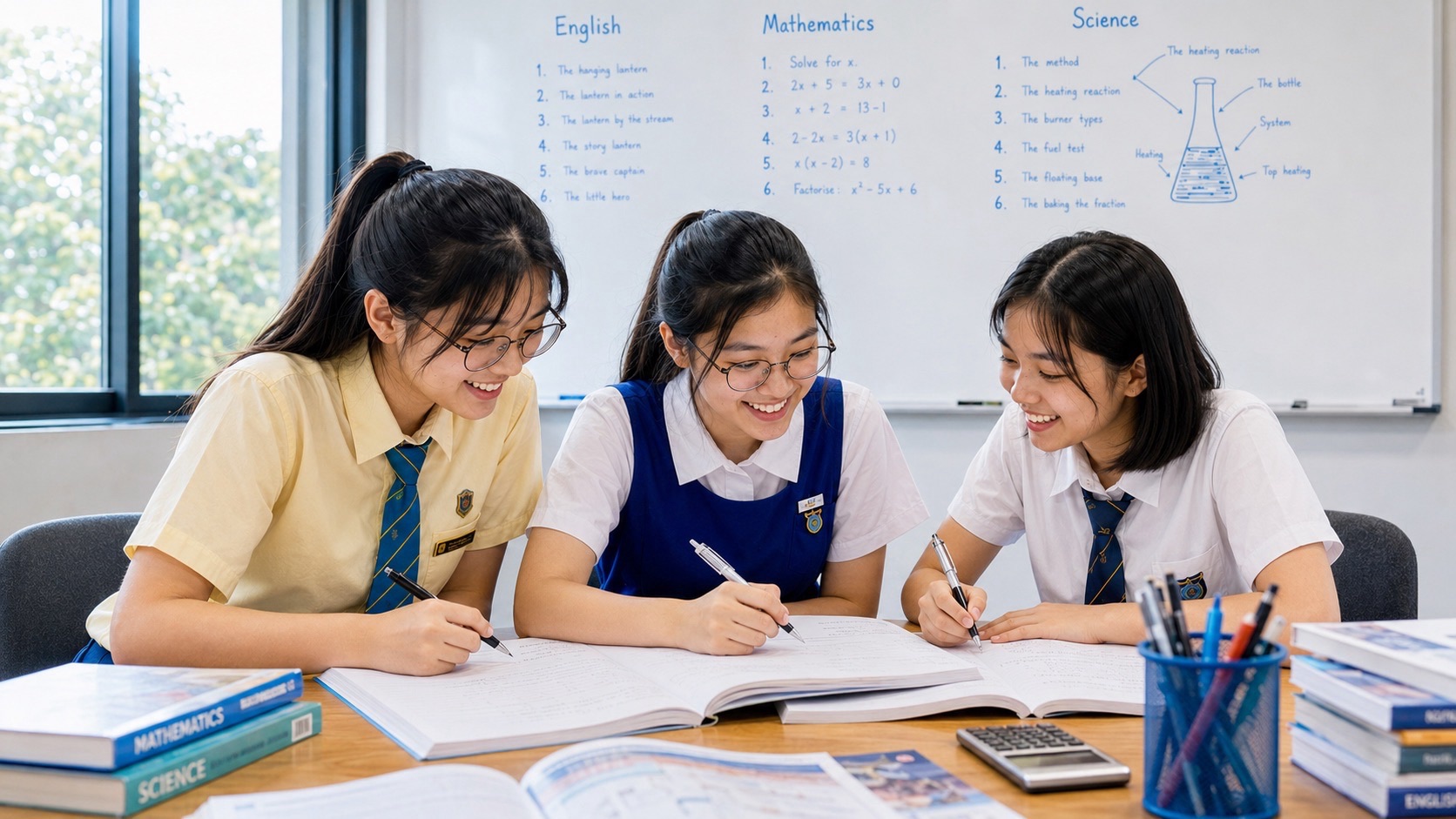
Lane ID: EDKS-VOC-S3-WORLD-060
A strong Secondary 3 vocabulary list should help a Grade 9 or Year 9 student do more than recognise difficult words. This world-facing Top 100 Secondary 3 Vocabulary List concentrates on academic command words: the verbs and task-language that tell students what to do when they read questions, write explanations, analyse evidence, interpret data, solve problems and communicate conclusions. It is for learners, parents and teachers searching for Grade 9 vocabulary words, Year 9 academic vocabulary, command words, vocabulary meanings, example sentences and exam vocabulary.
High-ranking vocabulary resources repeatedly use search language such as vocabulary words, academic vocabulary, word list, definitions, meanings, examples, practice and Grade 9. This article keeps that discoverable language but gives it a technical job. Instead of another decorative list, it teaches language that controls intellectual action across English, Mathematics, Science, Humanities, Computing and project work. The aim is transfer: understand not only what a command word means, but what successful performance looks like.
For international readers, Secondary 3, Grade 9 and Year 9 are practical search bridges, not claims that school systems are identical. Curricula and assessment conventions vary. Maren, Iona and Leonie—the stable resident students used across the eduKate English ecosystem—appear as learning cases: Maren tests writing and idea structure, Iona tests reading, inference and answer scope, and Leonie tests timing, execution and recovery.
What Are Academic Command Words?
Academic command words specify the intellectual operation a learner is expected to perform. Identify asks for recognition; describe asks for relevant features; explain asks how or why; analyse asks the learner to break material into meaningful parts and show relationships; evaluate asks for a judgement supported by criteria and evidence. Confusing these verbs can produce a knowledgeable but badly targeted answer.
Before answering, translate the command word into an action. Then decide what evidence, reasoning, representation and level of detail that action requires. This is answer-scope control. It prevents the common problem of writing everything a student knows while failing to do the specific thing the question requested.
How to Use This List
Work in sets of five to ten. For each word, learn four layers: plain meaning, required action, boundary that prevents over-answering, and one transfer example from another subject. Retrieval should be active: hide the definition, explain the word aloud, create a fresh question using it, answer that question, then check whether the response actually performs the requested operation.
1. Analyse
Meaning and task: To break a subject into parts and explain relationships. In a Secondary 3 or Grade 9 task, analyse controls the shape of the answer. A successful response must visibly perform that operation rather than merely mention the topic. The learner should be able to paraphrase the command in ordinary language before attempting the content.
Performance test: Maren converts “analyse” into three checks: what information is relevant, what must be done to that information, and what evidence would show that the operation is complete. In English, this means choosing material directly connected to the requested action. The response should be proportionate: enough detail to finish the command, but not so much unrelated knowledge that the reasoning disappears.
Common failure and repair: Students often replace the command with an easier one. They may list when reasoning is required, describe when explanation is required, or give an opinion when evaluation is required. Another failure is knowledge dumping: accurate facts that never complete the requested move. Repair this by underlining the command, paraphrasing it, and making every sentence contribute to that operation.
Transfer practice: Write one English question using analyse, answer it briefly, then change the command word and notice how the answer must change. Maren uses this contrast to build semantic boundaries, retrieval strength and decision speed. The same discipline transfers across comprehension, data interpretation, source work, mathematical reasoning, scientific investigation and extended writing.
2. Apply
Meaning and task: To use knowledge or a method in a new situation. In a Secondary 3 or Grade 9 task, apply controls the shape of the answer. A successful response must visibly perform that operation rather than merely mention the topic. The learner should be able to paraphrase the command in ordinary language before attempting the content.
Performance test: Iona converts “apply” into three checks: what information is relevant, what must be done to that information, and what evidence would show that the operation is complete. In Science, this means choosing material directly connected to the requested action. The response should be proportionate: enough detail to finish the command, but not so much unrelated knowledge that the reasoning disappears.
Common failure and repair: Students often replace the command with an easier one. They may list when reasoning is required, describe when explanation is required, or give an opinion when evaluation is required. Another failure is knowledge dumping: accurate facts that never complete the requested move. Repair this by underlining the command, paraphrasing it, and making every sentence contribute to that operation.
Transfer practice: Write one Science question using apply, answer it briefly, then change the command word and notice how the answer must change. Iona uses this contrast to build semantic boundaries, retrieval strength and decision speed. The same discipline transfers across comprehension, data interpretation, source work, mathematical reasoning, scientific investigation and extended writing.
3. Argue
Meaning and task: To present a reasoned position supported by evidence. In a Secondary 3 or Grade 9 task, argue controls the shape of the answer. A successful response must visibly perform that operation rather than merely mention the topic. The learner should be able to paraphrase the command in ordinary language before attempting the content.
Performance test: Leonie converts “argue” into three checks: what information is relevant, what must be done to that information, and what evidence would show that the operation is complete. In Mathematics, this means choosing material directly connected to the requested action. The response should be proportionate: enough detail to finish the command, but not so much unrelated knowledge that the reasoning disappears.
Common failure and repair: Students often replace the command with an easier one. They may list when reasoning is required, describe when explanation is required, or give an opinion when evaluation is required. Another failure is knowledge dumping: accurate facts that never complete the requested move. Repair this by underlining the command, paraphrasing it, and making every sentence contribute to that operation.
Transfer practice: Write one Mathematics question using argue, answer it briefly, then change the command word and notice how the answer must change. Leonie uses this contrast to build semantic boundaries, retrieval strength and decision speed. The same discipline transfers across comprehension, data interpretation, source work, mathematical reasoning, scientific investigation and extended writing.
4. Assess
Meaning and task: To make a reasoned judgement against relevant criteria. In a Secondary 3 or Grade 9 task, assess controls the shape of the answer. A successful response must visibly perform that operation rather than merely mention the topic. The learner should be able to paraphrase the command in ordinary language before attempting the content.
Performance test: Maren converts “assess” into three checks: what information is relevant, what must be done to that information, and what evidence would show that the operation is complete. In Geography, this means choosing material directly connected to the requested action. The response should be proportionate: enough detail to finish the command, but not so much unrelated knowledge that the reasoning disappears.
Common failure and repair: Students often replace the command with an easier one. They may list when reasoning is required, describe when explanation is required, or give an opinion when evaluation is required. Another failure is knowledge dumping: accurate facts that never complete the requested move. Repair this by underlining the command, paraphrasing it, and making every sentence contribute to that operation.
Transfer practice: Write one Geography question using assess, answer it briefly, then change the command word and notice how the answer must change. Maren uses this contrast to build semantic boundaries, retrieval strength and decision speed. The same discipline transfers across comprehension, data interpretation, source work, mathematical reasoning, scientific investigation and extended writing.
5. Calculate
Meaning and task: To work out a numerical answer using appropriate operations. In a Secondary 3 or Grade 9 task, calculate controls the shape of the answer. A successful response must visibly perform that operation rather than merely mention the topic. The learner should be able to paraphrase the command in ordinary language before attempting the content.
Performance test: Iona converts “calculate” into three checks: what information is relevant, what must be done to that information, and what evidence would show that the operation is complete. In History, this means choosing material directly connected to the requested action. The response should be proportionate: enough detail to finish the command, but not so much unrelated knowledge that the reasoning disappears.
Common failure and repair: Students often replace the command with an easier one. They may list when reasoning is required, describe when explanation is required, or give an opinion when evaluation is required. Another failure is knowledge dumping: accurate facts that never complete the requested move. Repair this by underlining the command, paraphrasing it, and making every sentence contribute to that operation.
Transfer practice: Write one History question using calculate, answer it briefly, then change the command word and notice how the answer must change. Iona uses this contrast to build semantic boundaries, retrieval strength and decision speed. The same discipline transfers across comprehension, data interpretation, source work, mathematical reasoning, scientific investigation and extended writing.
6. Categorise
Meaning and task: To place information into groups using shared features. In a Secondary 3 or Grade 9 task, categorise controls the shape of the answer. A successful response must visibly perform that operation rather than merely mention the topic. The learner should be able to paraphrase the command in ordinary language before attempting the content.
Performance test: Leonie converts “categorise” into three checks: what information is relevant, what must be done to that information, and what evidence would show that the operation is complete. In Computing, this means choosing material directly connected to the requested action. The response should be proportionate: enough detail to finish the command, but not so much unrelated knowledge that the reasoning disappears.
Common failure and repair: Students often replace the command with an easier one. They may list when reasoning is required, describe when explanation is required, or give an opinion when evaluation is required. Another failure is knowledge dumping: accurate facts that never complete the requested move. Repair this by underlining the command, paraphrasing it, and making every sentence contribute to that operation.
Transfer practice: Write one Computing question using categorise, answer it briefly, then change the command word and notice how the answer must change. Leonie uses this contrast to build semantic boundaries, retrieval strength and decision speed. The same discipline transfers across comprehension, data interpretation, source work, mathematical reasoning, scientific investigation and extended writing.
7. Characterise
Meaning and task: To identify and explain distinctive qualities. In a Secondary 3 or Grade 9 task, characterise controls the shape of the answer. A successful response must visibly perform that operation rather than merely mention the topic. The learner should be able to paraphrase the command in ordinary language before attempting the content.
Performance test: Maren converts “characterise” into three checks: what information is relevant, what must be done to that information, and what evidence would show that the operation is complete. In English, this means choosing material directly connected to the requested action. The response should be proportionate: enough detail to finish the command, but not so much unrelated knowledge that the reasoning disappears.
Common failure and repair: Students often replace the command with an easier one. They may list when reasoning is required, describe when explanation is required, or give an opinion when evaluation is required. Another failure is knowledge dumping: accurate facts that never complete the requested move. Repair this by underlining the command, paraphrasing it, and making every sentence contribute to that operation.
Transfer practice: Write one English question using characterise, answer it briefly, then change the command word and notice how the answer must change. Maren uses this contrast to build semantic boundaries, retrieval strength and decision speed. The same discipline transfers across comprehension, data interpretation, source work, mathematical reasoning, scientific investigation and extended writing.
8. Cite
Meaning and task: To identify a source or evidence precisely. In a Secondary 3 or Grade 9 task, cite controls the shape of the answer. A successful response must visibly perform that operation rather than merely mention the topic. The learner should be able to paraphrase the command in ordinary language before attempting the content.
Performance test: Iona converts “cite” into three checks: what information is relevant, what must be done to that information, and what evidence would show that the operation is complete. In Science, this means choosing material directly connected to the requested action. The response should be proportionate: enough detail to finish the command, but not so much unrelated knowledge that the reasoning disappears.
Common failure and repair: Students often replace the command with an easier one. They may list when reasoning is required, describe when explanation is required, or give an opinion when evaluation is required. Another failure is knowledge dumping: accurate facts that never complete the requested move. Repair this by underlining the command, paraphrasing it, and making every sentence contribute to that operation.
Transfer practice: Write one Science question using cite, answer it briefly, then change the command word and notice how the answer must change. Iona uses this contrast to build semantic boundaries, retrieval strength and decision speed. The same discipline transfers across comprehension, data interpretation, source work, mathematical reasoning, scientific investigation and extended writing.
9. Classify
Meaning and task: To organise items into classes using stated criteria. In a Secondary 3 or Grade 9 task, classify controls the shape of the answer. A successful response must visibly perform that operation rather than merely mention the topic. The learner should be able to paraphrase the command in ordinary language before attempting the content.
Performance test: Leonie converts “classify” into three checks: what information is relevant, what must be done to that information, and what evidence would show that the operation is complete. In Mathematics, this means choosing material directly connected to the requested action. The response should be proportionate: enough detail to finish the command, but not so much unrelated knowledge that the reasoning disappears.
Common failure and repair: Students often replace the command with an easier one. They may list when reasoning is required, describe when explanation is required, or give an opinion when evaluation is required. Another failure is knowledge dumping: accurate facts that never complete the requested move. Repair this by underlining the command, paraphrasing it, and making every sentence contribute to that operation.
Transfer practice: Write one Mathematics question using classify, answer it briefly, then change the command word and notice how the answer must change. Leonie uses this contrast to build semantic boundaries, retrieval strength and decision speed. The same discipline transfers across comprehension, data interpretation, source work, mathematical reasoning, scientific investigation and extended writing.
10. Comment
Meaning and task: To make a focused observation and explain its significance. In a Secondary 3 or Grade 9 task, comment controls the shape of the answer. A successful response must visibly perform that operation rather than merely mention the topic. The learner should be able to paraphrase the command in ordinary language before attempting the content.
Performance test: Maren converts “comment” into three checks: what information is relevant, what must be done to that information, and what evidence would show that the operation is complete. In Geography, this means choosing material directly connected to the requested action. The response should be proportionate: enough detail to finish the command, but not so much unrelated knowledge that the reasoning disappears.
Common failure and repair: Students often replace the command with an easier one. They may list when reasoning is required, describe when explanation is required, or give an opinion when evaluation is required. Another failure is knowledge dumping: accurate facts that never complete the requested move. Repair this by underlining the command, paraphrasing it, and making every sentence contribute to that operation.
Transfer practice: Write one Geography question using comment, answer it briefly, then change the command word and notice how the answer must change. Maren uses this contrast to build semantic boundaries, retrieval strength and decision speed. The same discipline transfers across comprehension, data interpretation, source work, mathematical reasoning, scientific investigation and extended writing.
11. Compare
Meaning and task: To identify meaningful similarities and differences. In a Secondary 3 or Grade 9 task, compare controls the shape of the answer. A successful response must visibly perform that operation rather than merely mention the topic. The learner should be able to paraphrase the command in ordinary language before attempting the content.
Performance test: Iona converts “compare” into three checks: what information is relevant, what must be done to that information, and what evidence would show that the operation is complete. In History, this means choosing material directly connected to the requested action. The response should be proportionate: enough detail to finish the command, but not so much unrelated knowledge that the reasoning disappears.
Common failure and repair: Students often replace the command with an easier one. They may list when reasoning is required, describe when explanation is required, or give an opinion when evaluation is required. Another failure is knowledge dumping: accurate facts that never complete the requested move. Repair this by underlining the command, paraphrasing it, and making every sentence contribute to that operation.
Transfer practice: Write one History question using compare, answer it briefly, then change the command word and notice how the answer must change. Iona uses this contrast to build semantic boundaries, retrieval strength and decision speed. The same discipline transfers across comprehension, data interpretation, source work, mathematical reasoning, scientific investigation and extended writing.
12. Compile
Meaning and task: To collect information from several places into a usable whole. In a Secondary 3 or Grade 9 task, compile controls the shape of the answer. A successful response must visibly perform that operation rather than merely mention the topic. The learner should be able to paraphrase the command in ordinary language before attempting the content.
Performance test: Leonie converts “compile” into three checks: what information is relevant, what must be done to that information, and what evidence would show that the operation is complete. In Computing, this means choosing material directly connected to the requested action. The response should be proportionate: enough detail to finish the command, but not so much unrelated knowledge that the reasoning disappears.
Common failure and repair: Students often replace the command with an easier one. They may list when reasoning is required, describe when explanation is required, or give an opinion when evaluation is required. Another failure is knowledge dumping: accurate facts that never complete the requested move. Repair this by underlining the command, paraphrasing it, and making every sentence contribute to that operation.
Transfer practice: Write one Computing question using compile, answer it briefly, then change the command word and notice how the answer must change. Leonie uses this contrast to build semantic boundaries, retrieval strength and decision speed. The same discipline transfers across comprehension, data interpretation, source work, mathematical reasoning, scientific investigation and extended writing.
13. Complete
Meaning and task: To supply all required parts of a task accurately. In a Secondary 3 or Grade 9 task, complete controls the shape of the answer. A successful response must visibly perform that operation rather than merely mention the topic. The learner should be able to paraphrase the command in ordinary language before attempting the content.
Performance test: Maren converts “complete” into three checks: what information is relevant, what must be done to that information, and what evidence would show that the operation is complete. In English, this means choosing material directly connected to the requested action. The response should be proportionate: enough detail to finish the command, but not so much unrelated knowledge that the reasoning disappears.
Common failure and repair: Students often replace the command with an easier one. They may list when reasoning is required, describe when explanation is required, or give an opinion when evaluation is required. Another failure is knowledge dumping: accurate facts that never complete the requested move. Repair this by underlining the command, paraphrasing it, and making every sentence contribute to that operation.
Transfer practice: Write one English question using complete, answer it briefly, then change the command word and notice how the answer must change. Maren uses this contrast to build semantic boundaries, retrieval strength and decision speed. The same discipline transfers across comprehension, data interpretation, source work, mathematical reasoning, scientific investigation and extended writing.
14. Conclude
Meaning and task: To state the judgement that follows from evidence. In a Secondary 3 or Grade 9 task, conclude controls the shape of the answer. A successful response must visibly perform that operation rather than merely mention the topic. The learner should be able to paraphrase the command in ordinary language before attempting the content.
Performance test: Iona converts “conclude” into three checks: what information is relevant, what must be done to that information, and what evidence would show that the operation is complete. In Science, this means choosing material directly connected to the requested action. The response should be proportionate: enough detail to finish the command, but not so much unrelated knowledge that the reasoning disappears.
Common failure and repair: Students often replace the command with an easier one. They may list when reasoning is required, describe when explanation is required, or give an opinion when evaluation is required. Another failure is knowledge dumping: accurate facts that never complete the requested move. Repair this by underlining the command, paraphrasing it, and making every sentence contribute to that operation.
Transfer practice: Write one Science question using conclude, answer it briefly, then change the command word and notice how the answer must change. Iona uses this contrast to build semantic boundaries, retrieval strength and decision speed. The same discipline transfers across comprehension, data interpretation, source work, mathematical reasoning, scientific investigation and extended writing.
15. Construct
Meaning and task: To build a response, model, argument or solution. In a Secondary 3 or Grade 9 task, construct controls the shape of the answer. A successful response must visibly perform that operation rather than merely mention the topic. The learner should be able to paraphrase the command in ordinary language before attempting the content.
Performance test: Leonie converts “construct” into three checks: what information is relevant, what must be done to that information, and what evidence would show that the operation is complete. In Mathematics, this means choosing material directly connected to the requested action. The response should be proportionate: enough detail to finish the command, but not so much unrelated knowledge that the reasoning disappears.
Common failure and repair: Students often replace the command with an easier one. They may list when reasoning is required, describe when explanation is required, or give an opinion when evaluation is required. Another failure is knowledge dumping: accurate facts that never complete the requested move. Repair this by underlining the command, paraphrasing it, and making every sentence contribute to that operation.
Transfer practice: Write one Mathematics question using construct, answer it briefly, then change the command word and notice how the answer must change. Leonie uses this contrast to build semantic boundaries, retrieval strength and decision speed. The same discipline transfers across comprehension, data interpretation, source work, mathematical reasoning, scientific investigation and extended writing.
16. Contrast
Meaning and task: To focus on significant differences. In a Secondary 3 or Grade 9 task, contrast controls the shape of the answer. A successful response must visibly perform that operation rather than merely mention the topic. The learner should be able to paraphrase the command in ordinary language before attempting the content.
Performance test: Maren converts “contrast” into three checks: what information is relevant, what must be done to that information, and what evidence would show that the operation is complete. In Geography, this means choosing material directly connected to the requested action. The response should be proportionate: enough detail to finish the command, but not so much unrelated knowledge that the reasoning disappears.
Common failure and repair: Students often replace the command with an easier one. They may list when reasoning is required, describe when explanation is required, or give an opinion when evaluation is required. Another failure is knowledge dumping: accurate facts that never complete the requested move. Repair this by underlining the command, paraphrasing it, and making every sentence contribute to that operation.
Transfer practice: Write one Geography question using contrast, answer it briefly, then change the command word and notice how the answer must change. Maren uses this contrast to build semantic boundaries, retrieval strength and decision speed. The same discipline transfers across comprehension, data interpretation, source work, mathematical reasoning, scientific investigation and extended writing.
17. Convert
Meaning and task: To change information from one form or unit into another. In a Secondary 3 or Grade 9 task, convert controls the shape of the answer. A successful response must visibly perform that operation rather than merely mention the topic. The learner should be able to paraphrase the command in ordinary language before attempting the content.
Performance test: Iona converts “convert” into three checks: what information is relevant, what must be done to that information, and what evidence would show that the operation is complete. In History, this means choosing material directly connected to the requested action. The response should be proportionate: enough detail to finish the command, but not so much unrelated knowledge that the reasoning disappears.
Common failure and repair: Students often replace the command with an easier one. They may list when reasoning is required, describe when explanation is required, or give an opinion when evaluation is required. Another failure is knowledge dumping: accurate facts that never complete the requested move. Repair this by underlining the command, paraphrasing it, and making every sentence contribute to that operation.
Transfer practice: Write one History question using convert, answer it briefly, then change the command word and notice how the answer must change. Iona uses this contrast to build semantic boundaries, retrieval strength and decision speed. The same discipline transfers across comprehension, data interpretation, source work, mathematical reasoning, scientific investigation and extended writing.
18. Critique
Meaning and task: To evaluate strengths, limitations and assumptions. In a Secondary 3 or Grade 9 task, critique controls the shape of the answer. A successful response must visibly perform that operation rather than merely mention the topic. The learner should be able to paraphrase the command in ordinary language before attempting the content.
Performance test: Leonie converts “critique” into three checks: what information is relevant, what must be done to that information, and what evidence would show that the operation is complete. In Computing, this means choosing material directly connected to the requested action. The response should be proportionate: enough detail to finish the command, but not so much unrelated knowledge that the reasoning disappears.
Common failure and repair: Students often replace the command with an easier one. They may list when reasoning is required, describe when explanation is required, or give an opinion when evaluation is required. Another failure is knowledge dumping: accurate facts that never complete the requested move. Repair this by underlining the command, paraphrasing it, and making every sentence contribute to that operation.
Transfer practice: Write one Computing question using critique, answer it briefly, then change the command word and notice how the answer must change. Leonie uses this contrast to build semantic boundaries, retrieval strength and decision speed. The same discipline transfers across comprehension, data interpretation, source work, mathematical reasoning, scientific investigation and extended writing.
19. Deduce
Meaning and task: To reach a logical conclusion from given information. In a Secondary 3 or Grade 9 task, deduce controls the shape of the answer. A successful response must visibly perform that operation rather than merely mention the topic. The learner should be able to paraphrase the command in ordinary language before attempting the content.
Performance test: Maren converts “deduce” into three checks: what information is relevant, what must be done to that information, and what evidence would show that the operation is complete. In English, this means choosing material directly connected to the requested action. The response should be proportionate: enough detail to finish the command, but not so much unrelated knowledge that the reasoning disappears.
Common failure and repair: Students often replace the command with an easier one. They may list when reasoning is required, describe when explanation is required, or give an opinion when evaluation is required. Another failure is knowledge dumping: accurate facts that never complete the requested move. Repair this by underlining the command, paraphrasing it, and making every sentence contribute to that operation.
Transfer practice: Write one English question using deduce, answer it briefly, then change the command word and notice how the answer must change. Maren uses this contrast to build semantic boundaries, retrieval strength and decision speed. The same discipline transfers across comprehension, data interpretation, source work, mathematical reasoning, scientific investigation and extended writing.
20. Define
Meaning and task: To state the precise meaning of a term in context. In a Secondary 3 or Grade 9 task, define controls the shape of the answer. A successful response must visibly perform that operation rather than merely mention the topic. The learner should be able to paraphrase the command in ordinary language before attempting the content.
Performance test: Iona converts “define” into three checks: what information is relevant, what must be done to that information, and what evidence would show that the operation is complete. In Science, this means choosing material directly connected to the requested action. The response should be proportionate: enough detail to finish the command, but not so much unrelated knowledge that the reasoning disappears.
Common failure and repair: Students often replace the command with an easier one. They may list when reasoning is required, describe when explanation is required, or give an opinion when evaluation is required. Another failure is knowledge dumping: accurate facts that never complete the requested move. Repair this by underlining the command, paraphrasing it, and making every sentence contribute to that operation.
Transfer practice: Write one Science question using define, answer it briefly, then change the command word and notice how the answer must change. Iona uses this contrast to build semantic boundaries, retrieval strength and decision speed. The same discipline transfers across comprehension, data interpretation, source work, mathematical reasoning, scientific investigation and extended writing.
21. Demonstrate
Meaning and task: To show clearly through evidence, reasoning or working. In a Secondary 3 or Grade 9 task, demonstrate controls the shape of the answer. A successful response must visibly perform that operation rather than merely mention the topic. The learner should be able to paraphrase the command in ordinary language before attempting the content.
Performance test: Leonie converts “demonstrate” into three checks: what information is relevant, what must be done to that information, and what evidence would show that the operation is complete. In Mathematics, this means choosing material directly connected to the requested action. The response should be proportionate: enough detail to finish the command, but not so much unrelated knowledge that the reasoning disappears.
Common failure and repair: Students often replace the command with an easier one. They may list when reasoning is required, describe when explanation is required, or give an opinion when evaluation is required. Another failure is knowledge dumping: accurate facts that never complete the requested move. Repair this by underlining the command, paraphrasing it, and making every sentence contribute to that operation.
Transfer practice: Write one Mathematics question using demonstrate, answer it briefly, then change the command word and notice how the answer must change. Leonie uses this contrast to build semantic boundaries, retrieval strength and decision speed. The same discipline transfers across comprehension, data interpretation, source work, mathematical reasoning, scientific investigation and extended writing.
22. Derive
Meaning and task: To obtain a result through a sequence of valid steps. In a Secondary 3 or Grade 9 task, derive controls the shape of the answer. A successful response must visibly perform that operation rather than merely mention the topic. The learner should be able to paraphrase the command in ordinary language before attempting the content.
Performance test: Maren converts “derive” into three checks: what information is relevant, what must be done to that information, and what evidence would show that the operation is complete. In Geography, this means choosing material directly connected to the requested action. The response should be proportionate: enough detail to finish the command, but not so much unrelated knowledge that the reasoning disappears.
Common failure and repair: Students often replace the command with an easier one. They may list when reasoning is required, describe when explanation is required, or give an opinion when evaluation is required. Another failure is knowledge dumping: accurate facts that never complete the requested move. Repair this by underlining the command, paraphrasing it, and making every sentence contribute to that operation.
Transfer practice: Write one Geography question using derive, answer it briefly, then change the command word and notice how the answer must change. Maren uses this contrast to build semantic boundaries, retrieval strength and decision speed. The same discipline transfers across comprehension, data interpretation, source work, mathematical reasoning, scientific investigation and extended writing.
23. Describe
Meaning and task: To give an accurate account of relevant features. In a Secondary 3 or Grade 9 task, describe controls the shape of the answer. A successful response must visibly perform that operation rather than merely mention the topic. The learner should be able to paraphrase the command in ordinary language before attempting the content.
Performance test: Iona converts “describe” into three checks: what information is relevant, what must be done to that information, and what evidence would show that the operation is complete. In History, this means choosing material directly connected to the requested action. The response should be proportionate: enough detail to finish the command, but not so much unrelated knowledge that the reasoning disappears.
Common failure and repair: Students often replace the command with an easier one. They may list when reasoning is required, describe when explanation is required, or give an opinion when evaluation is required. Another failure is knowledge dumping: accurate facts that never complete the requested move. Repair this by underlining the command, paraphrasing it, and making every sentence contribute to that operation.
Transfer practice: Write one History question using describe, answer it briefly, then change the command word and notice how the answer must change. Iona uses this contrast to build semantic boundaries, retrieval strength and decision speed. The same discipline transfers across comprehension, data interpretation, source work, mathematical reasoning, scientific investigation and extended writing.
24. Determine
Meaning and task: To find or establish something from evidence or calculation. In a Secondary 3 or Grade 9 task, determine controls the shape of the answer. A successful response must visibly perform that operation rather than merely mention the topic. The learner should be able to paraphrase the command in ordinary language before attempting the content.
Performance test: Leonie converts “determine” into three checks: what information is relevant, what must be done to that information, and what evidence would show that the operation is complete. In Computing, this means choosing material directly connected to the requested action. The response should be proportionate: enough detail to finish the command, but not so much unrelated knowledge that the reasoning disappears.
Common failure and repair: Students often replace the command with an easier one. They may list when reasoning is required, describe when explanation is required, or give an opinion when evaluation is required. Another failure is knowledge dumping: accurate facts that never complete the requested move. Repair this by underlining the command, paraphrasing it, and making every sentence contribute to that operation.
Transfer practice: Write one Computing question using determine, answer it briefly, then change the command word and notice how the answer must change. Leonie uses this contrast to build semantic boundaries, retrieval strength and decision speed. The same discipline transfers across comprehension, data interpretation, source work, mathematical reasoning, scientific investigation and extended writing.
25. Differentiate
Meaning and task: To identify a meaningful distinction between related things. In a Secondary 3 or Grade 9 task, differentiate controls the shape of the answer. A successful response must visibly perform that operation rather than merely mention the topic. The learner should be able to paraphrase the command in ordinary language before attempting the content.
Performance test: Maren converts “differentiate” into three checks: what information is relevant, what must be done to that information, and what evidence would show that the operation is complete. In English, this means choosing material directly connected to the requested action. The response should be proportionate: enough detail to finish the command, but not so much unrelated knowledge that the reasoning disappears.
Common failure and repair: Students often replace the command with an easier one. They may list when reasoning is required, describe when explanation is required, or give an opinion when evaluation is required. Another failure is knowledge dumping: accurate facts that never complete the requested move. Repair this by underlining the command, paraphrasing it, and making every sentence contribute to that operation.
Transfer practice: Write one English question using differentiate, answer it briefly, then change the command word and notice how the answer must change. Maren uses this contrast to build semantic boundaries, retrieval strength and decision speed. The same discipline transfers across comprehension, data interpretation, source work, mathematical reasoning, scientific investigation and extended writing.
26. Discuss
Meaning and task: To develop a balanced exploration using reasons and evidence. In a Secondary 3 or Grade 9 task, discuss controls the shape of the answer. A successful response must visibly perform that operation rather than merely mention the topic. The learner should be able to paraphrase the command in ordinary language before attempting the content.
Performance test: Iona converts “discuss” into three checks: what information is relevant, what must be done to that information, and what evidence would show that the operation is complete. In Science, this means choosing material directly connected to the requested action. The response should be proportionate: enough detail to finish the command, but not so much unrelated knowledge that the reasoning disappears.
Common failure and repair: Students often replace the command with an easier one. They may list when reasoning is required, describe when explanation is required, or give an opinion when evaluation is required. Another failure is knowledge dumping: accurate facts that never complete the requested move. Repair this by underlining the command, paraphrasing it, and making every sentence contribute to that operation.
Transfer practice: Write one Science question using discuss, answer it briefly, then change the command word and notice how the answer must change. Iona uses this contrast to build semantic boundaries, retrieval strength and decision speed. The same discipline transfers across comprehension, data interpretation, source work, mathematical reasoning, scientific investigation and extended writing.
27. Distinguish
Meaning and task: To show how closely related ideas differ. In a Secondary 3 or Grade 9 task, distinguish controls the shape of the answer. A successful response must visibly perform that operation rather than merely mention the topic. The learner should be able to paraphrase the command in ordinary language before attempting the content.
Performance test: Leonie converts “distinguish” into three checks: what information is relevant, what must be done to that information, and what evidence would show that the operation is complete. In Mathematics, this means choosing material directly connected to the requested action. The response should be proportionate: enough detail to finish the command, but not so much unrelated knowledge that the reasoning disappears.
Common failure and repair: Students often replace the command with an easier one. They may list when reasoning is required, describe when explanation is required, or give an opinion when evaluation is required. Another failure is knowledge dumping: accurate facts that never complete the requested move. Repair this by underlining the command, paraphrasing it, and making every sentence contribute to that operation.
Transfer practice: Write one Mathematics question using distinguish, answer it briefly, then change the command word and notice how the answer must change. Leonie uses this contrast to build semantic boundaries, retrieval strength and decision speed. The same discipline transfers across comprehension, data interpretation, source work, mathematical reasoning, scientific investigation and extended writing.
28. Document
Meaning and task: To record evidence, steps or sources systematically. In a Secondary 3 or Grade 9 task, document controls the shape of the answer. A successful response must visibly perform that operation rather than merely mention the topic. The learner should be able to paraphrase the command in ordinary language before attempting the content.
Performance test: Maren converts “document” into three checks: what information is relevant, what must be done to that information, and what evidence would show that the operation is complete. In Geography, this means choosing material directly connected to the requested action. The response should be proportionate: enough detail to finish the command, but not so much unrelated knowledge that the reasoning disappears.
Common failure and repair: Students often replace the command with an easier one. They may list when reasoning is required, describe when explanation is required, or give an opinion when evaluation is required. Another failure is knowledge dumping: accurate facts that never complete the requested move. Repair this by underlining the command, paraphrasing it, and making every sentence contribute to that operation.
Transfer practice: Write one Geography question using document, answer it briefly, then change the command word and notice how the answer must change. Maren uses this contrast to build semantic boundaries, retrieval strength and decision speed. The same discipline transfers across comprehension, data interpretation, source work, mathematical reasoning, scientific investigation and extended writing.
29. Elaborate
Meaning and task: To add relevant detail that makes an idea more complete. In a Secondary 3 or Grade 9 task, elaborate controls the shape of the answer. A successful response must visibly perform that operation rather than merely mention the topic. The learner should be able to paraphrase the command in ordinary language before attempting the content.
Performance test: Iona converts “elaborate” into three checks: what information is relevant, what must be done to that information, and what evidence would show that the operation is complete. In History, this means choosing material directly connected to the requested action. The response should be proportionate: enough detail to finish the command, but not so much unrelated knowledge that the reasoning disappears.
Common failure and repair: Students often replace the command with an easier one. They may list when reasoning is required, describe when explanation is required, or give an opinion when evaluation is required. Another failure is knowledge dumping: accurate facts that never complete the requested move. Repair this by underlining the command, paraphrasing it, and making every sentence contribute to that operation.
Transfer practice: Write one History question using elaborate, answer it briefly, then change the command word and notice how the answer must change. Iona uses this contrast to build semantic boundaries, retrieval strength and decision speed. The same discipline transfers across comprehension, data interpretation, source work, mathematical reasoning, scientific investigation and extended writing.
30. Estimate
Meaning and task: To produce a reasonable approximate value. In a Secondary 3 or Grade 9 task, estimate controls the shape of the answer. A successful response must visibly perform that operation rather than merely mention the topic. The learner should be able to paraphrase the command in ordinary language before attempting the content.
Performance test: Leonie converts “estimate” into three checks: what information is relevant, what must be done to that information, and what evidence would show that the operation is complete. In Computing, this means choosing material directly connected to the requested action. The response should be proportionate: enough detail to finish the command, but not so much unrelated knowledge that the reasoning disappears.
Common failure and repair: Students often replace the command with an easier one. They may list when reasoning is required, describe when explanation is required, or give an opinion when evaluation is required. Another failure is knowledge dumping: accurate facts that never complete the requested move. Repair this by underlining the command, paraphrasing it, and making every sentence contribute to that operation.
Transfer practice: Write one Computing question using estimate, answer it briefly, then change the command word and notice how the answer must change. Leonie uses this contrast to build semantic boundaries, retrieval strength and decision speed. The same discipline transfers across comprehension, data interpretation, source work, mathematical reasoning, scientific investigation and extended writing.
31. Evaluate
Meaning and task: To judge quality or validity against criteria and evidence. In a Secondary 3 or Grade 9 task, evaluate controls the shape of the answer. A successful response must visibly perform that operation rather than merely mention the topic. The learner should be able to paraphrase the command in ordinary language before attempting the content.
Performance test: Maren converts “evaluate” into three checks: what information is relevant, what must be done to that information, and what evidence would show that the operation is complete. In English, this means choosing material directly connected to the requested action. The response should be proportionate: enough detail to finish the command, but not so much unrelated knowledge that the reasoning disappears.
Common failure and repair: Students often replace the command with an easier one. They may list when reasoning is required, describe when explanation is required, or give an opinion when evaluation is required. Another failure is knowledge dumping: accurate facts that never complete the requested move. Repair this by underlining the command, paraphrasing it, and making every sentence contribute to that operation.
Transfer practice: Write one English question using evaluate, answer it briefly, then change the command word and notice how the answer must change. Maren uses this contrast to build semantic boundaries, retrieval strength and decision speed. The same discipline transfers across comprehension, data interpretation, source work, mathematical reasoning, scientific investigation and extended writing.
32. Examine
Meaning and task: To inspect a subject closely to identify important features. In a Secondary 3 or Grade 9 task, examine controls the shape of the answer. A successful response must visibly perform that operation rather than merely mention the topic. The learner should be able to paraphrase the command in ordinary language before attempting the content.
Performance test: Iona converts “examine” into three checks: what information is relevant, what must be done to that information, and what evidence would show that the operation is complete. In Science, this means choosing material directly connected to the requested action. The response should be proportionate: enough detail to finish the command, but not so much unrelated knowledge that the reasoning disappears.
Common failure and repair: Students often replace the command with an easier one. They may list when reasoning is required, describe when explanation is required, or give an opinion when evaluation is required. Another failure is knowledge dumping: accurate facts that never complete the requested move. Repair this by underlining the command, paraphrasing it, and making every sentence contribute to that operation.
Transfer practice: Write one Science question using examine, answer it briefly, then change the command word and notice how the answer must change. Iona uses this contrast to build semantic boundaries, retrieval strength and decision speed. The same discipline transfers across comprehension, data interpretation, source work, mathematical reasoning, scientific investigation and extended writing.
33. Explain
Meaning and task: To make something understandable by showing how or why. In a Secondary 3 or Grade 9 task, explain controls the shape of the answer. A successful response must visibly perform that operation rather than merely mention the topic. The learner should be able to paraphrase the command in ordinary language before attempting the content.
Performance test: Leonie converts “explain” into three checks: what information is relevant, what must be done to that information, and what evidence would show that the operation is complete. In Mathematics, this means choosing material directly connected to the requested action. The response should be proportionate: enough detail to finish the command, but not so much unrelated knowledge that the reasoning disappears.
Common failure and repair: Students often replace the command with an easier one. They may list when reasoning is required, describe when explanation is required, or give an opinion when evaluation is required. Another failure is knowledge dumping: accurate facts that never complete the requested move. Repair this by underlining the command, paraphrasing it, and making every sentence contribute to that operation.
Transfer practice: Write one Mathematics question using explain, answer it briefly, then change the command word and notice how the answer must change. Leonie uses this contrast to build semantic boundaries, retrieval strength and decision speed. The same discipline transfers across comprehension, data interpretation, source work, mathematical reasoning, scientific investigation and extended writing.
34. Explore
Meaning and task: To investigate a topic from several useful angles. In a Secondary 3 or Grade 9 task, explore controls the shape of the answer. A successful response must visibly perform that operation rather than merely mention the topic. The learner should be able to paraphrase the command in ordinary language before attempting the content.
Performance test: Maren converts “explore” into three checks: what information is relevant, what must be done to that information, and what evidence would show that the operation is complete. In Geography, this means choosing material directly connected to the requested action. The response should be proportionate: enough detail to finish the command, but not so much unrelated knowledge that the reasoning disappears.
Common failure and repair: Students often replace the command with an easier one. They may list when reasoning is required, describe when explanation is required, or give an opinion when evaluation is required. Another failure is knowledge dumping: accurate facts that never complete the requested move. Repair this by underlining the command, paraphrasing it, and making every sentence contribute to that operation.
Transfer practice: Write one Geography question using explore, answer it briefly, then change the command word and notice how the answer must change. Maren uses this contrast to build semantic boundaries, retrieval strength and decision speed. The same discipline transfers across comprehension, data interpretation, source work, mathematical reasoning, scientific investigation and extended writing.
35. Express
Meaning and task: To communicate an idea or relationship in an appropriate form. In a Secondary 3 or Grade 9 task, express controls the shape of the answer. A successful response must visibly perform that operation rather than merely mention the topic. The learner should be able to paraphrase the command in ordinary language before attempting the content.
Performance test: Iona converts “express” into three checks: what information is relevant, what must be done to that information, and what evidence would show that the operation is complete. In History, this means choosing material directly connected to the requested action. The response should be proportionate: enough detail to finish the command, but not so much unrelated knowledge that the reasoning disappears.
Common failure and repair: Students often replace the command with an easier one. They may list when reasoning is required, describe when explanation is required, or give an opinion when evaluation is required. Another failure is knowledge dumping: accurate facts that never complete the requested move. Repair this by underlining the command, paraphrasing it, and making every sentence contribute to that operation.
Transfer practice: Write one History question using express, answer it briefly, then change the command word and notice how the answer must change. Iona uses this contrast to build semantic boundaries, retrieval strength and decision speed. The same discipline transfers across comprehension, data interpretation, source work, mathematical reasoning, scientific investigation and extended writing.
36. Extract
Meaning and task: To select specific information from a larger source. In a Secondary 3 or Grade 9 task, extract controls the shape of the answer. A successful response must visibly perform that operation rather than merely mention the topic. The learner should be able to paraphrase the command in ordinary language before attempting the content.
Performance test: Leonie converts “extract” into three checks: what information is relevant, what must be done to that information, and what evidence would show that the operation is complete. In Computing, this means choosing material directly connected to the requested action. The response should be proportionate: enough detail to finish the command, but not so much unrelated knowledge that the reasoning disappears.
Common failure and repair: Students often replace the command with an easier one. They may list when reasoning is required, describe when explanation is required, or give an opinion when evaluation is required. Another failure is knowledge dumping: accurate facts that never complete the requested move. Repair this by underlining the command, paraphrasing it, and making every sentence contribute to that operation.
Transfer practice: Write one Computing question using extract, answer it briefly, then change the command word and notice how the answer must change. Leonie uses this contrast to build semantic boundaries, retrieval strength and decision speed. The same discipline transfers across comprehension, data interpretation, source work, mathematical reasoning, scientific investigation and extended writing.
37. Formulate
Meaning and task: To develop a precise question, hypothesis, rule or plan. In a Secondary 3 or Grade 9 task, formulate controls the shape of the answer. A successful response must visibly perform that operation rather than merely mention the topic. The learner should be able to paraphrase the command in ordinary language before attempting the content.
Performance test: Maren converts “formulate” into three checks: what information is relevant, what must be done to that information, and what evidence would show that the operation is complete. In English, this means choosing material directly connected to the requested action. The response should be proportionate: enough detail to finish the command, but not so much unrelated knowledge that the reasoning disappears.
Common failure and repair: Students often replace the command with an easier one. They may list when reasoning is required, describe when explanation is required, or give an opinion when evaluation is required. Another failure is knowledge dumping: accurate facts that never complete the requested move. Repair this by underlining the command, paraphrasing it, and making every sentence contribute to that operation.
Transfer practice: Write one English question using formulate, answer it briefly, then change the command word and notice how the answer must change. Maren uses this contrast to build semantic boundaries, retrieval strength and decision speed. The same discipline transfers across comprehension, data interpretation, source work, mathematical reasoning, scientific investigation and extended writing.
38. Generalise
Meaning and task: To form a broader statement from patterns within evidence limits. In a Secondary 3 or Grade 9 task, generalise controls the shape of the answer. A successful response must visibly perform that operation rather than merely mention the topic. The learner should be able to paraphrase the command in ordinary language before attempting the content.
Performance test: Iona converts “generalise” into three checks: what information is relevant, what must be done to that information, and what evidence would show that the operation is complete. In Science, this means choosing material directly connected to the requested action. The response should be proportionate: enough detail to finish the command, but not so much unrelated knowledge that the reasoning disappears.
Common failure and repair: Students often replace the command with an easier one. They may list when reasoning is required, describe when explanation is required, or give an opinion when evaluation is required. Another failure is knowledge dumping: accurate facts that never complete the requested move. Repair this by underlining the command, paraphrasing it, and making every sentence contribute to that operation.
Transfer practice: Write one Science question using generalise, answer it briefly, then change the command word and notice how the answer must change. Iona uses this contrast to build semantic boundaries, retrieval strength and decision speed. The same discipline transfers across comprehension, data interpretation, source work, mathematical reasoning, scientific investigation and extended writing.
39. Hypothesise
Meaning and task: To propose a testable explanation or prediction. In a Secondary 3 or Grade 9 task, hypothesise controls the shape of the answer. A successful response must visibly perform that operation rather than merely mention the topic. The learner should be able to paraphrase the command in ordinary language before attempting the content.
Performance test: Leonie converts “hypothesise” into three checks: what information is relevant, what must be done to that information, and what evidence would show that the operation is complete. In Mathematics, this means choosing material directly connected to the requested action. The response should be proportionate: enough detail to finish the command, but not so much unrelated knowledge that the reasoning disappears.
Common failure and repair: Students often replace the command with an easier one. They may list when reasoning is required, describe when explanation is required, or give an opinion when evaluation is required. Another failure is knowledge dumping: accurate facts that never complete the requested move. Repair this by underlining the command, paraphrasing it, and making every sentence contribute to that operation.
Transfer practice: Write one Mathematics question using hypothesise, answer it briefly, then change the command word and notice how the answer must change. Leonie uses this contrast to build semantic boundaries, retrieval strength and decision speed. The same discipline transfers across comprehension, data interpretation, source work, mathematical reasoning, scientific investigation and extended writing.
40. Identify
Meaning and task: To name or locate the relevant feature, fact or concept. In a Secondary 3 or Grade 9 task, identify controls the shape of the answer. A successful response must visibly perform that operation rather than merely mention the topic. The learner should be able to paraphrase the command in ordinary language before attempting the content.
Performance test: Maren converts “identify” into three checks: what information is relevant, what must be done to that information, and what evidence would show that the operation is complete. In Geography, this means choosing material directly connected to the requested action. The response should be proportionate: enough detail to finish the command, but not so much unrelated knowledge that the reasoning disappears.
Common failure and repair: Students often replace the command with an easier one. They may list when reasoning is required, describe when explanation is required, or give an opinion when evaluation is required. Another failure is knowledge dumping: accurate facts that never complete the requested move. Repair this by underlining the command, paraphrasing it, and making every sentence contribute to that operation.
Transfer practice: Write one Geography question using identify, answer it briefly, then change the command word and notice how the answer must change. Maren uses this contrast to build semantic boundaries, retrieval strength and decision speed. The same discipline transfers across comprehension, data interpretation, source work, mathematical reasoning, scientific investigation and extended writing.
Command-Word Control System
Treat every task as a compact specification: identify the command, the object of the command, constraints such as source limits or required method, the evidence standard, and the output form. A question can contain more than one operation. If it asks a student to compare two explanations and then evaluate which is better supported, comparison supplies organised evidence for the later judgement.
Command Words 41–70: Evidence, Representation and Transfer
41. Illustrate
Meaning and task: To make an idea clearer through a relevant example, diagram or case. The command illustrate is an instruction about intellectual work, not merely vocabulary to recognise. Before answering, translate it into an action and decide what visible evidence would prove that the action has been completed.
Performance test: Maren asks three questions: what information matters, what transformation must happen to it, and what should the finished answer contain? In English, the evidence may be language, data, working, a source, a diagram or a reasoned example. The response should match the command rather than display unrelated knowledge.
Boundary and failure mode: A learner can know the topic and still miss the task. The usual error is substituting a familiar operation for illustrate, or adding so much background that the required move becomes hard to see. The repair is to paraphrase the command, mark the object it acts on, and remove sentences that do not advance that operation.
Transfer practice: Maren writes one English question using illustrate, answers it, then swaps the verb for a neighbouring command. The student explains how the evidence, structure or depth must change. This contrast practice develops semantic precision, retrieval, flexible transfer and faster question interpretation under time pressure.
Mastery check: Without looking back, define illustrate in plain language, give a non-example, and use it in a task from a second subject. If the learner can explain why the non-example fails, the word has moved beyond recognition toward usable academic vocabulary.
42. Infer
Meaning and task: To reach a supported interpretation from clues and evidence. The command infer is an instruction about intellectual work, not merely vocabulary to recognise. Before answering, translate it into an action and decide what visible evidence would prove that the action has been completed.
Performance test: Iona asks three questions: what information matters, what transformation must happen to it, and what should the finished answer contain? In Science, the evidence may be language, data, working, a source, a diagram or a reasoned example. The response should match the command rather than display unrelated knowledge.
Boundary and failure mode: A learner can know the topic and still miss the task. The usual error is substituting a familiar operation for infer, or adding so much background that the required move becomes hard to see. The repair is to paraphrase the command, mark the object it acts on, and remove sentences that do not advance that operation.
Transfer practice: Iona writes one Science question using infer, answers it, then swaps the verb for a neighbouring command. The student explains how the evidence, structure or depth must change. This contrast practice develops semantic precision, retrieval, flexible transfer and faster question interpretation under time pressure.
Mastery check: Without looking back, define infer in plain language, give a non-example, and use it in a task from a second subject. If the learner can explain why the non-example fails, the word has moved beyond recognition toward usable academic vocabulary.
43. Integrate
Meaning and task: To combine ideas, evidence or methods coherently. The command integrate is an instruction about intellectual work, not merely vocabulary to recognise. Before answering, translate it into an action and decide what visible evidence would prove that the action has been completed.
Performance test: Leonie asks three questions: what information matters, what transformation must happen to it, and what should the finished answer contain? In Mathematics, the evidence may be language, data, working, a source, a diagram or a reasoned example. The response should match the command rather than display unrelated knowledge.
Boundary and failure mode: A learner can know the topic and still miss the task. The usual error is substituting a familiar operation for integrate, or adding so much background that the required move becomes hard to see. The repair is to paraphrase the command, mark the object it acts on, and remove sentences that do not advance that operation.
Transfer practice: Leonie writes one Mathematics question using integrate, answers it, then swaps the verb for a neighbouring command. The student explains how the evidence, structure or depth must change. This contrast practice develops semantic precision, retrieval, flexible transfer and faster question interpretation under time pressure.
Mastery check: Without looking back, define integrate in plain language, give a non-example, and use it in a task from a second subject. If the learner can explain why the non-example fails, the word has moved beyond recognition toward usable academic vocabulary.
44. Interpret
Meaning and task: To explain the meaning or significance of information. The command interpret is an instruction about intellectual work, not merely vocabulary to recognise. Before answering, translate it into an action and decide what visible evidence would prove that the action has been completed.
Performance test: Maren asks three questions: what information matters, what transformation must happen to it, and what should the finished answer contain? In Geography, the evidence may be language, data, working, a source, a diagram or a reasoned example. The response should match the command rather than display unrelated knowledge.
Boundary and failure mode: A learner can know the topic and still miss the task. The usual error is substituting a familiar operation for interpret, or adding so much background that the required move becomes hard to see. The repair is to paraphrase the command, mark the object it acts on, and remove sentences that do not advance that operation.
Transfer practice: Maren writes one Geography question using interpret, answers it, then swaps the verb for a neighbouring command. The student explains how the evidence, structure or depth must change. This contrast practice develops semantic precision, retrieval, flexible transfer and faster question interpretation under time pressure.
Mastery check: Without looking back, define interpret in plain language, give a non-example, and use it in a task from a second subject. If the learner can explain why the non-example fails, the word has moved beyond recognition toward usable academic vocabulary.
45. Investigate
Meaning and task: To conduct a systematic inquiry to answer a question. The command investigate is an instruction about intellectual work, not merely vocabulary to recognise. Before answering, translate it into an action and decide what visible evidence would prove that the action has been completed.
Performance test: Iona asks three questions: what information matters, what transformation must happen to it, and what should the finished answer contain? In History, the evidence may be language, data, working, a source, a diagram or a reasoned example. The response should match the command rather than display unrelated knowledge.
Boundary and failure mode: A learner can know the topic and still miss the task. The usual error is substituting a familiar operation for investigate, or adding so much background that the required move becomes hard to see. The repair is to paraphrase the command, mark the object it acts on, and remove sentences that do not advance that operation.
Transfer practice: Iona writes one History question using investigate, answers it, then swaps the verb for a neighbouring command. The student explains how the evidence, structure or depth must change. This contrast practice develops semantic precision, retrieval, flexible transfer and faster question interpretation under time pressure.
Mastery check: Without looking back, define investigate in plain language, give a non-example, and use it in a task from a second subject. If the learner can explain why the non-example fails, the word has moved beyond recognition toward usable academic vocabulary.
46. Justify
Meaning and task: To give sufficient reasons and evidence for a choice or conclusion. The command justify is an instruction about intellectual work, not merely vocabulary to recognise. Before answering, translate it into an action and decide what visible evidence would prove that the action has been completed.
Performance test: Leonie asks three questions: what information matters, what transformation must happen to it, and what should the finished answer contain? In Computing, the evidence may be language, data, working, a source, a diagram or a reasoned example. The response should match the command rather than display unrelated knowledge.
Boundary and failure mode: A learner can know the topic and still miss the task. The usual error is substituting a familiar operation for justify, or adding so much background that the required move becomes hard to see. The repair is to paraphrase the command, mark the object it acts on, and remove sentences that do not advance that operation.
Transfer practice: Leonie writes one Computing question using justify, answers it, then swaps the verb for a neighbouring command. The student explains how the evidence, structure or depth must change. This contrast practice develops semantic precision, retrieval, flexible transfer and faster question interpretation under time pressure.
Mastery check: Without looking back, define justify in plain language, give a non-example, and use it in a task from a second subject. If the learner can explain why the non-example fails, the word has moved beyond recognition toward usable academic vocabulary.
47. Label
Meaning and task: To attach accurate names to parts of a diagram or model. The command label is an instruction about intellectual work, not merely vocabulary to recognise. Before answering, translate it into an action and decide what visible evidence would prove that the action has been completed.
Performance test: Maren asks three questions: what information matters, what transformation must happen to it, and what should the finished answer contain? In English, the evidence may be language, data, working, a source, a diagram or a reasoned example. The response should match the command rather than display unrelated knowledge.
Boundary and failure mode: A learner can know the topic and still miss the task. The usual error is substituting a familiar operation for label, or adding so much background that the required move becomes hard to see. The repair is to paraphrase the command, mark the object it acts on, and remove sentences that do not advance that operation.
Transfer practice: Maren writes one English question using label, answers it, then swaps the verb for a neighbouring command. The student explains how the evidence, structure or depth must change. This contrast practice develops semantic precision, retrieval, flexible transfer and faster question interpretation under time pressure.
Mastery check: Without looking back, define label in plain language, give a non-example, and use it in a task from a second subject. If the learner can explain why the non-example fails, the word has moved beyond recognition toward usable academic vocabulary.
48. List
Meaning and task: To present requested items clearly without unnecessary explanation. The command list is an instruction about intellectual work, not merely vocabulary to recognise. Before answering, translate it into an action and decide what visible evidence would prove that the action has been completed.
Performance test: Iona asks three questions: what information matters, what transformation must happen to it, and what should the finished answer contain? In Science, the evidence may be language, data, working, a source, a diagram or a reasoned example. The response should match the command rather than display unrelated knowledge.
Boundary and failure mode: A learner can know the topic and still miss the task. The usual error is substituting a familiar operation for list, or adding so much background that the required move becomes hard to see. The repair is to paraphrase the command, mark the object it acts on, and remove sentences that do not advance that operation.
Transfer practice: Iona writes one Science question using list, answers it, then swaps the verb for a neighbouring command. The student explains how the evidence, structure or depth must change. This contrast practice develops semantic precision, retrieval, flexible transfer and faster question interpretation under time pressure.
Mastery check: Without looking back, define list in plain language, give a non-example, and use it in a task from a second subject. If the learner can explain why the non-example fails, the word has moved beyond recognition toward usable academic vocabulary.
49. Locate
Meaning and task: To find the position, source or occurrence of something accurately. The command locate is an instruction about intellectual work, not merely vocabulary to recognise. Before answering, translate it into an action and decide what visible evidence would prove that the action has been completed.
Performance test: Leonie asks three questions: what information matters, what transformation must happen to it, and what should the finished answer contain? In Mathematics, the evidence may be language, data, working, a source, a diagram or a reasoned example. The response should match the command rather than display unrelated knowledge.
Boundary and failure mode: A learner can know the topic and still miss the task. The usual error is substituting a familiar operation for locate, or adding so much background that the required move becomes hard to see. The repair is to paraphrase the command, mark the object it acts on, and remove sentences that do not advance that operation.
Transfer practice: Leonie writes one Mathematics question using locate, answers it, then swaps the verb for a neighbouring command. The student explains how the evidence, structure or depth must change. This contrast practice develops semantic precision, retrieval, flexible transfer and faster question interpretation under time pressure.
Mastery check: Without looking back, define locate in plain language, give a non-example, and use it in a task from a second subject. If the learner can explain why the non-example fails, the word has moved beyond recognition toward usable academic vocabulary.
50. Match
Meaning and task: To pair items according to a stated relationship. The command match is an instruction about intellectual work, not merely vocabulary to recognise. Before answering, translate it into an action and decide what visible evidence would prove that the action has been completed.
Performance test: Maren asks three questions: what information matters, what transformation must happen to it, and what should the finished answer contain? In Geography, the evidence may be language, data, working, a source, a diagram or a reasoned example. The response should match the command rather than display unrelated knowledge.
Boundary and failure mode: A learner can know the topic and still miss the task. The usual error is substituting a familiar operation for match, or adding so much background that the required move becomes hard to see. The repair is to paraphrase the command, mark the object it acts on, and remove sentences that do not advance that operation.
Transfer practice: Maren writes one Geography question using match, answers it, then swaps the verb for a neighbouring command. The student explains how the evidence, structure or depth must change. This contrast practice develops semantic precision, retrieval, flexible transfer and faster question interpretation under time pressure.
Mastery check: Without looking back, define match in plain language, give a non-example, and use it in a task from a second subject. If the learner can explain why the non-example fails, the word has moved beyond recognition toward usable academic vocabulary.
51. Measure
Meaning and task: To determine a quantity using an appropriate unit or instrument. The command measure is an instruction about intellectual work, not merely vocabulary to recognise. Before answering, translate it into an action and decide what visible evidence would prove that the action has been completed.
Performance test: Iona asks three questions: what information matters, what transformation must happen to it, and what should the finished answer contain? In History, the evidence may be language, data, working, a source, a diagram or a reasoned example. The response should match the command rather than display unrelated knowledge.
Boundary and failure mode: A learner can know the topic and still miss the task. The usual error is substituting a familiar operation for measure, or adding so much background that the required move becomes hard to see. The repair is to paraphrase the command, mark the object it acts on, and remove sentences that do not advance that operation.
Transfer practice: Iona writes one History question using measure, answers it, then swaps the verb for a neighbouring command. The student explains how the evidence, structure or depth must change. This contrast practice develops semantic precision, retrieval, flexible transfer and faster question interpretation under time pressure.
Mastery check: Without looking back, define measure in plain language, give a non-example, and use it in a task from a second subject. If the learner can explain why the non-example fails, the word has moved beyond recognition toward usable academic vocabulary.
52. Model
Meaning and task: To represent a system or idea in a simplified but useful form. The command model is an instruction about intellectual work, not merely vocabulary to recognise. Before answering, translate it into an action and decide what visible evidence would prove that the action has been completed.
Performance test: Leonie asks three questions: what information matters, what transformation must happen to it, and what should the finished answer contain? In Computing, the evidence may be language, data, working, a source, a diagram or a reasoned example. The response should match the command rather than display unrelated knowledge.
Boundary and failure mode: A learner can know the topic and still miss the task. The usual error is substituting a familiar operation for model, or adding so much background that the required move becomes hard to see. The repair is to paraphrase the command, mark the object it acts on, and remove sentences that do not advance that operation.
Transfer practice: Leonie writes one Computing question using model, answers it, then swaps the verb for a neighbouring command. The student explains how the evidence, structure or depth must change. This contrast practice develops semantic precision, retrieval, flexible transfer and faster question interpretation under time pressure.
Mastery check: Without looking back, define model in plain language, give a non-example, and use it in a task from a second subject. If the learner can explain why the non-example fails, the word has moved beyond recognition toward usable academic vocabulary.
53. Modify
Meaning and task: To change part of a method, design or text for a purpose. The command modify is an instruction about intellectual work, not merely vocabulary to recognise. Before answering, translate it into an action and decide what visible evidence would prove that the action has been completed.
Performance test: Maren asks three questions: what information matters, what transformation must happen to it, and what should the finished answer contain? In English, the evidence may be language, data, working, a source, a diagram or a reasoned example. The response should match the command rather than display unrelated knowledge.
Boundary and failure mode: A learner can know the topic and still miss the task. The usual error is substituting a familiar operation for modify, or adding so much background that the required move becomes hard to see. The repair is to paraphrase the command, mark the object it acts on, and remove sentences that do not advance that operation.
Transfer practice: Maren writes one English question using modify, answers it, then swaps the verb for a neighbouring command. The student explains how the evidence, structure or depth must change. This contrast practice develops semantic precision, retrieval, flexible transfer and faster question interpretation under time pressure.
Mastery check: Without looking back, define modify in plain language, give a non-example, and use it in a task from a second subject. If the learner can explain why the non-example fails, the word has moved beyond recognition toward usable academic vocabulary.
54. Name
Meaning and task: To supply the accepted term for a requested item. The command name is an instruction about intellectual work, not merely vocabulary to recognise. Before answering, translate it into an action and decide what visible evidence would prove that the action has been completed.
Performance test: Iona asks three questions: what information matters, what transformation must happen to it, and what should the finished answer contain? In Science, the evidence may be language, data, working, a source, a diagram or a reasoned example. The response should match the command rather than display unrelated knowledge.
Boundary and failure mode: A learner can know the topic and still miss the task. The usual error is substituting a familiar operation for name, or adding so much background that the required move becomes hard to see. The repair is to paraphrase the command, mark the object it acts on, and remove sentences that do not advance that operation.
Transfer practice: Iona writes one Science question using name, answers it, then swaps the verb for a neighbouring command. The student explains how the evidence, structure or depth must change. This contrast practice develops semantic precision, retrieval, flexible transfer and faster question interpretation under time pressure.
Mastery check: Without looking back, define name in plain language, give a non-example, and use it in a task from a second subject. If the learner can explain why the non-example fails, the word has moved beyond recognition toward usable academic vocabulary.
55. Observe
Meaning and task: To notice and record relevant features or changes carefully. The command observe is an instruction about intellectual work, not merely vocabulary to recognise. Before answering, translate it into an action and decide what visible evidence would prove that the action has been completed.
Performance test: Leonie asks three questions: what information matters, what transformation must happen to it, and what should the finished answer contain? In Mathematics, the evidence may be language, data, working, a source, a diagram or a reasoned example. The response should match the command rather than display unrelated knowledge.
Boundary and failure mode: A learner can know the topic and still miss the task. The usual error is substituting a familiar operation for observe, or adding so much background that the required move becomes hard to see. The repair is to paraphrase the command, mark the object it acts on, and remove sentences that do not advance that operation.
Transfer practice: Leonie writes one Mathematics question using observe, answers it, then swaps the verb for a neighbouring command. The student explains how the evidence, structure or depth must change. This contrast practice develops semantic precision, retrieval, flexible transfer and faster question interpretation under time pressure.
Mastery check: Without looking back, define observe in plain language, give a non-example, and use it in a task from a second subject. If the learner can explain why the non-example fails, the word has moved beyond recognition toward usable academic vocabulary.
56. Organise
Meaning and task: To arrange information so relationships and sequence are clear. The command organise is an instruction about intellectual work, not merely vocabulary to recognise. Before answering, translate it into an action and decide what visible evidence would prove that the action has been completed.
Performance test: Maren asks three questions: what information matters, what transformation must happen to it, and what should the finished answer contain? In Geography, the evidence may be language, data, working, a source, a diagram or a reasoned example. The response should match the command rather than display unrelated knowledge.
Boundary and failure mode: A learner can know the topic and still miss the task. The usual error is substituting a familiar operation for organise, or adding so much background that the required move becomes hard to see. The repair is to paraphrase the command, mark the object it acts on, and remove sentences that do not advance that operation.
Transfer practice: Maren writes one Geography question using organise, answers it, then swaps the verb for a neighbouring command. The student explains how the evidence, structure or depth must change. This contrast practice develops semantic precision, retrieval, flexible transfer and faster question interpretation under time pressure.
Mastery check: Without looking back, define organise in plain language, give a non-example, and use it in a task from a second subject. If the learner can explain why the non-example fails, the word has moved beyond recognition toward usable academic vocabulary.
57. Outline
Meaning and task: To give the main features or stages without unnecessary detail. The command outline is an instruction about intellectual work, not merely vocabulary to recognise. Before answering, translate it into an action and decide what visible evidence would prove that the action has been completed.
Performance test: Iona asks three questions: what information matters, what transformation must happen to it, and what should the finished answer contain? In History, the evidence may be language, data, working, a source, a diagram or a reasoned example. The response should match the command rather than display unrelated knowledge.
Boundary and failure mode: A learner can know the topic and still miss the task. The usual error is substituting a familiar operation for outline, or adding so much background that the required move becomes hard to see. The repair is to paraphrase the command, mark the object it acts on, and remove sentences that do not advance that operation.
Transfer practice: Iona writes one History question using outline, answers it, then swaps the verb for a neighbouring command. The student explains how the evidence, structure or depth must change. This contrast practice develops semantic precision, retrieval, flexible transfer and faster question interpretation under time pressure.
Mastery check: Without looking back, define outline in plain language, give a non-example, and use it in a task from a second subject. If the learner can explain why the non-example fails, the word has moved beyond recognition toward usable academic vocabulary.
58. Paraphrase
Meaning and task: To restate meaning accurately in substantially different wording. The command paraphrase is an instruction about intellectual work, not merely vocabulary to recognise. Before answering, translate it into an action and decide what visible evidence would prove that the action has been completed.
Performance test: Leonie asks three questions: what information matters, what transformation must happen to it, and what should the finished answer contain? In Computing, the evidence may be language, data, working, a source, a diagram or a reasoned example. The response should match the command rather than display unrelated knowledge.
Boundary and failure mode: A learner can know the topic and still miss the task. The usual error is substituting a familiar operation for paraphrase, or adding so much background that the required move becomes hard to see. The repair is to paraphrase the command, mark the object it acts on, and remove sentences that do not advance that operation.
Transfer practice: Leonie writes one Computing question using paraphrase, answers it, then swaps the verb for a neighbouring command. The student explains how the evidence, structure or depth must change. This contrast practice develops semantic precision, retrieval, flexible transfer and faster question interpretation under time pressure.
Mastery check: Without looking back, define paraphrase in plain language, give a non-example, and use it in a task from a second subject. If the learner can explain why the non-example fails, the word has moved beyond recognition toward usable academic vocabulary.
59. Plot
Meaning and task: To represent data on an appropriate graph or coordinate system. The command plot is an instruction about intellectual work, not merely vocabulary to recognise. Before answering, translate it into an action and decide what visible evidence would prove that the action has been completed.
Performance test: Maren asks three questions: what information matters, what transformation must happen to it, and what should the finished answer contain? In English, the evidence may be language, data, working, a source, a diagram or a reasoned example. The response should match the command rather than display unrelated knowledge.
Boundary and failure mode: A learner can know the topic and still miss the task. The usual error is substituting a familiar operation for plot, or adding so much background that the required move becomes hard to see. The repair is to paraphrase the command, mark the object it acts on, and remove sentences that do not advance that operation.
Transfer practice: Maren writes one English question using plot, answers it, then swaps the verb for a neighbouring command. The student explains how the evidence, structure or depth must change. This contrast practice develops semantic precision, retrieval, flexible transfer and faster question interpretation under time pressure.
Mastery check: Without looking back, define plot in plain language, give a non-example, and use it in a task from a second subject. If the learner can explain why the non-example fails, the word has moved beyond recognition toward usable academic vocabulary.
60. Predict
Meaning and task: To state a likely outcome based on patterns or evidence. The command predict is an instruction about intellectual work, not merely vocabulary to recognise. Before answering, translate it into an action and decide what visible evidence would prove that the action has been completed.
Performance test: Iona asks three questions: what information matters, what transformation must happen to it, and what should the finished answer contain? In Science, the evidence may be language, data, working, a source, a diagram or a reasoned example. The response should match the command rather than display unrelated knowledge.
Boundary and failure mode: A learner can know the topic and still miss the task. The usual error is substituting a familiar operation for predict, or adding so much background that the required move becomes hard to see. The repair is to paraphrase the command, mark the object it acts on, and remove sentences that do not advance that operation.
Transfer practice: Iona writes one Science question using predict, answers it, then swaps the verb for a neighbouring command. The student explains how the evidence, structure or depth must change. This contrast practice develops semantic precision, retrieval, flexible transfer and faster question interpretation under time pressure.
Mastery check: Without looking back, define predict in plain language, give a non-example, and use it in a task from a second subject. If the learner can explain why the non-example fails, the word has moved beyond recognition toward usable academic vocabulary.
61. Prioritise
Meaning and task: To rank tasks, evidence or factors by justified importance. The command prioritise is an instruction about intellectual work, not merely vocabulary to recognise. Before answering, translate it into an action and decide what visible evidence would prove that the action has been completed.
Performance test: Leonie asks three questions: what information matters, what transformation must happen to it, and what should the finished answer contain? In Mathematics, the evidence may be language, data, working, a source, a diagram or a reasoned example. The response should match the command rather than display unrelated knowledge.
Boundary and failure mode: A learner can know the topic and still miss the task. The usual error is substituting a familiar operation for prioritise, or adding so much background that the required move becomes hard to see. The repair is to paraphrase the command, mark the object it acts on, and remove sentences that do not advance that operation.
Transfer practice: Leonie writes one Mathematics question using prioritise, answers it, then swaps the verb for a neighbouring command. The student explains how the evidence, structure or depth must change. This contrast practice develops semantic precision, retrieval, flexible transfer and faster question interpretation under time pressure.
Mastery check: Without looking back, define prioritise in plain language, give a non-example, and use it in a task from a second subject. If the learner can explain why the non-example fails, the word has moved beyond recognition toward usable academic vocabulary.
62. Prove
Meaning and task: To establish a claim through sufficient evidence or logic. The command prove is an instruction about intellectual work, not merely vocabulary to recognise. Before answering, translate it into an action and decide what visible evidence would prove that the action has been completed.
Performance test: Maren asks three questions: what information matters, what transformation must happen to it, and what should the finished answer contain? In Geography, the evidence may be language, data, working, a source, a diagram or a reasoned example. The response should match the command rather than display unrelated knowledge.
Boundary and failure mode: A learner can know the topic and still miss the task. The usual error is substituting a familiar operation for prove, or adding so much background that the required move becomes hard to see. The repair is to paraphrase the command, mark the object it acts on, and remove sentences that do not advance that operation.
Transfer practice: Maren writes one Geography question using prove, answers it, then swaps the verb for a neighbouring command. The student explains how the evidence, structure or depth must change. This contrast practice develops semantic precision, retrieval, flexible transfer and faster question interpretation under time pressure.
Mastery check: Without looking back, define prove in plain language, give a non-example, and use it in a task from a second subject. If the learner can explain why the non-example fails, the word has moved beyond recognition toward usable academic vocabulary.
63. Propose
Meaning and task: To put forward a reasoned idea, plan or solution. The command propose is an instruction about intellectual work, not merely vocabulary to recognise. Before answering, translate it into an action and decide what visible evidence would prove that the action has been completed.
Performance test: Iona asks three questions: what information matters, what transformation must happen to it, and what should the finished answer contain? In History, the evidence may be language, data, working, a source, a diagram or a reasoned example. The response should match the command rather than display unrelated knowledge.
Boundary and failure mode: A learner can know the topic and still miss the task. The usual error is substituting a familiar operation for propose, or adding so much background that the required move becomes hard to see. The repair is to paraphrase the command, mark the object it acts on, and remove sentences that do not advance that operation.
Transfer practice: Iona writes one History question using propose, answers it, then swaps the verb for a neighbouring command. The student explains how the evidence, structure or depth must change. This contrast practice develops semantic precision, retrieval, flexible transfer and faster question interpretation under time pressure.
Mastery check: Without looking back, define propose in plain language, give a non-example, and use it in a task from a second subject. If the learner can explain why the non-example fails, the word has moved beyond recognition toward usable academic vocabulary.
64. Quote
Meaning and task: To reproduce source language exactly for a clear analytical purpose. The command quote is an instruction about intellectual work, not merely vocabulary to recognise. Before answering, translate it into an action and decide what visible evidence would prove that the action has been completed.
Performance test: Leonie asks three questions: what information matters, what transformation must happen to it, and what should the finished answer contain? In Computing, the evidence may be language, data, working, a source, a diagram or a reasoned example. The response should match the command rather than display unrelated knowledge.
Boundary and failure mode: A learner can know the topic and still miss the task. The usual error is substituting a familiar operation for quote, or adding so much background that the required move becomes hard to see. The repair is to paraphrase the command, mark the object it acts on, and remove sentences that do not advance that operation.
Transfer practice: Leonie writes one Computing question using quote, answers it, then swaps the verb for a neighbouring command. The student explains how the evidence, structure or depth must change. This contrast practice develops semantic precision, retrieval, flexible transfer and faster question interpretation under time pressure.
Mastery check: Without looking back, define quote in plain language, give a non-example, and use it in a task from a second subject. If the learner can explain why the non-example fails, the word has moved beyond recognition toward usable academic vocabulary.
65. Rank
Meaning and task: To place items in an ordered sequence using a stated criterion. The command rank is an instruction about intellectual work, not merely vocabulary to recognise. Before answering, translate it into an action and decide what visible evidence would prove that the action has been completed.
Performance test: Maren asks three questions: what information matters, what transformation must happen to it, and what should the finished answer contain? In English, the evidence may be language, data, working, a source, a diagram or a reasoned example. The response should match the command rather than display unrelated knowledge.
Boundary and failure mode: A learner can know the topic and still miss the task. The usual error is substituting a familiar operation for rank, or adding so much background that the required move becomes hard to see. The repair is to paraphrase the command, mark the object it acts on, and remove sentences that do not advance that operation.
Transfer practice: Maren writes one English question using rank, answers it, then swaps the verb for a neighbouring command. The student explains how the evidence, structure or depth must change. This contrast practice develops semantic precision, retrieval, flexible transfer and faster question interpretation under time pressure.
Mastery check: Without looking back, define rank in plain language, give a non-example, and use it in a task from a second subject. If the learner can explain why the non-example fails, the word has moved beyond recognition toward usable academic vocabulary.
66. Recommend
Meaning and task: To propose action supported by reasons, evidence and constraints. The command recommend is an instruction about intellectual work, not merely vocabulary to recognise. Before answering, translate it into an action and decide what visible evidence would prove that the action has been completed.
Performance test: Iona asks three questions: what information matters, what transformation must happen to it, and what should the finished answer contain? In Science, the evidence may be language, data, working, a source, a diagram or a reasoned example. The response should match the command rather than display unrelated knowledge.
Boundary and failure mode: A learner can know the topic and still miss the task. The usual error is substituting a familiar operation for recommend, or adding so much background that the required move becomes hard to see. The repair is to paraphrase the command, mark the object it acts on, and remove sentences that do not advance that operation.
Transfer practice: Iona writes one Science question using recommend, answers it, then swaps the verb for a neighbouring command. The student explains how the evidence, structure or depth must change. This contrast practice develops semantic precision, retrieval, flexible transfer and faster question interpretation under time pressure.
Mastery check: Without looking back, define recommend in plain language, give a non-example, and use it in a task from a second subject. If the learner can explain why the non-example fails, the word has moved beyond recognition toward usable academic vocabulary.
67. Record
Meaning and task: To capture information accurately for later checking or use. The command record is an instruction about intellectual work, not merely vocabulary to recognise. Before answering, translate it into an action and decide what visible evidence would prove that the action has been completed.
Performance test: Leonie asks three questions: what information matters, what transformation must happen to it, and what should the finished answer contain? In Mathematics, the evidence may be language, data, working, a source, a diagram or a reasoned example. The response should match the command rather than display unrelated knowledge.
Boundary and failure mode: A learner can know the topic and still miss the task. The usual error is substituting a familiar operation for record, or adding so much background that the required move becomes hard to see. The repair is to paraphrase the command, mark the object it acts on, and remove sentences that do not advance that operation.
Transfer practice: Leonie writes one Mathematics question using record, answers it, then swaps the verb for a neighbouring command. The student explains how the evidence, structure or depth must change. This contrast practice develops semantic precision, retrieval, flexible transfer and faster question interpretation under time pressure.
Mastery check: Without looking back, define record in plain language, give a non-example, and use it in a task from a second subject. If the learner can explain why the non-example fails, the word has moved beyond recognition toward usable academic vocabulary.
68. Reflect
Meaning and task: To consider experience or evidence to identify learning and next steps. The command reflect is an instruction about intellectual work, not merely vocabulary to recognise. Before answering, translate it into an action and decide what visible evidence would prove that the action has been completed.
Performance test: Maren asks three questions: what information matters, what transformation must happen to it, and what should the finished answer contain? In Geography, the evidence may be language, data, working, a source, a diagram or a reasoned example. The response should match the command rather than display unrelated knowledge.
Boundary and failure mode: A learner can know the topic and still miss the task. The usual error is substituting a familiar operation for reflect, or adding so much background that the required move becomes hard to see. The repair is to paraphrase the command, mark the object it acts on, and remove sentences that do not advance that operation.
Transfer practice: Maren writes one Geography question using reflect, answers it, then swaps the verb for a neighbouring command. The student explains how the evidence, structure or depth must change. This contrast practice develops semantic precision, retrieval, flexible transfer and faster question interpretation under time pressure.
Mastery check: Without looking back, define reflect in plain language, give a non-example, and use it in a task from a second subject. If the learner can explain why the non-example fails, the word has moved beyond recognition toward usable academic vocabulary.
69. Relate
Meaning and task: To show a meaningful connection between ideas or variables. The command relate is an instruction about intellectual work, not merely vocabulary to recognise. Before answering, translate it into an action and decide what visible evidence would prove that the action has been completed.
Performance test: Iona asks three questions: what information matters, what transformation must happen to it, and what should the finished answer contain? In History, the evidence may be language, data, working, a source, a diagram or a reasoned example. The response should match the command rather than display unrelated knowledge.
Boundary and failure mode: A learner can know the topic and still miss the task. The usual error is substituting a familiar operation for relate, or adding so much background that the required move becomes hard to see. The repair is to paraphrase the command, mark the object it acts on, and remove sentences that do not advance that operation.
Transfer practice: Iona writes one History question using relate, answers it, then swaps the verb for a neighbouring command. The student explains how the evidence, structure or depth must change. This contrast practice develops semantic precision, retrieval, flexible transfer and faster question interpretation under time pressure.
Mastery check: Without looking back, define relate in plain language, give a non-example, and use it in a task from a second subject. If the learner can explain why the non-example fails, the word has moved beyond recognition toward usable academic vocabulary.
70. Represent
Meaning and task: To show information in another form while preserving meaning. The command represent is an instruction about intellectual work, not merely vocabulary to recognise. Before answering, translate it into an action and decide what visible evidence would prove that the action has been completed.
Performance test: Leonie asks three questions: what information matters, what transformation must happen to it, and what should the finished answer contain? In Computing, the evidence may be language, data, working, a source, a diagram or a reasoned example. The response should match the command rather than display unrelated knowledge.
Boundary and failure mode: A learner can know the topic and still miss the task. The usual error is substituting a familiar operation for represent, or adding so much background that the required move becomes hard to see. The repair is to paraphrase the command, mark the object it acts on, and remove sentences that do not advance that operation.
Transfer practice: Leonie writes one Computing question using represent, answers it, then swaps the verb for a neighbouring command. The student explains how the evidence, structure or depth must change. This contrast practice develops semantic precision, retrieval, flexible transfer and faster question interpretation under time pressure.
Mastery check: Without looking back, define represent in plain language, give a non-example, and use it in a task from a second subject. If the learner can explain why the non-example fails, the word has moved beyond recognition toward usable academic vocabulary.
At this stage, the list should be used as a network rather than seventy isolated definitions. Group words by function: selecting information, transforming information, reasoning from evidence, representing relationships, judging quality and communicating results. Networks make retrieval faster because a student can first identify the family of action and then choose the precise command.
Command Words 71–100: Research, Judgement and Precision
71. Research
Meaning and task: To investigate a question systematically using appropriate sources. At Secondary 3 or Grade 9 level, research should trigger a specific plan. The student is not rewarded for merely recognising the word; the response must demonstrate the requested intellectual operation with suitable evidence and an appropriate level of detail.
Performance test: Maren separates content knowledge from task control. First comes the command, then its object, then constraints, evidence and output form. In English, that may require a paragraph, calculation, labelled representation, source-based judgement or concise statement. The exact convention varies by curriculum, but the need to perform the command does not.
Failure diagnosis: When an answer is accurate yet underperforms, inspect the verb. Did the student describe instead of research? Did they provide evidence without connecting it to the claim? Did they over-answer a narrow task or under-develop a judgement? Diagnosis at the command-word level turns vague feedback such as “answer the question” into a repairable language problem.
Transfer drill: Maren creates two prompts using research, one in English and one in another subject. The learner states what stays constant across both prompts and what changes because the disciplinary evidence is different. This separates the stable semantic core from subject-specific conventions and makes vocabulary portable.
Retrieval and precision: Close the list and define research in one sentence. Then name a nearby command that could be confused with it and explain the difference. Finally, write a miniature answer that visibly performs research. This three-step cycle—meaning, contrast, performance—tests usable knowledge rather than familiarity.
72. Review
Meaning and task: To reconsider material to check accuracy, quality and improvement. At Secondary 3 or Grade 9 level, review should trigger a specific plan. The student is not rewarded for merely recognising the word; the response must demonstrate the requested intellectual operation with suitable evidence and an appropriate level of detail.
Performance test: Iona separates content knowledge from task control. First comes the command, then its object, then constraints, evidence and output form. In Science, that may require a paragraph, calculation, labelled representation, source-based judgement or concise statement. The exact convention varies by curriculum, but the need to perform the command does not.
Failure diagnosis: When an answer is accurate yet underperforms, inspect the verb. Did the student describe instead of review? Did they provide evidence without connecting it to the claim? Did they over-answer a narrow task or under-develop a judgement? Diagnosis at the command-word level turns vague feedback such as “answer the question” into a repairable language problem.
Transfer drill: Iona creates two prompts using review, one in Science and one in another subject. The learner states what stays constant across both prompts and what changes because the disciplinary evidence is different. This separates the stable semantic core from subject-specific conventions and makes vocabulary portable.
Retrieval and precision: Close the list and define review in one sentence. Then name a nearby command that could be confused with it and explain the difference. Finally, write a miniature answer that visibly performs review. This three-step cycle—meaning, contrast, performance—tests usable knowledge rather than familiarity.
73. Revise
Meaning and task: To change work after checking accuracy, clarity and effectiveness. At Secondary 3 or Grade 9 level, revise should trigger a specific plan. The student is not rewarded for merely recognising the word; the response must demonstrate the requested intellectual operation with suitable evidence and an appropriate level of detail.
Performance test: Leonie separates content knowledge from task control. First comes the command, then its object, then constraints, evidence and output form. In Mathematics, that may require a paragraph, calculation, labelled representation, source-based judgement or concise statement. The exact convention varies by curriculum, but the need to perform the command does not.
Failure diagnosis: When an answer is accurate yet underperforms, inspect the verb. Did the student describe instead of revise? Did they provide evidence without connecting it to the claim? Did they over-answer a narrow task or under-develop a judgement? Diagnosis at the command-word level turns vague feedback such as “answer the question” into a repairable language problem.
Transfer drill: Leonie creates two prompts using revise, one in Mathematics and one in another subject. The learner states what stays constant across both prompts and what changes because the disciplinary evidence is different. This separates the stable semantic core from subject-specific conventions and makes vocabulary portable.
Retrieval and precision: Close the list and define revise in one sentence. Then name a nearby command that could be confused with it and explain the difference. Finally, write a miniature answer that visibly performs revise. This three-step cycle—meaning, contrast, performance—tests usable knowledge rather than familiarity.
74. Select
Meaning and task: To choose the most relevant item, method or evidence. At Secondary 3 or Grade 9 level, select should trigger a specific plan. The student is not rewarded for merely recognising the word; the response must demonstrate the requested intellectual operation with suitable evidence and an appropriate level of detail.
Performance test: Maren separates content knowledge from task control. First comes the command, then its object, then constraints, evidence and output form. In Geography, that may require a paragraph, calculation, labelled representation, source-based judgement or concise statement. The exact convention varies by curriculum, but the need to perform the command does not.
Failure diagnosis: When an answer is accurate yet underperforms, inspect the verb. Did the student describe instead of select? Did they provide evidence without connecting it to the claim? Did they over-answer a narrow task or under-develop a judgement? Diagnosis at the command-word level turns vague feedback such as “answer the question” into a repairable language problem.
Transfer drill: Maren creates two prompts using select, one in Geography and one in another subject. The learner states what stays constant across both prompts and what changes because the disciplinary evidence is different. This separates the stable semantic core from subject-specific conventions and makes vocabulary portable.
Retrieval and precision: Close the list and define select in one sentence. Then name a nearby command that could be confused with it and explain the difference. Finally, write a miniature answer that visibly performs select. This three-step cycle—meaning, contrast, performance—tests usable knowledge rather than familiarity.
75. Sequence
Meaning and task: To arrange stages, events or ideas in a meaningful order. At Secondary 3 or Grade 9 level, sequence should trigger a specific plan. The student is not rewarded for merely recognising the word; the response must demonstrate the requested intellectual operation with suitable evidence and an appropriate level of detail.
Performance test: Iona separates content knowledge from task control. First comes the command, then its object, then constraints, evidence and output form. In History, that may require a paragraph, calculation, labelled representation, source-based judgement or concise statement. The exact convention varies by curriculum, but the need to perform the command does not.
Failure diagnosis: When an answer is accurate yet underperforms, inspect the verb. Did the student describe instead of sequence? Did they provide evidence without connecting it to the claim? Did they over-answer a narrow task or under-develop a judgement? Diagnosis at the command-word level turns vague feedback such as “answer the question” into a repairable language problem.
Transfer drill: Iona creates two prompts using sequence, one in History and one in another subject. The learner states what stays constant across both prompts and what changes because the disciplinary evidence is different. This separates the stable semantic core from subject-specific conventions and makes vocabulary portable.
Retrieval and precision: Close the list and define sequence in one sentence. Then name a nearby command that could be confused with it and explain the difference. Finally, write a miniature answer that visibly performs sequence. This three-step cycle—meaning, contrast, performance—tests usable knowledge rather than familiarity.
76. Show
Meaning and task: To make the requested result, evidence or relationship visible. At Secondary 3 or Grade 9 level, show should trigger a specific plan. The student is not rewarded for merely recognising the word; the response must demonstrate the requested intellectual operation with suitable evidence and an appropriate level of detail.
Performance test: Leonie separates content knowledge from task control. First comes the command, then its object, then constraints, evidence and output form. In Computing, that may require a paragraph, calculation, labelled representation, source-based judgement or concise statement. The exact convention varies by curriculum, but the need to perform the command does not.
Failure diagnosis: When an answer is accurate yet underperforms, inspect the verb. Did the student describe instead of show? Did they provide evidence without connecting it to the claim? Did they over-answer a narrow task or under-develop a judgement? Diagnosis at the command-word level turns vague feedback such as “answer the question” into a repairable language problem.
Transfer drill: Leonie creates two prompts using show, one in Computing and one in another subject. The learner states what stays constant across both prompts and what changes because the disciplinary evidence is different. This separates the stable semantic core from subject-specific conventions and makes vocabulary portable.
Retrieval and precision: Close the list and define show in one sentence. Then name a nearby command that could be confused with it and explain the difference. Finally, write a miniature answer that visibly performs show. This three-step cycle—meaning, contrast, performance—tests usable knowledge rather than familiarity.
77. Simplify
Meaning and task: To reduce complexity while preserving essential meaning or value. At Secondary 3 or Grade 9 level, simplify should trigger a specific plan. The student is not rewarded for merely recognising the word; the response must demonstrate the requested intellectual operation with suitable evidence and an appropriate level of detail.
Performance test: Maren separates content knowledge from task control. First comes the command, then its object, then constraints, evidence and output form. In English, that may require a paragraph, calculation, labelled representation, source-based judgement or concise statement. The exact convention varies by curriculum, but the need to perform the command does not.
Failure diagnosis: When an answer is accurate yet underperforms, inspect the verb. Did the student describe instead of simplify? Did they provide evidence without connecting it to the claim? Did they over-answer a narrow task or under-develop a judgement? Diagnosis at the command-word level turns vague feedback such as “answer the question” into a repairable language problem.
Transfer drill: Maren creates two prompts using simplify, one in English and one in another subject. The learner states what stays constant across both prompts and what changes because the disciplinary evidence is different. This separates the stable semantic core from subject-specific conventions and makes vocabulary portable.
Retrieval and precision: Close the list and define simplify in one sentence. Then name a nearby command that could be confused with it and explain the difference. Finally, write a miniature answer that visibly performs simplify. This three-step cycle—meaning, contrast, performance—tests usable knowledge rather than familiarity.
78. Solve
Meaning and task: To find a valid answer using appropriate reasoning or methods. At Secondary 3 or Grade 9 level, solve should trigger a specific plan. The student is not rewarded for merely recognising the word; the response must demonstrate the requested intellectual operation with suitable evidence and an appropriate level of detail.
Performance test: Iona separates content knowledge from task control. First comes the command, then its object, then constraints, evidence and output form. In Science, that may require a paragraph, calculation, labelled representation, source-based judgement or concise statement. The exact convention varies by curriculum, but the need to perform the command does not.
Failure diagnosis: When an answer is accurate yet underperforms, inspect the verb. Did the student describe instead of solve? Did they provide evidence without connecting it to the claim? Did they over-answer a narrow task or under-develop a judgement? Diagnosis at the command-word level turns vague feedback such as “answer the question” into a repairable language problem.
Transfer drill: Iona creates two prompts using solve, one in Science and one in another subject. The learner states what stays constant across both prompts and what changes because the disciplinary evidence is different. This separates the stable semantic core from subject-specific conventions and makes vocabulary portable.
Retrieval and precision: Close the list and define solve in one sentence. Then name a nearby command that could be confused with it and explain the difference. Finally, write a miniature answer that visibly performs solve. This three-step cycle—meaning, contrast, performance—tests usable knowledge rather than familiarity.
79. State
Meaning and task: To give a concise direct answer without unnecessary development. At Secondary 3 or Grade 9 level, state should trigger a specific plan. The student is not rewarded for merely recognising the word; the response must demonstrate the requested intellectual operation with suitable evidence and an appropriate level of detail.
Performance test: Leonie separates content knowledge from task control. First comes the command, then its object, then constraints, evidence and output form. In Mathematics, that may require a paragraph, calculation, labelled representation, source-based judgement or concise statement. The exact convention varies by curriculum, but the need to perform the command does not.
Failure diagnosis: When an answer is accurate yet underperforms, inspect the verb. Did the student describe instead of state? Did they provide evidence without connecting it to the claim? Did they over-answer a narrow task or under-develop a judgement? Diagnosis at the command-word level turns vague feedback such as “answer the question” into a repairable language problem.
Transfer drill: Leonie creates two prompts using state, one in Mathematics and one in another subject. The learner states what stays constant across both prompts and what changes because the disciplinary evidence is different. This separates the stable semantic core from subject-specific conventions and makes vocabulary portable.
Retrieval and precision: Close the list and define state in one sentence. Then name a nearby command that could be confused with it and explain the difference. Finally, write a miniature answer that visibly performs state. This three-step cycle—meaning, contrast, performance—tests usable knowledge rather than familiarity.
80. Structure
Meaning and task: To organise parts so their relationships are clear and purposeful. At Secondary 3 or Grade 9 level, structure should trigger a specific plan. The student is not rewarded for merely recognising the word; the response must demonstrate the requested intellectual operation with suitable evidence and an appropriate level of detail.
Performance test: Maren separates content knowledge from task control. First comes the command, then its object, then constraints, evidence and output form. In Geography, that may require a paragraph, calculation, labelled representation, source-based judgement or concise statement. The exact convention varies by curriculum, but the need to perform the command does not.
Failure diagnosis: When an answer is accurate yet underperforms, inspect the verb. Did the student describe instead of structure? Did they provide evidence without connecting it to the claim? Did they over-answer a narrow task or under-develop a judgement? Diagnosis at the command-word level turns vague feedback such as “answer the question” into a repairable language problem.
Transfer drill: Maren creates two prompts using structure, one in Geography and one in another subject. The learner states what stays constant across both prompts and what changes because the disciplinary evidence is different. This separates the stable semantic core from subject-specific conventions and makes vocabulary portable.
Retrieval and precision: Close the list and define structure in one sentence. Then name a nearby command that could be confused with it and explain the difference. Finally, write a miniature answer that visibly performs structure. This three-step cycle—meaning, contrast, performance—tests usable knowledge rather than familiarity.
81. Summarise
Meaning and task: To compress material into central ideas while preserving meaning. At Secondary 3 or Grade 9 level, summarise should trigger a specific plan. The student is not rewarded for merely recognising the word; the response must demonstrate the requested intellectual operation with suitable evidence and an appropriate level of detail.
Performance test: Iona separates content knowledge from task control. First comes the command, then its object, then constraints, evidence and output form. In History, that may require a paragraph, calculation, labelled representation, source-based judgement or concise statement. The exact convention varies by curriculum, but the need to perform the command does not.
Failure diagnosis: When an answer is accurate yet underperforms, inspect the verb. Did the student describe instead of summarise? Did they provide evidence without connecting it to the claim? Did they over-answer a narrow task or under-develop a judgement? Diagnosis at the command-word level turns vague feedback such as “answer the question” into a repairable language problem.
Transfer drill: Iona creates two prompts using summarise, one in History and one in another subject. The learner states what stays constant across both prompts and what changes because the disciplinary evidence is different. This separates the stable semantic core from subject-specific conventions and makes vocabulary portable.
Retrieval and precision: Close the list and define summarise in one sentence. Then name a nearby command that could be confused with it and explain the difference. Finally, write a miniature answer that visibly performs summarise. This three-step cycle—meaning, contrast, performance—tests usable knowledge rather than familiarity.
82. Support
Meaning and task: To strengthen a claim with relevant evidence or reasoning. At Secondary 3 or Grade 9 level, support should trigger a specific plan. The student is not rewarded for merely recognising the word; the response must demonstrate the requested intellectual operation with suitable evidence and an appropriate level of detail.
Performance test: Leonie separates content knowledge from task control. First comes the command, then its object, then constraints, evidence and output form. In Computing, that may require a paragraph, calculation, labelled representation, source-based judgement or concise statement. The exact convention varies by curriculum, but the need to perform the command does not.
Failure diagnosis: When an answer is accurate yet underperforms, inspect the verb. Did the student describe instead of support? Did they provide evidence without connecting it to the claim? Did they over-answer a narrow task or under-develop a judgement? Diagnosis at the command-word level turns vague feedback such as “answer the question” into a repairable language problem.
Transfer drill: Leonie creates two prompts using support, one in Computing and one in another subject. The learner states what stays constant across both prompts and what changes because the disciplinary evidence is different. This separates the stable semantic core from subject-specific conventions and makes vocabulary portable.
Retrieval and precision: Close the list and define support in one sentence. Then name a nearby command that could be confused with it and explain the difference. Finally, write a miniature answer that visibly performs support. This three-step cycle—meaning, contrast, performance—tests usable knowledge rather than familiarity.
83. Synthesise
Meaning and task: To combine multiple sources or ideas into a coherent new understanding. At Secondary 3 or Grade 9 level, synthesise should trigger a specific plan. The student is not rewarded for merely recognising the word; the response must demonstrate the requested intellectual operation with suitable evidence and an appropriate level of detail.
Performance test: Maren separates content knowledge from task control. First comes the command, then its object, then constraints, evidence and output form. In English, that may require a paragraph, calculation, labelled representation, source-based judgement or concise statement. The exact convention varies by curriculum, but the need to perform the command does not.
Failure diagnosis: When an answer is accurate yet underperforms, inspect the verb. Did the student describe instead of synthesise? Did they provide evidence without connecting it to the claim? Did they over-answer a narrow task or under-develop a judgement? Diagnosis at the command-word level turns vague feedback such as “answer the question” into a repairable language problem.
Transfer drill: Maren creates two prompts using synthesise, one in English and one in another subject. The learner states what stays constant across both prompts and what changes because the disciplinary evidence is different. This separates the stable semantic core from subject-specific conventions and makes vocabulary portable.
Retrieval and precision: Close the list and define synthesise in one sentence. Then name a nearby command that could be confused with it and explain the difference. Finally, write a miniature answer that visibly performs synthesise. This three-step cycle—meaning, contrast, performance—tests usable knowledge rather than familiarity.
84. Tabulate
Meaning and task: To arrange information systematically in rows and columns. At Secondary 3 or Grade 9 level, tabulate should trigger a specific plan. The student is not rewarded for merely recognising the word; the response must demonstrate the requested intellectual operation with suitable evidence and an appropriate level of detail.
Performance test: Iona separates content knowledge from task control. First comes the command, then its object, then constraints, evidence and output form. In Science, that may require a paragraph, calculation, labelled representation, source-based judgement or concise statement. The exact convention varies by curriculum, but the need to perform the command does not.
Failure diagnosis: When an answer is accurate yet underperforms, inspect the verb. Did the student describe instead of tabulate? Did they provide evidence without connecting it to the claim? Did they over-answer a narrow task or under-develop a judgement? Diagnosis at the command-word level turns vague feedback such as “answer the question” into a repairable language problem.
Transfer drill: Iona creates two prompts using tabulate, one in Science and one in another subject. The learner states what stays constant across both prompts and what changes because the disciplinary evidence is different. This separates the stable semantic core from subject-specific conventions and makes vocabulary portable.
Retrieval and precision: Close the list and define tabulate in one sentence. Then name a nearby command that could be confused with it and explain the difference. Finally, write a miniature answer that visibly performs tabulate. This three-step cycle—meaning, contrast, performance—tests usable knowledge rather than familiarity.
85. Test
Meaning and task: To check a claim, hypothesis, design or result using a suitable procedure. At Secondary 3 or Grade 9 level, test should trigger a specific plan. The student is not rewarded for merely recognising the word; the response must demonstrate the requested intellectual operation with suitable evidence and an appropriate level of detail.
Performance test: Leonie separates content knowledge from task control. First comes the command, then its object, then constraints, evidence and output form. In Mathematics, that may require a paragraph, calculation, labelled representation, source-based judgement or concise statement. The exact convention varies by curriculum, but the need to perform the command does not.
Failure diagnosis: When an answer is accurate yet underperforms, inspect the verb. Did the student describe instead of test? Did they provide evidence without connecting it to the claim? Did they over-answer a narrow task or under-develop a judgement? Diagnosis at the command-word level turns vague feedback such as “answer the question” into a repairable language problem.
Transfer drill: Leonie creates two prompts using test, one in Mathematics and one in another subject. The learner states what stays constant across both prompts and what changes because the disciplinary evidence is different. This separates the stable semantic core from subject-specific conventions and makes vocabulary portable.
Retrieval and precision: Close the list and define test in one sentence. Then name a nearby command that could be confused with it and explain the difference. Finally, write a miniature answer that visibly performs test. This three-step cycle—meaning, contrast, performance—tests usable knowledge rather than familiarity.
86. Trace
Meaning and task: To follow development, movement or sequence across time or stages. At Secondary 3 or Grade 9 level, trace should trigger a specific plan. The student is not rewarded for merely recognising the word; the response must demonstrate the requested intellectual operation with suitable evidence and an appropriate level of detail.
Performance test: Maren separates content knowledge from task control. First comes the command, then its object, then constraints, evidence and output form. In Geography, that may require a paragraph, calculation, labelled representation, source-based judgement or concise statement. The exact convention varies by curriculum, but the need to perform the command does not.
Failure diagnosis: When an answer is accurate yet underperforms, inspect the verb. Did the student describe instead of trace? Did they provide evidence without connecting it to the claim? Did they over-answer a narrow task or under-develop a judgement? Diagnosis at the command-word level turns vague feedback such as “answer the question” into a repairable language problem.
Transfer drill: Maren creates two prompts using trace, one in Geography and one in another subject. The learner states what stays constant across both prompts and what changes because the disciplinary evidence is different. This separates the stable semantic core from subject-specific conventions and makes vocabulary portable.
Retrieval and precision: Close the list and define trace in one sentence. Then name a nearby command that could be confused with it and explain the difference. Finally, write a miniature answer that visibly performs trace. This three-step cycle—meaning, contrast, performance—tests usable knowledge rather than familiarity.
87. Transform
Meaning and task: To change a form, representation or state according to a rule. At Secondary 3 or Grade 9 level, transform should trigger a specific plan. The student is not rewarded for merely recognising the word; the response must demonstrate the requested intellectual operation with suitable evidence and an appropriate level of detail.
Performance test: Iona separates content knowledge from task control. First comes the command, then its object, then constraints, evidence and output form. In History, that may require a paragraph, calculation, labelled representation, source-based judgement or concise statement. The exact convention varies by curriculum, but the need to perform the command does not.
Failure diagnosis: When an answer is accurate yet underperforms, inspect the verb. Did the student describe instead of transform? Did they provide evidence without connecting it to the claim? Did they over-answer a narrow task or under-develop a judgement? Diagnosis at the command-word level turns vague feedback such as “answer the question” into a repairable language problem.
Transfer drill: Iona creates two prompts using transform, one in History and one in another subject. The learner states what stays constant across both prompts and what changes because the disciplinary evidence is different. This separates the stable semantic core from subject-specific conventions and makes vocabulary portable.
Retrieval and precision: Close the list and define transform in one sentence. Then name a nearby command that could be confused with it and explain the difference. Finally, write a miniature answer that visibly performs transform. This three-step cycle—meaning, contrast, performance—tests usable knowledge rather than familiarity.
88. Translate
Meaning and task: To convert meaning or representation from one system into another. At Secondary 3 or Grade 9 level, translate should trigger a specific plan. The student is not rewarded for merely recognising the word; the response must demonstrate the requested intellectual operation with suitable evidence and an appropriate level of detail.
Performance test: Leonie separates content knowledge from task control. First comes the command, then its object, then constraints, evidence and output form. In Computing, that may require a paragraph, calculation, labelled representation, source-based judgement or concise statement. The exact convention varies by curriculum, but the need to perform the command does not.
Failure diagnosis: When an answer is accurate yet underperforms, inspect the verb. Did the student describe instead of translate? Did they provide evidence without connecting it to the claim? Did they over-answer a narrow task or under-develop a judgement? Diagnosis at the command-word level turns vague feedback such as “answer the question” into a repairable language problem.
Transfer drill: Leonie creates two prompts using translate, one in Computing and one in another subject. The learner states what stays constant across both prompts and what changes because the disciplinary evidence is different. This separates the stable semantic core from subject-specific conventions and makes vocabulary portable.
Retrieval and precision: Close the list and define translate in one sentence. Then name a nearby command that could be confused with it and explain the difference. Finally, write a miniature answer that visibly performs translate. This three-step cycle—meaning, contrast, performance—tests usable knowledge rather than familiarity.
89. Validate
Meaning and task: To check whether a method, result, source or claim meets standards. At Secondary 3 or Grade 9 level, validate should trigger a specific plan. The student is not rewarded for merely recognising the word; the response must demonstrate the requested intellectual operation with suitable evidence and an appropriate level of detail.
Performance test: Maren separates content knowledge from task control. First comes the command, then its object, then constraints, evidence and output form. In English, that may require a paragraph, calculation, labelled representation, source-based judgement or concise statement. The exact convention varies by curriculum, but the need to perform the command does not.
Failure diagnosis: When an answer is accurate yet underperforms, inspect the verb. Did the student describe instead of validate? Did they provide evidence without connecting it to the claim? Did they over-answer a narrow task or under-develop a judgement? Diagnosis at the command-word level turns vague feedback such as “answer the question” into a repairable language problem.
Transfer drill: Maren creates two prompts using validate, one in English and one in another subject. The learner states what stays constant across both prompts and what changes because the disciplinary evidence is different. This separates the stable semantic core from subject-specific conventions and makes vocabulary portable.
Retrieval and precision: Close the list and define validate in one sentence. Then name a nearby command that could be confused with it and explain the difference. Finally, write a miniature answer that visibly performs validate. This three-step cycle—meaning, contrast, performance—tests usable knowledge rather than familiarity.
90. Verify
Meaning and task: To confirm accuracy by checking against evidence or calculation. At Secondary 3 or Grade 9 level, verify should trigger a specific plan. The student is not rewarded for merely recognising the word; the response must demonstrate the requested intellectual operation with suitable evidence and an appropriate level of detail.
Performance test: Iona separates content knowledge from task control. First comes the command, then its object, then constraints, evidence and output form. In Science, that may require a paragraph, calculation, labelled representation, source-based judgement or concise statement. The exact convention varies by curriculum, but the need to perform the command does not.
Failure diagnosis: When an answer is accurate yet underperforms, inspect the verb. Did the student describe instead of verify? Did they provide evidence without connecting it to the claim? Did they over-answer a narrow task or under-develop a judgement? Diagnosis at the command-word level turns vague feedback such as “answer the question” into a repairable language problem.
Transfer drill: Iona creates two prompts using verify, one in Science and one in another subject. The learner states what stays constant across both prompts and what changes because the disciplinary evidence is different. This separates the stable semantic core from subject-specific conventions and makes vocabulary portable.
Retrieval and precision: Close the list and define verify in one sentence. Then name a nearby command that could be confused with it and explain the difference. Finally, write a miniature answer that visibly performs verify. This three-step cycle—meaning, contrast, performance—tests usable knowledge rather than familiarity.
91. Annotate
Meaning and task: To add concise notes identifying features, meanings or evidence. At Secondary 3 or Grade 9 level, annotate should trigger a specific plan. The student is not rewarded for merely recognising the word; the response must demonstrate the requested intellectual operation with suitable evidence and an appropriate level of detail.
Performance test: Leonie separates content knowledge from task control. First comes the command, then its object, then constraints, evidence and output form. In Mathematics, that may require a paragraph, calculation, labelled representation, source-based judgement or concise statement. The exact convention varies by curriculum, but the need to perform the command does not.
Failure diagnosis: When an answer is accurate yet underperforms, inspect the verb. Did the student describe instead of annotate? Did they provide evidence without connecting it to the claim? Did they over-answer a narrow task or under-develop a judgement? Diagnosis at the command-word level turns vague feedback such as “answer the question” into a repairable language problem.
Transfer drill: Leonie creates two prompts using annotate, one in Mathematics and one in another subject. The learner states what stays constant across both prompts and what changes because the disciplinary evidence is different. This separates the stable semantic core from subject-specific conventions and makes vocabulary portable.
Retrieval and precision: Close the list and define annotate in one sentence. Then name a nearby command that could be confused with it and explain the difference. Finally, write a miniature answer that visibly performs annotate. This three-step cycle—meaning, contrast, performance—tests usable knowledge rather than familiarity.
92. Correlate
Meaning and task: To identify a relationship between variables without assuming causation. At Secondary 3 or Grade 9 level, correlate should trigger a specific plan. The student is not rewarded for merely recognising the word; the response must demonstrate the requested intellectual operation with suitable evidence and an appropriate level of detail.
Performance test: Maren separates content knowledge from task control. First comes the command, then its object, then constraints, evidence and output form. In Geography, that may require a paragraph, calculation, labelled representation, source-based judgement or concise statement. The exact convention varies by curriculum, but the need to perform the command does not.
Failure diagnosis: When an answer is accurate yet underperforms, inspect the verb. Did the student describe instead of correlate? Did they provide evidence without connecting it to the claim? Did they over-answer a narrow task or under-develop a judgement? Diagnosis at the command-word level turns vague feedback such as “answer the question” into a repairable language problem.
Transfer drill: Maren creates two prompts using correlate, one in Geography and one in another subject. The learner states what stays constant across both prompts and what changes because the disciplinary evidence is different. This separates the stable semantic core from subject-specific conventions and makes vocabulary portable.
Retrieval and precision: Close the list and define correlate in one sentence. Then name a nearby command that could be confused with it and explain the difference. Finally, write a miniature answer that visibly performs correlate. This three-step cycle—meaning, contrast, performance—tests usable knowledge rather than familiarity.
93. Contextualise
Meaning and task: To place information in circumstances needed to understand significance. At Secondary 3 or Grade 9 level, contextualise should trigger a specific plan. The student is not rewarded for merely recognising the word; the response must demonstrate the requested intellectual operation with suitable evidence and an appropriate level of detail.
Performance test: Iona separates content knowledge from task control. First comes the command, then its object, then constraints, evidence and output form. In History, that may require a paragraph, calculation, labelled representation, source-based judgement or concise statement. The exact convention varies by curriculum, but the need to perform the command does not.
Failure diagnosis: When an answer is accurate yet underperforms, inspect the verb. Did the student describe instead of contextualise? Did they provide evidence without connecting it to the claim? Did they over-answer a narrow task or under-develop a judgement? Diagnosis at the command-word level turns vague feedback such as “answer the question” into a repairable language problem.
Transfer drill: Iona creates two prompts using contextualise, one in History and one in another subject. The learner states what stays constant across both prompts and what changes because the disciplinary evidence is different. This separates the stable semantic core from subject-specific conventions and makes vocabulary portable.
Retrieval and precision: Close the list and define contextualise in one sentence. Then name a nearby command that could be confused with it and explain the difference. Finally, write a miniature answer that visibly performs contextualise. This three-step cycle—meaning, contrast, performance—tests usable knowledge rather than familiarity.
94. Extrapolate
Meaning and task: To extend a pattern beyond observed data while acknowledging uncertainty. At Secondary 3 or Grade 9 level, extrapolate should trigger a specific plan. The student is not rewarded for merely recognising the word; the response must demonstrate the requested intellectual operation with suitable evidence and an appropriate level of detail.
Performance test: Leonie separates content knowledge from task control. First comes the command, then its object, then constraints, evidence and output form. In Computing, that may require a paragraph, calculation, labelled representation, source-based judgement or concise statement. The exact convention varies by curriculum, but the need to perform the command does not.
Failure diagnosis: When an answer is accurate yet underperforms, inspect the verb. Did the student describe instead of extrapolate? Did they provide evidence without connecting it to the claim? Did they over-answer a narrow task or under-develop a judgement? Diagnosis at the command-word level turns vague feedback such as “answer the question” into a repairable language problem.
Transfer drill: Leonie creates two prompts using extrapolate, one in Computing and one in another subject. The learner states what stays constant across both prompts and what changes because the disciplinary evidence is different. This separates the stable semantic core from subject-specific conventions and makes vocabulary portable.
Retrieval and precision: Close the list and define extrapolate in one sentence. Then name a nearby command that could be confused with it and explain the difference. Finally, write a miniature answer that visibly performs extrapolate. This three-step cycle—meaning, contrast, performance—tests usable knowledge rather than familiarity.
95. Interpolate
Meaning and task: To estimate a value within the range of known data. At Secondary 3 or Grade 9 level, interpolate should trigger a specific plan. The student is not rewarded for merely recognising the word; the response must demonstrate the requested intellectual operation with suitable evidence and an appropriate level of detail.
Performance test: Maren separates content knowledge from task control. First comes the command, then its object, then constraints, evidence and output form. In English, that may require a paragraph, calculation, labelled representation, source-based judgement or concise statement. The exact convention varies by curriculum, but the need to perform the command does not.
Failure diagnosis: When an answer is accurate yet underperforms, inspect the verb. Did the student describe instead of interpolate? Did they provide evidence without connecting it to the claim? Did they over-answer a narrow task or under-develop a judgement? Diagnosis at the command-word level turns vague feedback such as “answer the question” into a repairable language problem.
Transfer drill: Maren creates two prompts using interpolate, one in English and one in another subject. The learner states what stays constant across both prompts and what changes because the disciplinary evidence is different. This separates the stable semantic core from subject-specific conventions and makes vocabulary portable.
Retrieval and precision: Close the list and define interpolate in one sentence. Then name a nearby command that could be confused with it and explain the difference. Finally, write a miniature answer that visibly performs interpolate. This three-step cycle—meaning, contrast, performance—tests usable knowledge rather than familiarity.
96. Qualify
Meaning and task: To limit or refine a claim to match the strength of evidence. At Secondary 3 or Grade 9 level, qualify should trigger a specific plan. The student is not rewarded for merely recognising the word; the response must demonstrate the requested intellectual operation with suitable evidence and an appropriate level of detail.
Performance test: Iona separates content knowledge from task control. First comes the command, then its object, then constraints, evidence and output form. In Science, that may require a paragraph, calculation, labelled representation, source-based judgement or concise statement. The exact convention varies by curriculum, but the need to perform the command does not.
Failure diagnosis: When an answer is accurate yet underperforms, inspect the verb. Did the student describe instead of qualify? Did they provide evidence without connecting it to the claim? Did they over-answer a narrow task or under-develop a judgement? Diagnosis at the command-word level turns vague feedback such as “answer the question” into a repairable language problem.
Transfer drill: Iona creates two prompts using qualify, one in Science and one in another subject. The learner states what stays constant across both prompts and what changes because the disciplinary evidence is different. This separates the stable semantic core from subject-specific conventions and makes vocabulary portable.
Retrieval and precision: Close the list and define qualify in one sentence. Then name a nearby command that could be confused with it and explain the difference. Finally, write a miniature answer that visibly performs qualify. This three-step cycle—meaning, contrast, performance—tests usable knowledge rather than familiarity.
97. Quantify
Meaning and task: To express an amount, change or relationship numerically. At Secondary 3 or Grade 9 level, quantify should trigger a specific plan. The student is not rewarded for merely recognising the word; the response must demonstrate the requested intellectual operation with suitable evidence and an appropriate level of detail.
Performance test: Leonie separates content knowledge from task control. First comes the command, then its object, then constraints, evidence and output form. In Mathematics, that may require a paragraph, calculation, labelled representation, source-based judgement or concise statement. The exact convention varies by curriculum, but the need to perform the command does not.
Failure diagnosis: When an answer is accurate yet underperforms, inspect the verb. Did the student describe instead of quantify? Did they provide evidence without connecting it to the claim? Did they over-answer a narrow task or under-develop a judgement? Diagnosis at the command-word level turns vague feedback such as “answer the question” into a repairable language problem.
Transfer drill: Leonie creates two prompts using quantify, one in Mathematics and one in another subject. The learner states what stays constant across both prompts and what changes because the disciplinary evidence is different. This separates the stable semantic core from subject-specific conventions and makes vocabulary portable.
Retrieval and precision: Close the list and define quantify in one sentence. Then name a nearby command that could be confused with it and explain the difference. Finally, write a miniature answer that visibly performs quantify. This three-step cycle—meaning, contrast, performance—tests usable knowledge rather than familiarity.
98. Reconcile
Meaning and task: To bring apparently conflicting evidence into a coherent explanation. At Secondary 3 or Grade 9 level, reconcile should trigger a specific plan. The student is not rewarded for merely recognising the word; the response must demonstrate the requested intellectual operation with suitable evidence and an appropriate level of detail.
Performance test: Maren separates content knowledge from task control. First comes the command, then its object, then constraints, evidence and output form. In Geography, that may require a paragraph, calculation, labelled representation, source-based judgement or concise statement. The exact convention varies by curriculum, but the need to perform the command does not.
Failure diagnosis: When an answer is accurate yet underperforms, inspect the verb. Did the student describe instead of reconcile? Did they provide evidence without connecting it to the claim? Did they over-answer a narrow task or under-develop a judgement? Diagnosis at the command-word level turns vague feedback such as “answer the question” into a repairable language problem.
Transfer drill: Maren creates two prompts using reconcile, one in Geography and one in another subject. The learner states what stays constant across both prompts and what changes because the disciplinary evidence is different. This separates the stable semantic core from subject-specific conventions and makes vocabulary portable.
Retrieval and precision: Close the list and define reconcile in one sentence. Then name a nearby command that could be confused with it and explain the difference. Finally, write a miniature answer that visibly performs reconcile. This three-step cycle—meaning, contrast, performance—tests usable knowledge rather than familiarity.
99. Refute
Meaning and task: To show with evidence or logic why a claim is insufficient. At Secondary 3 or Grade 9 level, refute should trigger a specific plan. The student is not rewarded for merely recognising the word; the response must demonstrate the requested intellectual operation with suitable evidence and an appropriate level of detail.
Performance test: Iona separates content knowledge from task control. First comes the command, then its object, then constraints, evidence and output form. In History, that may require a paragraph, calculation, labelled representation, source-based judgement or concise statement. The exact convention varies by curriculum, but the need to perform the command does not.
Failure diagnosis: When an answer is accurate yet underperforms, inspect the verb. Did the student describe instead of refute? Did they provide evidence without connecting it to the claim? Did they over-answer a narrow task or under-develop a judgement? Diagnosis at the command-word level turns vague feedback such as “answer the question” into a repairable language problem.
Transfer drill: Iona creates two prompts using refute, one in History and one in another subject. The learner states what stays constant across both prompts and what changes because the disciplinary evidence is different. This separates the stable semantic core from subject-specific conventions and makes vocabulary portable.
Retrieval and precision: Close the list and define refute in one sentence. Then name a nearby command that could be confused with it and explain the difference. Finally, write a miniature answer that visibly performs refute. This three-step cycle—meaning, contrast, performance—tests usable knowledge rather than familiarity.
100. Substantiate
Meaning and task: To provide strong enough evidence to support a claim. At Secondary 3 or Grade 9 level, substantiate should trigger a specific plan. The student is not rewarded for merely recognising the word; the response must demonstrate the requested intellectual operation with suitable evidence and an appropriate level of detail.
Performance test: Leonie separates content knowledge from task control. First comes the command, then its object, then constraints, evidence and output form. In Computing, that may require a paragraph, calculation, labelled representation, source-based judgement or concise statement. The exact convention varies by curriculum, but the need to perform the command does not.
Failure diagnosis: When an answer is accurate yet underperforms, inspect the verb. Did the student describe instead of substantiate? Did they provide evidence without connecting it to the claim? Did they over-answer a narrow task or under-develop a judgement? Diagnosis at the command-word level turns vague feedback such as “answer the question” into a repairable language problem.
Transfer drill: Leonie creates two prompts using substantiate, one in Computing and one in another subject. The learner states what stays constant across both prompts and what changes because the disciplinary evidence is different. This separates the stable semantic core from subject-specific conventions and makes vocabulary portable.
Retrieval and precision: Close the list and define substantiate in one sentence. Then name a nearby command that could be confused with it and explain the difference. Finally, write a miniature answer that visibly performs substantiate. This three-step cycle—meaning, contrast, performance—tests usable knowledge rather than familiarity.
Maren, Iona and Leonie: Three Ways to Use the Same Vocabulary
Maren uses command words to control writing architecture. She converts analyse, justify, evaluate and synthesise into paragraph jobs before drafting. Iona uses the same vocabulary as a reading filter: the command tells her what evidence to search for and how much interpretation is required. Leonie uses it as an execution system: identify the operation, choose the smallest sufficient structure, complete it, check it, and move on.
The trio matters because vocabulary weakness can look different. One student may know the word but fail to structure the answer. Another may misread evidence. A third may understand both but lose time through indecision. The same command-word list therefore supports diagnosis as well as teaching.
A 12-Week Secondary 3 Vocabulary Mastery Programme
Week 1: Learn eight to ten words through meaning, contrast and retrieval. Build one question per word and answer at least three across different subjects. Revisit earlier words after a delay rather than rereading the same set repeatedly. Finish with an error log: command misunderstood, what the answer did instead, evidence that was missing, and the correction rule for the next attempt. Maren audits structure, Iona audits evidence and scope, and Leonie audits speed and recovery.
Week 2: Learn eight to ten words through meaning, contrast and retrieval. Build one question per word and answer at least three across different subjects. Revisit earlier words after a delay rather than rereading the same set repeatedly. Finish with an error log: command misunderstood, what the answer did instead, evidence that was missing, and the correction rule for the next attempt. Maren audits structure, Iona audits evidence and scope, and Leonie audits speed and recovery.
Week 3: Learn eight to ten words through meaning, contrast and retrieval. Build one question per word and answer at least three across different subjects. Revisit earlier words after a delay rather than rereading the same set repeatedly. Finish with an error log: command misunderstood, what the answer did instead, evidence that was missing, and the correction rule for the next attempt. Maren audits structure, Iona audits evidence and scope, and Leonie audits speed and recovery.
Week 4: Learn eight to ten words through meaning, contrast and retrieval. Build one question per word and answer at least three across different subjects. Revisit earlier words after a delay rather than rereading the same set repeatedly. Finish with an error log: command misunderstood, what the answer did instead, evidence that was missing, and the correction rule for the next attempt. Maren audits structure, Iona audits evidence and scope, and Leonie audits speed and recovery.
Week 5: Learn eight to ten words through meaning, contrast and retrieval. Build one question per word and answer at least three across different subjects. Revisit earlier words after a delay rather than rereading the same set repeatedly. Finish with an error log: command misunderstood, what the answer did instead, evidence that was missing, and the correction rule for the next attempt. Maren audits structure, Iona audits evidence and scope, and Leonie audits speed and recovery.
Week 6: Learn eight to ten words through meaning, contrast and retrieval. Build one question per word and answer at least three across different subjects. Revisit earlier words after a delay rather than rereading the same set repeatedly. Finish with an error log: command misunderstood, what the answer did instead, evidence that was missing, and the correction rule for the next attempt. Maren audits structure, Iona audits evidence and scope, and Leonie audits speed and recovery.
Week 7: Learn eight to ten words through meaning, contrast and retrieval. Build one question per word and answer at least three across different subjects. Revisit earlier words after a delay rather than rereading the same set repeatedly. Finish with an error log: command misunderstood, what the answer did instead, evidence that was missing, and the correction rule for the next attempt. Maren audits structure, Iona audits evidence and scope, and Leonie audits speed and recovery.
Week 8: Learn eight to ten words through meaning, contrast and retrieval. Build one question per word and answer at least three across different subjects. Revisit earlier words after a delay rather than rereading the same set repeatedly. Finish with an error log: command misunderstood, what the answer did instead, evidence that was missing, and the correction rule for the next attempt. Maren audits structure, Iona audits evidence and scope, and Leonie audits speed and recovery.
Week 9: Learn eight to ten words through meaning, contrast and retrieval. Build one question per word and answer at least three across different subjects. Revisit earlier words after a delay rather than rereading the same set repeatedly. Finish with an error log: command misunderstood, what the answer did instead, evidence that was missing, and the correction rule for the next attempt. Maren audits structure, Iona audits evidence and scope, and Leonie audits speed and recovery.
Week 10: Learn eight to ten words through meaning, contrast and retrieval. Build one question per word and answer at least three across different subjects. Revisit earlier words after a delay rather than rereading the same set repeatedly. Finish with an error log: command misunderstood, what the answer did instead, evidence that was missing, and the correction rule for the next attempt. Maren audits structure, Iona audits evidence and scope, and Leonie audits speed and recovery.
Week 11: Learn eight to ten words through meaning, contrast and retrieval. Build one question per word and answer at least three across different subjects. Revisit earlier words after a delay rather than rereading the same set repeatedly. Finish with an error log: command misunderstood, what the answer did instead, evidence that was missing, and the correction rule for the next attempt. Maren audits structure, Iona audits evidence and scope, and Leonie audits speed and recovery.
Week 12: Learn eight to ten words through meaning, contrast and retrieval. Build one question per word and answer at least three across different subjects. Revisit earlier words after a delay rather than rereading the same set repeatedly. Finish with an error log: command misunderstood, what the answer did instead, evidence that was missing, and the correction rule for the next attempt. Maren audits structure, Iona audits evidence and scope, and Leonie audits speed and recovery.
How This Lane Fits the eduKate Vocabulary Ecosystem
This article is intentionally narrow. It does not replace the existing Secondary 3 A1 distinction list, advanced vocabulary list, technical vocabulary owner, research and data-analysis vocabulary, critical-thinking vocabulary, or the wider Grade 9 and Year 9 teaching guides. Its owner job is academic command words and task interpretation. That separation protects search intent while allowing surgical internal links between complementary owners.
The lane namespace is EDKS-VOC-S3-WORLD. The logical hub is EDKS-VOC-S3-WORLD-000, mapped to the strongest existing Secondary 3 vocabulary owner rather than creating another generic hub. This article is EDKS-VOC-S3-WORLD-060. Future children should use reserved tens and own distinct intents such as source language, disciplinary collocations, quantitative reasoning language, synthesis language or other genuinely additive jobs after collision checks.
Final Mastery Test
A learner has mastered a command word when they can recognise it in a new question, define it plainly, distinguish it from a neighbouring command, select the evidence it requires, perform the operation, and transfer the same conceptual core into another subject. That standard is deliberately higher than memorising a glossary. It treats vocabulary as part of thinking, reading, writing and execution.
The practical sequence is: read the command, translate it into an action, identify the object, select evidence, choose the response structure, perform the operation, and verify that the answer actually did what the verb required. Repeated across one hundred words, this becomes a durable academic language system for Secondary 3, Grade 9 and Year 9 learners around the world.
Vocabulary routes: Vocabulary Article Directory · Vocabulary Learning System · English Vocabulary Lists.