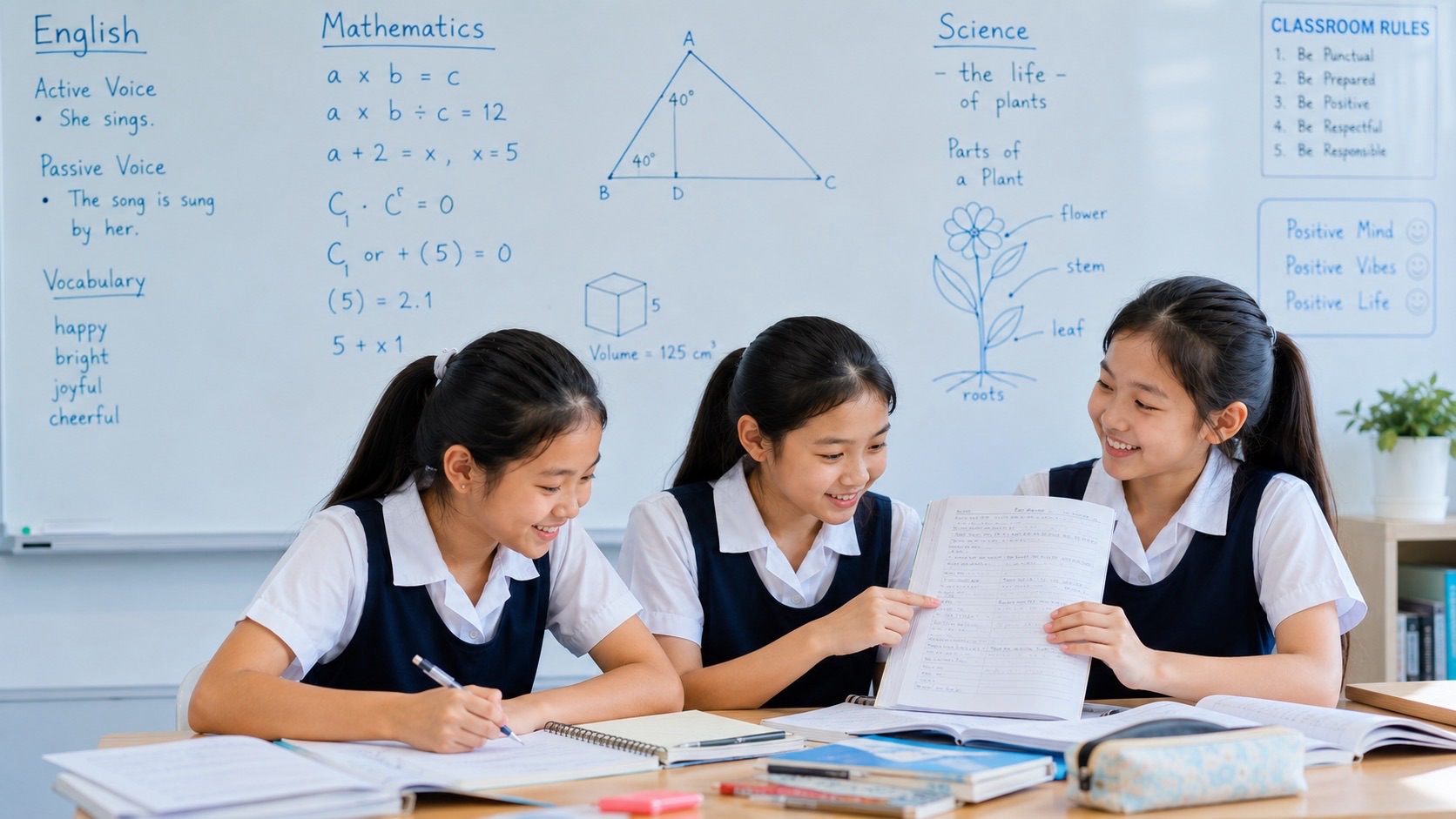
A child with 100 isolated words has a list. A child who can see how words are built, related, contrasted and transformed has a vocabulary system. This Primary 2 pillar teaches the machinery behind word growth.
Quick Read
- Level: Singapore Primary 2 / P2 English.
- Page job: teach how words connect and change—not another advanced-word list.
- Main systems: base words, prefixes, suffixes, compounds, synonyms, near-synonyms, antonyms, type-of relationships, word clines, word families, phrasal verbs and multiple meanings.
- Core rule: every new form must connect back to meaning.
- Master deck: use this with the Primary 2 Top 100 Advanced Vocabulary Master.
The One-Sentence Answer
Primary 2 word building means learning how one known word can unlock related meanings, forms, opposites, categories and expressions.
Why Word Building Matters at Primary 2
Primary 2 is an ideal point to move beyond “this word means that”. Children can begin asking: What is the base word? What changed when a prefix was added? Which form belongs in this sentence? Is this word a synonym or only a near-neighbour? What category does it belong to? Can one word have two meanings?
Current P2 curriculum mappings include compounding, prefixes and suffixes, synonyms, antonyms, type-of relationships and phrasal verbs. The goal is not terminology for its own sake. The terminology gives the child handles for noticing patterns.
Word-Building Map
| System | Question | Example |
|---|---|---|
| Base + prefix | What changed before the base word? | read → reread; understand → misunderstand |
| Base + suffix | What changed after the base word? | help → helpful / helpless |
| Compound | What new meaning comes from two words? | play + ground → playground |
| Word family | Which forms share a meaning core? | observe → observation → observant |
| Synonym | Which meaning is similar? | quick → fast |
| Near-synonym | What is similar but not identical? | glance / gaze / peer |
| Antonym | What is meaningfully opposite? | scarce ↔ abundant |
| Hyponym/type-of | What larger group does it belong to? | apple → fruit |
| Word cline | How does meaning change by degree? | possible → probable → certain |
| Phrasal verb | What does the whole expression mean? | give up, find out, look after |
| Multiple meaning | Which definition fits this context? | grasp the rail / grasp the idea |
Prefixes: Meaning Added Before the Base Word
At P2, useful prefixes include pre-, re- and mis-. Start with familiar bases and ask the child to predict the new meaning before checking.
| Prefix | Useful idea | Examples | Meaning move |
|---|---|---|---|
| pre- | before | preheat, preview, prepay | do or see something before the main event |
| re- | again/back | reread, rewrite, rebuild, reassure | repeat or restore an action/state |
| mis- | wrongly/badly | misread, misplace, misunderstand, misjudge | perform or understand incorrectly |
| un- | not/opposite | unfair, unsafe, unfortunate | reverse or negate the base meaning |
| im- | not | impossible, impatient | negate the base meaning in certain word forms |
Prefix Fencing
read → reread → misread is a useful fence. Reread means read again; misread means read incorrectly. The base is shared, but the direction of meaning changes.
Suffixes: Meaning or Grammar Added After the Base
| Suffix | Common job | Examples |
|---|---|---|
| -ful | full of / having | helpful, careful, hopeful |
| -less | without | helpless, careless, hopeless |
| -ly | often forms an adverb | gradually, immediately, deliberately, tactfully |
| -ness | often forms a quality noun | kindness, darkness, sturdiness |
| -tion / -sion | often forms an action/result noun | observation, cooperation, conclusion, persuasion |
| -ment | often forms an action/result noun | encouragement, disappointment, bewilderment |
Do not teach suffixes as spelling decorations. Ask what changed in the sentence: She was careful describes the person; She worked carefully describes how she worked; Her carefulness names the quality.
Word Families: Grow One Word Sideways
| Core | Family | Useful sentence contrast |
|---|---|---|
| observe | observe, observation, observant | The observant pupil made a useful observation. |
| encourage | encourage, encouraging, encouragement | Her encouraging words gave me encouragement. |
| persist | persist, persistent, persistence | He persisted; his persistence was obvious. |
| respond | respond, response, responsive | She responded with a calm response. |
| conclude | conclude, conclusion | We concluded after checking the evidence. |
| verify | verify, verified, verification | We verified the time before changing the plan. |
| adapt | adapt, adapted, adaptable, adaptation | An adaptable team can adapt quickly. |
Compounds: Two Familiar Words, One New Unit
Compounds help children see that English can build new meanings from known parts.
- work + book → workbook
- play + ground → playground
- door + way → doorway
- rain + coat → raincoat
- book + shelf → bookshelf
- class + room → classroom
- sun + light → sunlight
- foot + print → footprint
Then test whether the meaning is predictable. A raincoat clearly relates to rain and a coat; a butterfly cannot be understood by simply combining butter and fly. Word building also teaches children when a strategy has limits.
Synonyms: Similar Meaning, Same Context?
True synonyms are rarer than worksheets sometimes suggest. Teach children to test whether the replacement preserves the meaning and tone.
| Gateway | Near-neighbours | Fence |
|---|---|---|
| look | glance / gaze / peer / scan / inspect | duration, difficulty and purpose |
| worried | apprehensive / anxious | apprehensive focuses on what may happen next |
| help | comfort / reassure / encourage / support | each helps in a different way |
| strong | sturdy / powerful | sturdy usually refers to solid construction |
| result | effect / consequence | consequence often highlights what follows from an action or event |
Antonyms: Meaningful Opposites
| Pair | What changes? |
|---|---|
| approach ↔ retreat | distance to the target decreases vs increases |
| scarce ↔ abundant | too little available vs plentiful supply |
| fragile ↔ sturdy | easily damaged vs strongly built |
| temporary ↔ permanent | limited duration vs intended to last |
| obvious ↔ subtle | easy to notice vs difficult to notice |
| fortunate ↔ unfortunate | favourable vs unfavourable circumstances/outcome |
Word Clines: Meaning Has Degrees
| Scale | Cline | Reasoning question |
|---|---|---|
| certainty | possible → probable → certain | What evidence moves us to the right? |
| visibility | subtle → noticeable → obvious | How much attention is needed? |
| light | faint → bright → dazzling | How strong is the signal? |
| quantity | scarce → sufficient → abundant | Is there too little, enough or more than enough? |
| time/change | immediately → gradually → eventually | Are we describing the start, process or final outcome? |
Type-Of Relationships: Build Categories
Children should learn to move up and down a category tree: rose → flower → plant; sparrow → bird → animal; apple → fruit → food. This helps definition writing, classification and comprehension because a child can explain an unfamiliar item using its larger group.
Phrasal Verbs: The Whole Expression Owns the Meaning
| Phrasal verb | Meaning | Example |
|---|---|---|
| give up | stop trying | Do not give up after one failed attempt. |
| find out | discover information | We checked the notice to find out the time. |
| look after | take care of | She looked after the class plant. |
| pick up | lift/collect; sometimes learn informally | He picked up the fallen book. |
| calm down | become less upset/excited | She took a breath to calm down. |
| work out | solve or understand | We worked out the pattern. |
Do not define a phrasal verb by translating one part at a time. The learner must store and retrieve the whole expression.
Multiple Meanings: One Word, Different Contexts
| Word | Meaning A | Meaning B |
|---|---|---|
| grasp | hold firmly | understand |
| approach | move nearer | method |
| crisp | firm/crunchy | clear/sharp |
| release | set free | make available |
| resolve | solve/settle | firm determination |
Word-Building Fencing: One Base, Many Directions
Take the core observe:
- observe — the action: We observe the plant.
- observation — the thing noticed: My observation was that the leaves drooped.
- observant — describes a person good at noticing: An observant pupil spotted the change.
Then fence it against inspect: both involve looking carefully, but inspect usually has a checking purpose while observe focuses on noticing and recording.
24 Word-Building Practice Questions
- Add a prefix to read to mean “read again”.
- Add a prefix to read to mean “read wrongly”.
- What does preheat suggest about timing?
- Change help into an adjective meaning “giving help”.
- Change help into an adjective meaning “without enough help or ability to act”.
- Change gradual into an adverb.
- Give the noun form related to persist.
- Give the adjective form related to observe.
- Form a compound from play + ground.
- Form a compound from book + shelf.
- Which is more precise for a brief look: glance or gaze?
- Which is more precise for difficult seeing: peer or scan?
- Give an antonym for scarce.
- Give an antonym for temporary.
- Order these by likelihood: certain, possible, probable.
- Order these by visibility: obvious, subtle, noticeable.
- What larger category does sparrow belong to?
- What larger category does apple belong to?
- What does give up mean in “Do not give up after one attempt”?
- What does find out mean in “We checked the notice to find out the time”?
- Use grasp in a sentence meaning “hold firmly”.
- Use grasp in a sentence meaning “understand”.
- Explain the difference between observe and inspect.
- Explain why misread and reread are not synonyms.
Answer Key
1. reread. 2. misread. 3. heat before the main cooking/use stage. 4. helpful. 5. helpless. 6. gradually. 7. persistence. 8. observant. 9. playground. 10. bookshelf. 11. glance. 12. peer. 13. abundant. 14. permanent. 15. possible → probable → certain. 16. subtle → noticeable → obvious. 17. bird. 18. fruit. 19. stop trying. 20. discover/learn information. 21–22. answers vary by context. 23. observe = notice/watch; inspect = examine closely for checking. 24. misread = read wrongly; reread = read again.
Parent and Tutor Routine: Build One Word Five Ways
- Say the base word.
- Add or remove a prefix/suffix.
- Name a synonym or near-neighbour.
- Name an antonym or category partner.
- Use the word family in two different sentence roles.
Example: observe → observation → observant → notice → inspect (near-neighbour) → ignore (contrast). One word becomes a network instead of a flashcard.
How This Fits Primary 2 English
Singapore’s English Language Syllabus 2020 — Primary develops word consciousness, relationships and purposeful vocabulary use. Current P2 curriculum mappings explicitly include compounding, prefixes and suffixes such as pre-, re-, mis-, -ful and -less, synonyms, antonyms, type-of relationships and phrasal verbs.
Primary 2 Advanced Vocabulary Suite
- Master: Primary 2 Top 100 Advanced Vocabulary.
- Reading: Context clues, inference and meaning.
- Writing: Composition & Creative Writing.
- You are here: Word Building.
- Practice: mixed exercises, retrieval, Fencing and answers.
Final Principle
When a Primary 2 learner can see the base, the word parts, the family, the neighbours, the opposites and the context, one learned word becomes many future words.
Specialist Depth Gateways from Word Building
Word Building remains the broad architecture owner. Its existing prefixes, suffixes, compounds, synonym/antonym, word-cline, phrasal-verb, category and multiple-meaning sections are intentionally retained because children need to see how these mechanisms connect. When one mechanism needs maximum-resolution teaching, practice or repair, continue into its dedicated specialist owner below.
- Prefixes & Suffixes: base words, pre-, re-, mis-, un-, -ful, -less, word-class change, spelling and morphological inference.
- Synonyms & Antonyms: similar meaning, opposition, near-synonyms, context substitution, relational opposites and precision Fencing.
- Categories & Word Relationships: type-of, part-of, category trees, lexical fields, classification rules and category-based definitions.
- Compound Words: closed, open and hyphenated compounds; part-to-whole meaning; stable compounds vs ordinary phrases; reading and spelling transfer.
- Word Clines & Shades of Meaning: intensity, degree, certainty, proportion, evidence and when a matrix is better than a cline.
- Phrasal Verbs: whole-expression meaning, particles, separable/inseparable patterns, sentence frames and transfer.
- Multiple-Meaning Words: competing senses, grammar, collocation, context evidence and meaning switching.
- Collocations & Natural Word Partners: the company words keep—make/do, heavy/strong, adjective–noun, verb–noun and preposition patterns.
- Commonly Confused Words: Fencing by direction, role, attention and sentence relationship.
- Acronyms, Abbreviations & Short Forms: full forms, meaning, context, institutional language, standard abbreviations and short-form literacy.
Ownership rule: use this Word Building page to understand the whole system; use a specialist owner when the learner needs deeper teaching, targeted diagnostics or concentrated practice in one mechanism.
Continue the Primary 2 Advanced Vocabulary Suite
After word-building work, continue with Oral Vocabulary & Speaking, Revision & Retention, Diagnostic Assessment and the 12-Week Learning Plan.