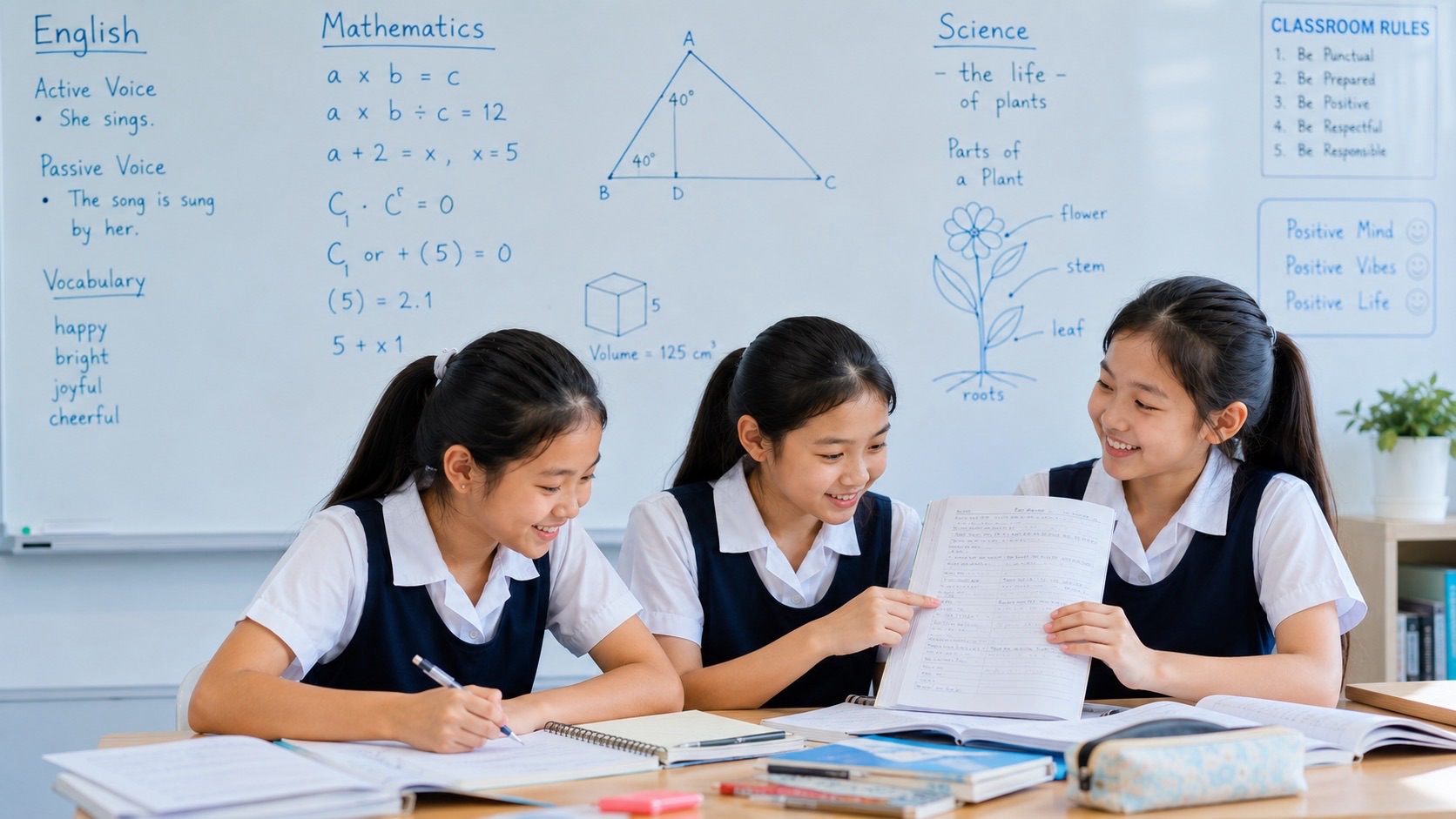
A Primary 2 child does not fully own an advanced word merely because it can be recognised on a worksheet. Spoken control matters: the learner should be able to hear the word, pronounce it, retrieve it while thinking, place it inside a complete sentence and use it naturally while describing, explaining or responding.
Quick Read
- Level: Singapore Primary 2 / P2 English.
- Page job: spoken vocabulary and oral transfer—not another Top 100 list.
- Main skills: pronunciation, complete-sentence responses, reading aloud, picture conversation, Show and Tell, explanation and spontaneous retrieval.
- Core rule: understand first, say it naturally, then make the sentence more precise.
- Development rule: oral use can come before perfect independent spelling.
- Master deck: Primary 2 Top 100 Advanced Vocabulary.
The One-Sentence Answer
Primary 2 oral vocabulary is the ability to retrieve an exact word while speaking, pronounce it clearly enough to be understood, build a complete sentence around it and adapt the language to the situation.
Why Oral Vocabulary Deserves Its Own Pillar
Reading, writing and speaking place different demands on memory. In writing, a learner has time to stop and search for a word. In speaking, the word must be retrieved while the child is also organising ideas, listening to the question, maintaining grammar and deciding what comes next. That makes oral vocabulary a separate performance problem.
Singapore’s primary English syllabus explicitly integrates oracy with reading and writing. School-level P2 assessment plans can also include components such as Reading Aloud, Picture Conversation and Show and Tell. These formats vary across schools, so this page teaches transferable oral language rather than claiming one national P2 oral examination format.
The Spoken Vocabulary Pipeline
| Stage | Learner action | Teacher / parent check |
|---|---|---|
| 1. Hear | Listen to the word inside a natural phrase. | Can the child recognise it without seeing the spelling? |
| 2. Echo | Repeat the whole phrase. | Is stress and rhythm close enough to be understood? |
| 3. Explain | Give the meaning in simple spoken language. | Does the explanation preserve the key distinction? |
| 4. Fence | Compare it with a nearby word. | Can the child explain why one fits better? |
| 5. Build | Use it in one complete sentence. | Does grammar and collocation sound natural? |
| 6. Extend | Add cause, evidence or consequence. | Does the extra language add meaning? |
| 7. Transfer | Use it in a new picture, topic or conversation. | Can the child retrieve without the original cue? |
Complete Sentences Before Complicated Sentences
Primary 2 oral development should not begin by demanding long answers. Begin by making short answers complete and precise.
| Weak fragment | Complete response | Precise extension |
|---|---|---|
| Because scared. | She is worried because the room is dark. | She feels apprehensive because she cannot see what is inside the dark room. |
| He looking there. | He is looking through the window. | He is peering through the window because the glass is misty. |
| Very messy. | The table is very messy. | The table is cluttered with books, paper and art materials. |
| She happy already. | She is happy because she found the book. | She looks relieved because the missing book has been found. |
Pronunciation: Teach the Whole Word, Not a Permanent Robot Version
Chunking can help a child start a difficult word, but the goal is fluent whole-word speech. Say the word naturally, let the child echo it, then place it inside a phrase.
| Word | Helpful chunk | Phrase |
|---|---|---|
| apprehensive | ap-ri-HEN-siv | feel apprehensive |
| bewildered | bi-WIL-derd | look bewildered |
| courteous | KUR-tee-us | courteous reply |
| persistent | per-SIS-tent | persistent effort |
| pungent | PUN-jent | pungent smell |
| consequence | KON-si-kwens | a consequence of |
| interpret | in-TUR-prit | interpret the clue |
| deliberately | di-LIB-er-it-lee | act deliberately |
Reading Aloud: Vocabulary Is Also Phrasing
When reading aloud, understanding affects expression. A child who understands however as a contrast signal is more likely to pause and shift tone appropriately. A child who understands eventually as an outcome after delay is more likely to phrase the sentence meaningfully.
Although Mira was apprehensive, / she approached the stage. / However, / she paused when she saw the unfamiliar microphone.
Do not teach exaggerated performance. Teach meaning-driven phrasing: pause where ideas turn, group words that belong together and pronounce key vocabulary clearly enough for the listener to follow the sentence.
Picture Conversation: See → Select → Explain → Extend
| Move | Question | Example |
|---|---|---|
| See | What can I observe? | A boy is holding a broken model. |
| Select | Which precise word fits? | He looks bewildered. |
| Explain | What evidence supports it? | He is staring at the pieces and does not know where to begin. |
| Extend | What might happen next? | He may inspect the pieces and ask a friend to cooperate. |
The child should distinguish observation from inference. “The boy is holding three pieces” is visible. “He is bewildered” is a judgement that needs evidence. “He will definitely cry” goes beyond what the picture proves.
Show and Tell: Build a Small Spoken Structure
A short Show and Tell can be organised into five moves:
- Name: What is the object, place or experience?
- Describe: What is one precise detail?
- Explain: Why does it matter to you?
- Example: Tell one short event or use.
- Close: What did you learn, decide or feel?
This is a small model bridge that I built with my cousin. At first, the frame was fragile and collapsed easily. We were frustrated, but we stayed persistent and added sturdier supports. Eventually, the bridge could hold six books. I like it because it reminds me that changing a design can solve a problem.
Notice that the vocabulary carries the story. It is not a string of unrelated advanced words.
Oral Fencing: Make the Child Choose Between Two Words
- “Did she glance or gaze? What tells you?”
- “Is he apprehensive or terrified? How strong is the evidence?”
- “Did she comfort or reassure him? Was she easing sadness or reducing worry?”
- “Is the answer merely possible, or already probable? What evidence changes the level?”
- “Is the object delicate or fragile? What exactly are we describing?”
This is one of the fastest ways to deepen spoken vocabulary because the child must retrieve meaning and boundary at the same time.
Speaking Frames That Fade
Sentence frames are useful when they are temporary. Begin with support and remove it as retrieval becomes secure.
| Purpose | Starter frame | Later independent version |
|---|---|---|
| Evidence | I think ___ because I can see ___. | She seems apprehensive; she keeps checking the dark doorway. |
| Contrast | Although ___, ___. | Although he was hesitant, he stepped forward. |
| Cause/result | ___; therefore, ___. | The handle was loose; therefore, I inspected it. |
| Comparison | ___ is different from ___ because ___. | A glance is brief, whereas a gaze lasts longer. |
| Reflection | At first ___, but eventually ___. | At first I was frustrated, but eventually I adapted my method. |
12 Oral Practice Prompts
- Describe someone waiting outside an unfamiliar room using apprehensive.
- Explain the difference between a glance and a gaze without using the words “short” or “long” first.
- Describe a cluttered desk and name three details that prove it.
- Use relieved in a before-and-after mini-story.
- Explain why urgent is not the same as important.
- Give a picture-conversation answer using observant and evidence.
- Use meanwhile to describe two actions happening at the same time.
- Use therefore after giving a real cause.
- Explain one situation where possible is correct but probable is not yet justified.
- Tell a 30-second story using frustrated → persistent → eventually.
- Describe an object that is fragile and explain how someone should handle it.
- Give one example of adapting a plan when conditions change.
A Simple Oral Vocabulary Rubric
| Dimension | Beginning | Developing | Secure |
|---|---|---|---|
| Meaning | word is guessed or misused | core meaning mostly correct | meaning precise and stable |
| Pronunciation | listener cannot identify word | understandable with hesitation | clear enough in natural speech |
| Sentence | fragment or grammar obscures meaning | complete but heavily framed | complete and independently formed |
| Fencing | cannot separate near-neighbours | can choose with prompting | can explain why another word is less exact |
| Transfer | uses only in rehearsed sentence | uses in a similar new context | retrieves across different topics |
A 15-Minute Oral Vocabulary Session
- 3 minutes: cold oral recall of five known words.
- 3 minutes: pronunciation and phrase echo for two stretch words.
- 4 minutes: picture conversation using evidence.
- 3 minutes: one near-synonym Fencing challenge.
- 2 minutes: transfer one word into an unrelated topic.
Common Oral Vocabulary Errors
| Error | What happens | Repair |
|---|---|---|
| One-word answer habit | Child knows the word but cannot build a full response. | Require one complete sentence before adding detail. |
| Memorised speech | Good performance disappears when topic changes. | Retell using a new picture or object. |
| Pronunciation avoidance | Child avoids useful words because they feel difficult to say. | phrase echo → sentence → spontaneous use. |
| Fancy-word dumping | Several advanced words are used without connection. | Ask what each word contributes. |
| Unsupported inference | Child invents a story from a picture. | Separate “I can see…” from “I think…because…”. |
| Frame dependence | Child can answer only with memorised starters. | fade prompts gradually. |
How This Fits Singapore Primary 2 English
The MOE English Language Syllabus 2020 — Primary treats language as integrated meaning-making and explicitly links oracy, reading and writing. As one current school example, Chua Chu Kang Primary School’s 2026 P2 English assessment plan includes Show and Tell as well as Reading Aloud & Picture Conversation, alongside vocabulary and comprehension components. School practices differ, so use this page as an oral-language development guide rather than a prediction of any one school’s assessment.
Primary 2 Advanced Vocabulary Suite
- Master: Top 100 Advanced Vocabulary.
- Reading: context clues and inference.
- Writing: composition and creative writing.
- Word Building: morphology and word relationships.
- Practice: 60 mixed exercises and answers.
- You are here: Oral Vocabulary & Speaking.
- Revision: retention and spaced retrieval.
- Diagnostic: vocabulary assessment and repair map.
- 12-Week Plan: term implementation for parents, teachers and tutors.
Final Principle
When an advanced word can leave the worksheet, survive a real conversation and still remain precise, it is becoming part of the child’s language.
Vocabulary routes: Vocabulary Article Directory · eduKate Vocabulary Learning System.