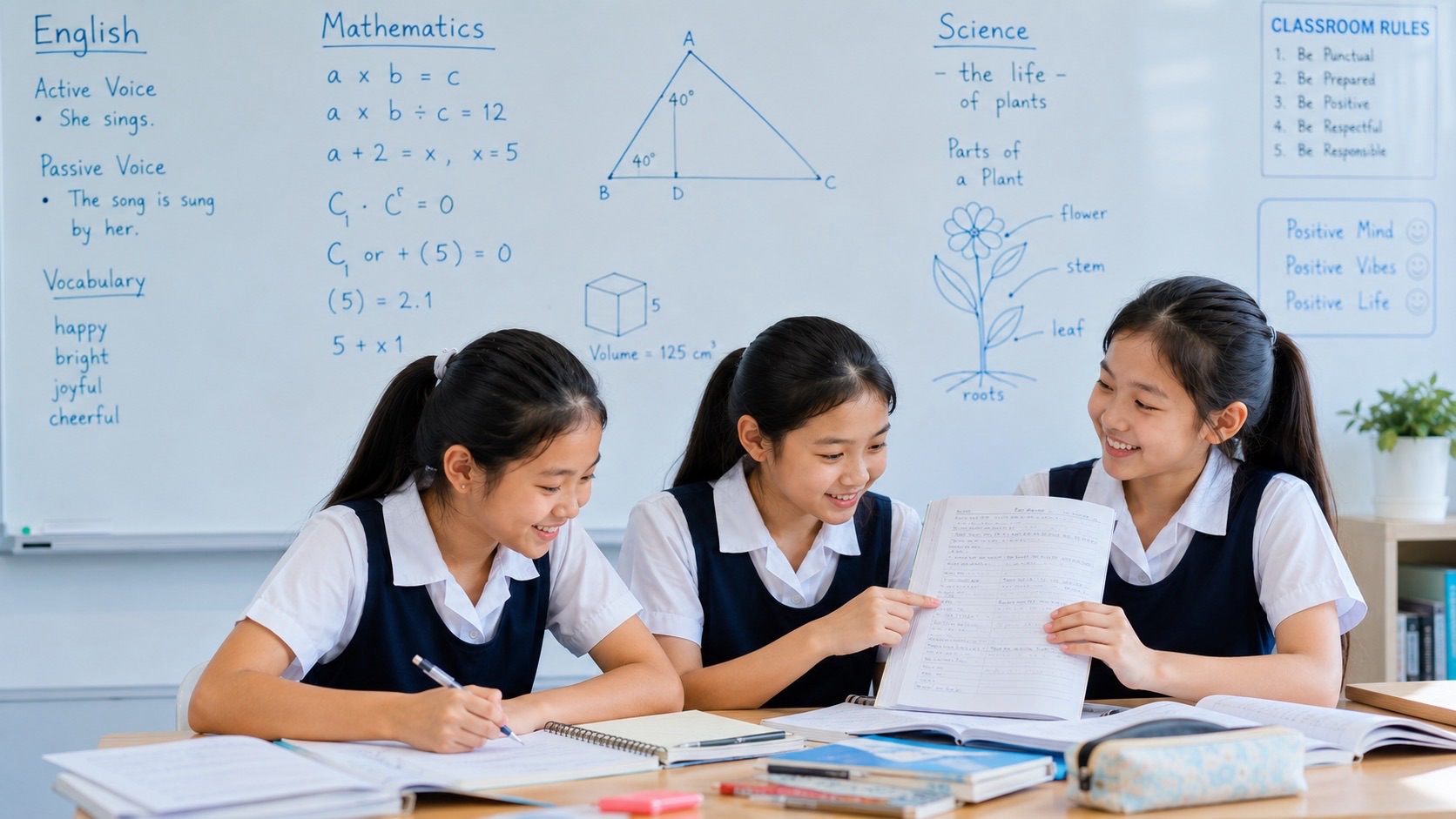
Strong picture conversation begins with what the student can actually see, then grows into interpretation supported by evidence.
For CHIJ St. Nicholas Girls’ School students, picture conversation becomes more reliable when students stop jumping straight from image to opinion. We teach a four-part route: observation → interpretation → evidence → extension.
At eduKate Singapore, our Punggol English classes are limited to three students and lessons normally run for 1.5 hours. From Primary 3 to Primary 6, oral work is connected to vocabulary, comprehension, reasoning and sentence control so students can speak with substance rather than fill time.
Families can also use our PSLE English Tuition guide and Vocabulary Lists hub.

The Hidden Problem: Opinion Arrives Before Evidence
A student may look at a picture of children near a recycling station and immediately say, “They care about the environment.” That may be reasonable, but the first useful step is to identify what is visible: the bins, the objects being sorted, the expressions, the signage and the actions.
Then interpretation can be built safely.
- Observation: what can I literally see?
- Interpretation: what does this suggest?
- Evidence: which visible detail supports that interpretation?
- Extension: what broader experience, consequence or view can I discuss?
Why Three Students Helps Oral Reasoning
Three students may notice different details in the same image. This is useful. One learner may focus on people, another on setting, and another on an object that changes the interpretation. The tutor can then show how strong responses grow from selective observation rather than memorised scripts.
Move From Description to Significance
Listing objects is not enough. Students learn to explain why a detail matters: what it reveals about behaviour, safety, responsibility, cooperation, emotion or another relevant theme.
Extension Needs a Bridge
Personal experience becomes stronger when it grows naturally from the image. Students practise bridging phrases such as “This reminds me of…”, followed by an experience that genuinely connects to the observed situation.
Vocabulary Should Increase Precision
We teach useful verbs and adjectives for observable action, emotion and setting, but students are not rewarded for forcing sophisticated words into every sentence. Precision and natural speech come first.
The Fencing Method for Picture Conversation
When students freeze, we fence the task to one quadrant of the image. They produce one observation, one interpretation and one piece of evidence. Once the chain is stable, the field expands to the whole picture and then to extension.
What a 90-Minute Lesson Can Look Like
- Retrieval: oral vocabulary and earlier structures return.
- Observation: visible details are named precisely.
- Interpretation: students explain what selected details suggest.
- Evidence: each interpretation is anchored to the image.
- Extension: a relevant personal or broader connection is developed.
- Transfer: the same route is used on an unseen image.
Primary 3 to Primary 6 Progression
Primary 3 students first describe visible details in complete sentences. Primary 4 and Primary 5 students add interpretation and evidence. By Primary 6, students need to extend ideas naturally, maintain relevance and speak with enough vocabulary and structure to sustain a coherent response.
What Parents Can Notice
- less vague description;
- better use of visible evidence;
- fewer unsupported assumptions;
- personal experiences connect more naturally;
- responses become longer because ideas develop, not because of filler; and
- the child can explain the observation-to-interpretation bridge.
For CHIJ St. Nicholas Girls’ School Families
This page serves families looking for Primary English tuition for a child attending the Primary section of CHIJ St. Nicholas Girls’ School. Recent oral work can help us identify whether the bottleneck sits in observation, vocabulary, evidence, extension or confidence under time.
eduKate Singapore is an independent tuition provider and is not affiliated with CHIJ St. Nicholas Girls’ School.
Arrange a Primary English Class
Call or WhatsApp Yuet Ling at +65 8823 1234 for current three-student class schedules and suitability.