Huamin Primary School Primary 3 English tuition should help a learner move from writing events in order to explaining why those events connect.
Primary 2 often builds sequence: first, next, then, finally. Primary 3 should deepen that into cause-and-effect paragraph architecture. A paragraph becomes stronger when each sentence is not merely later than the previous one, but related to it through cause, consequence, reaction, contrast or explanation.
This rebuilt page therefore owns a distinct RFE: sequence → cause-and-effect → paragraph architecture. Huamin’s broader English owner already focuses on vocabulary-to-writing control; P1 owns meaningful reading, and P2 owns sentence relationships. This P3 page is the next developmental step: make several sentences form one coherent explanatory or narrative unit.
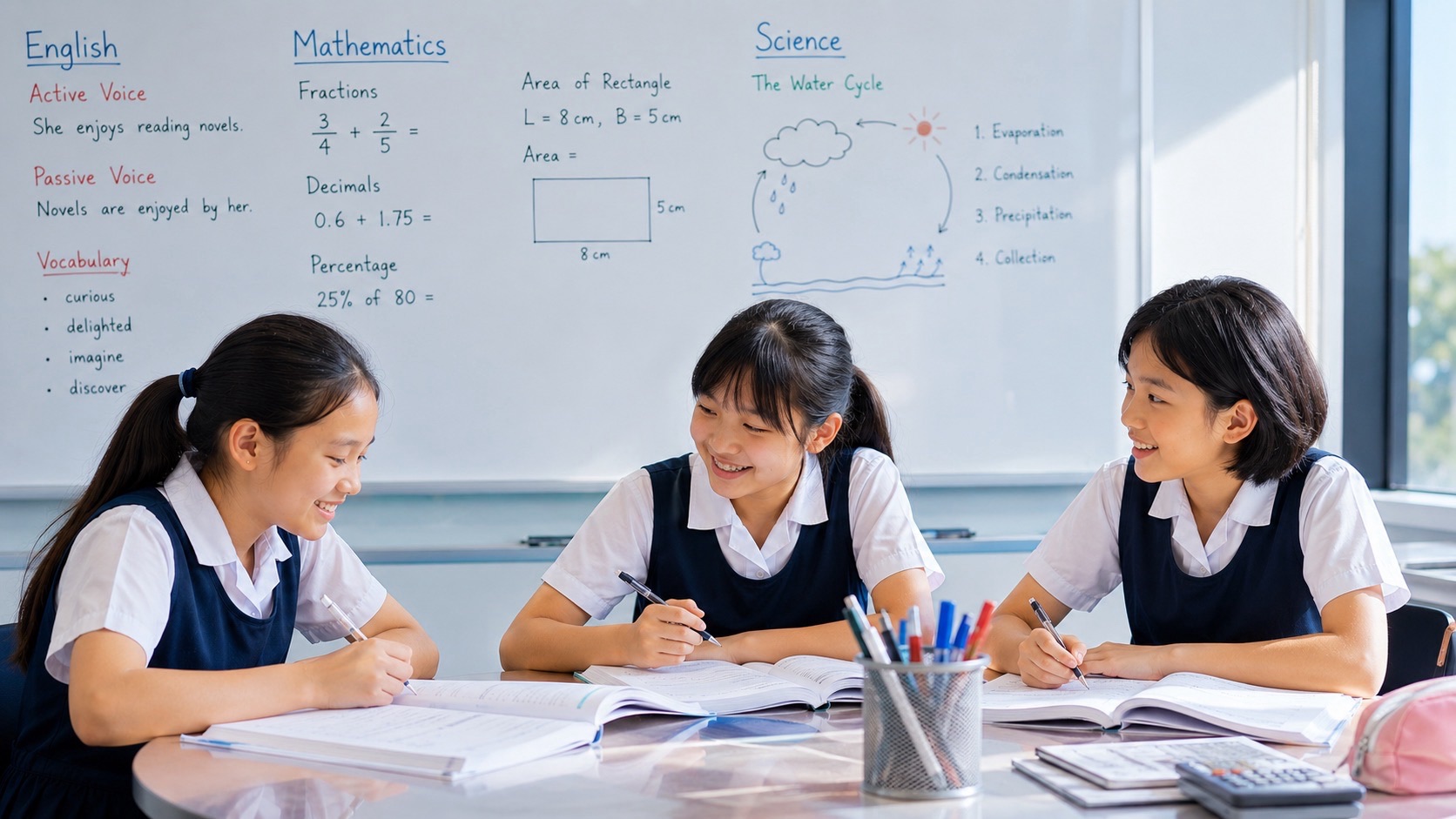
eduKate teaches in groups of up to three students, generally for 90 minutes. A 3-pax class lets students compare different causal chains and paragraph structures without forcing everyone into one model paragraph.
Independent-provider and location note: eduKate is not affiliated with Huamin Primary School. This legacy Yishun URL serves the learner/family route; current class location and availability should be confirmed directly.
From Sequence to Causality
| Sequence-only writing | Cause-and-effect writing |
|---|---|
| First, Ali missed the bus. | Ali missed the bus because he left home late. |
| Then he ran to school. | As a result, he had to run to school. |
| Then he was tired. | The long run left him exhausted by the time he arrived. |
| Then he forgot his homework. | Because he was rushing, he left his homework on the table. |
The second version helps the reader understand relationships, not only chronology.
The 2026 Primary English Floor
MOE’s Primary English Language Syllabus 2020 develops reading, writing and oracy as connected capabilities, with grammar and vocabulary supporting meaning. The eventual 2026 PSLE English assessment includes Writing, Language Use and Comprehension, Listening Comprehension and Oral Communication.
Parents can verify the current PSLE structure on the SEAB PSLE Formats Examined in 2026 page.
At P3, paragraph architecture becomes a critical bridge between sentence-level English and upper-Primary writing/comprehension.
What Is a Paragraph Job?
A paragraph should do one main thing.
In narrative writing, a paragraph may:
- establish a situation;
- show a problem beginning;
- develop a consequence;
- show a reaction;
- move toward a solution.
In explanatory writing, a paragraph may:
- explain one reason;
- describe one process;
- give one example;
- compare two ideas.
The job gives sentence selection a purpose.
Cause-and-Effect Signals
Useful language includes:
- because;
- so;
- therefore;
- as a result;
- since;
- because of;
- this caused;
- which meant that.
Students learn the relationship first and then choose language that represents it accurately.
Action → Reaction
Narrative paragraphs become more believable when actions create reactions.
Example:
Action: The glass slipped from Mei’s hand.
Immediate consequence: It shattered on the kitchen floor.
Reaction: Mei froze and stared at the broken pieces.
Next decision: She called for her mother instead of trying to pick them up.
This is a causal chain, not a random list of events.
Problem → Response → Consequence
Another useful paragraph pattern is:
PROBLEM
-> RESPONSE
-> CONSEQUENCE
Example:
- Problem: the dog escaped.
- Response: the child ran after it.
- Consequence: the child became separated from the family.
This prepares learners for later composition turning points.
Use Connectors Carefully
Cause/effect words can be overused.
We compare:
Because it rained, the field was wet. Therefore, the match was cancelled. As a result, the children went home.
versus a more natural paragraph where some relationships are expressed through sentence order and vocabulary.
The learner should not insert a connector into every sentence simply to appear organised.
Reference and Cohesion
Paragraphs also need clear reference.
Students learn to track:
- he/she/they/it;
- the same object across several sentences;
- when a noun should be repeated for clarity;
- when a pronoun becomes ambiguous.
Cause-and-effect is difficult to follow if the reader cannot tell who caused what.
Vocabulary for Cause and Consequence
Vocabulary can make relationships more precise.
Useful words include:
- triggered;
- caused;
- prevented;
- resulted;
- led to;
- because;
- consequence;
- reaction;
- decision.
The learner should use age-appropriate language naturally rather than force abstract words into every paragraph.
Reading for Paragraph Architecture
Students learn to ask:
- What is this paragraph mainly doing?
- Which sentence gives the cause?
- Which sentence gives the effect?
- What pronoun links back?
- Where does the paragraph shift?
Reading teaches writing structure and comprehension at the same time.
Paragraph Ordering
We may give students several sentences and ask them to order them by:
- time;
- cause/effect;
- problem/response;
- general idea/example.
The exercise reveals whether the learner understands how paragraphs are built.
The Huamin P3 Paragraph Diagnostic
Central Job
Can the learner identify one main paragraph purpose?
Sequence
Are events in sensible order?
Cause
Can the learner explain why something happened?
Consequence
Can the learner show what followed?
Reference
Are people/objects clear across sentences?
Connector Choice
Do linking words match the relationship?
Transfer
Can the same architecture be used on a new topic?
Six Common P3 Paragraph Failure Modes
1. Sequence Without Cause
Events happen one after another but feel unrelated.
2. Connector Decoration
Words such as therefore appear where no real cause/effect exists.
3. Paragraph Overload
One paragraph tries to do several jobs.
4. Pronoun Fog
The reader loses track of who is acting.
5. Repetition Instead of Development
The learner restates the same idea with new words.
6. Tutor-Designed Paragraph
The adult decides every relationship. We return causal choices to the learner.
What a 90-Minute 3-Pax P3 Lesson Can Look Like
0–10 minutes: Retrieval
Sequence and conjunction meanings return.
10–25 minutes: Read a Paragraph Structurally
Students identify cause, consequence and paragraph job.
25–40 minutes: Explicit Architecture Teaching
The tutor models one causal chain.
40–60 minutes: Guided Reconstruction
Students order and connect sentences.
60–80 minutes: Independent Paragraph
A new scenario requires one coherent paragraph.
80–90 minutes: Cohesion Check
Students inspect cause, pronouns and unnecessary repetition.
Why Three Students Helps P3 Paragraph Work
- Students compare different causal chains.
- Peers detect missing links.
- The tutor can ask each learner to defend sentence order.
- Different paragraph voices remain possible.
- The group can discuss one shared scenario while writing independently.
Preparing for P4
Useful P3 exit signals include:
- clear sentence boundaries;
- accurate conjunction meaning;
- paragraphs with one job;
- cause and consequence expressed clearly;
- pronoun reference stable;
- reading for paragraph structure;
- some independent revision.
P4 can then deepen cohesion and longer-text comprehension.
What Parents Can Bring
- paragraph writing;
- recent compositions;
- teacher comments about organisation;
- reading/comprehension work;
- examples of repetitive “then” writing.
What Progress Looks Like
- paragraphs feel less like event lists;
- cause/effect becomes clearer;
- connectors sound more natural;
- pronoun reference improves;
- repetition reduces;
- the learner can explain why a sentence follows another.
Frequently Asked Questions
Is eduKate affiliated with Huamin Primary School?
No. eduKate is an independent tuition provider.
Why does this P3 page focus on cause-and-effect paragraphs?
Because P2 owns conjunctions/sentence relationships. P3 should turn those relationships into paragraph architecture.
Should every paragraph use because/therefore?
No. The relationship can also be shown through sentence order, verbs and context. Connectors should be meaningful, not decorative.
Can strong P3 learners be extended?
Yes. Use more subtle causal chains, contrast, viewpoint and paragraph revision.
Ten Checks for P3 Paragraph Architecture
- What is the paragraph job?
- What happened first?
- What caused it?
- What followed?
- How did the character respond?
- Are pronouns clear?
- Do connectors fit?
- Is any sentence repeated?
- Does the paragraph end at the right point?
- Can the structure transfer?
Move From “Then This Happened” to “This Happened Because…”
That is the purpose of this Huamin Primary School Primary 3 English tuition route:
sequence → cause → response → consequence → coherent paragraph.
Families may also use the broader Huamin Primary English route and eduKate’s Primary English Small Group Tuition pathway.
Almost-Code Summary
LEARNER_ROUTE = Huamin_Primary_P3
PAGE_RFE = cause_effect_paragraph_architecture
PARAGRAPH = one_job
CHAIN = cause -> event -> reaction -> consequence
COHESION = reference + order + meaningful_connectors
CLASS = max_3
LESSON = 90_minutes
GOAL = paragraphs_built_from_relationships_not_sentence_piles