Huamin Primary School Primary 2 English tuition should help a child understand that sentences connect because ideas have relationships.
Primary 2 learners often learn conjunctions as vocabulary: and, but, because, so, when. The deeper skill is understanding what those words do. And adds, but contrasts, because explains cause, so shows consequence, and when locates one event in relation to another.
This rebuilt page therefore owns a distinct RFE: conjunctions and sentence relationships. Huamin’s broader English owner already focuses on vocabulary-to-writing control, while P1 now owns decoding→meaningful reading. This P2 page carries the learner from complete sentences into connected language through sequence, cause, contrast and expansion.
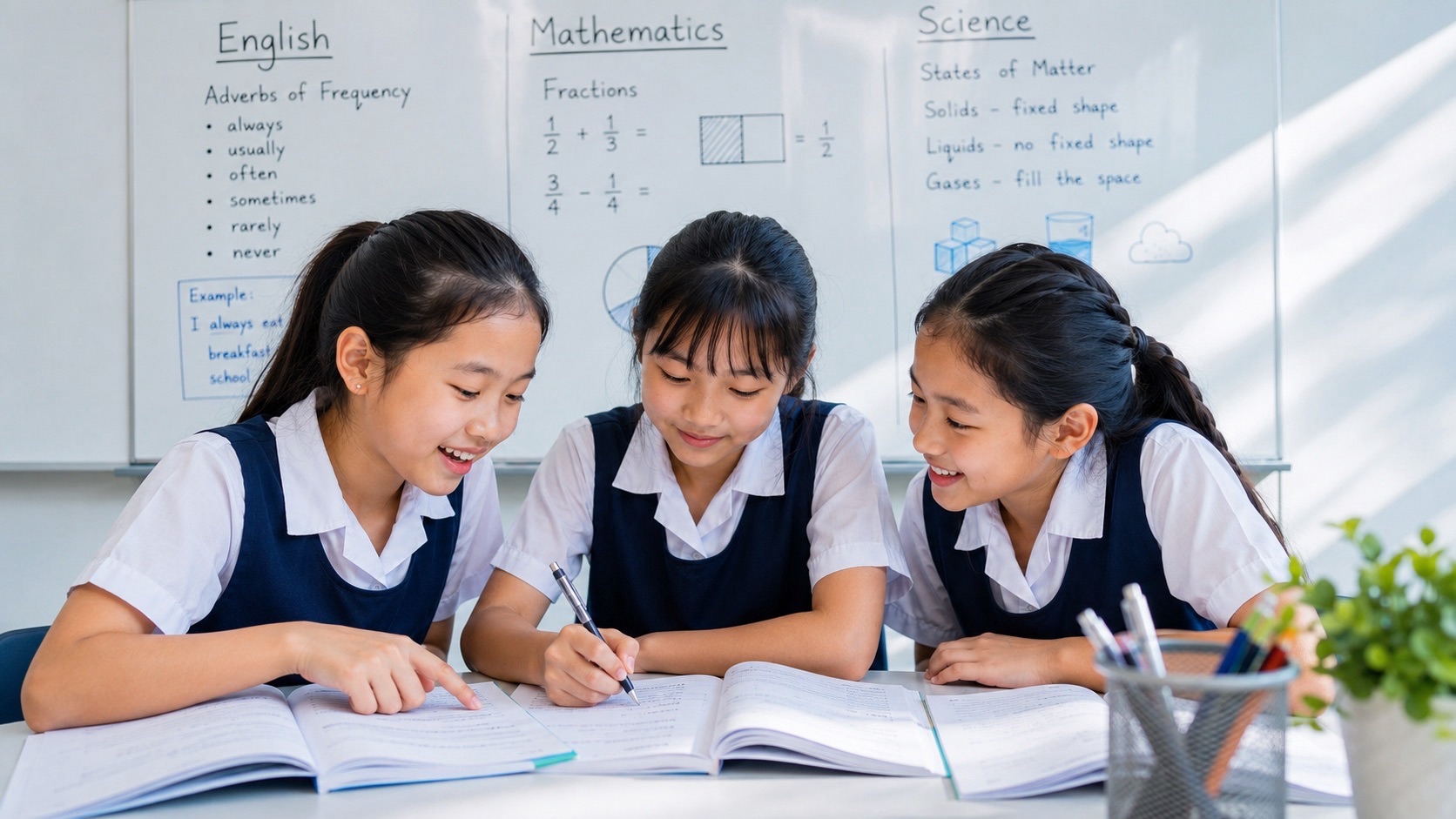
eduKate teaches in groups of up to three students, generally for 90 minutes. At P2, a 3-pax class lets students say several versions of the same sentence aloud before choosing which relationship makes the meaning clearest.
Independent-provider and location note: eduKate is not affiliated with Huamin Primary School. This legacy Yishun URL serves the learner/family route; current class location and availability should be confirmed directly.
Conjunctions Are Meaning Relationships
| Conjunction | Relationship | Example |
|---|---|---|
| and | Addition | She packed her bag and put on her shoes. |
| but | Contrast | He was tired but continued walking. |
| because | Cause | They stayed indoors because it was raining. |
| so | Consequence | It was raining, so they stayed indoors. |
| when | Time relationship | She smiled when her father arrived. |
| or | Choice | You may read a story or complete the puzzle. |
We teach the relationship first and the connector second.
The 2026 Primary English Floor
MOE’s Primary English Language Syllabus 2020 develops oracy, reading and writing as connected capabilities, with grammar and vocabulary supporting meaning. The eventual 2026 PSLE English assessment includes Writing, Language Use and Comprehension, Listening Comprehension and Oral Communication.
Parents can verify the current PSLE structure on the SEAB PSLE Formats Examined in 2026 page.
For P2, the useful job is to strengthen sentence relationships so later paragraph writing and comprehension become easier.
Start With Two Complete Ideas
Before joining sentences, students need to see the two thoughts.
Example:
I wanted to play outside.
It was raining heavily.
Now ask: what is the relationship?
Contrast:
I wanted to play outside, but it was raining heavily.
The conjunction represents the meaning between the ideas.
Cause vs Consequence
Primary 2 students often confuse because and so.
We make the direction visible:
Cause: It was raining.
Consequence: We stayed indoors.
Because: We stayed indoors because it was raining.
So: It was raining, so we stayed indoors.
The relationship remains the same while the representation changes.
Sequence
Sequence language includes:
- first;
- next;
- then;
- after that;
- later;
- finally;
- before;
- after;
- when.
Students practise retelling events and writing them in order. Over time, they need less dependence on starting every sentence with then.
Contrast
Contrast is an important early academic relationship.
Students learn:
- but;
- although in simple contexts where ready;
- however at paragraph level when developmentally appropriate.
Example:
The bag looked small, but it was surprisingly heavy.
Contrast helps reading too because students begin noticing when writers signal an unexpected relationship.
Choice
Or helps students express alternatives.
We connect it to real decisions:
- Would you like juice or water?
- We can walk to the park or take the bus.
Students learn that the connector changes the logical relationship between ideas.
Sentence Expansion Through Relationships
Instead of expanding only with adjectives, we add useful relationships.
Base:
The girl ran home.
Cause:
The girl ran home because she had forgotten her homework.
Time:
The girl ran home when she realised she had forgotten her homework.
The sentence becomes more informative because the learner connects ideas.
Do Not Create Run-Ons
A common error is chaining too many ideas with and.
We teach:
- count complete events;
- decide which belong in one sentence;
- use a conjunction if the relationship is clear;
- start a new sentence when the thought changes.
Controlled connection is better than endless joining.
Reading for Connectors
During reading, students circle or notice conjunctions and explain:
- what two ideas are being connected;
- what relationship the connector signals;
- what would happen to meaning if a different connector were used.
This makes grammar useful for comprehension.
From Sentence Relationships to Early Paragraphs
A short P2 paragraph may contain:
- a first event;
- a cause;
- a consequence;
- a final action.
Students learn that paragraphs are built from connected ideas, not isolated sentences placed one after another.
The Huamin P2 Diagnostic
Complete Ideas
Can the learner recognise two separate thoughts?
Relationship
Can addition, contrast, cause, consequence, time or choice be identified?
Connector
Can the correct conjunction be selected?
Boundary
Can the learner decide when a new sentence is needed?
Sequence
Can events be ordered?
Transfer
Can connector meaning help in reading as well as writing?
Independence
Can the learner write without an adult supplying the joining word?
Six Common P2 Relationship Failures
1. “And” for Everything
All ideas are joined the same way. We classify the actual relationship.
2. Because/So Reversal
Cause and consequence are confused. We map the direction.
3. But Without Contrast
The connector is used decoratively. We return to meaning.
4. Then Repetition
Sequence becomes mechanical. We broaden time relationships.
5. Run-On Chain
Too many complete thoughts are joined. We restore sentence boundaries.
6. Worksheet-Only Grammar
The child chooses connectors in exercises but not in original writing. We increase production.
What a 90-Minute 3-Pax P2 Lesson Can Look Like
0–10 minutes: Retrieval
Known connectors and their relationships return orally.
10–25 minutes: Reading Input
A short text is read for conjunction meaning.
25–40 minutes: Explicit Relationship Teaching
Two ideas are mapped before being joined.
40–60 minutes: Oral and Written Production
Students generate original examples.
60–80 minutes: Short Paragraph Connection
Several sentences are organised through sequence/cause.
80–90 minutes: Self-Check
Students inspect connector choice and sentence boundary.
Why Three Students Helps P2 Relationships
- Students hear different connectors for similar ideas.
- Peers can challenge whether contrast/cause is real.
- Each learner produces original sentences.
- The tutor can see who knows the word but not the relationship.
- Sentence comparison is quick and concrete.
Preparing for P3
Useful P2 exit signals include:
- complete sentences;
- clear cause/consequence;
- basic contrast;
- varied sequence language;
- fewer run-ons;
- short connected paragraphs;
- connector awareness during reading.
P3 can then build stronger cause-and-effect paragraph architecture and academic reading.
What Parents Can Bring
- recent writing samples;
- grammar/conjunction worksheets;
- teacher comments;
- reading work;
- examples of run-ons or repetitive connectors.
What Progress Looks Like
- connector choice matches meaning;
- because/so errors decrease;
- run-ons reduce;
- sequence sounds more natural;
- paragraphs connect more clearly;
- students notice connectors while reading.
Frequently Asked Questions
Is eduKate affiliated with Huamin Primary School?
No. eduKate is an independent tuition provider.
Why focus on conjunctions?
Because P2 is the stage where sentence relationships become an important bridge into connected writing and reading.
Should P2 students learn advanced connectors?
Only when the underlying relationship is secure. Accurate simple language is more useful than forced sophistication.
Can strong P2 students be extended?
Yes. Use more varied sentence structures, paragraph connections and reading-based connector analysis.
Ten Checks for P2 Sentence Relationships
- What are the two ideas?
- What relationship connects them?
- Is it addition?
- Contrast?
- Cause?
- Consequence?
- Time?
- Choice?
- Does the sentence need a boundary instead?
- Can the relationship be recognised while reading?
Connect Ideas Because the Meaning Calls for It
That is the purpose of this Huamin Primary School Primary 2 English tuition route:
two ideas → identify relationship → choose connector → preserve boundary → build paragraph.
Families may also use the broader Huamin Primary English route and eduKate’s Primary English Small Group Tuition pathway.
Almost-Code Summary
LEARNER_ROUTE = Huamin_Primary_P2
PAGE_RFE = conjunctions_and_sentence_relationships
RELATION = addition | contrast | cause | consequence | time | choice
CONNECTOR = choose_by_meaning
BOUNDARY = avoid_runon
CLASS = max_3
LESSON = 90_minutes
GOAL = connected_sentences_that_prepare_for_P3_paragraphs