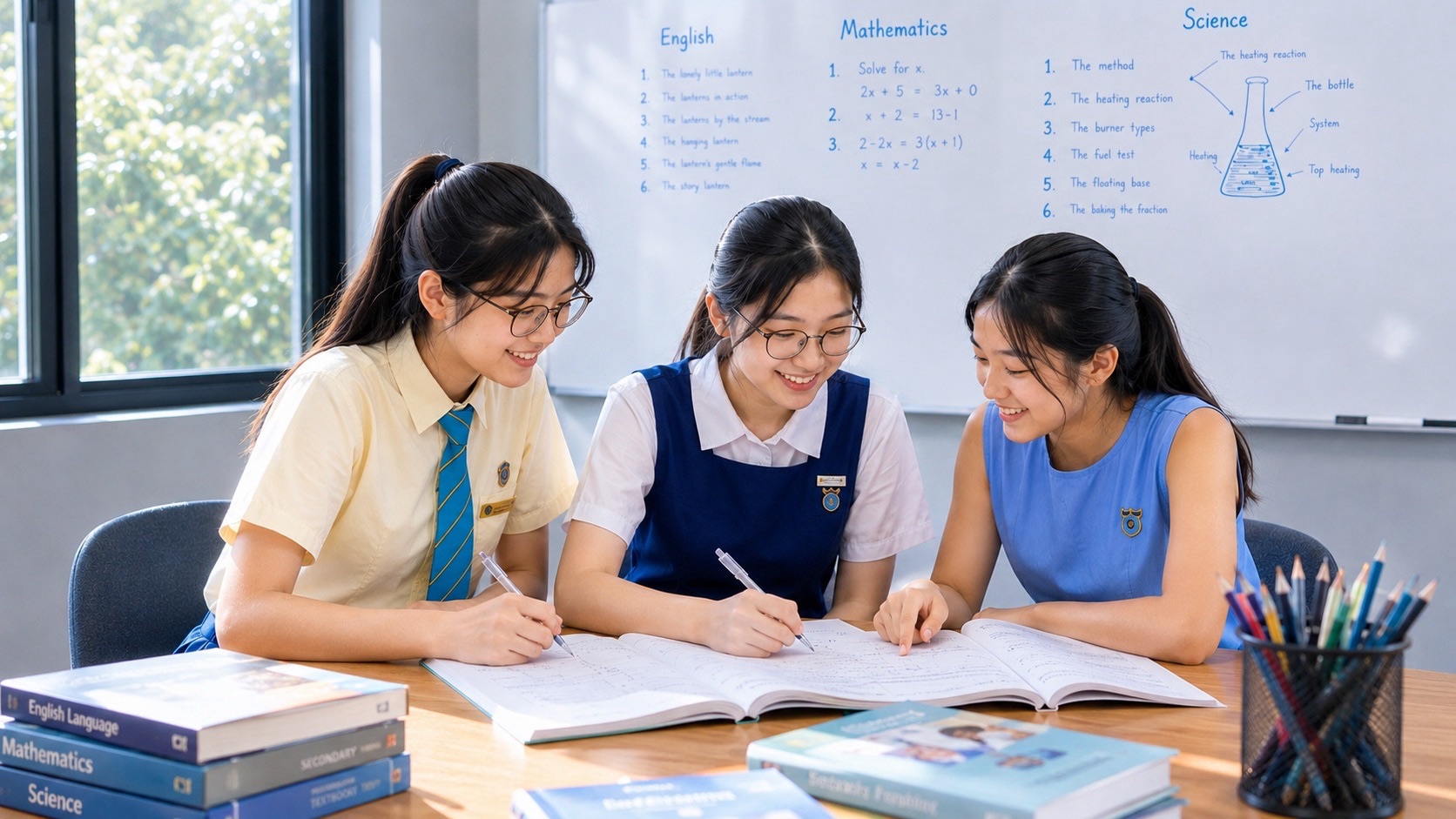
Bishan Science tuition should help a Primary learner explain not only that one condition caused a result, but how the change propagated through the scientific process to produce the observed outcome.
This rebuilt legacy page owns a distinct RFE: changed condition → scientific process → intermediate effect → observed outcome. Bishan already has a large Science tuition estate with stronger generic and level-specific owners, so this URL should not compete on the location term. Its job is to strengthen causal-chain reasoning across Primary Science.
eduKate teaches in groups of up to three students, generally for 90 minutes. In a 3-pax Science class, students can compare different causal chains, identify missing links and explain why one sequence fits the evidence better than another.
Location-integrity note: this legacy URL contains historical Yishun/Bishan wording. It should not be read as proof of a current branch at any old address. Current class location and availability should be confirmed directly.
The 2026 Primary Science Context
For the 2026 PSLE, Science is subject code 0009 and is based on the 2023 Primary Science syllabus. Students are expected to apply concepts, interpret information and communicate scientific explanations and reasoning.
Parents can verify the current syllabus through the 2026 PSLE Science syllabus and the SEAB PSLE formats page.
The Causal-Chain Frame
| Stage | Question |
|---|---|
| Condition | What changed? |
| Process | What scientific mechanism is affected? |
| Intermediate effect | What changes next? |
| Outcome | What is finally observed? |
| Evidence check | Does the chain fit the data? |
The learner should make the invisible middle visible.
Why One-Step Explanations Fail
Weak:
The plant grew less because it had less light.
Where the question requires mechanism, a stronger answer might connect:
less light → lower rate of the relevant plant process → less food/energy available for growth → less growth observed.
The exact concept and wording must fit the syllabus and question.
Start With the Changed Condition
Students should identify:
- what factor changed;
- direction of change;
- what remained comparable;
- what outcome was measured.
Causal explanation becomes unreliable if the learner misreads the starting condition.
Name the Process Precisely
A keyword alone is not enough.
Instead of:
“because of evaporation”
ask:
- What is evaporating?
- What condition changes the process?
- What consequence follows?
The process must connect condition and outcome.
Intermediate Effects Matter
Many Science questions contain a hidden middle.
Examples:
- changed temperature → changed process rate → changed observed time/result;
- changed food supply → population effect → predator/prey consequence;
- changed circuit arrangement → changed electrical behaviour → bulb outcome;
- changed material property → changed heat transfer → temperature outcome.
The intermediate effect is often where marks are gained or lost.
Do Not Skip the Direction
Students must state whether something:
- increases or decreases;
- becomes faster or slower;
- becomes greater or smaller;
- moves toward or away;
- produces more or less of an outcome.
Direction errors can reverse the entire explanation.
Use Evidence to Validate the Chain
After writing the mechanism, return to the observation.
Ask:
- Does the predicted direction match the data?
- Is the time sequence sensible?
- Is another changed factor present?
- Does the evidence support causation or only association?
The chain should not outrun the evidence.
Causal Chains in Biology
When appropriate to the syllabus, students may connect:
- environmental condition;
- organ/process response;
- resource availability;
- growth/survival outcome.
The focus is on the relationship, not memorised phrases.
Causal Chains in Physical Science
Students may connect:
- force/condition change;
- effect on movement;
- observed distance/speed/direction;
- evidence from the set-up.
Again, exact relationships must fit the level and question.
Causal Chains in Materials and Heat
Example reasoning:
material property → rate of transfer → temperature change → observed suitability.
This is stronger than jumping directly from material name to conclusion.
Causal Chains in Ecosystems
Use:
population/resource change → direct effect → indirect effect → ecosystem outcome.
Students learn to distinguish direct from indirect consequences.
The Bishan Causal Diagnostic
Condition
Can the changed factor be identified?
Process
Can the scientific mechanism be named/explained?
Intermediate Link
Can the hidden middle be stated?
Outcome
Can the observation be connected?
Direction
Are increase/decrease relationships correct?
Evidence
Does the chain fit the data?
Transfer
Can the method work on another topic?
Six Common Causal Failure Modes
1. Cause→Outcome Jump
The mechanism is missing.
2. Keyword Dump
Scientific terms appear without relationships.
3. Reversed Direction
Increase/decrease is inverted.
4. Wrong Starting Condition
The variable is misread.
5. Unsupported Cause
The answer adds a cause not supported by the set-up.
6. Memorised Chain
The learner reproduces a familiar sequence that does not fit the new context.
What a 90-Minute 3-Pax Science Lesson Can Look Like
0–10 minutes: Relationship Retrieval
Students recall one known process.
10–25 minutes: Observation Read
Changed condition and outcome are mapped.
25–45 minutes: Build the Middle
Students construct causal chains.
45–60 minutes: Compare Chains
Missing or unsupported links are challenged.
60–80 minutes: Fresh Context Transfer
The same causal frame appears in another topic.
80–90 minutes: Error Close
Was the failure condition, process, direction, evidence or language?
Why Three Students Helps
- Different chains can be compared.
- Peers expose missing intermediate links.
- The tutor can challenge unsupported causes.
- Students learn to defend direction and evidence.
- Every learner writes independent explanations.
What Parents Can Bring
- open-ended Science questions;
- answers with keywords but few marks;
- teacher comments;
- experiment/data questions;
- assessment dates.
What Progress Looks Like
- explanations contain fewer jumps;
- intermediate mechanisms become clearer;
- direction words become accurate;
- evidence and concept stay connected;
- keyword dumping decreases;
- causal reasoning transfers across topics.
Frequently Asked Questions
Does this page claim a current Bishan Science tuition centre?
No. It is a legacy Bishan/Yishun learner route; current class location and availability must be confirmed directly.
Should every Science answer use a long causal chain?
No. Use only the number of links needed to answer the question accurately.
Can strong learners be extended?
Yes. Use indirect effects, competing mechanisms and evidence that constrains which chain is justified.
Ten Checks for Causal Explanations
- What changed?
- In what direction?
- What process is affected?
- What changes next?
- What outcome is observed?
- Is the sequence scientifically sensible?
- Does evidence support it?
- Is any cause invented?
- Is the answer as long as necessary, not longer?
- Can the chain transfer?
Strong Science Explanations Make the Invisible Middle Visible
That is the purpose of this Bishan Science tuition support route:
condition → process → intermediate effect → observed outcome → evidence check.
Families may also use the broader Bishan Science Tuition route.
Almost-Code Summary
LEARNER_ROUTE = Bishan_Primary_Science_causal_chain
PAGE_RFE = intermediate_mechanism_explanation
PSLE_2026 = subject_0009 + 2023_primary_science_syllabus
CLASS = max_3
LESSON = 90_minutes
GOAL = evidence_bounded_causal_explanation