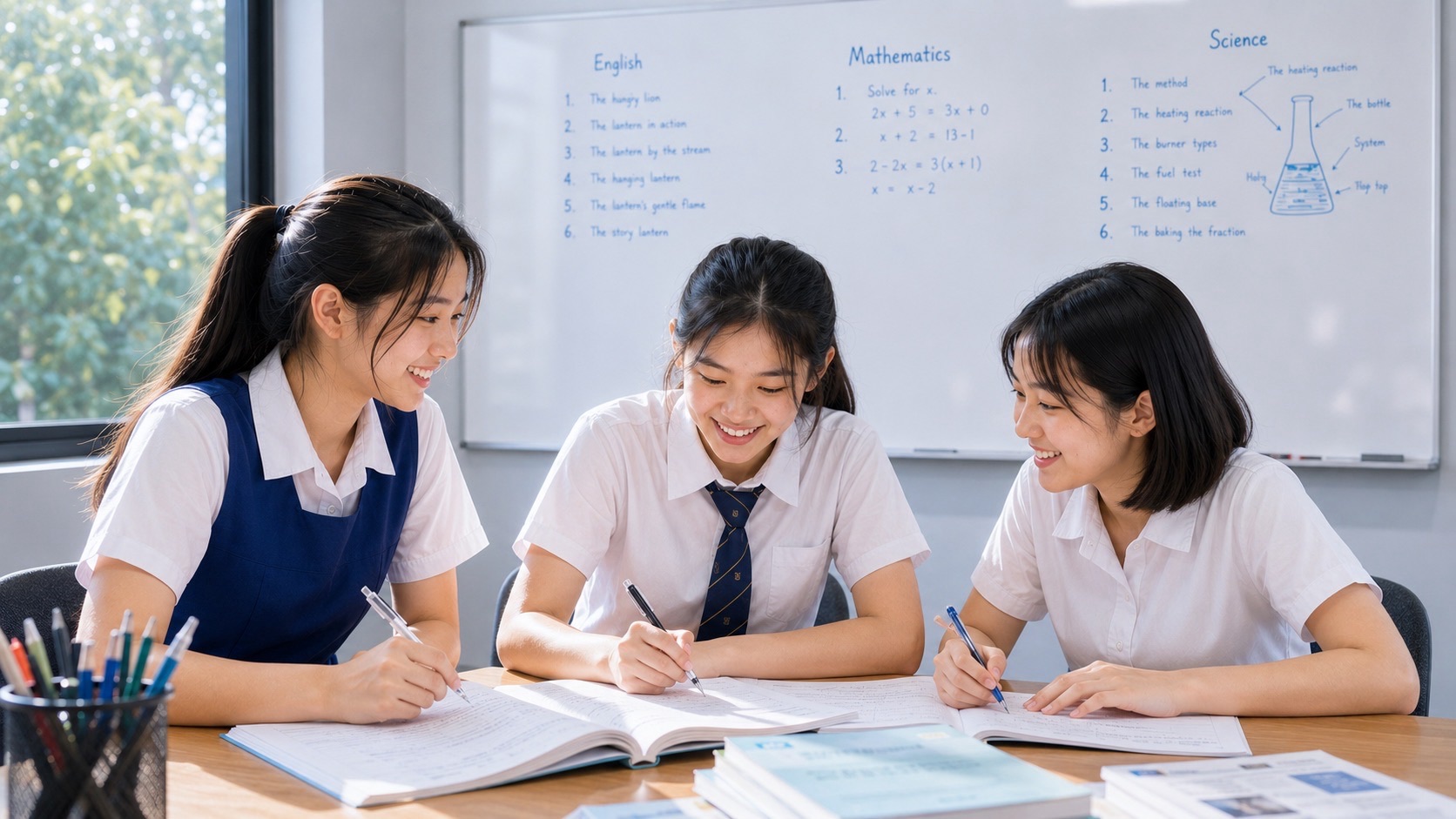
Ang Mo Kio Science tuition should help a Primary learner recognise the scientific relationship inside an unfamiliar situation instead of depending on familiar textbook surfaces.
A student may answer correctly when the question looks like the worksheet used in class, then fail when the same concept appears in a new object, diagram, environment or investigation. That is a transfer problem.
This rebuilt legacy page therefore owns a distinct RFE: known concept → abstract relationship → unfamiliar context → evidence-based application. Ang Mo Kio already has a very large modern Science tuition estate, so this old URL should not compete as another generic location owner. Its job is to strengthen transfer across new contexts.
eduKate teaches in groups of up to three students, generally for 90 minutes. In a 3-pax Science class, the tutor can give all three learners the same underlying concept through different surface examples and compare who recognises the relationship rather than the familiar object.
Location-integrity note: this legacy URL contains historical Yishun/Ang Mo Kio wording. It should not be read as proof of a current branch at any old address. Current class location and availability should be confirmed directly.
The 2026 Primary Science Context
For the 2026 PSLE, Science is subject code 0009 and is based on the 2023 Primary Science syllabus. Students must understand and apply scientific concepts to information, investigations and unfamiliar contexts rather than rely only on recall.
Parents can verify the current syllabus through the 2026 PSLE Science syllabus and the SEAB PSLE formats page.
The Transfer Pipeline
| Stage | Question |
|---|---|
| Recognise surface | What objects/details are present? |
| Abstract relationship | What scientific process is actually being tested? |
| Map variables | What changed, what is measured, what remains relevant? |
| Apply concept | How does the known relationship operate here? |
| Check evidence | Does the answer fit the observations/data? |
Surface Familiarity Can Be Misleading
Students often recognise a topic from objects:
- plant → photosynthesis;
- bulb → electricity;
- shadow → light;
- ice → change of state.
But a question may use the same object to test a different relationship. We therefore ask:
What is changing, and what scientific relationship would explain the result?
Strip Away the Story
An unfamiliar question may include many real-world details.
We reduce it to:
- system;
- changed condition;
- observed outcome;
- relevant concept;
- required explanation.
This helps students see the underlying Science without being distracted by the narrative shell.
Example: Heat Transfer
Familiar question: Which material keeps water warm longer?
Unfamiliar surface: A lunch container, emergency blanket or insulated delivery bag.
The learner should recognise the same relationship:
material/property → rate of heat transfer → observed temperature change.
The object changes. The scientific structure remains.
Example: Forces
Familiar surface: toy car on a ramp.
Unfamiliar surface: trolley, ball, bicycle or object moving down a slope.
Students identify:
- what force or condition changes;
- what motion is observed;
- what evidence supports the relationship.
They should not need the exact textbook object.
Example: Plant Processes
Familiar surface: potted plant.
Unfamiliar surface: leaf experiment, greenhouse, shaded garden or crop scenario.
Ask:
- What plant process is relevant?
- What condition changed?
- What outcome would be expected?
- What evidence in the question confirms or challenges it?
Abstract the Concept in One Sentence
Before transferring, ask the learner to state the relationship without the original object.
Example:
When the temperature difference is larger, the rate of heat transfer may be greater under otherwise comparable conditions.
Then apply it to a new context.
The exact statement should remain scientifically appropriate to the level and question.
Use Contrasting Examples
To avoid memorised surface matching, compare:
- same concept, different object;
- same object, different concept;
- similar-looking question, different variable;
- different-looking question, same relationship.
This teaches discrimination.
Near Transfer vs Farther Transfer
Near Transfer
New example is similar to the original.
Farther Transfer
New example uses a different setting or representation.
We build from near to farther transfer so the learner does not jump from memorised example to completely unfamiliar complexity in one step.
Question Words Still Matter
Even when the context is unfamiliar, the learner must identify whether the question asks to:
- predict;
- explain;
- compare;
- identify a variable;
- interpret data;
- suggest an improvement.
Transfer is concept application plus task control.
Use Evidence to Constrain Transfer
Students should not force a concept simply because it feels related.
Ask:
- What evidence indicates this concept is relevant?
- Does the direction of the observed change match?
- Is another factor a better explanation?
This prevents keyword-based over-transfer.
Transfer in Open-Ended Answers
A useful answer structure:
changed condition → known concept/process → intermediate effect → observed outcome.
The concept must be adapted to the new surface rather than copied from a model answer.
The Ang Mo Kio Transfer Diagnostic
Concept
Can the learner state the underlying relationship?
Surface Independence
Can the concept survive a different object?
Variable Mapping
Can relevant conditions be identified?
Evidence
Can the concept be checked against observations?
Question Demand
Can the task type still be recognised?
Explanation
Can the relationship be expressed naturally in the new context?
Delay
Can transfer survive after time?
Six Common Transfer Failure Modes
1. Object Matching
The learner answers from the familiar object, not the relationship.
2. Keyword Trigger
One word activates a memorised answer regardless of evidence.
3. Same-Example Dependence
The student succeeds only on rehearsed surfaces.
4. Over-Transfer
A concept is applied where evidence does not support it.
5. Question-Demand Loss
The learner identifies the concept but answers the wrong task.
6. No Delay
Transfer works immediately after teaching but disappears later.
What a 90-Minute 3-Pax Science Lesson Can Look Like
0–10 minutes: Concept Retrieval
Students state one relationship without examples.
10–25 minutes: Familiar Surface
The concept is applied once.
25–45 minutes: Surface Rotation
New objects/settings appear.
45–60 minutes: Discrimination
Students identify when the concept does and does not apply.
60–80 minutes: Open-Ended Transfer
A novel question requires evidence-based explanation.
80–90 minutes: Abstraction Close
Students restate the transferable relationship.
Why Three Students Helps
- Each learner can receive a different surface example.
- Peers compare which features are relevant.
- The tutor can detect object matching quickly.
- Students justify why a concept applies.
- Every learner still writes independent responses.
What Parents Can Bring
- questions marked wrong despite topic revision;
- unfamiliar-context questions;
- teacher comments;
- papers where performance varies sharply by surface;
- assessment dates.
What Progress Looks Like
- students rely less on familiar objects;
- concepts are stated more abstractly;
- variable mapping improves;
- unfamiliar contexts create less hesitation;
- unsupported concept use decreases;
- open-ended transfer becomes more reliable.
Frequently Asked Questions
Does this page claim a current Ang Mo Kio Science tuition centre?
No. It is a legacy Ang Mo Kio/Yishun learner route; current class location and availability must be confirmed directly.
How do you teach transfer without making questions too hard?
Move gradually from near transfer to farther transfer while keeping the underlying concept stable.
Can strong learners benefit?
Yes. Use deceptive surface similarities, competing concepts and multi-step application.
Ten Checks for Science Transfer
- What is the underlying concept?
- Can I state it without the original example?
- What changed in this new context?
- What is measured/observed?
- Does the concept apply?
- What evidence supports it?
- What alternative concept might compete?
- What does the question ask?
- Can I explain naturally?
- Can I repeat this after delay?
Learn the Relationship Deeply Enough That It Survives a New Surface
That is the purpose of this Ang Mo Kio Science tuition support route:
concept → abstraction → new context → evidence → application → transfer.
Families may also use the broader Ang Mo Kio Science Tuition route.
Almost-Code Summary
LEARNER_ROUTE = Ang_Mo_Kio_Primary_Science_transfer
PAGE_RFE = unfamiliar_context_transfer
PSLE_2026 = subject_0009 + 2023_primary_science_syllabus
CLASS = max_3
LESSON = 90_minutes
GOAL = concept_survives_surface_change