Choa Chu Kang Science tuition should help a Primary learner compare scientifically: use the same variable and basis for both cases, state the direction of the difference precisely, and support the comparison with evidence.
This rebuilt legacy page owns a distinct RFE: same basis → paired comparison → direction → evidence → conclusion. Choa Chu Kang already has broader Science tuition owners, so this old URL should not compete as another generic location page. Its job is to strengthen comparison as a reasoning tool across experiments, materials, organisms, systems, graphs and open-ended questions.
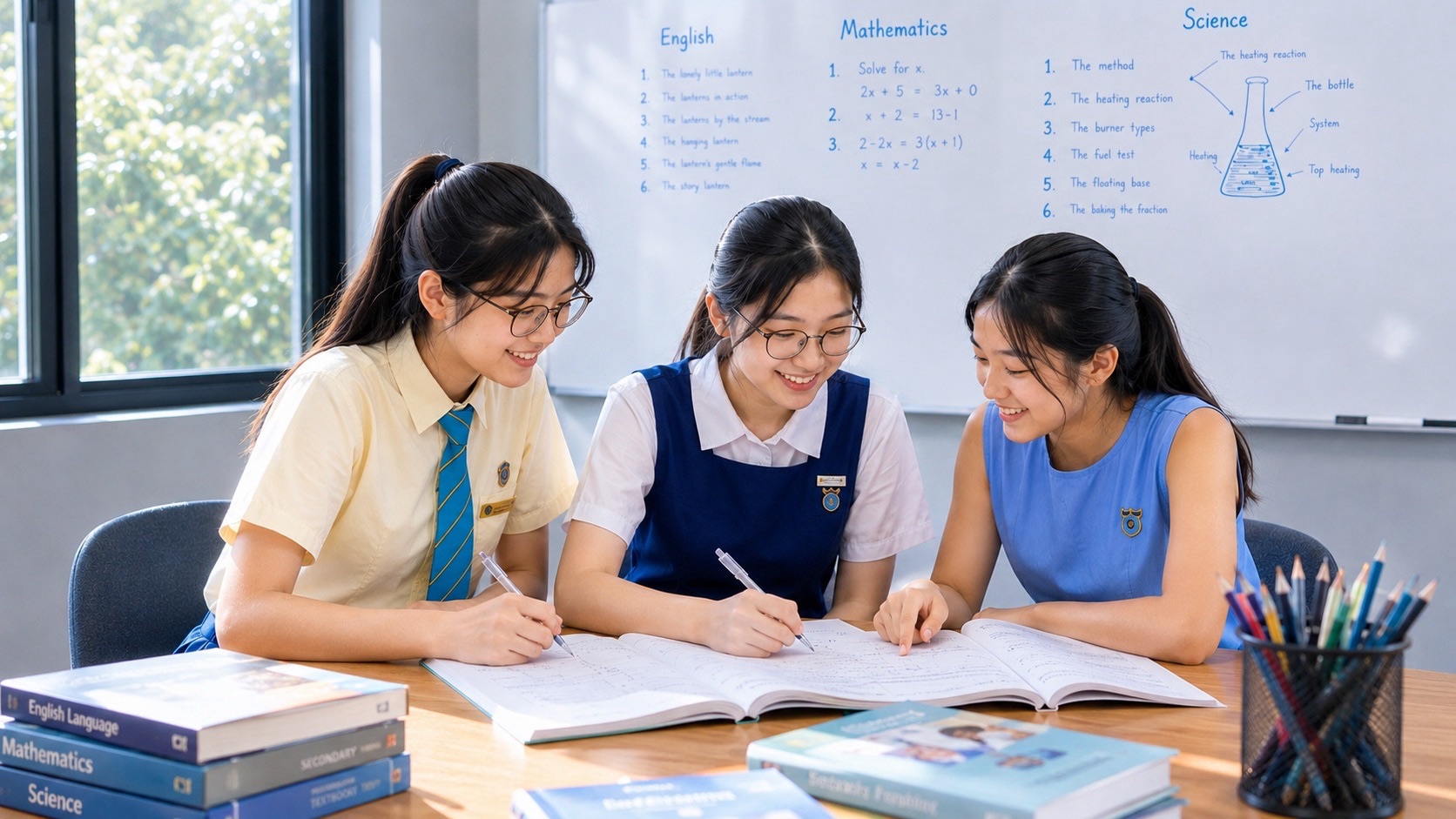
eduKate teaches in groups of up to three students, generally for 90 minutes. In a 3-pax Science class, students can compare several answers, identify when two unlike properties are accidentally being contrasted, and tighten scientific language until the comparison is fair and interpretable.
Location-integrity note: this legacy URL contains historical Yishun/Choa Chu Kang wording. It should not be read as proof of a current branch at any old address. Current class location and availability should be confirmed directly.
The 2026 Primary Science Context
For the 2026 PSLE, Science is subject code 0009 and is based on the 2023 Primary Science syllabus. Students are expected to interpret information, apply scientific concepts, compare evidence and communicate scientific reasoning clearly.
Parents can verify the current syllabus through the 2026 PSLE Science syllabus and the SEAB PSLE formats page.
The Compare-and-Contrast Frame
| Stage | Question |
|---|---|
| Basis | What same property or variable are we comparing? |
| Case A | What is true for A? |
| Case B | What is true for B? |
| Direction | Which is greater/lower/faster/slower/etc.? |
| Evidence | Which observation or value proves the difference? |
| Conclusion | What scientific relationship follows? |
A valid comparison keeps both sides on the same axis of meaning.
Compare the Same Property
Weak:
Material A is strong, while Material B is transparent.
That is not a direct comparison because the properties differ.
Stronger:
Material A is stronger than Material B under the same test.
or:
Material B allows more light through than Material A.
Both cases now share one comparison basis.
Use Paired Language
Useful structures:
- A has more X than B;
- A takes less time than B;
- A has a higher temperature than B;
- A shows a greater increase than B;
- Both A and B… but only A…;
- Unlike A, B….
Paired language makes the basis explicit.
Direction Must Be Correct
If the data says:
A = 12 cm
B = 8 cm
then valid comparisons include:
- A is 4 cm longer than B;
- A has the greater length;
- B is 4 cm shorter than A.
Students must not reverse greater/less or faster/slower while preserving the numbers.
Compare Change, Not Just Final Values
Suppose two plants start at different heights. Final height alone may be a weak basis for comparing growth.
Students may need to compare:
change = final − initial
when that is the quantity the investigation actually seeks.
This reinforces the rule: choose the comparison that matches the question.
Compare Under Fair Conditions
A difference is easier to interpret when relevant conditions are comparable.
Ask:
- Was only one factor changed?
- Were starting conditions similar?
- Was measurement consistent?
- Were both cases observed for the same duration?
Otherwise the comparison may exist numerically but be scientifically ambiguous.
Comparison in Graphs
Before comparing lines/bars:
- identify axes;
- read units;
- choose the same time/condition;
- compare corresponding values;
- state direction.
Do not compare A at 5 minutes with B at 10 minutes unless the question explicitly requires that.
Comparison in Tables
Students should locate the correct row/column intersections.
Use:
same variable + same condition + paired values.
Then explain the scientific meaning if required.
Comparison of Organisms
Possible bases may include:
- observable characteristics;
- life-cycle stages;
- structures and functions;
- habitat adaptations;
- feeding relationships.
Students should not compare unrelated traits merely because they are memorable.
Comparison of Systems
For two systems or set-ups, ask:
- What components differ?
- What condition is held constant?
- What output is being compared?
- What mechanism explains the difference?
Comparison can become a route into causal reasoning.
Comparison of Materials
Use one property at a time:
- strength;
- flexibility;
- absorbency;
- transparency;
- conductivity.
Then decide which material better fits the design requirement.
Similarity Is Also Evidence
Compare-and-contrast includes similarities.
Ask:
- What is the same?
- What differs?
- Which similarity matters scientifically?
- Which difference explains the outcome?
Sometimes the controlled variables are the important similarities.
Do Not Overcompare
When a question asks for one difference, provide one clear difference unless more is required.
Listing many properties can introduce an incorrect statement and dilute the answer.
Answer economy remains important in Science.
Evidence-Based Comparison
Weak:
Set-up A is better.
Stronger:
Set-up A produced a greater temperature increase than Set-up B, rising by 8°C compared with 3°C.
If explanation is asked, the relevant scientific concept can follow.
The Choa Chu Kang Comparison Diagnostic
Basis
Can the same variable/property be identified?
Pairing
Are A and B both described?
Direction
Are greater/less/faster/slower relations correct?
Condition
Is the comparison made under matching conditions?
Evidence
Can exact values/observations be cited?
Conclusion
Can the learner state what the difference means?
Transfer
Can the method move to a new Science topic?
Six Common Comparison Failure Modes
1. Different-Basis Comparison
A is compared on one property and B on another.
2. One-Sided Answer
Only A is described.
3. Reversed Direction
Greater/less is inverted.
4. Mismatched Conditions
Values from different times/conditions are compared.
5. Evidence-Free Judgement
“Better” or “more effective” is stated without data.
6. Too Many Differences
The answer adds unnecessary claims and creates errors.
What a 90-Minute 3-Pax Science Lesson Can Look Like
0–10 minutes: Comparison Vocabulary Retrieval
Students recall paired scientific language.
10–30 minutes: Same-Basis Sorting
Students identify valid vs invalid comparisons.
30–45 minutes: Graph/Table Comparison
Exact evidence is selected.
45–60 minutes: Explain the Difference
The relevant mechanism is added where required.
60–80 minutes: Cross-Topic Transfer
Comparison moves from materials to organisms or experiments.
80–90 minutes: Answer-Economy Close
Students reduce answers to the requested number of differences.
Why Three Students Helps
- Students challenge mismatched comparison bases.
- Peers catch reversed direction.
- The tutor can test evidence sufficiency.
- Different valid wordings can be compared.
- Every learner writes an independent answer.
What Parents Can Bring
- compare/contrast questions;
- graphs and tables;
- material or organism questions;
- teacher comments;
- assessment dates.
What Progress Looks Like
- comparisons stay on one basis;
- direction errors reduce;
- both sides are represented;
- exact evidence is used;
- matched conditions are checked;
- answers become shorter and more precise.
Frequently Asked Questions
Does this page claim a current Choa Chu Kang Science tuition centre?
No. It is a legacy Choa Chu Kang/Yishun learner route; current class location and availability must be confirmed directly.
Should every comparison include numbers?
No. Use numerical evidence when available and relevant; qualitative properties can also be compared scientifically.
Can strong learners be extended?
Yes. Use comparisons where the correct basis must first be derived, or where final value and change lead to different conclusions.
Ten Checks for Scientific Compare-and-Contrast
- What property/variable is the basis?
- Is it the same for both cases?
- What is true for A?
- What is true for B?
- What direction is the difference?
- Are conditions matched?
- What evidence supports the comparison?
- Does the question ask for similarity, difference or both?
- How many points are required?
- Can the comparison transfer?
Compare Like With Like, Then Let the Evidence Show the Difference
That is the purpose of this Choa Chu Kang Science tuition support route:
same basis → A/B pairing → direction → evidence → scientific meaning.
Almost-Code Summary
LEARNER_ROUTE = Choa_Chu_Kang_Primary_Science_comparison
PAGE_RFE = scientific_compare_contrast
PSLE_2026 = subject_0009 + 2023_primary_science_syllabus
CLASS = max_3
LESSON = 90_minutes
GOAL = precise_same_basis_evidence_comparison