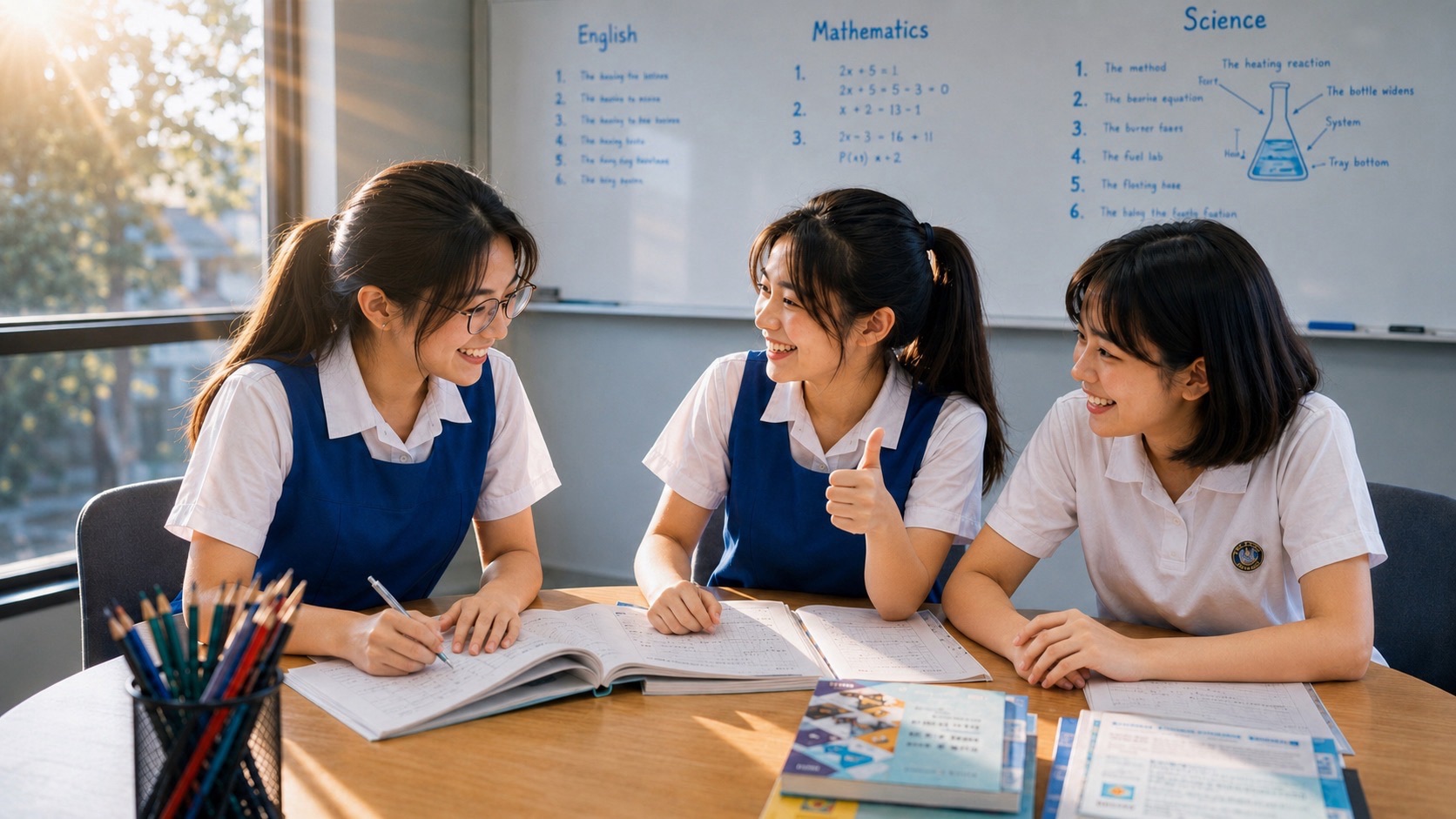
Bukit Timah Primary 2 Math Tuition for children who need stronger foundations, better problem-solving and confident mathematical thinking. Learn what P2 Mathematics students study in Singapore, how to identify learning gaps early, and what good Primary 2 Math tuition should actually do.
Bukit Timah Primary 2 Math Tuition | Building Strong Mathematics Foundations Early
Primary 2 Mathematics can look deceptively simple.
The numbers are still relatively small. There is no PSLE pressure yet. Children are only eight years old, and school still feels like the beginning of a much longer journey.
Yet Primary 2 is one of the most useful years to get Mathematics right.
This is the year when a child begins moving from simply doing sums to understanding how numbers, operations and mathematical relationships work together.
Addition becomes connected to subtraction.
Multiplication becomes connected to division.
Fractions begin to describe relationships rather than just pictures.
Money, time, measurement, shapes and graphs require children to take mathematical ideas and apply them to situations.
And word problems begin asking a more important question:
Do you understand what is happening well enough to decide what Mathematics to use?
For parents looking for Primary 2 Math tuition in Bukit Timah, this is therefore not simply about finding someone who can give a child more worksheets.
The better question is:
What should a good Primary 2 Mathematics education build now, so that Mathematics becomes easier rather than harder as the child grows?
That is where we begin.
Primary 2 Is a Foundation Year, Not an Examination Year
There are currently no weighted assessments or examinations in Primary 1 and Primary 2 in Singapore. MOE’s intention is to give younger children time to settle into formal schooling while developing important learning skills and dispositions. (Ministry of Education)
This is important.
It means Primary 2 should not become an artificial race to produce examination marks that do not yet need to exist.
But neither should it become a year that parents ignore simply because there is no major examination.
In fact, the absence of high-stakes examinations gives us something valuable:
time to build properly.
A Primary 2 child can learn to:
understand numbers rather than memorise procedures,
develop confidence before fear appears,
learn how to think through problems,
correct weak habits before they become permanent,
and discover that Mathematics is something that makes sense.
This is a much better use of Primary 2 than simply pushing a child several chapters ahead.
The aim is not acceleration for its own sake.
The aim is readiness.
What Does a Primary 2 Student Learn in Mathematics?
Under Singapore’s current Primary Mathematics syllabus, Primary 2 develops significantly beyond Primary 1.
Students work with numbers up to 1,000, three-digit addition and subtraction, multiplication tables of 2, 3, 4, 5 and 10, multiplication and division relationships, fractions, money, measurement, time, two-dimensional and three-dimensional shapes, and picture graphs with scales.
This creates several important areas of development.
Whole Numbers and Place Value
A child progresses from smaller numbers into numbers up to 1,000.
That means understanding:
hundreds, tens and ones,
how numbers can be decomposed,
how numbers are compared and ordered,
number patterns,
odd and even numbers,
and how place value affects calculation.
This sounds basic.
It is not.
Place value is one of the foundations underneath almost everything that follows in Mathematics.
A child who sees 347 merely as “three-four-seven” will struggle more than a child who intuitively sees:
300 + 40 + 7.
That second child has structure.
And structure makes later Mathematics easier.
Addition and Subtraction Must Become More Than Procedures
Primary 2 students learn addition and subtraction involving numbers of up to three digits.
Many children can learn the written algorithm.
They can stack numbers neatly.
They can carry.
They can borrow or regroup.
They may even obtain the correct answer.
But there is an important difference between:
“I know the steps.”
and
“I understand what the numbers are doing.”
A strong Primary 2 Mathematics student should gradually understand both.
For example:
Why does regrouping work?
Why can 300 become 2 hundreds and 10 tens?
How can we estimate whether an answer makes sense?
Can we calculate mentally when the numbers allow it?
Can we recognise that addition and subtraction are inverse relationships?
The child who understands these relationships has more flexibility.
The child who only memorises a procedure is more vulnerable when the question changes.
That distinction becomes increasingly important from Primary 3 onwards.
Multiplication and Division Are a Major Primary 2 Turning Point
Primary 2 introduces multiplication tables for 2, 3, 4, 5 and 10 and develops the relationship between multiplication and division.
This is one of the most important transitions in early Mathematics.
At first, multiplication may appear to be another thing to memorise.
2 × 4 = 8.
3 × 5 = 15.
4 × 6 = 24.
But good Mathematics teaching goes further.
A child should begin understanding multiplication as structure.
Three groups of four.
Four groups of three.
Repeated addition.
Arrays.
Equal groups.
Relationships between facts.
Then division begins to make sense naturally.
If:
4 × 5 = 20,
then:
20 ÷ 5 = 4,
and:
20 ÷ 4 = 5.
Now the child is not memorising three unrelated facts.
The child understands a mathematical family.
That is much more powerful.
Memorisation Still Matters — But Understanding Comes First
There is nothing wrong with knowing multiplication tables quickly.
Fluency is useful.
A child who spends too much mental energy calculating basic facts has less attention available for harder reasoning.
But speed should sit on top of understanding.
Not replace it.
We want the child eventually to know:
4 × 8 = 32
almost immediately.
But we also want the child to understand what multiplication means.
This gives us both:
fluency and flexibility.
That combination becomes increasingly important as Mathematics grows more complex.
Fractions Begin Earlier Than Many Parents Realise
Fractions appear formally in Primary 2.
Students learn fractions as parts of a whole, compare and order certain fractions, and work with addition and subtraction of like fractions within one whole.
This is an important conceptual beginning.
A fraction is not merely a strange number with one number written above another.
It describes a relationship.
One half.
One quarter.
Three quarters.
Two fifths.
The child needs to understand what the whole is, how it has been divided and what each part represents.
Visual understanding matters enormously here.
A child may memorise:
1/4 < 1/2
but a stronger child understands why.
That understanding eventually supports:
fractions,
decimals,
percentages,
ratios,
proportions,
rates,
and much later, algebraic reasoning.
The early concept may look small.
Its future consequences are not.
Why Some Children Suddenly Find Primary 2 Mathematics Difficult
Often, the difficulty is not one topic.
It is the increasing number of things the child must do at the same time.
Consider a simple word problem.
A child must first read the sentence.
Then understand the vocabulary.
Then identify what information matters.
Then understand the situation.
Then decide which operation is required.
Then perform the calculation accurately.
Then check whether the answer makes sense.
That is not merely arithmetic.
It is a chain of thinking.
A weakness anywhere in that chain can produce a wrong answer.
This is why simply giving a child more worksheets may not solve the problem.
We first need to know where the thinking broke down.
“My Child Can Do Sums but Cannot Do Problem Sums”
This is one of the most common observations parents make.
And it tells us something useful.
The problem may not be calculation.
The child may already know how to add, subtract, multiply or divide.
The difficulty may be deciding:
Which one should I use?
That is a different skill.
A child who sees:
347 + 286 =
has been told what Mathematics to perform.
A word problem does not always provide that instruction.
The child has to discover it.
That requires comprehension and mathematical reasoning.
This is why good Primary 2 Mathematics tuition should not train children merely to search for keywords such as:
“altogether means add”
or
“left means subtract.”
These shortcuts sometimes work.
Until they do not.
The better approach is to understand the situation.
What happened?
What do we know?
What are we trying to find?
What quantities are related?
What operation represents that relationship?
This takes slightly longer to teach.
But it builds a much stronger mathematician.
The Real Goal of Primary 2 Mathematics Tuition
Good tuition should make the child increasingly less dependent on tuition.
That may sound unusual.
But it is important.
The objective should not be to create a student who can only solve questions after a tutor explains every step.
We want to gradually develop a student who can:
read,
think,
choose,
attempt,
check,
correct,
and explain.
The tutor provides structure while the child develops independence.
At Primary 2, that process should be gentle.
But it should already begin.
What Good Primary 2 Math Tuition Should Do
1. Find Out What the Child Actually Understands
Two children can both score the same mark and need completely different help.
One may have weak number sense.
Another may calculate well but misunderstand word problems.
Another may know the concepts but work too carelessly.
Another may be strong and simply need greater challenge.
Therefore, good tuition should not begin with:
“Everyone, open Worksheet 27.”
It should begin by understanding the learner.
Where is the child comfortable?
Where does hesitation begin?
Which mistakes repeat?
Is the problem conceptual?
Procedural?
Language-related?
Attention-related?
Or simply a lack of practice?
Different problems require different solutions.
2. Build Number Sense Before Chasing Difficult Questions
Strong Mathematics begins with feeling comfortable around numbers.
A good Primary 2 student should increasingly notice relationships.
For example:
398 is close to 400.
25 + 25 = 50.
Four groups of five make twenty.
Half of twelve is six.
Three quarters is larger than one half.
60 minutes is one hour.
These relationships create mental flexibility.
A child with good number sense often finds new topics easier because numbers do not feel like isolated symbols.
They have meaning.
3. Develop Accuracy Without Creating Fear
Young children make mistakes.
That is normal.
An incorrect answer can be extremely useful because it shows us how the child was thinking.
Instead of simply marking:
❌ Wrong
a tutor can ask:
Where did this change?
What were you thinking here?
Can we find another way?
Does your answer make sense?
This turns errors into information.
Over time, children learn something even more valuable:
how to inspect their own work.
That is the beginning of mathematical independence.
4. Teach Children to Explain Their Thinking
One of the simplest ways to find out whether a child understands Mathematics is to ask:
“Can you explain why?”
A child who understands can usually explain the idea in simple language.
Not perfectly.
But meaningfully.
For example:
“I divided because the sweets are shared equally between four children.”
That sentence tells us far more than a correct numerical answer alone.
The child understands the relationship.
Singapore’s current Mathematics curriculum places mathematical problem-solving at its centre and explicitly includes reasoning, representing, communicating and metacognition alongside concepts and skills.
So we should not only ask:
Did the child get the answer?
We should also ask:
Does the child know why the answer makes sense?
5. Build Confidence Alongside Competence
Confidence in Mathematics should not mean:
“I always know the answer.”
A healthier confidence is:
“I may not know the answer immediately, but I know how to begin.”
That distinction matters.
Children who believe they must always be correct become afraid of unfamiliar questions.
Children who know how to explore can handle difficulty much better.
This is why a good Mathematics environment should allow a child to:
try,
make reasonable mistakes,
ask questions,
rethink,
and eventually succeed.
Confidence built this way is durable.
Primary 2 Mathematics Tuition for a Child Who Is Struggling
When a child begins struggling with Mathematics at Primary 2, the first response should not automatically be:
more work.
Sometimes more work simply gives the child more opportunities to repeat the same misunderstanding.
Instead, slow down.
Find the earliest weak point.
For example, a child struggling with three-digit subtraction may actually have weak place-value understanding.
A child struggling with division may not properly understand multiplication.
A child struggling with word problems may understand the Mathematics perfectly but have difficulty reading the problem.
A child who appears “careless” may actually be overloaded because too many steps are not yet automatic.
Repair the cause.
Then practise.
That order matters.
Primary 2 Mathematics Tuition for a Stronger Student
A strong Primary 2 student also needs thoughtful teaching.
But challenge does not necessarily mean rushing into Primary 4 Mathematics.
There is an enormous amount of depth available within age-appropriate Mathematics.
A strong student can be challenged to:
find several solution methods,
explain why a method works,
identify patterns,
generalise relationships,
solve unfamiliar problems,
compare strategies,
and justify answers.
This develops mathematical intelligence rather than simply syllabus acceleration.
There is a time to move ahead.
But moving deeper is often just as valuable as moving faster.
The current MOE syllabus itself emphasises making connections between mathematical ideas and developing deeper relational understanding rather than learning procedures alone.
Why Small-Group Primary 2 Math Tuition Can Work Well
At this age, children still benefit greatly from interaction.
A very large class can make individual misunderstandings difficult to notice.
Pure one-to-one teaching, meanwhile, is not always necessary for every learner.
A very small group can provide a useful middle ground.
The tutor can observe each child closely while students still hear other ways of thinking.
One student may explain a problem differently.
Another may ask the question everyone else was thinking.
A tutor can compare strategies and create discussion.
At eduKate Singapore, we have developed our small-group tuition model around very small classes, including a maximum-three-student format used across our tuition programmes. (eduKate Singapore)
For a young Mathematics learner, the purpose of keeping a class small is simple:
it makes it much harder for misunderstanding to hide.
What Should Happen Inside a Good Primary 2 Mathematics Lesson?
A good lesson does not need to feel complicated.
It should feel clear.
The tutor first establishes what the child already knows.
A new concept is introduced carefully.
The student sees examples and representations.
The tutor asks questions to test understanding.
The child attempts guided problems.
Support is gradually reduced.
Different question forms are introduced.
Mistakes are corrected.
The child explains important ideas.
Then practice strengthens fluency.
Finally, previous learning is revisited so that topics do not disappear after a chapter ends.
This rhythm matters.
MOE’s current Mathematics pedagogy similarly describes learning through readiness, engagement and mastery, with teachers considering prior knowledge, learner needs, appropriate pacing, deliberate instructional choices, practice, review and extension.
Good tuition should feel coherent for the same reason.
The child should know:
what they are learning,
why it works,
and what they are becoming able to do.
Primary 2 Mathematics Should Connect, Not Fragment
One of the greatest mistakes in Mathematics is treating every chapter as a separate island.
Chapter finished.
Close the book.
Next topic.
But Mathematics does not actually work that way.
Addition connects to subtraction.
Multiplication connects to division.
Multiplication later connects to fractions.
Fractions connect to division.
Money connects to decimals.
Measurement connects numbers with real quantities.
Graphs require students to interpret numbers in another representation.
Word problems combine all of them.
A good Mathematics education continually helps a child see these connections.
This makes later learning easier because new knowledge has somewhere to attach.
From Primary 2 to Primary 3: Why the Transition Matters
Primary 3 is where Mathematics becomes noticeably broader.
Numbers become larger.
Multiplication and division expand.
Fractions deepen.
New measurement ideas appear.
Bar graphs appear.
Area and perimeter enter.
Problem-solving becomes more demanding.
A child entering Primary 3 with strong Primary 2 foundations does not need to relearn basic structures while simultaneously learning new ones.
That gives the child more mental space.
Instead of thinking:
“How does division work again?”
the child can focus on the new problem.
That is the quiet advantage of strong foundations.
They make future learning less expensive.
Not financially.
Cognitively.
The child uses less effort to perform familiar skills and has more attention available for new thinking.
Do Not Wait for a Bad Result Before Looking Closely
Because Primary 2 students do not have weighted assessments and examinations, parents should not depend entirely on a major examination score to identify whether something is wrong. (Ministry of Education)
Look instead at behaviour.
Does your child avoid Mathematics homework?
Do simple calculations take unusually long?
Does your child repeatedly forget recently learned concepts?
Can your child calculate but not solve word problems?
Does multiplication seem memorised but poorly understood?
Can your child explain an answer?
Does your child become anxious when a question looks different?
Are careless mistakes becoming a pattern?
These observations often tell us more than a single mark.
The earlier we understand the problem, the calmer the correction can be.
What Parents Can Do at Home
Parents do not need to turn the home into another tuition centre.
In fact, that can sometimes create unnecessary tension.
Simple mathematical conversations are often enough.
At the supermarket:
Which item costs more?
How much change should we receive?
At home:
It is 4:35 now. How long until dinner at 6?
While sharing food:
If we divide this equally between four people, what fraction does each person receive?
While travelling:
If the journey usually takes 20 minutes and we leave at 3:10, when should we arrive?
Mathematics becomes powerful when children realise it is not merely something printed in a workbook.
It describes the world.
Choosing a Primary 2 Math Tutor in Bukit Timah
Parents searching for a Primary 2 Math tutor in Bukit Timah will find many choices.
The most important differences may not be in the worksheets.
Ask what happens when your child does not understand.
Does the tutor slow down and diagnose the problem?
Can the tutor explain the same idea in several ways?
Is the class small enough for misunderstandings to be noticed?
Does the tutor teach reasoning as well as calculation?
Are stronger students challenged thoughtfully?
Are weaker foundations repaired before harder material is added?
Does your child gradually become more independent?
These questions reveal more than simply asking:
“How many worksheets do you complete every week?”
Volume is easy to measure.
Learning is more subtle.
Should My Primary 2 Child Start Tuition If They Are Already Doing Well?
Possibly — but the reason matters.
A strong student does not necessarily need tuition simply to stay ahead of classmates.
There should be a useful purpose.
For example:
developing richer problem-solving,
strengthening mathematical reasoning,
building excellent foundational habits,
receiving more individual challenge,
or creating a stable long-term learning environment.
For a child already thriving independently, excessive tuition may add little.
Good education is not about filling every available hour.
It is about using time intelligently.
Should I Wait Until Primary 3 or Primary 4?
That depends on the child.
There is no universal age when tuition suddenly becomes necessary.
But there is one useful principle:
small problems are usually easier to correct while they are still small.
If your child is already showing uncertainty in:
number sense,
basic operations,
multiplication and division,
fractions,
or mathematical comprehension,
waiting does not automatically make those weaknesses disappear.
New topics are usually built on earlier ones.
The better approach is to understand what is happening now.
Then decide whether intervention is actually needed.
Does Primary 2 Math Tuition Need to Prepare for PSLE Already?
Not in the sense of drilling Primary 2 children with Primary 6 examination papers.
That would miss the point.
But good Primary 2 learning absolutely contributes to later PSLE Mathematics.
The preparation happens indirectly.
A child develops:
strong number foundations,
accurate arithmetic,
mathematical vocabulary,
problem-solving habits,
confidence,
persistence,
and the ability to reason.
Those abilities accumulate.
By Primary 6, strong students are rarely strong because of something magical that happened three months before PSLE.
Their performance is usually the visible result of years of increasingly connected learning.
A Better Way to Think About Early Mathematics Tuition
Perhaps the most useful question is not:
“How far ahead can my child go?”
Ask instead:
“How strong can the foundation become?”
There is nothing wrong with advancement.
A capable child should not be held back unnecessarily.
But genuine advancement should rest on understanding.
At Primary 2, we have something precious that becomes scarcer later:
time.
Time to explain.
Time to explore.
Time to correct.
Time to practise properly.
Time to develop confidence before examination pressure grows.
Use that time well.
Frequently Asked Questions About Bukit Timah Primary 2 Math Tuition
Is Primary 2 Mathematics difficult in Singapore?
Primary 2 Mathematics is still foundational, but the intellectual demands increase considerably from Primary 1. Students work with numbers up to 1,000, three-digit addition and subtraction, multiplication and division, fractions, money, measurement, time, geometry and picture graphs with scales.
The challenge is often not one individual topic but learning to connect concepts and apply them to problems.
Are there examinations in Primary 2?
MOE states that there are no weighted assessments and examinations in Primary 1 and Primary 2, allowing children more time to adjust to formal schooling and develop important learning dispositions. (Ministry of Education)
This does not mean learning progress is unimportant. It means parents and teachers should pay closer attention to understanding, confidence, classwork and learning behaviours rather than relying only on major examination marks.
What multiplication tables should Primary 2 students know?
The current Primary 2 syllabus includes the multiplication tables of 2, 3, 4, 5 and 10, together with multiplication and division relationships.
Children should develop both fluency and understanding rather than relying only on memorisation.
Does Primary 2 include fractions?
Yes. Primary 2 students learn fractions as part of a whole, representations of fractions, comparison and ordering of certain fractions, and addition and subtraction of like fractions within one whole.
How do I know whether my child needs Math tuition?
Look beyond marks.
Persistent difficulty with number sense, slow calculation, weak multiplication understanding, inability to interpret word problems, repeated mistakes, growing avoidance or loss of confidence may indicate that closer support would be useful.
The first step should be understanding the cause rather than simply adding more worksheets.
Is small-group tuition suitable for Primary 2?
For many children, a very small group can work well because it allows close tutor attention while retaining discussion and interaction with peers.
The quality of teaching and suitability of the group remain more important than the label “small group” alone.
Should a strong Primary 2 student learn Primary 3 or Primary 4 Mathematics early?
Sometimes selective advancement is appropriate.
However, depth should come before speed.
A strong child can also be challenged through unfamiliar problems, multiple solution methods, pattern recognition, mathematical explanation and deeper reasoning within age-appropriate concepts.
What is the most important thing a Primary 2 Math tutor should teach?
Ultimately:
how to think mathematically.
The child should know facts and procedures, but also understand relationships, choose strategies, recognise when an answer is unreasonable and increasingly explain why a solution works.
That foundation lasts much longer than any individual worksheet.
Primary 2 Math Tuition for Bukit Timah Families
At eduKate Singapore, we believe young students should be taught Mathematics carefully from the beginning.
Not with unnecessary pressure.
Not by simply piling on worksheets.
And not by racing so far ahead that understanding is left behind.
The early years should build something more valuable:
clarity, accuracy, confidence and a strong way of thinking.
For some children, that means repairing a small weakness before Primary 3.
For others, it means developing stronger problem-solving ability.
For a capable learner, it may mean providing greater depth and challenge.
The starting point is always the same:
understand the child first.
Then teach what the child needs next.
For parents looking for Bukit Timah Primary 2 Math Tuition, P2 Mathematics tuition or a Primary 2 Math tutor, speak with us about your child’s present Mathematics level, what you are noticing at home and what you would like the next stage of learning to look like.
A good education should make the path ahead clearer.
And at Primary 2, there is still plenty of time to build it properly.
eduKate Singapore
Primary Mathematics Tuition
Small-group learning with close tutor guidance
Consultations and class placement subject to availability
Call or WhatsApp: +65 8823 1234 (eduKate Singapore)