Primary 1 is often the first point at which parents wonder whether Mathematics tuition should begin.
The answer is not automatically yes.
Some children need structured support because number sense, language access or classroom confidence is already fragile. Others are developing normally and may gain more from calm home practice, play, reading and time to settle into school.
The useful decision is not “Is tuition good?” It is “What specific Primary 1 Mathematics problem would tuition solve that ordinary home support cannot?”
Primary 1 Mathematics Is About Readiness Before Acceleration
At this stage, the child is building relationships among number, quantity, comparison, place value, simple operations, shapes, measurement and mathematical language.
Speed should not dominate the decision. A child who thinks carefully and slowly may be developing well. A child who answers quickly by guessing or memorising patterns may be less secure than the worksheet suggests.
When Home Support May Be Enough
- The child generally understands schoolwork after normal explanation.
- Numbers correspond meaningfully to quantities rather than only symbols.
- Simple mistakes are occasional rather than patterned.
- The learner is willing to think aloud and ask questions.
- Schoolwork can be completed without prolonged distress.
- Parents can provide short, calm practice without turning home into another classroom.
In this state, formal tuition may add little.
When Tuition May Be Worth Considering
- The same number misconceptions persist despite ordinary practice.
- The child counts mechanically without understanding quantity.
- Mathematical language is blocking access to otherwise simple tasks.
- The learner becomes increasingly anxious or avoidant around Mathematics.
- Parents are spending long periods reteaching every assignment.
- The school has identified a genuine readiness gap that needs more structured support.
Home Practice Should Be Short and Concrete
Primary 1 Mathematics can be strengthened through everyday relationships: comparing quantities, sharing objects fairly, reading prices, measuring simple lengths, grouping items and explaining how two answers can be checked.
The point is not to convert every family activity into a lesson. It is to let numbers remain connected to meaning.
Formal Tuition Should Diagnose, Not Race Ahead
If tuition begins, the tutor should first identify the learner state rather than immediately accelerate into later work.
Does the child understand part and whole? Can the learner compare quantities? Is place value stable? Can the child explain a simple operation using objects, drawings or words?
A strong P1 programme strengthens representation and confidence before increasing speed.
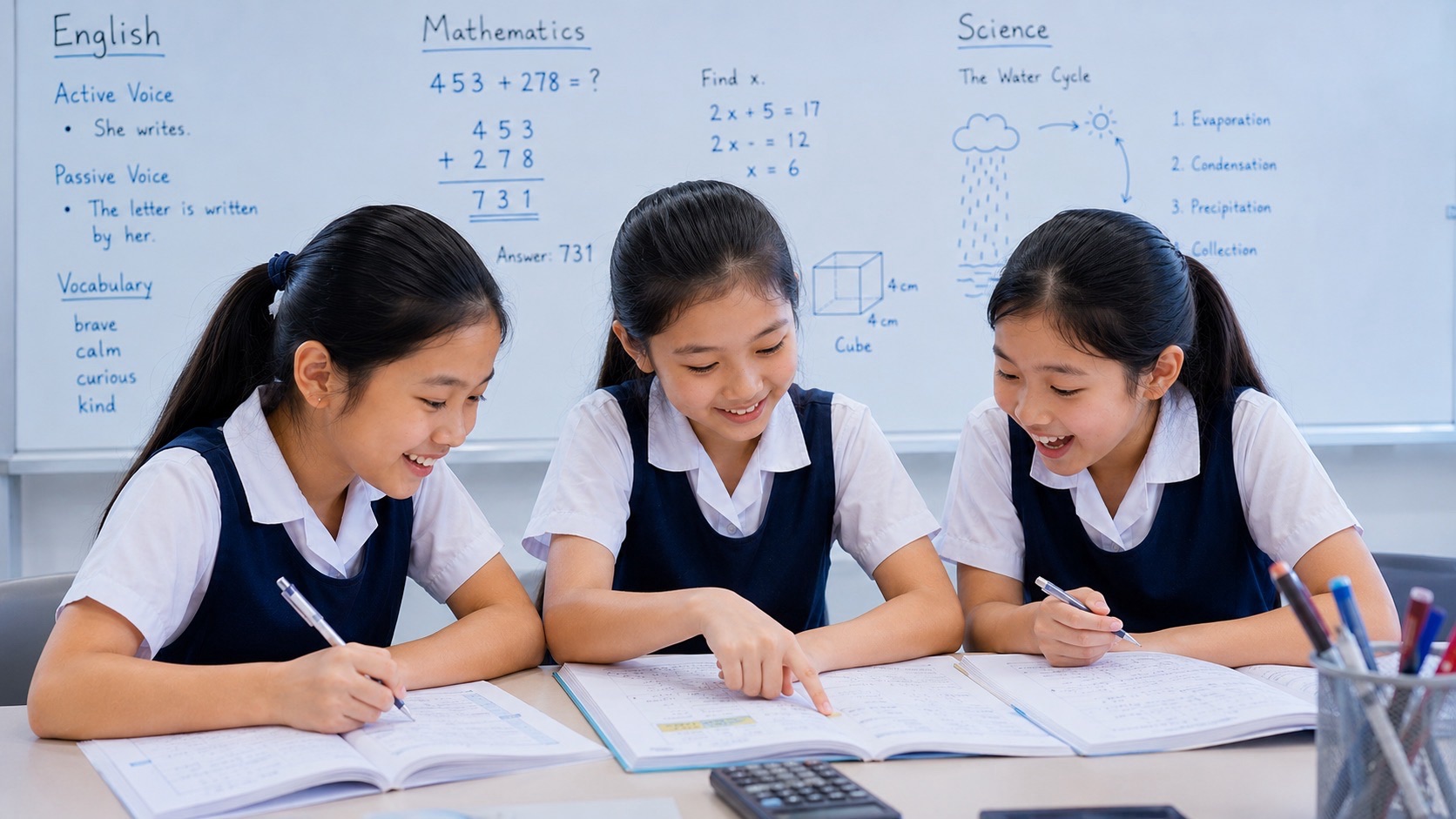
Three Students Can Work Well at P1—If the Group Is Carefully Matched
A three-student tutorial can help children hear different explanations and learn to communicate mathematical thinking.
But group fit matters. A child still learning one-to-one counting may not be well matched with a student already reasoning flexibly about place value and unknowns.
The same age is not enough. The learners need compatible readiness.
Do Not Add Tuition Simply Because Other Children Have Started
Primary 1 can create unnecessary comparison among families. One child is doing extra worksheets; another has started enrichment; a third appears to be learning future topics.
None of this proves your child needs the same schedule.
The relevant evidence is the learner in front of you.
Protect the Whole P1 Transition
Primary 1 is not only a Mathematics transition. The child is adjusting to school routines, reading demands, friendships, attention, homework and a longer day.
A tuition programme that improves Mathematics while exhausting the learner may have poor overall value.
What Progress Should Look Like
- Numbers feel connected to quantities.
- The child can explain simple relationships in words or drawings.
- Common mistakes become easier to self-correct.
- Mathematical language becomes less threatening.
- Independence grows.
- Confidence comes from understanding rather than worksheet familiarity.
The Better Parent Question
Instead of asking, “Should every Primary 1 child have Mathematics tuition?”, ask: Is there a specific readiness problem that needs structured diagnosis, or is my child developing well enough that calm home support remains the better use of time?
At Primary 1, the goal is not to be ahead. It is to build a mathematical floor strong enough for what comes next.
Current route: This legacy Bukit Timah P1 URL now owns the home-support-vs-formal-tuition decision rather than a current location claim. For the current P1 programme, continue to Primary 1 Mathematics Tuition and the Mathematics Article Directory.