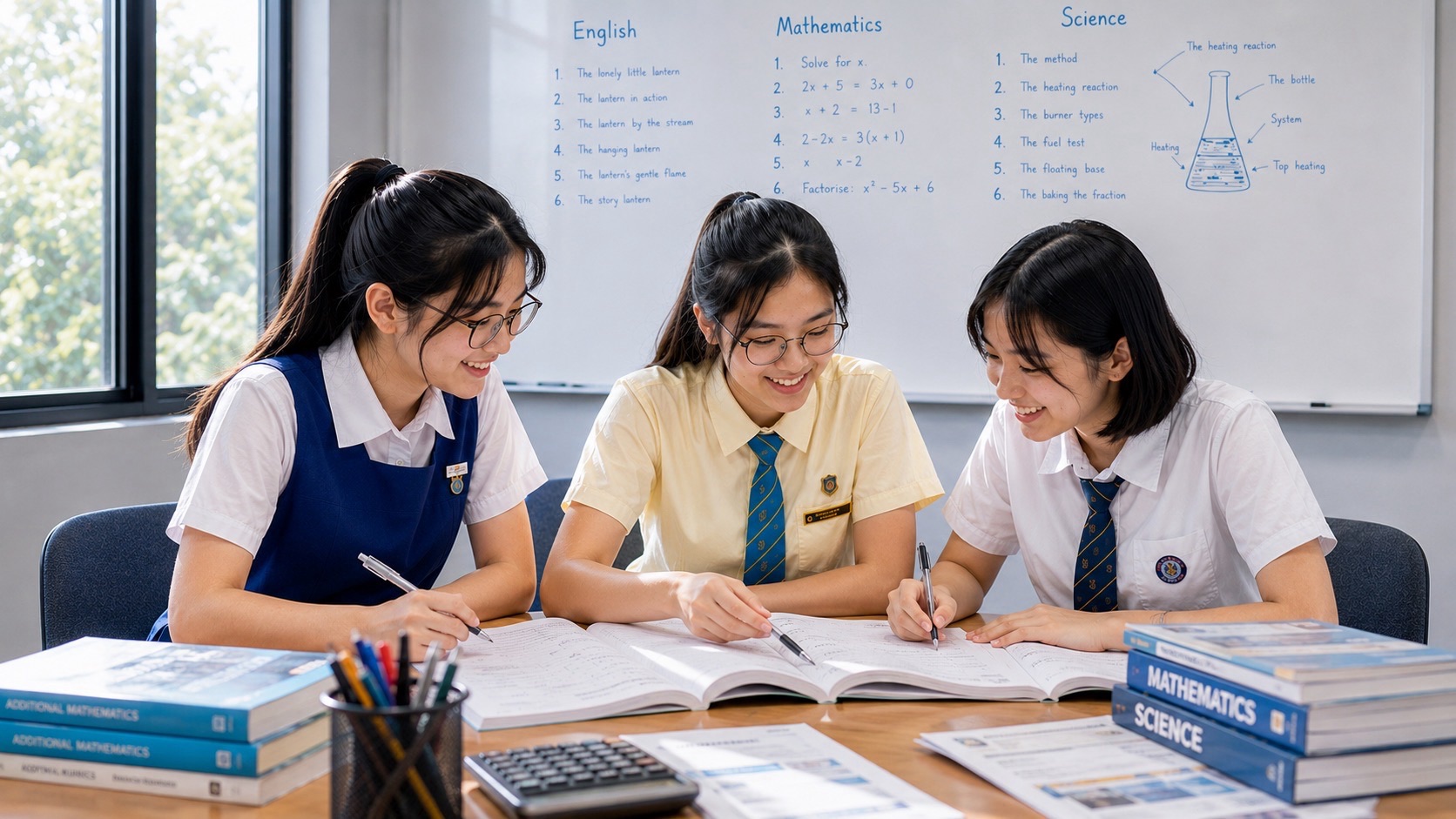
Writing flows when each sentence gives the next sentence something useful to continue.
For families looking for English tuition around Punggol Field, paragraph cohesion is a valuable Primary English focus. Students are often told to use more linking words, but a paragraph does not become coherent merely because it contains furthermore, however and therefore. Flow comes from relationships: reference remains clear, ideas develop in a sensible order, and each sentence contributes to the paragraph’s job.
At eduKate Singapore, our Punggol English classes are deliberately limited to three students, with lessons normally lasting 1.5 hours. From Primary 3 to Primary 6, we connect grammar, vocabulary, comprehension and composition so students learn not only how to write correct sentences, but how to make those sentences belong together.
Families preparing for the national examination can continue to our PSLE English tuition guide. Students developing language range can also use the eduKate Singapore Vocabulary Lists.

The Hidden Problem: Correct Sentences That Do Not Build Anything
A student may write five grammatically correct sentences and still produce a weak paragraph. Each sentence may be reasonable on its own, yet the paragraph repeats, wanders or changes direction without warning.
We ask the student to identify the paragraph’s job before expanding it.
- Is the paragraph establishing a situation?
- Is it explaining a reason?
- Is it developing a character’s response?
- Is it comparing two ideas?
- Is it moving the story towards a turning point?
- Is it showing a consequence?
Once the job is clear, each sentence can be tested against it. A sentence that does not develop, qualify, illustrate or move the paragraph may not belong.
Why More Connectors Can Make Writing Worse
Connectors are useful when they express a real relationship. They become distracting when inserted as decoration.
- Because should introduce cause.
- However should signal genuine contrast.
- Therefore should introduce a result supported by what came before.
- Meanwhile should manage simultaneous action or a relevant change of focus.
- For example should provide evidence or illustration.
We teach the relationship first and the connector second. This prevents mature-looking vocabulary from hiding weak logic.
Why Three Students Helps Cohesion Become Visible
The writer knows what was intended. Another reader only has the words on the page. In a three-student class, peers can identify where the paragraph becomes difficult to follow without turning the lesson into public criticism.
- One student reads the paragraph aloud.
- Another states what each sentence contributes.
- The third identifies the point where the relationship becomes unclear.
The tutor then helps the writer repair the smallest useful unit: reference, sequence, connector, missing explanation or paragraph direction.
Reference Is the Quiet Architecture of Flow
Pronouns and demonstratives—he, she, they, this, that, these—help writing flow only when the reader knows exactly what they refer to.
A paragraph can become confusing when two characters are both called he, when this points vaguely to an entire previous sentence, or when a noun disappears for so long that the reader must search backwards.
Students learn to repeat a key noun when clarity requires it. Avoiding repetition is not more important than preserving meaning.
Lexical Cohesion: Repeat the Idea Without Repeating the Same Sentence
Strong paragraphs often maintain a small family of related words. A paragraph about responsibility may use promise, duty, dependable, admit and consequence. These words keep the semantic field coherent without mechanically repeating one term.
We teach students to build language around the central idea rather than search for unrelated “advanced vocabulary”.
Sentence Order Is Reasoning
Sometimes every sentence belongs, but the order is weak. We teach students to test common organising patterns:
- cause → effect;
- claim → evidence → explanation;
- general idea → specific example;
- action → reaction → consequence;
- problem → attempted solution → result;
- earlier state → change → later state.
Changing sentence order can improve a paragraph more than adding new language.
Paragraph Openings and Endings Should Hand Information Forward
The first sentence should orient the reader to the paragraph’s new job. The final sentence should complete that job or create a natural hand-off to what follows.
In narrative writing, a paragraph may end on a decision that opens the next action. In expository writing, it may conclude a reason before the next paragraph introduces a different one. In comprehension, the answer should follow the reasoning order requested by the question.
The Fencing Method for Cohesion
When an entire composition feels disorganised, we reduce the field to three adjacent sentences or three adjacent paragraphs.
- Students label what each unit is doing.
- They identify the relationship between units.
- They remove unnecessary connectors.
- They repair reference and sequence.
- They read the result aloud to test flow.
Once local cohesion becomes reliable, the same process expands to the whole composition. The fence is temporary; independent control is the destination.
From Composition to Comprehension
Cohesion also helps students understand what they read. Reference words, connectors and lexical patterns reveal how a passage is organised.
- A contrast connector may signal a change in the writer’s position.
- A repeated semantic field may reveal the paragraph’s main concern.
- A pronoun may carry the subject across several sentences.
- A cause-and-effect chain may provide the evidence for an explanation question.
Students become stronger readers when they can see the same architecture they are learning to create as writers.
What a 90-Minute English Lesson Can Look Like
- Retrieval: earlier vocabulary, grammar or paragraph structures return.
- Model reading: students identify how a short paragraph maintains flow.
- Paragraph diagnosis: reference, sequence and relationship failures are located.
- Focused teaching: one cohesion mechanism is explained.
- Guided revision: students repair a paragraph with support.
- Independent writing: the same mechanism is used in a new paragraph.
- Read-aloud test: another reader checks where flow drops.
- Transfer: cohesion is applied to composition, comprehension or oral explanation.
Primary 3 to Primary 6 Progression
Primary 3 students first learn clear sequence, stable reference and paragraphs built around one central job. Primary 4 and Primary 5 students manage cause, contrast, evidence and more deliberate transitions. By Primary 6, students need to sustain cohesion across a complete composition and recognise the same relationships quickly in comprehension passages.
How We Read a Marked Composition
A weak flow comment can hide several different problems. We classify the earliest one.
- Did the paragraph lack a clear purpose?
- Were sentences in the wrong order?
- Did a pronoun lose its reference?
- Was a connector expressing the wrong relationship?
- Did the paragraph repeat instead of develop?
- Did a scene change without enough transition?
Different failures need different repairs. Telling the student to “make it flow” is not yet instruction.
What Parents Can Notice
- fewer paragraphs beginning with repetitive linking words;
- clearer pronoun reference;
- sentences build rather than restate;
- time and location changes are easier to follow;
- comprehension of passage structure improves;
- the child can explain the job of a paragraph; and
- revisions become more structural than cosmetic.
For Families Around Punggol Field
This page is a local route for families living around Punggol Field who are looking for Primary English tuition. It does not claim that lessons are conducted inside every named residence or public facility. Current class location, schedule and suitability should be confirmed directly with eduKate Singapore.
The student’s own schoolwork gives us the best evidence. We teach cohesion as a transferable language skill rather than as a neighbourhood-specific shortcut.
Frequently Asked Questions
Will students be taught lists of connectors?
Useful connectors are taught, but students first identify the relationship they need to express. A shorter list used accurately is stronger than a long list inserted mechanically.
Does this help comprehension too?
Yes. Recognising reference, sequence, cause and contrast helps students recover how a passage is organised.
Why three students?
Three provides genuine reader feedback while keeping each student’s paragraph and revision visible to the tutor.
Arrange a Punggol Field English Tuition Consultation
Call or WhatsApp Yuet Ling at +65 8823 1234 for current three-student Primary English class schedules and suitability.