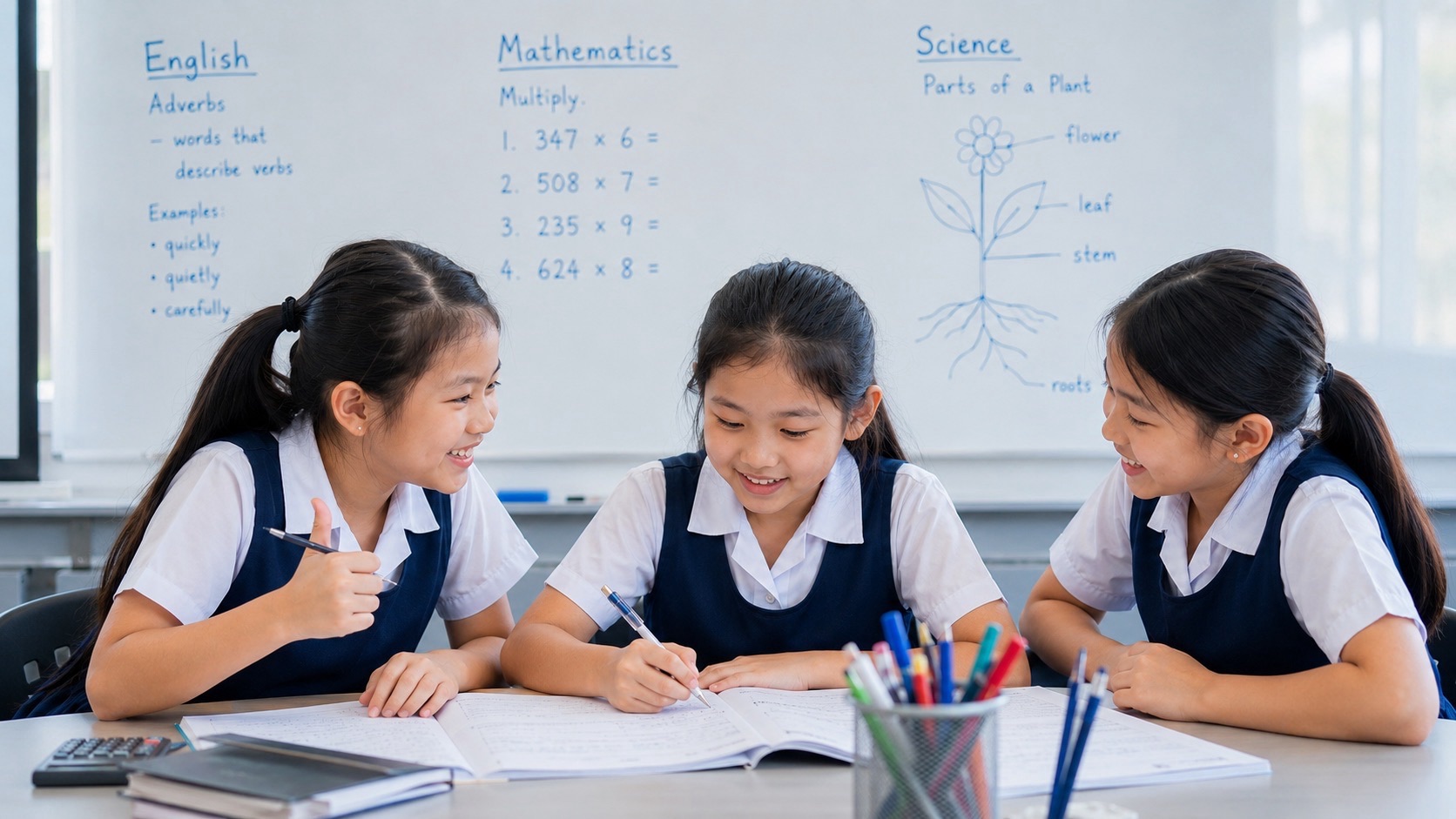
Quick Read: This 2017 Primary 2 vocabulary list is a learning bank, not an official MOE prescribed word list. The strongest use is not to memorise all seventy words at once. It is to select small groups, connect meaning to context, retrieve the word after a delay and use it naturally in reading, speaking and writing.
The title and URL remain unchanged. The rebuilt library edition serves search intent around Primary 2 vocabulary list, P2 English vocabulary, vocabulary words for Primary 2, English vocabulary with meanings, Primary school vocabulary, word meanings and vocabulary practice.
Primary 2 Vocabulary Should Build Access, Not Pressure
At Primary 2, vocabulary learning should widen what a child can understand and say. It should not turn every week into a contest to memorise the longest list. Children need common words, but they also benefit from richer words when those words are attached to stories, Science topics, places, actions and everyday situations.
A useful target is usable depth: the child can explain the word simply, recognise it in a new sentence and produce it later without seeing the answer.
The 70-Word Vocabulary Bank
| Word | Class | Core meaning | Example |
|---|---|---|---|
| adopt | verb | take something on as one’s own; legally take a child into a family | The class adopted a new reading routine. |
| ambition | noun | a strong desire to achieve something | Her ambition is to become an engineer. |
| advice | noun | guidance about what to do | My teacher gave me useful advice. |
| advantage | noun | a condition that makes success easier | Starting early gave us an advantage. |
| attitude | noun | a way of thinking or feeling | A positive attitude helped him keep trying. |
| attract | verb | draw attention, interest or movement towards something | Flowers attract bees. |
| average | noun / adjective | a typical amount; in maths, a calculated central value | The average score increased this term. |
| belief | noun | an idea accepted as true | Her belief changed after she saw the evidence. |
| beware | verb | be cautious about danger | Beware of the slippery floor. |
| brilliant | adjective | very bright, clever or excellent | The scientist proposed a brilliant solution. |
| chill | noun / verb | a feeling of coldness; make or become cold | A chill ran through the room when the air-conditioning started. |
| climate | noun | usual weather conditions of a place over a long period | Singapore has a tropical climate. |
| clog | noun / verb | block a passage | Leaves can clog a drain. |
| cling | verb | hold tightly or stay very close | The wet shirt clung to his back. |
| confess | verb | admit a wrongdoing or secret | He confessed that he had broken the model. |
| convince | verb | make someone believe or accept something | The evidence convinced her to change her answer. |
| continent | noun | one of Earth’s major land areas | Asia is the largest continent. |
| crumple | verb | crush or fold into wrinkles | She crumpled the paper by mistake. |
| custom | noun | a traditional way of behaving or doing something | The festival includes an old local custom. |
| defeat | noun / verb | loss in a contest; overcome an opponent | The team accepted defeat calmly. |
| defend | verb | protect from attack, criticism or harm | The goalkeeper defended the goal. |
| delay | noun / verb | a period of waiting; make something happen later | Heavy rain caused a delay. |
| diagram | noun | a drawing that explains arrangement or function | The diagram shows the parts of the plant. |
| distant | adjective | far away in place, time or relationship | We could see a distant mountain. |
| dissolve | verb | mix into a liquid until no longer separately visible; formally end | Sugar dissolves in water. |
| enable | verb | make something possible | The ramp enables easier access. |
| examine | verb | inspect or study carefully | We examined the leaf with a magnifying glass. |
| excel | verb | do extremely well | She excels in music. |
| explore | verb | investigate, travel through or study | The students explored the park. |
| fatal | adjective | causing death | The article explained why the disease can be fatal. |
| fierce | adjective | powerful, intense or aggressive | A fierce storm reached the coast. |
| fortunate | adjective | lucky or favoured by circumstances | We were fortunate to find shelter quickly. |
| flutter | noun / verb | move lightly and quickly, especially with wings | Butterflies fluttered above the flowers. |
| glide | verb | move smoothly and quietly | The swan glided across the pond. |
| gradual | adjective | happening slowly over time | The temperature showed a gradual rise. |
| grasp | noun / verb | hold firmly; understand an idea | She grasped the handle tightly. |
| habit | noun | a behaviour repeated regularly | Reading before bed became a habit. |
| harsh | adjective | rough, severe or unpleasant | The harsh sunlight made him squint. |
| imitate | verb | copy an action, sound or behaviour | The child imitated the bird’s call. |
| intelligent | adjective | able to learn, understand and reason well | The dolphin is an intelligent animal. |
| intention | noun | what someone plans or means to do | Her intention was to return the book. |
| launch | noun / verb | start or send something into motion | The team launched its model rocket. |
| locate | verb | find or identify the position of something | Can you locate Peru on the map? |
| loyal | adjective | faithful and supportive | The loyal dog stayed beside its owner. |
| method | noun | a particular way of doing something | We used a different method to solve the problem. |
| misery | noun | great unhappiness or suffering | The long illness caused great misery. |
| nectar | noun | sweet liquid produced by flowers | Bees collect nectar from flowers. |
| nursery | noun | a place for young children or young plants | The seedlings were grown in a nursery. |
| observe | verb | watch carefully or notice | Observe how the shadow changes. |
| opponent | noun | a person or team competing against another | She shook hands with her opponent. |
| permit | noun / verb | official permission; allow something | The sign does not permit cycling here. |
| portion | noun | a part or share of a whole | He ate only a small portion. |
| precious | adjective | very valuable or deeply important | The family protected the precious photograph. |
| proceed | verb | continue or move forward | Please proceed to the next station. |
| recent | adjective | having happened not long ago | A recent storm damaged the trees. |
| recognise | verb | identify something previously known | I recognised the tune immediately. |
| request | noun / verb | an act of asking politely or formally | She requested more time. |
| resist | verb | oppose, withstand or refuse to give in | The material can resist heat. |
| respond | verb | reply or react | He responded to the question clearly. |
| reveal | verb | make something known or visible | The test results revealed a pattern. |
| routine | noun / adjective | a regular sequence of actions; usual | Packing his bag became part of his routine. |
| route | noun | a path or way from one place to another | We chose the shortest route home. |
| source | noun | the place, person or thing from which something comes | The river is a source of water. |
| survive | verb | remain alive or continue to exist | Some plants survive in very dry places. |
| threat | noun | a sign or possibility of harm or danger | Flooding is a threat to low-lying areas. |
| tragic | adjective | causing or involving great sadness or disaster | The story ended with a tragic accident. |
| typical | adjective | having the usual features of a group or kind | This is a typical tropical afternoon. |
| vacant | adjective | empty or available for use | The seat beside me was vacant. |
| vast | adjective | extremely large | The desert covers a vast area. |
| venture | noun / verb | a risky or uncertain undertaking; go somewhere despite risk | They ventured further along the trail. |
How to Break a Long List Into Small Learning Sets
Seventy words are too many for one sitting. Divide them into semantic or functional groups. This gives the child more memory connections.
Thinking, learning and communication
- advice
- belief
- convince
- diagram
- examine
- grasp
- imitate
- intention
- method
- observe
- recognise
- respond
- reveal
- source
Character, behaviour and social life
- ambition
- attitude
- confess
- loyal
- opponent
- request
- resist
- custom
- habit
Movement and action
- attract
- cling
- crumple
- defend
- delay
- enable
- explore
- flutter
- glide
- launch
- locate
- proceed
- venture
World and Science
- climate
- continent
- dissolve
- nectar
- nursery
- survive
- threat
- vast
Description and judgement
- brilliant
- distant
- fatal
- fierce
- fortunate
- gradual
- harsh
- intelligent
- precious
- recent
- tragic
- typical
- vacant
Words With Multiple Meanings Need Extra Attention
| Word | Meaning 1 | Meaning 2 |
|---|---|---|
| average | a typical level | a calculated mathematical value |
| chill | a feeling of coldness | to cool something |
| clog | to block a passage | an object causing blockage; also a type of shoe in another context |
| defeat | a loss | to overcome an opponent |
| dissolve | mix into a liquid until no longer separately visible | formally bring something to an end |
| grasp | hold firmly | understand an idea |
| launch | send something into motion | start a project, product or event |
| permit | official permission | to allow |
| request | an act of asking | to ask |
| venture | a risky undertaking | to go somewhere despite risk |
Near-Neighbour Comparisons
| Words | Difference |
|---|---|
| route / routine | A route is a path; a routine is a repeated sequence of actions. |
| custom / habit | A custom is a shared traditional practice; a habit is a repeated individual behaviour. |
| observe / examine | Observe means watch or notice carefully; examine suggests closer inspection or study. |
| belief / advice | A belief is something accepted as true; advice suggests what someone should do. |
| fierce / harsh | Fierce suggests intensity or aggression; harsh suggests severity, roughness or unpleasantness. |
| fortunate / brilliant | Fortunate concerns luck; brilliant can mean very bright, clever or excellent. |
| respond / request | Respond means reply or react; request means ask. |
| source / route | A source is where something comes from; a route is the path it takes. |
Vocabulary in Science
Primary vocabulary becomes stronger when it crosses subjects. Climate, dissolve, nectar, observe, source, survive and diagram can all appear naturally in Science. A child who sees the same word in several contexts builds a more durable meaning network.
Example: “Observe how the sugar dissolves.” One sentence connects two target words with a real process.
Vocabulary in Stories
Words such as confess, loyal, threat, misery, fierce, fortunate and intention become memorable when attached to characters. Instead of asking a child to write a random sentence with loyal, ask for a moment where a character proves loyalty through action.
Vocabulary in Everyday Life
- request extra time
- choose a route home
- follow a routine
- beware of danger
- locate an item
- examine a broken toy
- respond to a message
- give advice
- develop a habit
Words become easier to retrieve when they are linked to real routines and objects.
A Five-Word Learning Cycle
- Choose five words.
- Explain each in child-friendly language.
- Read one example aloud.
- Ask the child to create a different example.
- Hide the words and give meaning clues.
- Return two or three days later and retrieve again.
- Use one or two target words during normal conversation or reading.
Do Not Force Adult-Level Abstract Meanings Too Early
Some words in this historical list are challenging for Primary 2. That does not make them forbidden, but the teaching should match the learner. Ambition, belief and intention are abstract. Teach them through stories and situations rather than dictionary language alone.
The page is therefore best used as a reference bank from which adults select appropriate words, not as a one-week spelling test.
Mini Practice: Choose the Best Word
- The butterfly began to ______ above the flowers.
- Please ______ the diagram carefully before answering.
- The signs helped us ______ the correct entrance.
- The heavy leaves may ______ the drain.
- The climbers chose a safer ______ down the mountain.
- The warm ______ allows many tropical plants to grow.
- She had no ______ of hurting anyone.
- The puppy remained ______ to its owner.
- The sugar began to ______ in the warm water.
- He finally decided to ______ that he had taken the pen.
Suggested answers: flutter, examine, locate, clog, route, climate, intention, loyal, dissolve, confess.
Mini Practice: Explain the Difference
- route and routine
- habit and custom
- observe and examine
- fierce and harsh
- respond and request
- fortunate and brilliant
The child does not need dictionary-perfect definitions. A clear contrast in simple language is enough.
A Parent-Friendly Weekly Plan
| Day | Task |
|---|---|
| Monday | Introduce five words through stories or examples. |
| Tuesday | Match words to meanings and pictures where possible. |
| Wednesday | Use three words in speech. |
| Thursday | Retrieve all five from clues without the list. |
| Friday | Read a short paragraph containing the words. |
| Weekend | Use two words in writing or a drawing-and-caption activity. |
Frequently Asked Questions
Is this an official Primary 2 vocabulary list?
No. It is an eduKate learning resource preserved from 2017.
Are some of these words too hard for Primary 2?
Some are advanced. Use the list selectively. The right word is one the child can understand in context and revisit repeatedly.
How many words should a Primary 2 child learn at once?
Small sets are usually more manageable. Five to eight words can work well, depending on the child and the difficulty of the words.
Should spelling be learned together with meaning?
Yes, but meaning and use should come first. A correctly spelled word that the child does not understand is shallow knowledge.
Library Routes
- Vocabulary Article Directory
- eduKate Vocabulary Learning System
- Primary 5 Vocabulary List
- Singapore Learning Library
Library note: The original 2017 page was a weekly Primary 2 word list. The 2026 edition preserves the title and URL while rebuilding it as a seventy-word reference bank with meanings, examples, semantic groups, multiple meanings, contrasts, practice and a low-pressure learning routine.