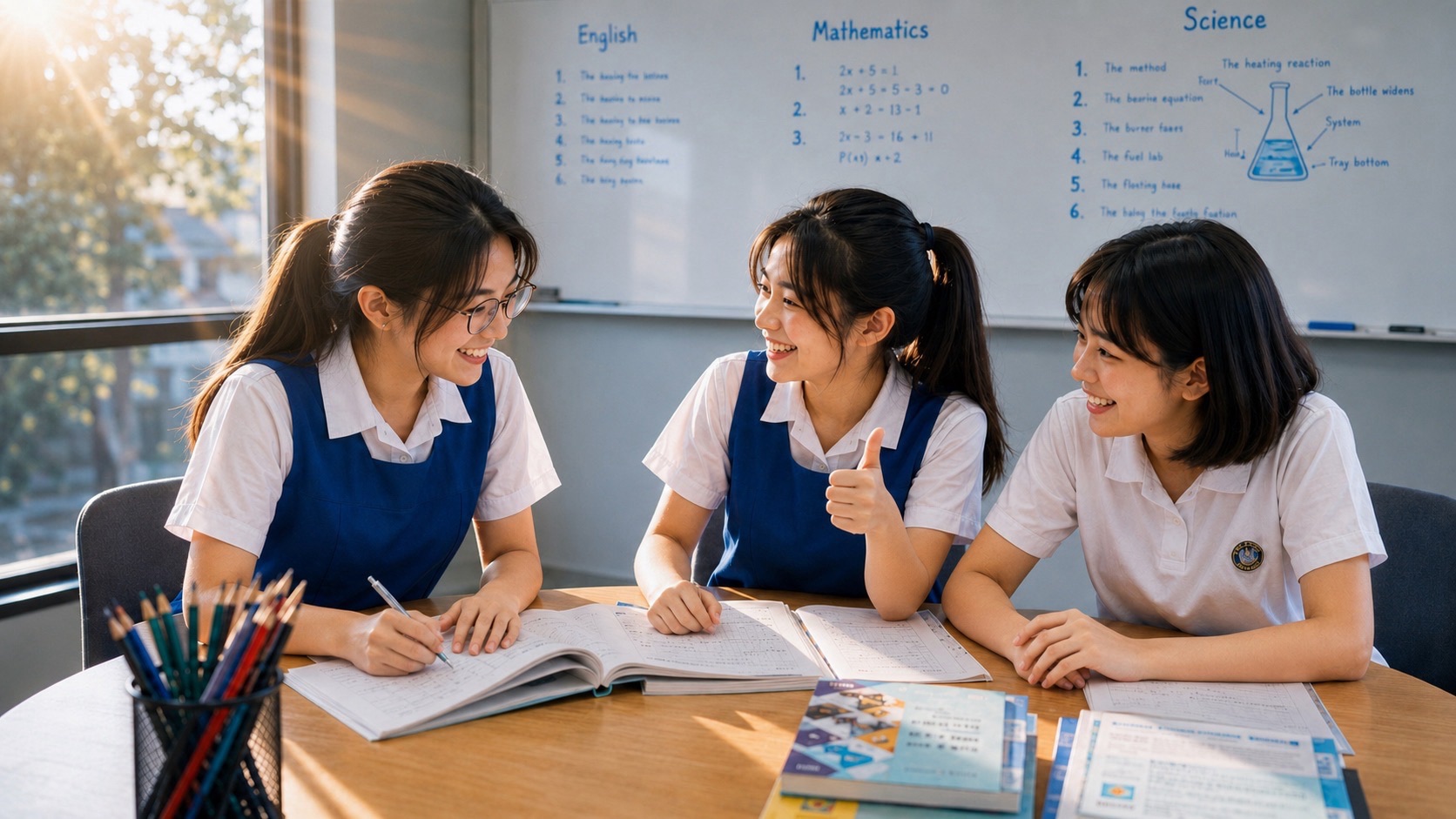
Punggol English Tuition Centre does MOE syllabus English, Maths and Science lessons for Pri1-6, Sec1-4 Express, 5 Normal(Academic). We are a small group format tuition centre at Punggol English with expert tutors that operates on a holistic approach to education.
Understand first, practice lots, Enjoy the learning process.
Following the curriculum format setup of MOE and SEAB, we believe that students should firstly understand their topics before attempting to answer any questions. Hence, we teach everything from scratch, making sure students understand their work, enjoy what they learn and be cognizant of its relevancy to everyday activities. The keyword here is “enjoy”, because once students enjoy the things they are learning, they latch onto the concepts faster and can apply it easily. To the point where our students are consistent in earning proficiency awards in their schools.
In opposition to that, a student that does not understand their work, struggles to comprehend the question and ability to answer the questions are destructive to the ability and psyche to study. Frustration sets in, then coupled with a constant fear of examinations and a general dislike to learn.
That does not happen at eduKate Punggol, as you can see from the photos below.


Custom classes for a gamut of students
eduKate Punggol do not stick to one formula and hope that it works. We alter and tune our teaching methods to the learning culture of students in that particular class in the aim to maximise the studying process and be efficient in workload delivery. We know n two students are alike, which means we teach them to their strengths, identify their weakness and overcome them on a case-by-case basis.

Holistic Education in Punggol
Of course, we setup our classes to be holistic in nature, doing everything beyond the class to make sure students learn more than curriculum, a very much needed criteria in the 21st Century. We have to teach them the relevance of a quality education in Singapore, and its potential to provide the stability in the uncertainty of the future. During the holidays, we have programs that gets students out of the classroom, with collaborations with other education facilities.
eduKate Primary Students Holistic Programme: Applying Biology, Physics, Maths and Strategy into real world applications:


Community development and eduKate Secondary students applying what they learn in our English classes, social development and character building.


Actions speaks louder than words
We talk the talk, and walk the walk. Our work doesn’t end when the student steps out of the classroom. Firm believers in education by process of learning, our students are our future and their success, ours.


For our classes, call Yuet Ling +65 88231234. See you soon!


What eduKate Does Educationally
The useful answer is not a list of subjects. The educational work is a cycle: diagnose what is missing, teach the underlying idea clearly, practise until the learner can use it, revisit it after a delay, transfer it to a changed task, and reduce support as independence grows.
The Six-Part Teaching Cycle
- Diagnose: find the earliest weak link.
- Explain: teach the concept from first principles where needed.
- Practise: build accurate use without unnecessary complexity.
- Retrieve: test whether the learning survives after time has passed.
- Transfer: change the wording, representation or context.
- Release: reduce prompts as the learner becomes more independent.
Teach From the Beginning—But Only as Far Back as Necessary
“Teach from scratch” should not mean restarting an entire subject automatically. It means tracing the error backward until the first missing dependency is found. A Secondary Mathematics problem may require a Primary fraction repair. A Science explanation problem may actually be a language-precision problem. The rebuild should begin at the first failed layer.
Understanding Comes Before Volume
Practice is valuable after the learner has something correct to practise. Repeating an unstable method at high volume can make the error more fluent. The sequence should therefore be understanding → controlled practice → retrieval → transfer → examination execution.
Different Subjects Need Different Machinery
| Subject | Core learning machinery |
|---|---|
| English | language access, inference, expression, audience and editing |
| Mathematics | representation, symbolic fluency, method selection and checking |
| Science | concept models, evidence, mechanism and experimental reasoning |
Enjoyment Is Not Entertainment
A useful lesson does not need to be easy or constantly amusing. Enjoyment can come from understanding something that was previously confusing, seeing improvement, solving a difficult problem, participating safely in discussion or discovering that knowledge connects to the real world.
Small Groups Should Increase Feedback Resolution
A small group earns its value when the tutor can inspect each learner’s thinking, vary scaffolding and still use peer comparison productively. The class size is not the educational outcome; better diagnosis and faster feedback are.
What Progress Should Look Like
- fewer repeated errors;
- better delayed retrieval;
- stronger transfer to unfamiliar questions;
- more precise self-correction;
- less dependence on tutor prompts;
- more stable performance under examination conditions.
Historical Boundary
The original 2017 page contained operating details from a different education and centre context. Those details belong to the archive. The durable teaching cycle above is the part worth carrying forward.