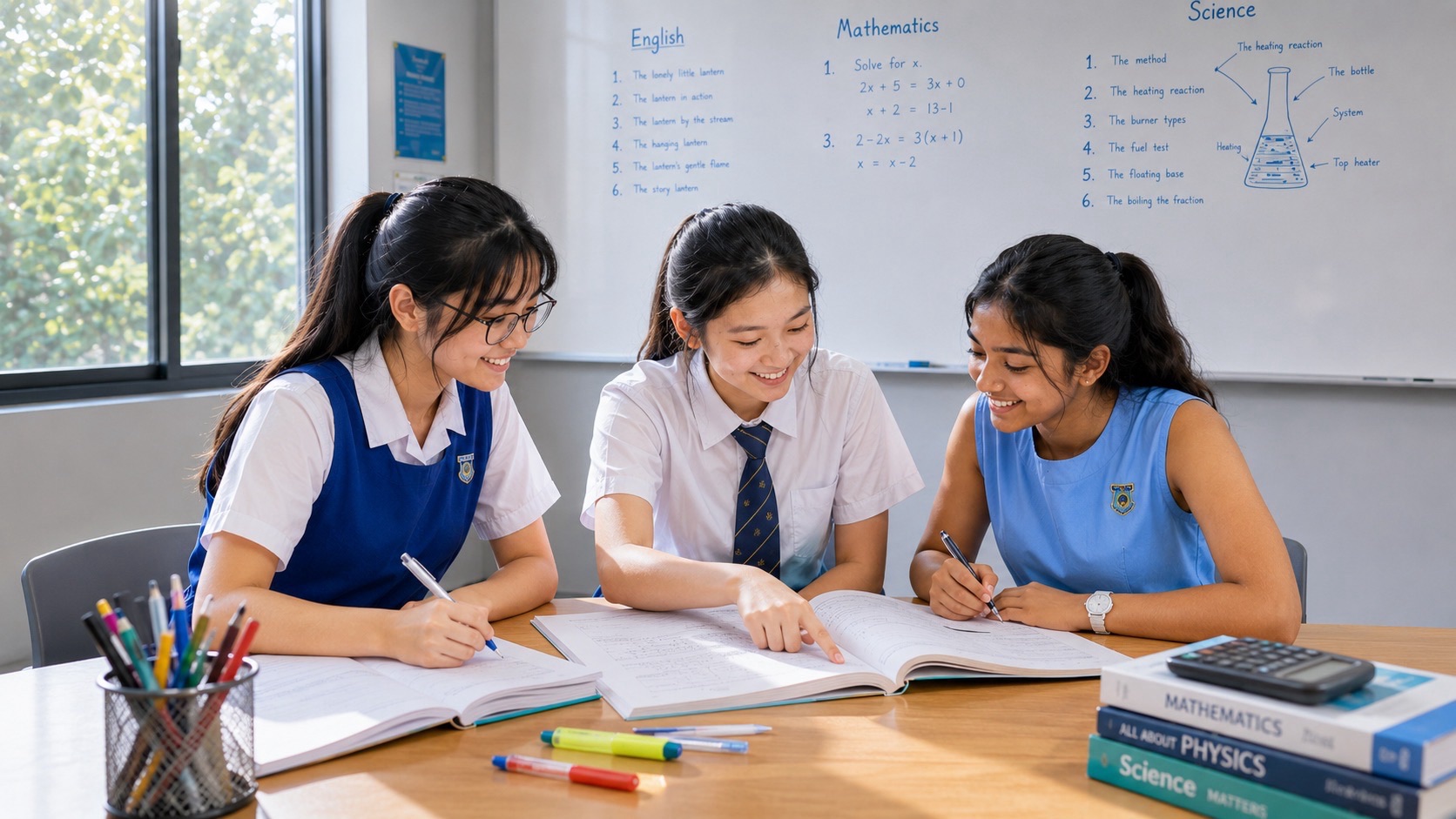
Originally published 4 June 2017 as a broad Punggol Mathematics tuition page promoting real-world applications and score improvement. Rebuilt in 2026 as a noindexed guide to using context well in Mathematics. Unsupported mark-improvement claims, grade guarantees, 24/7 support claims and unrelated image clutter have been retired.
Quick answer: real-world context helps Mathematics when it makes the relationship easier to see, gives quantities meaning, or provides a reason to check whether an answer is plausible. It becomes unhelpful when the story adds noise, suggests an operation through superficial keywords, or distracts from the mathematical structure. The useful cycle is world situation → identify quantities and constraints → build a mathematical representation → solve → interpret the result → return to the world and ask whether the model still makes sense.
This page is intentionally noindex. Its reader job is the role of real-world context in Mathematics learning and modelling, not general tuition ownership.
Context is a bridge, not the Mathematics itself
A train journey, shopping problem, water tank, sports statistic or building plan can make Mathematics feel concrete. But the student still needs to extract the underlying relationship.
- Which quantities matter?
- What units do they use?
- How are the quantities related?
- What conditions limit the answer?
- What information is irrelevant?
The mathematical work begins when the story is translated into structure.
A good context reduces abstraction cost at the right moment
When students first meet a relationship, familiar quantities can help them build meaning.
- ratio through mixtures or comparisons;
- percentage through discounts or changes;
- speed through journeys;
- area through floor plans;
- graphs through changing quantities over time.
The context is useful because it gives the symbols something to refer to.
But familiar stories can also create false shortcuts
Students sometimes learn to react to words rather than relationships.
- “more” does not always mean add;
- “left” does not always mean subtract;
- “of” does not always reveal a single fixed operation;
- “average” has a mathematical meaning that may differ from casual speech.
Keyword solving can work on familiar exercises and fail badly when the wording changes.
Translate the world into a mathematical model
A useful model can be:
- a bar model;
- a diagram;
- a table;
- a graph;
- an equation;
- a ratio;
- a labelled timeline.
The model is a selective representation. It keeps the relationships needed for the problem and leaves other real-world detail out.
Modelling always involves assumptions
Even simple school Mathematics contains assumptions.
- a speed may be treated as constant;
- a container may be treated as a perfect geometric solid;
- prices may be assumed not to change during the problem;
- measurement error may be ignored;
- people may be represented as identical units in a counting problem.
For Primary and Secondary students, the goal is not to make every model sophisticated. It is to recognise that a mathematical answer is valid inside the assumptions of the representation.
Observed, interpreted, unresolved
Context problems are especially useful for distinguishing evidence from interpretation.
- Observed: the question gives a 12 km journey completed in 30 minutes.
- Interpreted: the relationship can be represented using distance, time and speed.
- Unresolved: whether the stated speed is intended to be constant throughout the whole journey.
School questions usually supply enough conditions to resolve the intended model, but learning to notice assumptions improves mathematical reading.
Return to the world after solving
Many students stop when the calculator or arithmetic produces a number. The model should return to the original situation.
- What does this number represent?
- What unit belongs to it?
- Is it plausible?
- Does it satisfy the stated constraints?
- Would the conclusion still hold if the assumptions changed?
This is where context becomes a checking tool rather than decoration.
Real-world plausibility can catch mathematical errors
A negative length, a probability above the possible range, a person travelling at an implausible speed or a percentage that contradicts the stated change should trigger a review.
Plausibility does not prove an answer is correct, but it can reveal when the calculation has left the model’s valid range.
Context should gradually be removable
If a student understands ratio only when the problem involves sweets, the concept is still tied too tightly to one story.
A useful sequence is:
familiar context → diagram/model → abstract relationship → new context → context-free problem → return to application.
The student should learn both directions: abstract from a situation and apply the abstraction back to another situation.
Use contrasting contexts to reveal the invariant
If two very different stories share the same mathematical structure, compare them.
- recipe mixture and map scale;
- tax discount and percentage increase;
- water flow and travel rate;
- floor area and geometric diagrams.
The surface changes. The mathematical relationship remains.
Do not add context merely to make a question “fun”
A long story about a fashionable topic can increase reading load without improving mathematical meaning.
A context earns its place when it does at least one useful job:
- clarifies a quantity;
- makes a relationship visible;
- supports estimation;
- creates a meaningful constraint;
- tests whether the learner can model an unfamiliar situation.
Language can hide the Mathematics
A student can understand the underlying operation and still fail to access a word problem because the language is dense.
- restate the problem in simpler language;
- label quantities;
- remove irrelevant information temporarily;
- draw the relationship;
- then return to the original wording.
The final step matters. The support should help the student access the original task, not permanently replace it.
A modelling loop
| Stage | Question |
|---|---|
| World | What is happening? |
| Extraction | Which quantities and constraints matter? |
| Representation | What mathematical model shows the relationship? |
| Solution | What follows mathematically? |
| Return | What does the result mean in the original situation? |
| Boundary | When would this model stop being appropriate? |
Diagnose whether context is helping or hurting
If a student solves the same relationship easily in symbols but fails in a story, the problem may be language-to-model translation. If they fail in both forms, the underlying Mathematics may be weak. If they succeed only in one familiar story, transfer may be weak.
| Observed pattern | Possible first weak link | Smallest test |
|---|---|---|
| Symbolic correct, story wrong | Translation/representation | Same structure in simpler wording |
| Both wrong | Underlying concept | Simple abstract relationship |
| Only familiar context correct | Surface dependence | New context, same structure |
| Answer numerically correct but implausible | World-return checking | Estimate before solving |
The smallest useful repair depends on the failure
- language failure → simplify wording, then restore it;
- representation failure → draw/table/model;
- concept failure → rebuild the relationship;
- checking failure → estimate and interpret units;
- transfer failure → new context with same structure.
Historical classroom context
The original 2017 Punggol Mathematics page argued that lessons should connect to real-world applications. That purpose remains valuable, but the rebuilt version adds the necessary boundary: context should expose mathematical structure and support return-to-world checking, not become motivational decoration or a substitute for abstraction.


A compact world-to-Mathematics-to-world cycle
read situation → extract quantities/constraints → represent relationship → solve → interpret units → check plausibility → test assumptions → transfer to a new context.
What parents, tutors and students can measure
- Can the student distinguish relevant from irrelevant context?
- Can they extract quantities and constraints?
- Can they build an appropriate representation?
- Can they solve the same relationship without the familiar story?
- Can they apply it in a different context?
- Do units and plausibility inform checking?
- Can the student state an important assumption or boundary of the model?
What not to conclude
- A real-world story does not automatically make Mathematics more meaningful.
- Keywords should not replace relationship reasoning.
- The model is a selective representation, not the whole real situation.
- Context should eventually be removable so abstraction can transfer.
- An answer is incomplete until its meaning, units and plausibility return to the original situation.
- The strongest context makes the Mathematics more visible—not less.
Related Mathematics routes
- What a Mathematics Tutor Should Look for in a Student’s Working
- Why P5 Speed Problems Are Really About Three Quantities and One Relationship
- How Mathematics Changes From Secondary 1 to Secondary 4
For current eduKate programme information, use the contact page.