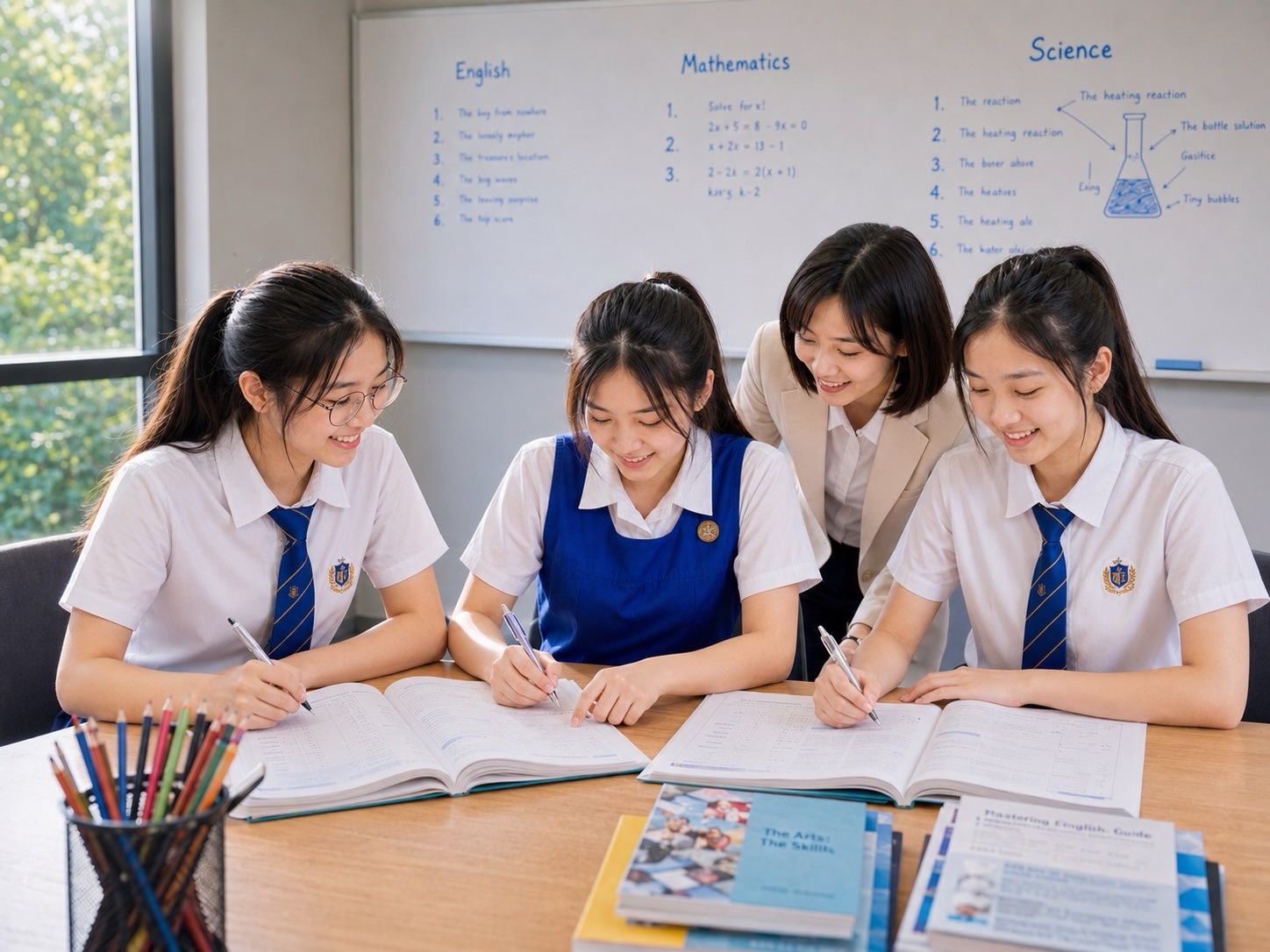
Quick answer: Primary Science improves when a child can do more than remember a fact. The student must recognise which scientific idea matters, connect that idea to the evidence in the question, explain the cause accurately, and communicate the reasoning in a form the examiner can follow.
This page was first published in 2014 as a local Yishun tuition-centre advertisement connected with Huamin Primary School. The old address, tutor claims, A* promises and historical contact information are no longer used here. This 2026 rebuild gives the URL a current educational job: a Primary Science learning and tuition guide for Huamin Primary School and Yishun families.
eduKate is an independent tuition provider and is not affiliated with, endorsed by, or part of Huamin Primary School. The school name remains in this historical URL because the original page was written for families in that locality. Current class locations and placement should always be checked through the eduKate Singapore tuition homepage.
Primary Science changed because the job of Science was always bigger than memorising model answers
The current MOE Primary Science syllabus frames Science around a strong foundation in scientific knowledge, practices and values. Its broader vision is captured through the ideas of Inspire, Inquire and Innovate.
That direction matters in tuition. A child who only memorises polished answer phrases may perform well when a question looks familiar and still collapse when the setup changes.
We therefore treat Primary Science as a connected system:
- observe accurately;
- identify what is changing;
- recall the relevant concept;
- distinguish observation from inference;
- connect cause to effect;
- interpret tables, diagrams and graphs;
- evaluate whether a test is fair;
- predict from scientific relationships; and
- communicate an explanation precisely.
Facts remain essential. They become useful when the student knows what to do with them.
The 2026 PSLE Science paper makes this distinction visible
SEAB states that the PSLE Science examination from 2026 assesses attainment in the 2023 Primary Science syllabus. Its assessment objectives are divided into two broad areas.
Knowledge with Understanding
Students must demonstrate knowledge and understanding of scientific facts, concepts and principles.
Application of Knowledge and Scientific Inquiry
Students must apply concepts and scientific inquiry. SEAB explicitly includes making predictions and hypotheses, interpreting and analysing information, evaluating observations or methods, and communicating explanations and reasoning.
The current paper is 1 hour 45 minutes. Booklet A has 30 multiple-choice questions worth 60 marks. Booklet B has 10–11 structured questions worth 40 marks. Students answer all questions.
Use the current SEAB PSLE 2026 formats and MOE’s 2023 Primary Science syllabus whenever official details matter.
Why a student can “know the chapter” and still lose Science marks
A child may recite that heat flows from a hotter object to a colder object and still answer a heat question poorly. Another may know that plants need light for photosynthesis but fail to use the idea correctly when the experiment changes. Another may remember the parts of the digestive system but not interpret a new diagram.
The visible wrong answer can come from several different places.
- Concept gap: the scientific relationship itself is not understood.
- Vocabulary gap: a word such as “dissolve”, “evaporate”, “insulator” or “variable” is being used imprecisely.
- Observation/inference confusion: the student states an explanation as though it were directly observed.
- Question-reading error: the response explains the phenomenon but not the comparison asked.
- Evidence gap: the answer gives a fact but does not connect it to the data or setup.
- Causal-chain gap: one important step between cause and outcome is missing.
- Experimental-design gap: the student does not recognise controlled, changed or measured conditions.
- Communication gap: the idea is present mentally but the written answer is incomplete or ambiguous.
A useful tuition lesson has to discover which of these is happening before assigning more questions.
Why we use a three-student Science tutorial
Science answers often reveal more through the student’s explanation than through the final mark. A three-student group gives the tutor enough time to hear those explanations and inspect how each child is interpreting a diagram, experiment or data set.
- Each student is asked to explain why an answer is true.
- Different interpretations can be compared without turning the lesson into a lecture hall.
- The tutor can identify whether an answer was understood or guessed.
- Structured-response wording can be corrected immediately.
- Students can see that two answers may use different wording while preserving the same scientific relationship.
- Misconceptions are exposed before they become rehearsed.
The small group is not valuable because “small” sounds premium. It is valuable when it increases the resolution of teaching.
What happens during a 90-minute Primary Science lesson?
1. Retrieval from earlier topics
Science knowledge is cumulative. A short retrieval set brings earlier concepts back into working use and reveals what has been forgotten.
2. Build or repair the concept
The tutor teaches the scientific relationship with clear examples, diagrams, comparisons or simple demonstrations where useful. The objective is meaning before answer phrasing.
3. Guided interpretation
Students read diagrams, experiments, tables and short scenarios. The tutor asks what can actually be observed, what must be inferred and which information is relevant.
4. Structured answering
Students turn the scientific idea into an answer that matches the question. Prompts are gradually reduced.
5. Variation
The surface of the problem changes. Students must decide whether the same concept still applies and what evidence now matters.
6. Error review
Errors are classified: concept, evidence, inference, language, experimental design, graph reading, causal chain or examination execution.
7. Focused continuation work
Home practice returns the student to the exact idea that needs stabilising. We prefer purposeful repetition to indiscriminate volume.
The Science answer chain: from observation to explanation
A strong structured answer often contains five moves.
- Read the condition: what is different between the cases?
- Identify the evidence: what did the table, graph, diagram or experiment show?
- Select the concept: which scientific relationship explains that evidence?
- Build the causal bridge: how does the condition produce the observed result?
- Close the loop: answer the comparison, prediction or conclusion actually asked.
For example, saying “Plant A grew better because it got more light” may still be incomplete if the question asks about food production. The student may need to connect greater light availability to the rate or amount of photosynthesis, then connect that to the production of food needed for growth, depending on the exact evidence and wording of the item.
The important principle is not to memorise that sentence. It is to understand the causal chain well enough to rebuild it when the experiment changes.
Observation is not inference
This distinction causes many avoidable errors.
An observation is something given or measured: the bulb is brighter, the water level fell, the object moved 5 cm, the leaf had fewer starch-positive areas.
An inference is an explanation drawn from the observation: more current may have flowed, water may have evaporated, a force caused motion, less photosynthesis occurred.
Good Science writing keeps these layers clear. Students should know when they are reporting evidence and when they are explaining it.
Scientific inquiry: learning to ask whether a test is actually fair
Experiment questions become much easier when students understand the logic rather than memorise a list of “variables”.
- What factor are we deliberately changing?
- What outcome are we measuring or observing?
- What other factors could also change that outcome?
- Which of those need to be kept the same?
- Would the measurement actually answer the stated question?
- Is the evidence sufficient for the conclusion?
Once students see the experiment as a causal test, “changed variable”, “measured variable” and “controlled conditions” stop being isolated vocabulary and become parts of a coherent design.
Reading graphs and tables as evidence
A graph is not merely a picture that comes before the question. It is a compressed argument.
Students learn to check:
- what each axis or column represents;
- the units;
- the scale;
- whether the values rise, fall, remain constant or change direction;
- which comparison is valid;
- whether the graph shows association or supports a causal conclusion from the experiment; and
- which scientific concept explains the pattern.
Students who learn to read evidence before reaching for a memorised answer become much more adaptable.
Primary 3: build the language of observation and classification
Primary 3 is where formal school Science becomes more visible for many students. The early job is to build accurate observation, comparison, classification, material properties and the language needed to describe patterns.
Students who rush immediately into model-answer memorisation can miss this foundation. We want them to notice carefully and state what the evidence actually supports.
Primary 4: connect systems, matter, light and heat to explanation
By Primary 4, students encounter more explicit systems and causal relationships. Plant and human systems, matter, light and heat create opportunities to ask not only “what happens?” but “why does it happen?”
This is an important bridge year. Students should begin writing complete explanations without turning every answer into a memorised paragraph.
Related route: Yishun Primary 4 Science Small-Group Tuition.
Primary 5: scientific systems begin to interact
Primary 5 brings greater content density and more connected systems. Students may understand each chapter separately and still struggle when questions cross boundaries.
The tuition priority becomes integration: retrieve older concepts, connect systems, interpret more complex evidence and maintain precision in longer explanations.
Related route: Yishun Primary 5 Science Small-Group Tuition.
Primary 6: integrate, transfer and execute under PSLE conditions
Primary 6 is not merely the year to complete the final topics. It is the year to integrate the entire Primary Science model.
- retrieve across several years of content;
- recognise which concept is relevant in unfamiliar contexts;
- interpret experimental evidence;
- write structured explanations efficiently;
- avoid overclaiming beyond the data;
- manage multiple-choice accuracy; and
- operate within the 1 hour 45 minute paper.
Related route: Yishun Primary 6 Science Small-Group Tuition.
Three student pathways
Repair
The child is confused by current work because an earlier concept or language layer is missing. We return to the first unstable point, rebuild it and reconnect it to the school topic.
Stabilise
The child understands lessons but loses marks through inconsistent recall, incomplete explanations or misreading of experiments. We use retrieval, mixed questions and repeated error analysis to make performance dependable.
Extend
The child is secure and ready for deeper inquiry. We use less familiar contexts, require stronger justification and ask the student to evaluate evidence rather than merely state the textbook conclusion.
How we reduce the “keyword problem”
Science teachers often emphasise keywords because scientific language needs precision. The danger is teaching students that marks come from sprinkling the right nouns into a sentence.
Keywords work when they name the correct concept inside the correct relationship.
We therefore teach students to ask:
- What is the relationship I am trying to express?
- Which scientific term makes that relationship precise?
- What evidence in this question proves I should use it?
- What cause-and-effect step must connect the term to the answer?
This produces scientific language rather than keyword decoration.
What progress should look like
- The student separates observation from explanation.
- Scientific vocabulary becomes more precise.
- Answers refer to the evidence in the question.
- Causal chains contain fewer missing steps.
- Graph and table interpretation becomes more systematic.
- The student can explain why an experimental control is necessary.
- Repeated misconceptions appear less often.
- Multiple-choice choices are justified rather than guessed.
- Structured answers become shorter where possible and complete where necessary.
- The learner can correct a wrong answer by identifying the broken scientific relationship.
Marks usually become more stable when these capabilities start working together. We do not promise a fixed grade improvement because the size of the gap, attendance, practice, school demands and time before assessment differ from child to child.
What parents can bring to a Science consultation
- a recent marked Science paper;
- a worksheet containing structured answers;
- the school’s current topics;
- teacher comments;
- examples of questions the child says are “tricky”;
- an indication of whether the child studies by rereading, memorising answers or actively retrieving; and
- one example of what happens when the child cannot answer immediately.
We are looking for patterns, not only the total mark.
Frequently asked questions
Is there currently an eduKate tuition centre at the old 664 Yishun Avenue 4 address?
This article is an historical URL and should not be used as a current location listing. Check the eduKate Singapore homepage for current placement and location information.
Is eduKate affiliated with Huamin Primary School?
No. eduKate is an independent tuition provider. Huamin Primary School is referenced because the original 2014 page served families in that locality.
Should my child memorise model Science answers?
Good exemplars can teach precision and structure. They should not replace understanding. A student must be able to reconstruct the explanation when the context, variables or evidence change.
Why does my child score well for MCQ but poorly for structured questions?
The student may recognise correct ideas when options are visible but struggle to retrieve, organise or communicate the reasoning independently. Structured responses expose those hidden layers.
Can Science tuition start before Primary 6?
Yes, when there is a clear need. Earlier years are useful for building observation, concept language and explanation habits before PSLE pressure. Tuition is not automatically necessary if the child is learning confidently and independently in school.
Do you only practise PSLE questions?
No. Assessment-style questions are important, especially closer to Primary 6, but concept building, retrieval, inquiry, explanation and transfer have to exist underneath exam practice.
The Primary Science map: five themes, one connected world
Primary Science becomes easier to organise when students stop seeing every chapter as an isolated island. The current syllabus is structured through broad themes such as Diversity, Cycles, Systems, Interactions and Energy. Those themes help students see relationships that return across several years.
Diversity
Diversity asks students to observe similarities and differences, classify objects or organisms and use properties as evidence. The deeper habit is disciplined comparison: what feature matters for this classification, and what feature does not?
Cycles
Cycles require students to track ordered change. Life cycles, water processes and other recurring systems are easier to understand when the learner can identify stages, conditions and what returns.
Systems
Systems train students to think about parts working together. The digestive system, transport systems in living things, electrical circuits and plant structures all become more meaningful when the child asks what each part contributes to the whole.
Interactions
Interactions ask what changes when two things affect each other: forces acting on objects, organisms affecting environments, heat transfer, magnets and other cause-and-effect relationships.
Energy
Energy topics help students track sources, transfers and effects. The important question is rarely “name the form of energy” alone. Students increasingly need to connect energy to what changes in a system.
These themes provide a useful mental filing system. A new question may look unfamiliar while still belonging to a relationship the student already knows.
The most important Science skill is selecting the right relationship
Many students know several facts but cannot decide which fact answers the question. This is why Science can feel unpredictable even after revision.
We teach a selection routine:
- What changed in the setup?
- What was measured or observed?
- Which scientific relationship connects the change to the result?
- What evidence in the question proves that relationship is relevant?
- What exactly must the final sentence explain, compare or predict?
This routine slows students down at the correct place. The goal is not slower Science overall. It is to prevent a fast but irrelevant model answer.
Five common structured-question jobs
Open-ended questions become more manageable when students recognise what kind of reasoning the item demands.
Explain
An explanation needs a causal bridge. Students should not merely restate the observation. They identify the scientific relationship and show how it produces the outcome.
Compare
A comparison requires the same feature to be discussed across two cases. Students often lose marks by describing Case A and forgetting to establish how Case B differs.
Predict
A prediction is strongest when it follows from a known relationship and the stated conditions. Guessing what “probably happens” is different from scientific prediction.
Suggest an improvement
Improvement questions ask students to identify a weakness in method or measurement and propose a change that directly reduces that weakness. “Repeat the experiment” is useful only when repeated trials address the relevant source of variation.
Conclude from data
A conclusion should fit the evidence and no more. Students learn not to claim that a factor always causes an effect when the experiment only tested a limited range or comparison.
The fair-test architecture
Students often memorise “changed variable, measured variable, controlled variable” without understanding why those ideas exist. We teach the logic beneath the labels.
A fair test is an attempt to isolate one relationship. If we want to know whether Factor X affects Outcome Y, other important factors that could also affect Y have to be controlled well enough that the observed difference can reasonably be linked to X.
- Changed factor: the condition deliberately altered.
- Measured outcome: the result used to detect the effect.
- Controlled conditions: other factors that might influence the result and therefore need to be kept comparable.
- Repeated trials: a way to reduce the influence of random variation where appropriate.
- Suitable measurement: the observation must actually answer the scientific question being asked.
Once the causal purpose is clear, variable questions stop being vocabulary exercises and become design reasoning.
Why diagrams matter in Primary Science
Diagrams compress relationships. A circuit diagram shows connectivity. A plant diagram shows structure. A forces diagram can show direction. An experimental setup shows what is being controlled and observed.
Students learn to read diagrams actively:
- What is labelled?
- What is connected to what?
- Which direction does movement, force or flow occur?
- Which part differs between setups?
- What information is implied by position or connection?
- Which scientific relationship is easier to see in the diagram than in the prose?
A child who ignores diagrams is discarding evidence before answering begins.
Common misconceptions we actively look for
Misconceptions are powerful because they can generate confident wrong answers. They often survive ordinary correction if the student only memorises the right sentence without replacing the wrong mental model.
Plants
- Thinking that plants obtain food directly from soil.
- Confusing water uptake with food production.
- Assuming photosynthesis and respiration are the same process.
- Using “needs sunlight to grow” without explaining the role of photosynthesis when the question requires it.
Human systems
- Treating digestion as simply food moving through a tube.
- Confusing digestion with absorption.
- Assuming oxygen is “turned into” energy rather than participating in processes that release usable energy from food.
Heat
- Thinking coldness moves from a cold object into a warm object.
- Calling an insulator an object that “does not allow heat at all” rather than recognising reduced heat transfer.
- Confusing temperature with amount of heat energy in a simplistic way.
Light
- Thinking the eye sends light to objects.
- Assuming a shadow is a physical substance.
- Confusing reflection with light passing through a material.
Electricity
- Thinking a bulb uses up all electric current before current returns to the battery.
- Focusing on whether components are “near” the battery rather than whether the circuit path is complete.
- Confusing a material’s conductivity with the shape or size of an object when those are not the tested factors.
Forces
- Believing a moving object must always have a forward force acting on it.
- Confusing mass with weight.
- Describing friction only as “bad” instead of a force that can be useful or resist motion depending on context.
We use questions and explanations that make the learner reveal the model, then repair the model rather than merely replacing one sentence.
A twelve-week Primary Science improvement cycle
Weeks 1–2: map concept and answer failures
We inspect recent papers and ask students to explain selected answers aloud. The distinction between “did not know” and “knew but could not express” becomes visible.
Weeks 3–5: rebuild high-value concepts
Repeated misconceptions and prerequisite gaps are repaired first. The learner practises explaining the concept in plain language before converting it into concise examination wording.
Weeks 6–8: mix evidence types
Questions increasingly use diagrams, tables, graphs and experimental setups. Students must select the concept from evidence rather than from the chapter title.
Weeks 9–10: increase unfamiliarity
Contexts change. The same scientific relationship appears in less familiar situations so transfer can be observed.
Weeks 11–12: integrate and measure
Mixed-topic and timed work shows whether the learning survives retrieval pressure. We compare error classes against the original baseline and decide what should be repaired next.
How we teach students to write less—but say more
Some students respond to open-ended questions by writing everything they remember. Longer answers can create more opportunities for contradiction or irrelevance.
We teach a tighter discipline:
- Answer the exact comparison or outcome.
- Name the relevant scientific relationship.
- Connect it to the evidence in the question.
- Stop when the causal chain is complete.
Concise Science is not simplistic Science. It is explanation with low information loss.
Why multiple-choice questions still need reasoning
MCQ can create an illusion of competence because the correct answer is visible somewhere on the page. A student may recognise it without being able to generate the reasoning independently.
During tuition, we sometimes ask students to justify why the three rejected options are wrong. This exposes whether the choice came from knowledge, elimination, guessing or a misconception.
The goal is not to turn every MCQ into an essay. It is to use selected questions diagnostically so recognition becomes understanding.
PSLE execution: the final layer
By Primary 6, students need to integrate Science knowledge with paper control. The 2026 examination has one 1 hour 45 minute paper containing both booklets, so attention and pacing matter.
- Read the question stem before being distracted by answer choices.
- Underline or mentally identify the changed condition.
- Use units and labels carefully.
- Do not over-invest time in one structured item.
- Return to uncertain MCQ rather than allowing one question to consume the paper.
- Check whether an open-ended answer actually addresses the comparison requested.
- Reserve final checking for high-probability personal errors rather than rereading everything equally.
Execution cannot compensate for absent Science knowledge, but it can prevent known Science from being lost unnecessarily.
Home Science without turning the house into another tuition centre
Parents can support Science by encouraging observation and explanation rather than immediately supplying the correct sentence.
- Ask “What did you observe?” before “Why?”
- Ask “Which evidence tells you that?”
- Ask the child to explain a familiar everyday event using a school concept.
- Encourage diagrams when relationships are difficult to hold mentally.
- Use ordinary experiences—melting ice, condensation, shadows, plant growth, simple circuits—as opportunities to notice rather than as compulsory mini-lessons.
- Allow the child to say “I do not know yet” and then identify what information is missing.
The aim is curiosity with precision. Science should not become a household quiz competition.
When should a Yishun Primary Science student start tuition?
There is no universal best starting age. The useful question is whether a clear learning job exists.
- Start earlier when misconceptions are accumulating and current school work is becoming inaccessible.
- Start when structured answers remain weak despite repeated correction.
- Start when the child knows facts but cannot interpret experiments or graphs.
- Start when Primary 5 content density exposes earlier weaknesses.
- Start in Primary 6 when integration and examination execution need deliberate work.
- Do not add tuition simply because peers have tuition if the child is learning independently and progressing well.
What parents should look for after several Science lessons
- The child uses evidence more often in explanations.
- Answers become less dependent on memorised openings.
- The learner can explain why a previous answer was wrong.
- Experimental variables are understood as parts of a fair test.
- Graphs and tables are approached systematically.
- Misconceptions recur less often across changed contexts.
- Open-ended responses become more concise without losing necessary causal steps.
- MCQ choices are supported by reasoning rather than pattern recognition alone.
These are signs that the child is becoming a more scientific reader of questions, not only a better memoriser of notes.
Extended questions from Huamin and Yishun parents
My child understands when the tutor explains but cannot answer alone. What is missing?
Understanding during explanation can still depend on cues supplied by the tutor. The next stage is retrieval and independent selection: the child must recognise the concept without being told which concept to use.
Should Science notes be memorised word for word?
Key definitions and terminology need accuracy, but most application questions require reconstruction. Students should know the relationship well enough to express it appropriately for the evidence presented.
Why does my child keep losing one mark in open-ended questions?
Repeated one-mark losses often indicate a missing link: comparison not completed, evidence not referenced, cause not connected to outcome, or terminology used without the required relationship. The pattern should be classified rather than accepted as “almost correct”.
Is more vocabulary the answer to weak Science writing?
Scientific vocabulary helps only when it makes the relationship more precise. Many weak answers already contain the correct keyword but fail to connect it causally to the observation.
Should a strong student do Secondary Science early?
Early exposure can be interesting, but depth within Primary Science often gives greater value: evaluating experiments, explaining unfamiliar contexts, connecting concepts and learning to reason from evidence. Acceleration is not the only form of extension.
The Phase 4 standard for this old Science tuition page
A current tuition page should help a parent understand the educational problem before asking for enrolment. It should show what is taught, why students fail, how the tutor diagnoses those failures, how progress is measured and what the official examination now requires.
That is why this 2014 Huamin/Yishun URL now functions as a full Primary Science decision guide rather than a preserved advertisement. The commercial intent remains clear—families can use it to decide whether small-group tuition is useful—but the page earns that role by explaining the learning system in enough depth to be inspected.
Primary Science for Huamin and Yishun families: the real target
The strongest Primary Science student is not the child who has memorised the greatest number of model sentences.
It is the child who can look at a new situation, identify what matters, retrieve the relevant science, reason from evidence and explain the result without losing precision.
For students who are behind, we repair the missing concept. For students who are inconsistent, we stabilise evidence and explanation. For students who are ready, we extend inquiry and transfer.
Current class route: visit the eduKate Singapore tuition homepage for present-day small-group tuition information.
Historical provenance: first published in September 2014 as a Yishun Science tuition page; rebuilt in 2026 as a current Primary Science learning guide aligned with the 2023 MOE syllabus and 2026 PSLE Science format.
From Observation to Explanation
Primary Science becomes stronger when students move beyond naming facts and learn to build explanation chains. The learner observes evidence, identifies the relevant concept, explains the mechanism and connects it to the result. This is especially important in open-ended questions, where a correct keyword without the relationship may still be incomplete.
For families connected with Huamin Primary School or the wider Yishun area, this page should be read as an independent learning guide rather than as a claim of school affiliation. The student’s own schoolwork remains the best evidence of which Science skill needs repair.
A Simple Primary Science Diagnostic
- Can the child identify the tested concept?
- Can evidence in the question be separated from irrelevant detail?
- Can the child explain cause and effect rather than list terms?
- Can the same concept be recognised in a different context?
- Can the child check whether the answer actually addresses the question?
When these processes become reliable, Science knowledge starts to transfer instead of remaining trapped inside one familiar worksheet.