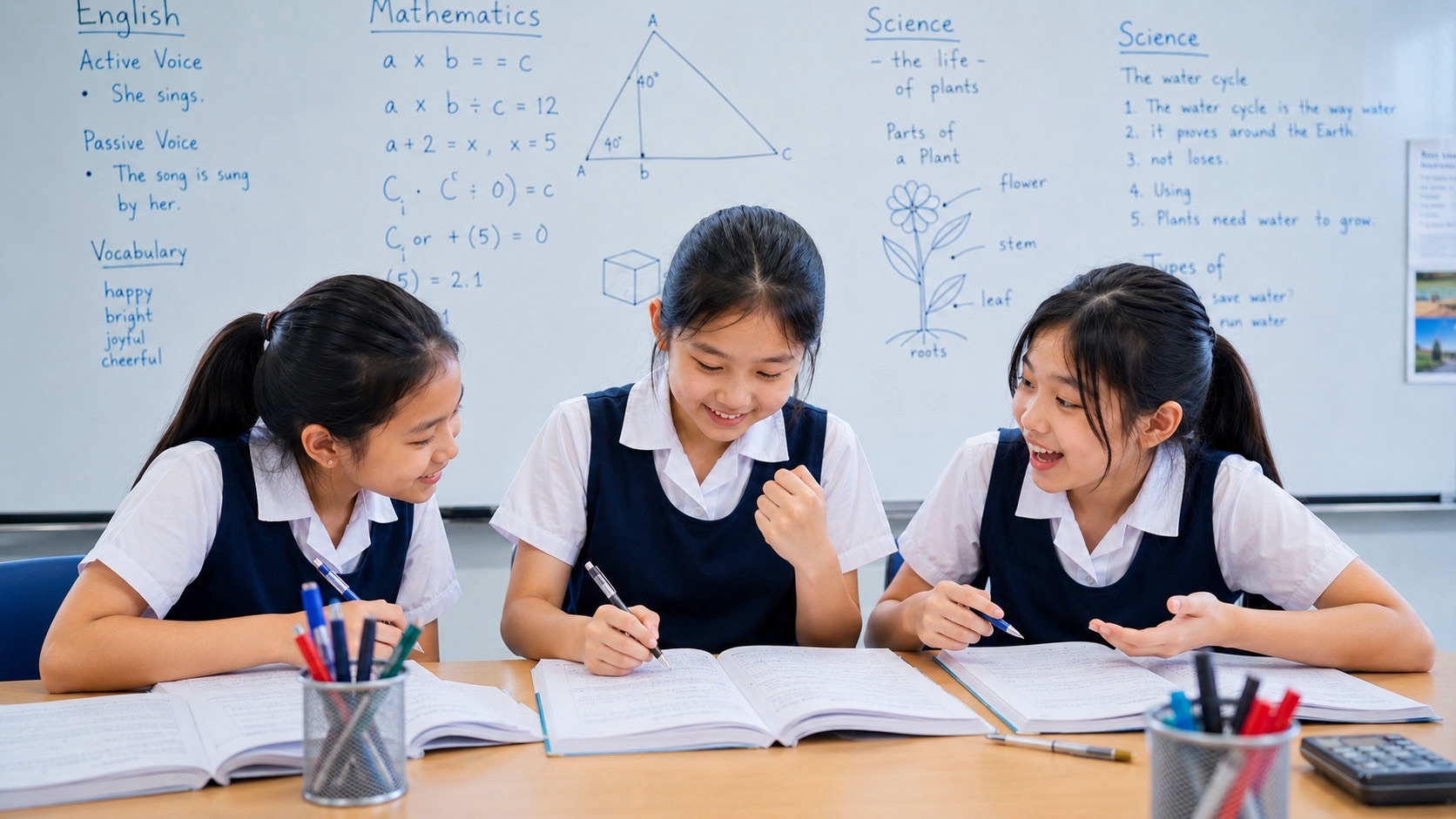
Primary 2 Maths Tuition Centre Yishun is a long-standing eduKate Singapore article for families looking for clear Primary 2 Mathematics support. The page has been rebuilt around the current learning task: strengthen number sense, operations, mathematical language, problem solving and independent checking before small weaknesses become expensive in Primary 3 and beyond.
The current MOE Primary Mathematics syllabus places substantial emphasis in Primary 2 on whole numbers up to 1,000, addition and subtraction, multiplication and division, fractions, money and the broader processes of reasoning, communication and problem solving. At this age, the objective is not to push children through advanced worksheets. It is to build a reliable mathematical system that a child can understand, retrieve and use.
This matters especially because Primary 1 and Primary 2 no longer have weighted assessments. A quieter assessment environment is healthy, but it also means parents should not wait for a single large score to reveal whether the foundation is stable. The better question is simple: can the child explain what a question means, choose a sensible method, carry it out accurately, and check the result?
Visit eduKate Singapore for current learning routes and contact information.
A More Important Year Than It First Appears
Primary 2 is sometimes treated as a gentle continuation of Primary 1. In one sense, that is true. Children are still working with familiar objects such as numbers, money, shapes, measures and short word problems. In another sense, however, Primary 2 is the year in which several mathematical habits begin to harden.
The student is expected to move beyond counting everything one by one. Place value must become secure. Addition and subtraction must become more efficient. Multiplication begins to represent equal groups and repeated structure rather than an isolated table to memorise. Division begins to mean sharing and grouping. Fractions introduce a new way of thinking about quantity. Word problems require the child to connect language with relationships rather than hunt for a keyword.
When these ideas are taught as disconnected procedures, the child may look competent for a while. A worksheet of near-identical questions can be completed by imitation. The difficulty appears later when the question changes shape.
A strong Primary 2 programme therefore protects the transition from visible arithmetic to mathematical structure.
The Hidden Mathematics Problem: A Correct Answer Can Hide Weak Thinking
At Primary 2, parents often look at whether an answer is right or wrong. That is understandable, but it is not enough.
Consider a child solving 346 + 127. A correct answer could come from a stable understanding of hundreds, tens and ones, a well-controlled written algorithm, sensible mental estimation and careful checking. It could also come from copying a method without understanding why digits are aligned.
Those two students may receive the same tick today. They will not have the same foundation tomorrow.
The same issue appears with subtraction. A child can be taught to “borrow” without understanding regrouping. The shortcut may survive routine questions but become fragile when zeroes appear, when the numbers are presented in a word problem, or when the child has to explain the method.
The tutor’s job is therefore not simply to mark the answer. The tutor must inspect the thinking that produced it.
A useful question is: what did the child believe at the moment the error occurred?
That question changes tuition from correction into diagnosis.
What Primary 2 Mathematics Is Building
The MOE syllabus is organised around content, but the deeper objective is mathematical competence. Primary 2 students are learning a network of ideas that will be reused for many years.
Whole numbers and place value
Students work with numbers up to 1,000 and need to understand hundreds, tens and ones as a place-value system.
A child should be able to read, write, represent, compare and order numbers without relying on guesswork. The difference between 407 and 470 should be visible as structure, not just remembered as “the bigger one has seven tens”.
Number patterns, odd and even numbers, counting in tens and hundreds, and flexible decomposition all strengthen this number sense.
A stable student can see 586 as:
- 5 hundreds, 8 tens and 6 ones;
- 500 + 80 + 6;
- 580 + 6;
- 600 – 14; or
- 5 hundreds, 7 tens and 16 ones when regrouping is useful.
That flexibility matters later in mental calculation, written methods, estimation and algebraic thinking.
Addition and subtraction
Primary 2 extends addition and subtraction into larger numbers and more deliberate algorithms.
The child should understand that an algorithm is not a magic sequence of pen movements. It is a compressed representation of place-value operations.
When adding, the child combines like units. When a place accumulates ten or more units, it is regrouped into the next place. When subtracting, a larger unit may be decomposed to make the required smaller units available.
Students also need mental strategies. Not every question deserves a full written method.
For example, 399 + 28 can be seen as 400 + 27. The ability to adjust numbers mentally reduces cognitive load and gives the student more than one way to check an answer.
Multiplication and division
Primary 2 students begin building multiplication and division around equal groups, repeated addition, arrays, sharing and grouping.
The tables of 2, 3, 4, 5 and 10 are important, but fluency should grow from meaning.
If 4 × 6 is only a memorised sound, forgetting the sound leaves the child with nothing. If the child understands four groups of six, six groups of four, repeated addition and array structure, there are several recovery paths.
Division should be connected to multiplication.
If 4 × 6 = 24, then 24 ÷ 4 = 6 and 24 ÷ 6 = 4.
These fact families reduce the amount of isolated information the child has to carry.
Fractions
Fractions are one of the first major conceptual shifts in Primary Mathematics.
A fraction is not simply “a number with one number on top and one below”. It represents a relationship between a whole, equal parts and a selected quantity.
Students need to understand why equal partitioning matters, how unit fractions behave, how like fractions can be compared, and why a larger denominator can mean smaller equal parts when the whole is fixed.
This is a good place to slow down.
A child who memorises rules without a picture of the whole may later struggle with fraction operations, ratio, percentage and algebraic fractions.
Money
Money connects Mathematics to daily life, but it is not automatically easy.
Students must read and write dollars and cents, compare amounts, convert between dollars-and-cents notation and cents, and solve practical problems.
The decimal point can be visually familiar before its meaning is secure. Good teaching makes the unit explicit.
$3.05 is three dollars and five cents, not three dollars and fifty cents.
Money problems also test reading. A student may calculate accurately but answer the wrong question because the relationship in the sentence was misunderstood.
Measurement, geometry and data
Primary Mathematics also develops the child’s ability to measure, compare, describe space and interpret information.
These areas are valuable because they force the learner to connect symbols with the physical world.
Length, mass, time, shapes, simple spatial relationships, tables and picture-based data all require careful observation. They reward students who read units, inspect labels and slow down before calculating.
Why Yishun Families Look for Primary 2 Mathematics Support
Families do not seek tuition for one single reason.
Some students are already showing visible gaps. Others appear comfortable but rely heavily on prompting. Some are mathematically strong and need deeper questions rather than more repetition. Others need help building a calm routine around homework.
For a Yishun family, the useful question is not whether a child “should have tuition” in the abstract.
The useful questions are:
- What is the first unstable mathematical skill?
- Is schoolwork becoming more independent or more dependent?
- Can the child remember methods after several days?
- Can the child solve a question when the wording changes?
- Is the student making concept errors, reading errors or careless execution errors?
- Does additional support reduce confusion, or simply add more workload?
- Can the child explain the reason for each step?
A good support programme should answer those questions with evidence.
Why Small Groups Can Work Well at Primary 2
A small group creates a useful balance.
The student receives close observation, but is not learning in isolation. Children hear other methods, compare explanations and see that mistakes can be discussed rather than hidden.
At Primary 2, this matters because the tutor needs to watch small behaviours.
A child may count on fingers long after a fact should be retrievable. Another may lose place value when numbers become three digits. Another may read every word problem as an instruction to add. Another may know a multiplication fact but not recognise when multiplication is appropriate.
These are not problems that a pile of extra worksheets will automatically solve.
They require observation.
In a carefully managed small group, the tutor can ask one student to explain a method, ask another to check it, and ask a third to find a different representation. The class becomes a place where mathematical language is practised, not merely answers produced.
The eduKate First-Principles Teaching Method
A strong Primary 2 Mathematics programme should have a repeatable operating system.
1. Diagnose the exact weakness
Avoid broad labels such as “weak in Maths”.
That description is too large to be useful.
A student may actually be struggling with:
- place value;
- number bonds;
- regrouping;
- subtraction across zero;
- multiplication meaning;
- division meaning;
- fraction language;
- money notation;
- reading comprehension;
- working memory;
- attention;
- checking habits; or
- confidence after repeated mistakes.
Different causes require different repairs.
The tutor should observe the child beginning a question, not only inspect the final answer.
2. Return to the first unstable point
If a current topic depends on an earlier idea that is not secure, repair the earlier idea first.
This is not moving backwards.
It is restoring the floor beneath the student.
For example, a child struggling with three-digit addition may not need harder three-digit addition. The actual weakness may be ten-to-one regrouping. A child struggling with division may first need equal-group representations. A child struggling with money may need place-value clarity and unit language.
Once the missing connection is rebuilt, the current topic often becomes easier.
3. Use visible representations before compression
Young learners benefit from seeing quantity.
Counters, number lines, place-value charts, bar models, arrays, simple diagrams and real objects can make a relationship visible.
The goal is not to remain dependent on manipulatives.
The goal is to use them long enough for the child to build a mental model, then move toward drawings and finally toward efficient symbols.
Concrete, representational and abstract forms should support each other.
4. Fence the difficulty
Do not introduce five new sources of difficulty at once.
If the purpose of a question is to practise subtraction regrouping, begin with clean numbers and familiar language. Once the method is secure, add larger numbers, zeroes, unfamiliar wording or multiple steps.
This makes diagnosis possible.
When too many variables change at the same time, the tutor cannot tell what caused the mistake and the student cannot tell what to improve.
5. Ask the student to explain
Explanation is one of the fastest ways to reveal understanding.
The tutor can ask:
- What does this number represent?
- Why did you choose addition?
- What does the 4 mean in 4 × 6?
- How do you know these parts are equal?
- What unit should the answer use?
- Is your answer reasonable?
- Can you solve it another way?
A child who can explain a method has a stronger chance of retrieving it later.
6. Retrieve after a delay
Learning is not demonstrated only at the end of the lesson.
The real test is whether the student can use the idea tomorrow, next week and inside a mixed worksheet.
Short retrieval sets are therefore valuable.
They should include older ideas so that the child must decide what kind of problem is present.
This prevents the common pattern in which a student succeeds only because every question on the page uses the same method.
7. Build checking as part of Mathematics
Checking should not be a punishment added after a mistake.
It should be part of the method.
Primary 2 students can learn simple checks:
- estimate before calculating;
- use the inverse operation where suitable;
- reread the question;
- circle the unit;
- compare the answer with the quantities given;
- solve a second way when possible; and
- ask whether the answer makes sense.
These habits compound over time.
What Happens During a 90-Minute Lesson
Each lesson should respond to the students in front of the tutor, but a stable rhythm helps young learners know what to expect.
Warm-up retrieval
The lesson begins with a small set of previously learned material.
This may include number bonds, place value, multiplication facts or a short mixed problem.
The purpose is not speed for its own sake. It is to reactivate useful knowledge and reveal what has been retained.
Concept instruction
The tutor introduces or revisits one central idea.
The explanation should be short enough to preserve attention and deep enough to reveal structure.
If the topic is division, students may move between physical groups, drawings, multiplication facts and division notation. If the topic is fractions, the tutor may compare equal and unequal partitioning before using symbols.
Guided practice
Students attempt carefully chosen questions with support available.
The tutor watches how the child starts.
Prompts are specific: “What is the whole?” “Which place are you working in?” “How many equal groups?” The goal is to guide thinking without taking over the thinking.
Independent application
Students then complete a smaller set without step-by-step help.
This stage matters because a child can look fluent while following a tutor’s voice. Independent work shows whether the method has become usable.
Mixed practice
Current and older topics are combined.
The student must recognise what kind of Mathematics is needed rather than rely on chapter labels.
This is where transfer begins.
Error review
Mistakes are classified.
Was the error caused by:
- misunderstanding;
- weak recall;
- misreading;
- arithmetic;
- notation;
- a missing unit;
- poor organisation; or
- rushing?
Naming the error makes the correction more precise.
Focused continuation work
Home practice should be selective.
A short set that targets the student’s current bottleneck is usually more useful than an indiscriminate stack of worksheets.
Three Primary 2 Student Pathways
Not every child needs the same programme.
The repair pathway
This student may already be uncertain with number bonds, place value, addition, subtraction or word problems.
The priority is to stop the gap from widening.
Work begins with the earliest unstable skill. Practice is controlled, representations are made visible, and success is built from genuine understanding rather than easier marking.
The stabilisation pathway
This student usually understands classwork but is inconsistent.
One day the work is accurate; another day there are avoidable mistakes. The child may forget methods after a gap, need repeated reminders to start, or struggle when several topics appear together.
The priority is reliability.
Retrieval, mixed practice, checking routines and better mathematical language help the student become less dependent on prompts.
The extension pathway
This student is comfortable with the core syllabus and needs depth.
Extension does not mean racing several years ahead.
Useful extension may involve:
- finding more than one method;
- explaining why a method works;
- solving non-routine word problems;
- creating a similar problem;
- identifying unnecessary information;
- estimating before exact calculation;
- comparing efficient strategies; and
- justifying an answer to another student.
The aim is flexible thinking.
Mathematical Language Is Part of Mathematics
Many Primary 2 errors are partly language errors.
Words such as more, fewer, difference, altogether, each, equal, share, left, change, twice, half and remaining carry mathematical relationships.
Students should not be trained to match one keyword to one operation. That strategy breaks quickly.
“Ali has 8 more stickers than Ben” does not automatically tell the student to add. The operation depends on what quantity the question asks for and which quantity is known.
Good tuition therefore teaches the child to reconstruct the situation.
Who has what? What changed? What is being compared? What is the unknown? What relationship connects the quantities?
This approach builds both Mathematics and reading discipline.
Word Problems: From Story to Structure
A word problem can be understood as a small model of a situation.
The child has to move through several stages:
1. understand the language;
2. identify the quantities;
3. identify the relationship;
4. choose a representation;
5. select an operation;
6. calculate accurately;
7. answer the actual question; and
8. check the result.
A mistake at any stage can produce a wrong answer.
This is why “do more word problems” is not a complete intervention.
If the student’s weakness is vocabulary, more questions may create more confusion. If the weakness is multiplication meaning, the student needs representation. If the weakness is copying numbers, the solution is an execution routine.
Diagnosis comes first.
Common Primary 2 Mathematics Mistakes and What They Mean
Digits are misaligned in column work
This often indicates weak place-value control or poor page organisation.
The repair is not simply “be careful”. Use place-value columns, verbalise hundreds/tens/ones, and reduce visual clutter.
The child subtracts the smaller digit from the larger digit regardless of position
This is a classic sign that the written algorithm has been memorised without the meaning of subtraction and regrouping.
Return to quantity, decomposition and place value.
Multiplication tables are remembered one day and lost the next
The child may be relying on short-term rehearsal.
Use spaced retrieval, arrays, fact families and strategic relationships between tables.
Division is confused with subtraction
The child may not have a stable model of equal grouping or sharing.
Use objects and drawings before returning to symbols.
Fractions are compared by denominator size alone
The student may be treating numerator and denominator as two unrelated whole numbers.
Return to equal parts of the same whole.
Money answers lose the unit
The Mathematics may be correct, but the student is not treating units as part of the meaning.
Make unit checking mandatory.
Word problems trigger random operations
The child may be keyword hunting.
Replace keywords with relationship questions and bar-model reasoning where appropriate.
How Parents Can Diagnose Without Turning Home Into Another Classroom
Parents can learn a great deal from observation.
You do not need to reteach every method.
Instead, watch what happens when the child works independently.
Useful observations include:
- How long does the child take to begin?
- Does the child reread the question?
- Are numbers copied accurately?
- Does the child know which operation is needed?
- Can the child explain one step?
- Does the child notice an unreasonable answer?
- Can the child remember the same method three days later?
- Does the child become distressed by one mistake?
- Is homework taking far longer than expected?
- Is help needed for every question or only certain types?
These observations help separate a concept gap from a habit problem.
What Good Home Practice Looks Like
Primary 2 children do not need endless hours of Mathematics.
They need useful repetitions.
A practical home routine can contain four small elements.
1. Retrieval
Spend a few minutes on known facts and previously taught ideas.
2. One current skill
Practise a small set of the method currently being learned.
3. One word problem
Choose a problem that requires reading and representation.
4. One explanation
Ask the child to explain one answer.
This can be more diagnostic than ten additional routine questions.
Stop before fatigue destroys quality.
The purpose is to make learning easier to retrieve, not to make Mathematics feel endless.
Why Confidence Should Follow Evidence
Confidence matters, but empty reassurance is fragile.
A child who repeatedly hears “you are good at Maths” while experiencing confusion may not believe the adult.
A stronger form of confidence is evidence-based.
The student can see:
“I used to confuse hundreds and tens. Now I can explain place value.” “I used to forget the 4-times table. Now I can rebuild it from doubles.” “I used to guess word-problem operations. Now I draw the relationship first.” “I made one regrouping error and found it during checking.”
This kind of confidence grows from capability.
It is calmer and more durable.
The Primary 2-to-Primary 3 Bridge
Primary 3 is a meaningful transition in Singapore primary education.
Formal Science begins, academic language becomes denser, Mathematics continues to expand, and students are expected to manage more information independently.
A stable Primary 2 Mathematics foundation reduces the load.
The child entering Primary 3 should ideally have:
- secure place value;
- dependable addition and subtraction;
- growing multiplication and division fluency;
- a sound first model of fractions;
- comfort with money and basic measurement;
- willingness to draw or represent a problem;
- a habit of showing working;
- a simple checking routine; and
- enough confidence to attempt unfamiliar questions.
The aim is not perfection.
The aim is readiness.
A Practical Diagnostic Checklist for Parents
A Primary 2 child may benefit from targeted support if several of these patterns persist:
- frequent confusion between tens and hundreds;
- slow or unstable number bonds;
- repeated regrouping errors;
- inability to explain multiplication as equal groups;
- division answered by guessing;
- fractions treated as two separate whole numbers;
- word problems avoided even when computation is strong;
- homework requiring constant adult prompting;
- methods forgotten after short gaps;
- excessive fear of mistakes;
- working so untidy that correct thinking becomes hard to follow;
- repeated unit errors;
- inability to estimate whether an answer is sensible; or
- growing resistance to Mathematics.
One sign alone is not a diagnosis.
Patterns across several weeks are more informative.
What Progress Should Look Like
A good programme should produce observable changes.
Progress is not only a higher worksheet score.
Look for:
- faster recognition of familiar structures;
- fewer repeated error types;
- better explanations;
- more independent starts;
- stronger recall after delays;
- neater and more logical working;
- willingness to check;
- better transfer into schoolwork;
- less need for prompting; and
- a calmer response to unfamiliar questions.
These are leading indicators.
Marks often improve after the underlying system becomes more reliable.
Why More Worksheets Are Not Always the Answer
Worksheets are useful when they provide the right practice at the right time.
They are less useful when they simply multiply a misunderstanding.
If a child uses the wrong model for division, thirty division questions can rehearse the wrong model thirty times. If the child misreads “fewer than”, more word problems may deepen frustration unless the language relationship is taught.
Practice should therefore follow diagnosis.
The sequence is:
understand → practise → retrieve → mix → transfer → check.
Volume comes after quality.
What a Primary 2 Mathematics Tutor Should Notice
A tutor working closely with a young child should notice more than academic content.
The tutor should notice:
- how the child enters a task;
- whether instructions are held in working memory;
- whether the pencil work reflects the thinking;
- whether an error changes the child’s emotional state;
- whether the student seeks confirmation after every line;
- whether speed is being used to avoid thinking;
- whether the child can tolerate a harder question;
- whether help is requested appropriately; and
- whether the student can recover after a mistake.
These behaviours affect learning efficiency.
A technically correct explanation will not help if the student has stopped engaging.
The Role of Assessment When P1 and P2 Have No Weighted Assessments
The removal of weighted assessments at Primary 1 and Primary 2 does not mean progress becomes invisible.
It means teachers and parents should use richer evidence.
Classwork, marked exercises, oral explanation, retrieval after a delay, school feedback, homework independence and error patterns all provide useful information.
This is healthy when interpreted well.
The focus can move from “What score did my child get?” to “What can my child now do independently?”
That is a better question for long-term learning.
Building Responsibility Without Overloading a Seven- or Eight-Year-Old
Primary 2 students are still young.
Independence should be taught gradually.
A practical responsibility ladder may look like this:
First, the child prepares the materials. Then the child reads the question before asking for help. Then the child attempts one step. Then the child marks uncertain questions. Then the child checks one answer. Then the child reviews corrections. Then the child explains what was learned.
Responsibility is not the absence of adult support.
It is the gradual transfer of useful learning actions from adult to child.
Frequently Asked Questions
Is Primary 2 too early for Mathematics tuition?
It depends on the child and the purpose. Support can be useful when it repairs a specific gap, improves learning habits or provides appropriate extension. It is less useful when it simply adds volume to a child who is already learning well. Diagnose first.
Should a Primary 2 child memorise multiplication tables?
Yes, fluency is useful, but meaning should accompany memory. Students should understand equal groups, arrays and the relationship between multiplication and division while building quick recall.
How much Mathematics practice should a Primary 2 child do at home?
There is no universal number of minutes. Short, focused practice with good attention is usually more useful than a long session completed in fatigue. Prioritise retrieval, one current skill, one problem-solving task and review of errors.
My child can calculate but cannot do word problems. What is wrong?
The bottleneck may be language, relationship recognition, representation or transfer rather than arithmetic. Ask the child to explain the situation before calculating.
My child makes careless mistakes. How do I fix carelessness?
Replace the label with the specific behaviour. Is the child copying digits incorrectly, skipping units, rushing the first step, misreading a sign or failing to check? A named error can be trained.
Should Primary 2 students work ahead of school?
Some can benefit from gentle preview, but acceleration should not replace depth. It is usually better to secure current foundations, then extend through richer problems and explanation rather than race through future chapters.
What if my child dislikes Mathematics?
Find the source of the dislike. Repeated failure, pace, unclear explanations, workload and fear of being wrong can all look like “I hate Maths”. Repairing the cause often changes the emotional response.
How do I know whether tuition is working?
Look for increasing independence, stronger retention, fewer repeated errors, better explanation, more stable schoolwork and reduced need for prompting. Progress should be visible in behaviour as well as marks.
A Better Definition of “Doing Well” at Primary 2
Doing well is not simply finishing the workbook first.
A strong Primary 2 mathematician is beginning to understand quantity, structure and relationships.
The student can make sense of a question, choose a method, represent thinking clearly, calculate with reasonable accuracy, explain important steps and learn from mistakes.
That foundation is powerful because it travels forward.
It supports Primary 3 Mathematics. It supports Science. It supports later fractions, ratio, percentage and algebra. It supports confidence because the child has something real to be confident about.
The best Primary 2 Mathematics tuition therefore does not try to make a young child look advanced.
It makes the foundation dependable.
Current Curriculum Reference
For the current national curriculum, see the MOE Primary Mathematics Syllabus, updated October 2025. It lists the Primary 2 content expectations and the broader mathematical processes that schools develop across Primary 1 to Primary 6.
Final Guide for Yishun Parents
If your child is in Primary 2, begin with evidence rather than anxiety.
Collect a few pieces of recent schoolwork. Look for repeated errors. Ask the child to explain one method. Check whether the same idea can be remembered several days later. Notice whether unfamiliar wording causes the Mathematics to collapse. Then decide what kind of support is actually needed.
A good Primary 2 Mathematics programme should make school Mathematics clearer, not heavier.
It should reduce confusion. It should build structure. It should create better habits. It should gradually return responsibility to the child.
That is the standard this rebuilt Primary 2 Maths Tuition Centre Yishun guide is designed to support.