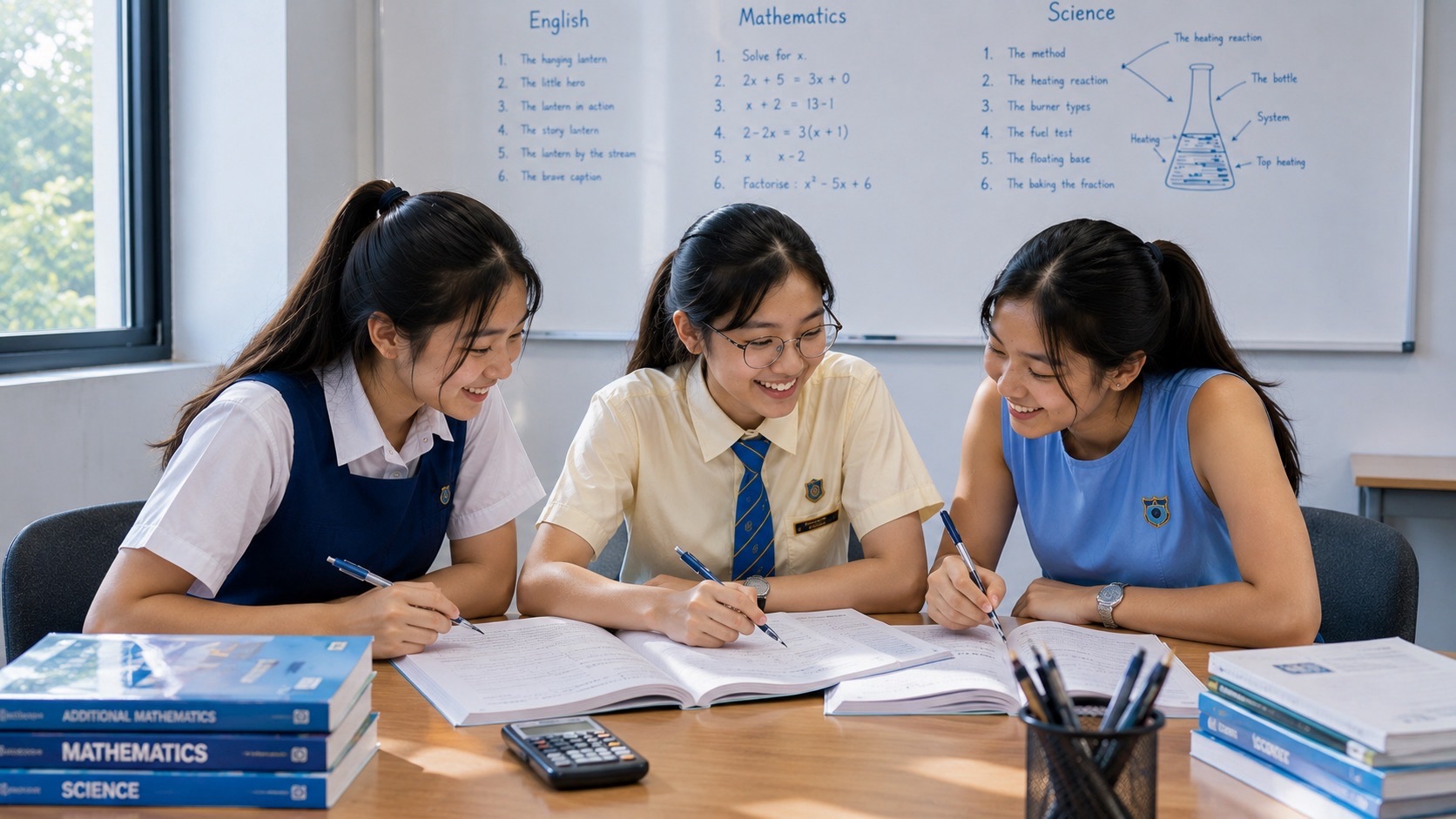
What happens in a Secondary 2 English Tutorial
Quick Read
Secondary 2 English is where language increasingly becomes judgement. Students are no longer only locating information or producing a correct paragraph. They must distinguish fact from interpretation, recognise viewpoint, infer what is implied, explain relationships, organise evidence and adapt language to audience and purpose.
- Core progression: Receive → Divide → Compare → Judge → Explain → Support → Revise.
- Comprehension moves beyond retrieval into inference, writer’s choices and evidence.
- Writing requires clearer development, paragraph purpose and audience control.
- Oral work should develop responsive reasoning rather than memorised answers.
- Grammar and vocabulary matter most when they transfer into real reading and writing.
- The aim is increasing independence before the upper-secondary load rises further.
The One-Sentence Answer
A strong Secondary 2 English tutorial teaches students to separate what a text says from what it suggests, form a defensible judgement, communicate it clearly and revise when the evidence does not support the first answer.

Why Secondary 2 Feels Different
Secondary 1 is often a year of development: students learn to handle longer texts, more mature topics, greater writing expectations and a faster school rhythm. Secondary 2 adds another demand. The student must increasingly divide information into categories that are easy to confuse.
- What is directly stated, and what must be inferred?
- What is fact, and what is interpretation?
- What is evidence, and what is merely assertion?
- What does the writer believe, and what does another person in the text believe?
- What is relevant to the question, and what is merely interesting?
- What can be claimed confidently, and what requires qualification?
That ability to divide and judge becomes increasingly important through Secondary 3 and Secondary 4.
The Secondary 2 English Operating Loop
Receive → Divide → Compare → Judge → Explain → Support → Revise.
Receive
Read or listen accurately before reacting. Many weak answers begin because the student answers the topic they expected rather than the question actually given.
Divide
Separate fact, viewpoint, example, evidence, cause, consequence and inference.
Compare
Place two ideas, perspectives or pieces of evidence beside each other and identify the meaningful relationship.
Judge
Decide what conclusion is justified by the available information.
Explain
Make the relationship visible in language rather than expecting the reader to infer it.
Support
Use evidence, examples or textual detail that actually support the claim.
Revise
Change the claim when the evidence is weaker, stronger or more complicated than the first answer suggested.
Comprehension: From Finding Answers to Defending Them
At this stage, comprehension should not be treated as a hunt for matching words. Students need to understand how answers are constructed from the text.
Locate → Interpret → Infer → Compare → Evaluate → Support.
A tutorial might take one short paragraph and ask several different questions:
- What happened?
- Why did it happen?
- What suggests the character was reluctant?
- How does the writer make the situation seem uncertain?
- Which word changes the strength of the claim?
- What alternative interpretation remains possible?
The text is the same. The thinking operation changes.
Fact, Interpretation and Viewpoint
One of the most important Secondary 2 habits is learning not to flatten every statement into “information”.
| Type | Question to ask |
|---|---|
| Fact | What can be directly checked or established? |
| Interpretation | What meaning has someone assigned to the facts? |
| Viewpoint | Whose position or perspective is represented? |
| Inference | What conclusion is suggested but not directly stated? |
| Judgement | What conclusion should we reach after considering the evidence? |
This distinction supports comprehension, oral communication and later argumentative writing.
Writing: Paragraphs Need Jobs
Secondary 2 students often know the basic structure of an essay but still write paragraphs that repeat each other. The next step is to make every paragraph perform a distinct job.
| Paragraph job | Possible function |
|---|---|
| Establish | Introduce context, situation, viewpoint or issue |
| Develop | Extend a reason, event or idea |
| Contrast | Show another perspective, condition or limitation |
| Evidence | Make a claim concrete with example or textual support |
| Turn | Change direction or complicate the initial position |
| Resolve | Bring the main line to a meaningful conclusion |
Development: The Student Must Go Beyond the First Sentence
A common Secondary 2 weakness is producing a correct point without enough development. The tutor should ask what the reader still needs after the first sentence.
Claim → Reason → Example/Evidence → Explanation → Qualification.
This is not a script to recite. It is a thinking sequence. The student makes a claim, explains the reasoning, supplies something concrete and then decides whether the claim needs a condition or limit.
Vocabulary: Precision Before Difficulty
Secondary vocabulary should increase the resolution of thought. A student who knows the difference between ineffective, unfair, inaccurate, unstable and harmful can diagnose a problem more precisely than a student who writes only “bad”.
The tutorial should therefore connect vocabulary to decisions:
- Which word best describes the relationship?
- How strong is this claim?
- What connotation does the word carry?
- Would the word suit a formal essay, dialogue or oral response?
- Can the student retrieve and use the word on a different topic?
Grammar: Control Meaning, Not Merely Rules
Grammar should be repaired through the student’s own reading and writing. A tense error may distort chronology. A pronoun error may make the reference unclear. A sentence boundary error may make two separate ideas appear to be one.
Detect → Name → Correct → Explain → Retest → Transfer.
The important question is whether the repaired grammar survives in a new task without the tutor pointing to the same error again.
Oral Communication: Respond, Do Not Recite
Secondary 2 oral practice should help students hold a viewpoint in real time. A useful discussion sequence is:
Position → Reason → Example → Explanation → Follow-up → Adapt.
Follow-up questions matter. A student may produce a polished first answer from memory but struggle when asked, “Would that always be true?” or “What might someone on the other side say?”
That second turn shows whether the student owns the reasoning.
Reading Current Issues Without Turning English Into General Knowledge
Secondary students benefit from reading age-appropriate current affairs, opinion pieces, explanatory texts and longer-form non-fiction. The purpose is not to memorise headlines. It is to practise reading claims, evidence, tone and perspective.
A good tutorial might ask:
- What is the writer’s central claim?
- Which evidence is strongest?
- What information would we need before accepting the conclusion?
- Which words frame the issue positively or negatively?
- What perspective is absent?
A Typical Secondary 2 Tutorial Flow
There is no single lesson template, because the lesson should respond to what the students need. A useful 1.5-hour small-group session may contain several of these elements:
- Retrieve: short recall of vocabulary, grammar or a previous reasoning method.
- Read: one text, question, paragraph or writing problem closely.
- Diagnose: identify where each student’s interpretation or expression diverges.
- Repair: teach the missing distinction or method.
- Practise: attempt another example with support reduced.
- Transfer: use the same reasoning on an unfamiliar text or topic.
- Review: state what changed and what still needs evidence.
Why Three Students Can Work Well at Secondary 2
eduKate currently teaches in groups of three. Secondary English benefits from comparison because language problems often involve more than one plausible interpretation.
One student may infer too much. Another may stay too literal. A third may reach the right judgement but explain it weakly. Placing these responses beside one another helps students see that the quality of an answer depends on both reasoning and evidence.
The group is still small enough for the tutor to inspect individual writing and rotate feedback without turning the lesson into a lecture.
Homework Should Close a Learning Loop
More homework is not automatically better. Secondary 2 students already manage multiple subjects and school commitments. Homework should have a clear job.
- Retest a grammar pattern that was repaired.
- Rewrite one weak paragraph.
- Apply a comprehension method to a new text.
- Read one substantial article and summarise the argument.
- Prepare evidence for an oral discussion.
The student should know why the task exists.
What Parents Should Look For
- Can the student explain why an answer is correct?
- Can they distinguish what the text says from what they inferred?
- Can they develop a paragraph beyond a first point?
- Are repeated grammar errors becoming less frequent?
- Can vocabulary move from a word list into speaking and writing?
- Can the student change a view when stronger evidence appears?
When Tuition May Be Useful
Tuition can help when a student repeatedly makes the same interpretation, writing or language errors and needs more diagnostic feedback than is currently available. It can also help when the student understands material during lessons but cannot transfer the method independently to unfamiliar tasks.
If the student is already reading widely, improving steadily, receiving useful school feedback and working independently, additional tuition may not be necessary.
Secondary 2 Should Prepare for Secondary 3, Not Merely Finish Secondary 2
The value of Secondary 2 is partly transitional. Upper Secondary brings more complex texts, more demanding writing and greater pressure to sustain an argument or interpretation.
The student should therefore leave Secondary 2 with a stronger ability to:
- hold multiple possibilities before deciding;
- support a claim with appropriate evidence;
- recognise when certainty is not justified;
- structure writing around reader needs;
- revise independently rather than waiting for correction.
Frequently Asked Questions
Is Secondary 2 mainly about preparing for examinations?
No. Examination performance matters, but the larger developmental job is building interpretation, judgement, communication and independence that continue into Upper Secondary.
Should Secondary 2 students memorise essay templates?
Templates can temporarily reveal structure, but students should learn paragraph jobs and reasoning relationships so they can adapt to unfamiliar questions.
How much vocabulary should a Secondary 2 student learn?
There is no useful fixed number. Prioritise vocabulary that increases precision and can be retrieved across reading, writing and oral contexts.
What is a strong sign of progress?
The student begins to justify answers, notices competing interpretations, writes with clearer paragraph purpose and needs less prompting to revise.
The Larger Idea
Secondary 2 English sits at an important point in the journey from receiving language to judging with language.
The student is learning that words do not merely carry information. They frame perspectives, hide assumptions, signal certainty, connect evidence and influence how another person understands the world.
A good Secondary 2 tutorial therefore does more than correct answers. It helps the student become increasingly responsible for the reasoning behind them.
Continue with Secondary 1 English Tuition, Narrative Essay Architecture, or Secondary 4 Writing Guide.