Secondary 1 English Tuition Singapore: Development After the Primary School Transition
Quick Read
- Secondary 1 is not a restart. It is a transition in how the same language system is expected to operate.
- Primary school often gives more visible scaffolding; Secondary 1 increasingly expects students to interpret tasks and organise responses for themselves.
- The central idea is Development: the student develops from receiving and reproducing language toward selecting, shaping and transmitting meaning independently.
- Writing becomes less about filling a known form and more about controlling idea, structure, development, language and editing.
- Good Sec 1 tuition protects continuity with Primary school while deliberately installing the habits needed for Sec 2, Sec 3 and Sec 4.
One-sentence answer: Secondary 1 English is the year a student begins moving from supported language use toward increasingly independent interpretation and expression.
The child did not leave Primary English behind
When students enter Secondary 1, the timetable, teachers, classmates and expectations change quickly. It can feel as if they have entered an entirely new subject. But the language system itself has a history. Vocabulary, sentence control, reading habits, inference, composition experience and oral confidence all arrive from Primary school with the student.
The important question is therefore not simply, “Can this student do Secondary 1 English?” It is, “What Primary capabilities arrived intact, what arrived partially developed, and what does Secondary 1 now demand from them?”
This continuity matters because the transition can disguise older gaps. A student may appear to have a new Secondary 1 comprehension problem when the real weakness is still vocabulary depth. Another may struggle with expository writing because Primary composition trained narrative fluency but not enough idea explanation. The level changed; the underlying mechanism did not suddenly disappear.
Development is the governing idea of Secondary 1
Development means more than learning harder words. It means the student’s role is changing. In Primary school, a large amount of language use may be closely supported: a teacher demonstrates, the student follows, a format is practised and the answer is corrected. In Secondary school, the student increasingly has to decide what the task means, which knowledge is relevant and how the answer should be constructed.
The language becomes more abstract because the thinking becomes more abstract. Students are asked not only what happened, but why it matters; not only what a character did, but what the action suggests; not only what they believe, but how they can develop and support that belief for an audience.

English begins as reception, but Secondary 1 strengthens the sender
Every English task involves a receiver and a sender. When a student reads, the student receives meaning created by someone else. When the student writes or speaks, the direction reverses: the student becomes responsible for creating meaning that another person can reconstruct.
Secondary 1 increases the importance of that second role. The student must choose what to include, decide how to organise it and make the relationship between ideas visible. A teacher can no longer supply every transition, every sentence pattern and every explanation.
This is one reason Secondary 1 can feel difficult even for children who did reasonably well in Primary school. They are not only being asked for more English. They are being asked for more ownership of the English.
The Primary-to-Secondary step is partly a scaffolding change
A student may have learnt many things successfully while an adult was quietly carrying part of the load. The teacher selected the relevant example, reminded the student of the method, prompted the missing step and checked whether the response was complete. That is normal teaching.
Secondary 1 begins removing some of those supports. The student needs to recognise the method without being told, retrieve vocabulary without a word bank, plan an answer from a less familiar prompt and notice personal errors before someone points to them.
Good tuition should not respond by adding permanent scaffolding. It should use temporary scaffolding deliberately, then remove it as the student becomes capable.
Reading changes from finding information to reconstructing meaning
Secondary reading increasingly requires students to infer relationships, recognise tone, follow shifts in viewpoint and explain how language creates an effect. The answer may not sit neatly in one sentence waiting to be copied.
A student therefore needs a more active reading process. What is the writer doing here? What changed between these paragraphs? Which phrase carries the evidence? Is the statement literal, implied, exaggerated or evaluative? What does the question require me to do with the text rather than merely locate inside it?
Writing changes from having an idea to developing one
Many Secondary 1 students can produce an opinion quickly. The challenge is sustaining it. “Technology is useful” is an idea, but it is not yet an argument. “The character was afraid” is an interpretation, but it is not yet a developed explanation.
We make the writing process visible through a repeatable sequence:
- Idea: what am I actually trying to say?
- Structure: where should this idea sit and what should come before or after it?
- Development: what explanation, evidence, example or consequence makes the point complete?
- Language: which words and sentence forms fit the purpose and audience?
- Edit: does the final version communicate what I intended?
The sequence is not intended to make every student sound the same. It gives the student a method for moving from thought to controlled expression.
Vocabulary must become more precise
At Secondary 1, vocabulary growth should increasingly involve distinctions. “Sad” may become disappointed, grief-stricken, discouraged, regretful or resentful depending on the situation. “Important” may become essential, influential, significant, urgent or consequential.
Precision matters because different words carry different boundaries. The stronger the student’s vocabulary network, the more precisely the student can interpret a passage and represent personal thinking.
Grammar becomes a control surface
Secondary 1 students still need grammatical accuracy, but the larger goal is control. Sentence length can alter pace. Subordination can show relationships between ideas. Punctuation can manage emphasis. Pronoun reference can either preserve clarity or create confusion.
The student should gradually move from “Is this sentence wrong?” to “What is this sentence doing, and is that what I want it to do?” That is a developmental step from compliance toward authorship.
Oral communication becomes rehearsal for independent thought
Speaking gives the tutor a fast view of the student’s thinking. When asked a question, does the student answer directly, then develop? Can they explain a reason? Can they respond when another student disagrees? Can they refine the answer after hearing a stronger example?
These are not merely oral-examination behaviours. They are the beginnings of argument, audience awareness and intellectual flexibility. A student who can think aloud with increasing control is building machinery that later supports writing.
Why a Secondary 1 student can suddenly look weaker than in Primary 6
Sometimes the student’s underlying ability has not declined. The environment simply changed faster than the method. A strategy that was adequate for Primary 6 may not carry the new Secondary load. More subjects compete for time. Texts become less familiar. Teachers expect greater independence. Writing tasks become broader.
That apparent drop is useful information. It tells us where the student’s old system reaches its limit.
Our diagnostic loop: inspect → locate → make visible → practise
When a Secondary 1 student struggles, we do not want to label the entire subject as weak. We inspect the work. We locate the break. We make the missing method visible. Then we practise until the student can increasingly reproduce the method without us.
| Observed problem | Possible underlying break | Teaching response |
|---|---|---|
| Comprehension answers are close but incomplete | Question interpretation or evidence selection | Teach demand words, evidence boundaries and complete response construction |
| Writing starts strongly then becomes thin | Development failure | Practise explanation, example, consequence and relevance |
| Student understands corrections but repeats the error | Retrieval or automation failure | Revisit the rule across spaced and varied tasks |
| Good work in class, weak work in tests | Load or independent-performance failure | Reduce prompting and progressively add time pressure |
Why three students is useful at the transition
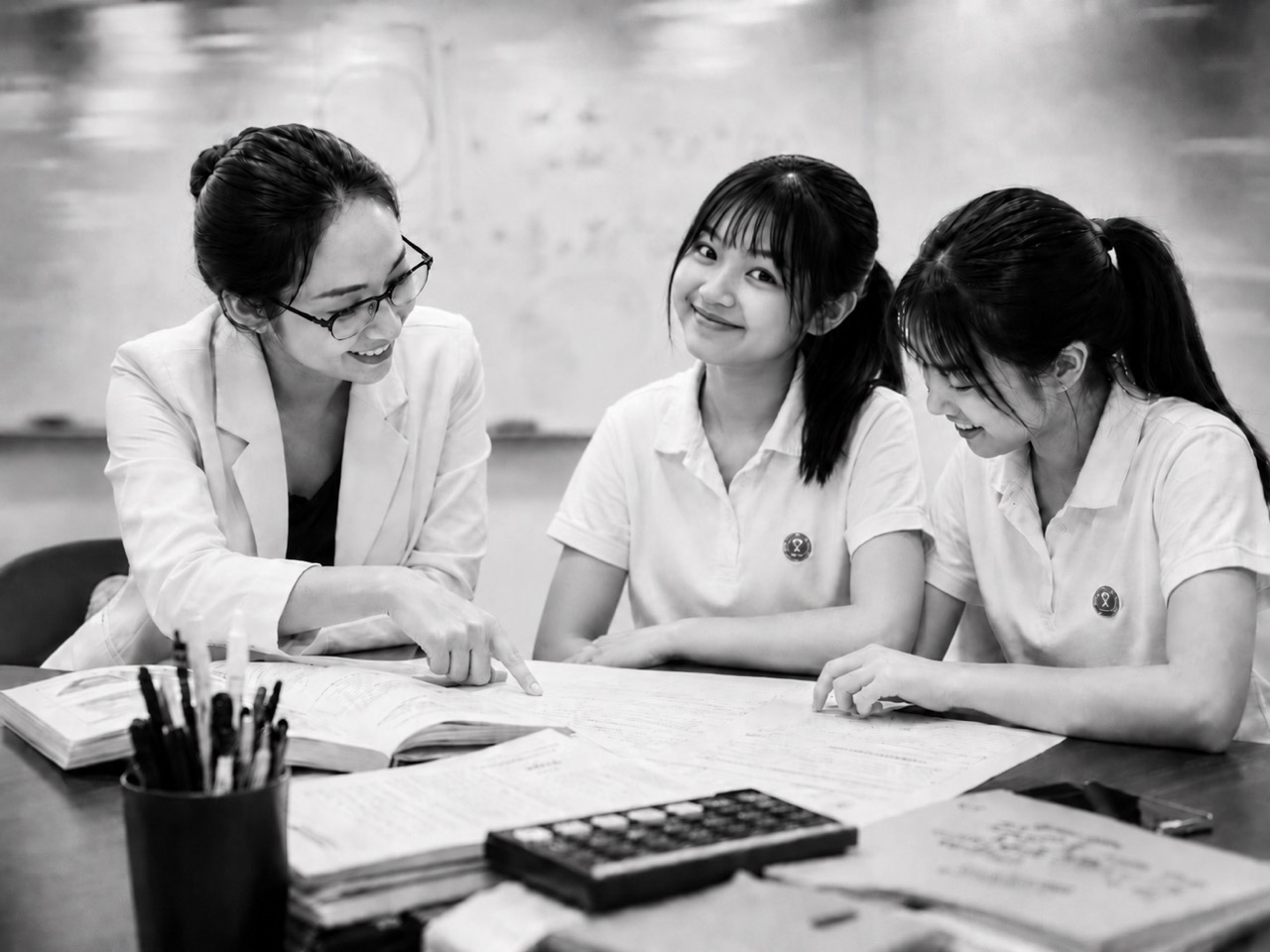
Secondary 1 students need both observation and comparison. A tutor needs enough time to inspect each student’s answer, but students also benefit from hearing that a classmate can reach a different valid interpretation or structure an explanation differently.
Three students create a useful middle ground. There is enough variety for discussion, defence and comparison, yet the tutor can still follow individual errors and return quickly to them. The group becomes part of the English lesson rather than background noise around it.
What parents should look for during Secondary 1
The most important signs are not only marks. Watch whether the student needs less prompting to begin work, whether answers become more complete, whether the child can explain why a correction is necessary and whether unfamiliar tasks cause less panic.
A Secondary 1 student is developing well when the student begins carrying more of the process alone. The tutor’s job is gradually shifting from supplying the answer to testing the student’s judgement.
Secondary 1 should already prepare for Secondary 2
The next stage will ask for stronger control of perspective, evidence, interpretation and audience. That means Secondary 1 should not end with the student merely comfortable with harder worksheets. The student should leave with a more independent reading process, a visible method for writing and the habit of asking what evidence supports a conclusion.
Development creates the platform for Division: once students can build and transmit ideas, they are ready to examine how different people can divide the same information into different interpretations.
Frequently Asked Questions
Is Secondary 1 English much harder than Primary 6 English?
The change is not only difficulty. The student is asked to operate with greater abstraction and independence. A strong Primary foundation helps, but the method often needs upgrading.
What should a Sec 1 student improve first?
The first target depends on diagnosis. For one student it may be vocabulary; for another, reading precision; for another, paragraph development or independent editing. The same mark can hide different causes.
Should Secondary 1 tuition already practise examination skills?
Yes, but examination practice should not replace capability building. Sec 1 is valuable precisely because there is time to build the system before the final examination year.
How do we know whether a student is becoming more independent?
Look for less prompting, better self-correction, stronger explanations, more reliable transfer to unfamiliar tasks and the ability to state why a method works.
What is the main objective of Secondary 1 English tuition?
To make the Primary-to-Secondary transition successful while developing the student into a stronger receiver and sender of language who can carry more of the thinking process independently.
The larger idea: Secondary 1 is where borrowed structure starts becoming personal control
Children begin language by borrowing. They borrow words, sentence patterns, stories, explanations and ways of organising the world from adults around them. Education gradually turns those borrowed structures into personal capability.
Secondary 1 is an important point in that development. The student is still learning from teachers, but increasingly has to decide, select, construct and revise. The language is becoming the student’s own operating equipment.
That is why the best outcome is not simply a smoother first year of secondary school. It is a student who has begun learning how to carry thought across language with less dependence on someone standing beside them.
Learn more about eduKate Singapore Secondary English small-group tuition.