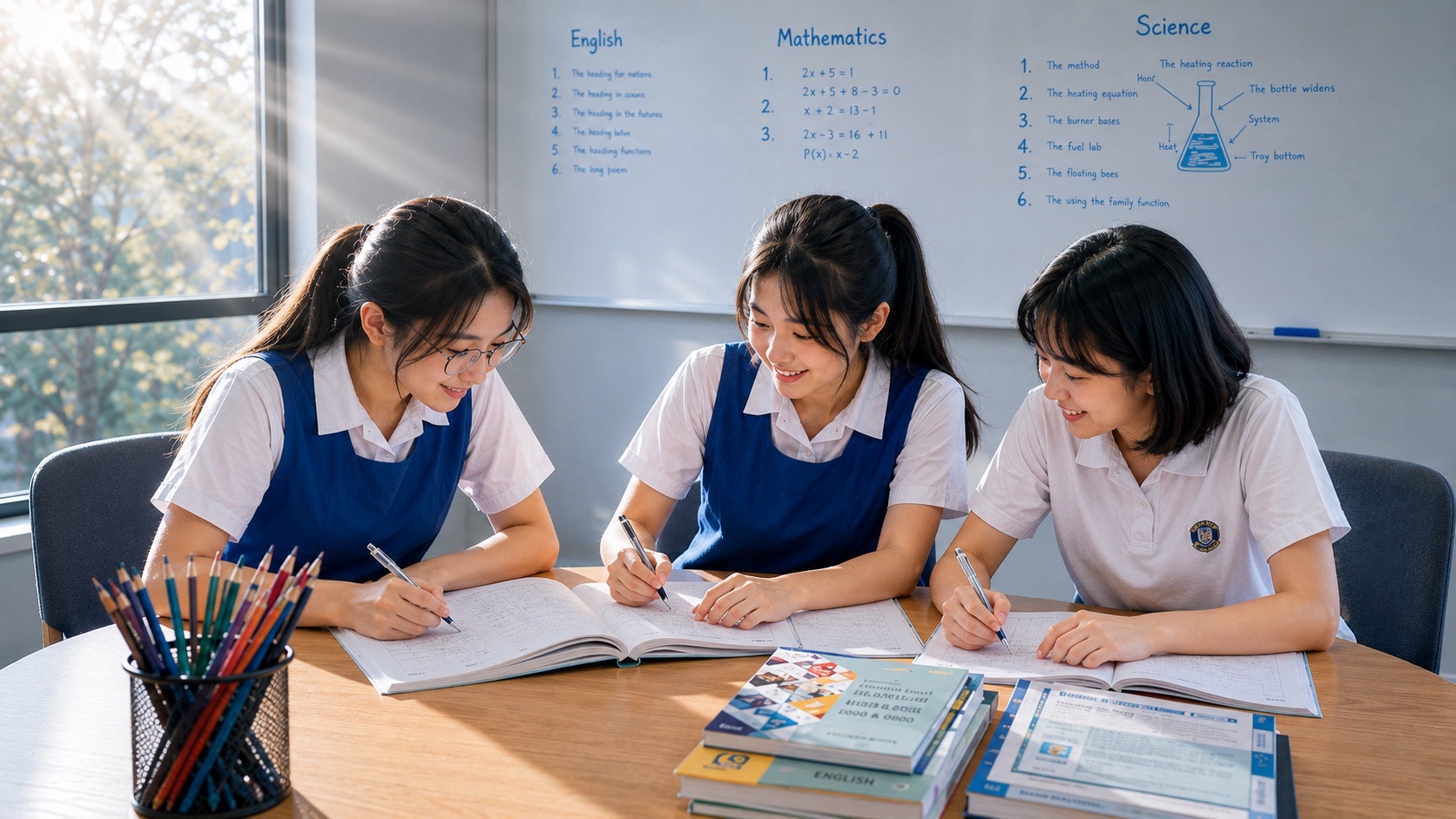
Secondary English Tuition | Katong — 3-Pax Small Groups
Convenient from Marine Parade MRT—same line/bus, quick ride to class
Build confident writers and critical readers. At eduKate, our premium 3-pax Secondary English classes (Sec 1–4) help students master composition, comprehension, oral, and listening—through first-principles teaching, intensive feedback, and exam-focused practice.
Book a consultation: Contact eduKate Singapore · Follow: eduKate SG Facebook
Why parents in Katong choose eduKate (near Marine Parade MRT)
- 3-pax small groups → laser-focused coaching, personalised targets
- MOE-aligned progression from Lower Sec to O-Level (MOE English curriculum)
- First-principles approach → we teach how English works (genre, audience, purpose, tone) before speed and templates
- Weekly drafts + annotated feedback → measurable improvement in structure, clarity, and style
- Exam habits early → time management, marking-scheme awareness, evidence-based answers
- Easy access from Katong/Marine Parade → short hop via Marine Parade MRT or direct buses along Marine Parade Rd
What we cover (Sec 1–4, Express/NA/IP support)
Writing (Paper 1)
- Situational Writing: purpose, audience, context; tight formats; concision and tone
- Continuous Writing: story, discursive, argumentative; planning frameworks; paragraph logic; strong conclusions
- Style upgrades: varied sentence structures, precise vocabulary, cohesive devices, active voice
Comprehension (Paper 2)
- Question typology (literal, inferential, language-use, summary)
- Evidence & explanation: quote-and-justify technique, PEEL paragraphs
- Summary skills: paraphrasing, condensation without meaning loss
Language Skills
- Grammar/usage: high-frequency errors (subject-verb, tenses, pronouns, modifiers)
- Vocabulary building: Tier 2/3 words, collocations, idioms, connotation vs denotation
- Editing for impact: clarity, concision, cohesion
Oral & Listening
- Spoken interaction: opinion framing, examples, counterpoints, elaboration
- Presentation craft: signposting, voice, pace, posture
- Listening: note-taking strategies, question anticipation
For O-Level paper structure and requirements, see SEAB GCE O-Level English.
How we teach (made for real gains)
- Fencing Method: start with a simple scaffold, then “fence in” complexity—sentence → paragraph → essay
- CRA for language: Concrete (models) → Representational (plans) → Abstract (independent writing)
- Retrieval + interleaving: short, spaced drills mixing grammar, vocab, and inference
- Rubric-aligned feedback: every draft annotated against criteria (Content/Organisation/Language)
- Think-aloud modelling: tutor demonstrates planning, inference, and summary compression live
Class format (90 minutes)
- Warm-up retrieval (grammar/vocab)
- Mini-lesson (skill focus, e.g., crafting topic sentences)
- Guided practice (shared writing or passage analysis)
- Timed exam task (Paper 1 or 2)
- Feedback & targets (micro-goals + take-home plan)
Tracks to suit different learners
- Bridge (foundation & confidence): grammar repair, paragraph fluency, short-answer accuracy
- Core (B→A climb): structure, style, and summary mastery; reduce “nearly-there” errors
- Enrichment (A1 target/IP support): argumentation, critical reading, nuanced style, sophisticated vocabulary
Outcomes you can expect
- Sharper argument & structure in essays
- Higher accuracy in comprehension short answers
- Stronger summary and language-use analysis
- Greater oral fluency and listening precision
- Consistent score lift toward A1/A2
Katong → Marine Parade MRT (getting here)
- MRT: Alight at Marine Parade MRT; our classroom is a short walk/bus hop away
- Bus: Frequent services along Marine Parade Rd / Parkway Parade area
- Nearby landmarks: Parkway Parade, East Coast Park—easy pick-up for parents
Class details
- Format: Premium 3-pax small groups
- Duration: 1.5 hours weekly (extra clinics near tests)
- Materials: model texts, scaffolded planners, vocab packs, timed drills
- Next step: Book a parent–student consultation via our homepage.
Limited “trial lessons” may be available depending on 3-pax capacity.
Parent FAQs
Q1: My child’s essays are unfocused—what’s the fix?
We teach planning discipline (thesis, 3-point outline, paragraph aims), with live modelling and annotated rewrites.
Q2: Comprehension marks stuck—how do you help?
Question-type drills, quote-and-explain technique, language-use analysis, and summary compression with word-budget training.
Q3: Will you reteach grammar?
Yes—targeted grammar repair tied to real writing so improvements transfer to essays and editing.
Q4: How fast will we see progress?
Most students improve within 2–4 feedback cycles: clearer structure, fewer language errors, better timing.
Q5: Do you align to school tests?
We map homework to upcoming topics and run pre-test clinics.
Helpful links
- Contact & Locations — eduKate Singapore
- MOE English Curriculum Overview
- SEAB O-Level English Examination