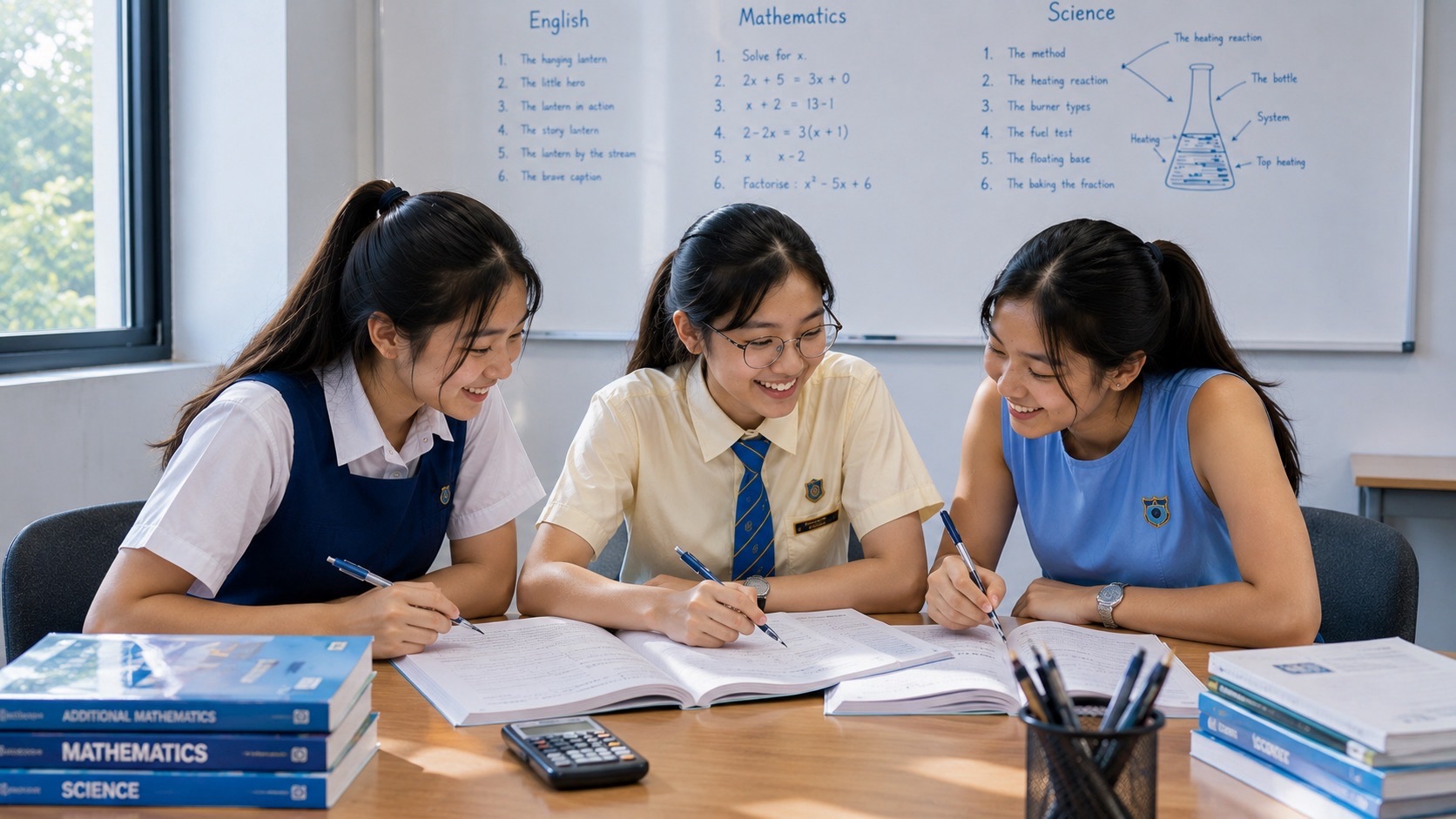
Secondary 2 English tuition in Marine Parade is often sought when students can no longer rely on broad comprehension or fluent writing alone. Families comparing Marine Parade English tuition, Parkway Parade tuition centres, secondary English enrichment, comprehension classes, situational writing programmes and small-group English tuition often look for stronger inference, vocabulary, grammar, editing and composition. The Secondary 2 challenge is control: students must justify interpretations, organise arguments, adapt register and revise writing with increasing independence.
A strong Secondary 2 English programme should connect close reading, inference, evidence weighting, vocabulary in context, grammar and editing, situational writing, expository and narrative writing, argument, tone and oral discussion. These capabilities reinforce one another. Strong reading supplies evidence and language models. Editing sharpens sentence control. Argument requires paragraph logic. Register determines whether communication fits audience and purpose.
At eduKate Singapore, 3-pax Secondary 2 English tuition allows the tutor to inspect reasoning closely. Students can compare two interpretations, justify why one clue is stronger, revise a paragraph for logic, and test whether a tone remains appropriate throughout a piece. The aim is not simply to prepare students for an examination years away. It is to make their English more precise, evidence-based and self-correcting now.
Secondary 2 Is Where Interpretation Needs Stronger Evidence
At Secondary 1, many students learn to move beyond literal reading. By Secondary 2, inference should become more disciplined. A plausible interpretation is not enough; the student should be able to show how language, detail and context support it.
We ask students to identify the clue, explain the implication and consider whether another interpretation accounts for the evidence better. This develops judgement rather than one-answer hunting.
Evidence → Interpretation → Explanation → Evaluation
Close Reading: Track How the Writer Builds Meaning
Secondary 2 reading should increasingly notice how meaning is constructed. Word choice, repetition, contrast, sequencing and paragraph position can shape emphasis. We teach students to ask why a writer chose this expression here rather than simply what the sentence says.
This does not mean turning every passage into literary criticism. It means recognising that language choices are functional and that good comprehension often depends on those functions.
Vocabulary: Nuance and Register
Students need broader vocabulary, but precision matters more than difficulty. We compare near-synonyms, connotation and register. A word can be technically correct yet inappropriate in tone.
Vocabulary learning therefore includes reading, discussion and writing. A word becomes stronger when the learner can recognise it in context, explain its nuance and retrieve it independently.
Argument: Make the Reasoning Visible
Secondary 2 writing increasingly benefits from explicit argument structure. A claim should be followed by a reason, evidence or example, and explanation of why that support matters.
We teach students to avoid paragraph patterns in which examples appear without analysis. The example is evidence; the writer still needs to show the connection to the claim.
Claim → Reason → Example or Evidence → Explanation → Link
Counterarguments and Qualification
Strong writing is not always absolute. Students can begin learning to qualify claims: “often”, “in many cases”, “although”, “however”, “provided that”. These words reflect more accurate thinking when a statement has conditions or exceptions.
We also introduce simple counterargument work. What might a reasonable person disagree with? How could the writer acknowledge that concern and respond? This develops intellectual flexibility.
Situational Writing: Information Hierarchy
Situational writing at Secondary 2 should move beyond content-point collection. Students need to decide which information belongs first, what the reader needs to know, which details require emphasis and what tone suits the relationship.
We treat the task as communication design. The goal is to make it easy for the intended reader to understand and respond appropriately.
Continuous Writing: Control the Shape of the Piece
Whether the task is narrative, reflective, descriptive or argumentative, structure matters. Students should know the central job of the piece and what each paragraph contributes.
Narrative writers work on causality, pacing and point of view. Expository writers work on claims, development and transitions. Reflection requires insight rather than a chronological diary. The tutor helps the student identify the form before drafting.
Editing: Move From Surface Errors to Sentence Decisions
Editing is not only catching subject–verb agreement or tense. Students can also improve clarity, remove redundancy, repair ambiguous references and vary sentence structure deliberately.
We use three passes: meaning, structure and accuracy. There is little value polishing grammar in a paragraph whose logic is fundamentally unclear.
Comprehension Answers: Use Enough Evidence, Not All the Evidence
Students often over-answer because they fear leaving something out. Others under-answer with a correct idea but no support. We teach sufficiency: identify the exact demand of the question, choose the strongest relevant evidence and explain the relationship.
This produces answers that are concise without being thin.
Tone and Attitude
Secondary 2 passages increasingly expect students to infer how a writer or speaker feels. Tone should be derived from language evidence, not labelled by intuition alone.
We compare possible tone words and ask which one best matches the intensity and context. “Concerned”, “frustrated”, “sarcastic” and “angry” describe different attitudes. Precision matters.
Oral Discussion: Move Beyond One-Layer Answers
Students practise developing answers through reason and example. They also learn to listen to a peer, respond to the actual point and modify their view when new evidence appears.
This teaches spontaneous language control and strengthens the same reasoning used in writing.
Why Three Students Works Well in Secondary 2 English
- each student must justify interpretations;
- different readings can be compared against the text;
- writing feedback can be tested immediately through revision;
- argument paragraphs can be challenged for missing links;
- oral responses receive enough time for development;
- strong learners can be stretched through nuance, qualification and counterargument.
A Useful Secondary 2 English Lesson Loop
- Read: establish the text’s meaning and structure.
- Question: identify the inference or language job.
- Evidence: locate the strongest support.
- Explain: connect evidence to interpretation.
- Write: apply the same logic in a paragraph.
- Edit: improve meaning, structure and accuracy.
- Transfer: use the skill on a different text type.
Catch Up, Keep Up or Move Ahead
- Catch up: repair comprehension accuracy, sentence control and paragraph structure.
- Keep up: strengthen evidence use, situational writing, editing and argument.
- Move ahead: develop rhetorical analysis, qualification, counterargument and stylistic control.
Marine Parade Families: Comparing Secondary 2 English Tuition
Marine Parade, Parkway Parade, Parkway Centre and Katong offer many Secondary English tuition and enrichment options. Parents may encounter comprehension techniques, writing frameworks, vocabulary, grammar, editing, oral skills and examination preparation. The useful comparison is how the programme handles reasoning.
Ask whether students explain why an inference is valid. Ask whether vocabulary is taught through context and nuance. Ask whether writing is revised after feedback. Ask how argument development is assessed. Ask whether strong students are challenged to qualify and evaluate ideas rather than simply produce longer essays.
For related routes, see Secondary 1 English Tuition Marine Parade, Secondary English Tuition | Marine Parade — 3-Pax Small Groups and the English Article Directory.
What Parents Can Bring to a Diagnostic Review
- recent comprehension and language-use papers;
- one situational writing piece;
- one continuous writing or expository piece;
- teacher comments;
- examples of repeated grammar or editing errors;
- information about reading and writing habits.
How We Know Secondary 2 English Is Improving
- inferences use stronger textual support;
- tone labels become more precise;
- paragraphs develop claims rather than merely list examples;
- situational writing prioritises information better;
- grammar errors reduce in authentic writing;
- students revise for logic as well as correctness;
- oral answers develop with reasons and examples;
- new texts feel less dependent on familiar question formats.
Frequently Asked Questions
Should Secondary 2 start full examination drilling?
Students benefit from exposure to assessment formats, but targeted reading, writing and editing development should remain central. Strong future examination performance depends on underlying language control.
Why are inference questions becoming harder?
The text may provide several plausible clues. Students need to weigh evidence and select the interpretation that best fits the whole passage.
How can my child improve argumentative writing?
Strengthen paragraph reasoning: clear claims, relevant examples, explanation and connections. More sophisticated vocabulary cannot compensate for missing logic.
Secondary 2 Should Make English More Analytical
By the end of a strong Secondary 2 year, students should not merely know what a passage says. They should be better able to explain how they know, why one interpretation is stronger and how language choices influence meaning.
That is the purpose of Secondary 2 English tuition for Marine Parade students: strengthen the reasoning underneath reading and writing so upper-secondary English has a stable analytical foundation.