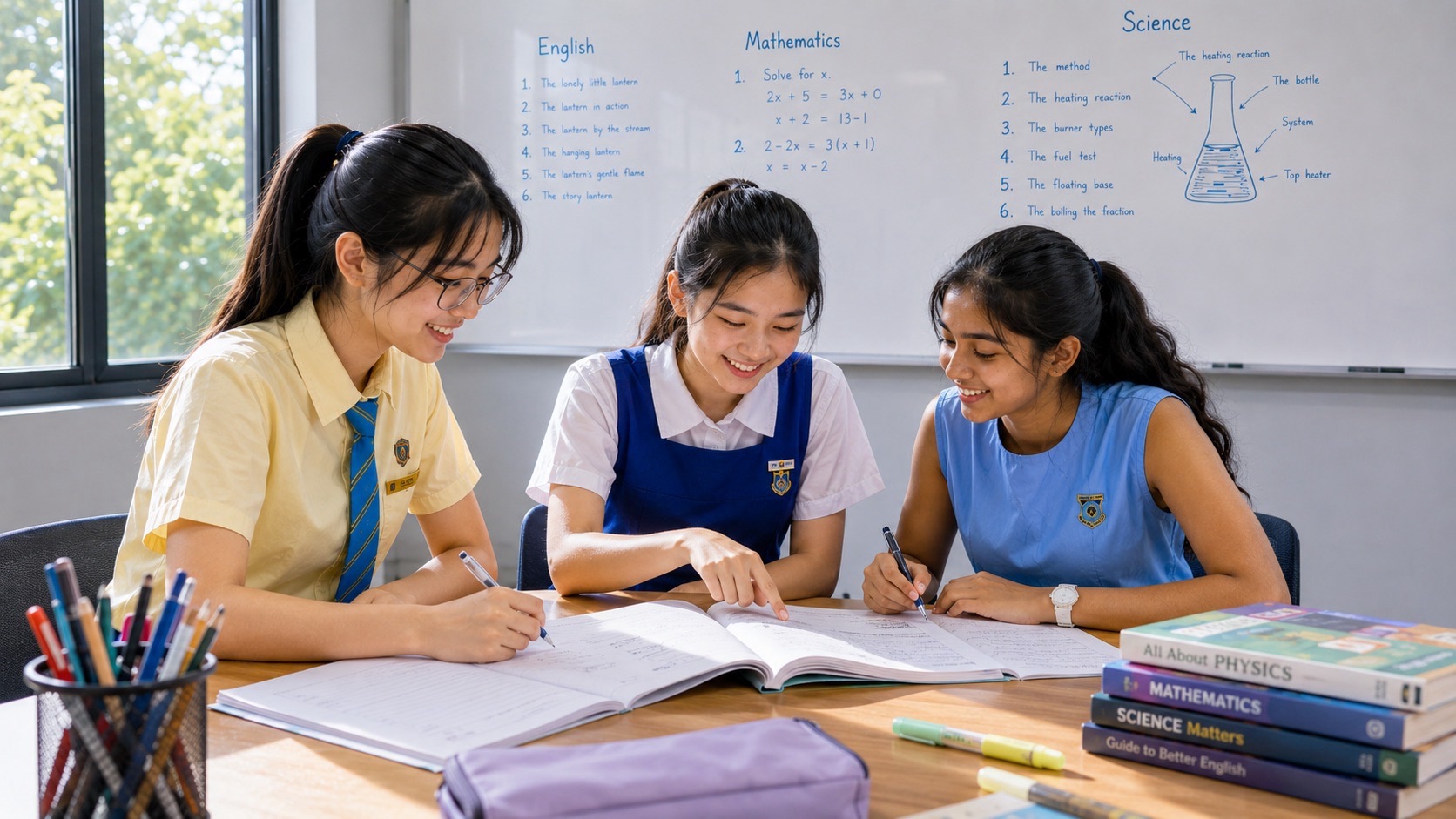
Secondary 1 English tuition in Marine Parade is often sought when students discover that secondary-school English is not simply Primary 6 English with longer passages. Families comparing Marine Parade English tuition, Parkway Parade tuition centres, secondary English enrichment, comprehension classes, writing programmes and small-group English tuition often look for stronger reading comprehension, vocabulary, editing, situational writing, continuous writing and oral communication. The real transition is deeper: students must move from answering correctly to explaining precisely, supporting interpretations with evidence and adapting language to purpose, audience and context.
A strong Secondary 1 English programme should connect close reading, inference, evidence selection, vocabulary in context, grammar and editing, register, situational writing, continuous writing and oral discussion. These areas interact. A student who cannot distinguish formal from informal register may struggle in situational writing. A learner who reads superficially may produce unsupported comprehension answers. A student with good ideas may still write weakly if paragraph logic and sentence control are unstable.
At eduKate Singapore, 3-pax Secondary 1 English tuition makes those transitions visible. The tutor can ask each student to justify an inference, compare two possible word choices, explain why a tone suits an audience and revise a paragraph while the reasoning is still fresh. The goal is not to turn Secondary 1 into premature examination drilling. It is to build the language control that later G2/G3 and SEC or O-Level pathways will require.
Secondary 1 Is a Change in Language Demands
Primary English often provides clearer scaffolding. Secondary texts become denser, perspectives more layered and writing tasks more sensitive to audience and purpose. Students are expected to move beyond locating information toward interpreting implications and evaluating how language choices work.
This change can surprise strong primary students. A learner who previously relied on intuition may find that “it sounds right” is no longer enough. Secondary English asks for reasons.
Claim → Evidence → Explanation → Connection
Reading: Build a Mental Model of the Text
Strong comprehension begins before the questions. Students should know who is speaking, what the situation is, what changes, what attitudes are implied and how paragraphs connect. Without a mental model, answering becomes random scanning.
We teach students to track reference words, contrast, cause, sequence and shifts in tone. A sentence rarely stands alone. Its meaning often depends on what came before and what the writer assumes the reader will infer.
Inference: Evidence Before Personal Opinion
Secondary 1 students often understand the idea of inference but still answer with personal assumptions. We make inference disciplined: identify the clue, state the interpretation and explain why the clue supports it.
If two interpretations seem possible, compare the evidence. Which explanation accounts for more of the text with fewer unsupported assumptions? This turns comprehension into reasoning rather than guessing.
Vocabulary in Context: Meaning Is Local
A word can change meaning according to context, tone and collocation. Students need more than dictionary definitions. We examine the surrounding sentence, grammatical role, nearby contrast and the writer’s purpose.
Vocabulary development also feeds writing. Students compare near-synonyms and learn that a precise familiar word is often stronger than an advanced word used awkwardly.
Register: Language Changes With Relationship and Purpose
Secondary English increasingly expects students to recognise that language should fit the situation. A message to a close friend, a formal report, a speech to schoolmates and an email to an organisation require different levels of formality and different rhetorical choices.
We teach register by asking four questions: who am I, who is the audience, what am I trying to achieve and what language choices make that relationship work? This foundation supports situational writing and oral communication.
Situational Writing: Complete the Communication Job
Situational writing is not simply a format exercise. Students must extract required content, identify purpose and audience, then organise information so the reader can act on it.
We teach a pre-writing audit: role, audience, purpose, required information, tone and organisation. Students then check that every required point is communicated clearly rather than hidden inside decorative writing.
Continuous Writing: Paragraphs Need Jobs
Secondary 1 writing benefits from a simple principle: every paragraph should do something. In narrative writing, a paragraph may establish, disrupt, develop, turn or resolve. In expository or reflective writing, a paragraph may make a claim, explain, exemplify or qualify.
When paragraph jobs are clear, sentence choices become easier. Students are less likely to produce long writing that sounds fluent but drifts.
Grammar and Editing: Accuracy Under Cognitive Load
Students may know grammar rules in exercises and still make errors during writing because free composition requires idea generation, organisation and sentence construction at the same time. We therefore move grammar from focused practice into editing and authentic writing.
The progression is deliberate: notice the pattern, explain it, practise it, use it in a paragraph, then monitor it independently. Transfer is the real test.
Evidence-Based Answers
Many Secondary 1 comprehension answers are weak not because the student misunderstood the text but because the response is under-evidenced or vague. We teach answer sufficiency: what exactly must this response contain? Which phrase or detail supports it? What explanation connects the evidence to the claim?
Students learn that copying more text is not automatically safer. A shorter answer can be stronger if it is precise and complete.
Oral Discussion: Make Thinking Audible
Small-group discussion gives the tutor a direct view of language reasoning. A student may understand a passage but struggle to express the inference. Another may speak fluently but rely on unsupported claims. Oral work helps separate understanding from expression.
Students practise stating a view, developing the reason, giving an example and responding to another perspective. These are communication skills as well as future assessment skills.
Why Three Students Works Well in Secondary 1 English
- every student explains interpretations aloud;
- comprehension evidence can be challenged immediately;
- writing can be revised during the lesson;
- register choices can be compared across audiences;
- quieter students cannot disappear into a large class;
- strong students can be stretched through nuance and argument rather than more worksheets.
A Useful Secondary 1 English Lesson Loop
- Retrieve: reactivate vocabulary, grammar or a reading habit.
- Read: build a mental model of a short text.
- Infer: identify evidence and justify interpretation.
- Write: apply the same language control in a paragraph or response.
- Edit: revise for meaning, structure and accuracy.
- Transfer: apply the skill to a different text type or audience.
Catch Up, Keep Up or Move Ahead
- Catch up: repair sentence control, vocabulary, literal comprehension and paragraph structure.
- Keep up: stabilise inference, editing, situational writing and school-assessment performance.
- Move ahead: deepen rhetoric, tone, argument, text comparison and deliberate stylistic choices.
Marine Parade Families: Comparing Secondary English Tuition
Marine Parade, Parkway Parade, Parkway Centre and Katong offer many Secondary English tuition and enrichment options. Parents will see programmes focused on comprehension techniques, writing, vocabulary, grammar, editing, oral communication and examination preparation. These labels are useful, but the teaching process matters more.
Ask how a tutor diagnoses a vague comprehension answer. Ask whether writing feedback changes the next piece. Ask whether students learn why a register suits an audience. Ask how vocabulary is connected to reading and writing rather than memorised as a list.
For broader eduKateSingapore routes, see Secondary English Tuition | Marine Parade — 3-Pax Small Groups, the English Article Directory and the Tuition Programmes Directory.
What Parents Can Bring to a Diagnostic Review
- recent comprehension or language-use papers;
- one piece of situational writing;
- one continuous writing piece;
- teacher comments or correction codes;
- examples of grammar errors that recur;
- information about reading habits and homework time.
How We Know Secondary 1 English Is Improving
- inferences are supported with better evidence;
- vocabulary is interpreted more accurately in context;
- register becomes more appropriate to audience and purpose;
- paragraphs have clearer functions;
- grammar errors reduce inside authentic writing;
- students can explain why a revision improves the sentence;
- unfamiliar texts trigger a reading strategy rather than panic.
Frequently Asked Questions
Should Secondary 1 already prepare for O-Level or SEC English?
Secondary 1 should build the reading, writing, editing and communication capabilities that later examinations depend on. Premature paper drilling is less valuable than strong transferable language control.
Why does my child read well but lose comprehension marks?
Reading fluency and answer construction are different stages. The student may choose weak evidence, infer too freely or express the idea vaguely.
Is vocabulary memorisation enough?
No. Vocabulary becomes useful when students can recognise nuance in reading and retrieve the right word while writing or speaking.
Secondary 1 Should Make Language More Deliberate
The strongest Secondary 1 progress is not simply harder vocabulary or longer essays. It is deliberate control: reading for relationships, selecting evidence, adapting register, organising paragraphs and editing with a purpose.
That is the purpose of Secondary 1 English tuition for Marine Parade students: build a language system that can explain, adapt and transfer before upper-secondary demands intensify.