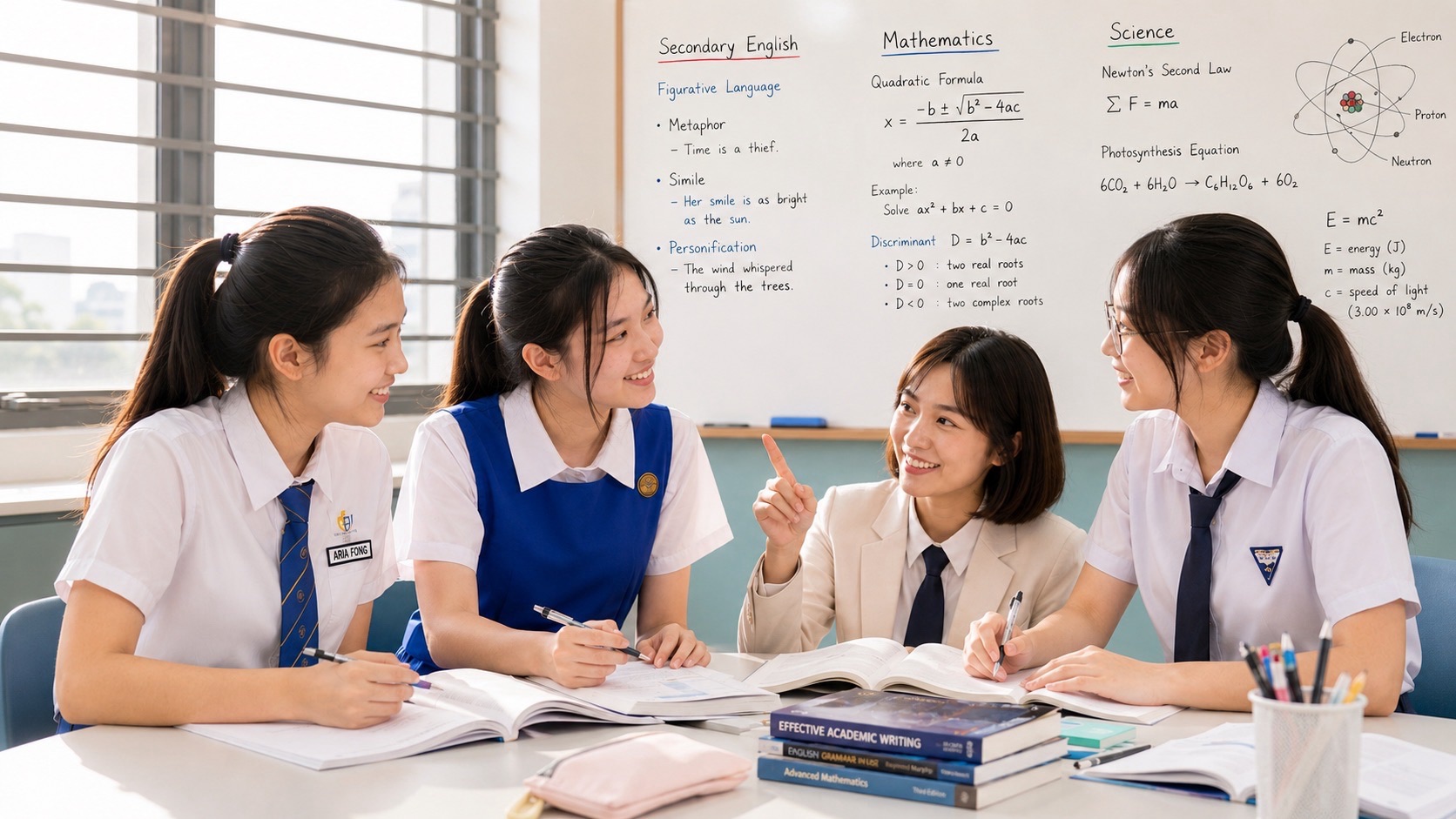
Punggol Secondary 3 Mathematics Tutor
This is the local programme gateway for Secondary 3 Mathematics at eduKate Punggol. Secondary 3 is the year Mathematics expands, branches and begins operating under much heavier load.
Secondary 1 installs the new mathematical machinery. Secondary 2 connects and load-tests it. Secondary 3 asks the student to run a larger system: more topics, longer solutions, less signposted methods, increasing examination pressure and, for some students, Additional Mathematics at the same time.
Secondary 3 is the expansion year.
Who this programme is for
- Students whose Secondary 1–2 foundations are now breaking under greater load.
- Students who understand chapters individually but struggle with mixed questions.
- Students who are passing but inconsistent because method selection, algebra, working or timing is unreliable.
- Strong students who need greater depth, efficiency and examination control.
- G2 and G3 Mathematics students whose teaching needs to match their present subject level and school sequence.
- Students also taking Additional Mathematics who must manage two related but different mathematical systems without allowing one to destabilise the other.
The Secondary 3 problem is not one hard chapter
Students often say that Secondary 3 Mathematics suddenly feels difficult. The increase is usually systemic rather than isolated.
- Algebra must remain accurate across longer chains.
- Graphs require interpretation rather than mechanical plotting.
- Geometry and trigonometry require better diagram reading and route selection.
- Statistics and probability require interpretation as well as calculation.
- Mixed papers remove the chapter label that used to tell the student what method to use.
- Earlier weaknesses become more expensive because more topics depend on them.
A student can therefore know many individual methods and still be unable to run the whole system reliably.
We begin with the actual learner state
Two Secondary 3 students with the same mark may need completely different interventions. We therefore look at what produced the result.
- Concept depth
- Algebraic control
- Representation and diagram reading
- Method selection
- Working accuracy
- Retrieval of older topics
- Transfer into unfamiliar questions
- Timing under load
- Independent checking and recovery
- Interaction between Mathematics and Additional Mathematics where relevant
The lesson route is then built from the diagnosis rather than from the label “Secondary 3”.
The Secondary 3 teaching loop
- Stabilise — repair any lower-secondary dependency that cannot carry current load.
- Expand — install the new upper-secondary concepts properly.
- Integrate — connect topics so the student can choose between methods.
- Retrieve — keep older Mathematics active through spiral revision.
- Perform under load — add mixed, timed and examination-style work progressively.
- Correct and recompile — use errors to decide the next target.
This is the core Secondary 3 engine: Stability → Acceleration → Examination Control.
Why the three-student format matters more in Secondary 3
Longer solutions create more places for errors to begin. Students also diverge more strongly by Secondary 3: one may need repair, another may need consolidation, while a third is ready for extension.
A maximum of three students allows the tutor to observe the actual working, intercept errors close to the point where they form, and adjust the difficulty without turning the lesson into three unrelated private lessons.
Read Why Three Students Work Under Upper-Secondary Mathematics Load for the teaching mechanism.
The Mathematics and Additional Mathematics split
For some students, Secondary 3 is also the point where Additional Mathematics begins. The two subjects support each other, especially through algebra, functions and graphs, but they are not interchangeable.
Main Mathematics retains a wide applied range across algebra, geometry, trigonometry, mensuration, statistics, probability and real-world interpretation. Additional Mathematics is more algebraically intensive and develops a more specialised symbolic system.
The correct strategy is not to let the apparently harder subject consume all study time. Both systems need to remain healthy.
The Secondary 3 library route
- From Lower Secondary Mathematics to Upper Secondary — the incoming handover state.
- How Secondary 3 Mathematics Works — the main Mathematics runtime.
- Secondary 3 G3 Mathematics — Stability → Acceleration → Examination Control.
- Why Three Students Work Under Upper-Secondary Mathematics Load — the small-group architecture.
- Punggol Secondary 3 Additional Mathematics Tutor — the A-Math programme gateway.
- Secondary 3 G3 Additional Mathematics — the high-resolution A-Math route.
- Secondary 4 Mathematics — the examination-year route forward.
Consultation before placement
Before recommending a class, we look at the student’s current subject level, recent work, error patterns, algebraic readiness, school pace and whether the student is also carrying Additional Mathematics.
The aim is to identify the smallest useful intervention rather than simply add more workload. For Secondary 3 Mathematics tuition in Punggol, contact eduKate Singapore for a consultation. Email: admin@edukatesg.com.