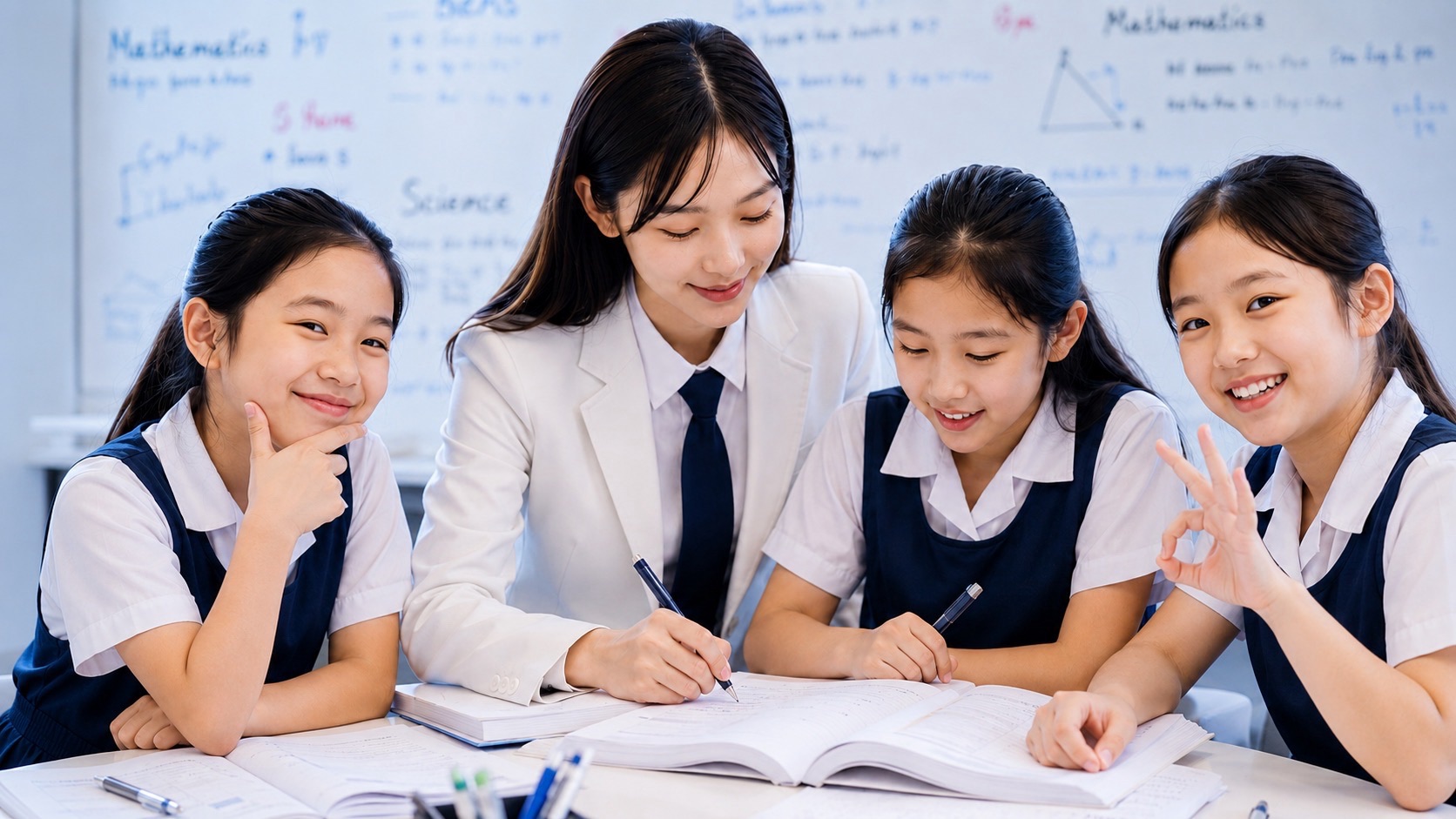
Why Three Students Work for Primary Science
“Small class” is often used as a marketing phrase. For Primary Science, the more important question is what becomes possible when the class is small enough to observe each learner’s reasoning route.
Three students is not only about more attention. It is about higher-resolution diagnosis and faster correction.

The same wrong answer can come from different causes
Suppose three students choose the same wrong option.
- Student A does not know the concept.
- Student B knows the concept but misreads the diagram.
- Student C understands both but rushes and selects before checking.
The visible error is identical. The repair should not be.
A class size of three makes it practical to ask each learner to explain the route, compare the three routes, and immediately assign a different next action.
Science needs visible thinking
Primary Science is not only a content subject. Students must observe, infer, interpret, predict, explain, evaluate and communicate. These processes are difficult to diagnose from a final answer alone.
We therefore need opportunities to hear and inspect the student’s thinking:
- “What did you notice first?”
- “Why did you eliminate that option?”
- “Which evidence in the diagram supports your conclusion?”
- “What would change if this variable were different?”
- “Can you explain the same idea without using the model sentence?”
Why three is different from one
One-to-one teaching gives maximum individual attention, but three students add something useful: comparison.
A learner can see that another student used a different route, hear a different explanation, challenge an inference, or notice a missing piece in someone else’s answer. This creates controlled variation without turning the lesson into a large class.
One student gives a route. Three students give routes to compare.
That matters especially in Science because the subject benefits from prediction, discussion, evidence and explanation.
Why three is different from a large class
As class size grows, the tutor has less time to inspect every student’s internal route. It becomes easier to teach the common error and harder to see the uncommon one.
With three students, the loop can remain tight:
Question → response → reasoning → diagnosis → correction → retest.
The tutor can run that loop repeatedly within one lesson instead of waiting until a worksheet is marked later.
Three students allows branching without splitting the class apart
| Learner state | Possible next task |
|---|---|
| Concept unstable | Return to a simpler representation and rebuild the mechanism |
| Concept stable, explanation weak | Convert model into precise cause-and-effect language |
| Familiar questions strong, new contexts weak | Transfer task with changed diagram or wording |
| Accurate but slow | Fluency and timed discrimination |
| Strong across all of these | Stretch through mixed-topic reasoning and deeper inquiry |
All three students can remain inside the same topic while working at different points of the learning architecture.
The tutor can catch misconceptions earlier
Misconceptions are dangerous because they can produce internally consistent but incorrect answers. A child may repeatedly reason from the wrong model and become more confident in it with practice.
Small-group questioning makes those models easier to expose before repetition stabilises them.
The class can use productive disagreement
If two students predict different outcomes, we do not need to resolve the disagreement immediately. We can ask each student to state the model, identify what evidence would distinguish the two predictions, then test or reason through it.
This teaches an important scientific habit: disagreement can be turned into a question that evidence can answer.
What three students does not mean
- It does not mean every learner receives the same worksheet at the same pace.
- It does not mean the tutor talks three times as much.
- It does not mean every lesson must be an experiment.
- It does not mean class size alone guarantees good teaching.
The value appears only when the small group is used to increase diagnostic resolution, participation, comparison and feedback speed.
How this changes across P3→P6
| Year | What the three-student format helps us see |
|---|---|
| P3 | Vocabulary, observation habits and early misconceptions |
| P4 | Whether facts are becoming connected mechanisms |
| P5 | How students integrate systems and transfer ideas |
| P6 | Where capability fails to convert under examination load |
Continue through the Punggol Science Library
- Does My Child Need Primary Science Tuition? Parent Decision Guide
- P3–P6 Programme Gateway
- How Primary Science Works
- Primary Science Learning Architecture
- Primary Science P3→P6: The Learning Journey
Programme consultation
The three-student format is most useful when the learner state is clear, so the small class has a specific job rather than merely adding another lesson. For current Punggol Primary Science consultation, class suitability, timing and availability, continue to Sign Up for Primary Science Tuition at eduKatePunggol. This eduKateSingapore page remains the small-group teaching reference room.