Canonical local owner: start with Primary 6 Science Tuition Tengah for the current location × year × subject route. This page is retained as supporting material with its original explanatory angle.
Primary 6 Science is where the separate chapters finally have to behave like one subject.
A question about a plant may involve photosynthesis, transport, water and environmental conditions. A question about movement may involve several forces acting together. An environmental question may require the student to connect food relationships, population change, human action and energy flow. Experimental evidence may sit inside a graph, diagram or unfamiliar apparatus.
The difficulty is no longer only whether the child knows the fact. It is whether the child can identify which facts matter, connect them in the correct order and explain only what the evidence allows.
Quick Read for Parents
- Primary 6 Science completes the formal P3–P6 concept progression and requires much more integration.
- Current MOE P6 topics include photosynthesis, energy conversion, frictional/gravitational/elastic spring forces and interactions within the environment.
- Students need to retrieve earlier knowledge because many P6 questions span more than one year or topic.
- Open-ended answers need complete causal chains tied closely to the evidence in the question.
- Experimental questions test fair comparison, data interpretation, variables and justified conclusions.
- Good tuition should use practice papers as diagnostic evidence, not as a substitute for concept repair.
The One-Sentence Answer
Strong Primary 6 Science tuition should help a student integrate concepts across systems, energy, forces and environments, then convert that understanding into precise evidence-based answers under PSLE conditions.
What Primary 6 Science Adds
MOE’s current Primary Science syllabus places P6 topics around photosynthesis, energy conversion, interactions of forces—including frictional, gravitational and elastic spring forces—and interactions within the environment.
Read the current MOE Primary Science Syllabus.
But the educational meaning of Primary 6 is larger than those new topics. The student is expected to bring forward earlier ideas about plants, water, matter, heat, human systems, electricity, life cycles and experimental reasoning. P6 turns the primary Science curriculum into an integrated network.
Why Primary 6 Science Is an Integration Problem
Imagine a question in which one group of plants receives less light and later shows reduced growth. A complete explanation may require the student to connect light availability to photosynthesis, food production, transport and growth.
None of those ideas is individually exotic. The challenge is choosing the relevant chain and preserving it from start to finish.
This is why students can say, quite truthfully, “I know all these topics” and still lose marks. The issue may not be storage. It may be retrieval, connection, explanation or question interpretation.
Eight Primary 6 Patterns That Need Different Repairs
1. The student knows facts but cannot combine them
This is an integration weakness. We use questions that deliberately cross topics and ask the student to identify which concepts are needed before answering.
2. Photosynthesis is memorised as an equation-like sentence
The child may recall inputs and outputs but not understand why each condition matters or how food production affects the wider plant system. We reconnect photosynthesis to leaves, light, water, gases, transport and growth.
3. Energy answers list forms but do not trace conversion
Knowing names such as electrical, light, heat, kinetic or potential energy is only the beginning. The learner must identify where energy starts, how it changes form and what observable effect follows.
4. Force questions assume one force acts at a time
Real situations can involve several forces simultaneously. Students need to identify the relevant forces and explain how changes in friction, gravity or spring force affect motion or equilibrium.
5. Environmental questions become storytelling
Students may write plausible ecological narratives without grounding them in the food relationships or evidence shown. The explanation must trace how one change affects another population or resource through a specific relationship.
6. Experiment answers ignore the actual variable changed
The student may know the topic well but answer the question they expected instead of the investigation presented. We teach them to read the setup before retrieving the explanation.
7. Open-ended answers contain correct keywords but weak causal links
Keywords earn little if they are not connected. We train condition → process → intermediate effect → observed outcome.
8. Practice papers produce the same score repeatedly
This suggests measurement without sufficient repair. Full papers should reveal what to teach next; targeted work should change the weak process before the next full-paper check.
Photosynthesis: Connect Food Production to the Whole Plant
Photosynthesis becomes much easier to reason about when it is not treated as an isolated P6 paragraph.
The plant needs suitable conditions to make food. Leaves are central because they receive light and are involved in gas exchange. Water must reach the relevant parts of the plant. The food produced supports growth and other life processes.
Questions may therefore alter light, water availability or leaf area and ask the student to predict an effect. The answer should trace the changed condition through food production to the observed outcome.
Energy Conversion: Follow the Transfer, Not Just the Labels
Energy questions often become keyword exercises: “electrical to light”, “chemical to kinetic”. The stronger understanding asks where the energy came from, what form it takes at each stage and which changes are useful or unwanted.
In a battery-powered toy, for example, stored chemical energy ultimately supports electrical processes and movement, while some energy may also appear as heat or sound. The exact level of detail should match the syllabus and question, but the reasoning habit is stable: trace the conversion through the system.
Forces: Ask What Is Acting and What Changes
Primary 6 introduces more explicit reasoning about frictional force, gravitational force and elastic spring force.
Students benefit from drawing or mentally mapping the situation. What object are we considering? Which forces act on it? Which force changes when a surface becomes rougher, a spring is stretched more or an object is released?
Rather than memorising “friction slows things down”, we ask how friction depends on the interacting surfaces and how changing it affects the observed motion in the given setup.
Environment: Trace Relationships, Not Just Food Chains
Environmental interactions ask students to reason through dependence.
If one population falls, which organisms lose a food source? Which may face less competition? How might human action alter habitats or resources? Which conclusion is supported by the data shown rather than merely possible?
This is where students learn that ecological systems can produce indirect effects. A change in one place can travel through several relationships before becoming visible elsewhere.
Experimental Questions: Read the Logic Before the Topic
Upper-primary experimental questions can be solved more reliably with a fixed reading routine.
- What question is the investigation trying to answer?
- What factor was deliberately changed?
- What outcome was measured or observed?
- What important conditions were kept similar?
- What pattern appears in the results?
- What conclusion does the evidence support?
- Is there another plausible explanation the setup has not ruled out?
The final question is especially useful for stronger students because it teaches restraint. Science does not allow a conclusion to become stronger than the evidence.
Graphs and Tables: Do Not Skip the Axes
Many P6 students lose marks not because they cannot reason scientifically, but because they misread the evidence representation.
Before interpreting, read the axis labels, units, scales and categories. Decide whether the graph shows change over time, comparison between groups or a relationship between two variables. Then describe the actual pattern before explaining it.
Description and explanation are different jobs. “The rate increased” describes. “The rate increased because…” explains.
Open-Ended Science: Precision Beats Length
Students sometimes react to high-stakes Science by writing more. More words can actually make an answer less precise.
A strong answer should contain the necessary scientific terms, but every sentence should do work. We ask:
- What changed?
- Which scientific process is relevant?
- What happens because of that process?
- How does this produce the observed result?
- Which evidence from the question supports the chain?
This keeps the answer rigorous without becoming bloated.
Practice Papers: Measure, Diagnose, Repair, Retest
Primary 6 needs realistic paper practice, but practice should create information.
- Measure: complete a suitable paper or section under known conditions.
- Diagnose: classify lost marks—concept, recall, interpretation, experiment, data, causal chain, precision or timing.
- Repair: isolate and reteach the weak process.
- Retest: use unfamiliar questions to check transfer.
A paper that produces only a score is a missed teaching opportunity.
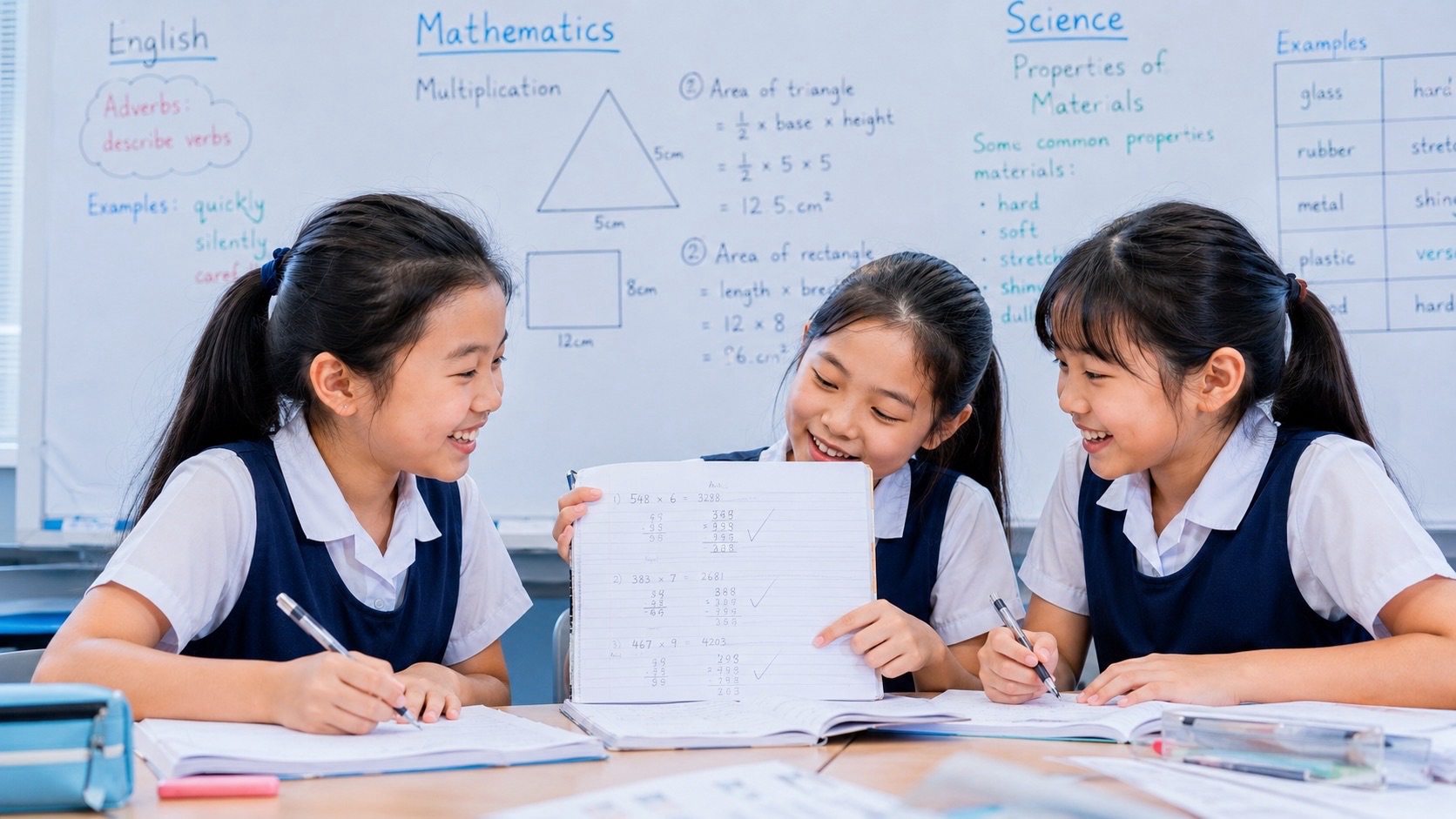
Why Three Students Works Well for Primary 6 Science
At P6, multiple plausible explanations are common. A small group allows students to compare chains rather than simply compare final answers.
One student may identify the correct process but miss an intermediate link. Another may use a stronger piece of evidence. A third may notice that the conclusion goes beyond what the experiment measured.
The tutor can make those differences visible and ask each student to rebuild the explanation independently.
What Parents Can Do During the PSLE Year
- Ask where the marks went. Separate concept errors from explanation and experiment errors.
- Keep marked papers. Patterns across several papers are more reliable than one score.
- Ask for the evidence. “Which part of the diagram or data supports that?”
- Ask for the missing link. If the answer stops at a keyword, ask what happens next.
- Protect sleep and routine. Science reasoning needs working memory and attention.
- Do not chase every exotic question. Reliable core reasoning is more valuable than collecting rare tricks.
TengahOS and Primary 6 Science Complement Each Other
The broader local systems story belongs in TengahOS. This page keeps its job on the learner.
That is especially useful at P6. The town pillar can show how energy, environment, infrastructure and human decisions interact at a real-world scale; the tuition page teaches the student how to reason carefully within the Primary Science syllabus.
What Improvement Should Look Like
Primary 6 improvement should become visible as integration and restraint.
The student retrieves earlier plant knowledge when photosynthesis requires it. Energy answers trace conversions instead of list labels. Force explanations identify the relevant interaction. Environmental answers follow food and population relationships. Experimental conclusions become narrower and better supported.
The student also becomes better at recognising what the question does not justify. That is a mature scientific skill: knowing the boundary of the evidence.
Who This Programme Can Help
Primary 6 Science tuition can support students who need stronger integration across P3–P6 topics, better open-ended explanations, clearer experimental reasoning, more accurate data interpretation, stronger energy and forces understanding or more reliable performance under PSLE-style conditions.
Stronger students can be stretched through multi-topic questions, ambiguous evidence, experimental design critique and explanations where the challenge is not recall but deciding exactly how much the evidence supports.
Frequently Asked Questions
Should Primary 6 Science be mostly practice papers?
No. Full papers are necessary for calibration and integration, but targeted concept and reasoning repair should sit between them. Repeated measurement without repair is inefficient.
Why does my child know the answer after correction but not during the paper?
The knowledge may be present while recognition, retrieval or question interpretation is weak. Test the same concept in a new context without the original prompt to see whether transfer has occurred.
How can open-ended answers improve?
Train complete causal chains tied to evidence. The answer should identify the relevant condition, explain the process and connect it to the observed result without unnecessary extra facts.
What should parents look for in a marked Science paper?
Look beyond topic labels. Ask whether lost marks came from missing knowledge, misread diagrams, weak experiment logic, incomplete explanation chains, vague vocabulary or failure to use the evidence given.
The Final Primary Science Job
Primary 6 Science should prepare a child for PSLE. It should also leave behind something more durable.
Secondary Science will separate into increasingly specialised ways of studying biology, chemistry and physics. The child who can already trace a system, distinguish observation from explanation, read evidence, test a conclusion and revise an idea when the evidence changes has a powerful foundation for that next world.
The best P6 Science learning therefore does not end when the paper is collected. It teaches the student how to keep asking the world what is actually true.