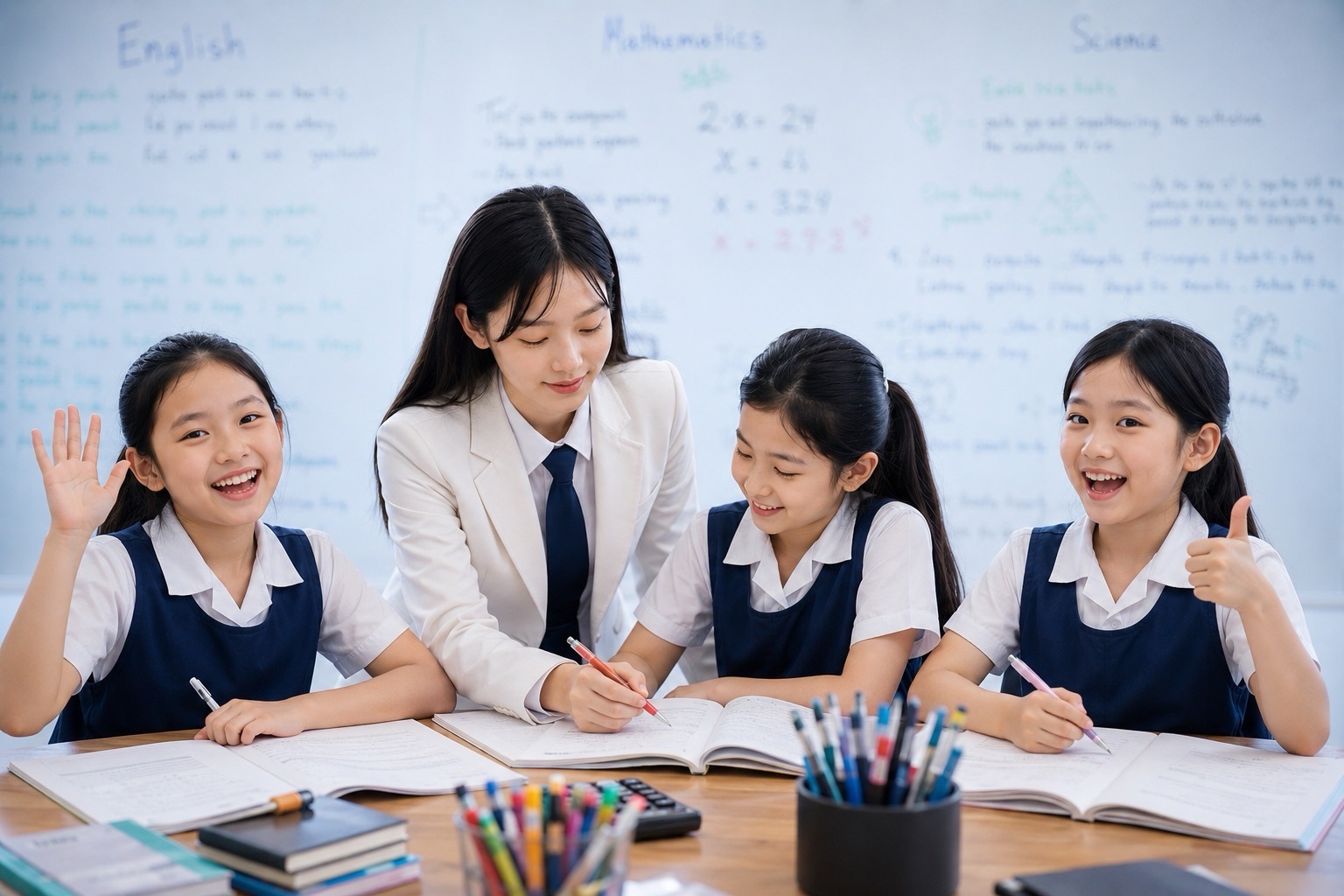
Primary 2 Pre-Science Foundation | Compare → Sort → Sequence → Represent
Primary 2 is the bridge between everyday observation and the more formal scientific thinking that begins in Primary 3.
The useful job at Primary 2 is not to start Primary 3 Science early. It is to make comparison, sorting, sequencing and representation more deliberate.

The Primary 2 pre-science runway
Compare → Sort → Sequence → Represent.
| Capability | What it looks like at P2 | Why it matters in P3 |
|---|---|---|
| Compare | The child identifies similarities and differences using the same characteristic. | P3 classification and observation depend on controlled comparison. |
| Sort | Objects can be grouped using a stated rule. | P3 Science introduces more formal classification of living things, materials and other observable features. |
| Sequence | The child can put events or stages in a sensible order. | Life cycles, processes and cause-and-effect explanations depend on order. |
| Represent | An idea can be shown with a simple diagram, table, labels or ordered pictures. | Science increasingly moves between words, diagrams, tables and other representations. |
Why comparison comes before classification
Children can sort objects correctly by intuition without being able to explain the rule. The more useful pre-science move is to make the comparison explicit.
For example, instead of simply placing objects into two groups, ask:
- “What characteristic are you using?”
- “Does the same rule work for every object in this group?”
- “Where would this new object go, and why?”
- “Can you sort the same objects using a different rule?”
This starts to turn intuitive sorting into explicit reasoning.
Sequence before mechanism
Before a child can explain why a process occurs, the child often needs to see the order clearly.
- Put pictures of a simple growth sequence in order.
- Describe what happened first, next and last.
- Notice which stage changed.
- Predict what might happen next and then check.
Primary 3 will later add more scientific vocabulary and causal explanation. P2 can prepare the sequencing structure without forcing advanced content into it.
Representation: show the same idea more than one way
A powerful P2 foundation is learning that one idea can be represented in several forms.
| Starting form | Possible transformation |
|---|---|
| A collection of objects | Sort into groups and label the rule. |
| A short story of change | Draw three ordered pictures. |
| Several observations | Place them in a simple table. |
| A diagram | Describe in words what the diagram shows. |
| Two objects | Make a comparison chart. |
If the child can move an idea between forms, Primary 3 diagrams and scientific representations become less foreign.
What parents can do at home
- Compare two fruits, leaves, containers, fabrics or household objects.
- Ask the child to invent a sorting rule, then test it with a new object.
- Sequence pictures from cooking, growing plants, travelling or daily routines.
- Turn a spoken description into a simple sketch or table.
- Ask “How do you know?” without demanding an advanced scientific explanation.
- Change the example to see whether the same comparison rule still works.
What not to do
- Do not invent a Primary 2 Science examination programme.
- Do not measure readiness by how many P3 chapters have been pre-taught.
- Do not teach classification as memorised lists without a grouping rule.
- Do not force technical vocabulary where ordinary precise language is enough.
- Do not replace reading, play, conversation and observation with a large worksheet load.
Does a Primary 2 child need preparatory Science tuition?
Not by default. A child who can compare carefully, explain a sorting rule, sequence events and represent simple information already has a useful runway into Primary 3.
Additional support may be useful when these capabilities remain persistently weak despite ordinary school and home opportunities—for example, when the child cannot maintain one comparison rule, cannot explain why objects were grouped together, struggles to sequence a simple process, or cannot translate a basic diagram into words.
The Primary 3 handover gate
Before formal Science begins, a useful handover state is:
- Notice: looks carefully before answering.
- Describe: can state what is observable.
- Compare: uses a consistent characteristic.
- Sort: can state and defend a grouping rule.
- Sequence: can order stages and describe change.
- Represent: can move simple information between words, pictures, diagrams or tables.
- Question: is willing to ask, predict and change an idea when evidence disagrees.
Primary 3 can then install the formal scientific language and habits on top of something that already works.
The Science runway
P1 Notice → Name → Describe
P2 Compare → Sort → Sequence → Represent
P3 Observe → Compare → Classify → Explain
The point of P1 and P2 is not acceleration for its own sake. It is a cleaner handover into formal Science.
Continue through the Science runway
- Primary 1 Pre-Science Foundation: Notice → Name → Describe
- Primary 3 Science: The Installation Year
- P3 Decision Room: Do We Need Help Yet?
- Primary Science P3→P6: The Learning Journey
Consultation
If you are wondering whether your Primary 2 child needs early Science preparation, we can first look at the pre-science capabilities above. If the runway is already healthy, the best decision may simply be to let it develop naturally until Primary 3.