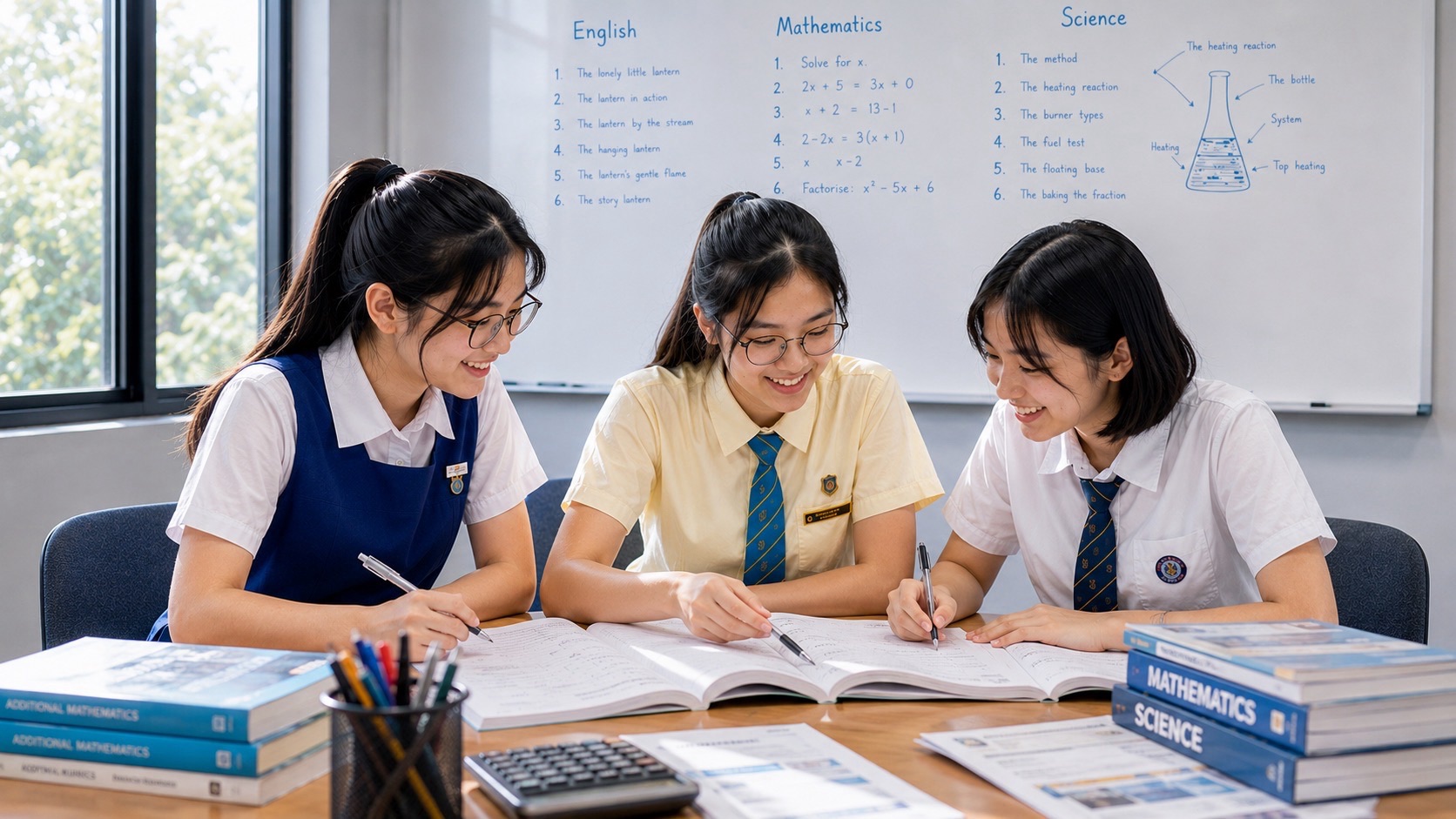
Parents preparing a student for Secondary 4 G1 English Language and the 2027 Singapore-Cambridge Secondary Education Certificate should focus on practical communication, not memorised model essays. The four required abilities are purposeful writing, accurate language use and reading, attentive listening, and confident oral communication. Begin with the pupil’s latest school papers and teacher comments, then decide whether the main obstacle is sentence accuracy, understanding a text, meeting a writing task’s requirements, handling spoken details or responding to unfamiliar questions. A short revision programme that addresses the actual weakness is usually more useful than another large stack of unreviewed exercises.
SEAB’s official 2027 G1 English Language syllabus K100 contains four compulsory papers: Paper 1 Writing (70 marks, 30%, 1 hour 20 minutes), Paper 2 Language Use and Comprehension (60 marks, 40%, 1 hour 20 minutes), Paper 3 Listening (20 marks, 10%, about 45 minutes) and Paper 4 Oral Communication (40 marks, 20%, about 20 minutes including preparation). Crucially, the Writing paper is computer-delivered, while the Oral paper includes reading aloud and video-based spoken interaction. These are the published 2027 requirements for K100 and should not be replaced with the G2 K200 or G3 K300 examination formats.
Quick information for parents
• Exact subject: 2027 SEC G1 English Language, K100; confirm school registration.
• Writing, 30%: 80 minutes; editing (10 marks), situational writing (30), continuous writing (30); delivered by computer.
• Writing lengths: at least 180 words for situational writing and at least 120 words for one of two continuous-writing topics.
• Language Use and Comprehension, 40%: 80 minutes; vocabulary and grammar cloze, narrative and non-narrative reading, including visual texts.
• Listening, 10%: about 45 minutes, 20 marks; attend to meaning and important details.
• Oral, 20%: about 20 minutes including preparation; Reading Aloud 15 marks and Spoken Interaction 25 marks.
• Preparation: use real marked work, teach specific skills, practise digital writing, oral discussion and listening, then add realistic timing.
• Next stage: verify current 2028 post-secondary admission pathways using the pupil’s complete subject results, not English alone.
Understand G1 English and the 2027 SEC transition
G1 is the level of the English Language subject under Full Subject-Based Banding, broadly aligned with the former Normal (Technical) standard. The new SEC is a common certificate structure recording subjects at their respective levels. G1 English does not define a student’s full set of strengths or post-secondary possibilities. A learner may offer other subjects at different G levels where eligible and as approved under school and MOE arrangements.
The English subject assesses communication relevant to study, work and everyday life. A pupil needs to read instructions, understand the meaning of texts, write for a real audience, listen for key facts and take part in a conversation. These are valuable skills even when the topic is not an examination passage. Parents should avoid reducing the subject to a score or telling the student that language improvement is impossible because of a subject label.
A useful question is: which English task can the student now complete independently that they could not complete last term? A clearer email, accurate inference or more developed oral answer represents meaningful progress. The next revision session should grow from that evidence rather than chase a generic promise of distinction.
Know the official four-paper assessment accurately
| 2027 K100 paper | Duration and weighting | Sections or tasks |
|---|---|---|
| Paper 1: Writing | 1 h 20 min; 70 marks; 30% | Editing 10; Situational Writing 30; Continuous Writing 30; computer-delivered |
| Paper 2: Language Use and Comprehension | 1 h 20 min; 60 marks; 40% | Vocabulary cloze 10; grammar cloze 10; narrative comprehension 10; non-narrative comprehension 30 |
| Paper 3: Listening | About 45 min; 20 marks; 10% | Listening and matching or selection tasks on spoken texts |
| Paper 4: Oral Communication | About 20 min including 10 min preparation; 40 marks; 20% | Reading Aloud 15; Spoken Interaction 25 |
The four papers have 190 raw marks in total, but that does not mean every raw mark contributes equally to the final result. The subject weighting is set by paper: Language Use and Comprehension is 40%, Writing 30%, Listening 10% and Oral 20%. A parent who simply divides total raw marks by 190 may misrepresent the final weighting.
A balanced revision plan must practise all four skills while devoting extra time to the student’s diagnosed difficulties. It is possible to be a confident conversational speaker and still struggle with comprehension; equally, a good reader may hesitate during oral interaction. Each paper measures something related but distinct.
The actual national timetable, registration details, exam-centre instructions and permitted materials must be checked through SEAB and the school. The syllabus describes the scheme, while separate official communications provide the relevant examination logistics. Do not rely on a tuition advertisement for exact examination dates.
Start revision by finding the first missing skill
Collect one Writing paper, one Language Use and Comprehension exercise, one listening feedback record and a note about oral performance. Ask what the teacher corrected and why. A final score tells only part of the story. The important question is whether the child lost marks because they misunderstood the task, used weak sentence structures, guessed vocabulary, omitted information or could not develop an oral answer.
- Reading: Does the pupil identify the exact information requested?
- Inference: Can a conclusion be linked to a clue from the text?
- Vocabulary: Is a word selected because it fits meaning, not just grammar?
- Writing: Are purpose, audience, required points and structure clear?
- Grammar: Which recurring errors interfere with meaning?
- Listening: Are important names, numbers or reasons missed?
- Oral: Can the child give a reason and example, then answer a follow-up?
- Timing: Which section is regularly unfinished?
Select the two largest teachable problems. For example, ‘correct verb tense in my own email’ and ‘support a reading inference with one phrase from the text’ are specific. ‘Improve English quickly’ is not. Ask the child to keep one original and one revised answer to compare after several weeks.
Use a new task to test every correction. If the learner corrects a sentence only because they remember the teacher’s exact version, the principle has not yet transferred. A changed sentence or passage reveals whether the rule is becoming independent knowledge.
Paper 1: Editing is not generic proofreading
The 2027 K100 Writing paper contains an editing section of ten marks. Candidates examine a passage of about 150 words and indicate whether underlined words are incorrect or redundant, correcting the errors as required. The official syllabus says spelling and punctuation are not tested in this particular section. Students should therefore practise the grammatical relationships that the task actually assesses.
That does not mean spelling or punctuation is unimportant in original writing. It means the formal Editing task has a particular target. A child who spends all their time correcting commas in a grammar-only task may miss the assessed errors. Read the school and SEAB instructions carefully.
Useful review topics include agreement, tense, articles, pronouns, prepositions and sentence structure. Teach two recurring patterns at a time through the student’s own mistakes. Once corrected, test the rule in a fresh sentence and later in a complete paragraph.
Subject–verb agreement
A sentence’s verb must fit its subject in the intended standard grammar. Students may be misled by a plural noun within a phrase when the main subject is singular. A correct edit depends on identifying the grammatical structure, not merely choosing whichever word sounds familiar.
In ‘Each of the students have a locker’, the formal singular subject ‘each’ takes ‘has’. Compare with ‘The students have lockers’. The learner should explain the difference and produce a new example rather than memorise only these two sentences.
After an editing worksheet, ask the student to review a paragraph of their own writing for the same pattern. A correction that appears independently in a composition is stronger evidence of learning than an isolated right answer.
Verb tense and time sequence
Time expressions and relationships between events influence verb form. A student may write one sentence correctly but switch tenses unnecessarily in the next. Teach the child to locate the time marker, decide whether the action is completed or ongoing, and check consistency with surrounding sentences.
If the passage says ‘Yesterday she go to the library’, the past event calls for ‘went’. A longer recount might use past perfect to distinguish an earlier event, but only when the meaning requires it. Avoid inserting complicated forms simply to sound sophisticated.
Practise with a short personal recount: what happened first, what happened next and what was still happening at the relevant moment? Clear time order improves both grammar and writing coherence.
Articles, prepositions and pronouns
Small words can make a sentence inaccurate or unclear. Articles depend on reference and sound or countability conditions, while pronouns must point clearly to the intended person or thing. Prepositions often depend on the context of a phrase, not a single word learnt in isolation.
A student might write ‘He gave it to Sarah when she was outside’ and leave the referent of ‘it’ unclear. Ask what object the reader is meant to understand and whether a noun should be repeated. Clarity matters more than avoiding repetition at all costs.
In editing, identify the exact grammatical reason. In original writing, check whether a real reader could understand the intended message. A technically polished sentence can still need revision if its reference is ambiguous.
Paper 1 situational writing
The official K100 situational task is worth 30 marks and requires at least 180 words. It is guided and based on a context involving a visual text. The candidate must choose language suitable for purpose, audience and context. Task fulfilment matters more than an elaborate memorised greeting.
A fictional prompt may ask the student to explain an activity to a teacher, using details from a school notice. The response should state the purpose, include relevant information, develop requested points and end suitably. Copying an unrelated model letter will not answer the actual task.
Before drafting, ask four questions: who is the reader, why is the message being written, what points are compulsory and which details from the visual stimulus must be used? Check each against the final draft.
Writing for the right audience
A journal entry, personal letter and explanation address different readers and purposes. An informal note to a friend differs from a respectful request to school staff. Appropriate tone is not the same as using the longest or rarest words available.
If explaining why an activity should be changed, the student should identify the proposed change, state a practical reason and give relevant details. A reader should not have to guess the request from a page of unrelated description.
Ask the child to read the draft aloud and imagine receiving it without seeing the original prompt. Would the recipient know what action or information was required? This is a useful communication test.
Paper 1 continuous writing
The official 2027 K100 continuous task offers two topics, with the candidate choosing one and writing at least 120 words in continuous prose. Narrative, personal recount and description are among possible forms. The minimum word length is a requirement, not a target for unnecessary padding.
A story about missing a bus can work if it includes a clear event, the response and a meaningful ending. It does not need dramatic accidents or highly unusual vocabulary. The reader should understand what happened, why it mattered and how the situation concluded.
Plan a beginning, a central development and an ending. Use clear sentences and relevant details. Once a draft is accurate, add useful development rather than simply repeating the same event in different words.
Computer-delivered writing
SEAB states that the 2027 K100 Writing examination is delivered via computer. A candidate should be comfortable typing complete sentences, moving between sections, checking the prompt and reviewing the response on screen. Familiarity with digital tools helps language skills be demonstrated efficiently.
Practise an appropriate school-approved writing task on a computer. The student should be able to type a short message, use basic editing controls and check whether all required points are included before submitting. Follow the actual official interface instructions when provided.
Typing speed is useful but should not dominate revision. A fast typist who answers the wrong audience requirement is not prepared. Combine digital practice with task analysis and language accuracy.
Paper 2 vocabulary cloze
The first modified cloze task tests vocabulary selection from a provided word list. A word must match the meaning of the sentence and the passage, not merely fit the grammatical shape of the blank. Context markers such as ‘however’ and ‘therefore’ can change what is required.
If the passage describes someone who was reluctant to join an activity, ‘unwilling’ may fit while ‘unable’ carries a different meaning. The child should explain how the surrounding words support the choice rather than select it because it looks familiar.
After completing the passage, reread the whole text and check whether the ideas still connect. A grammatically possible but illogical answer needs reconsideration.
Paper 2 grammar cloze
The second modified cloze task tests grammar, asking candidates to supply their own words. The correct form depends on tense, subject, preposition, clause relationship and other features. A random guess may produce a familiar phrase without fitting the specific sentence.
Ask the learner to identify the subject and time reference before completing a missing verb. If a connective is required, determine whether the relationship is contrast, cause, sequence or addition. The chosen word should express the correct logical link.
Use short explanations for wrong answers. A child who corrects a grammar blank but cannot use the same construction in original writing may need further transfer practice.
Narrative and recount comprehension
The K100 comprehension paper includes narrative or recount questions. Students must understand what happened, how events relate and what can reasonably be inferred about people. A matching keyword from the passage is not always the answer to a ‘why’ question.
Consider ‘Maya checked the route again before leaving’. A supported inference might concern her wish to confirm the journey, but the sentence alone does not prove she dislikes travelling. Ask which words support a conclusion and whether an alternative explanation is also possible.
Teach the pattern claim, textual clue and connection. The learner should avoid inventing dramatic backstories not supplied by the passage, because plausible guesses are not necessarily text-supported answers.
Non-narrative comprehension
The 2027 K100 paper includes three non-narrative texts, at least one with visuals. These may require interpreting instructions, facts, purposes or comparisons. Students who read only stories can find informational passages harder because their sentences contain more compressed detail.
An event notice may state eligibility, date, location and what participants must bring. Ask the child who it addresses and what action is required. Missing ‘only’, ‘before’ or ‘except’ can change the correct response significantly.
Practise with accessible public notices and school materials. Identify the main message, important details and which words limit the claim. Accurate everyday reading strengthens exam comprehension.
Visual text and purpose
A visual can communicate through image, layout and text. The student must identify its practical purpose, intended audience and any detail that helps the message. A colour or icon cannot be assigned a universal emotional meaning without considering the actual stimulus.
If a poster uses a large heading announcing an activity, it may direct attention to the event. A printed time and venue provide factual details. The learner should explain how these features support the communication, not invent what the designer privately intended.
Choose a real library poster or school notice and ask who should act, what they should do and which elements make that clear. This is useful in ordinary life as well as comprehension.
Listening for key information
The G1 Listening paper assesses understanding of different spoken texts and may use multiple-choice and multiple matching tasks. Students need to follow the speaker and identify meaning, sequence, reasons and details. Listening is not automatically mastered through ordinary chatting.
Read a short announcement: ‘The workshop has moved to Tuesday at 3.30 pm in Room 5. Please bring a notebook.’ Ask for day, time, place and required item. Then change one detail and see whether the child catches it.
When an answer is wrong, identify whether the problem was unfamiliar vocabulary, attention, similar-sounding numbers or note-taking overload. Match the next practice to that cause rather than saying ‘listen harder’.
Reading aloud for Paper 4
The published 2027 K100 Oral Communication paper includes Reading Aloud worth fifteen marks. Students need intelligible pronunciation, suitable pace, awareness of punctuation and reading that reflects meaning. A fashionable accent or theatrical performance is not required.
Give the pupil a short appropriate paragraph on screen. Let them read it silently, identify unfamiliar words and then read aloud. If they stumble, note a few problem words, practise those and ask for a second reading of the full sentence.
Do not interrupt every syllable. Feedback should help communication, not create fear. A child who knows what the passage means is often better able to read it naturally.
Spoken interaction based on video
The K100 oral paper also has a video-based Spoken Interaction section worth twenty-five marks. It differs from the G2 and G3 planned-response formats. The learner needs to answer questions about related ideas, develop an opinion and respond to follow-ups rather than deliver an unrelated memorised speech.
If the stimulus concerns helping a neighbour, ask how the student might help, why the action could matter and what they would do if the neighbour declined. These questions train flexibility and consideration of other perspectives.
Use a simple scaffold: view, reason, example. Gradually remove it and ask a changed question. The student should learn to listen and answer, not merely reproduce rehearsed sentences.
Oral confidence without constant correction
Some students avoid speaking because they fear every sentence will be corrected. Communication requires an opportunity to finish an idea. Give feedback on relevance and clarity first, then choose one or two language points to improve after the response.
During a conversation about a school activity, let the student explain a preference even if grammar is imperfect. Then ask for one clearer version of a sentence that was confusing. This approach teaches both confidence and accuracy.
A child can practise with a trusted adult, teacher or suitable small group. What matters is participation and specific feedback. A tutor who speaks throughout the lesson while the student listens cannot develop oral interaction sufficiently.
Written and spoken vocabulary
Vocabulary must be understood in context. A long list of advanced adjectives is less useful than accurate everyday words that express reasons, requests, comparisons and consequences. Students should distinguish near-synonyms that alter the meaning of a passage or tone of a message.
Words such as confirm, recommend, compulsory, optional, reluctant, available and consequence appear in practical communication. Ask the child to explain each in a sentence and contrast it with a similar word. Then use the word naturally after several days.
A small set revisited through reading, speech and writing helps retention. The learner should not force every new word into the next composition merely to sound sophisticated.
Timing and section completion
The 2027 Writing and Language Use and Comprehension papers each last eighty minutes. Students need time to read instructions, complete every section and check for omissions. There is no universal allocation that fits every pupil; practice should reveal where time is lost.
One child may spend too long on a composition opening, leaving editing unfinished. Another may rush through vocabulary cloze without rereading the passage. Ask them to record where the minutes went during a school-style practice task.
First establish a reliable method, then train timing. A stopwatch cannot teach an unknown grammar rule or an unsupported inference. Rehearse moving on from a stubborn question and returning when possible.
Reading and writing beyond exam papers
Students need English for school notices, future learning, work and everyday communication. Reading accessible stories, instructions, short news explanations and informational articles provides useful context. Writing emails or explaining a choice develops practical language confidence.
Choose a text linked to the child’s interests, perhaps sport, transport, technology or family activities. Ask for the main point, one useful new expression and one question about the text. Avoid turning every page into a score-based interrogation.
Enjoyment matters. A student who sees language only as a source of correction may avoid it. Support curiosity, allow choice of material and measure increasing independent comprehension.
Using correction logs
A correction record should identify what the pupil wrote, why it failed and what correct principle should be used next time. Copying a model answer does not demonstrate learning; the child must apply the idea to another task.
If a situation-writing prompt was answered without a required date or reason, record the missing information and why it mattered to the recipient. Give a different message-writing prompt later and check whether the student now scans for compulsory points.
Review one or two recurring problems each week. A short note used in later writing is more valuable than an elaborate correction folder never opened again.
A twelve-week 2027 K100 preparation plan
| Weeks | Main priority | Evidence of improvement |
|---|---|---|
| 1–2 | Audit marked English work and confirm K100 registration | Two or three precise weaknesses identified |
| 3–4 | Repair editing patterns and vocabulary-in-context difficulties | Fewer repeated grammar and cloze errors |
| 5–6 | Practise relevant situational messages and continuous writing | Clear purpose, complete points and better sentences |
| 7–8 | Develop narrative and non-narrative comprehension | Accurate evidence-based answers |
| 9–10 | Practise listening, reading aloud and video discussions | Better key-detail recall and spoken development |
| 11–12 | Use mixed timed sections, digital writing and correction review | Improved completion without sacrificing accuracy |
This plan is an example, not SEAB’s formal examination timetable. Adapt it to the school’s preliminary exam dates, actual candidate registration and the time remaining before national assessments. A student with strong writing but poor comprehension should allocate more attention to reading; another with sufficient comprehension but weak oral interaction needs opportunities for genuine conversation.
A normal week might include one writing task, two comprehension sessions, one listening activity and two brief oral practices, with a review of earlier errors. As national examinations approach, practise realistic timing and approved digital tasks. Make room for the child’s other subjects and adequate rest.
How to choose revision resources
The correct code for 2027 G1 English Language is K100. Old Normal (Technical)-Level English materials may contain useful skills, but parents should not assume their entire format is identical to the SEC. The official syllabus and school-recommended specimen questions should govern examination preparation.
A G2 or G3 English paper is not a substitute for K100. Writing lengths, listening arrangements and oral structures differ. A student can learn broadly useful language from another level, but formal exam technique must use the correct subject specification. Check the publication year and intended candidate level before purchasing a commercial workbook.
Use teacher-marked work as the main diagnostic. If the child struggles with cloze grammar, select targeted tasks; if spoken interaction is weak, practise discussion; if writing misses required points, teach prompt analysis. More full papers are not always the answer.
The 2028 Post-Secondary Admissions Exercise
MOE has announced a new Post-Secondary Admissions Exercise (PSE) from 2028 for eligible students receiving the first SEC results. It brings applications to relevant post-secondary pathways into a common process, subject to the requirements of the institutions and programmes involved. A G1 English result is one part of the pupil’s SEC profile; it is not by itself an admissions formula.
Parents should ask the school’s Education and Career Guidance staff about current options, deadlines and eligibility. Some courses have minimum grades or particular subject prerequisites. A student who enjoys practical training, creative work, technology, business or other areas may consider different paths. Decisions should be based on the complete subject combination and the student’s interests rather than an assumption that one G1 grade permanently closes all possibilities.
Avoid relying on an older N-Level admissions flow without checking the revised 2028 rules. Institution-specific conditions can change, and a familiar course name does not guarantee unchanged entry requirements. Keep official notifications and ask the school to explain the choices that are realistically available.
When additional English support may be useful
Extra teaching can be helpful when a specific problem persists despite school instruction and practice. A student may need help with sentence construction, understanding a visual text, filling grammar cloze or responding to oral questions. The tutor should use actual work, demonstrate the missing skill and then test it in a fresh task.
Small-group lessons can provide opportunities to read, write and discuss when every learner participates and receives feedback. Individual teaching may suit a concentrated reading or confidence issue. Neither format automatically guarantees better results or a particular post-secondary place.
School consultations, appropriate reading and consistent independent practice may be enough for many pupils. Families should consider cost, travel time, the quality of instruction and the learner’s wellbeing before adding commitments.
Common K100 preparation mistakes
Using K200 or K300 writing word ranges. K100 requires at least 180 words for situational writing and at least 120 for continuous writing in the 2027 examination. These are separate G1 specifications.
Preparing the wrong oral format. K100 includes Reading Aloud and Spoken Interaction, not the same planned-response arrangement used at G2 or G3. Check the paper code.
Ignoring computer-delivered Writing. Practice reading prompts and producing meaningful writing on a screen when relevant. Typing skill supports, but does not replace, language skill.
Assuming the highest raw-mark paper automatically has the greatest weighting. Paper 2 has 60 raw marks but contributes 40%; Paper 1 has 70 marks but contributes 30%. Follow the official percentages.
Memorising a generic model essay for every task. Real prompts require a relevant response for a particular audience. A beautiful but unrelated composition cannot fully satisfy the task.
Calling every mistake careless. A missed purpose, tense error and unsupported inference require different teaching. Diagnose the first missing skill and practise it deliberately.
Frequently asked questions
What is the official 2027 G1 English code? K100. The previous N(T)-Level reference code was 1195, but the SEC syllabus is the current reference for school candidates in 2027.
Is Writing on a computer? The published 2027 K100 syllabus explicitly states that Paper 1 Writing is computer-delivered. Follow official examination and school instructions for the interface.
How long are the writing tasks? Situational Writing requires at least 180 words, and Continuous Writing at least 120 words from one of two topics. Relevance and language accuracy remain essential.
How is Oral assessed? The 2027 K100 scheme has Reading Aloud worth 15 marks and Spoken Interaction worth 25 marks, together contributing 20% of the subject grade.
Should G1 pupils practise G3 planned response? Not as their formal K100 oral format. Some general discussion skills overlap, but K100 has its own specified tasks.
Can the student improve without tuition? Yes. School teaching, useful reading, real-life writing, oral discussion and deliberate correction can be sufficient when the learner is progressing.
Will one English grade determine post-secondary entry? No. Check the 2028 PSE rules and institution-specific criteria against the pupil’s entire subject profile.
Final preparation checklist for parents
- Confirm 2027 SEC English Language K100 registration.
- Read the official four-paper weightings and durations.
- Practise grammar editing without confusing the subtest with spelling correction.
- Complete appropriate situational writing with all required information.
- Write relevant continuous compositions, not memorised unrelated essays.
- Use the computer confidently for the writing paper.
- Practise vocabulary and grammar cloze in full context.
- Read narrative and non-narrative texts with careful evidence selection.
- Understand visual text purpose and audience.
- Practise listening for main ideas, names, times and conditions.
- Read aloud clearly and develop natural video-based discussion.
- Use short timed sections and targeted correction logs.
- Follow SEAB and school examination announcements.
- Review 2028 PSE options and actual programme prerequisites.
- Maintain rest, other subjects and the student’s growing independence.
Official references and related eduKate guides
Official sources: SEAB’s 2027 G1 syllabuses, the 2027 K100 English Language official PDF, SEAB’s SEC overview, and MOE’s post-secondary admissions announcements. The relevant prior stages are Secondary 1 G1 English and Secondary 2 G1 English. Different G levels have different paper specifications.
Successful Secondary 4 G1 English preparation produces a learner who can read information accurately, choose words and sentences that communicate a purpose, listen for important details and speak with confidence. The 2027 SEC is a meaningful milestone, but those skills also support applications, interviews, training and everyday decisions after school.