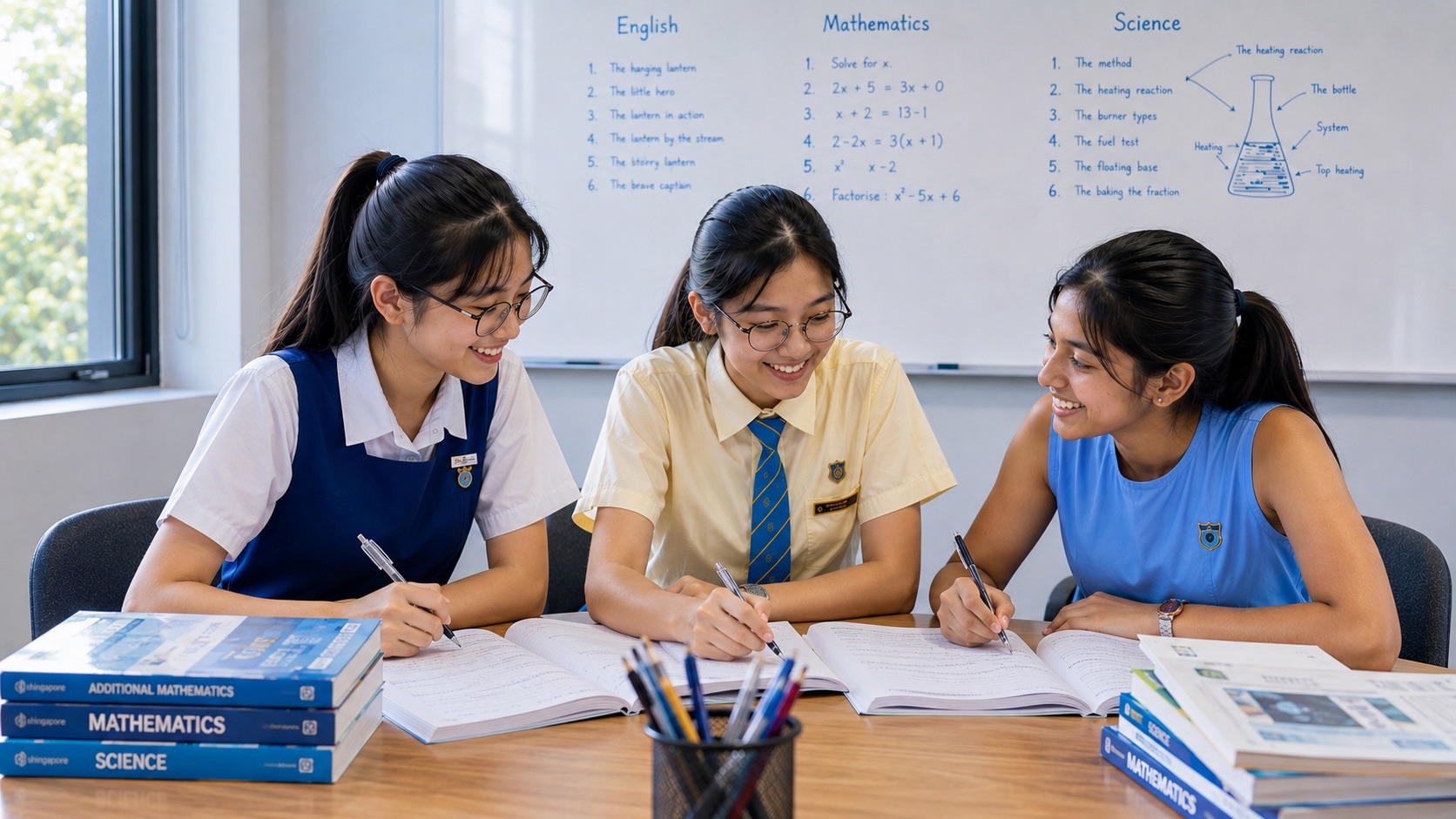
If your child receives PSLE Score 28 with Standard English Language AL6, Standard Mathematics AL6, Science AL8 and Mother Tongue AL8, the four contributions add to 6 + 6 + 8 + 8 = 28. Both English and Maths satisfy the special AL7-or-better requirement for ordinary Posting Group 1. The child may be eligible to study G2 English and G2 Mathematics from the usual G1 starting level under Full Subject-Based Banding, subject to the receiving school’s actual subject offers. Neither Standard AL6 independently meets the initial G3 criterion of Standard AL5 or better. Parents should choose six suitable PG1 schools that support this dual G2 opportunity while giving the child clear G1 Science and Mother Tongue teaching, a manageable weekly workload, CCAs and safe transport.
For PSLE 2026 pupils entering Secondary 1 in 2027, the school score ranges shown in MOE SchoolFinder describe PSLE 2025 admissions into Secondary 1 in 2026, not guaranteed cut-offs for the incoming cohort. Historically, Kranji and Greenridge had non-affiliated PG1 endpoints of 28, Admiralty 29, and Punggol Secondary and Northbrooks 27. Bedok Green and Broadrick showed 30* where places remained after the previous exercise. At score 28, the prior 28 is a boundary, 29 a one-point numerical historic margin, and 27 a historical reach; 30* is a past-vacancy notation rather than a guaranteed seat. Families should compare current G2 teaching, Foundation SBB arrangements, CCAs, language provision, actual daily journey and school culture before ranking six genuine preferences.
Quick parent summary
• Exact profile: Standard English AL6 + Standard Maths AL6 + Science AL8 + Mother Tongue AL8 = 28.
• Ordinary admission: PG1 because English and Mathematics are each AL7 or better.
• English and Maths AL6 each meet the initial subject-grade criterion for potential G2 offers from G1; actual school confirmation is essential.
• Standard AL6 does not independently meet the initial G3-from-G1 criterion, which uses Standard AL5 or better.
• Science AL8 and Mother Tongue AL8 ordinarily start at G1 and need dedicated foundational support.
• Dual G2 subject offers do not turn PG1 admission into PG2; compare schools using the PG1 historical cut-off only.
• Select six realistic schools for comprehension, numeracy, Science, language, CCA, wellbeing and transport.
Exact score 28: why this combination is not the same as other profiles
The PSLE Score is calculated by adding the Achievement Level contributions from four subjects, with lower totals indicating stronger assessed performance. In this profile, English and Mathematics contribute six each, leaving sixteen points to reach the total of twenty-eight. Because Science and Mother Tongue cannot contribute more than eight each, both must contribute AL8. The numerical combination is therefore exact.
Other pupils with the same aggregate may have one Standard AL5 or one AL6 and a different pattern of weaker subjects. Their individual higher-level subject eligibility can differ. The child in this article has two Standard AL6 subjects and therefore two potential G2 offers, not the initial G3 option associated with a Standard AL5.
Scores 26–30 normally permit PG1 only if English and Maths are AL7 or better. Here both are AL6, so the condition is met. The overall posting group is still PG1 despite the relatively stronger grades in two subjects. Parents should understand both parts of the system before selecting schools.
| Subject | Original grade | Potential starting subject level | Primary learning need |
|---|---|---|---|
| English Language | Standard AL6 | Possible G2 English | Main ideas, inference and purposeful writing |
| Mathematics | Standard AL6 | Possible G2 Maths | Fractions, ratios, algebra and methods |
| Science | AL8 contribution | Usually G1 Science | Concepts, observations, evidence |
| Mother Tongue | AL8 contribution | Usually G1 MTL | Actual language, reading and oral/written skills |
| Total | 28 | PG1 school admission | Six genuine, suitable preferences |
Posting Group 1 and two G2 offers are different decisions
Posting Groups facilitate school admission and guide the usual level at which students begin subjects. G1, G2 and G3 describe the curricula of individual secondary subjects. Under Full SBB, an eligible PG1 student may take a subject at G2 if the corresponding PSLE grade meets the national criterion and the receiving school offers it.
Standard AL6 in English or Mathematics meets the usual initial G2 criterion from an indicative G1 start. This child has that grade in both. However, the actual school will communicate which offers it makes and whether the family must respond by a particular deadline. A general eligibility rule cannot confirm a class before the posting exercise is complete.
A pupil taking G2 English and Maths is not admitted through PG2. A parent should not use a school’s historical PG2 cutoff to judge the school-choice likelihood for this PG1 applicant. Keeping admissions and subject levels separate prevents a common planning mistake.
Why two G2 options do not make G3 inevitable
A Standard AL6 does not independently qualify for G3 from an indicative G1 starting point under the published initial grade criterion; that row recognizes Standard AL5 or better. This applies separately to English and Mathematics. Parents should not describe the child’s two G2 opportunities as automatic G3 in both subjects.
Later subject-level reviews may be possible as the pupil develops performance, interest and readiness, according to school and MOE criteria. No article can guarantee a date, a specific outcome or promotion merely after completing a tuition package. The actual school must explain its review process.
A student can make excellent progress within G2 by understanding unfamiliar material, using evidence and correcting misconceptions. The purpose of subject levels is to match teaching to readiness, not to create a ranking of children’s worth.
Should the child accept both G2 English and G2 Maths?
Some pupils may have confidence in reading and numerical reasoning and enjoy the opportunity to learn both subjects at a more demanding level. Others might be comfortable with the English workload but need extra time bridging algebra. The same AL6 grades do not mean the child’s readiness is identical in both areas.
Ask the receiving school about actual texts, writing assignments, algebra topics, assessments and homework volume for the first term. Consider whether the school offers bridging support, teacher consultation and a clear way to ask questions. The child’s interests and willingness to study each subject should be part of the decision.
The remaining Science and Mother Tongue AL8 results make the whole timetable important. A family that selects every higher option to display ambition but neglects foundational teaching may create stress without improving understanding. A good academic stretch is sustainable and allows correction.
A readiness check based on understanding, stamina and transfer
Understanding means knowing what an idea means, not merely reproducing an answer. In English this includes recognizing a passage’s main point and supporting evidence. In Maths it includes explaining why an equation is balanced and which quantities a ratio compares.
Stamina matters because a student may complete a familiar short task accurately but struggle after a long school day. Transfer matters because an idea learned in one context should be usable in another. Parents can ask teachers whether the child handles unfamiliar reading or number problems independently, with appropriate feedback.
A family checklist can identify where one subject needs bridging. It should not become another stressful examination at home. The receiving school’s actual subject offer, current criteria and teacher observations are authoritative.
English AL6: what the grade does not diagnose
English AL6 is a broad achievement band covering different language tasks. A child might have a good grasp of grammar yet struggle with inference, or speak confidently but take longer to plan writing. The grade alone does not show which component will be most challenging at Secondary 1.
Ask the Primary 6 teacher for samples of independent comprehension and composition. Can the child identify a main idea, locate a detail supporting an interpretation and organize a response with a clear purpose? Do they revise written work after specific feedback?
A more demanding English curriculum is valuable when it develops these skills through meaningful tasks. Parents should seek schools with clear instruction and feedback rather than assume more difficult vocabulary lists or larger quantities of worksheets will automatically improve performance.
Reading unfamiliar texts for meaning
A pupil can read every word of a paragraph and still miss its central meaning. Begin by asking what the writer is explaining, then which sentence supports that idea. If an unfamiliar term appears, discuss its meaning in context rather than select an isolated synonym.
Only after literal understanding is secure should the reader move to inference. Ask which detail makes an implied conclusion reasonable. A child who guesses without evidence may need guidance rather than faster timed practice.
G2 English can introduce increasingly varied texts. A school that helps students explain meaning accurately, recognize tone and revise unsupported interpretations provides meaningful language stretch.
Vocabulary and sentence structure in secondary reading
Vocabulary is useful when a pupil can understand a word’s meaning and use it accurately in another sentence. Some words change meaning according to context, tone or subject. Memorizing difficult synonyms without understanding the surrounding passage can lead to awkward writing and mistaken comprehension.
Choose one new word from an accessible text and ask the child to explain it in simpler language. Discuss how it functions within the sentence, then ask for an accurate new example. Repeat with different genres as confidence increases.
A school should also teach the structure of more complex sentences. Recognizing which clause states a condition or contrast can help pupils read school instructions, Maths problems and Science explanations, although subject concepts still need their own teaching.
Writing to explain, discuss and persuade
Secondary English involves writing for different purposes, not only narrative composition. A pupil who previously told stories well may find factual explanation or argument unfamiliar. Teachers can explicitly teach the relationship between a central claim, supporting reason, evidence and conclusion.
Begin with a short paragraph that answers a meaningful question. Ask whether each sentence contributes and whether the examples genuinely support the view. Invite the child to revise one vague or repetitive sentence rather than let an adult rewrite the whole paragraph.
A G2 English offer is productive when the child becomes more independent in planning and editing. Longer writing should develop out of clear thinking, not simply the need to fill pages.
Oral communication and active listening
English confidence includes listening to questions and responding appropriately. A pupil may speak fluently about familiar interests but be uncertain when asked to consider another perspective. Effective communication is not just talking at length; it requires relevance and clarity.
Ask the child to express an opinion, give one reason and respond to a gentle counterpoint. Encourage clarification when unfamiliar words are used. These habits support classroom discussions, oral assignments and real interactions with school staff.
Check which drama, debate, reading or leadership activities are available to ordinary pupils at prospective schools. A CCA that develops communication can be valuable alongside academic classes.
Maths AL6: abstract representation is a new kind of challenge
Mathematics AL6 may indicate useful numerical foundations but does not guarantee ease with variables, algebraic expressions or directed numbers. A pupil who can solve a bar-model question may initially find the same relationship expressed with x unfamiliar. Good instruction shows that the symbol has a meaning.
Consider three equal sets containing twenty-one objects. The equation 3x = 21 represents the quantity in each set. If four additional loose objects make the total twenty-five, 3x + 4 = 25 describes the new situation. Ask why subtracting four on both sides preserves equality and how to check the answer.
A student who understands the balance principle can transfer the idea to harder algebra. Copying a shortcut without understanding may produce errors when the equation includes brackets, fractions or negative signs.
Place value and fractions before formal algebra
A child may calculate familiar whole-number questions accurately while confusing decimals or the reference whole in fractions. Ask what 0.5 and 0.05 mean and why they represent different quantities. A place-value chart can help before symbolic operations become more complicated.
With fractions, show equal parts of the same whole and compare three quarters with six eighths. Ask why they can be equivalent. Then change the whole so the pupil must identify the reference amount rather than apply a memorized method.
A G2 Maths programme should stretch pupils while revisiting a foundation when needed. Parents should ask teachers how they identify misconceptions and what feedback is available, especially for an eligible student whose Science also requires numerical support.
Ratio, proportion and mathematical meaning
Ratios describe how quantities compare. A pupil may know that 2:3 and 4:6 are equivalent but not understand the practical meaning or confuse a part-to-part ratio with a fraction of a whole.
Use drawings or small groups of objects and scale both quantities together. Then discuss a recipe or measurement context. The pupil should explain why the relationship stays consistent before selecting a formal operation.
This reasoning supports later algebra and Science data. A school that teaches proportionality through meaning rather than keyword triggers helps students apply knowledge to unfamiliar problems.
Word problems: English and Maths strengths can support each other
With English AL6 and Maths AL6, the pupil may begin to read numerical instructions more independently while developing formal mathematical reasoning. Yet the two skills remain separate: interpreting a sentence correctly does not guarantee identifying the right quantity relationship.
Ask what is known, what is unknown and what the problem asks. Represent the information through a diagram or equation before calculating. If the child solves the diagram but not the written version, teaching the language may help. If both versions are confusing, the underlying Maths concept may need work.
Parents should look for a receiving school that diagnoses errors carefully. A child should learn why their method was wrong and transfer the correction to a different example rather than simply reproduce a model answer.
Numerical checking and error correction
A pupil may understand a method but make sign or calculation slips under time pressure. Another may select an invalid operation because they misunderstood the relationship. These errors should not all be described as carelessness.
Ask the child to show the first incorrect step and explain a corrected method. Substitution into the original equation or estimation of the result can help check accuracy. Then vary the question to see if the same reasoning applies.
Specific feedback makes G2 Maths more useful. Repeated worksheets without understanding can reinforce a misconception, whereas a small number of varied questions and explanation can develop independent competence.
Science AL8: why careful foundations are essential
Science AL8 may reflect uncertain scientific concepts, difficulty with experimental reasoning, unfamiliar diagrams or written explanation. The grade is not a diagnosis of curiosity or intelligence. Ask teachers which ideas the pupil can already explain and which need targeted teaching.
Scientific reasoning begins with what was observed, what was measured and what conditions were comparable. If two plants grow differently, that observation does not by itself establish which factor caused the difference. A fair test needs relevant controls.
At G1 Science, teachers should develop accurate concepts and safe practical skills. A more demanding English or Maths subject does not replace the need for foundational Science knowledge.
Science explanations must connect claims to evidence
A pupil may read an experiment accurately but make a confident claim unsupported by its data. Ask which observation supports the conclusion, which relevant concept applies and whether any alternative explanation remains.
A good answer can be short and precise. Memorizing technical phrases is not enough if the child selects the wrong process or ignores important conditions. A receiving school should give feedback on both the scientific idea and the clarity of written explanation.
Use safe observations and school diagrams rather than hazardous experiments at home. Science learning is about reasoning accurately and understanding safety, not simply producing impressive demonstrations.
Graphs and measurements can expose different difficulties
Science uses data and graphs involving time, length, mass, temperature and other measurements. A student may understand the scientific topic but misread a scale, or calculate accurately yet misunderstand what a graph proves.
Ask what each axis represents, which units apply and whether a trend rises or falls. Read values before computing any change. Then discuss what the result means in the scientific context and what further evidence would be needed to infer a cause.
A child with Maths AL6 may benefit from numerical practice linked to Science, but teachers should distinguish mathematical and scientific misconceptions. Improving one skill does not automatically resolve every difficulty in the other subject.
Mother Tongue AL8: the actual language matters
An AL8 in Mother Tongue could reflect difficulty with Chinese, Malay or Tamil reading, writing, listening or oral communication. The numeric result alone cannot reveal which skill requires the most help. If the examination was taken at Foundation level in a different case, the original grade letter must be preserved.
A pupil may speak comfortably with relatives yet find formal passages difficult. Another may recognize common written forms but hesitate in class discussion. Families should ask teachers which tasks the child performs independently and what a sensible first reading goal looks like.
Check each prospective school’s language provision and any approved alternative venue or timetable. A school that offers strong English and Maths teaching may still be impractical if the child’s Mother Tongue arrangement creates excessive extra travel.
Dual G2 subjects should not squeeze out the rest of school life
If English and Maths are both offered at G2, the child may have longer reading, writing and algebra assignments alongside foundational Science and Mother Tongue work. The parent should see the whole timetable rather than consider each subject offer in isolation.
Ask how the receiving school coordinates homework, classroom movements and teacher contact. CCA, friendships, meals and sleep are part of a sustainable educational routine. A pupil who is always tired may struggle even with material they could understand when rested.
Eligible subject levels are opportunities, not a competition to maximize difficulty. A student who can ask for help, correct mistakes and participate confidently across subjects is making meaningful progress.
Full SBB and mixed form classes
Full SBB includes mixed form classes and common curriculum experiences for pupils with different Posting Groups. A PG1 pupil taking English and Maths at G2 remains part of the school community alongside classmates whose subjects may be at other levels.
Explain that PG1 is an admissions and starting curriculum category, not a permanent social identity. The child may have genuine strengths in reading and numbers while needing more support in Science and language. That is precisely why individual subject levels exist.
Ask prospective schools about orientation, CCAs and how pupils are supported when moving among learning groups. A welcoming form teacher and clear organizational routines can help the pupil adjust.
Historical PG1 cut-offs at Score 28
A previous PG1 endpoint of 27 is a historic reach for a score-28 pupil; an endpoint of 28 is the old boundary; 29 offers one point of numerical historic margin. These are references to a previous cohort rather than guaranteed admission thresholds for the next year.
A 30* notation indicates places remained after the earlier posting exercise. The published upper eligible PG1 score does not necessarily equal the actual last pupil’s result, and it does not guarantee another vacancy or represent school quality.
MOE generally advises six genuine preferences and some with historically favorable score comparisons when feasible. At score 28, such options may be limited in some areas. Do not invent ordinary PG1 cut-offs above 30 or put an unwanted school on the list merely for a numeric advantage.
| School | Historical PG1 cutoff (2026 entry) | Score-28 position | Area |
|---|---|---|---|
| Punggol Secondary School | 27 | Historical reach | Punggol |
| Northbrooks Secondary School | 27 | Historical reach | Yishun |
| Kranji Secondary School | 28 | Old boundary | Choa Chu Kang |
| Greenridge Secondary School | 28 | Old boundary | Bukit Panjang |
| Admiralty Secondary School | 29 | One-point margin | Woodlands |
| Bedok Green Secondary School | 30* | Earlier vacancies; no guarantee | Bedok |
| Broadrick Secondary School | 30* | Earlier vacancies; no guarantee | Dakota |
School research should examine both G2 subjects and G1 support
Ask each prospective school how G2 English and G2 Maths are offered to eligible PG1 entrants, whether the pupil will receive different textbooks and how learning is reviewed. A school with an appealing advanced programme may still need to demonstrate clear ordinary teaching in Science and Mother Tongue.
An academic showcase or competition prize is not a full description of the experience of every Secondary 1 pupil. Parents should look for specific classroom feedback, student support and opportunities for help when an unfamiliar reading or algebra topic becomes difficult.
Record the real school journey, CCA and language arrangements. The family’s best choice is not necessarily the school with the most selective old cutoff, but one the child can attend happily and benefit from daily.
Kranji and Greenridge: previous boundary choices
Kranji in Choa Chu Kang and Greenridge in Bukit Panjang had prior PG1 endpoints of 28. For score 28 they were at the previous boundary, not guaranteed entries. Their programmes, neighborhoods and journeys differ despite matching historical numbers.
Kranji’s applied-learning focus on design innovation for sustainable living can interest a child who enjoys explaining problems and using numerical reasoning. Greenridge has its own activities and CCAs. Ask what ordinary pupils experience and whether the school’s academic offer processes suit this profile.
Consider the route after CCA. A school that consumes a great deal of travel time can leave less energy for two G2 subjects and necessary G1 foundational practice.
Admiralty: one-point historic margin in the north
Admiralty in Woodlands had a previous PG1 cutoff of 29, giving the score-28 child a one-point numerical historical margin. This is not a guarantee or precise admission probability, as the new cohort’s choices can change the cutoff.
A family in Woodlands may value a local option, but should also compare current English and Maths teaching, Science support, the child’s Mother Tongue and CCA activities. A school whose programmes fit the child matters more than a one-point admissions statistic alone.
A longer journey to another area might be worthwhile for a genuinely preferred programme, but the family should consider the total weekly travel and whether the child can maintain a balanced routine.
Bedok Green and Broadrick: why 30* is not a promise
Bedok Green and Broadrick displayed previous PG1 30* records because places remained after the earlier posting exercise. A family should understand what the asterisk means, but should not interpret it as a reserved place in 2027.
A school with historical vacancies can still provide excellent teaching, supportive adults and enjoyable activities. The cutoff is an admissions outcome, not a school-quality metric. Ask how the school teaches ordinary pupils, supports weaker subjects and arranges higher-level offers.
A family living near Bedok or Dakota might find these schools practical, while one elsewhere may have a more suitable local option. The shortlist should use real family geography and genuine preference, not a national list of vacancy-notated school names.
Worked family example: dual AL6 subjects at score 28
Imagine a child with Standard English AL6, Standard Maths AL6, Science AL8 and Mother Tongue AL8. They enjoy reading short factual articles and solving puzzles but struggle with unfamiliar Science explanations and formal language writing. Their parents want to develop reading and numerical strengths without overloading the child.
The primary school confirms PG1 eligibility and the two potential G2 subject offers. The family asks receiving schools about the first-term English and Maths curriculum, homework demands and support for G1 Science and MTL. They compare historical school cutoffs accurately and choose six genuinely reachable schools.
After posting, they read the actual offers, discuss readiness with the child and teachers and establish a timetable that includes CCA, rest and regular foundational practice. The result is an individual learning plan rather than an attempt to label the pupil as belonging to another Posting Group.
Another case: G2 English feels fine but algebra is new
A different pupil with identical grades may enjoy long English passages but become uncertain when algebraic letters and negative numbers appear. Eligibility for G2 Maths does not mean every new topic is already mastered. The teacher can use diagrams and small equations to introduce meaning.
Parents should ask whether the pupil understands a concrete relationship, can explain the equation representing it and can check a solution. If a concept remains confusing, it may need bridging before additional timed tasks. A correction that transfers to another problem is a useful sign of growth.
The school can explain its actual subject-level options and review procedure. The family should avoid assuming one early difficult topic proves the pupil cannot learn at G2 or that a higher level is compulsory regardless of workload.
How to rank six schools with an honest shortlist
Begin with the original four grades and verify ordinary PG1 eligibility. Use MOE SchoolFinder to identify schools offering PG1 within a practical travel area. Record their previous PG1 cutoff, actual G2 English and Maths offer process, G1 Science and language foundations, CCAs and travel.
At score 28, an old cutoff of 27 is a reach, 28 a boundary and 29 a one-point margin. A 30* means prior vacancies rather than future certainty. Balance historical information with the child’s willingness to attend each school and the practical weekly routine.
Rank six genuinely acceptable choices in real preference order. When pupils with equal results compete for the last available place, citizenship, choice order and computerised balloting may act as tie-breakers. The school choice order cannot override a stronger score, and individual G2 offers are decided separately after posting.
A first-month plan across four subjects
In week one, confirm the school, actual English and Maths offers, timetables, books and safe route. Help the pupil know where to ask teachers questions and how to manage different learning groups.
In week two, practise a short English reading task and a simple equation with explanation. In week three, work on a targeted fraction or ratio difficulty and one Science observation, and include a manageable Mother Tongue reading activity. Use the child’s actual teachers’ advice instead of assigning broad advanced work.
By week four, review school friendships, CCA, homework, transport and sleep. If the selected G2 subjects are persistently difficult, discuss specific work with teachers and ask about available support. A good beginning builds confidence, learning and independence across the whole timetable.
Questions for school open houses
- Does the school offer PG1 and what was its previous non-affiliated PG1 cutoff?
- Can Standard English AL6 and Maths AL6 each receive a G2 subject offer from PG1?
- What actual first-term reading, writing, fractions and algebra demands apply at G2?
- How does the school help students who are strong in one of the two subjects but need bridging in the other?
- How are G1 Science AL8 concepts and fair-test reasoning taught?
- Does the school offer the child’s specific Mother Tongue at the appropriate level and location?
- How are mixed form classes, homework deadlines and pupil wellbeing coordinated?
- Which CCAs and applied-learning activities are available to all pupils?
- What is the daily morning and after-CCA commute?
- What school process applies if a subject-level option becomes consistently difficult?
Frequently asked questions
Does English AL6, Maths AL6, Science AL8 and MTL AL8 total PSLE 28?
Yes. 6 + 6 + 8 + 8 = 28 and the English/Maths criteria for ordinary PG1 are met.
Can both English and Maths be at G2 from PG1?
Each Standard AL6 meets the published initial G2 grade criterion from G1. The receiving school must confirm the actual offers.
Does Standard AL6 qualify for G3 immediately?
Not from the usual G1 starting point by grade alone. The initial G3 criterion requires Standard AL5 or better.
Does dual G2 make the pupil a PG2 school applicant?
No. School admission remains through PG1, regardless of individual G2 classes.
Does Science or MTL AL8 automatically prevent the G2 offers?
Those grades do not independently cancel the two published subject-grade criteria, although actual offers and readiness remain subject to the school.
Does a previous PG1 cutoff of 29 guarantee a seat for score 28?
No. It is a one-point historical numeric comparison, not guaranteed admission.
Final parent checklist
- We confirmed Standard English AL6, Maths AL6, Science AL8 and Mother Tongue AL8, total 28.
- We understood PG1 school admission and the two separate potential G2 offers.
- We did not promise initial G3 from AL6 or use PG2 cutoff data for PG1 school selection.
- We checked reading/writing, fractions/algebra, Science and Mother Tongue foundations.
- We used historic school ranges accurately and understood the previous 30* notation.
- We selected six real schools with manageable CCAs, language arrangements, student support and transport.
- We will follow current MOE rules and the receiving school’s actual subject-level offer.
Official sources and companion parent guides
MOE Secondary 1 Posting; MOE SchoolFinder; MOE PSLE and Full Subject-Based Banding; MOE 2026 education announcements; Score 26 with English and Maths AL5; Score 27 with English AL5 and Maths AL6; Score 27 with Maths AL5 and English AL6.
Updated 14 November 2026. School comparisons use PSLE 2025 results for Secondary 1 entry in 2026; the 2027 cutoffs are not predetermined. The child’s original results, active MOE instructions and receiving-school subject offers take precedence.