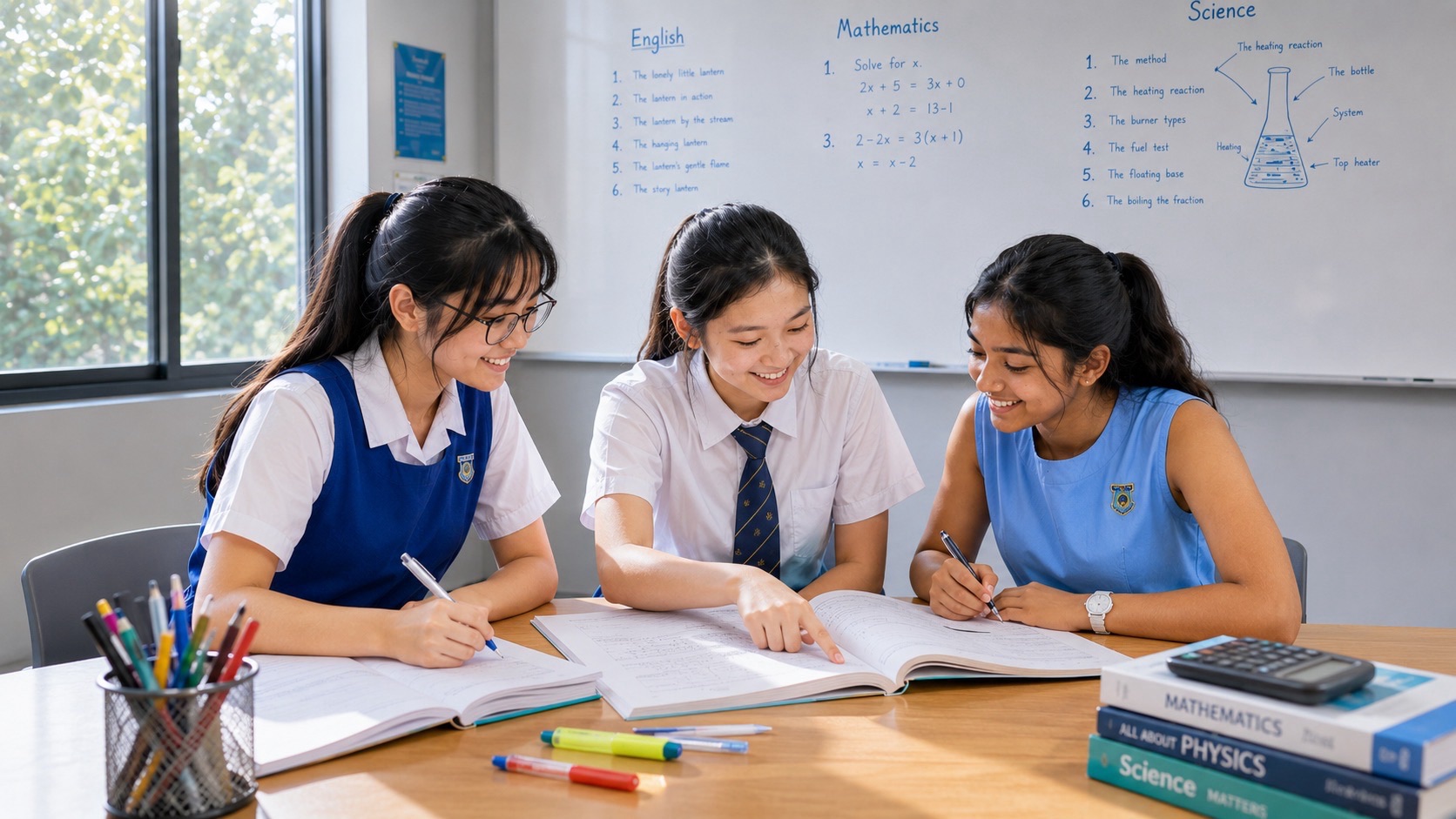
Toa Payoh Central parents choosing secondary schools after the 2026 PSLE should compare CHIJ Secondary (Toa Payoh), Beatty Secondary, Bartley Secondary, St. Andrew’s School (Secondary), Cedar Girls’ Secondary, Maris Stella High School (Secondary) and Raffles Girls’ School (Secondary), plus eligible neighbouring options in Bishan such as Guangyang and Whitley Secondary. The historical 2026-entry non-affiliated Posting Group 3 last-posted PSLE Scores were CHIJ Secondary (Toa Payoh) 10, Beatty 18, Bartley 21, St. Andrew’s 9, Cedar Girls’ four-year SEC 9, Maris Stella 12, Guangyang 22 and Whitley 22. Cedar also offers a separate six-year Integrated Programme at historical IP 9; Raffles Girls’ offers IP only at historical IP 6.
For Secondary 1 entry in 2027, these are earlier results from PSLE 2025 and cannot guarantee current-cohort admission. CHIJ Secondary (Toa Payoh) is a girls’ school at 626 Lorong 1 Toa Payoh with an affiliated-primary route; St. Andrew’s and Maris Stella admit boys, while Cedar and Raffles Girls’ admit girls. Beatty, Bartley, Guangyang and Whitley are co-educational. A particularly important correction is that First Toa Payoh Secondary merged into Bartley in 2016 and is no longer a separate 2027 school. Maris Stella’s secondary section will also use a holding campus at Jalan Damai during the 2027–2029 rebuilding, so an old Mount Vernon commute may be misleading.
Quick summary for parents
• Mainstream previous 2026 PG3 last-posted: CHIJ Secondary (Toa Payoh) 10 non-affiliated (20 affiliated); Beatty 18; Bartley 21; St. Andrew’s 9 non-affiliated; Cedar 9 SEC; Maris Stella 12; neighbouring Guangyang 22 and Whitley 22.
• Separate IP routes: Cedar Girls’ IP 9 to Victoria Junior College and Raffles Girls’ IP 6 leading to RI for A-Levels. These cannot be compared as ordinary PG3 entries.
• School gender: CHIJ Secondary, Cedar and RGS girls; St. Andrew’s and Maris Stella boys; Beatty, Bartley, Guangyang and Whitley co-educational.
• First Toa Payoh Secondary merged with Bartley in 2016. Do not create an additional school with an obsolete COP.
• Maris Stella’s 2027–2029 secondary holding site is on Jalan Damai in Bedok North, not its familiar permanent Mount Vernon campus.
What Toa Payoh Central parents should check before choosing a secondary school
The first step is to read the child’s full PSLE result slip. It shows the overall PSLE Score, individual Achievement Levels and the eligible Posting Group or Groups. Before looking at a school’s reputation, confirm that the pupil can actually apply for the exact route, including any gender restrictions, Chinese or other language requirements, the current school code, affiliation conditions and any committed DSA offer. A child cannot be allocated an ordinary place merely because a school is popular with relatives or appears within walking distance of home.
This parent guide is prepared on 14 November 2026 for Primary 6 families expecting the PSLE 2026 results and making school choices for Secondary 1 entry in January 2027. All numeric historical school score figures in this article refer to 2026 Secondary 1 entry following the 2025 PSLE cohort. The 2027 final cut-offs cannot be known before this cohort’s applications are processed. Use MOE SchoolFinder for the latest school profile and previous score range, and MOE Secondary 1 Posting for official exercise dates, programme codes and allocation rules.
A meaningful school choice is not only about admission possibility. Ask the pupil which subject has become difficult, which subjects and CCAs they enjoy, what kind of class helps them learn and how they feel about the journey. A child fascinated by health technology may still need help explaining a Science experiment; another who likes music may need direct teaching of algebra. Parents should look for an environment that makes it possible to improve, receive useful feedback and develop healthy friendships over several years rather than simply select the school with the smallest previous last-posted number.
- Verify eligibility: actual score and ALs, Posting Group, gender, mother-tongue conditions, DSA and recognised affiliation.
- Verify school identity: current school name, operating campus and the exact ordinary SEC, IP or specialist school code.
- Interpret prior cut-offs correctly: a 2026-entry last-posted result is evidence from an earlier cohort, not a guaranteed 2027 threshold.
- Investigate ordinary teaching: how do first-year pupils learn core subjects and receive help when a lesson remains unclear?
- Check all-student versus selected programmes: an ALP can be schoolwide while advanced CCAs, DSA and competitions have separate criteria.
- Test transport, costs and wellbeing: include a school morning, a late CCA, books, uniforms, meals, devices and rest.
- Rank six genuine options: the child should be able to imagine learning in every school placed on the form.
Secondary schools near Toa Payoh Central: compare the correct routes
These schools form a geographical and educational discovery shortlist for households in Toa Payoh MRT, Lorong 1, Lorong 2, Braddell, Potong Pasir, Bartley, Bidadari and the Bishan boundary. Several are in adjacent planning areas because ordinary Secondary 1 school choice is national and an eligible school across an estate boundary can be a sensible option. The table states previous 2026-entry Posting Group 3 or IP values by route. It is not a league table of school quality or a predicted set of cut-offs for the 2027 intake.
| Current school and route | Historical 2026-entry last-posted result | Distinctive learning to investigate |
|---|---|---|
| CHIJ Secondary (Toa Payoh) — Girls’ autonomous government-aided Catholic mainstream school | PG3 10 non-affiliated; PG3 20 affiliated | Lower Secondary Drama, Art Elective, visual arts, communication, girls’ leadership and service |
| Beatty Secondary School — Co-educational mainstream school near Toa Payoh North | PG3 18 | NEXUS interdisciplinary inquiry and specialised hearing-loss support |
| Bartley Secondary School — Co-educational mainstream school in the Bartley/Toa Payoh field | PG3 21 | Chemical and Applied Sciences (Fragrance), experimental reasoning and community leadership |
| St. Andrew’s School (Secondary) — Boys’ Anglican government-aided mainstream school in Potong Pasir | PG3 9 non-affiliated; PG3 22 affiliated | River Studies, environmental enquiry, sport and character development |
| Cedar Girls’ Secondary School — Girls’ four-year mainstream SEC and separate six-year Victoria-Cedar Alliance IP | PG3 9 (SEC); IP 9 separately | Social Innovation for all lower-secondary girls and VCA IP to Victoria Junior College |
| Maris Stella High School (Secondary) — Boys’ four-year SAP school; temporary secondary campus at Jalan Damai from 2027 | PG3 12 non-affiliated; PG3 16 affiliated | Bicultural Chinese SAP learning, Marist values and a critical campus relocation |
| Raffles Girls’ School (Secondary) — Girls’ independent six-year Raffles Programme; later years at RI | IP 6 only — not PG3 | Enriched independent enquiry, cross-disciplinary research and A-Level progression |
| Guangyang Secondary School — Co-educational mainstream school in neighbouring Bishan | PG3 22 | Sustainability STEM, solar-powered car design, scientific investigation and leadership |
| Whitley Secondary School — Co-educational mainstream school in neighbouring Bishan | PG3 22 | Communicative Arts, English, performance, photography and community youth leadership |
A smaller overall PSLE total means a stronger examination result. For example, if a school’s previous PG3 last-posted score was 20, a pupil scoring 17 was numerically stronger than that earlier last-admitted student. The pupil is not ‘too strong’ to select the school, nor is a pupil whose score exactly matches an earlier cut-off guaranteed a place the following year. Applicant results, choices, vacancies, tie-breakers and programme-specific rules can change the outcome. Never compare a six-year IP score or eligible affiliated value as though it came from the ordinary non-affiliated PG3 pool.
The score also cannot tell a parent whether a teacher gives careful feedback or how a shy child will find friends. A school with a more competitive previous admission may offer an excellent programme for a particular child, but a school with a less selective history may do so as well. The child’s subject profile, academic support needs, opportunities to grow, everyday culture, gender or language eligibility and sustainable commute should determine the family’s genuine preferences.
How each school could fit a Toa Payoh Central child
CHIJ Secondary (Toa Payoh)
Address and educational route: 626 Lorong 1 Toa Payoh, Singapore 319764. Girls’ autonomous government-aided Catholic mainstream school. CHIJ Secondary’s current 2026 official programme includes weekly drama for all lower-secondary girls, teaching performance-making, presenting and reflection through collaborative activity. Every student can explore communication and critical thinking through short scenes, while the Art Elective Programme offers a more sustained four-year specialist route with subjects such as drawing, printmaking, digital art and design. The AEP has its own selection and subject demands, and should not be mistaken for a compulsory route for every pupil. CHIJ Primary (Toa Payoh) has a recognised affiliation, with a historical 2026 PG3 last-posted 20 for affiliates and 10 for non-affiliated pupils.
Possible learning fit: A daughter who enjoys drama, visual art or wants to build confidence in a girls’ learning community may appreciate the school, even as a beginner. Ask how lower-secondary drama is assessed and what support exists for other subjects. Families should discuss the Catholic school culture and the route to Lorong 1 Toa Payoh, as well as affiliation conditions if relevant. A son cannot list this institution in the normal S1 exercise.
One direct question for the open house: What weekly drama experience reaches all girls, how does the Art Elective differ from normal Art, and how do the actual named affiliation rules operate? Parents can then ask what every Secondary 1 pupil actually does, which activities are reserved for selected talent groups and how the teacher supports a student who is new to the skill. A successful competition photo may be interesting but does not reveal what a normal class learns in its first month.
Ask how the distinctive programme strengthens foundations. A good engineering task includes measurements, safe procedures, a testable prediction and a clear explanation of the outcome. A strong communication task includes source judgement, careful reading, planning and constructive revision. A useful arts or health activity helps pupils make evidence-based decisions and reflect on their work. An exciting finished model is not enough if the child does not understand the relevant Science or Maths. The school should be able to show ordinary student work and meaningful feedback.
Look beyond this one programme. The pupil will also study languages, Mathematics, Science, Humanities and other subjects at appropriate G levels. They will participate in CCAs, work with new peers and manage an unfamiliar timetable. If a desired advanced team, elective or competition place is unavailable, would the teenager still want to attend this school? Parents should ask about the whole week, not only an attractive showcase or a selectively admitted group.
Official source: Read CHIJ Secondary (Toa Payoh)’s current programme or school information. Verify the actual 2027 cohort’s conditions with the school before submission.
Beatty Secondary School
Address and educational route: 1 Toa Payoh North, Singapore 318990. Co-educational mainstream school near Toa Payoh North. Beatty’s NEXUS programme connects learning across subjects so pupils can investigate real-world questions with evidence and thoughtful solutions. It is also a designated mainstream school with specialised support for students with hearing loss; families should ask about the exact educational and communication accommodations suited to their child. Any selected DSA STEM or competition activity is a separate route from the ordinary first-year classroom. The Toa Payoh North campus may be more approachable from Braddell than from the town centre.
Possible learning fit: A student who enjoys linking subjects or needs a learning environment that teaches careful inquiry may find a good fit. Parents should ask how weak foundations are identified and how form teachers help with belonging. For hearing-related needs, the family must confirm actual classroom arrangements instead of assuming a general designation settles the child’s suitability.
One direct question for the open house: What does every first-year pupil learn in NEXUS and what specific accessibility or academic support can the school provide? Parents can then ask what every Secondary 1 pupil actually does, which activities are reserved for selected talent groups and how the teacher supports a student who is new to the skill. A successful competition photo may be interesting but does not reveal what a normal class learns in its first month.
Ask how the distinctive programme strengthens foundations. A good engineering task includes measurements, safe procedures, a testable prediction and a clear explanation of the outcome. A strong communication task includes source judgement, careful reading, planning and constructive revision. A useful arts or health activity helps pupils make evidence-based decisions and reflect on their work. An exciting finished model is not enough if the child does not understand the relevant Science or Maths. The school should be able to show ordinary student work and meaningful feedback.
Look beyond this one programme. The pupil will also study languages, Mathematics, Science, Humanities and other subjects at appropriate G levels. They will participate in CCAs, work with new peers and manage an unfamiliar timetable. If a desired advanced team, elective or competition place is unavailable, would the teenager still want to attend this school? Parents should ask about the whole week, not only an attractive showcase or a selectively admitted group.
Official source: Read Beatty Secondary School’s current programme or school information. Verify the actual 2027 cohort’s conditions with the school before submission.
Bartley Secondary School
Address and educational route: 10 Jalan Bunga Rampai, Singapore 538403. Co-educational mainstream school in the Bartley/Toa Payoh field. Bartley’s Applied Learning Programme uses fragrance chemistry to develop careful observation, extraction, laboratory safety and design thinking. Students learn how materials behave and how to collect evidence supporting a claim. Its history is particularly important locally: the Ministry of Education Heritage Centre confirms that First Toa Payoh Secondary merged with Bartley in 2016, retaining the Bartley name at Jalan Bunga Rampai. A former First Toa Payoh Secondary campus or school code cannot be used as a second 2027 option.
Possible learning fit: A student curious about Chemistry or creating a product may appreciate the applied experiments. Parents should ask how every first-year pupil learns to explain a result and how pupils struggling in Mathematics receive guidance. Bartley is near the Circle Line’s Bartley station, not literally inside Toa Payoh Central, so the transport and CCA return should be tested.
One direct question for the open house: How is fragrance chemistry taught to normal first-year pupils and how should parents understand the 2016 First Toa Payoh merger? Parents can then ask what every Secondary 1 pupil actually does, which activities are reserved for selected talent groups and how the teacher supports a student who is new to the skill. A successful competition photo may be interesting but does not reveal what a normal class learns in its first month.
Ask how the distinctive programme strengthens foundations. A good engineering task includes measurements, safe procedures, a testable prediction and a clear explanation of the outcome. A strong communication task includes source judgement, careful reading, planning and constructive revision. A useful arts or health activity helps pupils make evidence-based decisions and reflect on their work. An exciting finished model is not enough if the child does not understand the relevant Science or Maths. The school should be able to show ordinary student work and meaningful feedback.
Look beyond this one programme. The pupil will also study languages, Mathematics, Science, Humanities and other subjects at appropriate G levels. They will participate in CCAs, work with new peers and manage an unfamiliar timetable. If a desired advanced team, elective or competition place is unavailable, would the teenager still want to attend this school? Parents should ask about the whole week, not only an attractive showcase or a selectively admitted group.
Official source: Read Bartley Secondary School’s current programme or school information. Verify the actual 2027 cohort’s conditions with the school before submission.
St. Andrew’s School (Secondary)
Address and educational route: 15 Francis Thomas Drive, Singapore 359342. Boys’ Anglican government-aided mainstream school in Potong Pasir. St. Andrew’s schoolwide learning includes River Studies and outdoor or service-related development, along with academic subjects and a well-established Anglican boys’ school culture. A recognised affiliation with St. Andrew’s Junior School has a different older admission outcome, with 2026 non-affiliated PG3 9 and affiliated 22. It does not guarantee a place simply because a boy lives near Potong Pasir or has a similar religious school background. Selected sport or CCA teams are another separate decision from normal school posting.
Possible learning fit: A boy interested in River Studies, sport or the school’s traditions may want to investigate, but the family should ask how ordinary new students learn and how an academically weaker pupil is supported. Its Francis Thomas Drive campus lies nearer Potong Pasir than Toa Payoh Central; an actual train or bus journey and late CCA return must be evaluated.
One direct question for the open house: What River Studies are taught to all first-year boys, how does sports selection work and which named primary affiliation conditions apply? Parents can then ask what every Secondary 1 pupil actually does, which activities are reserved for selected talent groups and how the teacher supports a student who is new to the skill. A successful competition photo may be interesting but does not reveal what a normal class learns in its first month.
Ask how the distinctive programme strengthens foundations. A good engineering task includes measurements, safe procedures, a testable prediction and a clear explanation of the outcome. A strong communication task includes source judgement, careful reading, planning and constructive revision. A useful arts or health activity helps pupils make evidence-based decisions and reflect on their work. An exciting finished model is not enough if the child does not understand the relevant Science or Maths. The school should be able to show ordinary student work and meaningful feedback.
Look beyond this one programme. The pupil will also study languages, Mathematics, Science, Humanities and other subjects at appropriate G levels. They will participate in CCAs, work with new peers and manage an unfamiliar timetable. If a desired advanced team, elective or competition place is unavailable, would the teenager still want to attend this school? Parents should ask about the whole week, not only an attractive showcase or a selectively admitted group.
Official source: Read St. Andrew’s School (Secondary)’s current programme or school information. Verify the actual 2027 cohort’s conditions with the school before submission.
Cedar Girls’ Secondary School
Address and educational route: 1 Cedar Avenue, Singapore 349692. Girls’ four-year mainstream SEC and separate six-year Victoria-Cedar Alliance IP. Cedar Girls’ has a four-year mainstream SEC track and a six-year Victoria-Cedar Alliance Integrated Programme with Years 5 and 6 at Victoria Junior College leading to A-Levels. Its Social Innovation programme develops research, empathetic design thinking and the ability to evaluate a proposed improvement to the community. Although both older 2026 last-posted totals were 9, the SEC and IP are separate school codes, examination routes and long-term choices. Some DSA Social Innovation and talent opportunities are selected beyond universal first-year activities.
Possible learning fit: A daughter who wants a girls’ school and enjoys inquiry or social innovation may appreciate Cedar, but the family should understand whether a longer IP is desirable. The route from Toa Payoh Central to Cedar Avenue can involve a bus or train connection and must be checked alongside selected CCA hours. A son cannot select Cedar at Secondary 1.
One direct question for the open house: What is taught to every Year 1 pupil through Social Innovation and how do the SEC and IP tracks differ in later pathways? Parents can then ask what every Secondary 1 pupil actually does, which activities are reserved for selected talent groups and how the teacher supports a student who is new to the skill. A successful competition photo may be interesting but does not reveal what a normal class learns in its first month.
Ask how the distinctive programme strengthens foundations. A good engineering task includes measurements, safe procedures, a testable prediction and a clear explanation of the outcome. A strong communication task includes source judgement, careful reading, planning and constructive revision. A useful arts or health activity helps pupils make evidence-based decisions and reflect on their work. An exciting finished model is not enough if the child does not understand the relevant Science or Maths. The school should be able to show ordinary student work and meaningful feedback.
Look beyond this one programme. The pupil will also study languages, Mathematics, Science, Humanities and other subjects at appropriate G levels. They will participate in CCAs, work with new peers and manage an unfamiliar timetable. If a desired advanced team, elective or competition place is unavailable, would the teenager still want to attend this school? Parents should ask about the whole week, not only an attractive showcase or a selectively admitted group.
Official source: Read Cedar Girls’ Secondary School’s current programme or school information. Verify the actual 2027 cohort’s conditions with the school before submission.
Maris Stella High School (Secondary)
Address and educational route: Permanent heritage campus 25 Mount Vernon Road; planned 2027–2029 holding campus at Jalan Damai. Boys’ four-year SAP school; temporary secondary campus at Jalan Damai from 2027. Maris Stella’s official rebuilding plan identifies major construction of its Mount Vernon campus in 2027–2029. During that period, the secondary section is scheduled to use the former Bedok North Secondary School site on Jalan Damai. The boys’ secondary intake has a SAP Chinese-learning identity, with a recognised primary affiliation under specific conditions. Families must not infer that the primary section’s co-educational plans change the secondary section’s boys-only eligibility. This is a mainstream four-year school, not a six-year IP.
Possible learning fit: A boy interested in Chinese language, bicultural study and the school ethos may value the programme, but the daily journey to Jalan Damai rather than Mount Vernon is a major practical consideration. Parents should ask whether the child can handle the language workload, how learning support works and what transport plan is feasible now and after rebuilding. The older PG3 12 non-affiliated score cannot guarantee the 2027 result.
One direct question for the open house: Where exactly will the 2027 secondary cohort report, which SAP language conditions apply, and how might the school return after rebuilding? Parents can then ask what every Secondary 1 pupil actually does, which activities are reserved for selected talent groups and how the teacher supports a student who is new to the skill. A successful competition photo may be interesting but does not reveal what a normal class learns in its first month.
Ask how the distinctive programme strengthens foundations. A good engineering task includes measurements, safe procedures, a testable prediction and a clear explanation of the outcome. A strong communication task includes source judgement, careful reading, planning and constructive revision. A useful arts or health activity helps pupils make evidence-based decisions and reflect on their work. An exciting finished model is not enough if the child does not understand the relevant Science or Maths. The school should be able to show ordinary student work and meaningful feedback.
Look beyond this one programme. The pupil will also study languages, Mathematics, Science, Humanities and other subjects at appropriate G levels. They will participate in CCAs, work with new peers and manage an unfamiliar timetable. If a desired advanced team, elective or competition place is unavailable, would the teenager still want to attend this school? Parents should ask about the whole week, not only an attractive showcase or a selectively admitted group.
Official source: Read Maris Stella High School (Secondary)’s current programme or school information. Verify the actual 2027 cohort’s conditions with the school before submission.
Raffles Girls’ School (Secondary)
Address and educational route: 2 Braddell Rise, Singapore 318871. Girls’ independent six-year Raffles Programme; later years at RI. Raffles Girls’ School admits Year 1 girls into its six-year Raffles Programme. Pupils study four years at RGS and two pre-university years at Raffles Institution, leading to A-Level examinations. Its curriculum includes academic enquiry, research, leadership and opportunities for selected advanced talent programmes at later levels. The historical 2026 IP last-posted 6 is a separate applicant category and should not be treated as a very selective PG3 number. Independent school costs and available financial assistance need to be understood.
Possible learning fit: A daughter who enjoys sustained academic challenge and a six-year route may want to investigate RGS. Families should discuss the actual school culture, readiness for independent work and the later campus transition, rather than choose solely because the old IP last-posted number was 6. The school is at Braddell Rise, not at the Toa Payoh MRT exit.
One direct question for the open house: How does the Year 1 curriculum support learners, which advanced research opportunities come later and what is the full six-year progression? Parents can then ask what every Secondary 1 pupil actually does, which activities are reserved for selected talent groups and how the teacher supports a student who is new to the skill. A successful competition photo may be interesting but does not reveal what a normal class learns in its first month.
Ask how the distinctive programme strengthens foundations. A good engineering task includes measurements, safe procedures, a testable prediction and a clear explanation of the outcome. A strong communication task includes source judgement, careful reading, planning and constructive revision. A useful arts or health activity helps pupils make evidence-based decisions and reflect on their work. An exciting finished model is not enough if the child does not understand the relevant Science or Maths. The school should be able to show ordinary student work and meaningful feedback.
Look beyond this one programme. The pupil will also study languages, Mathematics, Science, Humanities and other subjects at appropriate G levels. They will participate in CCAs, work with new peers and manage an unfamiliar timetable. If a desired advanced team, elective or competition place is unavailable, would the teenager still want to attend this school? Parents should ask about the whole week, not only an attractive showcase or a selectively admitted group.
Official source: Read Raffles Girls’ School (Secondary)’s current programme or school information. Verify the actual 2027 cohort’s conditions with the school before submission.
Guangyang Secondary School
Address and educational route: 8 Bishan Street 12, Singapore 579807. Co-educational mainstream school in neighbouring Bishan. Guangyang’s applied learning integrates environmental sustainability with Science, engineering and design. First-year pupils can explore how a solar-powered car works and learn to use measurements and forces to improve a model. Some later STEM and community activities are selected, while the broad curriculum is offered at appropriate Full SBB levels. It is in Bishan rather than Toa Payoh Central, but national S1 posting permits an eligible family to include it where the daily journey fits.
Possible learning fit: A child who enjoys designing and testing a model may appreciate the programme. Parents should ask how accurate calculations are taught and what support exists when a learner struggles with written explanation. Compare travel to Bishan Street 12 with the routes to Toa Payoh North and Lorong 1.
One direct question for the open house: How does the first-year solar-car experiment develop Science and Maths and which advanced activities require selection? Parents can then ask what every Secondary 1 pupil actually does, which activities are reserved for selected talent groups and how the teacher supports a student who is new to the skill. A successful competition photo may be interesting but does not reveal what a normal class learns in its first month.
Ask how the distinctive programme strengthens foundations. A good engineering task includes measurements, safe procedures, a testable prediction and a clear explanation of the outcome. A strong communication task includes source judgement, careful reading, planning and constructive revision. A useful arts or health activity helps pupils make evidence-based decisions and reflect on their work. An exciting finished model is not enough if the child does not understand the relevant Science or Maths. The school should be able to show ordinary student work and meaningful feedback.
Look beyond this one programme. The pupil will also study languages, Mathematics, Science, Humanities and other subjects at appropriate G levels. They will participate in CCAs, work with new peers and manage an unfamiliar timetable. If a desired advanced team, elective or competition place is unavailable, would the teenager still want to attend this school? Parents should ask about the whole week, not only an attractive showcase or a selectively admitted group.
Official source: Read Guangyang Secondary School’s current programme or school information. Verify the actual 2027 cohort’s conditions with the school before submission.
Whitley Secondary School
Address and educational route: 30 Bishan Street 24, Singapore 579747. Co-educational mainstream school in neighbouring Bishan. Whitley’s applied learning in Communicative Arts develops creative expression and the ability to present ideas, while its wider student activities include sport, drama, debating and service. Selected competition or specialist CCA teams have different requirements from the ordinary school curriculum. The school is located in Bishan Street 24, not Toa Payoh Central, but it can be a sensible cross-area option for a family with an easy bus and a child who enjoys its learning culture.
Possible learning fit: A pupil who wants to gain confidence in speaking or enjoys arts may benefit from a programme that gives constructive rehearsal and feedback. Parents should ask about support for weaker Mathematics and Science foundations and the child’s normal morning and CCA journeys. The previous PG3 22 is not a promise of entry or a quality verdict.
One direct question for the open house: What Communicative Arts work is compulsory for all and how are shy beginners and students with academic gaps supported? Parents can then ask what every Secondary 1 pupil actually does, which activities are reserved for selected talent groups and how the teacher supports a student who is new to the skill. A successful competition photo may be interesting but does not reveal what a normal class learns in its first month.
Ask how the distinctive programme strengthens foundations. A good engineering task includes measurements, safe procedures, a testable prediction and a clear explanation of the outcome. A strong communication task includes source judgement, careful reading, planning and constructive revision. A useful arts or health activity helps pupils make evidence-based decisions and reflect on their work. An exciting finished model is not enough if the child does not understand the relevant Science or Maths. The school should be able to show ordinary student work and meaningful feedback.
Look beyond this one programme. The pupil will also study languages, Mathematics, Science, Humanities and other subjects at appropriate G levels. They will participate in CCAs, work with new peers and manage an unfamiliar timetable. If a desired advanced team, elective or competition place is unavailable, would the teenager still want to attend this school? Parents should ask about the whole week, not only an attractive showcase or a selectively admitted group.
Official source: Read Whitley Secondary School’s current programme or school information. Verify the actual 2027 cohort’s conditions with the school before submission.
Understanding the daily journey from Toa Payoh Central
Toa Payoh Central includes homes close to the town centre and MRT, but the wider school choices are at Lorong 1, Toa Payoh North, Potong Pasir, Bartley, Braddell Rise and the Bishan boundary. CHIJ Secondary’s 626 Lorong 1 campus is associated with Toa Payoh MRT and buses 59, 141 and 231, while Beatty is at 1 Toa Payoh North. They are not identical journeys.
Bartley Secondary is at Jalan Bunga Rampai near the Circle Line. St. Andrew’s is at Francis Thomas Drive near Potong Pasir, and Cedar at Cedar Avenue. A family whose home is close to Toa Payoh Central may need a bus or train interchange to these schools, especially for a child carrying sports or arts equipment.
Raffles Girls’ is at Braddell Rise, and the nearby Raffles Institution has a separate campus. A family considering a six-year IP should understand the later Years 5–6 location and the different academic milestones, not assume a single Toa Payoh gate for the entire route.
Maris Stella is a special case: the permanent campus is at Mount Vernon Road but the 2027–2029 secondary holding site is in Jalan Damai. This shift could transform a seemingly convenient Toa Payoh choice into a longer journey toward Bedok North. Verify school correspondence before making a choice.
Neighbouring Bishan schools such as Guangyang and Whitley may be eligible and have practical buses for some Toa Payoh homes. The national S1 system allows cross-area choices and does not reserve places to a household near Toa Payoh MRT.
For every viable school, complete a door-to-gate route check. Start where the child will actually live on school nights, include walking to the bus or rail station, the usual waiting time, any transfer, the road crossings and the entrance used by Secondary 1 students. A weekend car trip to an open house can be much quicker than public transport before morning reporting. A map showing two school icons close together also does not mean their gates are on the same bus corridor.
Repeat the test after a late Co-Curricular Activity. A pupil may be carrying a musical instrument, wet PE clothes or a heavier school bag, and public transport service or family pickup may be different later in the afternoon. A slightly longer direct route might be easier than one requiring several transfers. Parents should decide consciously whether a longer trip is justified by a distinctive school environment and whether the family can sustain the routine over several years.
The child’s home address is essential to commuting but is not a standard ordinary S1 admissions priority. The one- and two-kilometre distance categories used in parts of Primary 1 registration do not apply to the usual Secondary 1 school-choice allocation. A school across the planning-area boundary is still a valid choice for an eligible pupil; a very close school is still subject to the national posting rules. Location affects sleep, independence, homework and wellbeing rather than giving the child a reserved place.
Local school identity and admission mistakes to avoid
First Toa Payoh Secondary School merged into Bartley Secondary School in 2016 and is not a separate school for 2027. MOE Heritage Centre confirms the merged school operates at Jalan Bunga Rampai.
CHIJ Secondary (Toa Payoh), Cedar Girls’ and Raffles Girls’ admit girls only; St. Andrew’s and Maris Stella admit boys; Beatty, Bartley, Guangyang and Whitley are co-educational.
CHIJ Secondary has a recognised primary affiliation. Its 2026 historical PG3 10 non-affiliated and 20 affiliated are not interchangeable. An unrelated pupil cannot claim the affiliated number.
Cedar Girls’ SEC and IP each had historical last-posted 9 but represent different academic routes. RGS is IP-only with a historical 6; neither can be treated as the same PG3 applicant pool.
Maris Stella’s secondary holding campus moves to Jalan Damai during 2027–2029. The primary section’s co-educational arrangements do not change the secondary boys-only intake.
An arts-oriented CHIJ programme may include universal lower-secondary Drama but a specialised Art Elective has distinct expectations. Normal school admission does not automatically guarantee every elective or competitive CCA.
A parent can avoid confusion by recording five facts beside each school’s name: current operating campus, exact school code, eligible student group and subject conditions, previous intake year and the pupil’s personal reason for preferring that institution. If a school has merged, the former name is school history rather than a second current school. If a school follows a six-year IP or a specialist direct admission route, it is a different educational decision, not just an alternative numerical score. Check any campus move before committing to a long daily journey.
How the PSLE Achievement Levels produce the total score
The PSLE uses four examinable subject Achievement Levels: English, Mathematics, Science and Mother Tongue. The four ALs are added to get the overall PSLE Score. For example, AL3 in English, AL4 in Mathematics, AL3 in Science and AL4 in Mother Tongue produce a total of 14. The strongest total is 4, so a smaller numerical total represents stronger examination performance. This result matters for secondary school admission but is not a measure of the child’s kindness, creativity, sport, artistic skill, resilience or future capacity to learn.
Read the four subject ALs, not only their sum. A child may be exceptionally interested in Mathematics but have less confidence reading a long English passage, while another may be a fluent speaker who finds multistep algebra difficult. A school that provides appropriate subject levels, direct teaching and constructive feedback can support these different strengths. The family should ask what happens when a student cannot explain an answer and whether there is a clear way to practise, correct the misconception and try again.
The published school score range is usually a record of the first and last children allocated through a particular route in an earlier year’s Secondary 1 Posting Exercise. The final admitted pupil’s score becomes the historical cut-off point. It is not set in advance as a promised total for the next intake. A school whose 2026 PG3 last-posted score was 18 may have a different 2027 outcome even when the curriculum is unchanged, because families submit different preferences and the new cohort has different results.
Affiliated and non-affiliated score rows must not be mixed. A recognised affiliated-primary applicant meets the school’s precise primary-school relationship, eligibility and often first-choice rules. A home nearby is not sufficient. SAP schools may show Higher Chinese notation (D), (M) or (P), indicating the Higher Chinese grade involved at the last admitted score. A separate IP route has a different programme and historical applicant pool. A missing score sometimes means no pupil was newly allocated in that exact category, which is not a reason to invent a value.
Posting Groups and G1, G2 and G3 subject demand
The Posting Group is an initial mainstream school admission classification. G1, G2 and G3 identify different levels of academic demand for individual secondary subjects under Full Subject-Based Banding. They are not lifelong whole-person streams. A pupil may be stronger in English than Mathematics or read Science more readily than Mother Tongue, and eligible students may take some subjects at levels suited to their readiness. Mixed form classes and shared school activities also enable friendships across different academic starting points.
A simplified general guide is: PSLE totals of 4–20 normally qualify for Posting Group 3; 21–22 may permit a choice between PG2 and PG3; 23–24 typically qualify for PG2; 25 may offer PG1 or PG2; and 26–30 can qualify for PG1 subject to specific English and Mathematics AL conditions. Foundation subjects or special cases may affect the actual result slip. The family’s authority is the slip and current MOE guidance, not an approximate blog chart.
If a child qualifies for two Posting Groups, the family selects one for the six ordinary school choices, and the chosen group applies throughout the same submission. They cannot switch group from one school to another just because the earlier PG3 or PG2 cut-off seems easier. The decision should reflect the child’s appropriate starting subject demand and ability to grow. Parents can ask the primary and secondary schools what opportunities exist to take a particular stronger subject at a different level when the student meets the criteria.
The Singapore-Cambridge Secondary Education Certificate begins with the relevant graduating cohort in 2027, replacing the old N- and O-Level structures for mainstream secondary education. Pupils entering Secondary 1 in 2027 will learn within this G-level framework. Some IP and specialised schools lead to different examination milestones, including six-year routes toward A-Levels. This is a reason to compare the actual curriculum and long-term student experience rather than regard all school names as the same programme at different cut-off scores.
Using earlier cut-offs carefully in a six-choice plan
An earlier school with PG3 last-posted 12 was more selective than a school with previous 22, but that does not directly measure the quality of its teachers, how much a pupil will improve or whether a teenager will feel supported. More selective schools may have had more applicants for limited places; a historically less selective school can still have outstanding teaching and a supportive culture. A family should not treat one admission number as a lifelong assessment of its child or of everyone already attending that school.
For an eligible PG3 child scoring 17, an older last-posted 19 is a historically less restrictive comparison, an older 17 is an exact historical boundary, and an older 13 was more selective. No category is guaranteed in 2027, and the new intake can change the cut-off. Parents can keep a genuinely desired aspirational school and still construct a balanced list of alternatives. A child should not have five schools they dream of and one sixth school they would be distressed to join.
MOE encourages families to use all six choices and include two or three schools whose previous cut-off points were numerically higher than the child’s score—that is, places where the pupil’s result was stronger than the old last-posted outcome. This is risk management, not an admissions formula. The schools must still suit the child’s strengths, support needs, school culture and journey. Historical ranges also differ by Posting Group, affiliation and IP; only the appropriate category provides a meaningful comparison.
| Choice position | Evidence a parent should verify | Reason it remains genuinely preferred |
|---|---|---|
| 1 | The actual top school, programme code and eligibility | The child genuinely wants its full school experience |
| 2 | A second eligible option with suitable teaching and a manageable journey | A real alternative, not only another prestigious name |
| 3 | Correct earlier cut-off for the chosen Posting Group or IP | Historical risk is understood without a false guarantee |
| 4 | Normal subject teaching, school culture, student care and CCAs | The pupil has a way to learn and belong there |
| 5 | Historically less restrictive outcome where reasonable | Better balance while still being a wanted school |
| 6 | Another truly acceptable and eligible school | No throwaway line that would cause distress if allocated |
When two eligible pupils with the same PSLE Score compete for the last places, the standard ordinary posting tie-breakers use citizenship, then the school’s ranking in the pupil’s preference list, then computerised balloting. Better eligible scores have academic priority before those tie-breakers. Listing a school first does not overcome gender or language ineligibility or a stronger competing score, but order matters in a real tie. Families should rank schools according to the pupil’s genuine wishes rather than attempt a hidden strategy based on rumours.
Direct School Admission (DSA-Sec) also changes the process. A pupil with a confirmed successful accepted DSA allocation is ordinarily committed and does not treat that school as a flexible backup while using the normal six-school form. An unsuccessful DSA applicant is in a different situation. Specialist and IP schools may have their own codes, auditions, assessments or campus considerations. Read the actual offer and current MOE rules carefully rather than use an assumption from another family’s experience.
Worked family examples for Toa Payoh Central
A girl with PSLE Score 17 in PG3
Beatty’s earlier PG3 18, Bartley’s 21, Guangyang’s 22 and Whitley’s 22 were historically less restrictive than 17. CHIJ’s non-affiliated 10 and Cedar’s SEC 9 were more selective, while RGS is a separate IP-only route. St. Andrew’s and Maris Stella are boys-only. The family should include genuinely preferred feasible choices rather than promise an outcome.
The family can divide the decision into verified information and preferences that require conversation. The official school, entrance, curriculum, history and admission category are verifiable. The child’s enjoyment of the programme, comfort with school culture, subject learning needs and willingness to travel require a discussion. When both sets of evidence support the same school, it belongs on the shortlist. Where they conflict, investigate before submitting rather than force the choice from reputation alone.
A boy who prefers four-year mainstream learning
CHIJ, Cedar and RGS are not valid by gender. St. Andrew’s, Maris Stella and the co-educational schools may be considered subject to the result and other conditions. A family should investigate the real Jalan Damai journey if Maris Stella is shortlisted.
The family can divide the decision into verified information and preferences that require conversation. The official school, entrance, curriculum, history and admission category are verifiable. The child’s enjoyment of the programme, comfort with school culture, subject learning needs and willingness to travel require a discussion. When both sets of evidence support the same school, it belongs on the shortlist. Where they conflict, investigate before submitting rather than force the choice from reputation alone.
A daughter who enjoys drama and visual art
CHIJ Secondary’s weekly lower-secondary Drama and Art Elective are distinct experiences. A daughter can enjoy the school even without entering the specialist AEP. Compare the mission-school ethos, beginner activities, academic support and the family’s transport to Lorong 1.
The family can divide the decision into verified information and preferences that require conversation. The official school, entrance, curriculum, history and admission category are verifiable. The child’s enjoyment of the programme, comfort with school culture, subject learning needs and willingness to travel require a discussion. When both sets of evidence support the same school, it belongs on the shortlist. Where they conflict, investigate before submitting rather than force the choice from reputation alone.
A girl considering a six-year IP
Cedar’s VCA IP to Victoria Junior College and RGS’s Raffles Programme finishing at RI are two distinct six-year options. The student should understand their school cultures, academic approaches, potential costs and later destinations, not merely compare IP cut-off numbers.
The family can divide the decision into verified information and preferences that require conversation. The official school, entrance, curriculum, history and admission category are verifiable. The child’s enjoyment of the programme, comfort with school culture, subject learning needs and willingness to travel require a discussion. When both sets of evidence support the same school, it belongs on the shortlist. Where they conflict, investigate before submitting rather than force the choice from reputation alone.
A pupil who likes science through practical activities
Bartley’s fragrance Chemistry, Guangyang’s solar-car Science and Beatty’s NEXUS inquiry develop different kinds of thinking. A child should discuss whether they enjoy measuring substances, constructing and testing, or connecting concepts across disciplines.
The family can divide the decision into verified information and preferences that require conversation. The official school, entrance, curriculum, history and admission category are verifiable. The child’s enjoyment of the programme, comfort with school culture, subject learning needs and willingness to travel require a discussion. When both sets of evidence support the same school, it belongs on the shortlist. Where they conflict, investigate before submitting rather than force the choice from reputation alone.
A family with older relatives who attended First Toa Payoh Secondary
That school has a meaningful local history but merged into Bartley in 2016. The current child would choose Bartley under the present school code and current programme, not an old historical cut-off or the former Toa Payoh campus.
The family can divide the decision into verified information and preferences that require conversation. The official school, entrance, curriculum, history and admission category are verifiable. The child’s enjoyment of the programme, comfort with school culture, subject learning needs and willingness to travel require a discussion. When both sets of evidence support the same school, it belongs on the shortlist. Where they conflict, investigate before submitting rather than force the choice from reputation alone.
What to ask at a school open house
- Which Applied Learning and Learning for Life experiences reach every first-year pupil, rather than only selected talent groups?
- How does the school identify weak foundations in English reading, Mathematics and scientific reasoning during Term 1?
- What does a teacher do when the child repeatedly makes the same error or cannot explain a solution?
- How do individual G1, G2 and G3 subject levels work, and what are the conditions for changing demand later?
- What are the normal school reporting time, dismissal and expected CCA or competition schedules?
- Which arts, sport, service and technical activities welcome complete beginners?
- How are bullying, cyber conflict, friendship exclusion and distress reported and addressed?
- What actual learning, hearing, mobility, sensory or medical support can be provided for students with additional needs?
- What are the realistic costs of fees, books, uniforms, meals, devices, transport and specialised equipment?
- Can we see ordinary student work and the feedback that improved it, not only the strongest competition team’s achievements?
Ask for specifics rather than slogans. A school claiming to nurture confident communicators should show how a quiet first-year pupil learns to prepare and practise speaking. A school with excellent robotics facilities should demonstrate how students learn measurements, code, test and explain a failure. A strong teacher should be able to identify a misconception and give the pupil another opportunity to solve a related problem independently. Those everyday details are more relevant to educational fit than whether a school was very selective in one older year.
Results-week actions for parents
- Read the whole result slip. Check overall PSLE Score, four ALs and the child’s actual Posting Group or group choice.
- Verify current school identities. Confirm merges, separate IP/SEC codes, relevant gender and language restrictions and the 2027 gate.
- Review prior-year results by route. Keep PG3, PG2, PG1, IP, HCL and affiliation categories distinct.
- Talk to the child. Ask about interests, learning strengths and gaps, friendships, school ethos and preferred CCAs.
- Test the actual journey. Compare morning reporting and late CCA, transport cost, equipment and rest.
- Agree six genuine schools. Rank sincerely and include historically less restrictive options the child could still enjoy.
- Submit and retain confirmation. Use the actual MOE school-choice dates and system; check codes and rank order before final submission.
The PSLE results period can bring excitement, disappointment and anxiety about friends or a hoped-for school. Parents can acknowledge those feelings without turning the following week into repeated comparisons with relatives. The practical task is to find eligible places where the child can learn, grow and belong. A score affects the next educational starting point, but is not a complete prediction of character, creativity, confidence or later success. Constructive support and steady learning remain possible through many school routes.
Fees, wellbeing and the Secondary 1 transition
Parents should count more than headline school fees. Budget for transport, uniforms, books, food, personal learning devices, CCA equipment, camps and optional learning journeys. An independent or specialised programme may have different costs. Ask about the actual MOE financial assistance scheme and school-level support before assuming a suitable institution is unaffordable. A parent who must drive every day also gives time and energy that need to be sustainable for the household.
In Secondary 1 the child meets new teachers, classmates and multiple homework systems, learns to travel independently and joins CCAs. Useful preparations include practising the school route, packing according to a timetable, writing down deadlines, learning how school devices are used and asking a teacher when a concept is unclear. Students who performed well in Primary 6 may still find the first secondary assessment difficult. Learning from specific feedback matters much more than treating that early difficulty as proof the school choice has failed.
For students with learning, sensory, hearing, mobility, medical or emotional needs, speak early with the primary and prospective secondary schools about reasonable adjustments, accessibility and the support that actually exists. A nearby institution may be convenient but unsuitable if an essential facility is unavailable, while a farther school with designated support may justify a careful journey plan. The child should be able to participate safely and with dignity, not only gain entry on paper.
Finding friends may also take time. Some students settle immediately; others need several weeks. Parents can ask about an enjoyable lesson, a confusing idea and one person the child can approach for help. Persistent bullying, exclusion or anxiety merits constructive communication with the form teacher and relevant school staff. The first year is a period for building resilience, study habits and healthy relationships, not a reason to revisit school rankings every evening.
Parent decision worksheet
| Question | Evidence to collect | Mistake to avoid |
|---|---|---|
| Is the child eligible? | Official result, Posting Group, programme code, gender, language and affiliation | Listing a school or route the child cannot enter |
| What is the correct earlier cut-off? | 2026 intake PG/IP/affiliated category and any Higher Chinese suffix | Pretending an older value is the guaranteed 2027 result |
| How does the child learn? | Core teaching, feedback, support for misconceptions and whole-cohort programmes | Choosing from a specialist showcase alone |
| Can the teenager belong? | School culture, wellbeing support, CCAs and the student’s own wishes | Ignoring ordinary pupil experience |
| Can the family commute? | Actual school gate, morning and late CCA transport, route changes | Using a wrong campus or a generic MRT map |
| Can we afford it? | Fees, meals, books, uniforms, device, CCA and available financial support | Forgetting recurring costs |
| Are all six choices wanted? | Verified eligible codes, genuine order and historic score spread | Putting an unwanted school in the sixth slot |
This worksheet is not a formula that announces a universally best school. Two pupils with identical PSLE totals can have different interests, academic needs, school-culture preferences and commuting constraints. One may want a six-year IP, another a four-year SEC route with a shorter journey and excellent subject help. Each family should understand the evidence and be able to explain its own trade-offs without using an old cut-off as the sole decision.
Frequently asked questions for Toa Payoh Central parents
Is First Toa Payoh Secondary still open for new S1 students?
No. MOE records its 2016 merger into Bartley Secondary, now at 10 Jalan Bunga Rampai.
What is the 2026 historical PG3 cut-off for CHIJ Secondary (Toa Payoh)?
10 for non-affiliated applicants and 20 for eligible affiliates; those are separate categories, not guarantees for 2027.
Does CHIJ Secondary (Toa Payoh) admit boys?
No. It is a girls’ school at 626 Lorong 1 Toa Payoh.
Does Cedar Girls’ offer both SEC and IP?
Yes, a four-year SEC and a six-year VCA IP progressing to Victoria Junior College.
Does Raffles Girls’ offer a mainstream PG3 route?
No. Its Year 1 entry is through the six-year IP, with historical IP last-posted 6.
Will Maris Stella’s 2027 new Secondary 1 pupils be at Mount Vernon?
Its rebuilding plan identifies a Jalan Damai secondary holding campus during 2027–2029. Confirm the present school notice before planning transport.
Can Toa Payoh Central families choose a Bishan school?
Yes, if eligible and able to travel. National S1 posting is not restricted by planning-area lines.
Does living close to Toa Payoh MRT give admission priority?
No. Ordinary Secondary 1 posting does not use Primary 1 home-distance priority bands.
Does matching last year’s cut-off guarantee entry?
No. The published number is the last pupil allocated through that route in an earlier exercise. Current vacancies, applicant scores, preferences and tie-breakers can lead to a different 2027 outcome.
Can my child choose a school outside our neighbourhood?
Yes, if the child meets the programme’s actual eligibility and the journey works. Secondary 1 posting is national and is not restricted to the home planning area.
Is the school with the more selective previous last-posted result always better?
No. It shows earlier admission competition, not teacher quality, student care or how a particular pupil would flourish. Investigate learning, belonging and daily practical life.
Official school references and useful parent guides
- MOE SchoolFinder — official school profiles and previous cut-off score ranges
- MOE Secondary 1 Posting — current rules, actual dates and school codes
- MOE PSLE and Full Subject-Based Banding guidance
- MOE DSA-Sec — special application routes and commitment rules
- CHIJ Secondary (Toa Payoh): official programme or school information
- Beatty Secondary School: official programme or school information
- Bartley Secondary School: official programme or school information
- St. Andrew’s School (Secondary): official programme or school information
- Cedar Girls’ Secondary School: official programme or school information
- Maris Stella High School (Secondary): official programme or school information
- Raffles Girls’ School (Secondary): official programme or school information
- Guangyang Secondary School: official programme or school information
- Whitley Secondary School: official programme or school information
- CHIJ Secondary 2026 school profile and score details
- CHIJ Secondary lower-secondary Drama
- MOE Heritage Centre Bartley and First Toa Payoh merger
- Toa Payoh 2026 school score comparison
- Toa Payoh parent area guide
- Bidadari parent area guide
Information date and limitations: prepared 14 November 2026. Numeric cut-offs are historical 2026 Secondary 1 intake results based on PSLE 2025, not guaranteed cut-offs for entry in 2027. School programmes, subject offerings, campuses, affiliations, fees, school codes and DSA or IP arrangements may change. Confirm the current details with MOE SchoolFinder and the individual schools before submitting choices. This independent guide makes no admission guarantee or claim that a school endorses the article.
What a good Toa Payoh Central Secondary 1 choice should achieve
The final decision can be tested with three questions. Can our child enter the correct route? Check actual eligibility. Can the child learn and grow there? Examine daily subject teaching, school culture, support and activities. Can the family sustain the routine? Test transport, fees, sleep and CCA commitments. An eligible school that satisfies these conditions deserves a genuine place on the preference list regardless of how frequently other parents mention a different school’s name.
A twelve-year-old does not need a permanent career plan. They need the next school to help them develop stronger language and mathematical foundations, scientific reasoning, creative interests, friendships and the confidence to ask for help. A well-informed and honestly ranked set of six schools, followed by constructive support through the first secondary year, is more useful than any attempt to promise the future from an older posting number.