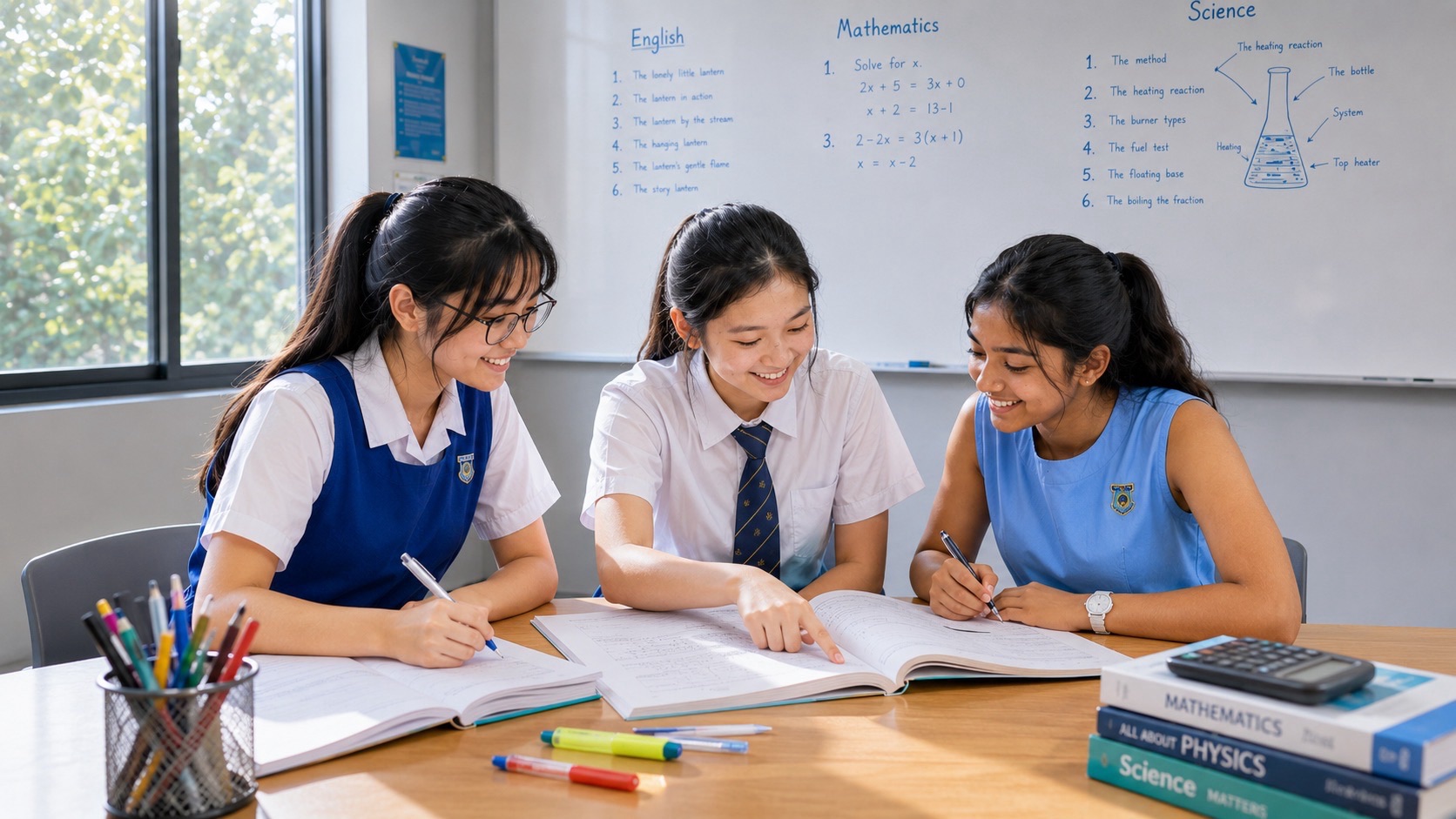
Bishan North parents choosing a secondary school after PSLE 2026 can compare Catholic High School (Secondary), Raffles Institution, Kuo Chuan Presbyterian Secondary, Guangyang Secondary, Whitley Secondary, Peirce Secondary, Beatty Secondary and Raffles Girls’ School (Secondary). These institutions serve different pupils and different routes: Catholic High has separate four-year SEC and six-year IP programmes; Raffles Institution has a six-year boys’ IP; Raffles Girls’ has a six-year girls’ IP; and the other schools follow mainstream Full Subject-Based Banding. The historical 2026-entry figures were Catholic High PG3 8(M) and IP 7(M), RI IP 6, RGS IP 6, Peirce PG3 20, Guangyang and Whitley PG3 22 and Beatty PG3 18. Kuo Chuan had no non-affiliated PG3 pupil posted through the ordinary 2026 exercise after DSA took those reserved places, so it does not have a comparable non-affiliated PG3 cut-off for that intake.
For entry into Secondary 1 in 2027, these are earlier posting outcomes from the PSLE 2025 cohort and do not guarantee places for the present children. Bishan North is not a self-contained admissions zone: Raffles Institution is at Raffles Institution Lane, Catholic High on Bishan Street 22, Kuo Chuan on Bishan Street 13, Guangyang on Street 12, Whitley on Street 24, Peirce at Sin Ming Walk, Beatty at Toa Payoh North and Raffles Girls’ at Braddell Rise. Parents must verify whether a boy or girl is eligible for the correct school and track, then compare school culture, subject learning, specialised programmes and the real commute from the family’s own Bishan or Marymount home.
Quick answers for parents
• Mainstream SEC options: Catholic High for boys (historical non-affiliated PG3 8M), Peirce 20, Guangyang 22, Whitley 22, Beatty 18; Kuo Chuan had no non-affiliated PG3 last-posted figure for 2026.
• Separate six-year IP routes: RI boys IP 6, RGS girls IP 6 and Catholic High boys IP 7(M); these are not ordinary PG3 cut-offs.
• Catholic High’s SEC and IP programmes are distinct, and its IP progresses to Eunoia Junior College for A-Levels. RGS’s secondary girls progress to RI for A-Levels.
• Kuo Chuan’s named primary affiliation and DSA-filled non-affiliated PG3 allocation require careful interpretation, rather than a made-up score.
• Check travel via Bishan, Marymount, Braddell, Bright Hill and Upper Thomson, and remember that a Bishan North address does not provide ordinary S1 home-distance priority.
How Bishan North parents should start after receiving the PSLE results
The first step is not to pick the most famous school. Read the official PSLE result slip, including the total score, the four subject Achievement Levels, and the Posting Group or Groups the child may use. Any Higher Mother Tongue result, school gender restriction, recognised affiliated-primary eligibility or committed DSA placement can change the valid list. A school that a family admires but the child is not eligible to enter cannot be used as a real choice. Only after checking eligibility should parents compare learning experiences, student care, school culture, CCAs and practical transport.
This guide is dated 13 November 2026 and addresses the 2026 PSLE cohort preparing for Secondary 1 in 2027. The PSLE figures in the comparison are historical outcomes for Secondary 1 entry in 2026, following PSLE 2025. The coming 2027 last-posted results cannot be known in advance; they emerge from the actual allocation exercise. Before submitting choices, verify the precise programme, school code, current campus and relevant historical range using MOE SchoolFinder. Refer to MOE’s official Secondary 1 Posting guidance for application dates, school-choice rules and instructions.
Talk to the child about what kind of schoolday they can manage and what makes learning meaningful. One pupil may enjoy creating devices but need help reading a scientific explanation. Another may excel in written language but feel nervous speaking in a new group. A third may need a shorter commute to make time for homework and rest. The student will live with the timetable for years, so the family’s decision must consider how core subjects are taught, whether support is available when an error persists, and which activities offer a genuine opportunity to grow.
- Establish the available routes: PSLE total, actual eligible Posting Group, gender, Chinese or other language rules, DSA and affiliation.
- Identify the real school: use operating names, campus gates and school codes rather than a historic merger or a misleading estate name.
- Read score data by cohort and route: an old COP is not a future guarantee or a direct measure of teaching quality.
- Investigate ordinary Secondary 1 teaching: ask about the subjects, feedback, schoolwide ALP/LLP and which activities are selected.
- Test daily life: check weekday transport, late CCA dismissal, costs, sleep, wellbeing and independence.
- Prepare six genuine choices: rank schools in sincere preference order with an appropriate range of earlier admission competition.
Secondary school options near Bishan North: admission routes and score references
This comparison covers Bishan, Marymount, Sin Ming, Braddell and the Ang Mo Kio boundary, not one legally reserved neighbourhood school catchment. Schools in adjacent planning areas are included where parents may reasonably investigate an eligible programme. The cut-off figures are labelled by their historical 2026 intake and their relevant Posting Group or IP route. They describe previous admission competition, not an official statement that any school is more caring, academically effective or suitable for every child.
| School and educational route | Historic 2026-intake last-posted score | What the family should investigate |
|---|---|---|
| Catholic High School (Secondary) — Boys’ SAP dual-track school: SEC and six-year Joint IP | PG3 8(M) non-affiliated; IP 7(M) separately | Chinese bicultural study, two curriculum routes, Passion Pursuit and A-Level progression |
| Raffles Institution (Years 1–4) — Boys’ independent six-year Raffles Programme to A-Levels | IP 6 only | Enriched academic inquiry, talent development, leadership and research |
| Kuo Chuan Presbyterian Secondary School — Co-educational government-aided Presbyterian mainstream school | No non-affiliated PG3 pupil posted in 2026; affiliated PG3 20, non-affiliated PG2 23 | Media literacy, podcasting, film, journalism and community leadership |
| Guangyang Secondary School — Co-educational mainstream school in Bishan | PG3 22 | Sustainability STEM, solar-powered cars and evidence-based inquiry |
| Whitley Secondary School — Co-educational mainstream school in Bishan | PG3 22 | Communicative Arts, language, performance and student leadership |
| Peirce Secondary School — Co-educational mainstream school in Sin Ming/Upper Thomson | PG3 20 | AI-driven STEM, coding, microcontrollers and inclusive design |
| Beatty Secondary School — Co-educational mainstream school near Braddell/Toa Payoh North | PG3 18 | NEXUS interdisciplinary learning and specialised support for hearing loss |
| Raffles Girls’ School (Secondary) — Girls’ independent six-year Raffles Programme; Years 5–6 at RI | IP 6 only | Enriched cross-disciplinary curriculum, research, leadership and A-Levels |
In the PSLE Achievement Level system, a smaller total score is stronger. If the earlier PG3 last-posted score at School A was 20, a child whose total is 18 had a numerically stronger result than the previous last-posted child. The pupil is not ‘too strong’ to apply. Equally, a child who gets exactly 20 does not have a guaranteed 2027 seat, because the current cohort’s demand, available places and tie-breakers may differ. A missing result or an IP value must not be silently substituted for a normal PG3 range.
Every school can offer a broad curriculum beyond its publicised specialism. A school celebrated for robotics still teaches reading, Mathematics, Science, Humanities and Mother Tongue at appropriate levels; a school associated with music has CCAs, form teachers and ordinary exam preparation. It is therefore useful to ask not only what the school does distinctively but what happens to an ordinary student who needs to improve in a less confident subject. A small difference in an earlier cut-off is far less informative than evidence of good daily teaching, suitable challenge and wellbeing support for this pupil.
A school-by-school parent guide for Bishan North
Catholic High School (Secondary)
Current school and campus: 9 Bishan Street 22, Singapore. Boys’ SAP dual-track school: SEC and six-year Joint IP. Catholic High’s 2026 dual-track information distinguishes the four-year Singapore-Cambridge Secondary Education Certificate programme from a six-year Joint Integrated Programme run with CHIJ St. Nicholas Girls’ School and Singapore Chinese Girls’ School. Its IP route moves to Eunoia Junior College for Years 5 and 6 and A-Levels; the SEC route culminates in the national secondary examinations. Shared enrichment includes leadership, appreciation of Chinese culture and Passion Pursuit, while IP-only work includes independent projects and World Readiness. The historical 8(M) SEC and 7(M) IP scores are separate outcomes carrying Higher Chinese Merit at the last place.
How this may fit your child: A boy who is strong in Chinese and enjoys sustained academic investigation may appreciate the school’s SAP identity, but he should understand the choice between SEC and IP. The SEC route may appeal to a child who wants a four-year assessment milestone; the IP suits one who genuinely wants the longer design. Ask about school ethos, workload, fees, any named primary affiliation and the route to Bishan Street 22, rather than simply favour the track with the smaller cut-off.
A useful open-house question: Which programme code will our son select in 2027, how do IP and SEC assessments differ, and what are the required Chinese-language conditions? Ask for an example of a normal first-year lesson, what all learners take part in, which electives require a talent or audition, and what support is given when the pupil makes mistakes or struggles with homework. The quality of the ordinary classroom experience matters as much as an advanced competition or an attractive programme brochure.
Parents can look for concrete signs of learning. Does a science project teach the pupil how to measure accurately and explain why a prototype works? Does a language lesson help students distinguish a credible source from misinformation? Does a student who cannot solve a Mathematics word problem receive a model and a second chance to practise? These questions are worth more than asking teachers how many pupils won awards. A school can have impressive infrastructure but still need structured teaching and a caring system for everyday learners.
The child’s enjoyment of one special programme is a good reason to investigate further, not a reason to stop asking questions. They will still need a workable CCA schedule, friends, an understanding form teacher, reasonable school materials and enough sleep. An advanced arts team, selected robotics workshop or later enrichment group may have additional criteria. A family should be confident that the child would want to join the school even if that selective opportunity is unavailable.
Official programme information: Read Catholic High School (Secondary)’s current school or programme page. Confirm the arrangements and school code for the 2027 entering cohort before making a live preference.
Raffles Institution (Years 1–4)
Current school and campus: 1 Raffles Institution Lane, Singapore 575954. Boys’ independent six-year Raffles Programme to A-Levels. Raffles Institution describes its Raffles Programme as four junior-high years followed by two senior-high years culminating in A-Level examinations. Its 2026 Years 1–4 material emphasises wide academic study, curriculum innovation, outdoor development, House activities, CCAs, and multiple talent programmes in subjects such as Mathematics, Science, Humanities and music. Some advanced Raffles Academy opportunities are for selected pupils in Years 3–4 and should not be described as automatic Year 1 participation. Its official visitor page says the main gate is along Bishan Street 21 and lists Marymount and Bishan MRT references.
How this may fit your child: A boy who enjoys sustained inquiry, a demanding academic rhythm and a six-year programme may want to investigate RI. Parents should ask how new students are supported when the work challenges them, what financial assistance applies, and whether the youngster actually wants the long IP route. An IP last-posted 6 is a historical competition measure, not an appraisal of pupils who enter another school. RI’s school entrance should not be estimated from a generic Bishan station map.
A useful open-house question: What does ordinary Year 1 learning involve, what enrichment starts later, and how does the school support academic and social adjustment? Ask for an example of a normal first-year lesson, what all learners take part in, which electives require a talent or audition, and what support is given when the pupil makes mistakes or struggles with homework. The quality of the ordinary classroom experience matters as much as an advanced competition or an attractive programme brochure.
Parents can look for concrete signs of learning. Does a science project teach the pupil how to measure accurately and explain why a prototype works? Does a language lesson help students distinguish a credible source from misinformation? Does a student who cannot solve a Mathematics word problem receive a model and a second chance to practise? These questions are worth more than asking teachers how many pupils won awards. A school can have impressive infrastructure but still need structured teaching and a caring system for everyday learners.
The child’s enjoyment of one special programme is a good reason to investigate further, not a reason to stop asking questions. They will still need a workable CCA schedule, friends, an understanding form teacher, reasonable school materials and enough sleep. An advanced arts team, selected robotics workshop or later enrichment group may have additional criteria. A family should be confident that the child would want to join the school even if that selective opportunity is unavailable.
Official programme information: Read Raffles Institution (Years 1–4)’s current school or programme page. Confirm the arrangements and school code for the 2027 entering cohort before making a live preference.
Kuo Chuan Presbyterian Secondary School
Current school and campus: 10 Bishan Street 13, Singapore 579795. Co-educational government-aided Presbyterian mainstream school. Kuo Chuan’s current lower-secondary English and media programme includes a Secondary 1 podcasting journey, followed by film and broadcasting work in Secondary 2. Its broader PACE media-literacy programme helps students access, analyse, create and evaluate messages, while selected Spin Doctors workshops and competitions extend writing and presentation. The 2026 admission history is unusual: the non-affiliated PG3 places reserved for normal posting had been filled through DSA, leaving no non-affiliated pupil newly posted in that PG3 category. The reported affiliated PG3 last-posted 20 is a different category; do not copy it as the non-affiliated figure or assume the same circumstance will recur.
How this may fit your child: A student who likes writing, media, podcasting or examining information sources may find a motivating programme. Parents should ask how beginning pupils learn to check evidence and what English-learning support is available to weaker readers. If considering Kuo Chuan, contact the school and verify the current 2027 route, DSA or affiliation circumstances rather than invent a cut-off from an older cohort. The school’s Presbyterian character and travel from Bishan North are also meaningful considerations.
A useful open-house question: What explains the missing 2026 non-affiliated PG3 result, what should 2027 applicants check, and how does the first-year podcasting programme support novices? Ask for an example of a normal first-year lesson, what all learners take part in, which electives require a talent or audition, and what support is given when the pupil makes mistakes or struggles with homework. The quality of the ordinary classroom experience matters as much as an advanced competition or an attractive programme brochure.
Parents can look for concrete signs of learning. Does a science project teach the pupil how to measure accurately and explain why a prototype works? Does a language lesson help students distinguish a credible source from misinformation? Does a student who cannot solve a Mathematics word problem receive a model and a second chance to practise? These questions are worth more than asking teachers how many pupils won awards. A school can have impressive infrastructure but still need structured teaching and a caring system for everyday learners.
The child’s enjoyment of one special programme is a good reason to investigate further, not a reason to stop asking questions. They will still need a workable CCA schedule, friends, an understanding form teacher, reasonable school materials and enough sleep. An advanced arts team, selected robotics workshop or later enrichment group may have additional criteria. A family should be confident that the child would want to join the school even if that selective opportunity is unavailable.
Official programme information: Read Kuo Chuan Presbyterian Secondary School’s current school or programme page. Confirm the arrangements and school code for the 2027 entering cohort before making a live preference.
Guangyang Secondary School
Current school and campus: 8 Bishan Street 12, Singapore 579807. Co-educational mainstream school in Bishan. Guangyang’s applied STEM work uses environmental sustainability to teach Science and practical design. First-year pupils can apply forces, energy conversion, measurements and iteration through a solar-powered car task; later learning can investigate forensics and food security. A Learning for Life emphasis on community and youth leadership adds opportunities beyond technical work. Advanced challenges or competitions may be selective and should be distinguished from basic lower-secondary experiences. The school is at Bishan Street 12, not another gate of Kuo Chuan on Street 13.
How this may fit your child: A pupil who learns through testing and revising models may find solar-car work engaging, but a family should ask how the formal Mathematics and Science are taught and how the child will obtain help after an incorrect result. Guangyang’s historical 22 could provide a less restrictive comparison for certain eligible children, but it is not a guaranteed 2027 score or a judgement of the quality of the school’s learning.
A useful open-house question: What physics and calculation does the entire Secondary 1 cohort learn through the solar-car programme, and how are mistakes corrected? Ask for an example of a normal first-year lesson, what all learners take part in, which electives require a talent or audition, and what support is given when the pupil makes mistakes or struggles with homework. The quality of the ordinary classroom experience matters as much as an advanced competition or an attractive programme brochure.
Parents can look for concrete signs of learning. Does a science project teach the pupil how to measure accurately and explain why a prototype works? Does a language lesson help students distinguish a credible source from misinformation? Does a student who cannot solve a Mathematics word problem receive a model and a second chance to practise? These questions are worth more than asking teachers how many pupils won awards. A school can have impressive infrastructure but still need structured teaching and a caring system for everyday learners.
The child’s enjoyment of one special programme is a good reason to investigate further, not a reason to stop asking questions. They will still need a workable CCA schedule, friends, an understanding form teacher, reasonable school materials and enough sleep. An advanced arts team, selected robotics workshop or later enrichment group may have additional criteria. A family should be confident that the child would want to join the school even if that selective opportunity is unavailable.
Official programme information: Read Guangyang Secondary School’s current school or programme page. Confirm the arrangements and school code for the 2027 entering cohort before making a live preference.
Whitley Secondary School
Current school and campus: 30 Bishan Street 24, Singapore 579747. Co-educational mainstream school in Bishan. Whitley’s distinctive learning includes an Applied Learning Programme in Communicative Arts and a Learning for Life Programme focused on active citizenship and community leadership. Its co-curricular choices include drama, choir, band, debate, photography, sports and uniformed groups. Parents should ask about the activities available to every new pupil and those requiring auditions or competition selection. The school is on Bishan Street 24 rather than at the main Bishan town centre, so its transport and school-gate route can differ from other Bishan schools.
How this may fit your child: A student who enjoys creative expression or needs a gradual route to confident speaking may respond well, particularly if lessons give novices time to plan and practise. Families should check how teachers support Reading and Mathematics foundations and whether a desired CCA will be realistic with the student’s bus or MRT journey. Historical 22 tells parents about a previous intake, not about the child’s maximum potential.
A useful open-house question: Which Communicative Arts tasks are universal and how is a quieter student guided from basic preparation to a confident presentation? Ask for an example of a normal first-year lesson, what all learners take part in, which electives require a talent or audition, and what support is given when the pupil makes mistakes or struggles with homework. The quality of the ordinary classroom experience matters as much as an advanced competition or an attractive programme brochure.
Parents can look for concrete signs of learning. Does a science project teach the pupil how to measure accurately and explain why a prototype works? Does a language lesson help students distinguish a credible source from misinformation? Does a student who cannot solve a Mathematics word problem receive a model and a second chance to practise? These questions are worth more than asking teachers how many pupils won awards. A school can have impressive infrastructure but still need structured teaching and a caring system for everyday learners.
The child’s enjoyment of one special programme is a good reason to investigate further, not a reason to stop asking questions. They will still need a workable CCA schedule, friends, an understanding form teacher, reasonable school materials and enough sleep. An advanced arts team, selected robotics workshop or later enrichment group may have additional criteria. A family should be confident that the child would want to join the school even if that selective opportunity is unavailable.
Official programme information: Read Whitley Secondary School’s current school or programme page. Confirm the arrangements and school code for the 2027 entering cohort before making a live preference.
Peirce Secondary School
Current school and campus: 10 Sin Ming Walk, Singapore 575566. Co-educational mainstream school in Sin Ming/Upper Thomson. Peirce’s updated 2026 Applied Learning Programme gives lower-secondary pupils foundational AI literacy, coding, microcontrollers and a design-thinking framework. Sec 1 projects such as a robotic grand prix help pupils develop computational reasoning and test solutions. Selected Makerspace and tertiary-linked mentorship provide additional opportunities, not guaranteed entry for all. Peirce’s school information distinguishes its Sin Ming Walk entrance from an Upper Thomson Road back gate, which matters when planning a child’s route using Bright Hill or Upper Thomson stations.
How this may fit your child: A child who likes building, debugging or asking how technology can solve a human problem may enjoy the approach. The family should ask how AI tools are used responsibly, what mathematics supports each project and what support exists for beginners who find coding difficult. A pupil in Bishan North can have a different journey to Sin Ming from one living near Bishan Central.
A useful open-house question: What AI and coding does every first-year student learn, and which advanced STEAM or maker opportunities are reserved for interested pupils? Ask for an example of a normal first-year lesson, what all learners take part in, which electives require a talent or audition, and what support is given when the pupil makes mistakes or struggles with homework. The quality of the ordinary classroom experience matters as much as an advanced competition or an attractive programme brochure.
Parents can look for concrete signs of learning. Does a science project teach the pupil how to measure accurately and explain why a prototype works? Does a language lesson help students distinguish a credible source from misinformation? Does a student who cannot solve a Mathematics word problem receive a model and a second chance to practise? These questions are worth more than asking teachers how many pupils won awards. A school can have impressive infrastructure but still need structured teaching and a caring system for everyday learners.
The child’s enjoyment of one special programme is a good reason to investigate further, not a reason to stop asking questions. They will still need a workable CCA schedule, friends, an understanding form teacher, reasonable school materials and enough sleep. An advanced arts team, selected robotics workshop or later enrichment group may have additional criteria. A family should be confident that the child would want to join the school even if that selective opportunity is unavailable.
Official programme information: Read Peirce Secondary School’s current school or programme page. Confirm the arrangements and school code for the 2027 entering cohort before making a live preference.
Beatty Secondary School
Current school and campus: 1 Toa Payoh North, Singapore 318990. Co-educational mainstream school near Braddell/Toa Payoh North. Beatty’s NEXUS@BTY programme connects knowledge from multiple subjects through real-world inquiry. The school also provides designated mainstream support for pupils with hearing loss, subject to the student’s particular language, access and learning needs. A school with interdisciplinary learning still teaches core English, Mathematics, Science and Humanities; its programme should help students explain evidence and apply learning, not only display a project. Beatty’s Toa Payoh North address is a different destination from Raffles Girls’ on Braddell Rise and the Bishan Street schools.
How this may fit your child: This school may suit a child who enjoys linking subjects or who needs carefully considered support in the transition to secondary learning. Parents should ask what whole-cohort NEXUS means, how feedback is provided and what school-life support is available. If hearing-related needs are relevant, speak directly with staff about the child’s actual requirements instead of assuming a general designation meets all possible needs.
A useful open-house question: What is a typical NEXUS learning task and which specific classroom, hearing-related and transition supports are available? Ask for an example of a normal first-year lesson, what all learners take part in, which electives require a talent or audition, and what support is given when the pupil makes mistakes or struggles with homework. The quality of the ordinary classroom experience matters as much as an advanced competition or an attractive programme brochure.
Parents can look for concrete signs of learning. Does a science project teach the pupil how to measure accurately and explain why a prototype works? Does a language lesson help students distinguish a credible source from misinformation? Does a student who cannot solve a Mathematics word problem receive a model and a second chance to practise? These questions are worth more than asking teachers how many pupils won awards. A school can have impressive infrastructure but still need structured teaching and a caring system for everyday learners.
The child’s enjoyment of one special programme is a good reason to investigate further, not a reason to stop asking questions. They will still need a workable CCA schedule, friends, an understanding form teacher, reasonable school materials and enough sleep. An advanced arts team, selected robotics workshop or later enrichment group may have additional criteria. A family should be confident that the child would want to join the school even if that selective opportunity is unavailable.
Official programme information: Read Beatty Secondary School’s current school or programme page. Confirm the arrangements and school code for the 2027 entering cohort before making a live preference.
Raffles Girls’ School (Secondary)
Current school and campus: 2 Braddell Rise, Singapore 318871. Girls’ independent six-year Raffles Programme; Years 5–6 at RI. RGS’s official Raffles Programme takes pupils through four secondary years at Raffles Girls’ School and the final two years at Raffles Institution, culminating in A-Levels. Its school materials emphasise advanced content, interdisciplinary thinking, research, reflection and varied assessment including projects and presentations. The Raffles Academy is a later opt-in Years 3–4 opportunity, not a universal Year 1 entitlement. The school’s address is Braddell Rise, near the Bishan–Toa Payoh boundary; families should not confuse it with RI’s Raffles Institution Lane gate.
How this may fit your child: A girl who likes independent inquiry and sustained academic challenge may enjoy the Raffles Programme, but the family should consider whether she wants a six-year academic pathway and the school ethos. Ask about financial assistance, academic and social support and the actual journey to Braddell Rise now and to RI during the later pre-university years. A historical IP 6 is not the same kind of admission data as a mainstream PG3 20.
A useful open-house question: How does RGS support a new Year 1 student, what is the six-year commitment, and which advanced research programmes become available only in later years? Ask for an example of a normal first-year lesson, what all learners take part in, which electives require a talent or audition, and what support is given when the pupil makes mistakes or struggles with homework. The quality of the ordinary classroom experience matters as much as an advanced competition or an attractive programme brochure.
Parents can look for concrete signs of learning. Does a science project teach the pupil how to measure accurately and explain why a prototype works? Does a language lesson help students distinguish a credible source from misinformation? Does a student who cannot solve a Mathematics word problem receive a model and a second chance to practise? These questions are worth more than asking teachers how many pupils won awards. A school can have impressive infrastructure but still need structured teaching and a caring system for everyday learners.
The child’s enjoyment of one special programme is a good reason to investigate further, not a reason to stop asking questions. They will still need a workable CCA schedule, friends, an understanding form teacher, reasonable school materials and enough sleep. An advanced arts team, selected robotics workshop or later enrichment group may have additional criteria. A family should be confident that the child would want to join the school even if that selective opportunity is unavailable.
Official programme information: Read Raffles Girls’ School (Secondary)’s current school or programme page. Confirm the arrangements and school code for the 2027 entering cohort before making a live preference.
What parents should know about Bishan North school travel
Bishan North is not one transport stop. Homes nearer Bishan Street 22, Marymount Road, Sin Ming Avenue or Bright Hill have different routes to Catholic High, RI, Kuo Chuan, Guangyang, Whitley and Peirce. Raffles Institution’s official visitor guide specifies its main gate on Bishan Street 21, with Bishan and Marymount MRT as relevant stations. Parents should not measure only the distance to the middle of the campus.
Catholic High is at 9 Bishan Street 22; Kuo Chuan at 10 Street 13, Guangyang at 8 Street 12 and Whitley at 30 Street 24. The similar street numbers are not interchangeable entrances. Peirce at Sin Ming Walk has a separate Upper Thomson Road gate; walking from Bright Hill may be different from arriving via Bishan Central.
Beatty is at Toa Payoh North, and Raffles Girls’ is at Braddell Rise. These schools lie around the Toa Payoh and Braddell boundary, not inside a neat Bishan North circle. Both may be relevant to eligible children, but the morning journey and late dismissal will not necessarily resemble the route to a Bishan Street school.
Parents considering a six-year IP should also think beyond the first two terms. RGS pupils will progress to RI for Years 5–6, while Catholic High’s Joint IP progresses to Eunoia Junior College. Future campuses and timetables matter, even if the initial lower-secondary location is convenient.
The useful measurement is the door-to-school-gate journey. Start at the place the child will actually live on a school night, not the geographical centre of the neighbourhood. Account for walking, waiting, operating bus or rail connections, transfers, crossings and the entrance used by Secondary 1 pupils. Repeat the exercise at the school’s normal reporting time, not merely on a quiet Saturday afternoon when the family is visiting an open house.
A second journey check should be made when a CCA finishes late. A child may be carrying sports clothes, a device, a musical instrument or extra books in the rain. A longer but direct journey can be less stressful than a nominally shorter trip that needs multiple transfers. Some families may willingly accept extra travel for a programme the child genuinely loves, but they should know the cost in sleep, homework time and independence. Do not assume a parent who drives on orientation day can provide the same journey every weekday for four years.
Singapore’s ordinary Secondary 1 Posting Exercise does not apply the Primary 1 registration system’s one- or two-kilometre priority bands. A home close to a school can make the route convenient but does not reserve admission. Equally, being outside the home’s planning area does not make an eligible school invalid. National choice rules and the child’s actual Posting Group, programme and school preferences matter for admission; transport matters for family wellbeing.
Mistakes to avoid when choosing Bishan North schools
RI is boys-only at Years 1–4 and RGS is girls-only at Years 1–4. Catholic High’s Secondary section is boys-only. Peirce, Kuo Chuan, Guangyang, Whitley and Beatty are co-educational. A child who does not meet the gender eligibility cannot include the school as a normal preference.
Catholic High’s PG3 8(M) and IP 7(M) are distinct 2026 outcomes with Higher Chinese notation, and RI and RGS’s IP 6 are different admissions routes. Do not compare them directly with mainstream PG3 ranges as though they represent the same curriculum.
Kuo Chuan’s absent non-affiliated PG3 outcome in 2026 reflects an intake in which DSA filled the reserved non-affiliated PG3 places. Its affiliated PG3 20 is not a valid substitute for a non-affiliated cut-off; parents must check 2027 with the school.
RGS is at Braddell Rise, RI at Raffles Institution Lane, and Peirce is in Sin Ming. A school whose address seems nearby on a Bishan map may have a very different gate, commute or programme requirement.
The historic last-posted score describes admissions competition, not the quality of teaching or the child’s ability to improve. A score more competitive than another does not mean a school is universally better.
One practical way to avoid confusion is to record five details for every school: its current operating name and address, the school/programme code, who is eligible, the correct previous-year score category and the child’s genuine reason for wanting it. If the school has merged, its old name can be part of local heritage but no longer creates an independent school choice. If it has separate SEC and IP routes, those are different programmes, not merely a difference in the last-posted total. A separate DSA-based institution may not appear in the ordinary six-school selection at all.
The four PSLE Achievement Levels and the total score
A PSLE total is obtained by adding the Achievement Levels in English, Mathematics, Science and Mother Tongue. For example, if the child earns AL3 in English, AL4 in Mathematics, AL3 in Science and AL4 in Mother Tongue, the overall result is 14. The strongest possible total is 4. This is why a numerically lower PSLE total is more competitive for admission. It is a significant examination result, but it does not measure the child’s kindness, creativity, physical fitness, willingness to learn or potential to make progress over the next several years.
Parents should inspect the individual subject ALs rather than reduce the child to the sum. A pupil who did well in Science but less well in English may need more direct teaching of reading and written scientific explanation. Another may be strong in language and require support with numerical reasoning or the first steps in algebra. Different subject strengths are normal. A prospective school should be able to explain how it identifies learning gaps, teaches prerequisites, gives corrected examples and checks whether a student has improved.
A school’s published score range represents the first and last pupils posted through a specified route in a previous cohort. The last admitted total is often called the cut-off point, but it is not a fixed requirement announced before the new cohort applies. It can shift because of applicant results, the popularity of a school, vacancies and other posting conditions. A previous PG3 last-posted score of 19 is therefore one piece of historical evidence, not the number parents can demand be used for 2027.
Schools with recognised primary affiliations can have different reported results for affiliated and non-affiliated applicants, and eligibility often depends on the actual named primary school and the rank position of the secondary school. Some Special Assistance Plan schools’ historical results include a Higher Chinese Language suffix such as (D) for Distinction or (M) for Merit. A suffix or a missing value can be material to the interpretation; do not delete it to make a simple table. An Integrated Programme result likewise comes from a different educational route than a mainstream PG3 score.
Full Subject-Based Banding: Posting Groups are not permanent streams
Under Full Subject-Based Banding, the Posting Group is an admission category. G1, G2 and G3 are levels of academic demand for particular secondary school subjects. They are not whole-person labels that permanently fix the child’s educational capacity. Pupils may study subjects at different levels when they meet the applicable criteria, and mixed form classes allow students with different strengths to learn and participate in school life together. Parents should ask schools what the starting subject level means for the child’s actual classroom learning and possible later progress.
For most pupils, total PSLE Scores 4–20 generally qualify for Posting Group 3. Scores 21–22 may offer a choice between PG2 and PG3; 23–24 normally correspond to PG2; 25 can allow a choice between PG1 and PG2; and 26–30 may qualify for PG1 subject to the particular English and Mathematics AL conditions. Foundation-level subjects or other special cases require the actual result slip and current MOE guidance. No internet chart should override the eligibility stated for an individual pupil.
If the child is eligible to choose between two Posting Groups, the selected group applies to all six schools in the ordinary submission. A family cannot switch groups one school at a time to take advantage of whichever historical range appears most favourable. Discuss the child’s readiness and confidence, including the chance to take a stronger subject at a higher level where permitted. The aim is appropriately demanding learning with steady growth, not the impression of gaining a more fashionable label.
The Singapore-Cambridge Secondary Education Certificate (SEC) examinations begin in 2027 for the first relevant graduating cohort, replacing the previous N- and O-Level structure for mainstream pupils. A child entering Secondary 1 in 2027 learns in this revised subject-based system. Some six-year IP schools and specialised institutions follow different progression routes, such as A-Levels after pre-university education. Parents should understand the long-term curriculum instead of comparing every school as though it leads to an identical examination at the end of Secondary 4.
How to use a previous cut-off without misleading your child
A school with a historical last-posted score of 12 was more selective in that intake than a school whose last-posted score was 22. This is not direct evidence that every teacher, CCA or student experience at the first school is better. A lower last-posted total may reflect greater demand, fewer places or a different programme. A teenager who needs specific academic support, a supportive community or a manageable commute might thrive at either institution, depending on their circumstances. The score should help the family understand admission competition, not become a moral judgement of pupils.
Consider a PG3 pupil scoring 17. Against a school’s earlier PG3 cut-off of 19, that pupil had the stronger numerical comparison. Against a different school’s old score of 14, the same pupil would have had a less competitive comparison. Neither school is guaranteed or impossible for 2027 merely from the old data. The family can keep an eligible aspirational choice if it is truly wanted, but should also include schools with historically more attainable outcomes that the child would be glad to attend.
MOE encourages parents to use all six school choices and include two or three schools for which the child’s PSLE total is better than the previous cut-off. This reduces the chance of submitting six very competitive preferences but cannot promise that any choice will have the same demand in the new year. The sixth listed school may become the child’s actual posting, so it should never be an unwanted name added to complete the form. A school may be less selective historically and still provide excellent teaching, meaningful activities and friends.
The six-school preference planning method
| Preference rank | What to check | Why the family could keep it |
|---|---|---|
| 1 | Genuine first preference, correct admission code and programme eligibility | The pupil genuinely wants the whole school experience |
| 2 | Another eligible school with a suitable environment and journey | A real alternative rather than another adult’s favourite name |
| 3 | Correct historic COP for the actual Posting Group or IP route | A grounded view of competition, not an invented forecast |
| 4 | Core teaching, subject support, CCAs and student wellbeing | A school that can help this pupil learn and belong |
| 5 | A historically less selective school that is still sincerely wanted | Spreads risk without an unwanted backup |
| 6 | A final eligible school the child would willingly attend | No disposable preference that could become a regret |
School-choice order matters only within the prescribed posting rules. Academic merit is central: when pupils with the same eligible PSLE Score compete for a school’s remaining vacancies, the standard tie-breakers are citizenship, then the position of the school in the applicant’s preference list, and then computerised balloting if required. Listing an ineligible school first does not make it valid; listing a highly selective school first cannot erase the academic priority of a stronger applicant. Rank schools honestly because position matters in an actual tie and because the child should own the choice.
Direct School Admission needs a separate check. A pupil who has a confirmed successful DSA-Sec allocation is ordinarily committed to that institution and does not treat it as an optional backup while entering the usual six-school preferences. A child who merely applied but did not receive an accepted allocation is in a different situation. Some specialised schools use their own applications or conditional supplementary windows. Follow the actual 2026 offer and official 2027 school instructions rather than make an assumption from someone else’s application experience.
Worked family choices: realistic situations for Bishan North
A boy with PSLE Score 19 in Posting Group 3
Peirce’s previous PG3 last-posted 20 and Guangyang and Whitley’s 22 were historically less restrictive than 19, while Beatty’s 18 and Catholic High’s 8(M) were more selective. Kuo Chuan has no comparable 2026 non-affiliated PG3 result; RI is IP-only, RGS is girls-only. A realistic six-choice list needs genuine eligible options, not a ranking from old numbers alone.
The next useful step is to separate what can be verified from what needs family discussion. The school identity, campus, admission route, earlier score and published curriculum are checkable facts. The student’s preferences, feelings about the school culture, enthusiasm for an activity and ability to manage the journey require direct conversation. Both columns belong in a sound decision, and neither can substitute for the other.
A daughter with a strong score who wants a six-year IP
RGS is an IP choice for eligible girls, but Catholic High and RI Year 1 are boys’ routes. The family should investigate the Raffles Programme’s actual learning style, academic expectations, fees and future Years 5–6 at RI. Other suitable girls’ IP programmes may exist elsewhere, but the child should genuinely want a long academic path.
The next useful step is to separate what can be verified from what needs family discussion. The school identity, campus, admission route, earlier score and published curriculum are checkable facts. The student’s preferences, feelings about the school culture, enthusiasm for an activity and ability to manage the journey require direct conversation. Both columns belong in a sound decision, and neither can substitute for the other.
A boy choosing between Catholic High SEC and its IP
The two tracks share much school life but differ in curriculum, assessment and later progression. The IP moves to Eunoia JC, while the SEC route leaves later options open under the appropriate qualifications. A difference in historic cut-off does not decide the pupil’s readiness or desire for the six-year path.
The next useful step is to separate what can be verified from what needs family discussion. The school identity, campus, admission route, earlier score and published curriculum are checkable facts. The student’s preferences, feelings about the school culture, enthusiasm for an activity and ability to manage the journey require direct conversation. Both columns belong in a sound decision, and neither can substitute for the other.
A pupil who loves programming but struggles with long reading passages
Peirce’s AI and coding, Guangyang’s model-based STEM and Kuo Chuan’s media literacy may offer different reasons to practise. Ask which school directly helps the child repair comprehension while continuing to stretch computational reasoning; technology alone will not solve a reading gap.
The next useful step is to separate what can be verified from what needs family discussion. The school identity, campus, admission route, earlier score and published curriculum are checkable facts. The student’s preferences, feelings about the school culture, enthusiasm for an activity and ability to manage the journey require direct conversation. Both columns belong in a sound decision, and neither can substitute for the other.
A family close to Braddell rather than Bishan MRT
RGS and Beatty may have a practical journey from one home, while Peirce or Catholic High may require bus connections. Compare a schoolday trip to the real gates and a later CCA dismissal. An apparently prestigious nearby campus may be ineligible by gender or programme.
The next useful step is to separate what can be verified from what needs family discussion. The school identity, campus, admission route, earlier score and published curriculum are checkable facts. The student’s preferences, feelings about the school culture, enthusiasm for an activity and ability to manage the journey require direct conversation. Both columns belong in a sound decision, and neither can substitute for the other.
A parent reading a blank Kuo Chuan PG3 table
Do not assume the school never accepts PG3 pupils or that its affiliated score is the non-affiliated score. The blank is a genuine prior-year category outcome related to DSA allocation; confirm this year’s arrangements and keep other preferred schools on the list.
The next useful step is to separate what can be verified from what needs family discussion. The school identity, campus, admission route, earlier score and published curriculum are checkable facts. The student’s preferences, feelings about the school culture, enthusiasm for an activity and ability to manage the journey require direct conversation. Both columns belong in a sound decision, and neither can substitute for the other.
Ten questions to ask at a secondary-school open house
- Which Applied Learning and Learning for Life experiences are part of every first-year pupil’s normal curriculum, and which require selection?
- How does the school find gaps in Primary 6 reading, Mathematics and scientific reasoning when the pupil begins Secondary 1?
- What happens after a weak first assessment: who gives a corrected explanation and checks whether the student can now solve a new problem?
- How does the school offer and review subject levels at G1, G2 and G3 where appropriate under Full SBB?
- What are the actual reporting, dismissal and normal CCA hours, and which activities often end later?
- Which sports, arts, language, technical and leadership activities welcome beginners who have no competition record?
- How do form teachers respond to bullying, online conflict, loneliness, or a child having difficulty finding friends?
- What accessibility, learning or wellbeing support is available for a pupil with special educational or health needs?
- What are the total costs of uniforms, books, meals, school devices, transport, club equipment and trips, and which assistance schemes might apply?
- Could we see an ordinary pupil’s lesson, feedback or improvement, rather than only an exhibition by the strongest competition team?
Answers should be specific. A school that promises confident communicators should explain how a shy pupil learns to prepare a short speech, receive feedback and gradually speak to a larger audience. A school that claims to build innovators should show how students test a failed prototype and understand what went wrong. A positive school culture is demonstrated by how a student seeks help, how peers cooperate and how teachers guide errors. The family’s decision should rest on those ordinary processes, not only on attractive publicity.
A results-week plan: from PSLE slip to confirmed choices
- Read the complete result. Confirm total PSLE Score, four subject ALs, eligible Posting Groups and relevant Higher Mother Tongue information.
- Verify the current school list. Check any merger, campus relocation, gender condition and separate IP, SEC or specialised code.
- Compare the correct previous data. Label each PG1, PG2, PG3, IP and affiliated score separately; do not invent a missing range.
- Speak with the child. Discuss subject interests, CCA hopes, travel confidence, school culture and which teachers or supports may help.
- Test the journey and budget. Check schoolday mornings, late CCA and recurring financial or time costs.
- Agree six real preferences. Rank honestly and include appropriate historically more attainable options that the child wants.
- Submit and retain acknowledgement. Follow MOE’s actual announced deadline and portal instructions, and check every programme code before final confirmation.
Children may be delighted with their score, disappointed or anxious about missing a particular school. Parents can acknowledge the feeling without making the following days a comparison with relatives or classmates. The immediate next task is constructive: identify which schools are eligible and where the child can learn and belong. The PSLE is an important assessment at this stage, not a permanent measure of intelligence, moral character or future possibility. Careful planning and later effort can open many educational routes.
Budget, wellbeing and starting Secondary 1 with confidence
School fees are not the whole household budget. Count transport, textbooks, uniforms, meals, personal learning devices, CCA equipment, instruments, learning journeys and optional activities. Independent and specialised schools may have fee structures that differ from government mainstream schools. Families should check MOE financial assistance and individual school support rather than reject a potentially suitable school without understanding the costs. A regular long journey can also impose a substantial burden on family time and the child’s sleep.
The first Secondary 1 term brings a bigger campus, more teachers, new subjects, varied homework deadlines and greater independence. Parents can prepare by practising the school route, letting the child take responsibility for packing the bag, learning to record deadlines and asking a teacher for help when instructions remain unclear. A child who was confident in Primary 6 may still find the first secondary assessment hard. This is an opportunity to practise seeking explanations and correcting misconceptions, not a reason to assume the school was the wrong choice.
For a pupil with learning differences, sensory or hearing needs, mobility difficulties, health conditions or emotional support needs, involve the primary and prospective secondary schools early. Ask what facilities, teaching adjustments, allied educators or counselling are available and how the child can communicate a concern. A school with an impressive old admission range may be a poor practical fit if the child cannot access its classes or manage the journey. Educational suitability involves safety, dignity and the opportunity to participate fully.
Social adjustment is another part of the transition. Some children find friends in their first week; others need time. Parents can ask what the child enjoyed, one thing that was difficult and whom they might approach for help. Persistent exclusion or distress should prompt constructive contact with the form teacher or student-support staff. Good friendships and confident study habits take practice. They should not be reduced to whether a pupil’s classmates all have similar PSLE totals.
A family decision worksheet before final submission
| Decision question | Evidence to collect | Mistake to avoid |
|---|---|---|
| Is the child eligible? | Official slip, Posting Group, actual school code, gender, language and any affiliation | Submitting a favourite but invalid programme |
| Does the past result help? | Correct 2026 intake PG/IP/affiliation range, HCL suffix or missing-category note | Treating history as a guaranteed 2027 seat |
| How will the child learn? | Core subjects, feedback, subject support, all-student ALP and classroom culture | Judging a school only by trophies or old cut-offs |
| Will the teenager belong? | School ethos, pupil’s interests, student care, CCAs and form-teacher support | Ignoring the pupil’s everyday experience |
| Can the family manage the route? | Operating morning and late-CCA door-to-gate journeys | Planning from an outdated campus or an MRT station name |
| What does it cost? | Fees, food, transport, books, devices, equipment and financial assistance | Forgetting recurring household costs |
| Are all six choices real preferences? | Verified codes, good fit, honest order and historical score spread | Choosing an unwanted sixth school |
The worksheet should not be turned into a false numerical ranking of school quality. It exists to reveal trade-offs for an individual child. One pupil may need a short commute and structured support for English, while another may find lasting motivation in coding, music or a demanding bilingual IP. Two children with the same PSLE total can make different but equally defensible choices when the relevant facts and preferences are understood.
Frequently asked questions for Bishan North parents
Is Bishan North a special S1 posting priority area?
No. Ordinary Secondary 1 allocation is national. A residence near a school does not create the Primary 1 home-distance priority.
Does Catholic High have both SEC and IP?
Yes. Its four-year SEC route and six-year Joint IP are distinct; the IP continues to Eunoia Junior College.
Do Raffles Institution and Raffles Girls’ admit the same Secondary 1 pupils?
No. RI Years 1–4 admits boys, while RGS admits girls; both have six-year programmes that later connect to RI’s pre-university education.
Why is there no normal PG3 cut-off for Kuo Chuan’s 2026 non-affiliated intake?
Those reserved places were filled through DSA. A separate affiliated PG3 result of 20 must not be applied to non-affiliated pupils.
Is Peirce Secondary in Bishan Central?
Its campus is 10 Sin Ming Walk, with another gate facing Upper Thomson Road.
Does an IP 6 guarantee RGS or RI?
No. It was a historical 2026 last-posted outcome, not an admissions promise for the 2027 cohort.
Can Bishan North children select Beatty or a school beyond Bishan?
Yes, if eligible and the commute works; estate boundaries are not barriers to national S1 choices.
Does the old cut-off guarantee a new school place?
No. It is the last-posted pupil’s score in an earlier allocation. The new cohort’s scores, preferences, vacancies and tie-breakers may produce different results. A child who matches the old figure has no reserved place.
Can an eligible child choose schools outside the neighbourhood?
Yes. The ordinary Secondary 1 choice system is national. A school beyond the formal planning-area boundary may still be a valid option and even have a better daily journey, provided the pupil meets its entry requirements.
Does a smaller historical COP necessarily mean better teaching?
No. It indicates a more selective previous admission result, not a direct measure of teacher effectiveness, student wellbeing or the educational fit for every child. Investigate normal teaching and the pupil’s needs.
Official sources and further reading
- MOE SchoolFinder — current school profiles, historical score ranges and subject offerings
- MOE Secondary 1 Posting — current eligibility, choice submission and allocation rules
- MOE PSLE and Full Subject-Based Banding guidance
- MOE Parent Kit — a sensible six-school list and previous cut-off information
- MOE Direct School Admission — relevant school-specific commitments and procedures
- Catholic High School (Secondary) — official school or programme information
- Raffles Institution (Years 1–4) — official school or programme information
- Kuo Chuan Presbyterian Secondary School — official school or programme information
- Guangyang Secondary School — official school or programme information
- Whitley Secondary School — official school or programme information
- Peirce Secondary School — official school or programme information
- Beatty Secondary School — official school or programme information
- Raffles Girls’ School (Secondary) — official school or programme information
- Bishan-area historical 2026 score comparison
- Catholic High dual-track curriculum
- RI official campus access
- RGS six-year programme
- Existing Bishan area parent guide
- Existing Upper Thomson guide
Information date and limitations: updated for November 13, 2026. The numerical values are historical outcomes for Secondary 1 entry in 2026, based on the PSLE 2025 cohort. They are not final cut-offs for 2027 entry. School programmes, addresses, language and affiliation conditions, DSA selection, fees and official posting deadlines can change; verify the child’s current eligibility and school information before submitting a live form. This independent parent guide makes no admission guarantee and does not imply endorsement by the schools.
The best next school for a child living in Bishan North
Before finalising, answer three questions. Can the child enter the exact route? Verify the school code and official eligibility. Can the child learn and grow there? Look at subject teaching, care, friendships and meaningful opportunities. Can the family sustain it? Test transport, recurring expenses, CCA hours and the pupil’s energy. A school that meets all three deserves consideration regardless of whether relatives speak more often about another name.
A twelve-year-old does not need a fixed career or a lifetime label. Secondary school should help the pupil strengthen reading, vocabulary, mathematics, scientific thinking, communication and friendships while learning to recover from mistakes. A carefully researched and genuinely ranked list gives the child a sound start in that next stage, without turning one examination result or a previous admissions number into a prediction of everything they can become.