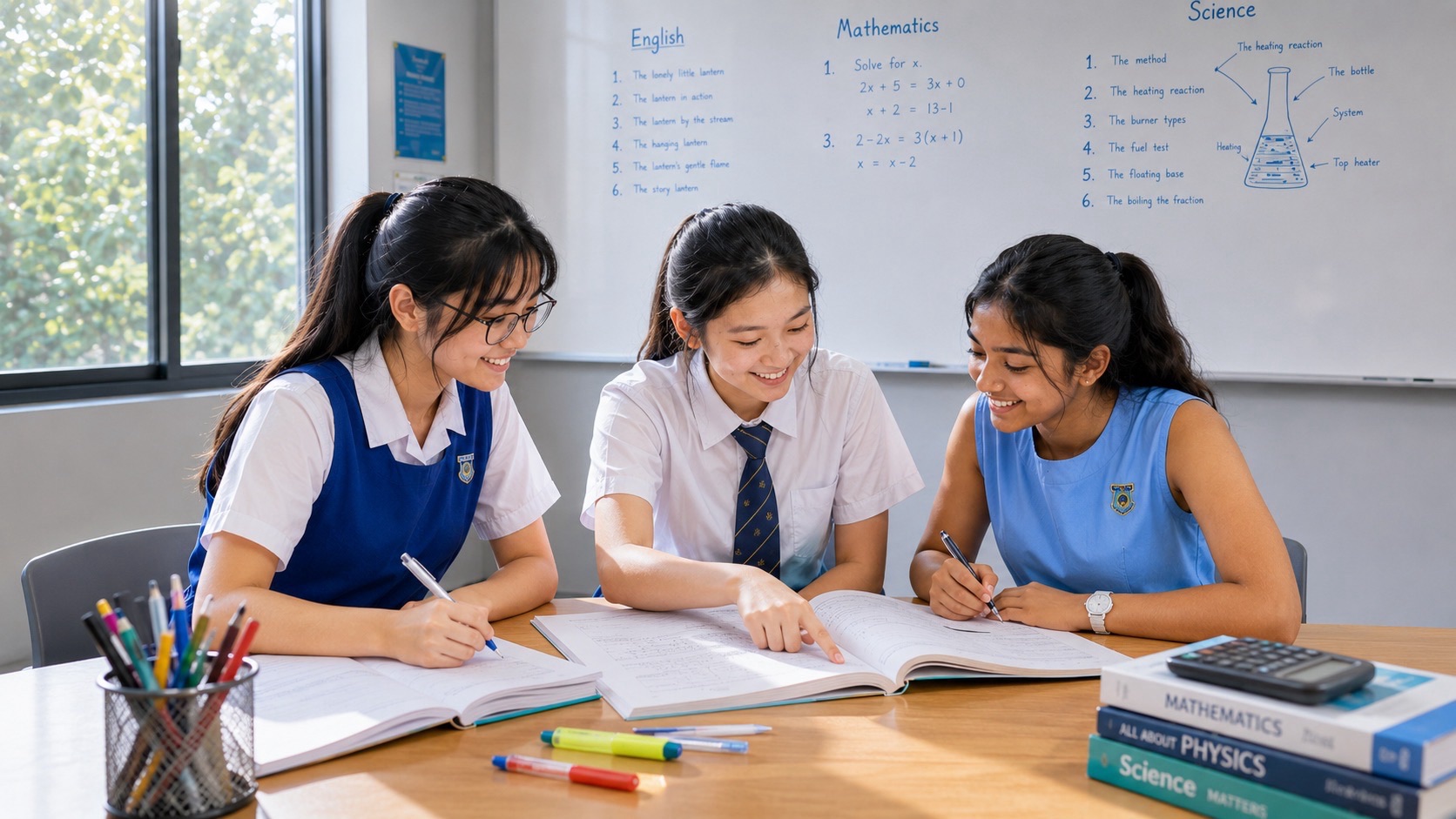
Invictus International School (Singapore) after the PSLE result at 11.00am on Tuesday 24 November 2026: this is an international school at Centrium Square campus: 320 Serangoon Road, #06-01, Singapore 218108; Dempsey Hill campus: 73 Loewen Road, #01-21, Singapore 248843, not a school participating in the MOE Secondary 1 six-choice Posting Group allocation. The real educational pathway is Cambridge Lower Secondary in Years 7–9, IGCSE in Years 10–11 and Cambridge International AS & A Levels in Years 12–13; campus availability differs. There is no meaningful MOE PG3, PG2 or PG1 last-posted score to quote for this school, and a PSLE result by itself neither guarantees a place nor determines international-school grade placement.
Parents living in Farrer Park, Jalan Besar, Little India, Novena, Balestier, Dempsey, Queenstown and Bukit Timah should use the 24 November result as a starting point for understanding the child’s learning strengths, while requesting a direct admissions assessment from Invictus International School (Singapore). Confirm the right grade, actual curriculum and later qualifications, nationality/permission rules, timetable, campus, support, written fees and travel before committing. The ordinary MOE S1 choice window runs from 11.30am on 24 November to 4.30pm on 30 November 2026 for families using that system; it is separate from an international-school offer and should not be missed if needed as a contingency.
Quick summary for parents
• School and campus: Invictus International School (Singapore), Centrium Square campus: 320 Serangoon Road, #06-01, Singapore 218108; Dempsey Hill campus: 73 Loewen Road, #01-21, Singapore 248843.
• Available actual curriculum: Direct international-school application rather than national S1 Posting. Years 7–9 Cambridge Lower Secondary; IGCSE Years 10–11 and A Levels Years 12–13 at Centrium Square. Dempsey Hill currently lists Year 7 only among lower-secondary years.
• PSLE score: no official MOE PG1/PG2/PG3 COP; direct admissions and individual grade placement are required.
• Fees: Published annual Year 7–9 tuition S$25,190.99 with one-time payment, S$25,836.27 semesterly or S$26,481.55 termly; annual materials, technology, insurance and one-time application, assessment and enrolment fees are additional.
• Singapore citizenship: check MOE approval and the school’s policy before assuming attendance is permitted.
• Next move: ask for a written offer and suitable year, compare local schools and preserve any necessary national S1 submission by 30 November at 4.30pm.
The critical distinction: a PSLE result is not an international-school posting offer
In Singapore’s national system, the four PSLE Achievement Levels combine into a total score from 4 to 32, and pupils use their official eligibility to select schools participating in the MOE Secondary 1 Posting Exercise. Invictus International School (Singapore) is outside that ordinary allocation. It does not have an official 2026 intake PG3, PG2 or PG1 cut-off point, nor does it award automatic entry to pupils based on a local-school score. Families should never substitute a made-up ‘AL requirement’ from a commercial website for the international school’s actual admissions process. The result can still be useful: it may show that a child is confident in Mathematics, needs stronger English writing or is ready for a particular academic challenge. The school must evaluate that evidence with previous reports, age and language needs. A child is not accepted merely by scoring well, nor excluded simply because their PSLE aggregate resembles a national PG1 band.
The official 24–30 November dates still matter for national posting
MOE and SEAB confirmed on 17 November 2026 that PSLE results will be released on Tuesday 24 November at 11.00am. Parents using the ordinary national S1 process can submit school choices online from 11.30am that day until 4.30pm Monday 30 November with Singpass. A tentative posting-result date of Friday 18 December was announced, subject to confirmation. Those dates do not impose an identical application window on Invictus International School (Singapore); it follows its own private-school admissions timetable. However, a family that may require a national-school fallback must not casually abandon the official six-choice deadline while waiting for an international offer. The child should not be withdrawn from a school place or told an international transfer is certain until admissions, start date and applicable approvals are confirmed. Discuss both processes with the institutions involved.
The child’s total AL is not a full account of their subject readiness
Two children can receive the same overall PSLE score yet require very different support in secondary education. One child might be strong in numerical reasoning but struggle to organise a long explanation in English; another may write fluent paragraphs but make frequent errors with fractions, units or graphs. An international curriculum may introduce unfamiliar sequencing, coursework conventions, project language or subject names. Parents should send accurate transcripts and ask admissions which areas will be assessed, rather than hiding difficulties in the hope of winning a place. A realistic fit starts with what the pupil can do independently, where they need guidance and whether the receiving school has capacity to provide it. The goal is not to erase the PSLE score, but to use it correctly: one data point in a much richer educational picture.
Grade placement is a real educational decision, not a translation of labels
Singapore Secondary 1, Cambridge Year 7, an IB MYP grade and a French collège class are not automatically identical administrative categories. Schools use different academic years, age cutoffs, prior curriculum requirements and placement assessments. The parent should ask Invictus International School (Singapore) to specify the child’s proposed grade and date of entry in writing, along with the topics already taught in the current term. A family moving from a January-to-December Singapore school calendar into an August- or September-starting international calendar may be joining halfway through a year. That can require extra orientation, subject bridging or a delayed entry decision. It is better to discuss these differences before signing a contract than to discover after enrolment that the child has missed foundational units or cannot join the expected class.
Citizenship, residence and government approval cannot be assumed away
For a Singapore citizen child, attending a foreign-system international school may require specific MOE approval. The international-school admissions office should clarify the applicable permission pathway for the family’s circumstances and whether the school helps obtain approvals. Permanent residents and foreign-national pupils may instead need evidence of their own residence or immigration status. A parent’s friend’s experience does not prove that another nationality or age group is treated the same. The family should obtain an official statement of what must be satisfied before the child attends school. It is unsafe to assume that a good PSLE result, a paid application fee or a verbal expression of interest is an exemption from national requirements. If approval or a student pass remains pending, the enrolment should be treated as conditional until the competent authority and school confirm otherwise.
The learning environment should be assessed through an ordinary Tuesday
International schools often advertise beautiful facilities, diverse communities and modern learning methods. Those features can matter, but a pupil’s everyday experience is determined by timetables, feedback, classroom relationships, assessment expectations and travel. Ask to see a typical timetable for the proposed grade, a sample Mathematics task, an example of English writing feedback and how class teachers communicate with parents. Consider the child’s temperament: some students relish open-ended inquiry or multilingual discussion while others require more structure to build confidence. A school is not automatically the best choice merely because it offers a familiar international examination. The parent should understand how an ordinary lesson helps a child recover from a wrong answer and improve. A sustainable education is built through repeated everyday interactions, not only through award ceremonies and campus photographs.
Admissions documents and assessments should be understood before payment
Direct international admissions often involve forms, previous academic reports, proof of age and nationality, sometimes language assessments and other placement information. Ask Invictus International School (Singapore) which documents apply to this child, how the school interprets the results, what fees must be paid before an offer, and whether any assessment or interview is compulsory. Do not guess a grade or claim the school will accept every applicant when a place may depend on available capacity. When the school issues an offer, read the actual course or student contract and understand whether it is conditional on approvals or payment. Families should retain records of the application and correspondence, just as they would save an MOE S1 choice confirmation. Clear administrative steps protect the student from unnecessary uncertainty during a major school transition.
Fees must be budgeted as a multi-year commitment, not a one-year headline
School-fee pages may separate tuition from application, assessment, enrolment, development, insurance, transport, uniforms, devices, meals and optional activities. Some learning or language supports may attract additional charges. The family should compare the cost over several years and allow for fee revisions rather than assessing only the first annual number. Ask when payments fall due, whether discounts apply, and what refund or notice requirements operate if the family relocates. Financial stress can affect a pupil’s experience when parents must repeatedly reconsider transport or activities. An international school may be a good fit for a family that values its curriculum and can sustain the cost; for another family, a suitable national school may be the more stable educational choice. The responsible decision is the one the household can carry consistently.
A school’s future qualification is not proof of every current subject offering
Parents should distinguish a school’s broad qualification pathway from the exact subjects it currently offers at each year and campus. A school may advertise IGCSE but restrict some electives to a particular site, or offer a Diploma Programme but have variable higher-level subject availability. Similarly, a French national certificate is not equivalent to an IB Diploma simply because both sound international. Ask the school for a current course list, progression requirements and examination arrangements, and revisit those questions as the child approaches subject-choice years. A pupil joining at twelve will develop new interests; the family should keep options open rather than choosing school solely for a future course that may not be available or suitable. Strong reading, Mathematics and scientific reasoning are broadly useful foundations across educational systems.
Academic language is more than the ability to hold a conversation
A multilingual student may speak fluently in English or another teaching language while still struggling to read a dense Science passage or explain a historical argument. Conversely, a pupil with strong grammar knowledge may feel nervous participating in oral discussion. Ask the school how it evaluates academic language and whether it offers suitable support at the intended grade. The difference matters because assessments can require research, extended writing, oral explanation or subject-specific vocabulary. Parents can help by reading varied texts, discussing a main idea and encouraging the pupil to revise an explanation after feedback. A family should not promise that international schooling makes learning automatically easier. The child will still need to build knowledge, follow instructions, manage time and ask teachers for help when uncertain.
The family should make a transfer-continuity plan before a transfer
Consider what happens if Invictus International School (Singapore) is not available for the intended start date, if the family moves country, or if the pupil later wishes to return to Singapore’s national system. A transcript from one system does not automatically grant an identical year placement in another. Ask how credits, qualifications and school records are documented, and what assessment or bridging a receiving school might require. Keep reports, subject outlines, examination entries and evidence of language progress. Ask whether the international school provides counselling about university pathways or school transfers, and what happens to fees if a pupil leaves. A good decision includes an intended route forward and a credible alternative, without treating a future transfer as either impossible or effortless.
The child should help build the shortlist rather than inherit a parent’s prestige ranking
Ask the pupil what they would enjoy learning, which school experiences make them apprehensive, and how much journey time feels manageable. A child’s preferences are not sufficient to decide citizenship rules or financial capacity, but they are important evidence about motivation and belonging. Some children love debate, self-directed projects or multilingual settings; others prefer a familiar neighbourhood cohort with a structured national subject pathway. Avoid describing either group as more intelligent or internationally minded. Have the child name two benefits and one difficulty of Invictus International School (Singapore), then compare those with one or two alternatives. A parent can explain uncertainty honestly while still offering reassurance that there are several credible paths to a meaningful secondary education.
An international-school application is not one of the national six choices
The family may be constructing a parallel international enquiry and a national school shortlist. These are two different processes with different deadlines, legal conditions and outcomes. A private international school cannot be inserted into MOE’s six-choice portal as if it were a national Posting Group school. For an eligible family that still needs an MOE allocation while the private admission is unresolved, the responsible approach is to comply with the official posting requirements and seek advice before any later transfer or withdrawal. MOE’s recommendation to include two or three historically less stringent cutoffs applies to the national list, not to a private school without PSLE cutoffs. No parent should manufacture an AL estimate for Invictus International School (Singapore) just to make the two lists appear comparable on a spreadsheet.
School transport should be tested at the actual reporting time
A school that looks close on a map may involve difficult transfers, lengthy walks, an early bus pickup or late return after extracurricular activities. Test the route from the family’s actual block to Invictus International School (Singapore) at a realistic morning hour, and again for a typical afternoon departure. Ask the school whether a bus service covers the address, how fees are calculated and what happens if a child stays late. Consider wet weather and the safety of crossings. A pupil needs time to sleep, eat, complete assignments and maintain friendships, regardless of whether the school is national or international. Geography should not be turned into a prestige judgment: a practical commute can be a meaningful academic advantage because it supports steady attendance and manageable routines.
Avoid assuming every optional activity is included in tuition
A school may advertise trips, competitions, sports, performing arts, service projects or specialist clubs, while some activities require separate payment, selection, equipment or parental consent. The family should ask which activities form part of the normal timetable and which are optional. A child who values music or sport should check actual availability rather than assuming a photograph of a representative team guarantees a place. Ask about the weekly time commitment, supervision, late transport and whether different grades can access the same facilities. The value of extracurricular life is not just a trophy: it can teach cooperation, patience and contribution. But parents should count the whole practical cost before treating an optional activity as a reason to select the school.
The best comparison uses several dimensions rather than one label
Create a simple worksheet with proposed grade, admissions method, qualification pathway, language of instruction, assessment style, campus, transport, one-time fees, recurring fees, support arrangements, extracurricular options and future transfer plans. Include an MOE school or two if relevant, with their actual Posting Groups and historical cutoffs, but do not try to translate a PSLE AL into an international-school cutoff. Allow the child to rate how comfortable they felt asking questions during a visit. The school that wins the family’s attention should be one whose actual teaching and conditions are understood, not one chosen because it sounds more global. A good worksheet makes uncertainties visible and identifies questions that only the admissions office can answer.
What to do during the week immediately after PSLE results
On 24 November, collect the result and review the child’s subject strengths without rushing to a final judgment. If considering Invictus International School (Singapore), contact admissions with age, previous reports, citizenship and intended entry date; ask for the correct proposed grade and any assessments. Before 30 November at 4.30pm, complete the national S1 process if the child requires it as a fallback under the applicable rules. During the same week, compare travel and request an itemised fee quotation. Once an international offer is received, review government permission, contract terms and start dates before confirming a transfer. Do not assume that the tentative national posting-results date of 18 December controls a private school’s admissions decisions. Each system should be tracked with its own timeline.
A first-term readiness plan can be helpful in either system
Regardless of the curriculum, new secondary pupils need routines for organising materials, tracking tasks, listening carefully, reading longer instructions and seeking help. A short weekly timetable and a quiet place for reflection can support that transition. In Mathematics, revisit fractions, number operations and the habit of showing reasons rather than memorised shortcuts. In English, practise summarising a passage, using precise vocabulary and revising a paragraph after feedback. In Science, distinguish observation, inference and conclusion. Encourage a hobby or community responsibility as well, so the child sees learning as more than marks. The family does not need to rush through years of examination content before the first class; a rested student with good habits has a stronger platform for later subject work.
Honest family expectations protect the pupil during a difficult decision
The parent can tell the child: ‘We will investigate Invictus International School (Singapore) because its curriculum may suit your interests. We also need to confirm whether it can admit you, which grade it recommends, what language support is required and whether we can afford the course over time. We will not treat your PSLE result as an identity or promise that one school guarantees success.’ This approach makes uncertainty manageable without pretending it does not exist. A child should not feel punished for entering a national-school Posting Group, nor superior because the family can afford an international option. The purpose of school selection is to create a setting for learning, friendships, growth and eventual informed choices—not to win an argument about brands.
School-specific guide: real curriculum, campus and family decisions
The first Invictus question is which campus the child would actually attend
Invictus operates a Dempsey Hill campus at 73 Loewen Road and Centrium Square at 320 Serangoon Road. These are different physical environments and have different secondary-year offerings. The current official Cambridge Lower Secondary page identifies Dempsey Hill for Year 7 only, while Centrium offers the broader Years 7–9 sequence. The school’s IGCSE Years 10–11 and Cambridge International A Levels Years 12–13 are described for Centrium Square. A family visiting Dempsey because of its greenery should not assume its child can remain on that site through graduation. Ask admissions for the actual school year, campus placement and any later transfer plan in writing. It is sensible to compare an expected Year 7 transition with a family’s preferred route and whether a move between campuses would be disruptive or manageable.
The two campus journeys suit different parts of Singapore
Centrium Square sits near Farrer Park MRT in a busy urban district, with teaching spaces across several floors of the building. Dempsey Hill is a lower-rise environment at 73 Loewen Road. A family in Novena, Balestier, Jalan Besar or Little India might find Centrium practical, while some families from Queenstown, Bukit Timah or Tanglin might reach Dempsey more easily. The travel estimate must start at the actual home block, with the child’s schedule and bus transfers included. A campus may look calm during a tour while the commute at 7.30am feels demanding, or conversely have a city-centre address but a simple direct MRT route. Parents should consider the effect of facilities on learning but not assume one campus’s photos describe the other site’s resources. If a transfer from Dempsey to Centrium later is necessary, test both routes now.
Cambridge Lower Secondary is not yet an IGCSE examination
Invictus labels Years 7–9 as the Cambridge Lower Secondary stage. This prepares pupils for IGCSE work later but should not be described as every twelve-year-old immediately sitting an IGCSE. The skills include reading with understanding, accurate mathematical notation, scientific investigation and the ability to discuss evidence. A Singapore Primary 6 graduate may be strong at PSLE-style word problems but unfamiliar with parts of a Cambridge sequence, or may have strong creative work but need more practice with extended writing. Ask the school how it diagnoses gaps when a pupil arrives from another curriculum, which topics are reviewed and how teachers communicate progress. Year 7 is an adjustment in subject order, teaching conventions and social setting. The correct grade should be determined by age, records and any required internal assessment, not simply by the words ‘Secondary 1’.
The official admissions page sets Year 7 age and learning conditions
The current Invictus admissions-eligibility page says Cambridge Lower Secondary Years 7–9 requires at least eleven years of age by 31 August of the relevant academic year, with completed documents and a suitable prior academic record or internal placement assessment. It also expects English-language proficiency appropriate to the year being entered. This is a different admissions model from the Singapore six-choice PSLE allocation. A parent should send school reports, clarify which subjects need bridging and ask whether a particular child meets English expectations for their proposed year. The child’s total PSLE AL score may be evidence of previous learning but is neither a school cutoff nor a guarantee of international admission. The key question is the placement offer the school can justify for that child, with a realistic assessment of supports needed.
The Centrium IGCSE programme: subjects, assessment and choice
At Centrium Square, Invictus describes IGCSE Years 10–11 with examples including English Language and Literature, Mathematics, Mandarin, ICT, Physics, Chemistry, Biology, Business, Geography, History and Music. These are subjects that can support different future interests, but the school notes that offerings and timetable arrangements can change. Parents should ask which courses a Year 7 entrant is likely to be prepared for, how options are chosen in Year 9 and what combination restrictions may apply. IGCSE examinations assess specific international syllabuses, with coursework or practical components in some subjects; they are not identical to Singapore’s Secondary Education Certificate. A school that offers ‘IGCSE’ as a qualification does not promise every Cambridge subject that exists worldwide. The family needs a current, campus-specific subject list and progression policy before relying on a planned future combination.
Years 12–13 Cambridge A Levels are a further distinct stage
Invictus lists Cambridge International AS and A Levels at Centrium Square in Years 12–13. Its published examples include Mathematics, Sciences, Economics, English, History, ICT, Music and selected language or Business offerings, with a clear caveat that the list may change according to demand. Cambridge International A Levels can be considered by universities, but subject prerequisites vary by institution and programme. The parent of a twelve-year-old need not plan a degree now; the sensible goal is to preserve future options through strong foundations. Parents should ask how subject suitability is assessed after IGCSE and how students are advised about realistic combinations. It is also important not to confuse these Cambridge International A Levels with the Singapore-Cambridge A-Level pathway at an MOE junior college: they have different institutional settings and may use different subject specifications.
Year 7 at Dempsey and Years 8–13 at Centrium: a continuity question
The official Lower Secondary webpage currently specifies the Dempsey Hill campus for Year 7 only. It follows that a parent selecting Dempsey on the assumption that their child can remain there for Year 8 should request explicit written confirmation about continuity. It may be possible that arrangements evolve; the school, not an independent website, must confirm future cohort plans. A student who changes campus may have a new commute, peer group and facilities even if the underlying curriculum remains Cambridge. Parents should assess how much adjustment their child manages well. A pupil comfortable making friends may treat a move as a new opportunity; another who values stability might prefer to start at Centrium, where the broader secondary route is currently listed. Avoid relying on an outdated campus brochure or treating the school brand as a single uniform building.
The published fee structure is not the cost of a single optional course
Invictus’s official fees page currently lists Year 7–9 annual tuition of S$25,190.99 under a one-time payment plan, S$25,836.27 for semesterly payment and S$26,481.55 for termly payment. In addition, the page lists annual course-material, technology and fee-protection-insurance charges, and one-time application S$545, assessment S$218 and enrolment S$2,180 fees. Families should not quote S$25,190.99 as the fully inclusive cost of attending the school, because the page makes clear that other charges apply. There may be optional extracurricular activities, support charges or trips. Ask for the current academic-year total, when fees are due, the payment/refund policy and what a campus change would mean financially. In a sustainable education decision, affordability is a real wellbeing factor.
The difference between annual tuition and cash required before enrolment
A family may have budgeted enough for the tuition quoted online but underestimate the cash needed at the point of acceptance. Application, assessment, enrolment and the first fee instalment can fall close together. Course-material and technology charges recur even when the family pays annual tuition in one amount. Before signing a contract, request an itemised illustration for the proposed campus and year of entry, including insurance, uniforms, transport, device requirements, extracurricular activities and any support programme. Ask whether the payment option changes the annual total and whether published discount conditions actually apply to this family. A school that is less costly than some other international schools can still be substantially more expensive than the national pathway. Financial clarity should come before emotional commitment to a particular campus.
English–Chinese bilingual claims need a year-level timetable
Invictus describes an English–Chinese bilingual environment at Centrium Square, alongside the wider Cambridge curriculum. Parents should ask which school levels participate in particular bilingual experiences, what language of instruction is used in each academic subject, and how a student from a predominantly English-medium Singapore primary school would adapt. A child who has strong spoken Mandarin may still need help using formal academic language for Science or Humanities. Conversely, a student who reads Chinese well may find the bilingual community enjoyable without requiring all subjects to be taught equally in both languages. Avoid claiming that the presence of the word bilingual guarantees the same number of Chinese periods or the same language curriculum in every year. Obtain the actual Year 7 timetable and languages-offered list.
Do not convert a PSLE AL into a fictional Invictus IGCSE cutoff
Singapore PSLE total scores determine eligibility for MOE’s ordinary Secondary 1 posting, whereas Invictus has its own direct application process. There is no official Invictus PG3, PG2 or PG1 last-posted range to compare against a child’s result. A pupil with AL8 has demonstrated strong examination performance in the national syllabus; a pupil with AL25 may have strengths better expressed through other learning tasks. Neither score alone determines acceptance, year placement or support needs at Invictus. The admissions page describes review of previous academic reports, internal assessments and English-language readiness. For Singapore citizens, parents must also confirm the current approval requirements for attending a foreign-system school. Anyone advertising ‘IGCSE if your child gets PG2’ as if the posting group automatically allocates a Cambridge place is misleading families.
Cambridge IGCSE and Singapore SEC are two different secondary examinations
A parent choosing a curriculum must distinguish the examination a child will prepare for several years later. Singapore’s Secondary Education Certificate begins in 2027 for the relevant graduating national-school cohort and records subject levels such as G1, G2 and G3. Cambridge IGCSE is an internationally administered subject-based qualification with its own syllabuses and grading. Year 7 at Invictus is preparation for a possible later IGCSE course, not an SEC subject. The choice affects which textbooks, subject assessment methods and school-to-school transfer assumptions are sensible. Ask how Mathematics concepts are sequenced, whether English writing is assessed through different genres and how practical Science is examined. Do not assume that simply because two systems teach Biology or Mathematics, their examination demands and subject choices are interchangeable.
How learning support and EAL can influence placement
Invictus states that applicants need appropriate English-language proficiency for the intended Cambridge year. Its current fees list English-language support as a possible additional service for identified students. A family whose child is multilingual should ask what the receiving school expects in reading, writing, oral communication and disciplinary vocabulary, and how support needs would be determined. A child who can converse fluently might still struggle with extended laboratory reports. The parent should request the actual provision, frequency, cost and review process rather than assuming that ‘international’ means a pupil will naturally absorb academic English. Stronger reading and writing make Cambridge subjects more manageable, especially when assessment requires explaining a process or justifying a conclusion. Equally, a pupil with robust English may need help with a new Mathematics or Science topic sequence.
Singapore citizenship is not just another box in the application
The school’s direct admission requirements must be read alongside the rules for Singapore citizen pupils attending an international school. Parents should ask Invictus and MOE about the applicable approval before treating an offer as an unrestricted replacement for the MOE posting process. Some international schools assist with permission applications, but their procedures can differ. A permanent resident or foreign pupil may face a different immigration-document route. Keep the family’s national S1 responsibilities in mind while a direct application is being assessed; do not allow the 30 November deadline to pass on the assumption that a paid application automatically yields a place. Written confirmation of eligibility, the student’s course and the lawful start date is more useful than relying on another family’s successful enrolment from a different nationality background.
The Farrer Park campus may suit some city-fringe families but not all
Centrium Square is close to Farrer Park MRT on Serangoon Road, a practical location for some families in Balestier, Jalan Besar, Novena and Little India. But public transport convenience depends on where the child lives. A pupil travelling from Pasir Ris or western Singapore may face a long journey despite the central address. Dempsey Hill has a very different transport profile and could be more convenient for parts of Queenstown or Bukit Timah. Parents should test morning arrival, expected after-school departure and alternative routes in rain. Ask which extracurricular activities extend beyond the normal timetable and which amenities the pupil can use at the actual campus. A glossy photograph of greenery is not a substitute for visiting Centrium’s classrooms, and a convenient MRT stop is not a substitute for a good teaching environment.
The question of what happens after IGCSE matters earlier than parents think
Year 10–11 IGCSE results can guide the choice of Cambridge A-Level subjects, but they do not guarantee entry into every course. The school lists requirements for Year 12 entry, including academic evidence in the intended AS subjects and appropriate English readiness. A family planning to stay through Year 13 should ask whether the same campus can provide a viable set of A-Level subjects, how examination fees are managed and how university advice is provided. A child who is curious about computing today may become interested in design or Economics later. The best Year 7 foundation should therefore build broad literacy, mathematical reasoning and study habits rather than narrowly training for one future university course. Subject lists should be rechecked in each later academic year.
Compare Invictus with SJI International and national school routes without confusion
SJI International and other international schools may offer different IGCSE, IB or other senior qualifications. A national school such as Bendemeer or Whitley uses MOE posting groups and the Full SBB subject-level framework. Invictus uses direct admissions and Cambridge schooling. Those options cannot be sorted fairly by a single PSLE cutoff or one published tuition figure. Ask about actual grade, curriculum, language support, academic assessment, co-curricular life, accreditation, transport and total cost. If the child wants a conventional Singapore SEC route, do not substitute Cambridge IGCSE because the names sound similar. If the family wants an international pathway and can satisfy permissions and fees, compare the continuity and subjects of international alternatives rather than assuming every Cambridge school is equivalent.
Three example families: the route must fit their actual circumstances
A Singapore citizen finishing P6 with AL19 may have several national PG3 options and should not abandon a balanced six-choice list simply because an Invictus admissions appointment is scheduled. A permanent resident changing country systems may prioritise Cambridge continuity but should still compare school fees and grade placement. A child with a specific interest in Physics may benefit from Invictus’s later IGCSE and A-Level offerings, but the family must confirm that the intended subject combination is available by the time the pupil reaches those years. In all three cases, the school can be a reasonable subject of investigation but a different official process controls actual admission. No PSLE score creates a guaranteed place, no campus visit guarantees long-term subject availability, and no claim about affordability replaces a signed fee schedule.
What a prospective student should ask on the campus tour
Ask admissions to identify the actual Year 7 classroom and the campus the child would attend for Year 8. Ask teachers for an example of Cambridge Lower Secondary Science and Mathematics assessment, how English writing is marked, and what support is available after a transfer from Singapore Primary 6. Ask whether subject language and any bilingual programme differ by year. Inspect how pupils use labs and recreational spaces at Centrium rather than assuming access to facilities shown at Dempsey. Request the full written fee quotation, contract and withdrawal terms. Encourage the child to ask a question about ordinary classmates or daily homework. The best school visit ends with a clear list of facts and remaining uncertainties, not merely an enthusiastic impression of the building.
Preparing for Year 7 without doing an entire Cambridge syllabus early
A pupil coming from Singapore P6 can build readiness by reading longer informational passages, explaining mathematical steps accurately and recording observations in a simple Science journal. Review negative numbers, fractions, ratios and basic algebraic expressions without assuming which units the receiving teacher will cover first. Encourage respectful participation in group discussion and independent tracking of deadlines. The family might ask for a sample reading or Maths placement task from admissions if provided, but should not purchase dozens of workbooks from a different system before the grade is confirmed. An educational transition is easier when the child has a reliable routine, confidence to ask for help and clear expectations about feedback. Those habits matter more than whether the family’s school choice sounds fashionable.
What would change the family’s decision?
Write down three conditions that must be true before committing: the school offers an appropriate place at the intended campus and year, its fees are sustainable after all additional costs, and the child understands and likes the proposed curriculum. The family may add the ability to handle a future campus transfer or a suitable IGCSE-to-A-Level subject pathway. If the school cannot confirm a required condition, treat the application as provisional. A different international school or a well-researched MOE secondary option may be a better fit. The objective is an educational environment the child can attend consistently and learn within, not to prove status through a private-school brand.
Alternatives to compare across Singapore and near the estate
Parents in Farrer Park, Jalan Besar, Little India, Novena, Balestier, Dempsey, Queenstown and Bukit Timah can investigate the following options, but every school on the list has its own curriculum, admissions permissions, fee structure, travel pattern and available year levels. An MOE school with a PG3 historical cutoff and an international school without a PSLE cutoff cannot be sorted into a single numeric ranking. The key is to understand the child’s eligibility and learning fit in each distinct system.
- Dover Court International School — another international-school curriculum and support environment to investigate. Check the full current programme and actual admissions conditions before using it as a choice.
- SJI International School — an IGCSE-to-IB-oriented secondary option with separate entry rules. Check the full current programme and actual admissions conditions before using it as a choice.
- Middleton International School — an international alternative with its own grade and fee structure. Check the full current programme and actual admissions conditions before using it as a choice.
- Bendemeer Secondary School — government MOE PG school, a different route near the city fringe. Check the full current programme and actual admissions conditions before using it as a choice.
- St Joseph’s Institution — national and IP-related routes where the child is eligible. Check the full current programme and actual admissions conditions before using it as a choice.
- Whitley Secondary School — national Full SBB alternative for some central-north families. Check the full current programme and actual admissions conditions before using it as a choice.
- Queensway Secondary School — government option closer to some Dempsey-area homes. Check the full current programme and actual admissions conditions before using it as a choice.
The existing eduKate parent profile for this school and eduKate international school pathways directory offer useful background. Use the school’s own current admissions website and fee schedule as the final authority, and verify national alternatives through MOE SchoolFinder. A family can be attracted to both a neighbourhood secondary school and an international curriculum, but it should not blur the deadlines or treat a private offer as an MOE posting allocation.
Three result-day family cases to work through
Case one: a Singapore P6 child with a strong PSLE result
A pupil whose PSLE result is strong enough to consider several PG3 or IP routes may nevertheless be attracted to Invictus International School (Singapore). The family should compare the actual proposed international grade and future qualification with the national options, rather than assuming the school is more prestigious or academically harder. A local IP-to-IB school is not the same as an IB international school, and a local Full SBB school is not the same as a Cambridge or French-system school. Ask which curriculum the pupil would enjoy learning every day, what language demands apply and how the family would handle fees. Keep government approval and admissions timing separate from the child’s original AL result. A choice made with these facts may be sensible; a decision based only on exam status is not.
Case two: a child whose total AL conceals uneven strengths
A pupil with a moderate overall score may read and write confidently but find Mathematics difficult, or have the opposite profile. An international school does not erase those differences. Ask what placement assessments show, whether suitable support exists and how teachers respond if the pupil cannot manage a task. The family should look for a real curriculum bridge rather than a promise that smaller classes or a new examination system will automatically improve marks. Some children benefit from the structured G-level flexibility of a national school; others may respond well to the receiving school’s teaching method. The correct conclusion depends on the child’s actual learning, not a general statement about PSLE bands.
Case three: a family likely to relocate before graduation
For an internationally mobile family, curriculum continuity and recognised documentation may be especially important. Ask how a later receiving school would interpret grades, reports and examination results from Invictus International School (Singapore), and whether the family can support a planned transfer between international curricula if necessary. A future country may have different age cutoffs and required subjects. Keep written records and ask about likely tuition liabilities if the student leaves. A school can be attractive because of a particular qualification but still be inconvenient for a family expecting another move within one year. Discuss the likely period of residence before accepting a long-term enrolment and explain the plan calmly to the pupil.
Essential parent checklist for 24 November through 30 November
- Record the child’s PSLE total, individual subject ALs and any official Posting Group or DSA eligibility, but do not invent an international-school PSLE cutoff.
- Use the school’s current admissions guidance to request a proposed grade, term and any assessments or language criteria.
- Check the school’s actual pathway: Cambridge Lower Secondary in Years 7–9, IGCSE in Years 10–11 and Cambridge International AS & A Levels in Years 12–13; campus availability differs.
- Confirm which campus and classroom the child will attend; ask what later campus or qualification transitions are expected.
- Ask about Singapore citizenship permission, or immigration/residence documentation relevant to the child’s status.
- Obtain a personalised fee quotation and read the official fee schedule with one-time and ongoing costs separated.
- Visit or speak to school staff about the ordinary timetable, assessment feedback, available subject and language support, friendships, CCAs and transport.
- If the child requires a national-school contingency, follow MOE’s S1 posting instructions and meet the 30 November 2026 4.30pm deadline.
- Do not withdraw a national placement or pay major non-refundable fees on the assumption that international admission, permissions or grade placement are already guaranteed.
- Keep the child involved by asking what they are excited about, what worries them and which realistic alternative would also work.
Questions parents ask about this international route
Is Invictus in the MOE six-choice school list?
No. It uses direct international-school admissions and does not have ordinary PG1, PG2 or PG3 PSLE cutoff figures.
Does Invictus offer IGCSE?
Yes, it offers Cambridge IGCSE in Years 10–11 at its Centrium Square campus, after lower-secondary preparation.
Does Dempsey Hill provide IGCSE Years 10–11?
The current official listing places IGCSE Years 10–11 and A Levels Years 12–13 at Centrium Square, not Dempsey.
Can a P6 child enter Year 7?
Possible subject to age, academic record, English-language readiness, assessment, places and the school’s grade-placement decision.
What is the tuition for Year 7–9?
The published annual tuition is S$25,190.99 in the one-time plan, with higher amounts for semesterly or termly payment; other fees apply.
Can Singapore citizens simply enrol after PSLE?
They should not assume so. Check MOE approval requirements for foreign-system education and the school’s admissions policy.
Are Cambridge A Levels the same as Singapore’s national A-Level programme?
They are separate institutional pathways with subject and assessment differences; ask about the exact qualification and university prerequisites.
Will my child have to move from Dempsey to Centrium?
The current webpage lists only Year 7 lower secondary at Dempsey and the broader secondary years at Centrium; obtain the school’s specific continuity plan in writing.
Can the school be compared by PG3, PG2 or PG1 cutoffs?
No. Invictus International School (Singapore) uses a direct international-school admissions process. Historical MOE Posting Group score ranges apply to participating national schools, not to this school’s intake. Do not manufacture a cutoff where one does not exist.
Must we still submit six national school choices?
That depends on the child’s official MOE eligibility, status and whether the family requires or is pursuing a national-school placement. An unresolved international application is not the same as an S1 posting offer. Follow MOE’s instructions for any national-school contingency and seek advice before withdrawing or changing placements.
Does a named future qualification guarantee every subject or university course?
No. Actual later subject availability, prerequisites and progression depend on the school, year and student’s results. Universities may have their own admissions rules. Ask for current subject lists and counselling rather than assuming one future credential secures a particular degree.
A careful school-choice conclusion
The right reason to choose Invictus International School (Singapore) is that a specific grade, teaching environment and longer-term qualification make sense for this child and this family. Admission is not guaranteed by a PSLE AL, the cost is not just a headline tuition figure, and a future school-leaving award does not replace foundational language and Mathematics learning in the first year. Families should use official sources and written school responses to close uncertainties before committing. If the school is not a realistic match, a well-chosen national or another international option can also support a meaningful education.
After the 24 November results, the family should manage two clocks if necessary: the MOE S1 submission period ending 30 November 2026 at 4.30pm, and the international school’s own admissions and academic calendar. Plan both openly with the child. Learning is not a competition to select the most impressive title; it is the daily work of becoming more capable, connected and independent in a sustainable school environment.
Official and eduKate verification links
- SEAB / MOE 2026 PSLE results and S1 Posting Exercise, 17 November 2026
- MOE S1 Posting and choice deadlines
- MOE SchoolFinder for actual national-school alternatives
- MOE Full Subject-Based Banding and Posting Groups
- SEAB Singapore-Cambridge SEC explanation
- Invictus International School (Singapore) official website
- Official first-stage curriculum description
- Official later qualification description
- Official direct admissions requirements and application
- Official school fee schedule
- Campus and contact details
- eduKateSingapore existing parent guide for this school
- eduKateSingapore estate school-choice context
- eduKateSingapore international curriculum and admissions directory
- eduKateSingapore parent PSLE scores AL4–AL32 school finder
- eduKateSG Clementi Secondary 1 Mathematics and transition reference
Editorial verification: prepared 18 November 2026 using official school and MOE/SEAB sources. Any fees and programme information relate to the specified published academic year and can change. This guide does not invent a PSLE posting-group cutoff for an international school; confirm grade, visa/citizenship permission, subject availability, costs and entry in writing.