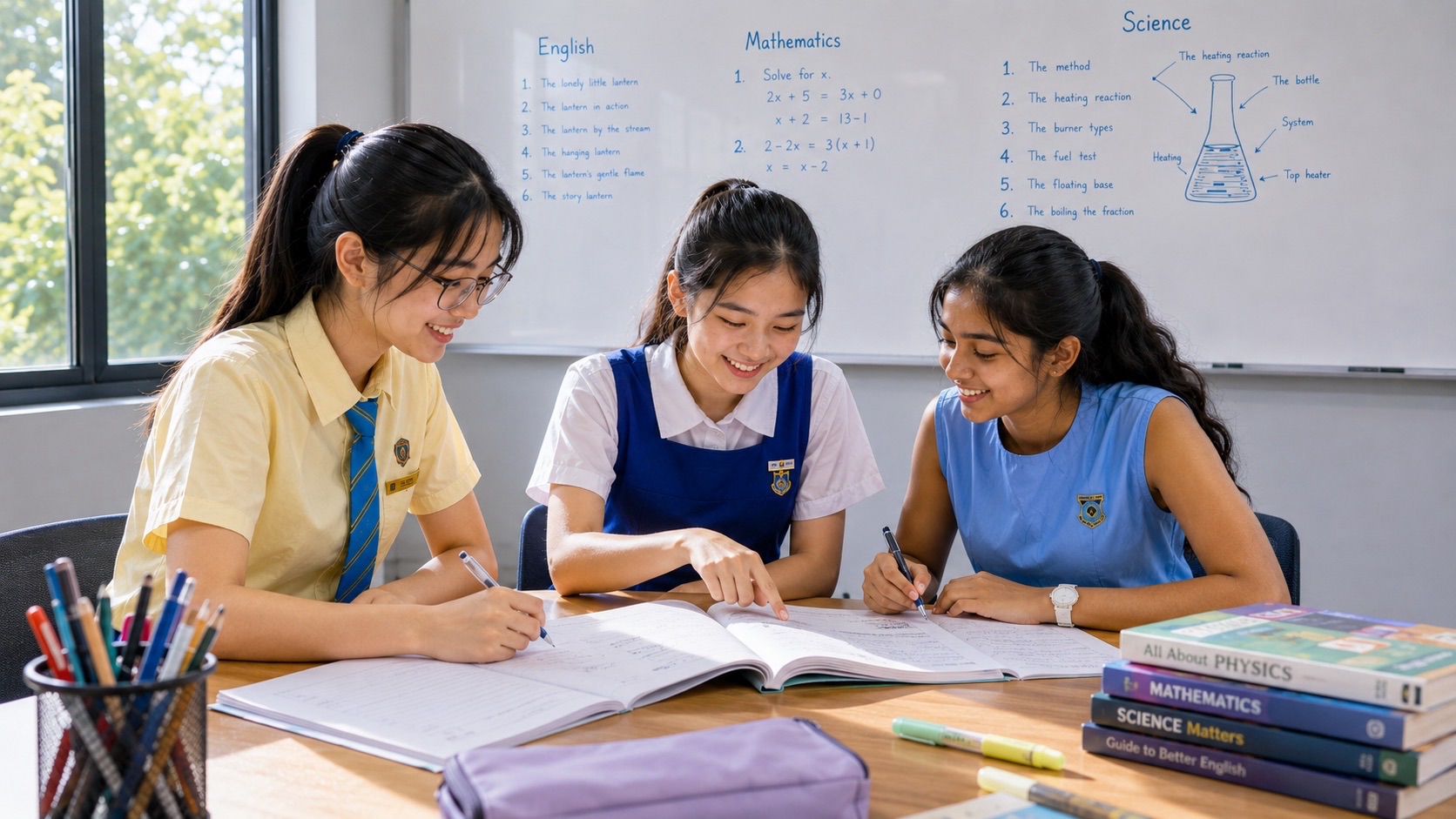
Which W–Z secondary school should parents visit before the 2026 PSLE school-choice deadline? The 2026 PSLE results will be released on Tuesday, 24 November at 11.00am, and the official S1 Portal will be open from 11.30am that day to 4.30pm on Monday, 30 November. MOE encourages families to visit secondary-school open houses and research school culture, learning programmes, subject options and CCAs. This guide gives parents practical questions to ask at eight W–Z schools, from West Spring and Zhenghua to Xinmin, Whitley, Woodlands Ring and Yishun Town, without inventing event dates or selected programme entitlements.
Begin with the child’s actual Posting Group, genuine school interests and daily commute. A previous cut-off point is only the outcome of the completed 2026 Secondary 1 intake after PSLE 2025; it cannot guarantee entry in January 2027. A visit should help distinguish normal lessons from selected AEP, EMP, robotics or leadership opportunities and should test whether the pupil would enjoy the entire school even without one special activity. Parents should rank up to six acceptable choices in sincere preference order and include two or three historically less stringent options, as MOE advises.
- PSLE result: 24 November 2026 at 11.00am.
- S1 Portal: 24 November 11.30am to 30 November 4.30pm.
- Open houses: verify each school’s actual dates and entry arrangements from official notices; no universal schedule is assumed.
- Compare: ordinary English, Mathematics and Science teaching, student support, ALP/LLP, CCAs and current campus.
- Selected programmes: a school posting does not automatically award an art elective, advanced music, robotics team or DSA offer.
- Score data: historical 2026 Secondary 1 intake after PSLE 2025, not fixed 2027 cutoffs.
- Group: use PG3, PG2 or PG1 eligibility consistently; G1/G2/G3 refer to subjects.
- Rank: six genuine preferences with at least two or three historically less stringent and acceptable schools.
Eight schools and their former cut-off points
| School | PG3 COP 2026 intake | PG2 COP | PG1 COP |
|---|---|---|---|
| West Spring Secondary School | 17 | 24 | 27 |
| Zhenghua Secondary School | 20 | 24 | 27 |
| Yuan Ching Secondary School | 18 | 24 | 28 |
| Yuhua Secondary School | 20 | 25 | 28 |
| Xinmin Secondary School | 13 | 23 | 28 |
| Whitley Secondary School | 22 | 25 | 30* |
| Woodlands Ring Secondary School | 22 | 25 | 29 |
| Yishun Town Secondary School | 13 | 22 | 27 |
The numbers are previous last-admitted scores, not current offers. A smaller PSLE Score is stronger. A previous 30* means vacancies remained in the earlier exercise; it does not promise a place at the maximum score or prove a particular last-admitted child scored 30. For the current application, use the child’s eligible and selected Posting Group, and verify official school profiles through SchoolFinder.
What to ask at each school about ordinary learning
West Spring Secondary School — Advocating for Sustainability and youth leadership
Ask whether ordinary Secondary 1 classes investigate real waste data before presenting advocacy proposals, and what teachers do when a quiet child is uncomfortable speaking. The programme can develop environmental reasoning, English persuasion and community responsibility, but an advanced leadership appointment should not be promised. A parent near Bukit Panjang can also compare the route with Zhenghua, rather than use the word nearby without testing a weekday journey.
The current campus is 61 Senja Road, Singapore 677737. Ask a staff member how the school teaches a child who is new to the programme, which parts reach the whole Secondary 1 cohort and what selection is required for deeper participation. Also ask how pupils seek help with English reading, mathematical understanding and science explanations. Official programme or contact information.
For 2026 S1 intake, the former PG3 COP was 17, PG2 24 and PG1 27. These are separate admissions groups. The child should explain a real reason for wanting the school, while the family checks the home-to-gate journey on a normal weekday and after late CCA. An old COP is not a measure of educational quality or the student’s future.
Zhenghua Secondary School — Future of Transportation and Outdoor Education
Look for a normal student project in which pupils investigate the needs of a traveller, use measurement and revise a design. A polished micro:bit prototype only matters if the student can explain it. Confirm that the first-year outdoor activities involve local planning and exploration, not the later multi-day expedition. Parents must use the current Bukit Panjang Ring Road campus rather than an obsolete Senja Road address.
The current campus is 62 Bukit Panjang Ring Road, Singapore 679962. Ask a staff member how the school teaches a child who is new to the programme, which parts reach the whole Secondary 1 cohort and what selection is required for deeper participation. Also ask how pupils seek help with English reading, mathematical understanding and science explanations. Official programme or contact information.
For 2026 S1 intake, the former PG3 COP was 20, PG2 24 and PG1 27. These are separate admissions groups. The child should explain a real reason for wanting the school, while the family checks the home-to-gate journey on a normal weekday and after late CCA. An old COP is not a measure of educational quality or the student’s future.
Yuan Ching Secondary School — REAP robotics and community leadership
At an open house, distinguish the ordinary Tier 1 land-robotics experience from selected advanced marine or aerial work. Ask for examples of how pupils debug code, interpret sensor readings and write a scientific explanation. A model can be exciting while concealing a conceptual gap. A family from Pioneer or Lakeside should time the real journey to Yuan Ching Road and ask about return transport after a technical CCA.
The current campus is 103 Yuan Ching Road, Singapore 618654. Ask a staff member how the school teaches a child who is new to the programme, which parts reach the whole Secondary 1 cohort and what selection is required for deeper participation. Also ask how pupils seek help with English reading, mathematical understanding and science explanations. Official programme or contact information.
For 2026 S1 intake, the former PG3 COP was 18, PG2 24 and PG1 28. These are separate admissions groups. The child should explain a real reason for wanting the school, while the family checks the home-to-gate journey on a normal weekday and after late CCA. An old COP is not a measure of educational quality or the student’s future.
Yuhua Secondary School — MELODY music, Changemakers and later EMP
Ask what musical experiences are open to every S1 pupil and which CCAs have trials. The Enhanced Music Programme is a selected upper-secondary G3 Music route, not an immediate S1 qualification. A parent can ask a child what type of music learning they would enjoy even if they do not later enter EMP. Compare the normal curriculum and Street 41 transport rather than choosing solely because a concert performance looks impressive.
The current campus is 35 Jurong West Street 41, Singapore 649406. Ask a staff member how the school teaches a child who is new to the programme, which parts reach the whole Secondary 1 cohort and what selection is required for deeper participation. Also ask how pupils seek help with English reading, mathematical understanding and science explanations. Official programme or contact information.
For 2026 S1 intake, the former PG3 COP was 20, PG2 25 and PG1 28. These are separate admissions groups. The child should explain a real reason for wanting the school, while the family checks the home-to-gate journey on a normal weekday and after late CCA. An old COP is not a measure of educational quality or the student’s future.
Xinmin Secondary School — MAKERS and RefleXions drama
Ask how every pupil participates in lower-secondary makers and drama lessons. The school has described AI ethics, coding and performance-based reflection, but not every student joins an advanced competition or a selected stage production. A good open-house question is how the teacher checks an AI-generated answer or helps an anxious speaker gradually contribute. Its previous PG3 COP 13 is a historical admissions number, not a guarantee for a child scoring 13.
The current campus is 11 Hougang Avenue 8, Singapore 538789. Ask a staff member how the school teaches a child who is new to the programme, which parts reach the whole Secondary 1 cohort and what selection is required for deeper participation. Also ask how pupils seek help with English reading, mathematical understanding and science explanations. Official programme or contact information.
For 2026 S1 intake, the former PG3 COP was 13, PG2 23 and PG1 28. These are separate admissions groups. The child should explain a real reason for wanting the school, while the family checks the home-to-gate journey on a normal weekday and after late CCA. An old COP is not a measure of educational quality or the student’s future.
Whitley Secondary School — Communicative Arts and Active Citizenship
The Communicative Arts sequence runs from a short paired vlog through interviewing and later talk-show discussion. Ask to see the way pupils learn to verify a claim and respond respectfully to an unexpected question. A child may be a confident talker but need help with reading evidence, or be quiet yet strong at researching. The prior PG1 30* indicates former vacancies, not assured posting; check the journey from the actual Marymount or Bishan home.
The current campus is 30 Bishan Street 24, Singapore 579747. Ask a staff member how the school teaches a child who is new to the programme, which parts reach the whole Secondary 1 cohort and what selection is required for deeper participation. Also ask how pupils seek help with English reading, mathematical understanding and science explanations. Official programme or contact information.
For 2026 S1 intake, the former PG3 COP was 22, PG2 25 and PG1 30*. These are separate admissions groups. The child should explain a real reason for wanting the school, while the family checks the home-to-gate journey on a normal weekday and after late CCA. An old COP is not a measure of educational quality or the student’s future.
Woodlands Ring Secondary School — Future of Transportation and 3C learning
The first open-house question is which campus the 2027 S1 pupil will actually use. Woodlands Ring merged with Fuchun in 2025 and operates at the Woodlands Avenue 1 holding campus while the former site is rebuilt. The school has projected completion near the end of 2028, but timing can change. Ask about ordinary introductory coding, merged-school orientation and the morning and CCA-day journeys, not just pictures of a future campus.
The current campus is 21 Woodlands Avenue 1, Singapore 739062 (holding campus). Ask a staff member how the school teaches a child who is new to the programme, which parts reach the whole Secondary 1 cohort and what selection is required for deeper participation. Also ask how pupils seek help with English reading, mathematical understanding and science explanations. Official programme or contact information.
For 2026 S1 intake, the former PG3 COP was 22, PG2 25 and PG1 29. These are separate admissions groups. The child should explain a real reason for wanting the school, while the family checks the home-to-gate journey on a normal weekday and after late CCA. An old COP is not a measure of educational quality or the student’s future.
Yishun Town Secondary School — Tamil Language Elective Programme
Yishun Town’s TLEP develops advanced Tamil language, literature and culture for eligible students. School posting and programme entry are different decisions. Ask about normal language teaching, the specialist participation criteria and how a pupil who does not take TLEP can still develop Tamil reading and writing. This is not Yishun Secondary on Street 71, so confirm the correct school name, programme and journey before ranking it.
The current campus is 6 Yishun Street 21, Singapore 768610. Ask a staff member how the school teaches a child who is new to the programme, which parts reach the whole Secondary 1 cohort and what selection is required for deeper participation. Also ask how pupils seek help with English reading, mathematical understanding and science explanations. Official programme or contact information.
For 2026 S1 intake, the former PG3 COP was 13, PG2 22 and PG1 27. These are separate admissions groups. The child should explain a real reason for wanting the school, while the family checks the home-to-gate journey on a normal weekday and after late CCA. An old COP is not a measure of educational quality or the student’s future.
Start with the child’s everyday school life, not the entrance banner
A school open house is useful because parents can observe the campus, meet staff and ask questions. The most impressive part may be a science demonstration, performance or display, but a twelve-year-old will spend many more hours in ordinary lessons. Ask how English, Mathematics, Science and humanities are taught to pupils with different readiness. A good school choice considers how the child will learn on an uneventful Tuesday, not just the school’s strongest publicity moment.
Ask the child what they noticed, not merely whether the event was exciting. Did they understand a project? Could they imagine asking a teacher a question there? Did they like the atmosphere of the form-class spaces? If a family has limited time, it is better to examine two or three genuine possibilities carefully than attend many showcases without evaluating the ordinary experience.
Use MOE’s actual open-house information rather than inventing a calendar
SEAB’s 17 November release explicitly encourages families to use school open houses and websites and points to MOE’s SchoolFinder and Schoolbag’s open-house resource. Individual schools may publish separate visit arrangements, registration forms or dates. Do not tell a family that a school is open at a particular hour or that walk-in attendance is accepted without a current school notice.
Some parents cannot attend a school event because of work or caregiving commitments. A thoughtful decision can still be made from the official school profile, programme details, phone or email enquiry and a safe route check. Open-house attendance can improve understanding, but absence from an event should not be confused with an adverse admissions factor.
Ask to see one ordinary English, Mathematics and Science task
A parent may ask for a simple illustration of how an unfamiliar Mathematics idea is explained in Secondary 1. Is there a worked example, a chance for a pupil to explain the method and feedback when a misconception arises? In English, ask how teachers help pupils make a claim supported by evidence rather than merely memorise essay phrases. In Science, ask how a child learns the difference between observation and inference.
These questions do not require confidential student records or a classroom inspection. A teacher can explain the school’s pedagogy and show suitable examples of ordinary learning. The family should look for concrete teaching methods, not demand a promise that every child will obtain a distinction. A school should be evaluated by how it supports learning, especially when a child initially struggles.
Differentiate programmes available to all from selected tiers
Schools often describe an Applied Learning Programme and a Learning for Life Programme as part of their identity. Some introductory activities reach all pupils, whereas advanced workshops, leadership posts, CCAs and competitions may be selected or optional. An open-house presenter may be a student who has earned a special position. Parents should ask what a normal incoming S1 child will do before assuming that every visitor can access the same opportunities.
Request a year-level pathway. For example, does an arts activity start in Secondary 1 or require a later audition? Is a robotics demonstration a standard lesson or a competition project? Does community service take place in form classes before students can apply for deeper leadership roles? A truthful answer may still be highly attractive; the point is not to discourage ambition but to distinguish actual access from aspiration.
Ask about the pupil who needs help, not only the prize winner
Schools understandably celebrate students who perform, compete or win awards. Parents also need to know what happens when a child is overwhelmed by homework, reads slowly or feels unsure asking for help. Ask about the form teacher’s role, subject consultations, peer support and how families are contacted when an issue persists. A good fit depends on ordinary responses to ordinary difficulties.
A pupil with PSLE score 21 or 22 may have a PG2/PG3 option, and one scoring 25 may have PG1/PG2. The school should explain appropriate demand levels without stereotyping an entire child. A family’s preferred pace can be discussed with primary-school teachers before submission; the open house should be a place to understand opportunities, not obtain an informal guarantee of a specific G3 subject.
Verify addresses in areas with similar school names
Woodlands Secondary, Woodgrove and Woodlands Ring are separate schools. Yishun Secondary and Yishun Town are different. Westwood, West Spring and Yuhua occupy different parts of the island. Parents who rely on search snippets can accidentally research a school with a similar name but the wrong location or programme.
Woodlands Ring is a particular example because it operates at a holding campus on Woodlands Avenue 1 during rebuilding. The current school contact page and January 2027 registration instructions matter more than an old school photograph. If a school moves, merges or uses a temporary site, ask how orientation, CCAs and transport will be managed.
Read the historical COP with the correct Posting Group
The school range’s last number is a result of the previous S1 Posting Exercise, not a future score requirement fixed by the principal. A lower PSLE Score represents stronger examination performance. A school with a former PG3 COP 20 was historically less stringent numerically than one with 13, but that does not measure the quality of individual teachers or the child’s potential.
A score-22 family must not use the PG2 COP of a school to promise admission through PG3. The chosen eligible Posting Group applies across the ordinary six-school list. A 30* at some schools indicates vacancies in the completed earlier exercise, not a guaranteed new place. MOE’s recommendation to include two or three historically less stringent and acceptable options is sensible because cut-offs can vary with the cohort.
Speak to ordinary students with respectful questions
If a school provides student guides, ask what a normal lesson or first-term adjustment felt like. What helped them find classrooms? How are assignments communicated? Which CCA did they try and what did they learn? These questions give useful texture without expecting a teenager to disclose personal grades or private problems.
Listen for specific examples rather than dismissing an experience because it is not spectacular. One pupil may remember a teacher who patiently explained a difficult concept; another may describe finding confidence through a normal class project. The parent can compare these accounts with the official school information while recognising that one student’s experience is not a statistical measure of the whole institution.
Check the full cost and commitment of a CCA
Co-Curricular Activities can include uniformed groups, sport, performing arts, clubs and other interests. Each may require equipment, time and sometimes selection or trials. A school representative can clarify typical days, whether beginners can join, what training entails and who supports a child who does not receive a first-choice activity.
An attractive orchestra, robotics team or stage performance can be a reason for deeper enquiries, but the family should not rank a distant school solely for a selected CCA without knowing whether the pupil can participate. The school should still be worthwhile through its ordinary curriculum and community. A pupil has the right to develop interests over several years rather than decide every future activity at twelve.
Use a two-column evidence sheet after each school visit
Write down verified facts in one column and unanswered questions in another. Facts may include the current school address, official PG range, published ALP title and the school’s confirmed timetable arrangements. Questions may concern a selected specialist programme, a late CCA return or support for the child’s subject-specific weaknesses. Do not move an unanswered question into the fact column because a promotional display looked persuasive.
Keep the sheet simple enough for the child to use. Ask which programme they would actually enjoy doing, how comfortable they felt asking questions and whether they could imagine travelling to the campus on a normal weekday. This turns the visit into a real conversation instead of a competition among schools’ branding.
Make the commute part of the visit, not an afterthought
An open house may take place outside ordinary school hours and public transport may behave differently from the morning rush. Parents should test a realistic route from the actual home block, allowing for waiting, interchanges and a safe final walk. A direct bus can make a school farther away on a map more practical than a nominally nearby school requiring several changes.
Also consider a late dismissal after CCA, remedial lessons or an optional programme. The child should know where to wait in rain or after missing a bus and who to contact. A sustainable journey preserves time for reading, homework, physical activity and friends. It is educationally meaningful even when it cannot be expressed in a cut-off table.
Compare genuine preferences when two schools share a cutoff
West Spring and Zhenghua both recorded previous PG2 COP 24 and PG1 COP 27. Their distinctive programmes are different: environmental advocacy and leadership at West Spring versus transport-design work and Outdoor Education at Zhenghua. If the child has a preference, parents should take it seriously rather than regard the matching historical number as the entire decision.
Yuhua and Westwood both had previous PG2 COP 25, but music and selected later EMP differ from Arts for Life and entrepreneurship. A family in Jurong can compare these education experiences and the Street 41 or Street 25 journey. Two identical previous scores are evidence of one admission outcome, not proof that the schools have equivalent teaching.
Plan for the child who may change interests
A Primary 6 pupil can be devoted to robotics in November and become interested in drama after one school term. A good secondary school offers normal lessons and varied CCAs, so the child has a reason to attend even if one narrow ambition changes. Parents should ask whether a student can explore activities, what the current selection rules are and whether opportunities begin in later years.
Do not force the pupil to promise a professional career at twelve because a school advertises an exciting ALP. Applied learning should help children build curiosity, experimentation, communication and confidence. A school choice is about the setting where those habits will grow, not a guarantee of one future occupation or institution.
Confirm specialist subjects separately from ordinary admission
Zhonghua’s Art Elective Programme and Yishun Town’s Tamil Language Elective Programme are named specialist offerings with their own eligibility or selection requirements. Yuhua’s Enhanced Music Programme is a selected upper-secondary path. A child who gets a normal S1 place at the school should not be told that every specialist route is immediately theirs.
Ask when the programme starts, what preparation is expected, how selection works and what ordinary alternatives exist if the child is not selected. This is a more constructive question than whether a brochure’s programme sounds prestigious. The child’s enthusiasm can remain positive while the family prepares realistic expectations.
SchoolFit includes wellbeing and a safe way to ask for help
Parents should ask how the school welcomes new pupils into mixed form classes under Full SBB. What does a student do when they cannot find a room, are worried about a friendship or misunderstand a teacher’s instructions? The school should be able to explain how teachers and student-support staff respond, without promising that a child will never face an adjustment difficulty.
A quieter child can have strong analytical or artistic ability and may need time to feel comfortable speaking. A confident child can still struggle academically. Ask how teachers recognise multiple strengths and how pupils can seek help without being embarrassed. A supportive culture is a real educational feature that does not fit neatly on an entrance-score spreadsheet.
Finalise six choices in real order before 30 November
After visiting and researching schools, rank up to six genuine preferences that the child would accept. Use the previous COP in the selected group, check any school-specific conditions and ensure two or three options have historically less stringent numbers. A faraway school added only because it looks safe may be an unsuitable fallback if the family cannot manage the daily journey.
Choice order can matter when applicants with identical PSLE scores compete for a final place, after citizenship and before possible computerised balloting. The process is not first-come-first-served. Save the successful MOE S1 Portal submission before 4.30pm on Monday 30 November rather than assume an unsaved draft counts.
What to do if the family cannot attend an open house
An open house is a useful research opportunity, not the sole source of school information. Families can use the official website, MOE SchoolFinder, programme pages and direct enquiries. Ask concise questions about class support, electives, CCAs and current campus locations. School websites can change, so the school itself should clarify any programme detail that matters significantly to the child’s decision.
The family can still do a safe transport rehearsal and ask the pupil to explain their own shortlist. An ordinary child does not need access to a private alumni network or an expensive consultant to compare known facts and genuine preferences. The objective is a realistic educational choice that can be understood and accepted.
Five worked families preparing their six choices
PG3 score 18 in Bukit Panjang
The family compares West Spring’s previous PG3 COP 17 and Zhenghua’s 20. West Spring is historically more ambitious for that score, while Zhenghua is historically less stringent. The child likes transport prototyping more than environmental advocacy, so Zhenghua may be a genuine higher preference regardless of the numeric direction.
The family should record the child’s actual group, the former COP in that same group, a genuine reason for choosing the school and a repeatable transport plan. If a programme is selected or begins later, that distinction needs to be written down rather than assumed. The example does not forecast the current posting result; it illustrates how to turn an attractive open house into a balanced school application.
PG2 score 24 in Woodlands
Woodgrove’s previous PG2 COP 24 matches the child’s score; Woodlands Ring’s and Woodlands Secondary’s were 25. The family should compare different STEM themes and current campuses, including Woodlands Ring’s Avenue 1 holding site.
The family should record the child’s actual group, the former COP in that same group, a genuine reason for choosing the school and a repeatable transport plan. If a programme is selected or begins later, that distinction needs to be written down rather than assumed. The example does not forecast the current posting result; it illustrates how to turn an attractive open house into a balanced school application.
A music enthusiast near Jurong West Street 41
Yuhua may be appealing, but the parent must distinguish MELODY from later selected EMP and ask about suitable music CCAs in the first year. A school preference should remain positive even without the selected Music pathway.
The family should record the child’s actual group, the former COP in that same group, a genuine reason for choosing the school and a repeatable transport plan. If a programme is selected or begins later, that distinction needs to be written down rather than assumed. The example does not forecast the current posting result; it illustrates how to turn an attractive open house into a balanced school application.
A shy child interested in art and stories
Zhonghua or Xinmin may be worth researching for art or drama, but specialist selection is different from ordinary posting. The family should ask how common lessons welcome beginners and help pupils gradually gain confidence.
The family should record the child’s actual group, the former COP in that same group, a genuine reason for choosing the school and a repeatable transport plan. If a programme is selected or begins later, that distinction needs to be written down rather than assumed. The example does not forecast the current posting result; it illustrates how to turn an attractive open house into a balanced school application.
A pupil scoring 25 with PG1/PG2 options
The family must decide appropriate academic pace using the official form and primary-school advice before comparing historical school cut-offs. A school open house should help with teaching and support questions, not override the national Posting Group rules.
The family should record the child’s actual group, the former COP in that same group, a genuine reason for choosing the school and a repeatable transport plan. If a programme is selected or begins later, that distinction needs to be written down rather than assumed. The example does not forecast the current posting result; it illustrates how to turn an attractive open house into a balanced school application.
The official timeline after the open house
On Tuesday, 24 November 2026 at 11.00am, pupils receive their PSLE results under primary-school arrangements. Parents can begin the S1 Portal application from 11.30am and review school websites, SchoolFinder and any valid open-house information. Do not believe that entering choices in the first minute improves academic eligibility.
The portal closes at 4.30pm on Monday, 30 November. Parents should check exact school names, selected group, rank order and the successful submission confirmation. For an accepted DSA offer, the family should follow the separate DSA obligations rather than assume the normal six-choice exercise applies unchanged.
S1 Posting results are tentatively expected on Friday, 18 December 2026, with MOE to confirm the final release date. After the posting outcome, follow the receiving school’s current enrolment and orientation instructions. Appeals and transfers are subject to rules and available places, so a preferred school should never be promised as the result of an appeal.
Questions to copy into a school-enquiry message
- Which of the programmes demonstrated at open house reaches every new Secondary 1 pupil?
- What is the difference between normal curriculum and selected talent development?
- How are G1/G2/G3 subject levels offered and reviewed for an eligible pupil?
- How does the school help pupils with misconceptions, missing homework or an unfamiliar timetable?
- What are the normal CCA trial, selection and late dismissal arrangements?
- Is the campus address shown on the school website the one a new 2027 pupil will use?
- How does the school create form-class belonging for quieter pupils?
- What should parents do if a programme detail remains unconfirmed before the deadline?
- Does the child genuinely prefer this school even without a specific selected activity?
Official source and eduKate ecosystem links
- SEAB/MOE official 2026 results and S1 posting release
- MOE S1 Posting Portal
- MOE SchoolFinder
- Schoolbag school open-house information
- MOE Full Subject-Based Banding
- eduKateSingapore 2027 PSLE Score school finder
- eduKateSG immutable Clementi learning reference
Editorial verification: 19 November 2026. All school COPs cited are from the completed 2026 Secondary 1 intake following PSLE 2025. Open-house dates and registration are school-specific and must be verified directly. Programme selection and 2027 cut-offs are not guaranteed by this guide.