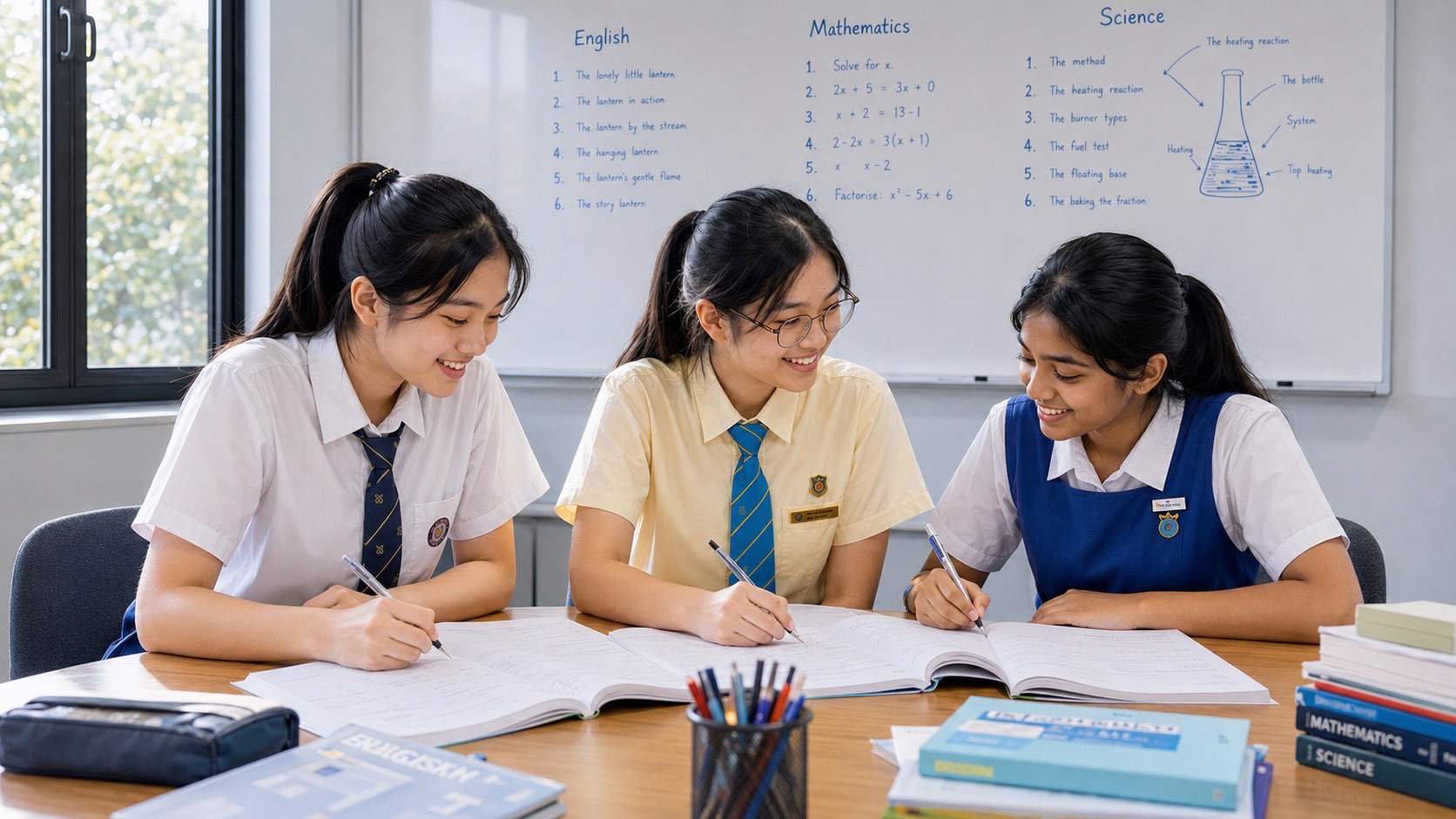
Which W–Z secondary school would suit a quieter, shy or thoughtful child after the 2026 PSLE results on Tuesday, 24 November at 11.00am? A pupil does not need to become outgoing to learn well, and quietness alone is not evidence of weak ability. Schools with art, drama, music, robotics and community learning can offer different routes for a child to observe, experiment, communicate and gain confidence. This guide compares eight W–Z schools while respecting that one pupil may enjoy small-group research and another may prefer visual art or technical making. School fit depends on ordinary teaching, respectful support and a practical daily journey, not a personality label.
Parents should first read the child’s official Posting Group and subject ALs, then investigate real learning experiences at the schools they might choose. The 2026 PSLE results are released at 11.00am on 24 November, and the MOE S1 Portal is open from 11.30am that day until 4.30pm on Monday 30 November. Submit up to six genuinely acceptable choices with two or three historically less stringent options, as MOE advises. A selected Art Elective Programme, advanced music course, CCA or robotics competition is not automatically included in ordinary school posting; previous 2026-intake cutoffs are historical only.
- Audience: pupils who are quiet, shy in new settings, thoughtful, reserved or more comfortable with small groups.
- Important distinction: being quiet is not the same as needing a specialist educational intervention.
- School programmes: ask what is open to everyone and what requires auditions or selection.
- Normal teaching: look for clear feedback and meaningful contributions beyond public performance.
- School culture: ask about form-class orientation, friendship support and a safe way to seek help.
- PSLE result: 24 November 2026 at 11.00am.
- S1 Portal: 24 November 11.30am to 30 November 4.30pm.
- Historical cutoffs: previous 2026 Secondary 1 intake, not 2027 guarantees.
- Travel: practise the current school gate journey and late CCA return.
Eight possible schools and historical score references
| School and general programme | PG3 prior COP | PG2 prior COP | PG1 prior COP |
|---|---|---|---|
| Whitley Secondary School | 22 | 25 | 30* |
| Xinmin Secondary School | 13 | 23 | 28 |
| Yio Chu Kang Secondary School | 22 | 25 | 30* |
| Yishun Secondary School | 20 | 24 | 27 |
| West Spring Secondary School | 17 | 24 | 27 |
| Woodgrove Secondary School | 19 | 24 | 28 |
| Yuhua Secondary School | 20 | 25 | 28 |
| Zhonghua Secondary School | 12 | 23 | 27 |
A lower PSLE total is stronger. Each historical COP is the previous last-admitted score for that Posting Group and can change with the new cohort. The old 30* footnote indicates vacancies in the earlier exercise; it is not a guaranteed current place. No score in this table identifies a child as shy, outgoing, good at friendship or more deserving of a particular school. The family must compare the correct admission group alongside genuine programme and transport fit.
What to ask about each school’s first-year experience
Whitley Secondary School — Communicative Arts
Whitley’s staged Communicative Arts programme offers a useful parent question: how is a pupil who is uncomfortable speaking to a camera supported before a short Secondary 1 paired vlog? Learning through rehearsals, research and collaborative interviewing can develop communication without requiring an instantly extroverted personality. Parents should also ask how individual student contributions are recognised and what happens when a student is confident with facts but hesitant before an audience.
This school’s current campus is 30 Bishan Street 24, Singapore 579747. Parents should ask a teacher how a pupil can learn and contribute to the ordinary programme without being the loudest speaker in every class. Specific questions about group work, assessment, preparation and access to CCAs are more useful than a general promise that everyone will feel confident immediately. Official school programme details.
The completed 2026 S1 intake’s previous COPs were PG3 22, PG2 25 and PG1 30*. They are admissions reference figures, not personality indicators or guarantees. The child should be able to name a genuine reason to attend and feel that the family has considered the normal timetable and home-to-school journey, not simply an attractive showcase.
Xinmin Secondary School — RefleXions drama and MAKERS
Xinmin combines school-wide lower-secondary drama with making, coding and ethical AI learning. A quieter pupil may enjoy explaining a prototype in a small team before speaking to a larger audience, or exploring the motives of a dramatic character through reflection. Parents should ask what beginners do in the common modules and whether group tasks provide fair opportunities to contribute. A selected Drama CCA or makers competition is not automatically awarded through normal school posting.
This school’s current campus is 11 Hougang Avenue 8, Singapore 538789. Parents should ask a teacher how a pupil can learn and contribute to the ordinary programme without being the loudest speaker in every class. Specific questions about group work, assessment, preparation and access to CCAs are more useful than a general promise that everyone will feel confident immediately. Official school programme details.
The completed 2026 S1 intake’s previous COPs were PG3 13, PG2 23 and PG1 28. They are admissions reference figures, not personality indicators or guarantees. The child should be able to name a genuine reason to attend and feel that the family has considered the normal timetable and home-to-school journey, not simply an attractive showcase.
Yio Chu Kang Secondary School — Arts, Media and Design
Yio Chu Kang’s Secondary 1 arts-and-media modules include drama, dance, music, short-film production and interior design. A pupil who dislikes public performance may still enjoy planning a scene, editing an image or designing a space. Parents should ask whether teachers scaffold different starting confidence levels and assess learning without rewarding only the loudest students. The common introductory experience is not the same as selected arts talent development, and the child’s normal curriculum matters just as much.
This school’s current campus is 3063 Ang Mo Kio Avenue 5, Singapore 569868. Parents should ask a teacher how a pupil can learn and contribute to the ordinary programme without being the loudest speaker in every class. Specific questions about group work, assessment, preparation and access to CCAs are more useful than a general promise that everyone will feel confident immediately. Official school programme details.
The completed 2026 S1 intake’s previous COPs were PG3 22, PG2 25 and PG1 30*. They are admissions reference figures, not personality indicators or guarantees. The child should be able to name a genuine reason to attend and feel that the family has considered the normal timetable and home-to-school journey, not simply an attractive showcase.
Yishun Secondary School — Sonic Arts and StAR
Yishun Secondary’s Tier 1 sonic-arts exposure provides a reason to ask how a pupil can engage through listening, rhythm or technical exploration before performing publicly. Some deeper recording or arts opportunities may be selected. The school has also described StAR support for relevant G1 learners, but parents should verify actual 2027 participation and not assume that quietness is a reason to assign a child to that programme. Normal teacher support and form-class friendships remain important.
This school’s current campus is 4 Yishun Street 71, Singapore 768516. Parents should ask a teacher how a pupil can learn and contribute to the ordinary programme without being the loudest speaker in every class. Specific questions about group work, assessment, preparation and access to CCAs are more useful than a general promise that everyone will feel confident immediately. Official school programme details.
The completed 2026 S1 intake’s previous COPs were PG3 20, PG2 24 and PG1 27. They are admissions reference figures, not personality indicators or guarantees. The child should be able to name a genuine reason to attend and feel that the family has considered the normal timetable and home-to-school journey, not simply an attractive showcase.
West Spring Secondary School — Sustainability advocacy and Community Youth Leadership
West Spring’s projects involve researching community problems and communicating possible changes. A quieter student may contribute through observing patterns, writing accurately, organising data or interviewing a person in a small group rather than delivering a public speech immediately. Ask teachers how pupils develop these skills over time and whether common community experiences include all learners. A selected leadership title is different from practising responsibility as an ordinary class member.
This school’s current campus is 61 Senja Road, Singapore 677737. Parents should ask a teacher how a pupil can learn and contribute to the ordinary programme without being the loudest speaker in every class. Specific questions about group work, assessment, preparation and access to CCAs are more useful than a general promise that everyone will feel confident immediately. Official school programme details.
The completed 2026 S1 intake’s previous COPs were PG3 17, PG2 24 and PG1 27. They are admissions reference figures, not personality indicators or guarantees. The child should be able to name a genuine reason to attend and feel that the family has considered the normal timetable and home-to-school journey, not simply an attractive showcase.
Woodgrove Secondary School — STEM sustainability and youth leadership
Woodgrove’s sustainability projects can give quieter pupils meaningful technical roles: measuring variables, recording observations, coding or preparing a careful explanation. Parents should ask how teams distribute work so that confident speakers do not dominate and beginners gain genuine understanding. Community Youth Leadership need not be reduced to holding a formal badge, but deeper selected roles may have separate criteria. The school must still be an academic and transport fit for the child.
This school’s current campus is 3 Woodlands Avenue 6, Singapore 738990. Parents should ask a teacher how a pupil can learn and contribute to the ordinary programme without being the loudest speaker in every class. Specific questions about group work, assessment, preparation and access to CCAs are more useful than a general promise that everyone will feel confident immediately. Official school programme details.
The completed 2026 S1 intake’s previous COPs were PG3 19, PG2 24 and PG1 28. They are admissions reference figures, not personality indicators or guarantees. The child should be able to name a genuine reason to attend and feel that the family has considered the normal timetable and home-to-school journey, not simply an attractive showcase.
Yuhua Secondary School — MELODY, music and Changemakers
A quiet child who enjoys music may find satisfaction in listening, practising an instrument or making music with others before performing publicly. Yuhua’s wider MELODY arts experiences and selected later Enhanced Music Programme should not be conflated. A family should ask which first-year music opportunities suit beginners, how CCAs are allocated and how a pupil with performance anxiety can progress at a reasonable pace. The school’s everyday subject support must also be considered.
This school’s current campus is 35 Jurong West Street 41, Singapore 649406. Parents should ask a teacher how a pupil can learn and contribute to the ordinary programme without being the loudest speaker in every class. Specific questions about group work, assessment, preparation and access to CCAs are more useful than a general promise that everyone will feel confident immediately. Official school programme details.
The completed 2026 S1 intake’s previous COPs were PG3 20, PG2 25 and PG1 28. They are admissions reference figures, not personality indicators or guarantees. The child should be able to name a genuine reason to attend and feel that the family has considered the normal timetable and home-to-school journey, not simply an attractive showcase.
Zhonghua Secondary School — Art Elective Programme and visual learning
Zhonghua’s selected four-year AEP may attract a thoughtful pupil who observes details, enjoys drawing and prefers expressing ideas visually. Yet art study also includes explanation, interpretation, feedback and sometimes public presentation, so quietness is not an automatic advantage or qualification. Parents should ask about its AEP school-based selection and ordinary Visual Art for pupils who do not join the specialist route. A child should like the whole Serangoon campus and curriculum, not only the prospect of a special title.
This school’s current campus is 13 Serangoon Avenue 3, Singapore 556123. Parents should ask a teacher how a pupil can learn and contribute to the ordinary programme without being the loudest speaker in every class. Specific questions about group work, assessment, preparation and access to CCAs are more useful than a general promise that everyone will feel confident immediately. Official school programme details.
The completed 2026 S1 intake’s previous COPs were PG3 12, PG2 23 and PG1 27. They are admissions reference figures, not personality indicators or guarantees. The child should be able to name a genuine reason to attend and feel that the family has considered the normal timetable and home-to-school journey, not simply an attractive showcase.
Quiet, shy and introverted are not the same educational need
A pupil who speaks little in a new class may simply be taking time to observe, prefer small-group conversation or need a gradual introduction to unfamiliar people. Another may enjoy solitude yet feel confident explaining a subject when prepared. Parents should avoid treating all these pupils as one type of learner or assuming that every quiet student has a difficulty requiring a special intervention.
The practical question is what helps the individual child participate and learn. A thoughtful pupil may be excellent at reading, art, mathematics or analysis; another may need specific support with presenting or making friends. A school choice should recognise demonstrated strengths and offer opportunities to practise less familiar skills without pressuring the child to adopt a different personality.
Ask how first-year teachers introduce pupils to a new form class
Under Full Subject-Based Banding, pupils can share mixed form-class experiences with classmates who have different subject strengths and interests. The school should explain how orientation, ordinary group work and form-teacher support help new students find classrooms, understand routines and make connections. A parent’s question should be about the actual process, not a demand for a guarantee that the child will never feel awkward.
A school with frequent performances or presentations is not automatically unsuitable for a shy child, just as a STEM-focused school is not automatically a quiet environment. What matters is the teaching sequence, class expectations and opportunities to contribute through different tasks. Ask how pupils are prepared and how constructive feedback is delivered when someone struggles.
Choose the kind of participation the child genuinely enjoys
Some children love making a device or taking careful measurements and would prefer technical project work to performance. Others enjoy writing scripts, arranging music or observing visual details. A family should ask the child which actual activity appeals to them and then identify the school programme that teaches it. A subject-themed title alone is less informative than a clear description of what the student will do in the first year.
The school choice should be based on the whole programme, including ordinary academic lessons. A pupil who likes short-film editing still needs English and Mathematics teaching, and a robotics enthusiast needs scientific reasoning and written explanation. The attractive activity is valuable when it builds knowledge and confidence, not when it becomes a substitute for foundational learning.
Public speaking should be learned in steps, not demanded all at once
A school programme involving vlogging, drama or community advocacy can develop speaking skills gradually. A child may begin with research, pair discussion, a short rehearsed explanation and feedback before presenting to a larger group. Ask whether the school teaches these stages explicitly and how pupils can demonstrate understanding even when their first delivery is hesitant.
Confident speech alone is not evidence of accurate reasoning. A quiet pupil may have a better-supported argument than a fluent presenter, and teachers should help both improve. Parents can practise a brief explanation at home without turning every conversation into a public-speaking assessment. The aim is to communicate with clarity when needed, not to make an introverted child perform continuously.
Group project fairness matters for both confident and quiet pupils
A class project may involve collecting data, building a prototype, writing an explanation, presenting or organising materials. A student can contribute substantially without being the spokesperson. Parents should ask how the school ensures every team member learns the underlying ideas and how individual contributions are assessed, particularly when one child is much more experienced or talkative.
In Science and STEM, a pupil who measures carefully needs to explain what those measurements mean. In arts, a child who edits or designs needs to justify creative choices. Fairness does not mean avoiding all speaking forever; it means providing a structured route towards participation while recognising different forms of competence.
Art and music can develop confidence without instant stage success
Visual art allows pupils to record observations, revise work and communicate ideas through composition. Music can involve listening, rhythm, individual practice and ensemble cooperation. These are meaningful experiences even when the pupil does not aspire to perform solo or compete for a prize. A quiet child may value the time to practise and develop skill before public presentation.
Parents should still understand specialist selection and workload. Zhonghua’s AEP is a separately selected four-year programme; Yuhua’s EMP is a selected upper-secondary route after preparation. Neither is automatically promised by ordinary posting. The child should enjoy school-wide art or music experiences even if a specialist place is unavailable.
A robotics project is not a retreat from all communication
Technical learning may feel appealing to a pupil who enjoys focused practical work. But a strong robotics or environmental Science project also requires cooperation, written explanation and the ability to describe evidence. A school should help the child practise these skills rather than allow the most experienced teammate to speak for everyone while others only watch.
A quiet child who builds a functioning device may be ready for the next challenge of explaining why it works. The teacher can scaffold this through a small-group demonstration, questions about variables and a short written reflection. A parent should ask whether this teaching sequence is available in the ordinary cohort rather than rely on selected competition photos.
Community leadership does not require a formal badge
A child can show empathy by listening carefully, preparing accurate information or taking responsibility for a shared task. School programmes such as West Spring’s Community Youth Leadership and Woodgrove’s community work can provide opportunities to practise these behaviours even when advanced leadership roles are selected. Quietness is not proof that a pupil cannot lead.
Parents should ask how the school values contribution beyond public visibility. Does it recognise a student who follows through on a promise or helps a teammate? How does a pupil apply for a leadership role later if they become interested? A healthy school culture should allow students to develop their own voice over time.
A child who dislikes a particular CCA can still thrive
An arts-keen student may fail an audition or discover that a rehearsal schedule feels too demanding. A technology enthusiast may not be selected for an advanced competition team. These are ordinary possibilities in schools with limited opportunities, not proof that the school choice was a mistake or that the child has no talent.
Parents can help the pupil identify more than one genuine interest and ask what other CCAs or normal curriculum experiences are available. A school should be selected because the child could enjoy regular lessons and friendships, not solely because of a club whose allocation is uncertain.
The commute influences a child’s confidence in a new school
A pupil who feels comfortable at home may become anxious when a journey involves unfamiliar interchanges or a long final walk. Parents can rehearse the current school-day route and identify a safe plan for missed transport. A predictable journey can help the child arrive with enough attention for lessons and return home with time to recover.
Schools with similar names can be at quite different campuses: Yishun Secondary on Street 71 is not Yishun Town on Street 21, and Woodgrove on Avenue 6 is not Woodlands Ring at its Avenue 1 holding campus. Parents should test the true address rather than make an assumption from the estate name.
Check the child’s own meaning of a good friend
Some children are content with one or two close friendships rather than a large group. A school should not be judged solely by whether a pupil is immediately popular or speaks confidently to every classmate. Ask whether the child has someone they feel comfortable talking to and whether the school provides a safe way to seek adult help if a problem arises.
A pupil may need time to learn group norms, join a CCA or find a classmate with similar interests. Parents can encourage small manageable social steps without pressuring the child to become the centre of attention. Persistent exclusion or distress should be discussed with school staff using specific observations.
How to ask about pastoral support without labelling a school or child
A parent can ask who the form teacher is, how school staff respond to friendship concerns and which channel pupils can use to report troubling behaviour. These are appropriate questions for any school. They do not imply that a particular institution has a bullying problem or that a quiet pupil needs a medical diagnosis.
If the child shows sustained distress, avoids attending school or reports repeated harmful behaviour, contact the school’s relevant teachers or support staff promptly. Describe the facts and ask what actions can be taken. A family should neither dismiss a serious pattern nor assume every normal adjustment difficulty is evidence of a hostile environment.
Some quiet children struggle with workload rather than friendships
A pupil may have no problem speaking to a close friend but become overwhelmed by multiple assignment systems and subject teachers. The child can appear withdrawn because they are worried about missing work or misunderstood instructions. Parents should check how tasks are recorded and whether the learner can explain a normal Mathematics or English exercise before concluding that the school is socially unsuitable.
A simple planner, stable bedtime and routine of asking a teacher for clarification can help. When the child struggles to understand a concept, the response should be subject teaching, not merely organisational advice. The cause needs to be identified rather than inferred from how talkative the pupil appears.
Depth, Load and Transfer help separate different problems
Depth means understanding why a concept works, Load means managing assignments and activities, and Transfer means applying knowledge when the wording or situation changes. A shy student may have strong depth and need a safe setting to demonstrate it; another may understand a project but become overloaded by repeated deadlines.
Parents can review real work with one question from each subject. Ask what the child did independently and what caused uncertainty. A child who memorises an algebra rule needs conceptual help, one who forgets a task needs better organisation and one who struggles with new word problems needs transfer practice. Different repairs support confidence more effectively than generic extra worksheets.
The same PSLE total can conceal different strengths
Two pupils both scoring 22 can have different subject AL patterns. One may be strong in Mathematics and Science while finding writing difficult; another may be an excellent reader who needs help with calculation. Under Full SBB, the selected Posting Group and individual subject-level eligibility should be discussed in relation to the child’s real profile.
A parent should not decide that an arts or technology school is automatically easier for a shy pupil with a particular score. The official group and subject offers still govern academic learning, and the receiving school should help the family understand appropriate challenges. A school’s previous COP is not a test of whether a child belongs socially.
Use the open house to test support, not to demand a personality match
At an open house, ask how the ordinary form-class and first-year activities work. Do teachers allow pair or small-group rehearsal before presentations? How are pupils assessed when some contribute through research or technical work? What happens when a child is unable to join their preferred CCA? The answers can show whether a school has thought carefully about learner participation.
Do not ask a teacher to guarantee that the child will never feel anxious or disappointed. A school can explain its support structures and teaching methods, while the family can plan gradual practice and a clear communication route. A positive decision rests on sensible expectations rather than unrealistic promises.
A balanced school list remains necessary for every personality
A child can have a strong preference for a music, art, drama or STEM programme while still needing an honest six-school shortlist. The family should use the child’s official Posting Group and compare historical cutoffs only in that group. MOE advises including two or three historically less stringent and genuinely acceptable options.
Within the same group, a numerically higher previous cutoff was generally less stringent, but this is not a quality rating or a guarantee of new admission. A more selective school may be a sincere ambition, while a nearby school with supportive teachers and suitable activities may be the better everyday fit. A child should have a voice in ranking the choices.
A four-week transition plan that respects the child’s pace
In the first week, focus on knowing where to go, how to get home and whom to ask for help. In the second, check assignment routines and understanding of basic subject tasks. In the third, help the pupil explore CCA interests without promising selection. In the fourth, talk about friendships, strengths and one manageable goal for the next month.
A child should not be expected to display every social skill immediately. Parents can notice gradual progress: asking a teacher one question, working cooperatively on a project or finding a classmate to sit with. If a persistent difficulty emerges, seek specific school support instead of declaring the entire transition unsuccessful.
The goal is confidence based on competence and belonging
Confidence grows when a child learns to handle a real challenge, receives useful feedback and knows how to recover from a mistake. A pupil may develop courage through asking for clarification in Maths, explaining a science model in a small group or participating in music. There is no single school programme that transforms every student into the same personality.
The best school choice gives the learner opportunities to be thoughtful, curious and increasingly independent. Parents should value ordinary teaching, student wellbeing and a manageable commute alongside arts or STEM ambitions. The PSLE total and school name are starting facts, not final verdicts about the child’s character or future.
Five parent examples with different quiet-child strengths
A child who enjoys coding but dislikes big presentations
Woodgrove’s sustainability or Xinmin’s MAKERS work may be interesting, but parents should ask whether the pupil can contribute through design and small-group explanation before more public tasks. The child still needs normal English and Mathematics support.
The family should ask what the pupil actually enjoys doing, which part of the school’s normal programme allows that interest to develop and how support is provided when a skill feels unfamiliar. Check the official Posting Group and old COP separately. This scenario is illustrative; it is not an admission prediction or a claim that one specific school has guaranteed results for quieter pupils.
A young musician who prefers quiet individual practice
Yuhua’s music environment or Yishun Secondary’s sonic-arts exposure may be worth exploring. Ask how beginners participate and what selection is required, instead of promising a solo performance, studio session or later EMP place.
The family should ask what the pupil actually enjoys doing, which part of the school’s normal programme allows that interest to develop and how support is provided when a skill feels unfamiliar. Check the official Posting Group and old COP separately. This scenario is illustrative; it is not an admission prediction or a claim that one specific school has guaranteed results for quieter pupils.
A student who freezes when filmed
Whitley’s paired short-vlog sequence might offer scaffolded participation. The parent should ask about rehearsal and supportive feedback, and recognise that one hesitant performance does not mean the child lacks understanding.
The family should ask what the pupil actually enjoys doing, which part of the school’s normal programme allows that interest to develop and how support is provided when a skill feels unfamiliar. Check the official Posting Group and old COP separately. This scenario is illustrative; it is not an admission prediction or a claim that one specific school has guaranteed results for quieter pupils.
PG2 score-24 pupil with strong maths but few friends
West Spring and Woodgrove both had previous PG2 COP 24. The family should examine normal form-class inclusion, commute and practical learning fit rather than rank entirely by the shared number. The child may need time to make connections.
The family should ask what the pupil actually enjoys doing, which part of the school’s normal programme allows that interest to develop and how support is provided when a skill feels unfamiliar. Check the official Posting Group and old COP separately. This scenario is illustrative; it is not an admission prediction or a claim that one specific school has guaranteed results for quieter pupils.
A thoughtful artist interested in Zhonghua
Zhonghua’s Art Elective Programme may appeal to a pupil who likes observation and reflection, but selection is separate from posting. The family should also value normal Art and other core subjects, and ask how students receive feedback without undue pressure.
The family should ask what the pupil actually enjoys doing, which part of the school’s normal programme allows that interest to develop and how support is provided when a skill feels unfamiliar. Check the official Posting Group and old COP separately. This scenario is illustrative; it is not an admission prediction or a claim that one specific school has guaranteed results for quieter pupils.
A practical list of questions for an open house or school enquiry
- How do teachers introduce a hesitant new pupil to the form class?
- Can a child rehearse an oral explanation in pairs or small groups?
- How does the school recognise analysis, research and technical work as well as speaking?
- Which common arts, STEM and leadership lessons include every pupil?
- What happens if the child is not chosen for a preferred specialist programme or CCA?
- Who should a pupil approach if they are worried about friendship or classroom participation?
- How does the school assess academic understanding independently of public confidence?
- Can the child travel home safely after late activities?
- What does a successful first month look like for a thoughtful pupil?
- Have the family and pupil agreed on six genuine school preferences?
The official November 2026 timetable
The 2026 PSLE results are released on Tuesday 24 November at 11.00am. Parents with Singpass can submit eligible secondary-school preferences through the S1 Portal from 11.30am that day until 4.30pm on Monday 30 November. The process is not first-come-first-served, and genuine choice order matters in the relevant national tie-breaking rules.
The S1 Posting result is tentatively expected on Friday 18 December 2026, subject to MOE’s confirmation. The family should follow the assigned school’s current 2027 registration and orientation notices, practise a reliable travel route and help the child meet new teachers and classmates without expecting an instant personality transformation.
Once the child settles, judge progress through understanding, manageable work and meaningful participation rather than how frequently they speak in public. A child can be thoughtful and reserved while contributing deeply, and they should be supported to ask for help when needed.
Official sources and related eduKate school-choice articles
- SEAB/MOE 17 November 2026 results and posting announcement
- MOE Secondary 1 Posting
- MOE SchoolFinder
- MOE Full Subject-Based Banding
- Whitley Communicative Arts
- Xinmin RefleXions
- Yio Chu Kang Arts Media Design
- Zhonghua Art Elective Programme
- eduKateSingapore 2027 school finder
Editorial verification: 19 November 2026. A child’s quietness does not automatically indicate a medical condition or a specific school requirement. School programmes and selected activities can change, and previous cutoffs from the completed 2026 Secondary 1 intake do not guarantee a 2027 place. Families should confirm current details with MOE and individual schools.