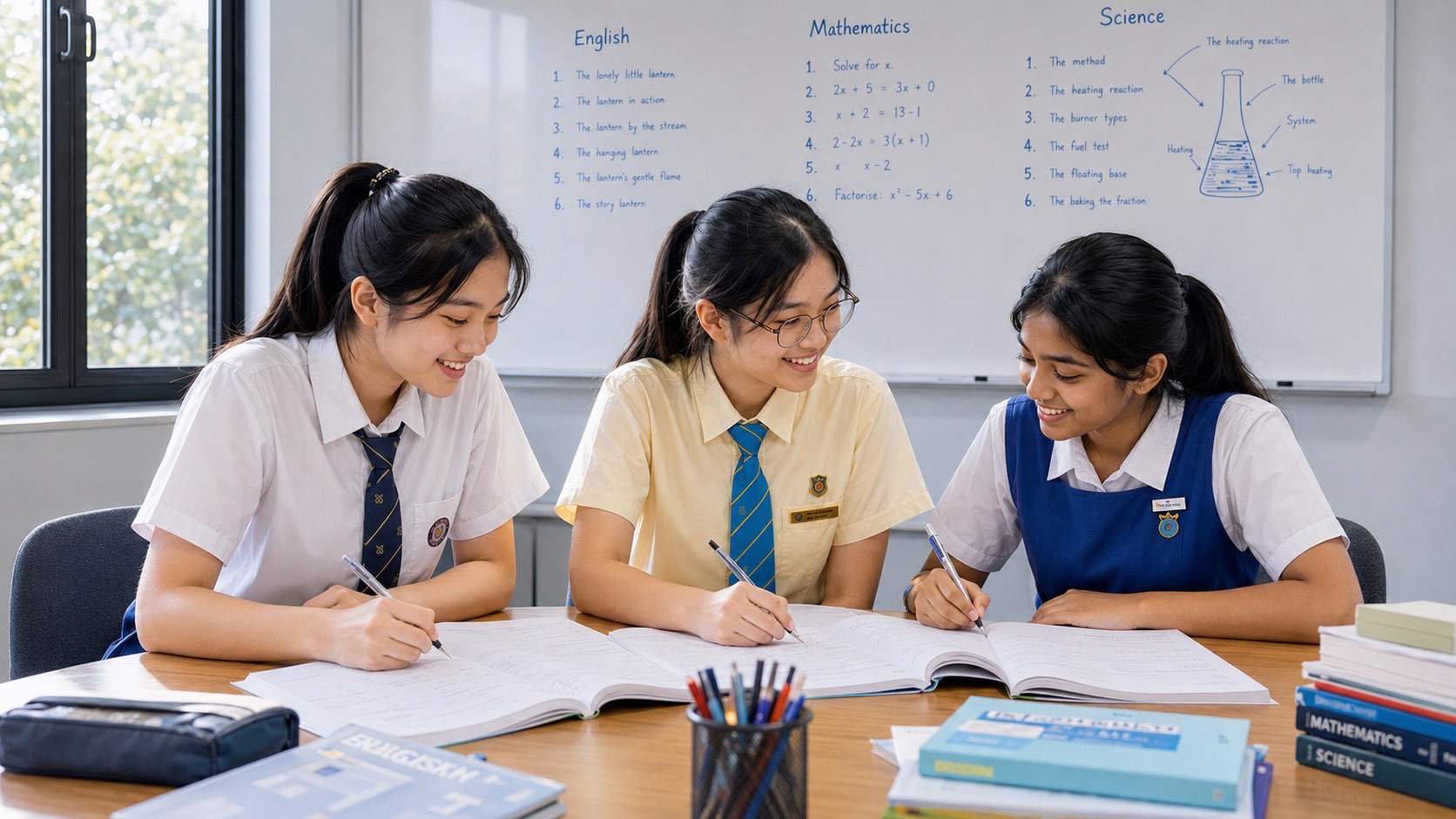
Nan Hua High School, New Town Secondary School and Queensway Secondary School offer three different choices for families around Clementi, Dover and Queenstown after the 2026 PSLE results at 11.00am on Tuesday 24 November 2026. Nan Hua at 41 Clementi Avenue 1 is a co-educational autonomous SAP school with a PG3-only historical route and substantial Higher Chinese/bicultural learning. New Town at 1020 Dover Road offers PG3, PG2 and PG1 with digital communications and upper-secondary Art opportunities. Queensway at 2A Margaret Drive offers PG3, PG2 and PG1 with water and food sustainability and community leadership. These schools are not interchangeable, and none is a verified six-year IP, IB Diploma or IGCSE school.
For the 2025 PSLE cohort entering Secondary 1 in 2026, Nan Hua’s historical PG3 5(M)–10(M) included Higher Chinese Merit annotations; it did not list a normal PG2 or PG1 intake. New Town’s ranges were PG3 14–20, PG2 21–25, PG1 26–30*. Queensway’s ranges were PG3 13–17, PG2 21–25, PG1 25–28. These are past results, not 2027 offers. The 30* at New Town means old PG1 vacancies remained, not that its last admitted pupil necessarily scored AL30 or that admission is certain now. Parents must compare the correct route, language fit, actual gate and six genuine preferences by 30 November 4.30pm.
Quick summary for parents
• Nan Hua High, 41 Clementi Avenue 1: 2026-entry PG3 last-posted 10(M); no ordinary PG2/PG1; SAP and Higher Chinese, not IP.
• New Town Secondary, 1020 Dover Road: PG3 20, PG2 25, PG1 30*; Digital Communicators, Change Makers and later Enhanced Art.
• Queensway Secondary, 2A Margaret Drive: PG3 17, PG2 25, PG1 28; lower-secondary water and food sustainability, plus community leadership.
• Higher Chinese M is a relevant school-admission annotation, not an extra AL unit or guaranteed bonus.
• An ordinary PG3-eligible child may still be far beyond Nan Hua’s previous AL10(M) endpoint.
• New Town and Queensway each offer mainstream Full SBB at multiple posting groups; their ALPs and CCAs differ.
• Test Dover, Clementi and Margaret Drive commutes from the exact home, including a late after-CCA return.
• Use the MOE Portal from 24 November 11.30am to 30 November 4.30pm; old school results are not 2027 cutoffs.
Actual school pathways, dated historical scores and reliable programme references
- Nan Hua High School — 41 Clementi Avenue 1, Singapore 129956; historic SAP PG3 5(M)–10(M); PG2 and PG1 not listed; SAP Chinese Culture and Bicultural Studies, Meraki and English-language work. Official programme details.
- New Town Secondary School — 1020 Dover Road, Singapore 139657; historic PG3 14–20, PG2 21–25, PG1 26–30*; Digital Communicators, Change Makers and Enhanced Art. Official programme details.
- Queensway Secondary School — 2A Margaret Drive, Singapore 149295; historic PG3 13–17, PG2 21–25, PG1 25–28; Water and Food Sustainability ALP and Community Youth Leadership. Official programme details.
Nan Hua High School: school identity, programme experience and admission fit
Nan Hua’s distinctive identity is a Special Assistance Plan that extends beyond learning a few Chinese vocabulary words. Its school flagship includes Chinese culture, bicultural understanding, ethics, literature, arts and an interest in how contemporary issues are understood across languages. It is a real educational opportunity for a pupil who is willing to read and write deeply in Chinese while continuing challenging English, Mathematics and Science. It can be a poor fit for a child whose motivation is exhausted by the language and who wants a different curriculum. Parents should ask how teachers support pupils whose spoken and written Chinese abilities are uneven.
The school’s published history of pupil writing, including the Meraki student literary magazine and Nan Hua Speaks, shows that the school values communication in English as well as Chinese. A family should not assume a SAP school neglects English; the relevant issue is how pupils balance both languages and other subjects. Ask to see the ordinary Secondary 1 expectations for extended writing and the role of class discussion. A pupil who enjoys interpreting an English short story may also find insight in a Chinese cultural text, but the workload needs to be sustainable over a full week.
Parents should distinguish Nan Hua’s SAP status from a six-year Integrated Programme. The verified historical entry was ordinary PG3, preparing students for the relevant national secondary assessment, not an IP-to-A-Level or IP-to-IB route. A child seeking six uninterrupted years of a named IP should investigate a school that actually offers it. A pupil who prefers a recognised secondary-year assessment milestone may find Nan Hua’s academic route appropriate. The educational decision is about the child’s way of learning, not a statement that one selective acronym is automatically superior to another.
The 2026-entry range 5(M)–10(M) includes a Higher Chinese Merit suffix at the recorded endpoints. It does not mean that a pupil’s overall PSLE score becomes two or more points better by adding a Merit grade, and an AL10 with a different relevant Higher Chinese outcome cannot be assumed identical to a published AL10(M) boundary. A pupil at AL11 in PG3 may still be very academically strong but was beyond Nan Hua’s earlier last-posted result. Treat this as a previous-cohort reference, not a permanent judgment about ability or a fixed future cut-off.
The actual campus at Clementi Avenue 1 may be attractive for a Clementi or West Coast family but can require a longer commute from Queenstown or Holland. A child should test the real journey before being asked to choose a demanding language programme and CCAs. Parents should examine daily academic support, student welfare and the fit of the school’s values and culture. An old score may make the school an aspiration, but it does not tell whether the pupil will enjoy and sustain the normal classroom experience.
The SAP PG3 5(M)–10(M); PG2 and PG1 not listed range describes applicants from the 2025 PSLE cohort posted into Secondary 1 in 2026, not the outcome for the current PSLE cohort. The pupil must have the correct school route and should be willing to learn at 41 Clementi Avenue 1, Singapore 129956 during a normal academic week. Ask about learning support, subject-level options, relevant language requirements, CCA selection and the real route home after activities. A strong education includes useful correction of mistakes and supportive peers, not only a flagship programme or a tight previous cutoff.
New Town Secondary School: school identity, programme experience and admission fit
New Town’s Applied Learning Programme, Digital Communicators, Change Makers, gives pupils a practical reason to examine local heritage, visual communication and digital media. Its current programme describes Secondary 1 smartphone photography and heritage work and Secondary 2 stop-motion storytelling. The learning should go beyond the excitement of editing a short video. Pupils can ask whether an image gives a fair impression of a person or place, how a claim can be verified and what responsibility a storyteller has to the community. A child interested in English, Humanities or Art may find connections even without private photography lessons.
Imagine a student photographing a historic corner of Dover. One image captures a beautiful façade but excludes the traffic noise, while another image shows how people use the public space. A thoughtful project asks which account is complete and which assumptions the student has made. Teachers can use that exercise to strengthen descriptive writing, source evaluation and ethical digital communication. Students can work through planning, image selection, captions and feedback rather than merely produce an attractive montage. Parents should ask how every class practises these skills and how shy learners contribute.
New Town’s Learning for Life Programme develops student and community leadership, while an Enhanced Art Programme exists for suitable upper-secondary pupils. The upper-year Art pathway is not the same as a universal Year 1 guarantee, nor is an advanced workshop an international qualification. A learner who loves visual work can explore before selecting later Art subjects, while another can benefit from broad communication without committing to a creative career. Ask about future subject eligibility, selection criteria and workload, including how pupils receive help with core academic subjects.
The old PG3 endpoint at New Town was 20, PG2 was 25 and PG1 was 30*. A pupil at AL19 in PG3 had a historical numerical margin compared with that prior endpoint, unlike Nan Hua’s much tighter AL10(M) reference. That does not make New Town an inferior school, nor does it guarantee a 2027 place. The PG1 star indicates unused previous capacity, not a binding future school offer. Families should ask whether they would genuinely choose New Town for its learning, class environment and travel rather than use it as an unexamined sixth preference.
Dover Road can be convenient for some families close to Dover MRT and Buona Vista, while a child travelling from Clementi or Queenstown may have different bus and walking options. Test the reporting-time journey and after-CCA return. A school closer to home can give a pupil more time to read, rest and participate in enrichment. That advantage is real even when the school has a broader historic entry range than a selective SAP school.
The PG3 14–20, PG2 21–25, PG1 26–30* range describes applicants from the 2025 PSLE cohort posted into Secondary 1 in 2026, not the outcome for the current PSLE cohort. The pupil must have the correct school route and should be willing to learn at 1020 Dover Road, Singapore 139657 during a normal academic week. Ask about learning support, subject-level options, relevant language requirements, CCA selection and the real route home after activities. A strong education includes useful correction of mistakes and supportive peers, not only a flagship programme or a tight previous cutoff.
Queensway Secondary School: school identity, programme experience and admission fit
Queensway’s Applied Learning Programme develops environmental sustainability through concrete Science experiences. Its official July 2026 page describes Secondary 1 water sustainability, including water treatment, harnessing water energy, and constructing a sea perch for navigation or testing. Secondary 2 proceeds to food production, nutrition, technology and waste management. These are meaningful real-world contexts for measurement, evidence and design. A child who enjoys Science may find the programme motivating, but the pupil must still develop solid English, Mathematics and other subject foundations. Parents should ask what all students receive and what advanced workshops or competitions require selection.
The school’s Tier 2 AI programme provides another type of enrichment, using generative AI to create content and code on microcontrollers. A child intrigued by technology may want this opportunity, but a normal PG posting does not automatically confer a selected advanced place. More importantly, children need to learn to verify AI output and consider the limits of data rather than assume a fluent answer is true. A school that connects AI with sustainability can teach useful judgment when pupils compare proposed interventions with evidence from experiments.
Consider a hypothetical water-treatment test. One group claims that a material makes water cleaner because the sample looks clearer. A better investigation measures the relevant properties, repeats trials and explains which types of contamination the method can and cannot address. A pupil may learn that visual appearance is not sufficient evidence for safety. The lesson can strengthen Mathematics graphing, Science explanation and clear English reasoning. It is the thinking behind a well-run experiment that matters more than a polished prototype displayed at an open house.
Queensway’s LLP develops Community Youth Leadership through a four-year journey from personal responsibility to serving others. Leadership should be visible through care, listening and reliable action, not simply a formal badge. A pupil who finds public speaking difficult may contribute through planning or practical work. Parents should ask how the school introduces new students to community activities and how teachers respond when a child needs academic or emotional support. The normal weekly environment matters as much as a special programme’s stated theme.
Queensway’s previous PG3 last-posted score was 17, with PG2 at 25 and PG1 at 28. At PG3 AL18, Queensway was beyond its old endpoint while New Town extended to 20; at PG2 AL25, both were at old boundaries. A school that has a tighter historic cutoff is not necessarily the better personal fit. The Margaret Drive site may be especially convenient for Queenstown or Commonwealth households. Compare the journey, subject support and the pupil’s genuine enjoyment of sustainability before placing it on the six-choice list.
The PG3 13–17, PG2 21–25, PG1 25–28 range describes applicants from the 2025 PSLE cohort posted into Secondary 1 in 2026, not the outcome for the current PSLE cohort. The pupil must have the correct school route and should be willing to learn at 2A Margaret Drive, Singapore 149295 during a normal academic week. Ask about learning support, subject-level options, relevant language requirements, CCA selection and the real route home after activities. A strong education includes useful correction of mistakes and supportive peers, not only a flagship programme or a tight previous cutoff.
What the three programmes and posting routes mean for the family
The first difference is not a ranking but an educational pathway. Nan Hua has a SAP language and culture commitment and only PG3 in its checked historical posting data. New Town and Queensway have historic PG3, PG2 and PG1 ranges under mainstream Full SBB. A child who is PG2-eligible cannot assume Nan Hua has a PG2 school-choice option because the family prefers its reputation. A student who is PG3-eligible generally is not automatically eligible for a school with a historical endpoint of AL10(M). The result slip, exact school route and earlier category must be kept distinct.
Their programme themes answer different questions. Nan Hua asks pupils to develop bicultural depth and communicate across languages. New Town develops storytelling, image analysis and digital literacy. Queensway explores the scientific and social consequences of water and food sustainability. A child could be interested in all three, but parents should ask which normal lessons they would enjoy and how the school supports a pupil who struggles in one academic subject. A special programme cannot replace daily classroom teaching, safe friendships and constructive feedback.
The PG3 historical endpoints were Nan Hua 10(M), Queensway 17 and New Town 20. For a pupil at AL10 with the relevant Higher Chinese outcome, Nan Hua is a historical boundary and the other two have numerical margin. For AL16, Queensway and New Town are within old ranges while Nan Hua’s earlier PG3 ended at 10(M). For AL18, New Town remained within its earlier range, while Queensway ended at 17. None of these figures guarantees admission, and comparing a SAP Higher Chinese annotation with an ordinary endpoint demands extra care.
For PG2, both New Town and Queensway had previous endpoints of 25, while Nan Hua did not have a published PG2 route. In PG1, New Town showed 30* with unfilled previous places, while Queensway ended at 28. That is not a promise of a new PG1 place or proof of last-admitted AL30. If the child has a PG1/PG2 choice, they need to select the proper group across ordinary school preferences, and cannot use a PG1 star to justify a PG2 entry. Consultation with the primary school is useful when strengths differ across subjects.
Clementi, Dover and Queenstown have different transport patterns even when parents refer to them collectively as central-west Singapore. Nan Hua’s Clementi Avenue 1 location may suit a West Coast household. New Town’s Dover Road campus may be closer to a family near Dover MRT. Queensway’s Margaret Drive location may be most practical for a Queenstown household. Test the actual morning and after-CCA journey. A pupil can gain significant extra rest and homework time from a convenient route, even when another school has a tighter previous cutoff.
Parents should distinguish advanced Art opportunities at New Town from the broad Art or cultural experiences at other schools, and selected AI enrichment at Queensway from its compulsory sustainability ALP. An exhibition photograph does not establish that every child enters a specialist programme. The pupil should still welcome the school even if a preferred CCA or elective is unavailable. The strongest six-school list contains real educational preferences and several historically less-stringent choices that the family would accept.
Twelve score-by-score parent cases
The following situations illustrate how to compare correctly dated score rows. They do not predict a 2027 cutoff or create an admission offer. Some schools have no PG1 or PG2 route, while others have separate PG3, PG2 and PG1 ranges. Read only the category for which the pupil is eligible, and preserve any SAP Higher Chinese annotations or starred vacant-place notation.
Case 1: PG3 AL9
Nan Hua’s prior PG3 ended 10(M), but Higher Chinese requirements and school fit still matter; the other two have broader historical endpoints.
The family should check the child’s actual result-slip eligibility, the relevant completed historical score and the genuine appeal of the school’s normal learning environment. Test the actual daily transport and include other suitable schools with historical margin. If a Higher Chinese, affiliation or selected programme condition remains uncertain, ask the official school or primary school rather than assume an older score guarantees the current year’s place.
Case 2: PG3 AL10
Nan Hua’s earlier endpoint was 10(M), including a Higher Chinese annotation; a plain AL10 is not an automatic SAP place.
The family should check the child’s actual result-slip eligibility, the relevant completed historical score and the genuine appeal of the school’s normal learning environment. Test the actual daily transport and include other suitable schools with historical margin. If a Higher Chinese, affiliation or selected programme condition remains uncertain, ask the official school or primary school rather than assume an older score guarantees the current year’s place.
Case 3: PG3 AL12
Nan Hua’s old endpoint was 10(M), while Queensway and New Town historically extended to 17 and 20.
The family should check the child’s actual result-slip eligibility, the relevant completed historical score and the genuine appeal of the school’s normal learning environment. Test the actual daily transport and include other suitable schools with historical margin. If a Higher Chinese, affiliation or selected programme condition remains uncertain, ask the official school or primary school rather than assume an older score guarantees the current year’s place.
Case 4: PG3 AL16
Queensway and New Town were within previous PG3 ranges; Nan Hua was beyond its earlier last-posted score.
The family should check the child’s actual result-slip eligibility, the relevant completed historical score and the genuine appeal of the school’s normal learning environment. Test the actual daily transport and include other suitable schools with historical margin. If a Higher Chinese, affiliation or selected programme condition remains uncertain, ask the official school or primary school rather than assume an older score guarantees the current year’s place.
Case 5: PG3 AL17
Queensway matched its historic PG3 endpoint; New Town extended to AL20.
The family should check the child’s actual result-slip eligibility, the relevant completed historical score and the genuine appeal of the school’s normal learning environment. Test the actual daily transport and include other suitable schools with historical margin. If a Higher Chinese, affiliation or selected programme condition remains uncertain, ask the official school or primary school rather than assume an older score guarantees the current year’s place.
Case 6: PG3 AL18–19
New Town’s old PG3 endpoint reached 20; Queensway had ended at 17, with Nan Hua at 10(M).
The family should check the child’s actual result-slip eligibility, the relevant completed historical score and the genuine appeal of the school’s normal learning environment. Test the actual daily transport and include other suitable schools with historical margin. If a Higher Chinese, affiliation or selected programme condition remains uncertain, ask the official school or primary school rather than assume an older score guarantees the current year’s place.
Case 7: PG3 AL20
New Town was at its previous PG3 boundary. A parent still needs acceptable alternatives.
The family should check the child’s actual result-slip eligibility, the relevant completed historical score and the genuine appeal of the school’s normal learning environment. Test the actual daily transport and include other suitable schools with historical margin. If a Higher Chinese, affiliation or selected programme condition remains uncertain, ask the official school or primary school rather than assume an older score guarantees the current year’s place.
Case 8: PG2 AL24–25
Queensway and New Town historically ended PG2 at 25; Nan Hua had no ordinary PG2 intake listed.
The family should check the child’s actual result-slip eligibility, the relevant completed historical score and the genuine appeal of the school’s normal learning environment. Test the actual daily transport and include other suitable schools with historical margin. If a Higher Chinese, affiliation or selected programme condition remains uncertain, ask the official school or primary school rather than assume an older score guarantees the current year’s place.
Case 9: PG1 AL28
Queensway was at its old PG1 boundary and New Town’s previous PG1 showed 30* with vacancies.
The family should check the child’s actual result-slip eligibility, the relevant completed historical score and the genuine appeal of the school’s normal learning environment. Test the actual daily transport and include other suitable schools with historical margin. If a Higher Chinese, affiliation or selected programme condition remains uncertain, ask the official school or primary school rather than assume an older score guarantees the current year’s place.
Case 10: PG1 AL30
New Town’s old 30* is not a new guarantee or proof of last actual entrant scoring 30.
The family should check the child’s actual result-slip eligibility, the relevant completed historical score and the genuine appeal of the school’s normal learning environment. Test the actual daily transport and include other suitable schools with historical margin. If a Higher Chinese, affiliation or selected programme condition remains uncertain, ask the official school or primary school rather than assume an older score guarantees the current year’s place.
Case 11: Child wants specialist Art
New Town’s upper-secondary EAP may be relevant, subject to future eligibility and available programme options.
The family should check the child’s actual result-slip eligibility, the relevant completed historical score and the genuine appeal of the school’s normal learning environment. Test the actual daily transport and include other suitable schools with historical margin. If a Higher Chinese, affiliation or selected programme condition remains uncertain, ask the official school or primary school rather than assume an older score guarantees the current year’s place.
Case 12: Child loves Chinese culture
Nan Hua’s SAP and Higher Chinese may suit; ask whether the child is prepared for the real language and reading workload.
The family should check the child’s actual result-slip eligibility, the relevant completed historical score and the genuine appeal of the school’s normal learning environment. Test the actual daily transport and include other suitable schools with historical margin. If a Higher Chinese, affiliation or selected programme condition remains uncertain, ask the official school or primary school rather than assume an older score guarantees the current year’s place.
Frequently asked parent questions
Which of these is a SAP school?
Nan Hua High School; the other two offer ordinary co-educational mainstream PG routes.
Does Nan Hua offer PG2 and PG1?
No such ordinary routes were listed in the checked historical SchoolFinder record.
What does Nan Hua 10(M) mean?
A previous PG3 endpoint with a Higher Chinese Merit annotation, not an extra Achievement Level.
Which school has Digital Communicators?
New Town Secondary School, with photography and stop-motion across the lower years.
Which school focuses on water sustainability?
Queensway, then food sustainability in Secondary 2.
What does New Town’s 30* mean?
Unfilled previous PG1 capacity, not a guaranteed offer for 2027.
Is EAP an IB Diploma option?
No. EAP is an upper-secondary Art enrichment pathway within the school’s applicable national curriculum.
Which is the easiest commute?
It depends on the family’s home block; check the actual gates and later return journey.
National timeline, choosing schools and preparing for the first term
The official 17 November 2026 MOE–SEAB release confirms Tuesday 24 November 2026 at 11.00am as PSLE results time. Primary schools share collection arrangements, including a proxy option by Thursday 26 November when the candidate cannot attend. Older tentative exam calendars are superseded by this specific announcement. Parents should use the actual result slip and eligible Posting Group rather than assume a past school cutoff or an early online prediction determines the child’s new school.
The online S1 Portal opens at 11.30am on 24 November and closes at 4.30pm on Monday 30 November. One parent can log in with Singpass and submit six ordered choices. The S1 results are tentatively expected on Friday 18 December, subject to a later confirmation. If the family cannot use the portal, the child’s primary school can provide assistance before the deadline. A screenshot showing an old year or a school name from another cohort should not control a decision.
The PSLE total is the sum of four subject Achievement Levels, with a smaller numerical total indicating stronger examination performance. A child with total 4–20 is generally in PG3; 21–22 normally offers a PG2/PG3 option; 23–24 generally means PG2; 25 usually offers a PG1/PG2 option; and 26–30 generally allows PG1 when the specified English and Mathematics conditions are met. Foundation-subject or unusual combinations need the actual slip and MOE guidance. Do not use a simplified online table to override eligibility.
Posting Groups guide initial admissions, whereas subject G1, G2 and G3 levels describe demand in individual academic subjects under Full SBB. The child may be strong in Mathematics yet need extra reading support, or good at oral English but slower in Science explanations. A choice between Posting Groups normally applies to the entire ordinary six-school application rather than allowing the family to switch groups at each listed school. The best route considers both eligibility and the pupil’s readiness for subject demands.
The Singapore-Cambridge Secondary Education Certificate (SEC) replaces the former separate N- and O-Level national qualifications from 2027 for applicable cohorts. A named six-year Integrated Programme can lead to A Levels or to the IB Diploma depending on the school, while IGCSE is a distinct international examination. The three schools compared here offer mainstream Full SBB with relevant national subject levels, not a separate IP, IB or IGCSE admission pathway. Parents should not invent additional qualifications because a school has an advanced Art or STEM project.
The score ranges used here come from the completed 2025 PSLE exercise for students who entered Secondary 1 in 2026. They do not establish the 2027 cutoffs, which depend on this cohort’s scores, preferences, citizenship-related tie-breaks, vacancies and applicable admission conditions. A numerically smaller total than the old last-posted score offers historical margin, equality marks the previous boundary and a larger number may be a reach by that reference. None is a precise admission probability.
At a school that publishes a value such as 30*, the asterisk signifies remaining places in that prior Posting Group. It does not prove that the last pupil actually scored AL30 or guarantee future spare places. Similarly, an affiliated score or a Higher Chinese grade attached to a SAP cutoff has a specific meaning that must not be borrowed by an ineligible applicant. Parents should keep every score labelled by the actual school, group, PSLE cohort and entry year. Combining different rows into one average is misleading.
MOE advises families to include two or three schools with less stringent previous cutoffs among the six choices. Because smaller AL totals are better, a previous endpoint numerically higher than the child’s score in the same group usually provides more historical margin. This is a technique to reduce the chance of missing all six schools, not a statement that a broader-entry institution has inferior teaching. The family should rank schools in true preference order and be willing to accept every one of the six.
A useful six-row comparison has the school’s exact current name and code, Posting Group, historical score and year, actual campus, one educational reason the child likes it, available subjects and CCAs, transport and unresolved eligibility conditions. The pupil’s feelings matter because they will spend far more time in ordinary classrooms than in award ceremonies. A child who likes the school only because of an impressive brochure may be disappointed if a selected CCA or competition is unavailable. Ask whether they would still want the normal curriculum.
An ALP, an LLP, a CCA, a DSA talent area and an upper-secondary selected subject are different things. A school may showcase a competition team or external learning journey without giving every entrant the same experience. Parents should ask what all Secondary 1 pupils receive and what requires selection, audition or later academic eligibility. A child can grow through a broad programme without joining the most advanced activity. Strong teaching helps beginners acquire foundations and interested students work towards deeper opportunities through sustained practice.
Good subject teaching includes identifying misunderstandings and helping students correct them. A pupil who has memorised the steps of an algebraic method may not understand why it works; another who reads a passage fluently may struggle to identify the evidence for an author’s claim. Ask how the school provides consultation and feedback rather than simply giving more tests. A child who initially finds one academic subject difficult should have a route to progress without feeling that the PSLE total set a permanent limit.
The family’s actual journey may be different from an estate label. For Clementi, Dover, Queenstown, Commonwealth, Holland Village, Buona Vista, West Coast and nearby central-west estates, test the morning route from the correct home block, including bus connections, walking and rain. Then test the return after a later CCA. A long commute can reduce sleep, time for homework and healthy recreation. Another school with a slightly less selective old endpoint might provide a more manageable day and equally meaningful learning. Proximity is not an automatic national S1 priority, but it can be a practical advantage for the child’s wellbeing.
After results on 24 November, first read the whole slip and discuss what the child values. From 25–26 November, verify school programmes, subject levels, address and any selected route with MOE SchoolFinder and the school’s own pages. If uncertain about PG1/PG2 or PG2/PG3, ask the primary school. During 27–29 November, test routes and rank six genuine preferences including less stringent historic alternatives. Submit before 4.30pm on 30 November and retain the portal acknowledgement.
A DSA commitment made earlier in 2026 must be respected according to the applicable rules; a pupil cannot simply reopen the 2026 DSA exercise after collecting the PSLE result. For ordinary S1 applicants, the six-school system and confirmed portal deadlines govern selection. Parents should avoid promising a particular school or CCA before posting and later school decisions are complete. The household can make an informed preference today without knowing tomorrow’s exact last-posted score.
Once the pupil is posted, use the 2027 Secondary 1 orientation, textbook and uniform instructions from the actual school. The correct books can depend on individual G subject levels, and older cohort documents may give outdated reporting times. Practise the route with the child and explain whom they can approach if unwell, worried or confused. A positive transition includes friendships, clear expectations, rest and a realistic workload, not a second PSLE exercise during December.
The eduKate Depth–Load–Transfer method asks whether a pupil understands a concept, can sustain the study routine, and can use the principle in a new situation. If Depth fails, teach a smaller example and ask the child to explain why it works. If Load fails, reduce the work and spread it across days. If Transfer fails, change the question and discuss what remains invariant. This helps pupils develop English, Mathematics, Science and independent learning without equating one exam result with their identity.
Parents can begin with short, useful preparation: negative numbers and simple algebraic expressions in Mathematics, distinguishing an observation from a cause in Science, or identifying a claim and evidence in an English passage. A small amount of deliberate practice with feedback is preferable to completing many worksheets without understanding. The child also needs sleep, family time and opportunities to enjoy the school holiday. The aim is to make the first Secondary 1 term manageable and welcoming.
A parent should ask the school which ordinary subject supports are available, how student welfare is handled, and what the child can do if a preferred CCA is oversubscribed. Ask about the routine timetable, the late dismissal after clubs and the exact campus address. A school that looks excellent in the previous cutoff table may still be a poor individual match for a particular learner. The decision should combine evidence about teaching, programmes, community and the full week rather than privilege an abstract ranking.
The best choice is a school the child can attend consistently and learn in, with adequate challenge and support, a workable route, and adults they can approach when something goes wrong. The family may reasonably prefer one of these three schools for its distinctive programme, or find that another current school offers a better fit. A comparison should widen options and improve reasoning, not force every parent to make the same selection.
Official sources and connected eduKate school guides
- SEAB 17 November 2026 official release for 24 November results and the 30 November closing time.
- MOE S1 Posting and MOE SchoolFinder for eligible current school choices.
- MOE Full Subject-Based Banding reference for PG versus G-level subjects.
- Nan Hua High School official programme and eduKate full school profile.
- New Town Secondary School official programme and eduKate full school profile.
- Queensway Secondary School official programme and eduKate full school profile.
- eduKate 2027 score-by-school hub and eduKate immutable Clementi editorial reference.
The final parent decision
The right school will depend on the pupil’s actual eligibility, learning disposition, language readiness, school culture and how the journey works across the normal week. A school with a more selective past last-posted score is not automatically a stronger fit for every child. A good six-choice list gives the pupil genuine alternatives, with adults providing accurate facts and a realistic understanding of uncertainty.
Once the actual school is allocated, move from speculative cutoff conversations towards the 2027 Secondary 1 start, correct textbooks and subjects, manageable homework routines, friendships and asking for help. A child’s development depends on sustained teaching, appropriate challenge and opportunities to improve, not one number from an earlier cohort’s posting table.