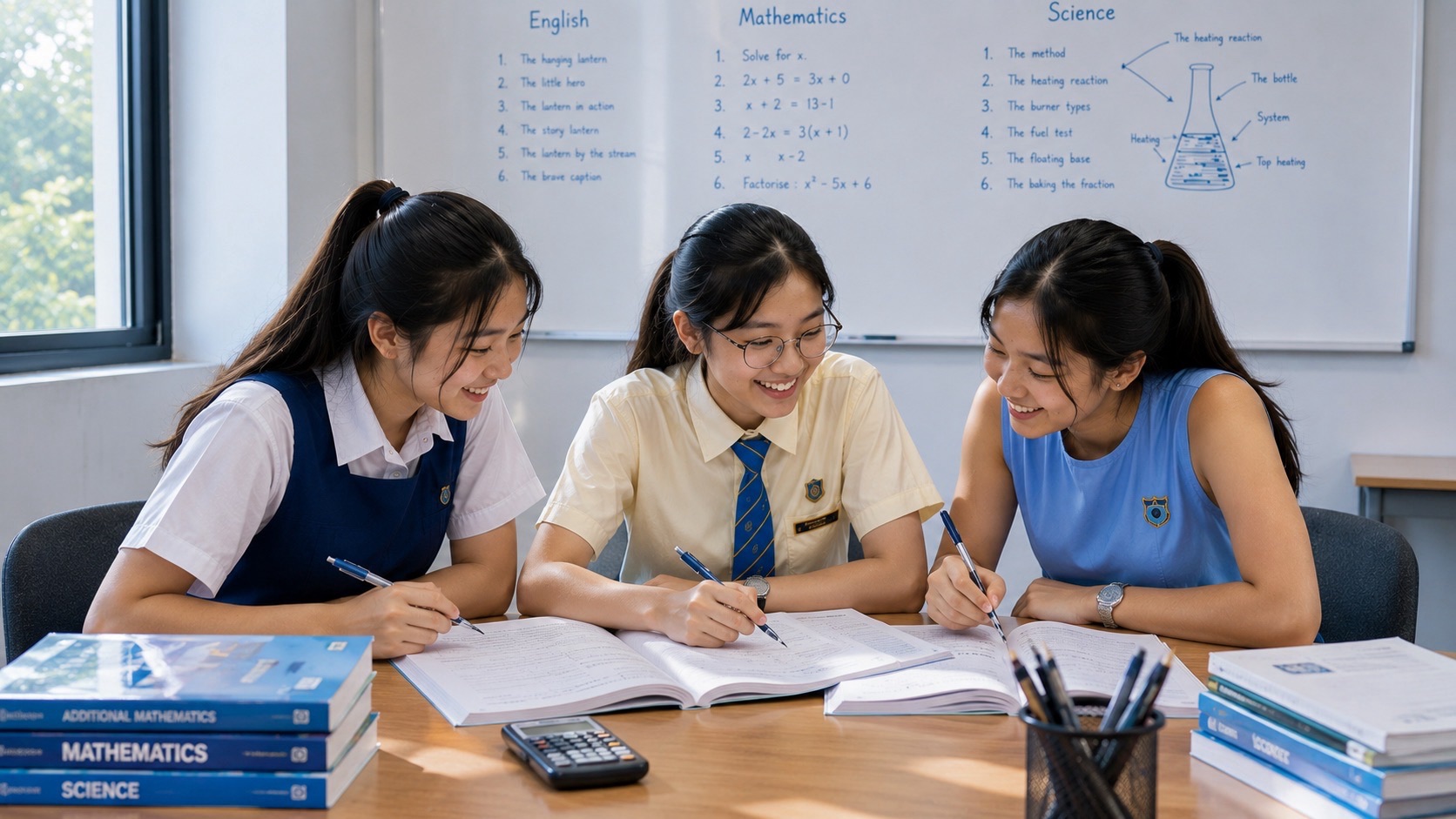
Yuhua Secondary School at 35 Jurong West Street 41, Singapore 649406 is available through mainstream Secondary 1 Posting Groups PG3, PG2 and PG1. When Singapore PSLE results are released on Tuesday, 24 November 2026 at 11.00am, parents can compare the official Posting Group with the school’s completed 2026 Secondary 1 intake figures: PG3 15–20, PG2 21–25, PG1 25–28. These are results of the previous PSLE 2025 posting cohort, not guaranteed entry requirements for January 2027. The school has no ordinary Secondary 1 route to the IB Diploma, IGCSE or a national Integrated Programme (IP).
Music-loving pupils should consider Yuhua for its broad arts education and possible later G3 Music pathway, not because they assume every Secondary 1 enrolment guarantees a place in the Enhanced Music Programme. EMP is a selected two-year upper-secondary route beginning in Secondary 3; the school publishes a sequence of Secondary 1 music interest and CCA involvement, Secondary 2 preparatory work and an EMP selection exercise. Parents living around Jurong West Street 41, Lakeside, Chinese Garden and nearby Taman Jurong should check whether the child is truly interested in Enhanced Music Programme (EMP) and the broader MELODY music-and-arts Learning for Life Programme, whether any specialist participation requires selection, and whether the school-day commute works. The MOE S1 Portal opens at 11.30am on 24 November 2026 and closes at 4.30pm on 30 November. Use six genuine school preferences, with two to three historically less stringent options where possible. A prior COP is a reference, not an admission promise.
- School and campus: Yuhua Secondary School — 35 Jurong West Street 41, Singapore 649406.
- PG3 completed 2026 intake: 15–20; previous COP 20.
- PG2 completed 2026 intake: 21–25; previous COP 25.
- PG1 completed 2026 intake: 25–28; previous COP 28.
- Special opportunity: Enhanced Music Programme (EMP) and the broader MELODY music-and-arts Learning for Life Programme.
- Selection warning: specialist programmes, DSA and CCA places can follow criteria separate from ordinary school admission.
- IP/IB/IGCSE: not ordinary S1 routes at this school. G1, G2 and G3 refer to subject demand levels under Full SBB.
- Results: Tuesday 24 November, 11.00am; MOE choices 24 November, 11.30am through Monday 30 November, 4.30pm.
- S1 posting: outcome tentatively 18 December 2026; check MOE’s final notice.
- First decision: choose a school for everyday teaching and support, not only a promised programme or old COP.
The 60-second answer: admission, specialist selection and future pathways
| Question | Answer for this school | Correct parent action |
|---|---|---|
| PG3 admission | 2026 S1 intake range 15–20; former COP 20 | Use only if applying through PG3; a past COP is not a reserved place. |
| PG2 admission | 2026 S1 intake range 21–25; former COP 25 | Check the selected group and compare only with PG2 figures. |
| PG1 admission | 2026 S1 intake range 25–28; former COP 28 | Check official eligibility, options and the receiving school’s G-level offers. |
| Special opportunity | Enhanced Music Programme (EMP) and the broader MELODY music-and-arts Learning for Life Programme | Check what is offered to all pupils versus selected entrants, and when selection occurs. |
| IP, IB Diploma, IGCSE | Not ordinary S1 pathways at this school | Do not use these labels as synonyms for PG1/PG2/PG3 or enrichment programmes. |
| Application window | 24 Nov 11.30am to 30 Nov 2026 4.30pm | Submit via MOE S1 Portal with one parent’s Singpass; save confirmation. |
The score figures in this article consistently refer to the 2026 Secondary 1 intake, following PSLE 2025. The incoming 2027 cohort’s final cut-off points cannot be known before the current posting exercise finishes. Families should verify any score, school programme, campus address and eligibility requirement in MOE SchoolFinder and the individual school’s website.
What the school really says about EMP
Yuhua’s August 2026 programme page states that the Enhanced Music Programme is a two-year upper-secondary course preparing students for G3 Music, beginning in Secondary 3. It is not a qualification awarded to new Secondary 1 entrants. The school is one of four offering EMP and functions as a G3 Music Centre for students from other schools. These facts matter for families who are choosing a school immediately after PSLE and are easily confused by the phrase ‘Music Programme’.
Students who actually participate in EMP engage with listening, performance, composition and musical theory, and explore Western classical music, Asian music, jazz and popular genres. The programme also describes camps, masterclasses, combined-school experiences and learning journeys. Ask how these opportunities are scheduled and which are compulsory, optional or subject to availability in the child’s eventual upper-secondary cohort.
The normal curriculum cannot be reduced to one elective. A young person will still need Mathematics, English, Science and humanities foundations, a suitable G-level subject combination and a weekly routine. A family should only choose Yuhua if the child would enjoy it even if EMP selection later proves unsuccessful. This distinction protects the child from being told a specialist pathway is guaranteed simply by obtaining a school place.
Yuhua’s EMP also gives music-interested families an honest planning advantage: it publishes the possible route early. Parents can use this to ask informed questions about CCA, preparation, technical listening, performance and the child’s willingness to practise over several years, rather than making a rushed choice based on a stage photograph.
The real Secondary 1 entry point for a music-loving child
For a student interested in pursuing G3 Music later, Yuhua advises joining an appropriate music CCA at Secondary 1—Concert Band, Harmonica Band or Girls’ Choir—or participating in specified external youth ensembles, and indicating interest to the school’s music teachers. This is guidance for building a music profile; it is not a separate PG3, PG2 or PG1 admission pathway. CCA placement and programme participation should be confirmed with the school.
Parents should ask which listed CCA the child genuinely likes rather than automatically selecting the one thought to be easiest for EMP. A child with no instrumental background may want to learn in a supportive ensemble; a pupil already taking music lessons may need to understand how an external ensemble is recognised. None of these choices should crowd out the first-term adjustment to a new school.
The school’s wider MELODY arts programme gives exposure beyond selected EMP students. This can include group music making and creative work that allows a beginner to discover an interest. The family can ask what all Secondary 1 students experience under MELODY and whether particular performance or song-writing opportunities are allocated by year level, ability or interest.
A practical parent exercise is to ask the child to describe one piece of music they like and why. Do they notice rhythm, instrumentation, lyrics, emotion, structure or performance? This says more about their present curiosity than an early demand that they commit to a future examination. Teachers can help develop that interest and judge readiness based on actual learning.
What happens in Secondary 2 before EMP selection
Yuhua’s programme page identifies an in-house Music Preparatory Course in Secondary 2, designed to build music listening, literacy, performing and creating skills. It states that students must pass the EMP selection exercise held in Semester 2. Parents planning a 2027 Secondary 1 entry should therefore understand a multi-step pathway rather than imagine a guaranteed music qualification printed on the S1 posting letter.
The school is the source for the current selection criteria, including any school examination expectations and performance tasks. Older subject-combination slides may refer to former course terminology or to earlier cohorts, and should not be copied into a promised 2028 selection formula. Ask for the instructions that will actually apply when the child reaches Secondary 2.
Music selection is often more revealing than an attractive exam result at age twelve. A pupil may enjoy performing but be reluctant to analyse a score; another may compose beautifully but need practice performing with an ensemble. EMP requires a sustained academic and musical commitment, so the child should be able to describe what parts of study they are willing to work hard at.
If the child is not selected, do not frame the choice of Yuhua as a failure. The school still offers mainstream subjects, design-thinking programmes, CCAs and wider arts experiences. Ask in advance how a pupil can continue playing, composing or performing through other legitimate options so that the child’s enthusiasm remains sustainable.
MELODY is not an IB or IP qualification
The Learning for Life Programme called MELODY provides music and arts experiences as part of the school’s broader character and student development. Its existence does not mean Yuhua offers the IB Diploma, Cambridge IGCSE or the national Integrated Programme as ordinary S1 courses. Music enrichment and a selected upper-secondary G3 Music subject are different things from a school-wide qualification framework.
The child may be academically eligible to consider Yuhua through PG3, PG2 or PG1, depending on the official result. The school’s last completed 2026 S1 intake showed PG3 15–20, PG2 21–25 and PG1 25–28. A student admitted through one group is not promised a particular later music subject. The G3 prefix describes subject demand, not admission through Posting Group 3 alone.
A parent can separate three decisions: where will the child attend Secondary 1, how will they take part in musical learning, and whether they later qualify for G3 Music. Those decisions happen at different times and under different rules. Keeping them separate reduces stress and prevents inaccurate school-choice claims.
A school can be a strong fit for a child who loves music without making their entire future depend on EMP. Parents should ask about ordinary teaching, support and friendships alongside the music opportunities; a broad education is still the reason for choosing a school.
Three different decisions: which school, which Posting Group and which programme
The first question is whether Yuhua Secondary School is a genuine school the family would want to attend. A school visit should investigate ordinary teaching, classroom support, the culture of the form class, CCAs and travel. The school’s distinctive opportunity is worth exploring, but an appealing programme should not displace the basics of learning well and feeling safe. Ask whether the child could still have a meaningful four-year experience if a selected programme were unavailable.
The second question is the pupil’s official Posting Group. Singapore’s PSLE Score adds the four Achievement Levels and smaller totals represent stronger examination performance. Scores from 4–20 generally correspond to PG3, scores 21–22 create an option between PG2 and PG3, 23–24 generally correspond to PG2, score 25 creates a PG1/PG2 option, and 26–30 may permit PG1 subject to conditions. The individual school option form is more authoritative than a generic online table, particularly in exceptional cases.
The third question is whether the pupil can take part in Enhanced Music Programme (EMP) and the broader MELODY music-and-arts Learning for Life Programme. A school-wide introductory experience and a selected specialist track need not have the same participation rules. DSA offers, if any, are separate earlier admission decisions, while certain electives may have their own assessments or year-level requirements. Parents should ask about the current conditions rather than using the child’s PSLE score as a substitute for programme selection.
Separating these decisions is valuable because the emotional pressure after PSLE can make parents collapse them into one statement: ‘If my child enters this school, they are in the special programme.’ That may be false. A precise statement respects the child’s hope while preserving realistic expectations. It is entirely possible to choose a school for an excellent overall experience without guaranteeing a particular elective.
How to use the previous PG3 cut-off correctly
The completed 2026 PG3 intake at Yuhua Secondary School covered PSLE Scores 15–20. The last-admitted number was 20. A numerically lower score is better. A child scoring 19 may reasonably consider the school based on previous admissions; a child scoring 20 is matching the earlier boundary; a pupil at 21 is less competitive on the previous evidence. These examples do not predict the final 2027 COP or guarantee a place.
Parents should be particularly careful about the first number in the school range. It records the strongest score among admitted pupils in that previous group, not a minimum threshold. If the historical range begins at 7 and the child scores 6, that does not mean the child is too strong to apply. A family is free to prefer a school with a different cohort profile if the fit is right; an admission table does not measure the child’s daily learning environment.
A historically close score may justify including a preferred school as an aspiration, provided the rest of the six-choice list is balanced. MOE advises that at least two or three choices should have previous COPs less stringent than the pupil’s PSLE Score. Those choices should still be schools the child would willingly attend; a distant fallback with a draining commute is not automatically helpful simply because a table looks reassuring.
Schools can differ significantly in philosophy and student development even when historical PG3 COPs match. A family that chooses Yuhua Secondary School for its programme should investigate what the child will actually do and how selected participation works. The old admissions number cannot answer that question.
How to use the previous PG2 cut-off correctly
The previous PG2 intake at Yuhua Secondary School covered PSLE Scores 21–25 and had COP 25. This is separate from the school’s PG3 figure 20. A child in PG2 must compare against the PG2 range; it would be an error to decide that a pupil has qualified because the PG1 number is higher or to exclude the child because the PG3 number is more selective.
Full Subject-Based Banding is designed to take account of different subject strengths. A pupil posted through PG2 may, where eligibility requirements are met, study certain subjects at G3 while taking other subjects at their appropriate demand level. An initial offer and later changes depend on actual school and MOE criteria, not an adult’s assumption that every pupil needs all subjects at the highest level immediately.
Parents should ask the child to show how they reason in Mathematics, interpret an unfamiliar Science question and respond to an English reading passage. These examples can reveal whether a pupil needs conceptual explanation, more varied practice or better time management. A good school-choice decision should be compatible with the child’s current readiness while leaving space for future progress.
The best PG2 option is not simply the most selective school whose previous COP seems achievable. A family should compare teaching, support, peer environment, school programmes and commute. If the child loves the school’s specialist theme but is struggling in core subjects, discuss how these interests can motivate learning without overloading the weekly timetable.
PG1 admissions and the misconception that specialist work belongs only to PG3
For the completed 2026 S1 intake, Yuhua Secondary School recorded PG1 25–28 and historical COP 28. The child’s official PG1 eligibility must still be confirmed. Parents should not assume a school has no meaningful creative, practical or leadership opportunities for PG1 entrants just because some specialist examinations use the label G3. The actual opportunities depend on programme criteria and individual abilities.
PG1 is an admission group and a broad starting reference, not a lifelong identity or prediction. A student may be particularly strong at music, drawing, speaking, design or sport and need more support in academic English or Mathematics. A responsive school should help the child use these strengths to build confidence while addressing specific conceptual gaps.
A parent can ask which introductory programmes are school-wide and how the school guides pupils considering more demanding individual subjects. Do not promise a G3 elective or a selected talent place to every child simply because it appears in the school’s list of opportunities. Conversely, do not discourage a pupil from exploring a meaningful interest without first checking the real criteria.
In the early weeks, focus on practical learning routines and communication with teachers. The child should know how to ask for help, where to find assignment instructions, how to manage materials and how to respond to feedback. These ordinary capabilities are valuable foundations across all Posting Groups.
Scores 21–22 and 25: decide the option band before making a six-school list
PSLE Scores 21 and 22 give families an option between Posting Group 2 and Posting Group 3. A pupil’s overall score may conceal differences among the four subject ALs. A child with strong language skills and weaker Mathematics concepts may have different needs from a pupil with the same total who enjoys demanding Mathematics but requires writing support. The option should be discussed with the primary school where needed, not treated as a prestige vote.
If the family selects PG3, the historical Yuhua Secondary School benchmark is 20; if PG2, it is 25. The different historical COPs reflect separate admission competitions, not parallel routes that a family can combine after the deadline. The child will also need to understand the academic demands expected at the start of Secondary 1, including any offered individual G levels.
PSLE Score 25 may present an option between PG1 and PG2. Here the family must distinguish the previous PG1 COP 28 and PG2 COP 25. The choice should consider understanding, confidence, subject-specific ability and the pupil’s ability to manage an appropriate pace. A lower numerical COP in a different group does not provide an alternative guaranteed offer.
Once the group is selected, compare all six national schools using the appropriate group’s figures. Do not use PG1 at one school and PG3 at another just because a table makes the latter seem appealing. If a child has already accepted a binding DSA offer, follow the specific DSA instructions rather than assuming the ordinary November selection process applies identically.
Nearby alternatives for families around Jurong West Street 41, Lakeside, Chinese Garden and nearby Taman Jurong
The table below uses historical 2026 Secondary 1 intake cut-off points, not 2027 forecasts. Each school has its own programmes and conditions. The numbers belong to PG3, PG2 or PG1 separately and some schools have special affiliation or vacancy footnotes. Check MOE SchoolFinder and the precise school name before submitting.
| School and approximate location | 2026 PG3 COP | 2026 PG2 COP | 2026 PG1 COP | Real parent comparison |
|---|---|---|---|---|
| Yuhua Secondary School — Jurong West Street 41, Lakeside, Chinese Garden and nearby Taman Jurong | 20 | 25 | 28 | This school’s current campus, ordinary curriculum and specialist opportunities. |
| Fuhua Secondary School — Jurong West Street 41 | 13 | 23 | 28 | Nearby campus but historically more selective PG3; not Yuhua’s EMP admission route. |
| Jurong West Secondary School — Jurong West Street 65 | 16 | 24 | 28 | Another west-side school; check the actual journey and its distinct arts options. |
| Westwood Secondary School — Jurong West Street 25 | 22 | 25 | 28 | Arts for Life exposure with a different signature and travel pattern. |
| Yuan Ching Secondary School — Yuan Ching Road | 18 | 24 | 28 | Different engineering and leadership emphasis; viable only with a sensible commute. |
Why a local alternative is not just a less selective name
A school with a historical COP two points less stringent than the child’s score may be a sensible comparison, but the number alone does not prove admission or quality. A family should inspect where the child actually travels, whether the programme appeals, how teachers support learning and whether the pupil can imagine attending the school with a positive attitude.
The word ‘nearby’ must also be tested. Singapore estates can span large areas, and MRT stations, LRT lines, feeder buses and busy road crossings can change the true trip substantially. Travel from a home near one boundary can make an apparently distant school easier to reach than another with the same area label. The family should do an ordinary weekday route test rather than assume the school with the shortest straight-line distance has the easiest journey.
Compare a normal school day, not just an open-house showcase. Ask what time the child must leave home, what happens if the bus is missed and when CCA finishes. A child who can return home safely and still have time to eat, read and sleep may gain meaningful advantages over four years. School programmes are valuable only when the pupil has enough energy to participate in them.
Finally, confirm the list contains genuine choices, not names inserted only to satisfy a numerical rule. If the family would reject a school after being posted there, research the objections before including it. A balanced six-choice plan makes the process safer without pretending there is an exact probability of admission.
Four worked parent situations: read the correct numbers and programme conditions
PG3 Score 19, Chinese Garden family
The previous Yuhua PG3 COP was 20, so a pupil with score 19 is historically stronger than the last admitted PG3 child in that completed exercise. That makes Yuhua a credible school to consider but not a guaranteed 2027 place. The family can compare Fuhua’s more selective PG3 COP 13 and Westwood’s less stringent 22, but the child’s sincere preference and actual Street 41 commute must determine the order.
PG2 Score 24, a pianist interested in EMP
The relevant Yuhua number is PG2 COP 25, not the PG3 COP 20. The child may have experience taking piano lessons but cannot use that alone to bypass the national posting group. Parents should ask how ordinary MELODY music is taught, how a new student joins an appropriate CCA and how the school later assesses the music preparatory pathway.
PG1 Score 27, no formal music lessons yet
Yuhua’s previous PG1 COP was 28. A score of 27 makes the school worth considering, although the actual 2027 outcome remains uncertain. A pupil who enjoys singing might discover music in the wider arts programme, while first building academic confidence and organisational routines. No prior instrumental lessons need to be invented and no upper-secondary selection should be promised.
A child with a DSA music offer versus an ordinary applicant
The school’s DSA page names performing-arts talents, but DSA offers are a separate earlier selection process with commitments. Families who already accepted one must follow the DSA rules. Families using the November S1 Portal should not assume that an encouraging audition or a listed CCA changes the ordinary PG admission rules.
What these worked examples cannot predict
The scenarios are illustrations, not predictions of the current posting competition. Historical cut-offs can move with cohort scores and school preferences. When same-score students compete for the last place, citizenship, the rank of the school choice and computerised balloting where applicable influence the result. An older COP cannot be turned into a precise percentage chance, even when the child is one point stronger.
The child should not be told that an attractive programme overrides national admission eligibility. The school place and the programme selection may depend on different processes and happen at different times. A clear parent can explain the distinction without dismissing the pupil’s enthusiasm: ‘This school has an opportunity you may enjoy, but we first need to see whether the school choice succeeds and then check how the programme works.’
If the child is disappointed by one result, support a positive adjustment to the school ultimately assigned. Real growth depends on classroom teaching, friendships, practice, feedback and the child’s willingness to try new experiences. A different school may offer worthwhile routes that the family had not initially considered.
Do not use an appeal as a guaranteed backup. Transfers and appeals depend on the current-year rules, vacancies and actual circumstances. Follow the posted school’s instructions first, then enquire through the official process where a genuine reason exists.
DSA-Sec, school enrolment, signature programmes and G3 subjects are different
Direct School Admission is a separate application process that takes place before the November S1 Posting exercise. It can recognise specific talent areas, but successful students have obligations that may include sustained participation in the area for which they were selected. The family should follow its actual DSA result and commitments; an interest in a programme does not automatically create a late DSA place.
Ordinary S1 posting is based on the student’s eligible Posting Group, PSLE Score and choice list. A pupil may select a school for the arts, engineering or language environment, but the school does not necessarily allocate the pupil to the most advanced related elective merely for being posted. This is especially important when a school advertises both broad exposure and a separately selected specialist route.
G1, G2 and G3 describe subject demand levels under Full SBB. They should not be confused with PG1, PG2 and PG3 or with IP, IB and IGCSE. A pupil with PG2 entry may be eligible for particular G3 subjects depending on criteria; equally, a school programme described as ‘G3 Music’ is a subject-level qualification, not proof that all pupils posted through PG3 take Music.
An Integrated Programme is a named national six-year route at designated institutions. The International Baccalaureate Diploma and IGCSE are separate qualification systems. Yuhua Secondary School is a mainstream secondary school with its own authentic offerings, not an ordinary IP, IB or IGCSE route. Parents should respect what the school actually provides rather than attaching unrelated labels.
The 2026 result-release window and what to do on each date
Tuesday, 24 November 2026 at 11.00am: PSLE results are released. The primary school will provide collection arrangements. Read the child’s official PSLE Score and any Posting Group option information, and give the pupil time to process the news. A good conversation begins with accurate information and respect, not a demand to pick a prestigious school immediately.
Tuesday, 24 November at 11.30am: The MOE S1 Portal opens for parents. A valid Singpass is required and only one parent needs to submit. Start with the child’s actual selected group, then compare schools’ historical COPs, culture, distinctive programmes, subjects and CCAs. The child’s preference matters; so do realistic alternatives.
Monday, 30 November at 4.30pm: The online choice period closes. Check names and rank order carefully and retain confirmation of a successful submission. Seek assistance from the primary school before the deadline if there are access or eligibility questions. Submitting early provides no first-come-first-served advantage for admission, but waiting until the last minute increases the risk of an avoidable technical problem.
Friday, 18 December 2026, tentatively: The S1 posting results are expected, subject to an official date confirmation. Families can check the S1 Portal, SMS where a local mobile number was supplied or the primary school. After a placement, use the receiving school’s current enrolment and orientation instructions rather than an archived timetable or a promise from another parent.
How to prepare for the first month without overwhelming the child
The transition from Primary 6 to Secondary 1 involves multiple subject teachers, new friends, more independence and potentially longer activities. A child may find the new system exciting while still forgetting books or misunderstanding the timetable. Parents should not interpret every early mistake as evidence of a poor school choice; look for patterns and opportunities to repair routines.
Build a simple plan for travel, school notices, a stable bedtime and a regular homework review. During the first four weeks, ask the pupil to show one English task, one Mathematics task and one Science or humanities task. Look at what they can explain independently and what they still need help understanding. Resist turning every evening into an examination drill.
Parents can use the Depth, Load and Transfer approach. Depth asks whether the pupil genuinely understands the idea; Load asks whether the timetable, reminders and assignments are manageable; Transfer asks whether the child can use the idea when the problem changes. The same symptom—poor marks or missing homework—can arise from different causes, so a different repair may be needed.
A child who cannot explain a negative-number rule needs concept teaching rather than twenty more identical worksheets. One who understands the work but repeatedly forgets submissions needs a better organisation habit. A pupil who can solve a familiar question but struggles with an unfamiliar scenario needs practice with applications and precise reading. Ask teachers for targeted help where a pattern persists.
Useful questions to ask the school instead of guessing
One concise and specific school enquiry is more helpful than hours of comparing uncited rankings. Explain that the child may join Secondary 1 in 2027 and say which programme attracts them. Ask whether it is school-wide or selected, when selection occurs, which academic levels may participate and how the child can continue learning even if they do not enter the advanced option.
The best questions also concern daily academic experience. How does the school help a pupil who is strong in one subject and weak in another? Who contacts parents when the child is struggling? How do form teachers support friendship formation? How are CCA places allocated, and what is the typical latest finish on an activity day? A school is a daily environment, not an entrance score.
For Yuhua Secondary School, the following questions are particularly worth taking to its official website, open house or admissions team. They also help distinguish genuine education from an attractive but imprecise marketing claim.
- Is the current EMP pathway still designed for G3 Music beginning at Secondary 3?
- For the entering 2027 S1 class, which MELODY experiences are school-wide?
- Which music CCAs can a beginner realistically join and how are places allocated?
- What distinguishes the Secondary 2 Music Preparatory Course from ordinary Music lessons?
- What criteria and information are given before the EMP selection exercise?
- Can a child continue meaningful music activities without joining EMP?
- How are G1/G2/G3 subject choices supported alongside rehearsals and homework?
A worksheet parents can actually use after PSLE
Draw six rows, one for each intended national school. Write the school name correctly, the child’s selected Posting Group, the previous cut-off for that group, the actual commute from home, a distinctive educational opportunity, and the child’s own reason for ranking it at that position. Where a school offers a special programme, add a separate column for selection requirements and year level. This prevents a family from making an incorrect admission assumption.
Mark which previous COPs are more stringent, roughly comparable or less stringent than the pupil’s score. A numerically higher previous COP in the same group is generally less stringent; do not reverse the meaning of a larger PSLE number. Include the two to three less stringent options that MOE recommends, but make sure the child would genuinely attend each if assigned.
Ask the child to make one comparison in their own words: ‘I prefer this school because its lessons and project work interest me, and I can reach it with one reliable bus.’ That is a more useful statement than ‘it has a better COP’ or ‘my cousin says it is famous.’ A child who can name a real reason is better prepared to accept the outcome and begin positively.
Before submission, check every school name and selected group. Save the online confirmation and do not promise the child an IP place, selected elective, CCA membership, school transfer or exact future exam outcome. Parents can create a realistic plan while preserving the pupil’s ambition and dignity.
Parent FAQ: quick answers for the actual school decision
What was the PG3 cut-off for Yuhua Secondary School?
For the completed 2026 S1 intake after PSLE 2025, PG3 was 15–20 with COP 20. It is not a predetermined 2027 cut-off.
What was the PG2 cut-off for Yuhua Secondary School?
The previous PG2 intake was 21–25 and COP 25. Use it only when the child is selecting PG2.
What was the PG1 cut-off for Yuhua Secondary School?
The prior PG1 intake was 25–28 and COP 28. Individual eligibility and 2027 demand still apply.
Does Yuhua Secondary School offer IP?
No ordinary Integrated Programme S1 route is identified here. It is a mainstream school with PG3, PG2 and PG1 admission groups.
Does the school offer IB Diploma or IGCSE?
Not as its ordinary MOE Secondary 1 route. Specialist programmes must not be misrepresented as separate international qualifications.
Does a listed special programme guarantee entry?
No. Some activities are for the cohort, while other programmes require selection, an interview, a portfolio or later subject readiness. Confirm the actual process.
What if the child gets PSLE Score 21 or 22?
That may be a PG2/PG3 option band. Read the official form, decide with appropriate teacher guidance, then use the corresponding school range.
What if the child scores 25?
This may be a PG1/PG2 option band. Choose an appropriate starting group before building the school list and never borrow another group’s COP.
Can a PG2 student take a G3 subject?
Selected subjects may be offered at a higher demand level where MOE criteria are met. The receiving school can explain the actual offers and review process.
Does rank order in six school choices matter?
Yes. MOE uses genuine choice rank as a tie-breaker after citizenship when applicants with the same score compete for a final seat.
Should I choose six schools with the strongest past cut-offs?
No. A balanced and sincere list should include two to three historically less stringent choices for the relevant group, as MOE recommends.
When can choices be submitted?
24 November 2026 at 11.30am through 30 November at 4.30pm, via the MOE S1 Portal using a parent Singpass.
When are posting results expected?
Tentatively 18 December 2026. Confirm the final release date with MOE.
Can we appeal if the child misses the favourite?
An appeal or transfer is not guaranteed and depends on official rules and places. Confirm the posted school first and follow the current process.
Parent conclusion: choose the school, not a promise of selection
The strongest reason to choose Yuhua Secondary School is that the pupil can attend reliably, learn from its teachers, make friends, receive the right level of academic help and enjoy the real programme environment. Its previous PG3 15–20, PG2 21–25 and PG1 25–28 are useful planning references, not fixed 2027 admissions thresholds.
The specialist opportunity—Enhanced Music Programme (EMP) and the broader MELODY music-and-arts Learning for Life Programme—may be a particularly good reason to explore the school. But parents should distinguish common educational experiences from selected programmes, and avoid claiming that ordinary posting guarantees a later elective or talent position. Clear expectations protect the child from avoidable disappointment.
A balanced six-choice list combines the child’s genuine preferences with historically realistic and acceptable alternatives. It leaves room for ambition and for the possibility that interests change during secondary school. The purpose of PSLE school choice is not to sort children into permanent labels; it is to help them take a worthwhile next step.
Primary official references and eduKate ecosystem links
- MOE/SEAB confirmed PSLE results date and S1 choice window, 17 November 2026
- MOE Secondary 1 Posting and S1 Portal
- MOE SchoolFinder: current school profiles and past cut-offs
- MOE PSLE and Full Subject-Based Banding
- MOE DSA-Sec and its separate admission process
- Yuhua official Enhanced Music Programme: S1-to-S3 steps
- Yuhua official MELODY arts and music LLP
- Yuhua 2026 DSA talent areas and conditions
- Yuhua design-thinking and Yuhua Changemakers
- eduKate main Yuhua 2027 S1 school-choice profile
- eduKate Yuhua versus West Spring
- eduKate Westwood school-choice guide
- eduKateSingapore: 2027 school finder by PSLE Score 4–32
- eduKateSG: Clementi Secondary 1 Mathematics learning reference
Editorial verification: 18 November 2026. All scores labelled 2026 S1 intake describe students who entered Secondary 1 in 2026 following the PSLE 2025 exercise. Actual January 2027 cut-offs will depend on the 2026 cohort’s results and choices. Programme eligibility and activities can change, and the school and MOE’s latest information take precedence over examples in this guide.