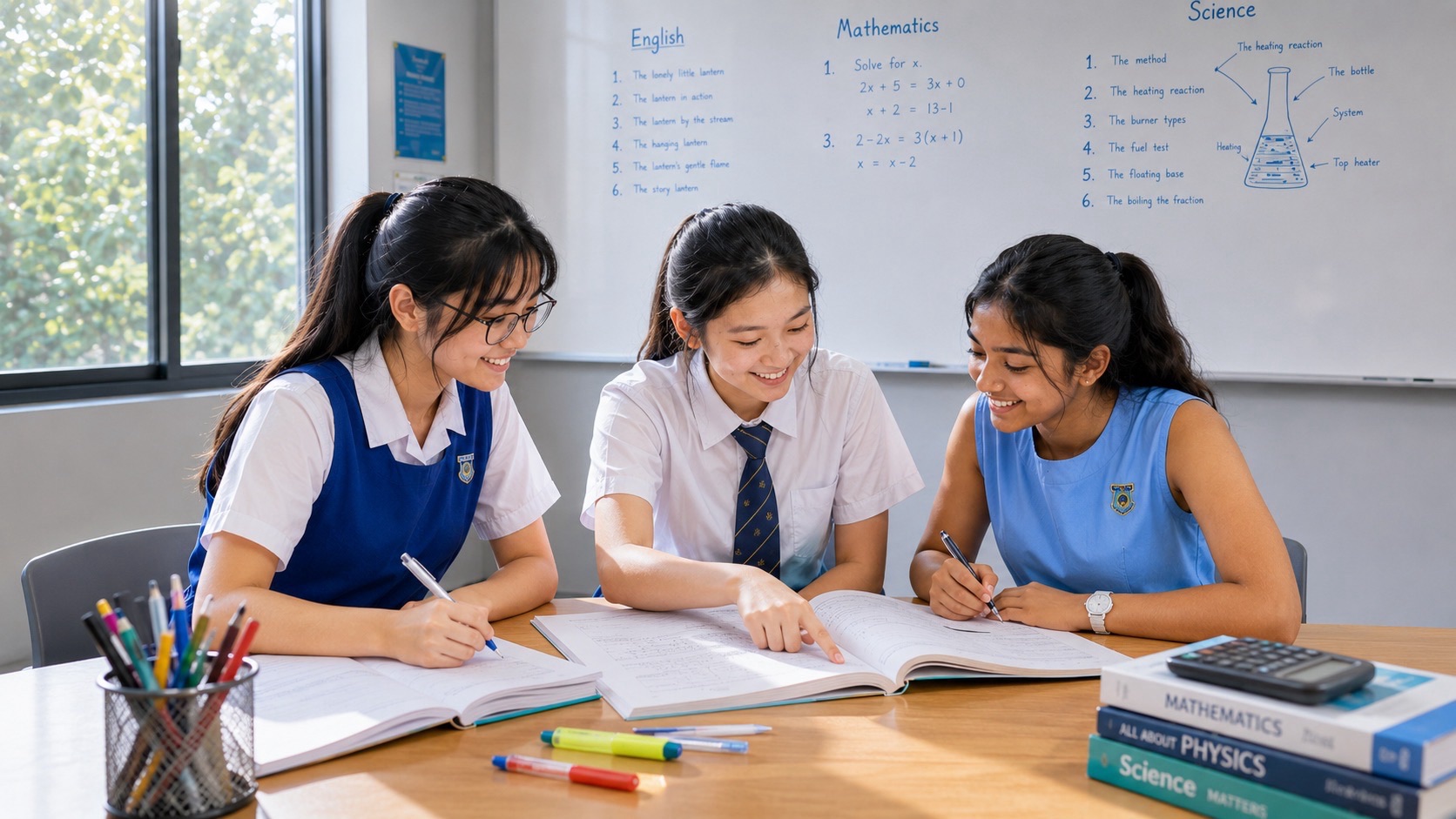
Which W–Z secondary school should a parent in Hougang, Serangoon, Bishan, Ang Mo Kio or Punggol select after the 2026 PSLE results at 11.00am on 24 November? The six choices in this guide include Xinmin, Yuying, Zhonghua, Whitley, Yio Chu Kang and Yusof Ishak. Their educational priorities range from makers and drama to arts, food innovation, communicative skills and sustainable smart cities. Historical intake scores help with planning, but do not rank teaching quality or guarantee 2027 admission.
The MOE S1 Portal opens at 11.30am on Tuesday 24 November and closes at 4.30pm on Monday 30 November 2026. First check the child’s official PG3, PG2 or PG1 eligibility, then compare real school programmes and journeys. Use up to six genuine preferences including two or three historically less stringent alternatives. An ordinary mainstream S1 posting is different from a selected arts, robotics or leadership programme, and none of these schools should be misrepresented as an ordinary IP, IB Diploma or IGCSE option.
- Area: Hougang, Kovan, Serangoon, Bishan, Ang Mo Kio, Lentor and Punggol.
- Schools: Xinmin, Yuying, Zhonghua, Whitley, Yio Chu Kang and Yusof Ishak.
- Scores: the completed 2026 S1 intake after PSLE 2025; not confirmed 2027 cut-offs.
- Groups: PG3, PG2 and PG1 are admissions routes; G1/G2/G3 describe individual subject demand.
- Programmes: common ALP/LLP learning and selected CCAs or specialist electives are distinct.
- PSLE results: Tuesday 24 November 2026, 11.00am.
- Choices: 24 November 11.30am through 30 November 4.30pm.
- Posting results: tentatively 18 December 2026, subject to later confirmation.
- Parent action: practical school fit, current campus, correct group and six sincere preferences.
Actual schools, current campuses and previous intake score ranges
| School | PG3 2026 | PG2 2026 | PG1 2026 |
|---|---|---|---|
| Xinmin Secondary School — 11 Hougang Avenue 8, Singapore 538789 | 8–13 | 21–23 | 25–28 |
| Yuying Secondary School — 47 Hougang Avenue 1, Singapore 538884 | 11–22 | 22–25 | 25–29 |
| Zhonghua Secondary School — 13 Serangoon Avenue 3, Singapore 556123 | 7–12 | 21–23 | 25–27 |
| Whitley Secondary School — 30 Bishan Street 24, Singapore 579747 | 15–22 | 22–25 | 26–30* |
| Yio Chu Kang Secondary School — 3063 Ang Mo Kio Avenue 5, Singapore 569868 | 15–22 | 23–25 | 25–30* |
| Yusof Ishak Secondary School — 8 Sumang Walk, Singapore 828676 | 7–15 | 21–22 | 25–27 |
Read each score within the child’s selected Posting Group. Lower PSLE totals mean stronger results. The last number of a range is an observed former cut-off, not a school guarantee; 30* indicates remaining places in the completed earlier PG1 exercise, not an assured 2027 opening. Verify every figure and school identity in MOE SchoolFinder.
Detailed programmes: what the ordinary pupil actually learns
Xinmin Secondary School: distinctive learning and real selection rules
MAKERS@Xinmin: AI, design and learning by making
Xinmin’s official MAKERS@Xinmin description calls it a two-year lower-secondary curriculum. All lower-secondary pupils are described as participating in hands-on analogue and digital making, learning about Artificial Intelligence ethics and applications, and collaborating on environmental or community problems. That is a specific and useful proposition for parents who want to understand the daily learning experience beyond a PSLE COP.
The programme describes designing and prototyping solutions, testing ideas, using AI tools to examine sustainability questions, coding eco-themed games and working with environmental data. A family should ask how tasks differ between Secondary 1 and Secondary 2, what an individual pupil is expected to complete and how teachers assess understanding rather than merely an attractive finished model.
A learner fascinated by AI may need to understand that an AI tool can produce plausible errors. An educationally successful makers task asks students to verify claims, show evidence, explain what they changed and judge whether a solution helps actual people. Parents can ask whether such routines are embedded in projects and whether pupils are taught not to substitute generated answers for their own thinking.
Neither coding nor making automatically guarantees a place in an advanced Computing subject later. Subject combinations, staffing and selection requirements must be checked at the relevant year level. For now, a parent can assess whether their child enjoys practical inquiry and can still build core English, Mathematics and Science skills through the experience.
RefleXions@Xinmin and the value of drama in ordinary learning
Xinmin’s lower-secondary overview identifies RefleXions@Xinmin as another signature experiential module. It uses elements of drama and performance to develop empathy, listening, critical thinking, reflection and collaborative expression. A pupil who likes writing stories may enjoy turning text into dialogue; a quieter child may grow comfortable exploring a role without being the loudest person in the room.
Parents should not confuse drama-infused learning with guaranteed selection for English Drama CCA or a performing-arts DSA place. The school-wide experiential module and a talent-based activity operate for different purposes. Ask what every pupil does and what is optional or selected. This distinction is especially important for a child who becomes anxious around public performance.
An effective drama activity has academic value when students analyse motives, evaluate different perspectives and explain how a choice affects another person. A child who can act a character but cannot articulate the evidence for a point of view still needs explicit reading and writing support. Drama is strongest when it deepens careful language and comprehension rather than replaces them.
Families can ask for a lower-secondary example: how does a scene lead into written reflection, speaking assessment or civic understanding? What happens when a child refuses to perform at first? A reassuring school answer should describe support, gradual exposure and respect for different learning styles.
Academy of Leaders, XinminCares and the meaning of school culture
The principal’s 2026 public foreword names the Xinmin Academy of Leaders and XinminCares alongside MAKERS and RefleXions. These strands point to leadership and civic contribution as part of the school’s broader curriculum. Parents should ask what participation looks like for an average Secondary 1 student rather than assuming every pupil becomes a councillor or holds a title.
A child can demonstrate leadership by helping a struggling classmate, organising group materials or taking responsibility for a task without public recognition. The family should be interested in how staff develop practical initiative, empathy and collaboration across ordinary lessons, CCAs and class responsibilities. The quality of these smaller opportunities may matter more than ceremonial leadership posts.
Xinmin also describes a talent development approach across cognitive, aesthetic, psychomotor, community and leadership domains. Ask how students are invited to develop these strengths and which advanced opportunities require their own selection criteria. Parents should resist making a promise that a listed school-wide aspiration ensures every student enters a competitive programme.
School culture should be evaluated by talking to current pupils about what happens when someone struggles, makes a mistake or needs guidance. A caring and high-expectation environment is one where children are corrected clearly and can improve without humiliation. No single official tagline can answer those questions without a real visit or conversation.
2026 intake: PG3 8–13, PG2 21–23, PG1 25–28. The campus is 11 Hougang Avenue 8, Singapore 538789. Confirm current access to advanced activities and read the full eduKate school guide.
Yuying Secondary School: distinctive learning and real selection rules
Secondary 1 Eco-Innovators: real-life food waste rather than a slogan
Yuying’s official Applied Learning Programme page names a collaboration with Singapore Institute of Technology for Secondary 1 Eco-Innovators. The work asks students to devise workable responses to food waste, including problems in the canteen. This is a specific local issue pupils can observe, measure and discuss. It is more useful for parents than the vague promise that every learner will somehow become an inventor.
A good project begins with understanding why waste happens. Children may have to watch how food is offered, think about portion choices and consider the constraints of a busy canteen. Parents can ask whether students are taught to collect evidence ethically, compare alternative solutions and explain the practical trade-offs instead of producing a poster based only on assumptions.
The page describes design thinking and critical design futures thinking. These are not a replacement for Mathematics or Science. They become valuable when pupils use accurate observations, sensible comparisons and clear writing. A child who is naturally creative may still benefit from a teacher insisting that a proposed solution must be explained and tested.
For families, the main practical question is what every first-year pupil actually experiences in the current cohort. Are there common lessons, a culminating showcase or optional extension activities? Are any products made at additional cost? An attractive collaboration does not automatically mean that every pupil receives personal mentorship from a university lecturer.
Secondary 2 food innovation and the progression towards enterprise
The published programme also describes a Secondary 2 food innovation collaboration with Super Bean International, associated with Mr Bean. Students explore ways to use soybean pulp that would otherwise be discarded to create product ideas. The connection between resource use and food design makes sustainability tangible and asks pupils to consider whether a new product is both interesting and feasible.
Parents should avoid telling a new Secondary 1 child that a particular 2026 commercial partner or workshop format is guaranteed to remain identical in 2028, when that child reaches Secondary 2. School collaborations, staff and partner arrangements can change. It is enough to know that the school currently demonstrates an applied design-thinking progression between the first two years.
An educationally strong food-innovation task should have scientific and ethical dimensions. Pupils can ask how ingredients behave, what a consumer actually wants, whether a claimed environmental benefit is supported by measurements and how to communicate the product responsibly. This is a valuable opportunity for a pupil who likes Design and Technology, Science or persuasive writing.
Some children thrive when they see a real organisation adopting or evaluating a problem, while others prefer more traditional classroom learning. The family should consider whether Yuying provides a balanced curriculum and a school culture that the child would enjoy even if one industry collaboration changes.
Yuying C.A.R.E.S: how community leadership changes with age
Yuying’s LLP is named C.A.R.E.S, meaning Collaborate, Act, Reflect, Empathise and Serve. Its 2026 programme page maps a coherent progression: Secondary 1 focuses on sustainability and the environment; Secondary 2 considers active ageing and the elderly; and later levels emphasise inclusion and wider social causes. This year-by-year structure gives parents a more credible idea of what pupils might actually do.
At Secondary 1, the school explains that students encounter the issue of food wastage firsthand and are encouraged to make better choices. A family can reinforce this learning at home without turning dinner into another test: the child might notice portion sizes, help plan leftovers or explain why food waste affects resources. A good reflection connects action to understanding.
At Secondary 2, the programme uses design thinking for projects related to ageing and older people. The first skill is listening to actual needs, not deciding for someone else what they must need. A thoughtful learner asks respectful questions and changes an idea when it is unhelpful. Parents should ask how the school protects dignity and safety during community outreach.
Later advocacy for inclusivity introduces further questions about communicating responsibly and avoiding stereotypes. Not every student will become a formal youth leader, yet every pupil can learn empathy and meaningful participation. Ask whether particular overseas service opportunities are selected or optional rather than assuming all pupils are guaranteed to travel.
2026 intake: PG3 11–22, PG2 22–25, PG1 25–29. The campus is 47 Hougang Avenue 1, Singapore 538884. Confirm current access to advanced activities and read the full eduKate school guide.
Zhonghua Secondary School: distinctive learning and real selection rules
What makes Zhonghua Secondary School a school worth inspecting
Zhonghua’s September 2026 school programme pages describe its four-year Art Elective Programme (AEP), Digital Literacy Programme, Eco Stewardship Programme, Cross-Cultural Programme, Student Leadership Programme and separately selected Talent Development Programme. AEP involvement, like TDP selection, may require an independent process or suitability check. The school’s school-choice page publishes the actual 2026 intake PG3 range as 7–12; some secondary tables report a different best-admitted number, but its PG3 COP of 12 is consistent.
A pupil deeply interested in visual art and interdisciplinary learning may have a genuine reason to explore Zhonghua; a pupil who is not interested in AEP can still evaluate its mainstream curriculum and school culture without feeling that one programme defines every student. That is a positive school-fit hypothesis, not a ranking claim. Parents can test it with real examples: how subjects are taught, what happens when an activity is oversubscribed, which pupils receive enrichment and how student well-being is managed during the transition.
The school’s published programmes are a starting point. They do not replace an open-house conversation, a subject selection briefing or the school’s official admissions information. A child should be able to explain what attracts them to the environment in ordinary words rather than simply repeating a promotional slogan. If the child cannot identify anything appealing apart from a reputation or a familiar name, the family may have more useful research to do before putting it first.
Think of school quality as an experience lived over several years. The right school is one where a child can attend reliably, learn from feedback, join a community, explore authentic strengths, and build a path forward. It is not necessarily the school whose previous last-admitted student had the lowest numerical PSLE Score.
A closer look at the school’s educational opportunities
the Art Elective Programme and broader digital literacy, sustainability, culture and talent-development programmes deserves a closer look because the decision has to concern the actual pupil. Art-loving children should ask to see examples of AEP workload, portfolio development and assessed work. Parents should also test whether the time needed for studio and exhibitions fits their child’s other needs and friendships.
Zhonghua also advertises 2026 DSA areas including sports, performing arts and leadership. Those opportunities do not make it an IP school or guarantee a student access to an arts place after posting. Co-curricular programmes may require selection, regular training or costs. Parents should ask about attendance expectations and whether alternative CCAs support the same interest if the first choice is full.
Some school programmes are whole-cohort experiences; others are selective, require an application or operate at a different year level. Distinguish these before telling a child that admission to Zhonghua Secondary School automatically grants access to a named elective, special group or talent pathway. A useful question is: ‘For my child entering Secondary 1 through the indicated Posting Group, which components are part of everyday curriculum, and which require separate selection?’
Children’s interests may change. A pupil enthusiastic about art or sports in November may discover another passion in Secondary 2. When comparing schools, look at the range of ordinary learning opportunities and adult support, not only a single signature. The strongest reason to attend is a workable overall environment with room to adapt.
The Serangoon commute can outweigh a tiny difference in historical COP
Zhonghua’s official contact page identifies Serangoon MRT and several buses as access routes to its Serangoon Avenue 3 campus. A family living near Serangoon Central may have a different journey from someone coming from Serangoon North or far-flung Hougang.
Do a whole commute test that includes the walk from MRT or bus stop, morning crowding and the return trip after CCA. Do not assume ‘Serangoon’ means the school is within walking distance of every Serangoon address.
Serangoon has several secondary schools clustered on different roads, but a shorter map distance does not eliminate a busy junction, bus wait or school-day travel barrier. A journey becomes part of a child’s education because it affects sleep, breakfast, punctuality, energy for lessons, social confidence and the capacity to remain for CCA or extra help.
Do a realistic rehearsal, not a tourist journey. Start from home during a normal school-morning period, include the time for lifts, walking, bus intervals and entry into school, then make the return journey after a longer day. Record not only the fastest time but also an ordinary, repeatable time and what happens when the child misses a connection. A pupil who is tired every day may get less benefit from an otherwise appealing activity programme.
Practical travel is not the same as choosing the geographically nearest school at any cost. A slightly longer direct MRT or bus journey may be easier than a short distance involving several transfers. Equally, a nearby environment may be wrong for a child whose needs or interests are better supported elsewhere. Use a timetable and the child’s experience to compare rather than an abstract distance ranking.
2026 intake: PG3 7–12, PG2 21–23, PG1 25–27. The campus is 13 Serangoon Avenue 3, Singapore 556123. Confirm current access to advanced activities and read the full eduKate school guide.
Whitley Secondary School: distinctive learning and real selection rules
Communicative Arts: why a one-minute vlog can be a real lesson
Whitley’s programme page describes a deliberate sequence. At Secondary 1, pupils use their personal learning devices and a news-making tool to create a one-minute vlog with a partner. Secondary 2 develops the more demanding skill of interviewing a peer, and Secondary 3 pairs students for a short talk show followed by audience questions. Parents should ask how teachers judge the quality of research and explanation, not simply video production polish.
A pupil may enjoy speaking but struggle to select reliable information. Another may research carefully but feel anxious when recorded. The programme gives teachers a reason to work on both kinds of need: evaluating sources and communicating clearly. Parents should ask whether pupils can practise privately first and how teachers encourage quieter learners without humiliating them.
When students move to interviews, listening becomes as important as speaking. A thoughtful interviewer asks a specific question, responds to the answer and invites clarification rather than reading a prepared script without attention. A parent can test this at home by inviting the child to interview someone about a hobby and writing a five-sentence summary with accurate details.
By Secondary 3, the question-and-answer session adds a higher-order skill: using evidence and responding fairly when someone disagrees. These are useful capabilities across science presentations, humanities discussions and eventually post-secondary interviews. They do not automatically confer a specialist language qualification; the programme is part of the school’s broader educational experience.
Active Citizenship for Social Change: a leadership opportunity beyond titles
Whitley’s official school page names its Community Youth Leadership Learning for Life Programme ‘Active Citizenship for Social Change’. It aims to nurture empathy and community action, extending beyond token volunteer hours. A helpful question is whether a student can describe the needs of the people they hope to help, rather than merely report that a class completed a service project.
Parents should distinguish student leadership by example from selected offices. An ordinary Secondary 1 pupil might work with classmates on a values-in-action activity without being a student councillor. A confident speaker might be invited to present; a quiet pupil might organise materials or notice how to make participation accessible. Both can grow through constructive feedback.
Community work can strengthen school subjects when students use Mathematics to plan resources, English to prepare clear messages and the humanities to understand the people affected. Ask Whitley for an age-appropriate first-year example and how the project avoids treating beneficiaries as props for student achievements.
The school advertises 2026 DSA areas in debating and public speaking and in leadership and character. Those early-year admission routes are distinct from ordinary S1 posting in November. A child who enjoys the same areas but did not apply through DSA can still investigate the school’s broad student activities; they must not assume a special DSA place has appeared.
GEAR-UP and why after-school support should be checked carefully
Whitley’s GEAR-UP page describes opportunities such as a welcoming after-school CABIN, ceramics, cooking, making, music and physical activity. The descriptions give a useful window into the school’s support philosophy, but some details originate in earlier years. Families should confirm the 2027 timetable, places and operating arrangements before relying on a named activity.
A pupil who is nervous about friendships may value a supervised place to meet classmates, while one who enjoys making useful objects may prefer ceramics or design fabrication. These experiences can strengthen patience, communication and problem-solving. They are not substitutes for tuition in a subject the pupil has not understood, nor are they promises of guaranteed after-school supervision for every student.
Whitley’s 2026 open-house notice invites families on Saturday 21 November, 8.30am to 12.30pm—before the result-release day. A family able to attend can ask to see the normal school environment. If the date has passed when the article is read, use the official school contact channel instead of assuming another visit is automatically available.
2026 intake: PG3 15–22, PG2 22–25, PG1 26–30*. The campus is 30 Bishan Street 24, Singapore 579747. Confirm current access to advanced activities and read the full eduKate school guide.
Yio Chu Kang Secondary School: distinctive learning and real selection rules
Technological Sustainability: Applied Learning Programme and real problem solving
Yio Chu Kang Secondary’s Applied Learning Programme develops inquiring minds through technology and STEM. Its current official description calls the thematic emphasis Technological Sustainability: students use coding and related technical knowledge to consider community problems and design better solutions. The Secondary 1 exposure and Secondary 2 experience sequence should be inspected before assuming that every child joins an advanced engineering competition.
The school names its Mechatronics, Aeronautical and Robotics Club, external competitions, polytechnic Advanced Elective Modules at later levels and mentoring as ways interested pupils can deepen learning. These are possible further opportunities rather than standard qualifications given to every school entrant. A family should distinguish ordinary ALP learning from an individual club or DSA selection outcome.
Real robotics learning asks a pupil to identify what a sensor measures, why a mechanism fails and how to alter the code after testing. An impressive drone demonstration is not evidence that every viewer has mastered the underlying science. Parents can ask teachers for an example of the written reasoning that accompanies a practical challenge and how beginners are supported.
Children with strong technical interests still need careful English comprehension, Mathematics fluency and a habit of checking evidence. Programming may increase motivation to learn these subjects; it cannot replace them. A parent should choose the school for its broad teaching and relationships, not on the assumption that a talented child will automatically be fast-tracked into a specific competition.
Arts, Media and Design: the Secondary 1 module sequence
Yio Chu Kang’s Learning for Life Programme offers Arts, Media and Design (AMD). Its published plan is unusually explicit: Secondary 1 students experience five modules, including modern dance, drama, rock and pop music, short film production and interior design. The school says pupils reflect on overcoming challenges while learning a new artistic skill.
At Secondary 2, students can specialise in a chosen module during curriculum time and later demonstrate the results in an AMD showcase. This progression is not the same as a promise of entry to a professional arts institution, an IB programme or an automatic elective examination route. It gives children a structured chance to discover which kind of creation they enjoy.
A pupil who loves editing short films can learn the importance of audience, sequence and a precise story; someone interested in design can learn to observe constraints and explain choices. Drama and dance can build collaboration and confidence, including for students who start out nervous. Ask teachers what adjustments help a pupil who finds performance uncomfortable.
Schools sometimes present spectacular showcases in marketing material. The educational test is what every student did before the show: practise, receive feedback, analyse a creative decision and respect the contributions of classmates. Parents should ask whether ordinary learners experience all five modules in the current 2027 plan, and which opportunities require later selection.
FITA, service learning and looking beyond technology
The school’s distinctive-programme index identifies From Ideas to Action (FITA), which combines STEM-related ideas with interdisciplinary problem-solving, and a separate Secondary 3 Service Learning through Issue Investigation strand. These offer useful future learning directions, but parents should confirm the exact sequence for their child’s future cohort.
A Secondary 1 pupil who learns how to describe a community problem can eventually use the same framework to investigate a social issue or build an engineering response. The valuable skill is identifying a real need and testing a claim. Parents can ask for evidence of how the school connects applied work to Science explanation, Mathematics data and responsible language.
Do not make a four-year choice solely because a later Secondary 3 module sounds exciting. A child’s interests will develop. Test the school’s ordinary teachers, form-class experience, subject-level arrangements and CCAs to see whether the learner would flourish even if an individual later opportunity changes.
Practical school projects should be manageable. A pupil with a demanding club rehearsal and a heavier G-level subject may need help prioritising, while a child with spare capacity might gain from a competition. A school with many opportunities is a good fit when it also guides learners toward an appropriate workload.
2026 intake: PG3 15–22, PG2 23–25, PG1 25–30*. The campus is 3063 Ang Mo Kio Avenue 5, Singapore 569868. Confirm current access to advanced activities and read the full eduKate school guide.
Yusof Ishak Secondary School: distinctive learning and real selection rules
The right campus: Sumang Walk, not the old Bukit Batok address
Yusof Ishak Secondary’s official current contact page confirms 8 Sumang Walk, Singapore 828676. This is important because older web pages and archived school publications refer to a former campus in Bukit Batok. For a Primary 6 family selecting schools for January 2027, the live Punggol address is the one to use. A school-name search that returns an old address can quietly invalidate a transport comparison.
The current school page lists Punggol MRT, Soo Teck and Sumang LRT stations as useful connections, as well as bus routes including 39, 43, 118, 381 and 382 variants at nearby stops. Parents should check up-to-date routes from their own HDB block and the actual school entrance. A route is not convenient merely because the home and school share a Punggol postcode.
For a family in western Punggol, the journey may be straightforward; a pupil from Punggol North or the far east of the estate may face more travel than expected. A child travelling from Sengkang may find a different secondary school nearer, while still reasonably preferring Yusof Ishak because of its programme focus. Rehearse peak morning and later CCA journeys before deciding.
The school is a co-educational mainstream institution rather than a new international school simply because it has a modern Punggol campus. Its ordinary Secondary 1 posting offers PG3, PG2 and PG1. The campus move changes geography, not the educational definitions of IP, IB or IGCSE.
S4TEM@YI: what sustainable smart-city learning looks like
Yusof Ishak’s Applied Learning Programme is called S4TEM@YI—STEM for the Strategic Development of a Sustainable and Smart City. Its July 2026 page describes school-wide learning involving urban farming, coding and aeronautics, together with interdisciplinary opportunities focused on sustainability. The school connects this work with the Singapore Green Plan 2030 and wider environmental questions.
The distinctive value lies in combining technical knowledge with a real community problem. A pupil may investigate a growing system, examine how an urban environment uses energy or consider how technology helps residents. A thoughtful project requires more than using a device: students need to collect evidence, weigh trade-offs and explain their choices clearly. Parents can ask how Secondary 1 pupils are guided through these steps.
The school describes a STEM Experience through Interdisciplinary Work initiative, STEMx IPW. It is meant to help pupils connect separate subjects and understand problems that do not arrive neatly labelled as Science or Mathematics. For example, an urban farming problem can involve plant biology, water use, data interpretation and ethical questions about resources. The school should be able to explain how that integration strengthens core curriculum learning.
Parents should distinguish common school-wide exposure from STEM Club, Robotics Club and external competitions. Competition achievements on the school site mostly describe previous participating teams, not something automatically won or experienced by every 2027 entrant. A child attracted to advanced robotics should ask about how CCA places are allocated and what the ordinary S1 baseline actually covers.
2026 intake: PG3 7–15, PG2 21–22, PG1 25–27. The campus is 8 Sumang Walk, Singapore 828676. Confirm current access to advanced activities and read the full eduKate school guide.
Six local school-choice decisions
PG3 score 12–15: three historically selective choices
Zhonghua’s previous PG3 COP was 12, Xinmin’s 13 and Yusof Ishak’s 15. A child with PG3 score 14 was historically beyond the first two former boundaries and stronger than Yusof Ishak’s old 15. This does not determine the next intake. The pupil may be more interested in AEP at Zhonghua, MAKERS at Xinmin or sustainable STEM at Yusof Ishak, but the family must preserve realistic alternatives.
The next action is to check the pupil’s officially selected Posting Group, a current school programme page and the actual journey. The previous completed 2026 cutoff is a reference, not a reserved seat. A child needs the broader school experience to remain a good fit even if an advanced selected opportunity is unavailable.
PSLE score 22: choosing PG2 or PG3 before comparing schools
A score of 22 may allow a family to choose PG2 or PG3. Under PG2, Yusof Ishak’s previous COP was 22, Xinmin and Zhonghua had 23, while Whitley, Yio Chu Kang and Yuying had 25. In PG3 those schools recorded different boundaries. The group choice should be informed by subject readiness rather than calculated as a way to bypass a preferred school’s admissions.
The next action is to check the pupil’s officially selected Posting Group, a current school programme page and the actual journey. The previous completed 2026 cutoff is a reference, not a reserved seat. A child needs the broader school experience to remain a good fit even if an advanced selected opportunity is unavailable.
AEP, MAKERS and sustainable-city STEM are different learning experiences
Zhonghua’s AEP has a school-based selection process, Xinmin’s MAKERS includes common lower-secondary learning, and Yusof Ishak’s smart-city STEM has separate opportunities beyond general curriculum. Parents should ask what every Secondary 1 student does and what only some are selected to join. A school preference should remain worthwhile even if a child does not secure a specialist activity.
The next action is to check the pupil’s officially selected Posting Group, a current school programme page and the actual journey. The previous completed 2026 cutoff is a reference, not a reserved seat. A child needs the broader school experience to remain a good fit even if an advanced selected opportunity is unavailable.
PG1 30*: a vacancy footnote, not a guarantee
Whitley and Yio Chu Kang previously recorded PG1 30* because places remained in that exercise. An eligible student with score 29 or 30 cannot treat the asterisk as a current offer. Check the official English and Mathematics AL eligibility condition for the PG1 route at scores 26–30, then examine academic support and the actual home-to-school journey.
The next action is to check the pupil’s officially selected Posting Group, a current school programme page and the actual journey. The previous completed 2026 cutoff is a reference, not a reserved seat. A child needs the broader school experience to remain a good fit even if an advanced selected opportunity is unavailable.
A north-east commute needs a specific home address
Xinmin is on Hougang Avenue 8, Yuying Avenue 1, Zhonghua in Serangoon, Whitley in Bishan, Yio Chu Kang in Ang Mo Kio and Yusof Ishak on Sumang Walk in Punggol. These campuses are not equally close to every north-east household. Time the normal school morning and after-CCA return rather than relying on one regional label.
The next action is to check the pupil’s officially selected Posting Group, a current school programme page and the actual journey. The previous completed 2026 cutoff is a reference, not a reserved seat. A child needs the broader school experience to remain a good fit even if an advanced selected opportunity is unavailable.
How to build an acceptable six-choice list
A family can rank a sincere ambitious school highly while including two or three historically less stringent and genuinely acceptable choices. The child should be able to explain what they like about every shortlisted school, and the parent should verify the actual campus, co-curricular options and academic support. Previous cut-offs cannot be turned into exact admission odds.
The next action is to check the pupil’s officially selected Posting Group, a current school programme page and the actual journey. The previous completed 2026 cutoff is a reference, not a reserved seat. A child needs the broader school experience to remain a good fit even if an advanced selected opportunity is unavailable.
The role of Full Subject-Based Banding after posting
PSLE Scores 21 and 22 can provide a PG2/PG3 option and score 25 a PG1/PG2 option. Posting Group determines the initial school admission route, while individual G1, G2 and G3 subject levels may vary where national criteria are met. The child’s official S1 form and the receiving school’s subject offers are decisive. A pupil with strong Science and weaker English needs different support from one with the same total but reversed strengths.
The Singapore-Cambridge Secondary Education Certificate begins replacing the former N- and O-Levels from 2027 for graduating cohorts. A child entering Secondary 1 in 2027 will study over several years before graduation. The school should explain subject choices and possible level reviews rather than promise an examination outcome based on the PSLE total.
The confirmed 2026 posting timetable and first-month check
24 November at 11.00am: PSLE results are released through the primary school. 24 November at 11.30am: the S1 Portal opens. 30 November at 4.30pm: the choice window closes; keep successful submission confirmation. 18 December, tentative: the S1 Posting result is expected, subject to MOE confirmation.
In the first month of Secondary 1, parents can check Depth, Load and Transfer. Depth asks whether a pupil understands a concept, Load whether assignments and travel are manageable, and Transfer whether knowledge can be used in unfamiliar problems. A child who understands Maths but loses homework needs a different repair from one who copies a formula without understanding it.
Parent FAQ
Does matching last year’s COP guarantee a place?
No. Current scores, places and choice rankings determine the outcome.
What does PG1 30* mean?
Vacancies remained in the previous exercise, not guaranteed future entry.
Can a PG2 child study a G3 subject?
Individual higher-demand subject offers can apply where MOE criteria are met.
Does a school ALP create an IP or IB route?
No. A distinctive learning programme is different from those qualifications.
Does choice order matter?
Yes, as a tie-breaker after citizenship for equal-score applicants.
When do choices close?
Monday 30 November 2026 at 4.30pm.
When is posting announced?
Tentatively Friday 18 December 2026, pending MOE confirmation.
Official sources
- SEAB and MOE confirmed PSLE results and S1 dates
- MOE S1 Posting
- MOE SchoolFinder
- MOE Full Subject-Based Banding
- eduKate Singapore complete school finder
- Clementi guide reference
Editorial date: 18 November 2026. School score ranges reflect the completed 2026 intake after PSLE 2025, not fixed 2027 cut-offs. Programme offerings and campus arrangements should be confirmed with MOE and the school.