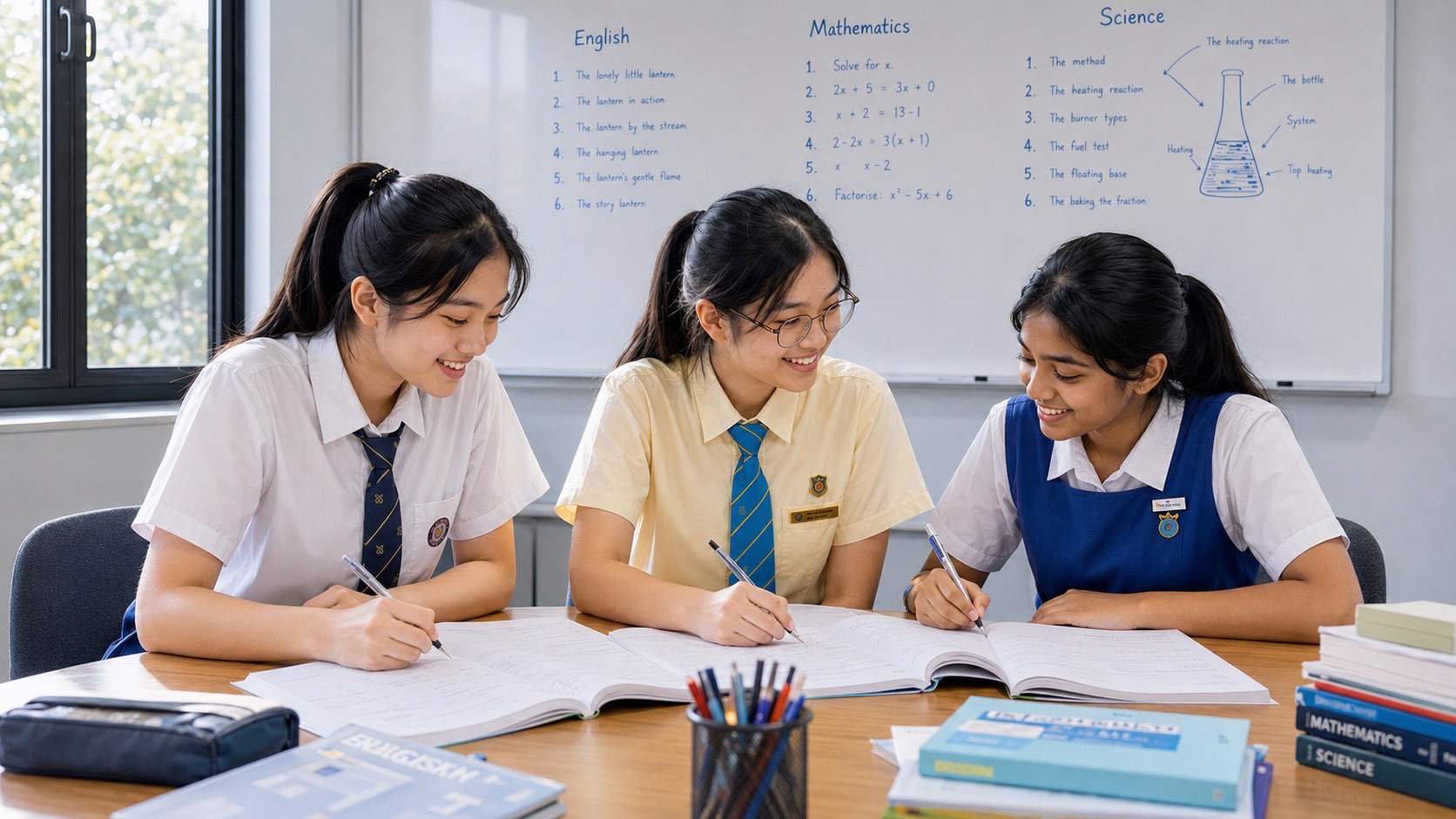
Which secondary school should parents in Bukit Panjang, Senja, Jelapang, Bangkit and Petir choose after PSLE results on Tuesday, 24 November 2026 at 11.00am? West Spring and Zhenghua offer two different ways to make learning practical. The former specialises in sustainability advocacy and community youth leadership; the latter brings accessible transport design and outdoor learning into its curriculum. Their previous PG3 cut-offs were 17 and 20, while PG2 was 24 at both and PG1 was 27 at both. The previous cohort’s admission figures do not make the two schools interchangeable or guarantee a place in 2027. All school score ranges in this guide are from the completed 2026 Secondary 1 intake after PSLE 2025, not the as-yet-unknown cut-offs for the January 2027 cohort. A school posting and selection into an advanced programme are also different steps.
Families should begin with the child’s actual Posting Group and subject ALs, then consider ordinary teaching, school culture, distinctive programmes and a repeatable journey from home. The MOE S1 Portal opens at 11.30am on 24 November and closes at 4.30pm on Monday, 30 November 2026. Parents can rank up to six genuine preferences, with two or three historically less-stringent alternatives, as MOE advises. These schools operate mainstream PG3, PG2 and PG1 routes, not ordinary IP, IB Diploma or IGCSE admission.
- Area: Bukit Panjang, Senja, Jelapang, Bangkit and Petir.
- Schools compared: West Spring Secondary School; Zhenghua Secondary School.
- Historical data: completed 2026 Secondary 1 intake following PSLE 2025, not fixed 2027 cut-offs.
- Admission: PG3, PG2 or PG1 as stated on the pupil’s official form.
- Full SBB: G1, G2 and G3 are levels of individual subjects, not identical to Posting Groups.
- Programme condition: distinguish common school activities from separately selected clubs and electives.
- PSLE results: 24 November 2026 at 11.00am; S1 Portal opens at 11.30am.
- School-choice deadline: Monday, 30 November 2026 at 4.30pm.
- Posting outcome: tentatively Friday, 18 December 2026, pending confirmation.
School names, current campuses and previous Posting Group ranges
| School / campus | PG3 previous range | PG2 previous range | PG1 previous range |
|---|---|---|---|
| West Spring Secondary School — 61 Senja Road, Singapore 677737 | 11–17 | 21–24 | 25–27 |
| Zhenghua Secondary School — 62 Bukit Panjang Ring Road, Singapore 679962 | 14–20 | 21–24 | 25–27 |
The first value in a school’s previous range is the strongest admitted PSLE Score, not the minimum score needed to apply; the final value is the historical last-admitted cut-off point. Lower PSLE Scores mean stronger results. The same number in two rows does not mean equal chance or the same teaching. An asterisk such as 30* denotes unused places in the former exercise, not a guaranteed 2027 opening.
What the pupil would actually learn at each school
West Spring Secondary School: undefined
The operating school address is 61 Senja Road, Singapore 677737. The completed 2026 S1 intake recorded PG3 11–17, PG2 21–24 and PG1 25–27. A family must use the child’s official selected group and check the daily school journey, not treat all the numbers as equivalent routes.
What makes West Spring Secondary School a school worth inspecting
The principal’s 2026 foreword describes an Applied Learning Programme refocused in 2024 on advocating for sustainability and helping pupils solve real-world environmental problems. Its Learning for Life Programme in Community Youth Leadership emphasises empathy, compassion and student-led projects. Parents should distinguish the programmes’ stated aims from a guarantee that every pupil gets the same project or leadership position.
A child who prefers applied environmental tasks, service activities, varied CCAs and a campus near Senja may find meaningful reasons to examine West Spring beyond its cut-off point. That is a positive school-fit hypothesis, not a ranking claim. Parents can test it with real examples: how subjects are taught, what happens when an activity is oversubscribed, which pupils receive enrichment and how student well-being is managed during the transition.
The school’s published programmes are a starting point. They do not replace an open-house conversation, a subject selection briefing or the school’s official admissions information. A child should be able to explain what attracts them to the environment in ordinary words rather than simply repeating a promotional slogan. If the child cannot identify anything appealing apart from a reputation or a familiar name, the family may have more useful research to do before putting it first.
Think of school quality as an experience lived over several years. The right school is one where a child can attend reliably, learn from feedback, join a community, explore authentic strengths, and build a path forward. It is not necessarily the school whose previous last-admitted student had the lowest numerical PSLE Score.
A closer look at the school’s educational opportunities
the school’s Advocating for Sustainability Applied Learning Programme and Community Youth Leadership Learning for Life Programme deserves a closer look because the decision has to concern the actual pupil. A family can ask whether sustainability learning occurs as class-based projects, elective opportunities, or wider school events, and how the school supports a shy new Secondary 1 pupil who does not yet see themselves as a leader.
Badminton, football, choir and shooting feature in West Spring’s 2026 DSA areas, but the availability of a DSA talent area is not a promise of admission through ordinary S1 posting or an automatic CCA place. Co-curricular programmes may require selection, regular training or costs. Parents should ask about attendance expectations and whether alternative CCAs support the same interest if the first choice is full.
Some school programmes are whole-cohort experiences; others are selective, require an application or operate at a different year level. Distinguish these before telling a child that admission to West Spring Secondary School automatically grants access to a named elective, special group or talent pathway. A useful question is: ‘For my child entering Secondary 1 through the indicated Posting Group, which components are part of everyday curriculum, and which require separate selection?’
Children’s interests may change. A pupil enthusiastic about art or sports in November may discover another passion in Secondary 2. When comparing schools, look at the range of ordinary learning opportunities and adult support, not only a single signature. The strongest reason to attend is a workable overall environment with room to adapt.
The Bukit Panjang commute can outweigh a tiny difference in historical COP
Families around Senja and Jelapang may have a practical daily route through Bukit Panjang; families coming from Yew Tee or farther sections of Choa Chu Kang should check the actual morning journey, not just the broad West Zone label.
A school that looks close on a planning-area map can still require a feeder bus, LRT connection, sheltered walking or multiple road crossings. Do the school-day journey from your own block and include weather, peak-hour crowding and CCA dismissal.
A child who can walk or take one predictable local transport leg to Senja Road may gain time for homework and sleep; a similar-ranking school with multiple interchanges could cost more energy each week. A journey becomes part of a child’s education because it affects sleep, breakfast, punctuality, energy for lessons, social confidence and the capacity to remain for CCA or extra help.
Do a realistic rehearsal, not a tourist journey. Start from home during a normal school-morning period, include the time for lifts, walking, bus intervals and entry into school, then make the return journey after a longer day. Record not only the fastest time but also an ordinary, repeatable time and what happens when the child misses a connection. A pupil who is tired every day may get less benefit from an otherwise appealing activity programme.
Practical travel is not the same as choosing the geographically nearest school at any cost. A slightly longer direct MRT or bus journey may be easier than a short distance involving several transfers. Equally, a nearby environment may be wrong for a child whose needs or interests are better supported elsewhere. Use a timetable and the child’s experience to compare rather than an abstract distance ranking.
Worked example: a child with PG3 score 16
Imagine a hypothetical pupil from Senja, Jelapang, Bukit Panjang and nearby Choa Chu Kang who receives PSLE Score 16 and is eligible for PG3. That score is numerically better than West Spring Secondary School’s historical PG3 COP of 17. This makes the school a reasonable candidate to research, not a guaranteed posting. The family should consider the pupil’s own enjoyment of the school’s Advocating for Sustainability Applied Learning Programme and Community Youth Leadership Learning for Life Programme and the school-day travel plan.
A parent might be tempted to put West Spring Secondary School first automatically because its name is familiar. A better conversation asks: ‘What do you like about this particular school? What is the first day likely to feel like? What would we do if the places at this score were filled?’ Then look at Zhenghua Secondary School and Greenridge Secondary School, whose historical PG3 COPs were 20 and 22. Which is genuinely worth attending? Which would the student rank higher after comparing daily life rather than an adult’s prestige expectations?
For a score near a COP, do not turn one year’s observed number into a precise probability. Citizenship, choice order and demand for available places enter the actual posting process. A school can be worth including as an ambition while the list also protects the child from exhausting all six choices on similarly competitive options. The result is a prepared set of preferences, not a prediction of who will win a last-place tie.
Worked example: a child with PG2 score 23
A different child might receive PSLE Score 23 and use Posting Group 2. The relevant previous figure at West Spring Secondary School is PG2 COP 24, not the more selective PG3 COP 17. Here the score is numerically stronger than the 2026-intake PG2 cut-off. That single comparison helps set the direction of investigation but does not remove uncertainty about the current cohort.
This parent should compare PG2 routes at the other realistically reachable schools, check whether the child qualifies for particular subjects at a more demanding G level, and ask how the first term is supported. The family should not decide that PG2 means every child will study all subjects at one unchangeable demand level. Students can have different strengths in English, Mathematics, Science and Mother Tongue.
For an ordinary first-year child, ask how the school’s undefined is integrated with teaching and whether it remains a good fit without selected competitions, leadership posts or specialist electives. Read the full individual eduKate school profile and confirm programme availability from the current school website.
Zhenghua Secondary School: undefined
The operating school address is 62 Bukit Panjang Ring Road, Singapore 679962. The completed 2026 S1 intake recorded PG3 14–20, PG2 21–24 and PG1 25–27. A family must use the child’s official selected group and check the daily school journey, not treat all the numbers as equivalent routes.
Reading PG3 at Zhenghua: when the historical comparison helps
The completed 2026 intake’s PG3 range was 14–20. The previous cut-off, 20, records the weakest PSLE Score among children posted through that group. A child with a numerically lower score than 20 is historically stronger than the previous last admitted pupil. That can make the school a plausible consideration, but it does not remove ties, changing preferences or the possibility that this year’s final cut-off will move.
A child whose score matches 20 should not read the figure as a confirmed threshold they have cleared. Another cohort may produce a different COP, and tie-breaks can matter around the last available place. A child with a higher numerical score should not treat the previous result as a personal judgement. The family can investigate West Spring Secondary School or other schools whose previous PG3 scores align differently, while still respecting the young person’s interests.
Strong families also compare daily experience. A pupil curious about accessible transport design, environmental exploration and outdoor resilience may benefit from a school that uses that curiosity to build reading, reasoning, teamwork and persistence. That same pupil should be supported in ordinary Mathematics, English, Science and the humanities. A distinctive school programme is a useful reason to visit, not a substitute for assessing academic support.
When comparing a PG3 option, write down two pieces of evidence beyond the COP: a confirmed school programme your child actually wants and a practical school-day journey. If the child cannot name either, the family may be relying on a ranking or somebody else’s preference rather than choosing for this learner.
Future of Transportation: applied learning that links design to empathy
Zhenghua’s current Applied Learning Programme is explicitly described as Future of Transportation. Students use design thinking and explore mobility needs, accessibility and transport improvements. The school’s September 2026 material describes the use of AI tools to refine real-world problem statements, including the needs of people with disabilities. This is a tangible topic for a child who enjoys building, observing and improving solutions.
The most educational moment in such a programme is often before a prototype is made. A pupil needs to ask whom the design serves, what difficulty those people actually face and how evidence could test a proposed improvement. Parents can ask whether students interview or observe potential users responsibly, read technical constraints and reconsider an early idea that does not work.
Mathematics and Science foundations become practical here: time, distance, motion, graphs, measurement, comparison and engineering trade-offs may all arise. English is equally important because a child needs to write a clear problem statement and present why a design might help. The signature topic can strengthen core subject meaning but should never be assumed to replace full academic instruction.
Families should ask which Future of Transportation experiences are school-wide and which involve selected students, competitions or additional enrichment. A pupil eager to use AI should understand that generated output requires verification. Strong learning is visible in the child’s reasoning, not simply the sophistication of the digital tool.
Outdoor learning: what Zhenghua actually describes for each year
Zhenghua’s Learning for Life Programme is Outdoor Education for character and leadership development. The school publishes a progressive four-year journey. At Secondary 1, Inter-Disciplinary Trails explore Singapore’s historic blue and green spaces and trip planning. At Secondary 2, pupils engage in orienteering at Zhenghua Nature Park. At Secondary 3, the description includes a four-day, three-night expedition camp.
The year-by-year distinctions matter. A parent should not tell a new Secondary 1 child that they must immediately complete an expedition camp; that is a later-stage experience in the school’s published framework. Instead ask how pupils build navigation skills, teamwork, confidence, safety awareness and respect for nature gradually.
For a child nervous about camping or physical activity, the useful parent question is how the school prepares pupils and supports different needs, not whether the experience can be avoided on a whim. A child who is enthusiastic outdoors may flourish, but teachers also need to communicate safety procedures and reasonable adaptations where appropriate.
Outdoor work is another form of academic learning when pupils plan routes, interpret maps, calculate time, observe environments and reflect on teamwork. The value is not simply that children spend time outside. Parents should listen for how each activity helps pupils make decisions, review mistakes and become considerate of others.
Ziesta, local heritage and the place of experiential learning
Zhenghua presents Ziesta as a signature experiential programme anchored in its Applied Learning and Learning for Life Programmes. Its Secondary 1 description points to sustainability, cultural heritage and reflective learning. Ziesta is associated with the beginning of Term 2 in the school’s information, but parents should verify the exact 2027 schedule rather than copying a 2026 calendar date.
A student may learn about Bukit Panjang’s surroundings, transport systems or Singapore’s cultural landscape through outdoor and interdisciplinary tasks. Parents can ask for examples of a worksheet or reflection task and how teachers connect the experience to a conventional subject lesson. A meaningful field experience should leave students better able to ask questions and explain evidence.
Zhenghua’s student-development materials emphasise dynamic learners, exemplary leaders and thoughtful contributors. Those aims gain substance when all children—including those not elected as leaders—can take responsibility for small tasks. Ask what ordinary class members do during planning and how pupils receive feedback on teamwork.
The community surrounding Zhenghua can become a resource rather than merely the school’s address. A parent can explore whether the pupil finds the surrounding parks, pathways and mobility questions intrinsically interesting. The child also needs to enjoy ordinary lessons, classmates and the school rhythm; enthusiasm for one event is not enough to sustain four years.
For an ordinary first-year child, ask how the school’s undefined is integrated with teaching and whether it remains a good fit without selected competitions, leadership posts or specialist electives. Read the full individual eduKate school profile and confirm programme availability from the current school website.
Five important school-choice comparisons for this estate
Parents should time both school routes from their actual block. Senja Road and Bukit
Parents should time both school routes from their actual block. Senja Road and Bukit Panjang Ring Road are not the same campus; a Jelapang or Bangkit family may find one route much simpler. Include the bus wait, final walk and late CCA return.
The family can turn this into a practical comparison by writing each school’s historical cut-off in the correct Posting Group, the actual door-to-gate route, and one positive reason the child wants to attend. If a programme is selected, ask what ordinary first-year students experience. An attractive school photograph is not evidence of a guaranteed specialist place.
The old PG3 comparison changes with the pupil’s score. At PG3 score 16, both former c
The old PG3 comparison changes with the pupil’s score. At PG3 score 16, both former cut-offs are numerically less stringent; at 18, West Spring’s 17 is historically more competitive than Zhenghua’s 20. Neither difference generates a reliable admission probability.
The family can turn this into a practical comparison by writing each school’s historical cut-off in the correct Posting Group, the actual door-to-gate route, and one positive reason the child wants to attend. If a programme is selected, ask what ordinary first-year students experience. An attractive school photograph is not evidence of a guaranteed specialist place.
Both schools previously had PG2 COP 24 and PG1 COP 27. A child with either relevant s
Both schools previously had PG2 COP 24 and PG1 COP 27. A child with either relevant score needs an actual educational reason to rank one above the other, because the score table alone does not separate them.
The family can turn this into a practical comparison by writing each school’s historical cut-off in the correct Posting Group, the actual door-to-gate route, and one positive reason the child wants to attend. If a programme is selected, ask what ordinary first-year students experience. An attractive school photograph is not evidence of a guaranteed specialist place.
West Spring’s sustainability advocacy may suit a student who likes communicating and
West Spring’s sustainability advocacy may suit a student who likes communicating and serving the local community, while Zhenghua’s mobility design may appeal to a pupil who enjoys prototyping and outdoor route planning. These are interests, not intelligence rankings.
The family can turn this into a practical comparison by writing each school’s historical cut-off in the correct Posting Group, the actual door-to-gate route, and one positive reason the child wants to attend. If a programme is selected, ask what ordinary first-year students experience. An attractive school photograph is not evidence of a guaranteed specialist place.
Families should also investigate accessible local schools outside this two-school com
Families should also investigate accessible local schools outside this two-school comparison. MOE’s recommendation to include two or three historically less stringent choices cannot be satisfied responsibly by limiting research to only the two favourite names.
The family can turn this into a practical comparison by writing each school’s historical cut-off in the correct Posting Group, the actual door-to-gate route, and one positive reason the child wants to attend. If a programme is selected, ask what ordinary first-year students experience. An attractive school photograph is not evidence of a guaranteed specialist place.
Five worked parent cases after result day
PG3 score 16 from Senja
PG3 score 16 from Senja: West Spring might be a sincere first preference for an environmental-project enthusiast, but a family should still examine the practical route to Zhenghua and other nearby schools.
The next action is to verify the pupil’s official Posting Group and subject ALs, ask about the school’s current programme and check that the six choices include acceptable alternatives. The example is a guide to comparing evidence; it cannot predict where an individual child will be posted in December.
PG3 score 18 from Bangkit
PG3 score 18 from Bangkit: Zhenghua’s former PG3 COP 20 was historically less stringent; the pupil should still enjoy transportation design and ordinary lessons before it is ranked highly.
The next action is to verify the pupil’s official Posting Group and subject ALs, ask about the school’s current programme and check that the six choices include acceptable alternatives. The example is a guide to comparing evidence; it cannot predict where an individual child will be posted in December.
PG2 score 24
PG2 score 24: the two schools share a previous COP of 24. Compare teacher support in English and Mathematics, the child’s actual subject ALs and the commute rather than promising admission.
The next action is to verify the pupil’s official Posting Group and subject ALs, ask about the school’s current programme and check that the six choices include acceptable alternatives. The example is a guide to comparing evidence; it cannot predict where an individual child will be posted in December.
PG1 score 27
PG1 score 27: form-class belonging, academic scaffolding and a reliable route are central. A historical boundary match at both schools does not guarantee posting.
The next action is to verify the pupil’s official Posting Group and subject ALs, ask about the school’s current programme and check that the six choices include acceptable alternatives. The example is a guide to comparing evidence; it cannot predict where an individual child will be posted in December.
Score 22 with a PG2/PG3 option
Score 22 with a PG2/PG3 option: choose the initial academic demand level using the official form and teacher feedback, then compare the correct old COP column.
The next action is to verify the pupil’s official Posting Group and subject ALs, ask about the school’s current programme and check that the six choices include acceptable alternatives. The example is a guide to comparing evidence; it cannot predict where an individual child will be posted in December.
Understand the PSLE Score rather than treating it as the child’s identity
The total PSLE Score is the sum of four subject Achievement Levels, with a lower total reflecting stronger overall performance. A previous school score range describes actual pupils posted in a completed intake. The former cut-off is the last-admitted score in that group; it is not set in advance by the school and can change with the next cohort’s application patterns.
For example, a previous PG3 range of 14–20 does not mean that a pupil scoring 12 is ineligible because 12 is less than 14. The first value simply describes the strongest pupil in the old cohort. Nor does a score exactly matching a prior cut-off confer a reserved place, because current numbers, preferences and tie-breakers may differ.
Schools can have similar historical cut-offs but very different learning experiences, cultures and routes from home. The score helps parents balance the list, but is not a complete school rating. A more selective intake is not automatically the best option for an individual child, and a numerically easier historical option need not provide weaker teaching.
If a pupil receives an unexpectedly disappointing result, parents can acknowledge it without making the child feel permanently limited. There are many routes to develop academic, technical, artistic and social strengths. The decision is to find a school in which the child can attend consistently, receive useful feedback and make friends.
The two option bands that often confuse parents
PSLE Scores 21 and 22 can offer an option between Posting Group 2 and 3; score 25 may offer PG1 or PG2. The parent should read the actual S1 Option Form and discuss academic readiness with Primary 6 teachers if uncertain. A child may be strong in one subject and still need scaffolding in another.
The chosen Posting Group applies to the ordinary S1 school choices. A family cannot compare PG2 at its favourite school, borrow PG3 at the second and PG1 at a third to argue that all six are equally reachable. This would combine different admissions competitions and distort the shortlist.
Under Full Subject-Based Banding, G1/G2/G3 refer to the demand levels of individual subjects. Eligible pupils may be offered a more demanding subject than their initial Posting Group would usually suggest. The receiving school can explain actual offers and later review mechanisms; parents should not promise an automatic G3 subject or discourage academic growth.
For aggregate scores 26 to 30, ordinary PG1 eligibility also has a national English and Mathematics AL7-or-better condition. The official option form is the authority. Families should seek direct advice from the primary school when a child does not meet the normal Posting Group criteria rather than guess from a blog chart.
Why a previous cut-off cannot be treated as an admission probability
A previous cutoff reflects a different cohort’s results and school rankings. The current cut-off is only known after all eligible children make their choices and the allocation is completed. A one-point advantage over the former score is a historical observation, not a mathematically measured percentage chance.
Among pupils with the same score competing for the final place, citizenship, choice rank and computerised balloting if required can affect allocation. The school order therefore matters. Submitting the online form the instant it opens does not create a first-come-first-served advantage; submitting an accurate and thoughtful list before the deadline is what matters.
MOE and SEAB advise including at least two or three schools whose previous cutoffs were less stringent than the pupil’s score. For a given Posting Group, a numerically higher old cutoff is less stringent, because lower PSLE totals are stronger. This does not make the school inferior or the place guaranteed.
A realistic fallback should also be one the child genuinely wants to attend. A school far across the island may have a very generous past cutoff but an impractical commute. A parent should prefer a well-considered and achievable list over six prestigious-sounding options based solely on admission statistics.
What IP, IB, IGCSE, the SEC and school programmes actually mean
The Integrated Programme (IP) is a named national route at designated schools. The International Baccalaureate Diploma and Cambridge IGCSE are other qualification systems. These estate choices are mainstream secondary schools with their own Applied Learning and Learning for Life programmes; robotics, art, community projects and music do not convert them into ordinary IB or IP schools.
An ALP helps pupils apply learning to real-life issues; an LLP builds character or community dispositions. Some are common cohort experiences, while specialised activities and advanced tiers may be selective. A school can provide an excellent environment for a learner without promising that every new child takes part in every showcase or competition listed on its website.
The Singapore-Cambridge Secondary Education Certificate (SEC) begins in 2027 for graduating students and replaces the former N- and O-Level examinations. A child entering Secondary 1 in January 2027 will begin the multi-year curriculum, not sit the graduating certificate that same year. Parents should focus on suitable subject levels and steady learning habits.
Direct School Admission is a separate earlier process. A successful DSA offer may create obligations and affect ordinary November school choices. Without such an accepted offer, ordinary applicants follow the selected Posting Group and six-choice system; an art or STEM talent portfolio does not create a new November DSA place.
Compare the actual journey, not the estate name
For a family in Bukit Panjang, Senja, Jelapang, Bangkit and Petir, the real route begins at its own home block. Use the school’s present address and a typical school-morning timetable to estimate walking, waiting, connections and the final approach. Two schools in the same town can sit in different bus corridors and feel very different to a new Secondary 1 pupil.
The late CCA journey is equally important. A child may take part in sports, drama, music, a maker club or leadership activities beyond ordinary lessons. Ask what time these finish, whether transport remains practical and how to travel safely in rain or after missing a bus.
Schools that have moved, merged or temporarily relocated require particular care. An old directory address should not be used to calculate a 2027 commute. The current school contact page and registration notices take precedence, while construction target dates can change.
Travel should be evaluated alongside academic and social fit. A direct, reliable journey may preserve time for homework, reading and sleep, whereas several transfers can become tiring. A longer route can be worthwhile for a clearly valuable education experience, but not for a vague reputation alone.
The family worksheet for six honest school choices
Write six exact school names in genuine preference order among places the child would accept. Beside each, record the pupil’s selected Posting Group, the former cutoff for that group, the child’s reason to attend, the current campus and a realistic journey. For any selected programme, write down its criteria and year level separately.
Then check that two or three options are historically less stringent and practically acceptable. A child who has a sincere preference for a more competitive institution can keep that aspiration, while the overall list still protects against missing every preferred place. Avoid claiming that a higher old COP guarantees placement.
Ask the pupil to explain at least one choice in their own words. “I like the chance to build prototypes” or “I can reach the school safely and want to try drama” is more informative than “My cousin says it is famous.” A constructive conversation turns a stressful result into a realistic plan.
Before 4.30pm on 30 November, use the S1 Portal with a parent’s Singpass, check the exact group and names and save the successful submission confirmation. The family should not treat an open browser page or unfinished draft as a submitted application.
Support the pupil after posting with Depth, Load and Transfer
The transition to Secondary 1 brings different subject teachers, new classmates, longer activity days and more responsibility. Depth means the pupil can explain why a concept works; Load means that school tasks, reminders and transport can be managed; Transfer means that the child can use a familiar idea in a different problem.
A pupil who memorises an algebra technique without understanding needs conceptual teaching. A learner who repeatedly forgets an assignment but knows the subject may need a planner and bag-packing habit. A pupil who answers routine Science questions but struggles with a new experiment may need varied practice and guidance interpreting evidence.
Each week, review one English task, one Mathematics exercise and one Science or humanities question. Ask what the pupil did independently and where help was needed. Communicate specific examples to the teacher if a pattern develops rather than automatically increasing homework or enrolling in every possible extra programme.
Protect school belonging, sleep and friendships. The educational success of a school choice depends on what happens during ordinary weeks, not just the name that appears on a posting message. Students need a reasonable pace and opportunities to grow without feeling permanently ranked.
The official 2026 timeline parents must remember
Tuesday 24 November at 11.00am: PSLE results are released. Follow the primary school’s arrangements and read the actual option form.
Tuesday 24 November at 11.30am: the S1 Portal opens for eligible parent submissions using Singpass. Check current school information before selecting.
Monday 30 November at 4.30pm: the online school-choice window closes. Confirm the ranking and retain the official submission receipt.
Friday 18 December, tentative: the S1 posting outcome is expected, subject to later MOE confirmation. Follow the receiving school’s registration and orientation instructions; appeals are not guaranteed.
Questions parents should ask the schools
- Which of the schools in Bukit Panjang, Senja, Jelapang, Bangkit and Petir would the pupil genuinely enjoy attending?
- How do ordinary Secondary 1 English, Mathematics and Science lessons work, and what support is available?
- Which programmes are for the whole cohort and which require additional selection or a later-year assessment?
- How are subject G1/G2/G3 offers determined for a pupil with different strengths across subjects?
- How does the school manage pupils who struggle with homework organisation, speaking confidence or a specific concept?
- What is the actual journey from our home to the current school campus during the morning rush?
- When do CCAs finish, and can the pupil travel home safely without a long wait?
- Would the child remain positive about the school if a preferred selected club or specialist course were unavailable?
- Does the school have a merger, holding campus or other unusual entry condition we must understand?
- Are all six chosen institutions genuine, practical preferences with enough historically less-stringent alternatives?
Frequently asked questions
Are the previous score ranges fixed for 2027?
No. They describe the completed 2026 Secondary 1 intake after PSLE 2025.
Does matching an old cutoff guarantee a school place?
No. The current cohort’s scores, preferences and actual school places determine posting.
Is a lower PSLE score better?
Yes. A total of 16 reflects stronger PSLE performance than 20.
Can a child mix PG2 and PG3 cutoff figures across the six schools?
No. Use the officially selected Posting Group consistently under the posting rules.
Is G3 the same as Posting Group 3?
No. G3 is an individual subject demand level, while PG3 is a school-admission group.
Can a PG2 child take a G3 subject?
Some eligible pupils can study individual subjects at more demanding levels, subject to national rules and school offers.
Does a specialist arts or STEM programme guarantee a DSA offer?
No. DSA occurs through a separate earlier process and selected programme entry may have its own conditions.
Does a 30* mean guaranteed entry at score 30?
No. It indicates vacancies in the earlier posting exercise, not assured future places.
What happens at PSLE Score 21 or 22?
The child may be offered a PG2/PG3 option. Use the official form and consider academic readiness.
What happens at PSLE Score 25?
A PG1/PG2 option may apply. Choose the starting group responsibly before comparing school cutoffs.
How many school preferences can be submitted?
Up to six genuine preferences for the eligible ordinary S1 exercise.
When are the PSLE results released?
Tuesday 24 November 2026 at 11.00am.
When does the S1 choice window close?
Monday 30 November 2026 at 4.30pm.
When are posting results expected?
Tentatively Friday 18 December 2026, with final confirmation to come from MOE.
Is a transfer or appeal guaranteed?
No. Follow the assigned school’s instructions and the current MOE appeal rules.
Official sources and eduKate school-choice references
- SEAB/MOE 17 November 2026 confirmed PSLE results and Secondary 1 dates
- MOE Secondary 1 Posting and S1 Portal
- MOE SchoolFinder school profiles and previous intake scores
- MOE Full Subject-Based Banding
- eduKateSingapore full 2027 school finder
- eduKateSG Clementi secondary transition reference
Editorial verification: 18 November 2026. All cited score ranges are from the completed 2026 S1 intake after PSLE 2025, not the future 2027 cutoffs. School programmes, addresses and selected activities can change. Confirm individual eligibility and current details with MOE and the school. Worked cases are illustrations, not admission forecasts.