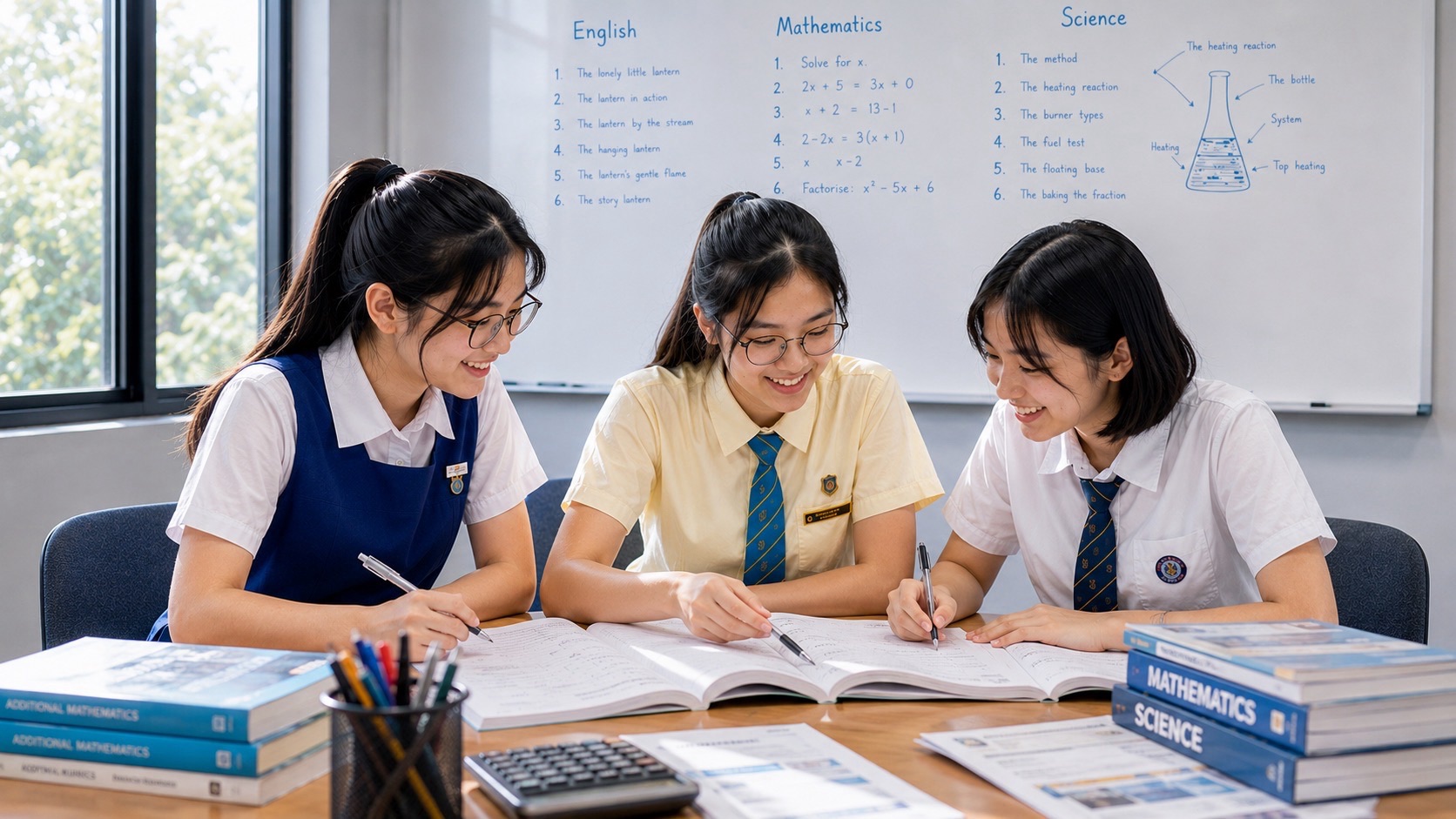
Holy Innocents’ High School after PSLE Result on Tuesday, 24 November 2026 at 11.00am: Holy Innocents’ High School is a co-educational government-aided Catholic secondary school at 1191 Upper Serangoon Road, Singapore 534786. The school offers mainstream PG3, PG2 and PG1 with separate affiliated and non-affiliated categories, but no six-year IP, IB Diploma or IGCSE S1 programme. For the completed 2026 Secondary 1 intake based on PSLE 2025, its historical score ranges were PG3 non-affiliated 11–14; PG3 affiliated 13–22; PG2 non-affiliated 21–24; PG2 affiliated 23–25; PG1 non-affiliated 25–27; PG1 affiliated 26–28. These are previous allocation outcomes, not guaranteed 2027 admission cutoffs. Parents should use the actual four PSLE subject ALs, the child’s personalised Posting Group eligibility and any official school-specific admission condition before forming their six choices.
Should your family choose Holy Innocents’ High? A child who enjoys storytelling, recording information fairly, media creation or service may be drawn to Holy Innocents’. Parents must distinguish Holy Innocents’ Primary School affiliation from the non-affiliated categories before considering whether the Upper Serangoon Road commute and Catholic ethos suit the child. Its distinctive learning includes Journalism and Broadcasting ALP for all pupils at Tier 1 with selected media enrichment at Tier 2; the Good Samaritan Project LLP; interdisciplinary Mustard Seed Project. Families in Hougang, Kovan, Serangoon, Sengkang, Punggol and nearby northeast estates should compare normal English, Mathematics and Science lessons, peer culture, suitable CCAs and the true journey home after activities. The MOE S1 Portal opens at 11.30am on 24 November 2026 and school choices close at 4.30pm on Monday, 30 November. A responsible six-school list contains genuine preferences, including two or three historically less stringent relevant entry options where possible. Never tell the pupil that a former cutoff automatically secures a place.
- School and campus: Holy Innocents’ High School, 1191 Upper Serangoon Road, Singapore 534786; general office 6283 3381.
- Real admission routes: mainstream PG3, PG2 and PG1 with separate affiliated and non-affiliated categories, but no six-year IP, IB Diploma or IGCSE S1 programme.
- 2026-entry results after PSLE 2025: PG3 non-affiliated 11–14; PG3 affiliated 13–22; PG2 non-affiliated 21–24; PG2 affiliated 23–25; PG1 non-affiliated 25–27; PG1 affiliated 26–28. The coming 2027 intake cutoffs are unknown.
- School programmes: Journalism and Broadcasting ALP for all pupils at Tier 1 with selected media enrichment at Tier 2; the Good Samaritan Project LLP; interdisciplinary Mustard Seed Project.
- Admission nuance: Holy Innocents’ Primary School, subject to current MOE school-choice priority requirements. Attending a different Catholic school or living in Hougang does not itself grant admission affiliation.
- Key dates: results Tue 24 Nov 2026 at 11am; choices open 11.30am and close Mon 30 Nov 4.30pm; S1 posting tentatively 18 Dec.
- Family questions: What subject levels does this pupil qualify for, how will they get to school and who helps if they need support?
- Official verification: 17 November MOE/SEAB announcement; MOE SchoolFinder.
Editorial date: 18 November 2026. “2026 Secondary 1 intake” refers to the 2025 PSLE cohort. “2027 Secondary 1 intake” refers to the children collecting PSLE results on 24 November 2026. This independent article is a guide to making informed choices, not a forecast of this year’s final posting scores or an official school statement.
1. Start with the actual child, not a popular ranking
The PSLE result is a significant piece of evidence about current academic attainment, but a secondary school is a place where the child must live and learn for several years. A cutoff is an outcome from a past cohort’s preferences and places. It is not a grade for teachers, a guarantee about future schoolmates or a measure of whether one individual can improve. Parents should combine the formal admission requirements with ordinary lesson quality, suitable academic support, friendship, CCA interest, safety and travel. A school that is historically less selective may be a very good fit, while a more selective school could have an unsuitable commute or programme for this pupil.
Ask the child to describe two parts of Holy Innocents’ High they would enjoy and one concern about joining. They might genuinely like journalism and broadcasting alp for all pupils at tier 1 with selected media enrichment at tier 2; the good samaritan project llp; interdisciplinary mustard seed project, or they may value the possibility of making new friends near home. A family should not dismiss those preferences, but should ask whether the normal English, Mathematics, Science and Mother Tongue timetable will fit the student’s actual AL profile. An imaginative pupil may need reading support; an articulate speaker may struggle with algebra; a strong coder may need help with group responsibility. Good school fit takes these real differences seriously.
Separate admissions facts from hopes. The factual column holds the official PSLE total, individual ALs, selected Posting Group, qualifying primary-school affiliation where relevant, school type and previous comparable cutoff. The hopes column includes whether the child will enjoy an ALP, win a place in a specialist CCA or eventually achieve a strong examination result. These hopes can guide conversation but should not become promises. Future demand and tie-breakers are not known. A careful parent can explain the difference and still encourage a child to consider ambitious but genuinely meaningful options.
2. Exactly which entry pathway is offered?
| Route | Available at this school? | Parent interpretation |
|---|---|---|
| Mainstream PG3 | Yes | Previous PG3 non-affiliated 11–14, affiliated 13–22; compare the valid category. |
| Mainstream PG2 | Yes | Previous PG2 non-affiliated 21–24, affiliated 23–25; different pools. |
| Mainstream PG1 | Yes | Previous PG1 non-affiliated 25–27, affiliated 26–28; check eligibility. |
| Six-year IP | No separate S1 pathway | An ALP, LLP or selected advanced module does not create an Integrated Programme. |
| IB Diploma or IGCSE | No separate S1 pathway | The school follows Singapore’s national secondary curriculum, not an IB/IGCSE entry route. |
| DSA-Sec | Earlier application process | Already accepted DSA offers have their own obligations; the November choice exercise does not reopen DSA. |
Full Subject-Based Banding distinguishes Posting Groups from levels at which individual subjects can be studied. A child may be admitted through PG1, PG2 or PG3, while English, Mathematics, Science and Mother Tongue may have eligible G1, G2 or G3 arrangements according to individual ALs and the school’s timetable. This flexibility does not mean every pupil automatically receives a higher-level offer or can change groups school by school. A child who begins at one level can make progress with appropriate support. The right question for parents is what this pupil can study now and how the school responds when their strengths are uneven.
The general PSLE posting pattern is Scores 4–20 to PG3, 21–22 with a PG3/PG2 option, 23–24 to PG2, Score 25 with a PG2/PG1 option and 26–30 to PG1 if English and Mathematics are each AL7 or better. Candidates with Foundation subjects or other special eligibility should rely on the exact official results document. Where a dual Posting Group option is offered, parents normally select one group for the entire ordinary six-school preference list. The existence of a good music, journalism or STEM programme does not override this formal rule.
The Singapore-Cambridge Secondary Education Certificate (SEC) is the applicable mainstream national examination pathway under the Full SBB transition. It is different from a six-year Integrated Programme, the IB Diploma and IGCSE. A school discussing global citizenship, advanced computing or an international learning trip does not necessarily offer those different qualifications. Parents should understand the route before comparing school names. There is no need for a twelve-year-old to declare a university major, but the family can help them begin with sound English, Mathematics, reading, reasoning and responsible study habits.
3. The PSLE result release and S1 school-choice calendar
| Singapore date and time | What a parent should do | Avoid |
|---|---|---|
| Tuesday 24 November 2026, 11.00am | Collect the actual PSLE result and personalised school options via the primary school. | Using predicted scores or another child’s eligibility letter. |
| Tuesday 24 November 2026, 11.30am | S1 Portal opens for online submission with a parent’s Singpass. | Selecting the wrong campus or invalid group. |
| 24–30 November 2026 | Compare school cultures, past same-route cutoffs, programmes, CCAs and transport. | Assuming an old cutoff guarantees a 2027 seat. |
| Monday 30 November, 4.30pm | Official school-choice submission closes; ask the primary school for assistance earlier if needed. | Leaving the application in draft or trying to submit after closing. |
| Friday 18 December (tentative) | Expected S1 posting result release, pending MOE confirmation. | Treating an expected posting date as already final. |
The joint SEAB/MOE statement of 17 November 2026 confirms PSLE results for 24 November at 11am. Schools will provide collection instructions, and pupils unable to attend can make authorised proxy arrangements by Thursday, 26 November. The online S1 Portal accepts parents’ six school choices from 11.30am on 24 November until 4.30pm on 30 November. One parent can sign in with Singpass. Parents requiring assistance should contact the child’s primary school early rather than wait until the closing hour. Keep copies of the result and evidence of a successful submission.
MOE encourages families to choose schools holistically, considering the pupil’s needs, strengths, school culture, subject offerings and CCAs. It recommends two or three choices whose previous cutoffs are less stringent than the child’s PSLE total within the appropriate entry group, because cutoffs can move from year to year. The advice is about managing uncertainty, not guaranteeing an allocation. Do not construct a list solely from an online score ranking or put a school the family would refuse to attend at the bottom as a disposable backup.
If the result surprises the family, separate the child’s emotional response from the administrative deadline. The pupil can be disappointed while still having meaningful options. An adult may acknowledge the result calmly, clarify eligibility and take time to investigate. A school choice is not a referendum on the child’s worth. A learner may develop powerful skills after Primary 6 through steady academic repair, supportive peers, good CCAs and a sustainable home routine. The family’s immediate duty is an informed, respectful application that reflects the actual child.
4. Read the 2026 intake cutoff in the correct column
| Historical 2026 intake category | First-to-last PSLE Score range | Previous end score | Meaning for 2027 |
|---|---|---|---|
| PG3 non-affiliated | 11–14 | 14 | Prior outcome in this particular programme/category, not a fixed future rule. |
| PG3 affiliated | 13–22 | 22 | Prior outcome in this particular programme/category, not a fixed future rule. |
| PG2 non-affiliated | 21–24 | 24 | Prior outcome in this particular programme/category, not a fixed future rule. |
| PG2 affiliated | 23–25 | 25 | Prior outcome in this particular programme/category, not a fixed future rule. |
| PG1 non-affiliated | 25–27 | 27 | Prior outcome in this particular programme/category, not a fixed future rule. |
| PG1 affiliated | 26–28 | 28 | Prior outcome in this particular programme/category, not a fixed future rule. |
A smaller overall PSLE total indicates stronger examination performance. The first figure in a completed school intake range shows the strongest posted total within the group, while the last normally records the last student admitted. That endpoint is often called the Cut-Off Point. The figures here are from the children who sat PSLE in 2025 and entered Secondary 1 in 2026. Children collecting results on 24 November 2026 are seeking entry in 2027, so their cohort’s actual last-posted score remains unknown until MOE has allocated places. A school cannot credibly promise its final cutoff before this process is complete.
School-specific affiliation: Holy Innocents’ Primary School, subject to current MOE school-choice priority requirements. Attending a different Catholic school or living in Hougang does not itself grant admission affiliation. The affiliated and non-affiliated results are different applicant categories. An unrelated pupil cannot borrow an affiliated last-posted score simply because the school is nearby, the parents like its religion or a cousin attended. A properly affiliated child still needs to satisfy the current admission and choice-order rules, and its former score does not guarantee the new allocation. Parents should verify the child’s actual school-history eligibility, rather than assume that any school with a similar name provides the same priority.
Even if a child scores numerically better than the former boundary, admission is not guaranteed. Families should compare genuine preferences and include a thoughtful range of schools. A numerical comparison is most meaningful within the same group and when the programme and applicant category match. A stronger overall score may broaden the list, but the family should still verify language offerings, daily travel and whether the child can seek help from teachers. The purpose of historical data is to inform a choice, not replace it.
5. The school’s distinctive learning and daily educational culture
Journalism and Broadcasting ALP for all pupils at Tier 1 with selected media enrichment at Tier 2; the Good Samaritan Project LLP; interdisciplinary Mustard Seed Project. These experiences can develop curiosity, literacy, technical reasoning or service, but they do not replace the need for ordinary teaching. Distinguish what all pupils experience from specialist projects selected later. A child should be able to thrive in the normal school week even without gaining a competitive CCA place or prestigious enrichment award. The following school-specific features explain what teachers could help a pupil learn and which practical questions parents should ask.
1. The 14 versus 22 PG3 distinction matters more than school reputation
The recorded 2026-intake PG3 last-posted result was 14 without affiliation but 22 for eligible pupils affiliated through Holy Innocents’ Primary. A pupil from an unrelated primary school with PSLE Score 18 cannot use the affiliated 22 as a historical match. A family that did qualify for affiliation must still comply with MOE’s current conditions, which can involve preference order. These are separate applicant pools, not two academic standards freely chosen on the portal. Record both the category and the reference year before planning the six-school list. An earlier last-posted number is never a guaranteed place for 2027.
2. Journalism and Broadcasting teaches ethical communication
The school’s Applied Learning Programme develops innovators, communicators and leaders through media. This can be appealing to a child who enjoys writing, photography, presenting or explaining ideas to classmates. But journalism is not simply finding a dramatic headline or making a viral video. Pupils should investigate who made a claim, check what evidence exists and recognise when an account leaves out a relevant perspective. Parents should ask what an ordinary Secondary 1 pupil researches and how the school distinguishes factual news from interpretation or dramatization. A school project becomes intellectually valuable when the child can substantiate and qualify a claim.
3. Tier 1 media literacy is for everyone
Holy Innocents’ June 2026 ALP page identifies Tier 1 as foundational learning for all pupils. It includes media literacy, interviewing, research, oracy, public speaking, photography, videography and photo/video journalism through curriculum work or cohort workshops. This is important for a beginner who has never owned a camera beyond a family phone. Ask how the school teaches source selection, asking respectful questions and planning a simple narrative. A confident speaker should learn to listen, and a quiet pupil should be able to contribute through careful research and editing. The objective is independent communication, not early commercial broadcasting.
4. An interview starts with consent and good questions
A pupil may be asked to interview a member of the school community. A useful interview begins with informing the other person of the purpose and asking open-ended questions. Children should learn not to pressure a participant, expose private details or present one anecdote as if it represents an entire group. A responsible final story attributes ideas accurately and acknowledges what remains unknown. Parents can support this habit by having the child ask an elder about one school memory and write a respectful, faithful summary. The same care benefits English comprehension, Humanities work and everyday disagreements among friends.
5. Photography and videography can mislead without context
A photograph may be accurate in a narrow sense while failing to show what happened just outside the frame. The school’s visual-media learning can teach pupils how framing, lighting, sound and editing affect interpretation. A carefully edited video should still respect the speaker’s intended meaning and distinguish staged scenes from documentary evidence. The rise of AI-generated images makes verification even more important: technical realism is not proof that an event occurred. Parents should ask how pupils document sources, obtain image permissions and explain their editing choices. The learning outcome is discernment rather than merely professional-looking content.
6. The Tier 2 media opportunities are selective
The school lists deeper activities for interested or talented pupils, including digital illustration, photography walks, videography workshops, live sound and event management, media competitions and student media representative positions. These are not automatic placements attached to an ordinary S1 offer. Parents should ask whether the child can apply, when selection happens and what additional commitment would be required. A pupil who prefers scriptwriting over public speaking can still build relevant strengths, and a child who never joins a media team can benefit from Tier 1. Choose the school for the everyday curriculum, not an imagined award.
7. The Good Samaritan Project puts values into action
Holy Innocents’ LLP, the Good Samaritan Project, aims to develop compassionate and morally upright pupils through service and student leadership. The school uses a progression in which children understand community needs and gradually take greater responsibility. A parent should not confuse the programme with an automatic charity position or a badge. Students can begin by noticing whether a classmate needs help, listening to feedback and following through on practical commitments. A good service project asks what the beneficiary actually needed and what the student learned when the first idea was inadequate. That is leadership grounded in evidence and respect.
8. Secondary 1 racial-harmony work belongs to the school community
The official LLP page describes Secondary 1 pupils organising games and advocacy booths during Racial Harmony Day. The educational purpose is to learn about belonging and respect across different cultures, not merely stage a colourful booth. Pupils should be encouraged to research the activity’s background accurately, avoid stereotypes and consider what younger students may misunderstand. A student who helps another pupil participate can practise service without having a formal council role. Ask teachers how pupils reflect afterward and whether they can describe one misconception they corrected through the process.
9. Secondary 2 inclusion learning asks for thoughtful care
The Good Samaritan progression includes inclusion-focused work with awareness of people who have different needs or abilities. An activity can teach students to ask what barriers exist in daily life and how to communicate without pitying or patronising the person concerned. A child may discover that a design or event excludes someone unintentionally, then learn to revise it. Parents should ask how sensitive activities are supervised, how people’s privacy is respected and which experiences are available to the normal cohort. The programme should teach practical empathy, not imply that every child is qualified to counsel someone else.
10. Older-pupil service is different from the Year 1 baseline
Upper-secondary outreach examples have involved external organisations and different community needs. Parents should distinguish a selected senior student’s portfolio from what every incoming Secondary 1 child will experience in 2027. External partners and programmes can change with time. A sensible question is how teachers prepare pupils to communicate responsibly, plan a realistic service activity and evaluate its effect. A child who discovers that a proposed intervention is not useful should be encouraged to listen and adjust. Service is educational when it leads to informed responsibility, not just collecting hours.
11. Mustard Seed is interdisciplinary, not a posting programme
The school’s Mustard Seed Project uses place-based inquiry to explore issues such as Singapore’s continuity and change, sustainability and technology’s influence on life. Learning journeys have included cultural galleries, museums and other places where pupils can connect classroom subjects with real contexts. This is a distinctive learning experience, but it is not an additional IP or IB route. Students should examine evidence, recognise different perspectives and describe the limitations of an exhibit or a short visit. A museum photograph does not replace reading sources or producing a careful explanation. Parents can ask how pupils are assessed individually after group project work.
12. The Catholic setting and pupil support deserve specific questions
Holy Innocents’ is a Catholic government-aided school. Families may appreciate its heritage or simply want to understand how values, religious practices and inclusive student support operate. Ask staff how pupils of different beliefs participate in ordinary lessons and assemblies and whom a child approaches when they are anxious or lonely. The school also describes a Learning Support Programme for selected pupils to develop study habits and self-directed learning. That support is not an automatic programme every child joins; ask what individual need triggers participation and how teachers communicate progress with families.
13. The school is close to Hougang transport, not every northeast home
Holy Innocents’ High stands at 1191 Upper Serangoon Road. A family near Hougang Central may have a short walk, while a pupil in Punggol, Sengkang or Serangoon may need a bus or rail transfer. Test the actual school gate in the morning and after CCA. A media workshop or school service event might keep a pupil later than ordinary lessons. Ask how the child will travel safely in rain and whether the journey leaves time for meals, reading and sleep. A programme that excites the child is most useful when it is sustainable across a school week.
14. Similar school names do not confer affiliated admission
Holy Innocents’ High School, Holy Innocents’ Primary School and Holy Innocents’ High’s affiliated educational traditions are not interchangeable applicant entries. A child’s earlier attendance at the actual linked primary school is the formal question, subject to prevailing conditions. Being a relative of an alumnus or attending another Catholic institution is not the same. A family should also distinguish Holy Innocents’ High from Holy Innocents’ High School’s other local competitors, including Xinmin, Bowen and Hougang Secondary. School codes, campus gates and programme offerings differ and should be checked independently.
6. Compare nearby secondary schools without mixing options
Parents in Hougang, Kovan, Serangoon, Sengkang, Punggol and nearby northeast estates can compare other nearby schools for real academic suitability, programme interests and transport. The list below is a research shortlist, not an assertion that all routes will be available to this particular PSLE result. Some schools are mission institutions with formal primary affiliation, some are single-gender, and others are ordinary co-educational schools. Each has separate school codes and gates. Numbers are dated 2026 intake references; parents should recheck them on MOE SchoolFinder before submission.
| School | Location | Historical reference or route | Why compare it? |
|---|---|---|---|
| Xinmin Secondary School | Hougang Avenue 8 | PG3 13; PG2 23; PG1 28 | Co-educational autonomous school with a more selective former PG3 cutoff than Holy Innocents’ open intake. |
| Bowen Secondary School | Lorong Napiri | PG3 16; PG2 24; PG1 28 | Business and Entrepreneurship ChANgeMakers, different curriculum. |
| Hougang Secondary School | Hougang Street 93 | PG3 20; PG2 24; PG1 27 | STEM innovation and community leadership, without Catholic primary affiliation. |
| Serangoon Secondary School | Upper Serangoon View | PG3 20; PG2 25; PG1 28 | Co-educational mainland Hougang alternative, separate school culture. |
| Yuying Secondary School | Hougang Avenue 1 | PG3 22; PG2 25; PG1 29 | Different language and values programmes and transport. |
| CHIJ St. Joseph’s Convent | Sengkang East Way | PG3 14 non-affiliated / 20 affiliated | Girls-only Catholic school; its affiliated primary schools differ. |
Alternative 1: Xinmin Secondary School
Xinmin Secondary School serves Hougang Avenue 8. Its earlier score reference or school option is PG3 13; PG2 23; PG1 28. Co-educational autonomous school with a more selective former PG3 cutoff than Holy Innocents’ open intake. A family should confirm the child’s actual group, any affiliation or SAP conditions, the normal academic curriculum and support arrangements, and the true home-to-gate travel time. A historically less stringent cutoff may help balance the six preferences, but it is not a promise. Choose this alternative only if the child could genuinely attend and find meaningful opportunities there rather than inserting it to fill a spreadsheet cell.
Alternative 2: Bowen Secondary School
Bowen Secondary School serves Lorong Napiri. Its earlier score reference or school option is PG3 16; PG2 24; PG1 28. Business and Entrepreneurship ChANgeMakers, different curriculum. A family should confirm the child’s actual group, any affiliation or SAP conditions, the normal academic curriculum and support arrangements, and the true home-to-gate travel time. A historically less stringent cutoff may help balance the six preferences, but it is not a promise. Choose this alternative only if the child could genuinely attend and find meaningful opportunities there rather than inserting it to fill a spreadsheet cell.
Alternative 3: Hougang Secondary School
Hougang Secondary School serves Hougang Street 93. Its earlier score reference or school option is PG3 20; PG2 24; PG1 27. STEM innovation and community leadership, without Catholic primary affiliation. A family should confirm the child’s actual group, any affiliation or SAP conditions, the normal academic curriculum and support arrangements, and the true home-to-gate travel time. A historically less stringent cutoff may help balance the six preferences, but it is not a promise. Choose this alternative only if the child could genuinely attend and find meaningful opportunities there rather than inserting it to fill a spreadsheet cell.
Alternative 4: Serangoon Secondary School
Serangoon Secondary School serves Upper Serangoon View. Its earlier score reference or school option is PG3 20; PG2 25; PG1 28. Co-educational mainland Hougang alternative, separate school culture. A family should confirm the child’s actual group, any affiliation or SAP conditions, the normal academic curriculum and support arrangements, and the true home-to-gate travel time. A historically less stringent cutoff may help balance the six preferences, but it is not a promise. Choose this alternative only if the child could genuinely attend and find meaningful opportunities there rather than inserting it to fill a spreadsheet cell.
Alternative 5: Yuying Secondary School
Yuying Secondary School serves Hougang Avenue 1. Its earlier score reference or school option is PG3 22; PG2 25; PG1 29. Different language and values programmes and transport. A family should confirm the child’s actual group, any affiliation or SAP conditions, the normal academic curriculum and support arrangements, and the true home-to-gate travel time. A historically less stringent cutoff may help balance the six preferences, but it is not a promise. Choose this alternative only if the child could genuinely attend and find meaningful opportunities there rather than inserting it to fill a spreadsheet cell.
Alternative 6: CHIJ St. Joseph’s Convent
CHIJ St. Joseph’s Convent serves Sengkang East Way. Its earlier score reference or school option is PG3 14 non-affiliated / 20 affiliated. Girls-only Catholic school; its affiliated primary schools differ. A family should confirm the child’s actual group, any affiliation or SAP conditions, the normal academic curriculum and support arrangements, and the true home-to-gate travel time. A historically less stringent cutoff may help balance the six preferences, but it is not a promise. Choose this alternative only if the child could genuinely attend and find meaningful opportunities there rather than inserting it to fill a spreadsheet cell.
It is useful to test the ordinary weekday journey rather than rely on a map screenshot. A child can live inside Hougang or Jurong West yet have a long transfer to a school with the same town name. Another campus may have a more direct bus. Consider the morning entry and the return after CCA, especially during rain, when carrying an instrument or when a project runs late. Sleep, meals and family time affect academic concentration. The best school choice balances distinctive curriculum with a life the teenager can sustain over years.
7. Worked family examples across PSLE bands
Case 1: Non-affiliated PG3 Score 12 enjoys journalism
The 2026 non-affiliated PG3 cutoff was 14. Score 12 is numerically stronger and worth investigating, but this old number cannot guarantee a 2027 place or a Tier 2 media role.
The family should distinguish verifiable facts from judgement. The result slip, actual programme eligibility, historical same-group cutoff and school address are facts. Enjoyment, academic readiness, student belonging and future posting are different considerations. A child should understand that 2027 admission is still unknown even when the historical comparison looks promising. A parent can preserve a genuine preference without offering false certainty and keep alternative options that the young person would willingly accept.
Case 2: Non-affiliated PG3 Score 18 and parental optimism
The prior non-affiliated PG3 cutoff was 14. An unrelated primary-school pupil cannot borrow affiliated PG3 22 to call the school historically safe. Compare Bowen or Hougang Secondary as additional possibilities.
The family should distinguish verifiable facts from judgement. The result slip, actual programme eligibility, historical same-group cutoff and school address are facts. Enjoyment, academic readiness, student belonging and future posting are different considerations. A child should understand that 2027 admission is still unknown even when the historical comparison looks promising. A parent can preserve a genuine preference without offering false certainty and keep alternative options that the young person would willingly accept.
Case 3: Affiliated PG3 Score 20 from Holy Innocents’ Primary
An officially qualified pupil can compare with the former affiliated PG3 cutoff of 22, but must verify all current choice-order conditions and prepare balanced options.
The family should distinguish verifiable facts from judgement. The result slip, actual programme eligibility, historical same-group cutoff and school address are facts. Enjoyment, academic readiness, student belonging and future posting are different considerations. A child should understand that 2027 admission is still unknown even when the historical comparison looks promising. A parent can preserve a genuine preference without offering false certainty and keep alternative options that the young person would willingly accept.
Case 4: Affiliated PG3 Score 22 at the prior edge
This was the former affiliated endpoint. The new cohort may differ, and affiliation does not guarantee a seat; choose realistic alternatives.
The family should distinguish verifiable facts from judgement. The result slip, actual programme eligibility, historical same-group cutoff and school address are facts. Enjoyment, academic readiness, student belonging and future posting are different considerations. A child should understand that 2027 admission is still unknown even when the historical comparison looks promising. A parent can preserve a genuine preference without offering false certainty and keep alternative options that the young person would willingly accept.
Case 5: Non-affiliated PG2 Score 23 interested in film
The older non-affiliated PG2 cutoff was 24. Ask how G2 English and Mathematics support this pupil’s media interests, while recognising the uncertainty of posting.
The family should distinguish verifiable facts from judgement. The result slip, actual programme eligibility, historical same-group cutoff and school address are facts. Enjoyment, academic readiness, student belonging and future posting are different considerations. A child should understand that 2027 admission is still unknown even when the historical comparison looks promising. A parent can preserve a genuine preference without offering false certainty and keep alternative options that the young person would willingly accept.
Case 6: Affiliated PG2 Score 25 with a chosen PG2 route
The former affiliated PG2 cutoff was 25. The child must be properly eligible for both PG2 and the affiliated route; the old endpoint is not an offer.
The family should distinguish verifiable facts from judgement. The result slip, actual programme eligibility, historical same-group cutoff and school address are facts. Enjoyment, academic readiness, student belonging and future posting are different considerations. A child should understand that 2027 admission is still unknown even when the historical comparison looks promising. A parent can preserve a genuine preference without offering false certainty and keep alternative options that the young person would willingly accept.
Case 7: Non-affiliated PG1 Score 26
The former PG1 non-affiliated cutoff was 27. With the required individual English and Mathematics ALs, the school may be a reasonable historic comparison, not a confirmed place.
The family should distinguish verifiable facts from judgement. The result slip, actual programme eligibility, historical same-group cutoff and school address are facts. Enjoyment, academic readiness, student belonging and future posting are different considerations. A child should understand that 2027 admission is still unknown even when the historical comparison looks promising. A parent can preserve a genuine preference without offering false certainty and keep alternative options that the young person would willingly accept.
Case 8: Affiliated PG1 Score 28
The former affiliated PG1 cutoff was 28. Treat the coming result as uncertain and discuss normal subject-level teaching and commuting.
The family should distinguish verifiable facts from judgement. The result slip, actual programme eligibility, historical same-group cutoff and school address are facts. Enjoyment, academic readiness, student belonging and future posting are different considerations. A child should understand that 2027 admission is still unknown even when the historical comparison looks promising. A parent can preserve a genuine preference without offering false certainty and keep alternative options that the young person would willingly accept.
Case 9: A Punggol pupil drawn to journalism but worried about travel
A meaningful ALP may justify a longer trip for some families, but compare what normal media learning exists in closer eligible schools and calculate the late-CCA return.
The family should distinguish verifiable facts from judgement. The result slip, actual programme eligibility, historical same-group cutoff and school address are facts. Enjoyment, academic readiness, student belonging and future posting are different considerations. A child should understand that 2027 admission is still unknown even when the historical comparison looks promising. A parent can preserve a genuine preference without offering false certainty and keep alternative options that the young person would willingly accept.
8. Twelve practical checks for learning and wellbeing
1. Reading comprehension across every subject
A Secondary 1 pupil must interpret instructions, understand a paragraph’s central idea and explain evidence. Ask the child to read an age-appropriate information passage, summarise it and identify one limitation or unanswered question. This is useful for journalism and broadcasting alp for all pupils at tier 1 with selected media enrichment at tier 2; the good samaritan project llp; interdisciplinary mustard seed project, but also for ordinary Mathematics and Science word problems. Parents should ask what English comprehension instruction is available at the pupil’s actual individual subject level and how teachers correct recurring misunderstandings. A long list of memorised vocabulary is not equivalent to understanding a text in context.
2. Mathematical depth rather than worksheet speed
A strong transition involves fractions, directed numbers, ratio and early algebra. Ask the child why performing the same valid operation on both sides of an equation preserves equality. A pupil who has memorised a rule about shifting numbers may need conceptual explanation before more difficult questions. Applied STEM or communication programmes can create reasons to use Mathematics, but cannot replace careful teaching of the subject. Ask the school about the actual G-level Maths offered to this pupil and how learning gaps are repaired through precise feedback.
3. Scientific evidence and limits of experiments
A young teenager can learn to ask how an experiment would be made fair. What is changed? What is kept constant? What is measured, and why might one result be misleading? These habits help whether the school programme studies food, media, technology or the environment. An attractive prototype or photograph cannot by itself demonstrate that a cause has been proven. Parents should ask how teachers help children record uncertainty, repeat tests and improve a method after a surprising result. Responsible scientific reasoning is a foundation for lifelong judgement.
4. Individual subject ALs and Full SBB flexibility
The overall PSLE Score does not reveal whether a child is stronger in English, Maths, Science or Mother Tongue. The four individual ALs matter when a receiving school determines initial subject levels and eligible flexibility under Full SBB. A student entering through one Posting Group may take a different subject level in a stronger area according to MOE rules and school arrangements. Do not promise an automatic higher-level subject or treat a group’s name as a permanent label of ability. Ask the school what that pupil’s actual timetable would look like.
5. Mother Tongue and language commitments
Families should clarify the child’s required Mother Tongue and any offer of Higher Mother Tongue or other eligible language learning. If the school emphasises bilingual communication, ask how activities differ for pupils taking different languages; not everyone is automatically given an extra Mother Tongue. Reading and writing at a higher level can add to workload. A good decision balances language ambitions with the student’s academic strengths and the rest of the school day. Confirm actual subjects before assuming the child will enter a particular class.
6. Ordinary curriculum versus selected enrichment
School sites often highlight advanced competitions, overseas experiences, specialist research and popular CCAs. These can be real learning opportunities, but places may be limited or allocated based on interest and aptitude. Ask which experiences all new Secondary 1 pupils receive and which require application, trial or later academic eligibility. A school should remain a good choice for its normal lessons and wellbeing even if the pupil is not selected for an advanced media or STEM group. The educational goal is genuine development, not collecting names of programmes.
7. True travel time and safe return after CCA
Measure the actual journey to 1191 Upper Serangoon Road, Singapore 534786 from the child’s home on a weekday morning and again after a late activity. Include walking, buses, trains, waiting, traffic, road crossings and rain. A school may look nearby on a map while requiring several transfers. A teenager can develop independence through commuting, but excessive fatigue affects learning. Discuss what to do when transport is delayed and how the child will get home safely while carrying books or equipment. The cost of travel accumulates over hundreds of school days.
8. Belonging, counselling and teacher contact
A child may be nervous about new friends or worried that they will not understand a difficult teacher. Ask who the pupil can approach when they feel isolated, are bullied or repeatedly fail to finish work. A supportive school should have a clear route for help and parental communication. Special access or learning needs should be discussed privately with staff; do not infer guaranteed individual provisions from a generic brochure. A good environment does not mean difficulties never arise, but that pupils can learn to recover with guidance.
9. CCA preferences, selection and weekly balance
Sports, performing arts, media, uniformed groups and clubs can develop friendship and a sense of belonging. Some have trials or auditions and may not have enough places for every interested child. Ask about current CCA options and when activities finish. Encourage the pupil to identify several genuinely appealing choices rather than assume one famous team is reserved. A balanced weekly routine should leave enough time for academic practice, meals, family life and sleep. More commitments are not automatically evidence of better education.
10. Finances, devices and financial assistance
Books, uniforms, transport, meals, learning devices and optional programme equipment all affect household budgeting. Ask the school about official financial assistance where relevant rather than rejecting a suitable choice because of rumours. At the same time, a distant campus may carry a real repeated transport cost. Do not purchase an entire school’s 2026 booklist before the actual 2027 posting is known. The right choice allows a pupil to participate in everyday school life without avoidable financial pressure.
11. Digital citizenship and original student work
Children will encounter online homework, AI tools, photographs, videos and group chats. A useful school-and-home principle is that pupils should be able to explain the evidence behind anything they submit, whether or not a digital tool was permitted in the process. An AI-generated answer can sound convincing but be false. Photos can omit context. Ask how teachers discuss privacy, source attribution, academic honesty and respectful online communication. Technology is most valuable when it improves rather than replaces independent reasoning.
12. A steady first term instead of another PSLE
After the posting result, practise the school route, establish a sleep and homework routine, and keep short reading, numeracy and Science-explanation practice. The child does not need to rush through every Secondary 1 chapter during December. On arrival, check whether the pupil knows their timetable, has made a friend and can ask for help. When an issue appears, repair it specifically: misunderstood fractions may need an explanation, an overloaded timetable a change, and a friendship problem patient adult support. A calm transition supports learning far beyond the examination score.
9. How to rank six meaningful and eligible schools
A credible six-school preference list includes schools that the child is eligible to attend and the family could genuinely welcome. Start with the actual S1 Option Form, removing schools or routes that do not apply. Compare previous cutoffs using the correct Posting Group, affiliation and curriculum. MOE encourages a balanced list with two or three historically less stringent options. A larger old cutoff within a matching group can indicate a less stringent previous intake, but it does not mean the school is inferior or that its future vacancies are guaranteed.
Give each school one row showing the full official name, school code, eligible route, old cutoff and reference year, two reasons for fit, one educational concern, possible CCA, morning transport and late-CCA return. Ask the pupil whether they would genuinely attend every school included. A school with a distinctive activity they do not like should not be selected purely to fill a numerical gap. Conversely, a school with a stronger old cutoff may be worthwhile as an aspiration when the child’s eligibility permits and the rest of the list is realistic.
| Check before submitting | Responsible family confirmation |
|---|---|
| Eligibility | The child’s personalised MOE options show this particular school and selected route. |
| Previous score | The PG3 non-affiliated 14, PG3 affiliated 22, PG2 non-affiliated 24, PG2 affiliated 25, PG1 non-affiliated 27, PG1 affiliated 28 numbers were 2026 intake outcomes, not future guaranteed cutoff points. |
| Subject needs | The child’s four ALs and possible G-level teaching requirements are understood. |
| Everyday fit | The pupil can explain why regular lessons, peers and CCAs could suit them. |
| Transport | The family has considered the actual gate-to-home commute after activities. |
| Balanced choices | Two or three other acceptable schools have less stringent old same-group cutoffs where appropriate. |
| Submission | One parent checks school codes and order, submits before Monday 30 November 4.30pm and retains acknowledgement. |
Ranking order expresses preference and can matter under MOE’s formal tie-breaking rules, but it cannot override a stronger score, an incompatible programme or an unavailable entry route. No school can be declared ‘secured’ simply because the pupil is one point numerically stronger than an older cutoff. A parent can help the child understand that getting a suitable school among several genuine choices is a positive outcome. Learning, friendships, character and opportunities continue long after the posting day.
10. What happens after the posting result
The 2026 S1 Posting Results are tentatively scheduled for Friday 18 December, subject to MOE’s final confirmation. Once posted, read the receiving school’s current registration instructions, actual reporting time, orientation schedule, 2027 booklist, personal-learning-device policy and any subject-level details. An archived event page is not a valid replacement for the new cohort’s instructions. Contact the school about special arrangements early and keep documents together in one family checklist.
A useful academic bridge is modest and diagnostic rather than a race to finish Secondary 1 before January. Read one age-appropriate information passage and explain the writer’s claim. Review fractions, negative numbers and basic algebra until the pupil can justify the steps. Discuss how to measure a simple Science question fairly. These skills help with media, STEM, design and reflective portfolios alike. The child also needs rest, friends, physical movement and the confidence to ask for help. An exhausted student may find even an attractive programme hard to enjoy.
In the first six weeks, monitor three questions. Depth: can the child explain why a method or interpretation is valid? Load: are travel, schoolwork and CCAs manageable without chronic loss of sleep? Transfer: can a learned idea be used in a new example? If depth is weak, repair the specific misconception; if load is high, adjust commitments; if transfer is weak, use varied practice. This helps parents improve learning without calling the whole child a failure because of one difficult test.
11. Frequently asked parent questions
Are these the new 2027 Secondary 1 cutoffs?
No. These score ranges describe the completed 2026 intake using the 2025 PSLE cohort. The coming 2027 cutoff will be known only after this year’s posting exercise.
Do all pupils use the same admissions column?
No. This school reports affiliated and non-affiliated categories. The correct formal primary-school eligibility and choice conditions determine which historical row applies.
Is a cutoff a ranking of school teaching quality?
No. It reflects the previous cohort’s preferences and places. School fit, academic support, CCAs and commute can be more important for a particular child.
Does this school offer IP, IB or IGCSE?
No separate Secondary 1 six-year IP, IB Diploma or IGCSE route is listed. Its distinctive ALP and LLP enrich the ordinary national curriculum.
Can an applicant select PG2 for one school and PG3 for another?
The ordinary option group is generally selected for the whole six-school list when a dual group is offered. Follow the child’s personalised MOE documentation.
What does Score 25 mean?
Score 25 can provide a PG1/PG2 option. A family’s choice should reflect academic readiness and the entire shortlist, not merely one school’s larger former cutoff.
Can a pupil in PG1 later offer a stronger subject?
Full SBB can allow eligible subject-level flexibility based on individual grades and school arrangements. Do not promise automatic G3 or later progression.
Does a 30* indicate a final student scored 30?
No. It reflects vacancies remaining in the completed earlier exercise rather than an actual final pupil necessarily scoring 30. It does not guarantee next year’s vacancies.
Are all special programmes and CCAs guaranteed after admission?
No. Some opportunities require auditions, selection, subject prerequisites or higher year levels. Ask which experiences are broad-based in Secondary 1.
What if the pupil is disappointed by the PSLE score?
Listen respectfully, verify the real school options, compare fit and travel, and choose several places where the child can grow. The score is an educational checkpoint, not a complete prediction of their future.
12. Official sources and relevant eduKate articles
- SEAB/MOE release, 17 November 2026: PSLE results and S1 Posting timetable
- MOE S1 Posting Portal and official six-choice instructions
- MOE SchoolFinder: available routes and historical school cutoffs
- MOE Full Subject-Based Banding and PSLE information
- Holy Innocents’ High School official school website
- eduKateSingapore PSLE Score 4–32 parent school-choice guide
- eduKateSG immutable Clementi Secondary 1 learning reference
- 2026 Journalism and Broadcasting ALP
- Good Samaritan Project LLP
- Mustard Seed place-based interdisciplinary enquiry
- School programmes directory
- School address and telephone
- eduKateSG Holy Innocents’ High school-choice guide
- eduKatePunggol school/affiliation explanation
- eduKateSingapore CHIJ St Joseph’s Convent alternative
- eduKateSingapore Bowen Secondary alternative
Evidence and scope: This independent eduKateSingapore article was prepared 18 November 2026 using the SEAB/MOE timetable announcement, 2026-intake historical school-score references and official school programme pages updated in 2026. The author does not represent Holy Innocents’ High School, MOE or SEAB and cannot guarantee a 2027 school posting. Families should verify the actual child’s eligible route, subject combination, selection requirements and current school notices before entering the official six choices.
Final parent judgement: Holy Innocents’ High belongs among the six preferences when the pupil is eligible, genuinely interested in its normal teaching and distinctive experiences, able to seek support there and capable of sustaining the school journey. Compare other acceptable schools honestly and keep the child’s voice central. A thoughtful Secondary 1 choice should give a young person room to develop intellectual depth, confidence, character and future options.