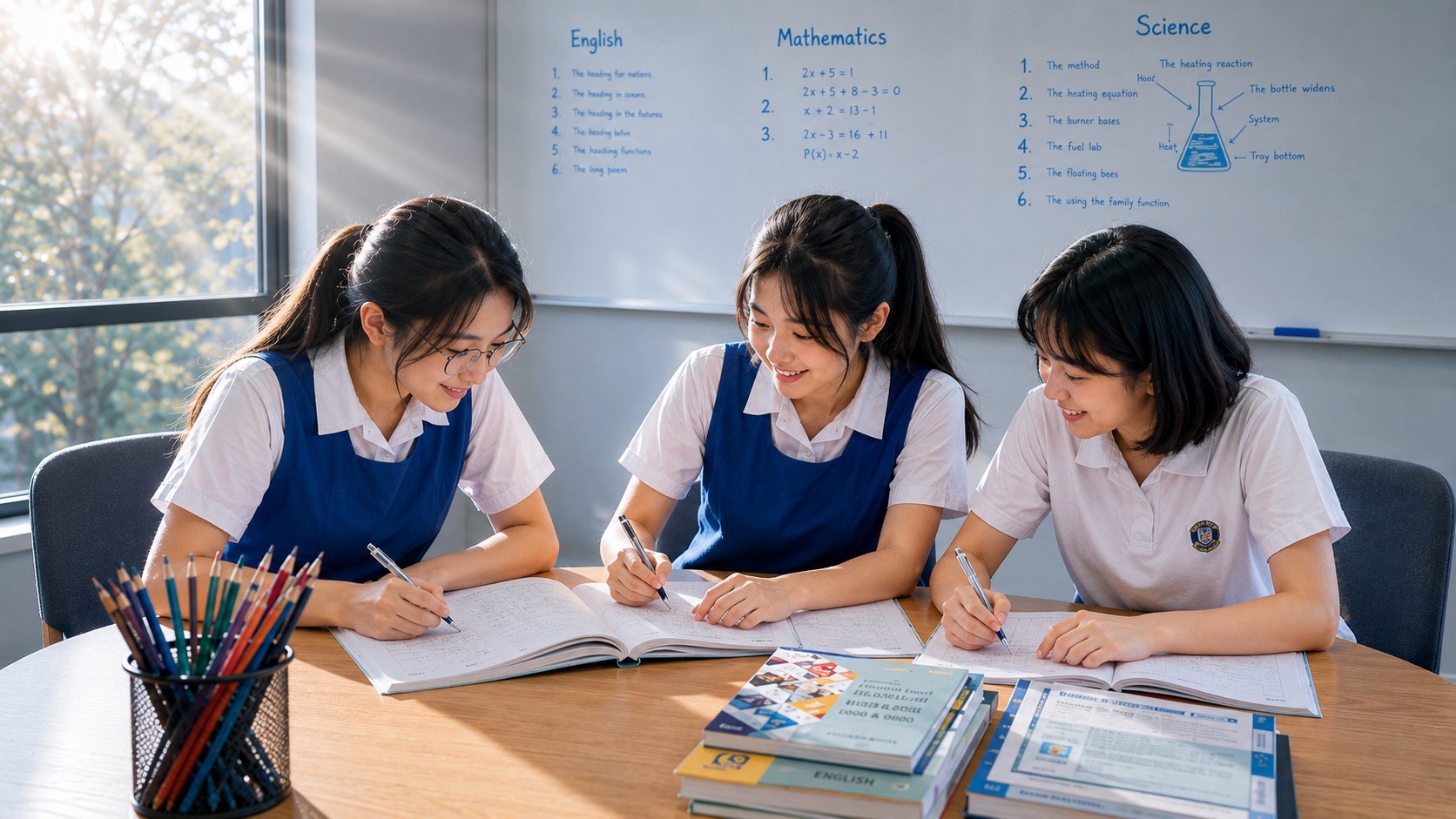
Secondary 1 G2 students can improve English comprehension by learning words that connect a story’s events, characters, dialogue and decisions. This guide teaches exactly 100 vocabulary words, including narrative, turning point, hesitation, dilemma, inference and reflection. Every word comes with a clear meaning and an original example. The purpose is to read more carefully, explain why a character acts and distinguish the writer’s words from the reader’s own interpretation.
Parents and teachers can use short fictional passages to practise these distinctions without relying on difficult novels or costly resources. A character’s silence does not always prove guilt, and a reader should not invent a motive without evidence. This is an original eduKate teaching resource informed by MOE English and literature learning aims, not an official SEAB list or a promise of examination themes. The activities aim for thoughtful, accurate explanations rather than decorative vocabulary.
- Exactly 100 unique English words in ten themed groups, with meanings and original usage.
- Practise plot structure, character decisions, feelings, literary devices and inference.
- Read an original mystery about a missing school library book with fully explained answers.
- Develop vocabulary through writing workshops, a diagnostic and a four-week plan.
- Use MOE and NLB educational references for context while following current school instructions.
Learning context: reading fiction with accuracy
The MOE Secondary English Language Syllabus 2020, prepared for the earlier Express and Normal (Academic) courses, describes reading and viewing closely, responding to texts and using vocabulary appropriately. It supplies pedagogical background, not a current promise that each format here is assessed in Secondary 1 G2. Students should use their school instructions and consult the relevant later syllabus when approaching a national examination.
The 2027 SEC G2 English Language K200 is a later national examination reference. It does not mandate these exact 100 words. The MOE Literature in English syllabus discusses analysis of prose, poetry and drama and responding with textual evidence, but an English vocabulary exercise is not the same as enrolling in Literature as a subject.
NLB provides reading resources and opportunities for young readers. For this lesson, a short original story is sufficient. Use age-appropriate texts selected with the teacher or family, and encourage independent evidence-based responses rather than copying analysis from another reader.
1. Kinds of stories and texts
Stories can be factual, invented, spoken or written in different forms. A genre or form gives readers expectations, but it does not tell them every theme or character trait in advance. One text can combine several features.
| No. | Word or term | Plain meaning | Original example sentence |
|---|---|---|---|
| 1 | story | A connected account of events, real or invented. | The story began with a missing library book and ended with a clearer explanation. |
| 2 | fiction | Writing that describes invented characters or events. | The class read fiction to practise drawing conclusions from textual details. |
| 3 | narrative | A connected account of events told in a particular way. | The narrative followed two pupils as they reconsidered an assumption. |
| 4 | prose | Ordinary written or spoken language, rather than arranged verse. | The pupils analysed a prose passage with several short paragraphs. |
| 5 | poetry | Writing that often uses rhythm, imagery and deliberate patterns of language. | The teacher included poetry as another form pupils might explore. |
| 6 | drama | A story presented through action and dialogue for performance. | The class performed a short drama about a misunderstanding. |
| 7 | fable | A brief story, often using animals, that illustrates a lesson. | The fable presented a choice and a possible moral. |
| 8 | memoir | An account based on a person’s memories and experiences. | The memoir described one person’s recollection, not every possible viewpoint. |
| 9 | folktale | A traditional story passed down within a community. | The folktale had variations that the students compared respectfully. |
| 10 | excerpt | A short part taken from a longer text. | The excerpt left the character’s final decision unknown. |
Use the words in a new context
Give the learner a brief invented narrative and ask whether its events are presented as factual or fictional. Identify which features show its form, then ask what information remains unknown about its genre.
2. Plot, sequence and structure
A plot connects events; a sequence describes their order. A climax is often a moment of strong tension, but not every story follows exactly the same pattern. Students should name the narrative features that the passage actually shows.
| No. | Word or term | Plain meaning | Original example sentence |
|---|---|---|---|
| 11 | plot | The connected events that make up a story. | The plot changed when the missing book appeared in another classroom. |
| 12 | setting | The time and place in which events occur. | The library was the setting for the story’s opening scene. |
| 13 | scene | A part of a story taking place in a particular situation. | The scene showed a conversation beside the return counter. |
| 14 | episode | A distinct event or section within a larger story. | The second episode explained why the pupil had moved the book. |
| 15 | event | Something that happens. | The important event was the discovery of a handwritten note. |
| 16 | sequence | The order in which events are arranged or happen. | The narrator revealed the events in a different sequence from the actual timeline. |
| 17 | turning point | A moment when the direction of a story or situation changes. | The turning point came when Mira decided to ask a question instead of accusing anyone. |
| 18 | climax | A moment of greatest tension or importance in a narrative. | The climax involved a decision that affected both friends. |
| 19 | resolution | The way a central problem is settled or addressed. | The resolution involved returning the book and explaining the misunderstanding. |
| 20 | ending | The final part of a story. | The ending left one question open while resolving the main conflict. |
Use the words in a new context
Write a five-sentence timeline for an invented school story. Mark the event that changes the characters’ choices. Explain why a turning point is more than simply the last action in a paragraph.
3. Characters and narrative roles
A protagonist is a central character, but being central does not make the person morally perfect. A narrator tells the story and may have limited knowledge. Identify each role from the text, not from a familiar stereotype.
| No. | Word or term | Plain meaning | Original example sentence |
|---|---|---|---|
| 21 | character | A person or other figure represented in a story. | The character changed her mind after hearing a second account. |
| 22 | protagonist | The main character whose experiences often drive the plot. | The protagonist struggled to choose between silence and a difficult question. |
| 23 | antagonist | A person or force that opposes the protagonist’s aims. | The antagonist was an obstacle in the story rather than proof of an evil personality. |
| 24 | narrator | The voice or person telling a narrative. | The narrator admitted that he did not witness the conversation. |
| 25 | speaker | The person or voice producing a statement. | The speaker’s words were quoted directly in the passage. |
| 26 | companion | Someone who accompanies another person. | The protagonist’s companion offered a different interpretation. |
| 27 | witness | A person who sees or experiences an event. | The witness described the doorway but could not say what happened inside. |
| 28 | observer | Someone watching an event without necessarily taking part. | The observer saw the two pupils leave together. |
| 29 | bystander | Someone present near an event without directly participating. | The bystander heard a raised voice but did not know the reason. |
| 30 | mentor | Someone who offers guidance based on experience. | The mentor encouraged the character to check the facts before acting. |
Use the words in a new context
In a fictional passage, ask who tells the story and who makes its main decisions. Explain why the narrator’s opinion about another character may not be the whole truth. Look for actions and dialogue as supporting evidence.
4. Actions that reveal character
A reader often learns about a character from an action rather than a label. Hesitate, refuse and reconsider describe different stages of choice. An action may have several possible motives, so avoid treating one verb as a complete explanation.
| No. | Word or term | Plain meaning | Original example sentence |
|---|---|---|---|
| 31 | hesitate | Pause before acting because of uncertainty or reluctance. | Clara hesitated before asking who had moved the book. |
| 32 | approach | Move towards someone or something. | The student chose to approach the teacher rather than confront a classmate. |
| 33 | withdraw | Move back or remove oneself from a situation. | The narrator withdrew from the discussion when the argument became louder. |
| 34 | interrupt | Break into another person’s speech or activity. | Kai interrupted before his friend could finish explaining. |
| 35 | apologise | Express regret for a mistake or hurt caused. | The pupil apologised for making an unsupported accusation. |
| 36 | conceal | Keep something hidden or prevent it from being known. | The character concealed the damaged page because she feared a reaction. |
| 37 | reveal | Make information known that was previously hidden. | The final note revealed why the book had been moved. |
| 38 | refuse | Decline to do something. | The classmate refused to repeat a rumour without evidence. |
| 39 | agree | Accept a proposal or share another person’s view. | The two pupils agreed to speak with the librarian together. |
| 40 | reconsider | Think about a judgement again in the light of information. | Mira chose to reconsider her first interpretation. |
Use the words in a new context
Read a short fictional exchange and underline the action verbs. Write one sentence saying what happened and another presenting a supported possibility about why. Keep what is known separate from what is inferred.
5. Motives and emotions
A feeling may be stated directly or suggested by behaviour. Readers can make inferences, but they should not turn every pause into proof of fear or every smile into proof of happiness. Context determines how strong a conclusion can be.
| No. | Word or term | Plain meaning | Original example sentence |
|---|---|---|---|
| 41 | motivation | A reason or desire that encourages an action. | The teacher asked what evidence revealed the character’s motivation. |
| 42 | intention | What a person aims or plans to do. | The note clarified the pupil’s intention to return the book. |
| 43 | reluctance | Unwillingness or hesitation about doing something. | Her reluctance was described through repeated delays before speaking. |
| 44 | doubt | A feeling of uncertainty about whether something is true. | Kai expressed doubt after noticing that the timeline did not fit. |
| 45 | regret | Sadness or disappointment about something already done. | The narrator expressed regret for spreading an unverified story. |
| 46 | relief | A feeling of worry being reduced or removed. | The classmates felt relief when the missing book was located. |
| 47 | pride | Satisfaction in an achievement or quality. | The character’s pride in her work did not mean she refused feedback. |
| 48 | shame | A painful feeling connected with perceived wrongdoing or failure. | The story described shame without saying it justified the character’s actions. |
| 49 | envy | A wish to possess something another person has. | The reader considered envy as one possible motive but needed stronger evidence. |
| 50 | empathy | An effort to understand another person’s feelings or perspective. | Empathy helped the narrator ask how the situation appeared to the other pupil. |
Use the words in a new context
Compare ‘She felt regret’ with ‘She returned to apologise’. The second is an action that may support an interpretation, while the first states a feeling. Ask what the passage actually supplies.
6. Choices, conflict and responsibility
A dilemma involves competing considerations. A conflict can happen between people, within someone or between goals. A consequence is an outcome, not automatically a punishment. These words improve explanations about decisions.
| No. | Word or term | Plain meaning | Original example sentence |
|---|---|---|---|
| 51 | dilemma | A difficult choice between options with important drawbacks or values. | The protagonist faced a dilemma about whether to speak immediately or check first. |
| 52 | conflict | A struggle or disagreement between people, goals or ideas. | The central conflict concerned trust after a misunderstanding. |
| 53 | consequence | A result or effect of an action. | One consequence of the rumour was that classmates stopped speaking. |
| 54 | choice | An option selected among possible actions. | The character made a choice after hearing a different account. |
| 55 | responsibility | A duty to act carefully or accept the results of one’s actions. | The pupil accepted responsibility for correcting the false message. |
| 56 | loyalty | Faithful support or commitment to a person or group. | Loyalty did not require the character to repeat an unverified claim. |
| 57 | honesty | Truthfulness and an effort not to deceive. | Honesty mattered when the narrator admitted what he had not seen. |
| 58 | integrity | Consistency with ethical principles and truthful conduct. | The character showed integrity by correcting the record despite embarrassment. |
| 59 | compromise | An agreement in which sides adjust some demands. | The friends reached a compromise about how to explain the mistake. |
| 60 | sacrifice | Giving up something valued for another purpose. | The story considered sacrifice without assuming every loss was necessary. |
Use the words in a new context
Give a fictional character two choices with different potential effects. Write a reasoned paragraph that names the conflict and one consequence. Avoid calling one character dishonest unless the narrative supports the claim.
7. Language and literary techniques
A literary technique should help explain a text’s effect, not become a label added at random. A metaphor describes one thing as another; a simile uses an explicit comparison. A repeated object may be a motif only when the context supports that reading.
| No. | Word or term | Plain meaning | Original example sentence |
|---|---|---|---|
| 61 | imagery | Language that creates sensory impressions or pictures. | The imagery of wet footsteps made the corridor scene vivid. |
| 62 | simile | A comparison using words such as ‘like’ or ‘as’. | The writer described the scattered pages as light as falling leaves. |
| 63 | metaphor | A figure of speech describing one thing as another. | The narrator called the unanswered question a locked door. |
| 64 | personification | Giving human qualities or actions to something non-human. | The story used personification when the clock seemed to scold the pupil. |
| 65 | symbol | An object or sign representing a wider idea. | The repaired book became a symbol of renewed trust. |
| 66 | motif | An image or idea repeated meaningfully in a work. | The key appeared as a motif in several important scenes. |
| 67 | contrast | A noticeable difference used for comparison or effect. | The contrast between silence and noise drew attention to the argument. |
| 68 | foreshadowing | An early clue that suggests a later development. | The torn page provided foreshadowing of the mystery’s solution. |
| 69 | repetition | The deliberate use of a word, phrase or feature more than once. | Repetition of the word ‘again’ emphasised the narrator’s uncertainty. |
| 70 | irony | A difference between expectation and reality or between stated and intended meaning. | The ending used irony when the person who warned against rumours spread one. |
Use the words in a new context
Provide two original practice sentences: ‘The hallway was a tunnel of whispers’ and ‘The hallway was like a tunnel of whispers’. Identify the metaphor and simile. Ask what each comparison suggests instead of merely naming the technique.
8. Evidence, inference and interpretation
A quotation reproduces exact words; paraphrase reports the meaning in new words. An inference draws a supported conclusion from clues, not any imaginative guess. Ambiguity may leave more than one reasonable interpretation.
| No. | Word or term | Plain meaning | Original example sentence |
|---|---|---|---|
| 71 | evidence | Textual details that support or challenge an explanation. | The pupil selected evidence from the dialogue to justify her answer. |
| 72 | clue | A detail suggesting information not directly stated. | The damaged cover was a clue but not proof of who had handled the book. |
| 73 | inference | A reasoned conclusion drawn from available details. | The inference was that the pupil felt uncertain, based on her repeated questions. |
| 74 | assumption | An idea accepted without enough supporting information. | The narrator’s assumption caused him to accuse the wrong person. |
| 75 | context | The surrounding information that helps establish meaning. | The word ‘return’ was easier to understand in context. |
| 76 | quotation | The exact words taken from a text or speaker. | The response included a brief quotation supporting the claim. |
| 77 | paraphrase | Express someone else’s meaning in different words. | The student paraphrased the explanation without changing its main point. |
| 78 | interpretation | A reasoned explanation of meaning. | Her interpretation acknowledged a second possible reading. |
| 79 | perspective | A particular way of viewing or understanding events. | The second character’s perspective changed how readers understood the argument. |
| 80 | ambiguity | A quality of allowing more than one possible meaning. | The ambiguity of the final line left the character’s next step uncertain. |
Use the words in a new context
Give two interpretations of a fictional character’s silence and ask what evidence supports each. If the text is ambiguous, state that limitation. Show how one new detail could strengthen one interpretation over the other.
9. Dialogue, tone and atmosphere
Dialogue tells us what characters say; tone concerns the attitude conveyed by language, and mood the atmosphere a text creates. A pause can show uncertainty but does not prove it without context. These words help explain how a passage affects the reader.
| No. | Word or term | Plain meaning | Original example sentence |
|---|---|---|---|
| 81 | dialogue | Speech exchanged between characters. | The dialogue revealed that the pupils had misunderstood one another. |
| 82 | monologue | A long speech delivered by one speaker. | The monologue explained why the narrator had kept quiet. |
| 83 | exclamation | A sudden or emphatic statement often expressing feeling. | The exclamation showed surprise when the book was found. |
| 84 | question | Words used to request information or challenge an idea. | One direct question changed the direction of the argument. |
| 85 | tone | The attitude expressed through words or voice. | The writer used a gentle tone when the character apologised. |
| 86 | mood | The emotional atmosphere created by a scene. | The mood became tense when both pupils fell silent. |
| 87 | gesture | A movement expressing meaning. | A small gesture invited the frightened student to sit down. |
| 88 | pause | A brief stop in speech or action. | The pause gave the narrator time to reconsider his reply. |
| 89 | emphasis | Special attention placed on a word or idea. | The emphasis on ‘only’ changed what the notice appeared to mean. |
| 90 | silence | The absence of speech or sound. | The silence after the accusation made the scene uncomfortable. |
Use the words in a new context
Read a six-line fictional exchange aloud, then rewrite it with a more considerate tone. Check whether the characters’ words changed or only the performance. A good explanation names a specific phrase and its effect.
10. Writing, revision and reflection
A good response connects a claim to the text and explains its meaning. Revising the reasoning is not the same as fixing spelling. Reflecting on an error means identifying a next step, not merely repeating that work should improve.
| No. | Word or term | Plain meaning | Original example sentence |
|---|---|---|---|
| 91 | draft | An early version of a piece of writing. | The student’s draft described the plot but needed a clearer inference. |
| 92 | outline | A plan showing the main parts of writing. | The writer made an outline before comparing two characters. |
| 93 | paragraph | A group of sentences developing a related idea. | The second paragraph explained why the narrator changed his judgement. |
| 94 | transition | A phrase or passage linking parts of a text. | The transition showed that the next event happened later. |
| 95 | cohesion | The way parts fit together meaningfully. | Cohesion improved when the explanation referred clearly to the earlier evidence. |
| 96 | clarity | The quality of being easy to understand. | Clarity increased when the response identified the correct speaker. |
| 97 | revision | The process of changing writing to improve it. | The revision replaced an unsupported accusation with a reasoned conclusion. |
| 98 | feedback | Information that helps someone improve a piece of work. | The feedback identified where the student had confused opinion with evidence. |
| 99 | proofread | Check written work carefully for remaining errors. | The student proofread the final paragraph after fixing its main idea. |
| 100 | reflection | Careful consideration of an experience and what can be learnt. | Her reflection named the specific step she would take before making an inference. |
Use the words in a new context
Take a first paragraph that describes every event but fails to explain the character’s decision. Revise it to make one supported inference. Proofread last so that a correct comma does not hide an unsupported answer.
Original reading: The book near the empty shelf
The story below is original fiction. During a busy school morning, Mira noticed that a library book was missing from the shelf where she had left it for a group activity. She remembered seeing Kai near the same shelf earlier. When she told her friend Alicia, she said, ‘Kai must have taken it.’ Alicia asked whether Mira had actually seen him carry the book away.
Mira hesitated. She had seen Kai near the shelf, but not with the book. Nevertheless, she had already begun interpreting his presence as evidence. During lunch, Kai approached their table and asked why his classmates had stopped including him in the group conversation. Mira wanted to say that she knew what had happened, but she could not name a direct observation supporting her claim.
Later, their teacher found the book in a storage box beside the room where another class had held an activity. A note in the box said, ‘Moved for the morning display; please return afterwards.’ The note did not identify who had moved it. Kai explained that he had been looking for his own reading folder near the shelf. His account was consistent with Mira’s observation that he had been nearby, but it did not independently establish every event that morning.
Mira apologised for accusing him without sufficient evidence. Kai said he was disappointed that he had not been asked directly before the rumour spread. Alicia pointed out that the mistake was not simply choosing the wrong suspect: it was treating a limited clue as proof of an action she had not witnessed.
For an English writing assignment, the class described the turning point in the story. Some pupils argued that it was the discovery of the book; others thought it was the moment Mira decided to acknowledge her assumption. The teacher accepted both possibilities when the pupil gave a coherent explanation supported by the text. They did not have to agree on every interpretation.
At the end, Mira wrote a short reflection: ‘I should have said that I saw Kai near the shelf, not that I saw him take the book.’ She could not undo the accusation, but her revised language showed a clearer understanding of evidence, inference and responsibility.
Comprehension questions and explained answers
- What did Mira directly observe? She observed Kai near the shelf. She did not see him remove or carry the book.
- Why was Mira’s first statement too strong? She treated a limited observation as proof that Kai had taken the book.
- What did Alicia ask? Whether Mira had actually seen Kai carry the book away, testing the evidence for the claim.
- Where was the book found? In a storage box near the room used for an earlier display.
- Did the note prove who moved the book? No. The note explained its purpose but did not name the person who moved it.
- What did Kai say about his own actions? He said he had been looking for his reading folder near the shelf.
- Why did Mira apologise? She recognised that she had made and spread an accusation without adequate evidence.
- What two turning points could be argued? The discovery of the book or Mira’s decision to acknowledge her assumption, provided the interpretation is supported.
- What is the difference between a clue and proof in this passage? Seeing someone nearby is a clue to consider, but it does not establish that the person took the missing item.
The passage leaves some details unresolved, including who actually moved the book. A good answer explains that uncertainty instead of inventing a culprit or a confession. A reader may disagree about the turning point if the explanation is supported by the text.
Writing, speaking and independent diagnostic
Workshop 1: Observation versus inference
Start with ‘Kai was near the shelf’. This is an observation reported by Mira. ‘Kai took the book’ is a stronger claim, and the passage supplies no direct support. Write two possible explanations for why someone could be near a shelf. Then name the additional evidence needed to decide between them. This practice does not mean that every interpretation is equally plausible; the strength of the evidence matters.
Workshop 2: A clear character paragraph
Try the structure: claim about a character, detail from the text, explanation of how the detail supports the claim, then a limitation if needed. For example: ‘Mira becomes more willing to reconsider her assumptions. After Alicia asks whether she saw Kai take the book, Mira recognises that she only saw him nearby. The change develops further when she apologises. The passage does not establish that she will never make another assumption.’
This is a teaching scaffold, not an examination formula. A short answer may need fewer sentences; a complex text may require a different structure. The goal is to connect language with evidence without repeating the question in more decorative words.
Workshop 3: Dialogue and tone
Write a six-line exchange between two fictional classmates after a misunderstanding. Use one question, one pause and one apology. Explain which word or phrase makes the tone respectful. The character should ask for information rather than pronounce judgement based on a rumour. Read the dialogue aloud once to check whether each speaker’s point is clear.
Independent checks
- Which word names the voice telling a story?
- Is the protagonist necessarily morally perfect?
- What is the difference between a clue and an inference?
- Choose the device: ‘The room was like a silent cave.’
- What does a turning point do?
- Why was Mira’s first accusation unsupported?
- What does a quotation preserve?
- What is ambiguity?
Answer key with explanations
- Narrator. It may be a character or a different narrative voice.
- No. Protagonist is a narrative role, not a moral judgement.
- A clue is a detail; an inference is a conclusion drawn from clues and reasoning.
- Simile, because it uses ‘like’ to compare two things.
- It changes the direction of events or a character’s decision.
- She had seen Kai nearby but not taking the book.
- The exact wording of the original speaker or text.
- More than one possible meaning or interpretation when the text does not fully settle the issue.
Four-week study plan for usable story vocabulary
Week 1: Name structure and roles
Choose ten words from forms, plot and character roles. Read the original story and mark its setting, central conflict and narrative voice. Explain the difference between a story event and a character’s motive. Use an unfamiliar short passage at the end of the week to check transfer.
Week 2: Explain choices and emotions
Practise hesitate, reconsider, responsibility, regret and empathy with fictional moments. Choose an action, quote or paraphrase a relevant detail and explain what can reasonably be inferred. Ask which motive remains uncertain. Avoid teaching the child to label classmates based on behaviour.
Week 3: Recognise techniques and effects
Use a short selection of original sentences containing simile, metaphor, repetition and contrast. The learner names the device and explains what it contributes to meaning. If a term is not clearly present, there is no need to force it into the answer.
Week 4: Independent paragraph and revision
Show a new fictional passage and ask for a paragraph explaining a character’s decision with evidence. Check whether the explanation supports the claim, then revise the reasoning before proofreading. Compare first and final versions for clarity and accuracy. Select the next learning target from the actual error rather than adding unrelated vocabulary.
What parents and small-group teachers can do
Ask a pupil what the text says before asking what they think it means. A child may have an imaginative interpretation but need help finding evidence. Another may quote correctly yet fail to explain the quotation. These require different teaching responses. Correct the underlying step instead of asking for a longer paragraph by default.
For a small group of three, use roles of event summariser, evidence finder and interpretation checker. Rotate the roles and give each pupil a fresh independent answer. A student who cannot explain a word without copying still needs meaning practice; one who can explain orally but writes weak sentences needs grammar and organisation.
Choose age-appropriate original or legally accessible texts. The aim is independent reading, enjoyment and thoughtful response, not reprinting long excerpts from copyrighted books. NLB reading resources offer useful choices, while school teachers can match texts to the pupil’s level.
Is this a compulsory SEC word list?
No. It is an original teaching selection. The later examination-year syllabus and current school work determine assessed requirements.
Can two students interpret the same turning point differently?
Yes, when the passage allows more than one reasonable reading. Each explanation should still connect a clear claim to suitable evidence.
What should a parent ask today?
Try ‘Which words in the passage make you think that?’ and ‘What else could explain this action?’ These questions encourage evidence and careful limits.
Official sources and further learning
- SEAB: 2027 SEC G2 syllabuses — Later English Language K200 context.
- MOE: Secondary English Language Syllabus 2020, Express/Normal (Academic) — Historical course context for critical reading and vocabulary in use, not a current G2 paper specification.
- MOE: Literature in English syllabus — Background on analysing prose, poetry, drama and textual evidence.
- NLB: Book clubs — Official context for group reading and discussion; check current age suitability and arrangements directly.
- NLB: National Reading Habits Study of Teenagers, 2024 — Evidence about reading habits, not a compulsory lesson plan.
Continue learning: eduKate Vocabulary Learning System · eduKate Vocabulary Hub.