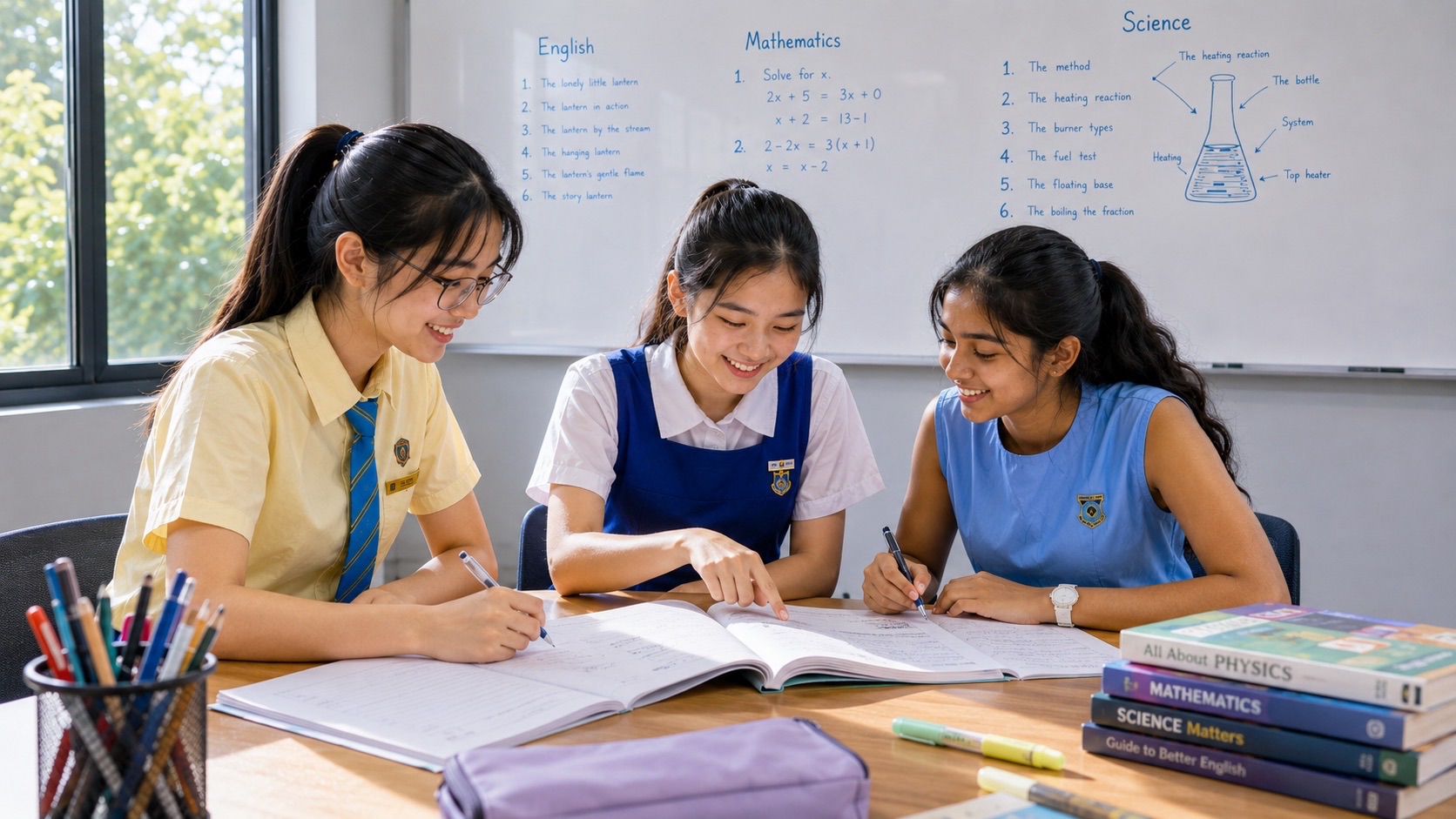
Queenstown Secondary School is a co-educational government secondary school at 1 Strathmore Road, Singapore 148800, near the Queenstown and Redhill areas. For children receiving PSLE 2026 results on Tuesday, 24 November 2026 at 11.00am, its relevant options are Posting Group 3, Posting Group 2 and Posting Group 1 under Full Subject-Based Banding. The school is not a verified IP, IB or IGCSE institution. Its distinctive FutureLearn curriculum combines environmental sustainability, community youth leadership and digital literacy, with hands-on Maker Education and a later community capstone.
For the 2025 PSLE cohort entering Secondary 1 in 2026, Queenstown Secondary’s historical ranges were PG3 AL15–22, PG2 AL22–25 and PG1 AL26–30*. The star on 30* indicates that places remained in that previous PG1 route, not proof that the last admitted student had AL30 or that 2027 admission is assured. The school has also announced a Saturday, 28 November 2026 Open House, 9.00am–12.30pm during the S1 choice window. Parents should use it to investigate Full SBB support, the actual Strathmore Road journey, subject/CCA fit and credible Queenstown–Bukit Merah alternatives before ranking six schools.
Quick summary for parents
• Co-ed government school at 1 Strathmore Road, Singapore 148800; Full SBB early pilot experience from 2020.
• 2025 PSLE / 2026 S1 historical PG3 15–22 and PG2 22–25.
• Historical PG1 26–30*, with 30* indicating remaining vacancies in the previous route, not an assured cut-off.
• No verified IP, IB Diploma or IGCSE school option.
• FutureLearn integrates environmental sustainability, community youth leadership and digital literacy.
• Secondary 1 water/biodiversity investigations, Secondary 2 alternative energy work and Secondary 3 community capstone.
• 2026 Open House: Saturday 28 November, 9.00am–12.30pm at 1 Strathmore Road.
• S1 choices close Monday 30 November at 4.30pm.
The 28 November Open House is inside the actual PSLE decision window
The school’s official November 2026 Open House page confirms Saturday, 28 November, 9.00am to 12.30pm, at 1 Strathmore Road. The event takes place after the 24 November PSLE release but before the 30 November school-choice deadline. This gives families a particularly useful chance to revisit a provisional shortlist once they know their child’s actual result. The school advertises principal sharing sessions, performances, interactive learning exhibits and contact with student leaders. Attendance does not confer a posting priority.
Parents should use a visit to answer real questions, not collect every brochure. Ask teachers to explain the usual Secondary 1 timetable under Full SBB, how academic subject levels are grouped, and how children who enter through PG1, PG2 or PG3 mix in common curriculum lessons. Ask student leaders to describe a difficult transition and the support they received. Ask what new pupils learn in FutureLearn during the first term. An answer about everyday classroom practice is more useful than a general promise that every child will become a “future-ready leader.”
A family may have only one weekend between results and final submission, and 28 November is valuable time. Decide what you need to learn before going. Bring the child’s questions and note which information remains uncertain when you leave. If the commute, atmosphere and programmes feel right, adjust the preference order thoughtfully; if the child feels uncomfortable, investigate why. There is no advantage to attending every open house or to making a dramatic last-minute decision without comparing the six actual options.
Queenstown’s three PG ranges show why Full SBB needs careful interpretation
The prior PG3 result was AL15–22, PG2 AL22–25 and PG1 AL26–30*. The number AL22 can appear in both PG3 and PG2 because pupils with PSLE 21–22 may have a Posting Group option under MOE’s rules. It does not mean pupils can choose PG3 for Queenstown and PG2 for a different school within the same six-choice submission. The selected Posting Group applies across the school choices. Ask the primary school for specific help if the family is unsure how a dual-group option works.
The PG1 notation 30* is a marker of leftover places in the earlier completed posting exercise, not a promise of automatic posting for 2027. It is especially important not to mistake the star for a personal grade, a special award or a confirmed last pupil at AL30. A child eligible for PG1 still needs to apply through the actual S1 process, meet the relevant English and Mathematics conditions where required and rank acceptable schools. Do not assume the family’s preferred school will again have vacancies.
Full SBB is not three permanent fixed streams. Queenstown Secondary was an early pilot school from 2020 and its official page explains that pupils learn common-curriculum subjects in mixed form classes while taking core academic subjects in groups suited to their readiness. A pupil initially admitted through PG2 may offer a more demanding subject level where eligible. A pupil admitted through PG1 may have particular strengths in applied learning or the arts. The national qualification framework ultimately assesses subjects at applicable G levels. Parents should ask how level changes and support are implemented at the school rather than attach a permanent label to a twelve-year-old.
FutureLearn: a concrete curriculum rather than a generic “innovation” slogan
Queenstown Secondary’s official FutureLearn programme page names three pillars: Environmental Sustainability, Community Youth Leadership and Digital Literacy, enriched by Maker Education and design challenges. This integration gives a pupil reasons to connect Science, Mathematics, Geography, English and citizenship education to real problems. The school does not claim every student receives the same advanced or overseas opportunity, so families should investigate broad-based versus selected activities.
A Secondary 1 example is fieldwork at Lower Seletar Reservoir, where earlier pupils studied biodiversity on a nature boardwalk, sketched land features and tested water quality. This is an example from the published programme, not a promise that the 2027 cohort will visit an identical site on the same date. It illustrates why observed evidence matters. A child may think clear-looking water is clean, but water quality depends on what is actually measured; learning to separate appearance from data is a transferable habit in Science, Mathematics and evaluating online claims.
Secondary 2 examples include constructing solar cars, making solar ovens and using kinetic energy. These tasks may look playful, but reliable experiments involve controls, measurement, calculation and explanation. If a solar car moves farther, what changed? Was light stronger, the weight lower or friction reduced? Does the child know how to test one factor at a time? Parents can ask to see how teachers teach pupils to document mistakes and improve a prototype. A school encouraging revisions may build resilience far more effectively than one that celebrates only perfect demonstrations.
The Secondary 3 capstone connects school knowledge to the community
Queenstown’s published FutureLearn account describes a Secondary 3 community capstone in which pupils work in teams on authentic issues they select with guidance. Examples include documenting local hawkers, promoting cultural heritage through videos and designing materials that explain why a community tradition matters. This is not simply a chance to film a pretty video. Students need to interview respectfully, verify facts, represent others fairly and decide whether the final message is accurate. Those are powerful English and civic competencies.
A young person who has learned to make claims with evidence can explain why a neighbourhood needs a particular improvement, what constraints a group encountered and what could be tested next. A pupil who is technically skilled but uncomfortable talking to strangers may grow through a supported interview role. Another who enjoys writing but dislikes calculations may discover why data matter. Ask how the school divides work among teams, how it gives individual feedback and whether every pupil has the opportunity to develop these skills.
The school also names selected enrichment opportunities such as Sustainability Champions and QUEST Global overseas experiences. These should not be represented as universal entitlements or guaranteed travel for all students. An overseas exchange can be valuable, but parents should consider selection, cost, supervision and whether the pupil is genuinely ready. The foundational classroom and community learning may be just as meaningful for a student who never joins a selective programme.
Digital literacy: a school device is not the same as digital judgment
FutureLearn identifies digital literacy as a central capability. A teenager may be familiar with video apps, web search and conversational AI while still finding it hard to verify a source or organise a complex assignment. Ask what Queenstown teaches about file management, cyber safety, evaluating evidence, ethical AI use, citation and privacy. Parents should also ask whether the school differentiates instruction for pupils who have had very different amounts of access to technology at home.
A healthy digital-learning habit is to separate assistance from understanding. A tool may help a pupil brainstorm or improve wording if school rules permit, but the learner must be able to explain the ideas, verify factual claims and show personal reasoning. A FutureLearn activity about energy use can be a good context for this: the student may gather data digitally, but must still ask whether the data are reliable and whether a proposed solution solves the real issue.
Parents can begin with one small practice: ask the child to find two sources about a familiar scientific question and explain which is more reliable and why. This encourages curiosity and judgment without turning the home into a surveillance centre. A school that connects digital literacy with real problems may help pupils see that technology is a tool for understanding and service, not a replacement for effort or accountability.
Strathmore Road versus other Queenstown schools
Queenstown Secondary is at 1 Strathmore Road, Singapore 148800. Families may come from Redhill, Queenstown, Alexandra, Bukit Merah, Commonwealth, Dover and neighbouring estates. A straightforward journey may be available for some households; others will need a bus from an MRT stop or a longer walk after CCA. Test the route at the correct reporting time and discuss how the child will travel home safely after a performance, sports training or late school activity.
Do not confuse Queenstown Secondary School with Queensway Secondary School. They are separate institutions with different addresses, curricula and historical Posting Group endpoints. Queenstown is at Strathmore Road and has FutureLearn. Queensway is at Margaret Drive and has its own sustainability and community leadership programmes. A parent’s spreadsheet should contain full names and addresses, not “Queenstown/Queensway” as one merged option. Check each correct school in the S1 portal before submission.
Other comparison candidates include New Town Secondary, Gan Eng Seng School, Fairfield Methodist School (Secondary), Kent Ridge Secondary and eligible schools in Bukit Merah or Clementi. Families should check actual school existence, the child’s offered Posting Group, historical COP, gender eligibility, CCA fit and commute before calling one a backup. A school with a less stringent earlier COP and a reliable journey can be a stronger real choice than a school selected for familiarity alone.
When is Queenstown Secondary a good fit?
Queenstown Secondary can be especially attractive to a pupil who wants a co-educational environment, benefits from mixed form classes with subject-level academic support, enjoys scientific and sustainability projects, and can imagine contributing to a community. A parent should still ask how a child who finds written explanations difficult receives help after an exciting project. Good practical learning must build the learner’s subject accuracy and ability to reason, not just confidence in giving a presentation.
The school may be a less comfortable fit when the family prioritises a specialised subject or CCA not available, when the commute is too tiring, or when the child strongly prefers another school culture. These are normal trade-offs, not negative statements about the school’s quality. A score at the prior PG3 boundary of 22 or PG1 starred limit of 30 cannot answer them. The family should compare pupil happiness and daily opportunities as seriously as competitive admission statistics.
The most useful final question for a parent is: “If my child is posted here in December, can we be genuinely happy and ready to start?” If the answer is yes and the actual Posting Group makes the option plausible, Queenstown Secondary belongs in the conversation. If the answer is no, do not use it merely to fill a sixth line. The point of six ordered preferences is to give MOE a list of schools the household would accept, with enough historical margin to improve the likelihood of being posted to one of them.
Real PSLE score situations for a family considering Queenstown Secondary School
The following situations explain choices, not future admissions. Every number refers to a comparison with the 2025 PSLE cohort’s completed 2026 Secondary 1 entry, unless otherwise labelled. A route’s historical range may be useful, but the actual 2027 allocation depends on the new cohort. Do not read these examples as guaranteed vacancies, an appeal entitlement, or a promise that a particular girl or boy will receive a place. Always take the official result slip, affiliation status, school gender and selected Posting Group into account.
Case 1: AL 17, PG3 eligible
The earlier Queenstown PG3 endpoint was 22, so AL17 has a historical numerical margin. That does not secure 2027 admission. If the child likes FutureLearn and can travel to Strathmore Road, Queenstown may be a meaningful preference.
To make this concrete, ask the family to write three items beside the score: the route shown in the official S1 portal, the actual daily school experience the child wants, and at least one other eligible school with a more comfortable historical margin. If the route or a language or affiliation condition is uncertain, treat that as an unresolved question for MOE or the school rather than a reason to guess. An attractive numerical result is helpful evidence, but it cannot substitute for a considered six-choice order.
Case 2: AL 21, with a PG2/PG3 option
The family must choose the relevant Posting Group for the six choices; Queenstown’s previous PG3 range included up to 22 and PG2 range extended to 25. Discuss initial subject levels and the child’s strengths before choosing.
To make this concrete, ask the family to write three items beside the score: the route shown in the official S1 portal, the actual daily school experience the child wants, and at least one other eligible school with a more comfortable historical margin. If the route or a language or affiliation condition is uncertain, treat that as an unresolved question for MOE or the school rather than a reason to guess. An attractive numerical result is helpful evidence, but it cannot substitute for a considered six-choice order.
Case 3: AL 22, with a PG2/PG3 option
The school showed AL22 in the earlier PG3 and PG2 ranges. This is not two simultaneous guaranteed offers. The selected group applies across the option form; each range is a historical outcome.
To make this concrete, ask the family to write three items beside the score: the route shown in the official S1 portal, the actual daily school experience the child wants, and at least one other eligible school with a more comfortable historical margin. If the route or a language or affiliation condition is uncertain, treat that as an unresolved question for MOE or the school rather than a reason to guess. An attractive numerical result is helpful evidence, but it cannot substitute for a considered six-choice order.
Case 4: AL 23 or 24, PG2 eligible
The prior PG2 endpoint was 25. The scores are historically plausible comparisons, but a new cohort and preferences can change admission. Explore the school experience and other suitable PG2 alternatives.
To make this concrete, ask the family to write three items beside the score: the route shown in the official S1 portal, the actual daily school experience the child wants, and at least one other eligible school with a more comfortable historical margin. If the route or a language or affiliation condition is uncertain, treat that as an unresolved question for MOE or the school rather than a reason to guess. An attractive numerical result is helpful evidence, but it cannot substitute for a considered six-choice order.
Case 5: AL 25, PG1/PG2 option
The previous PG2 range ended at 25 while PG1 ranged 26–30*. The family should not use the PG1 starred display as a universal cut-off or assume a selected PG can be switched between schools.
To make this concrete, ask the family to write three items beside the score: the route shown in the official S1 portal, the actual daily school experience the child wants, and at least one other eligible school with a more comfortable historical margin. If the route or a language or affiliation condition is uncertain, treat that as an unresolved question for MOE or the school rather than a reason to guess. An attractive numerical result is helpful evidence, but it cannot substitute for a considered six-choice order.
Case 6: AL 26 or 27, PG1 eligible under relevant conditions
The earlier PG1 record extended to 30* because vacancies remained. It gives some historical context but not a guarantee for 2027. Ask about Full SBB subject choices and the actual support offered.
To make this concrete, ask the family to write three items beside the score: the route shown in the official S1 portal, the actual daily school experience the child wants, and at least one other eligible school with a more comfortable historical margin. If the route or a language or affiliation condition is uncertain, treat that as an unresolved question for MOE or the school rather than a reason to guess. An attractive numerical result is helpful evidence, but it cannot substitute for a considered six-choice order.
Case 7: AL 30, with AL7 English and Mathematics as required
The child may qualify for PG1 under the published rules. The school’s previous 30* cannot guarantee a place, and it does not establish a final pupil who scored 30. Keep a full, acceptable PG1 choice list.
To make this concrete, ask the family to write three items beside the score: the route shown in the official S1 portal, the actual daily school experience the child wants, and at least one other eligible school with a more comfortable historical margin. If the route or a language or affiliation condition is uncertain, treat that as an unresolved question for MOE or the school rather than a reason to guess. An attractive numerical result is helpful evidence, but it cannot substitute for a considered six-choice order.
Case 8: A child very interested in sustainability but living far away
A strong interest is meaningful, but travel time is a genuine cost. Compare Queenstown with nearby schools offering hands-on applied learning, and evaluate whether long journeys leave enough time for sleep and recovery.
To make this concrete, ask the family to write three items beside the score: the route shown in the official S1 portal, the actual daily school experience the child wants, and at least one other eligible school with a more comfortable historical margin. If the route or a language or affiliation condition is uncertain, treat that as an unresolved question for MOE or the school rather than a reason to guess. An attractive numerical result is helpful evidence, but it cannot substitute for a considered six-choice order.
Frequently asked questions about Queenstown Secondary School
Is Queenstown Secondary the same as Queensway Secondary?
No. Queenstown is at 1 Strathmore Road; Queensway is at 2A Margaret Drive. They have distinct admissions ranges and school programmes.
Does Queenstown offer PG1, PG2 and PG3?
Its previous completed posting exercise showed ranges for all three groups. The family must check the current result slip and option form.
What does 30* mean in its PG1 history?
The previous PG1 route had remaining vacancies, and the displayed 30 is not proof that the last student actually scored AL30.
Is Queenstown an IP, IB or IGCSE school?
No such route is verified. The mainstream option is Full Subject-Based Banding and the applicable national examination pathway.
When is its November 2026 Open House?
Saturday 28 November, 9.00am–12.30pm at 1 Strathmore Road, according to the school’s official announcement.
Does every Secondary 1 pupil join QUEST Global?
No. The school describes selected pupils taking part in overseas immersion opportunities. Ask about eligibility and costs.
What is FutureLearn?
The school’s integrated curriculum combining environmental sustainability, community youth leadership, digital literacy and Maker Education.
What do Secondary 1 pupils do in sustainability?
The school publishes examples such as Lower Seletar Reservoir biodiversity observation and water-quality investigation; confirm the coming cohort’s activities.
Can a PG2 pupil take some G3 subjects?
Full SBB provides subject-level flexibility according to MOE and school criteria. Do not assume the change is automatic.
Is there a general home-distance priority at S1 posting?
Do not assume a primary-school-style home-distance priority. Read MOE’s S1 posting tie-breaks; distance matters to the family’s daily journey.
A final parent decision, not a verdict on a twelve-year-old
A parent choosing Queenstown Secondary School should be able to say more than “the score might be enough”. The important answer is whether the child is eligible for the verified route, interested in the learning offered, comfortable with school culture, able to travel sustainably and supported by the family. Historical cut-offs help identify realistic options; they are not measures of a child’s personal value. No school is guaranteed before the final posting, and no single school determines the whole of a pupil’s educational future.
When the 2026 result arrives on 24 November at 11.00am, speak calmly. Confirm the actual pathway and take the time needed to build a responsible list of six acceptable schools before the 30 November 4.30pm deadline. A parent can advocate for a child’s interests while recognising institutional constraints and an uncertain future COP. Once the place is confirmed, the strongest next move is to help the child settle, learn, make friends and acquire steady habits. That is a more useful long-term educational goal than winning an argument about one point on a historical score chart.
24 November 2026: the actual PSLE date and S1 school-choice deadline
The MOE–SEAB announcement issued 17 November 2026 confirms that PSLE 2026 results are released Tuesday, 24 November at 11.00am. School candidates receive their results according to their own primary school’s instructions; candidates unable to attend may appoint a proxy by Thursday, 26 November. Parents can access the S1 Portal using Singpass from 11.30am on Tuesday, 24 November. It closes at 4.30pm on Monday, 30 November 2026. One parent logs in to submit; the school can help a family encountering difficulties before the deadline. Secondary 1 posting results are tentatively expected on Friday, 18 December 2026, pending a subsequent confirmation.
Do not confuse a school open-house date with the national school-choice deadline. Some events take place before results and some during the option period. The national dates above come from the confirmed 17 November release, which supersedes earlier tentative 24–25 November PSLE date windows. The child’s own primary school remains the best first point of contact about collection arrangements, a proxy or a problem completing the portal. The most important piece of equipment is not a colourful school brochure: it is the child’s actual result and eligibility information in the S1 form.
On results day, give the child some time to react before negotiating six choices. A score is a record of performance in particular examinations, not the child’s character or future worth. Do not post the result to family groups without the child’s agreement. Parents can be calm and purposeful: check the four-subject total, read the posting eligibility carefully, review programmes with the learner, then make a considered submission well before closing time. The goal is informed direction, not an hour-long argument over a single cut-off point.
PSLE AL and the initial Posting Group: know the framework before comparing schools
The PSLE Score is the sum of Achievement Levels from the four examinable subjects. A lower total is a stronger numerical result. It is important to keep that total separate from Higher Chinese grades, subject-specific grades and any school admissions annotation. If a school publishes “4(D)–6(M)”, the letters describe the relevant Higher Chinese grades at the displayed endpoints; they are not additional ALs. If a school publishes “30*”, the star describes an admissions reporting convention, not a special grade earned by the child. Parents should read the legend that belongs to the particular school’s data.
- PSLE 4–20: generally eligible for Posting Group 3 (PG3), subject to applicable school pathways.
- PSLE 21–22: generally eligible to opt for PG2 or PG3.
- PSLE 23–24: generally eligible for PG2.
- PSLE 25: generally eligible to opt for PG1 or PG2.
- PSLE 26–30: PG1 eligibility is subject to the specified English and Mathematics AL7 conditions and other applicable rules.
- IP entry: an additional, separately identified school programme; do not infer an IP offer merely from general PG3 eligibility.
- Foundation-subject or special-case results: use the actual result slip and MOE guidance rather than mapping a single total from a third-party table.
When a student has a choice between two Posting Groups, the family should decide which group will be selected in the actual S1 portal. The selected Posting Group applies to the six secondary-school choices in the ordinary posting submission, rather than allowing parents to toggle one school to PG2 and another to PG3 without consequence. For a child with strengths at different subject levels, ask the school or primary-school teacher about the practical initial curriculum implications. Entry route, individual subject level and later assessment qualification are related, but different things.
Posting Group is not the child’s permanent subject ceiling
Under Full Subject-Based Banding, PG1, PG2 and PG3 organise initial admission. Individual subjects can be studied at G1, G2 or G3 where the pupil is eligible, and schools have rules for subsequent adjustments based on performance and readiness. A child may be strong in Mathematics but need more scaffolding in English; the response should be subject-specific rather than calling the entire child “weak”. Not all schools offer every subject combination or opportunity, so ask the specific school what is possible in Secondary 1 and later years.
The Singapore-Cambridge Secondary Education Certificate (SEC) examination begins from 2027 as the national examination framework that replaces separate N- and O-Level examinations for the relevant mainstream cohorts. For students entering Secondary 1 in 2027, the future national pathway generally leads toward taking the relevant subjects at their offered levels. However, an Integrated Programme (IP) is a distinct programme that may continue to an A-Level or IB Diploma route. The school in this article offers mainstream Full Subject-Based Banding with Posting Group 3, 2 and 1 and eventual SEC, not IP, IB Diploma or IGCSE. This is why an article title listing IP, IB, IGCSE and PG labels must clearly separate which choices actually exist rather than treat them as optional decorations.
The International Baccalaureate Diploma and the International General Certificate of Secondary Education (IGCSE) are different qualifications. Some Singapore IP schools lead to IB; others to A Levels. Mainstream schools following SEC should not be rebranded IGCSE schools because both names sound internationally recognised. Families should read the school website and the S1 portal to understand the final qualification and academic progression. This matters for course selection, study methods and future tertiary options.
How to read a school cut-off point without treating last year as a promise
The ranges cited for Queenstown Secondary School are historical records from PSLE 2025, for Secondary 1 entry in 2026. They are not the outcome of the PSLE 2026 cohort, and they cannot reveal a fixed cut-off for Secondary 1 entry in 2027. The number at the more lenient end of an ordinary published score range usually identifies the last student admitted in that completed exercise, subject to specific footnotes. Vacancies, the score distribution of applicants, ranked school choices, citizenship and the official tie-break procedures can change the new outcome. Equal to last year’s COP is not a guaranteed offer.
For example, a pupil with AL15 is numerically stronger than a historical PG3 endpoint of AL18, because smaller is better. That creates some reference margin but not certainty. A pupil with AL18 matching that endpoint was at a boundary of the previous exercise; a score of AL19 was beyond it. This illustration does not say anything about the actual Queenstown Secondary School admission chance unless the parent uses the correct programme, affiliated status and posting group. It is only a method for interpreting the numbers. School admissions are not a probability formula that can be reverse-engineered from one year’s endpoints.
For Queenstown Secondary School, the especially important historical comparison is PG3 endpoint AL22, PG2 endpoint AL25 and the special PG1 display AL30*. Never transfer an affiliated score to an unrelated child, or a starred PG1 score to a PG3 request, or an IP endpoint to an SEC route. SchoolFinder and the current S1 Portal are more authoritative than a social-media screenshot. If published figures conflict, look for a year label, whether the score is from the 2025 PSLE cohort or the 2026 intake, and whether the source mixes first-posted with last-posted scores. A reliable guide states what is known and leaves the future result unknown.
Make a six-school shortlist with ambition, actual preferences and sufficient margin
Start by listing only schools where the student is eligible for the specific entry route shown in the live portal. Check that the school is the right gender type, the right campus and the desired programme. Then remove schools the child would refuse to attend and those where the daily trip is unsustainable. A famous name is not an educational reason. Ask the child to explain what she or he would actually study, which activity seems appealing and whether there is a particular school culture or teaching style that resonates. Keep the conversation focused enough that the child remains involved.
The 17 November 2026 MOE–SEAB release encourages families to include at least two to three schools with historical COPs less stringent than the child’s score among the six choices. In PSLE AL terms, a less stringent COP usually means a higher last-posted AL total for the same relevant route. A child at AL16 might therefore include appropriate schools with previous last-posted scores such as 18, 19 or 20, rather than selecting six schools that previously ended at 10 or 12. This is a risk-management method, not a declaration that some schools are inferior. It also does not guarantee a place at those alternatives.
Rank the schools in genuine preference order. MOE’s posting tie-breakers include citizenship, school-choice order and computerised balloting under the applicable framework, with SAP/Higher Chinese and affiliation provisions where relevant. A child with the same score as another applicant can be affected by the order in which schools were ranked. This is not an argument to put an unwanted “safe” school ahead of a desired school. Use the shortlist to express the child’s real preferences and include acceptable less-stringent choices so that one ambitious preference does not consume the whole strategy.
An easy worksheet has six rows: School and precise route; historical score and year; child’s eligibility; one educational reason the pupil wants it; measured commute; and any unresolved risk. Add a separate column for gender restriction, affiliation, Higher Chinese, fees, an IP transition or a campus relocation. For each row ask, “Would we be willing to accept this place in December?” If not, the school does not belong on the list merely because a parent has heard its name. A viable sixth choice should feel like a genuine fallback, not a punishment.
Time, money and family life are legitimate education criteria
From Queenstown, Redhill, Alexandra, Bukit Merah, Commonwealth, Dover, Margaret Drive and the central-west neighbourhoods, different households may encounter very different journeys to 1 Strathmore Road, Singapore 148800. A travel app can provide a first estimate, but it does not show the actual effort of getting a tired twelve-year-old to school at reporting time. Test the route in the morning and after a CCA-style late dismissal. Include time to reach the station, walking in rain, transfers, crowded vehicles and what happens if the child misses a connection. A school three kilometres away may be less convenient than one several kilometres away on a direct reliable route.
Ask the school about real costs: uniform, books, school device, optional overseas programmes, specific CCA equipment, transport, meals and any school fees beyond normal government rates. Financial aid may be available under relevant schemes, but eligibility should be checked rather than assumed. A family can responsibly prefer a shorter commute or lower overall cost without apologising for the decision. Four years of regular school days produce thousands of opportunities for tiredness or positive engagement; practical sustainability deserves attention.
Pay particular attention to after-school schedules. A pupil may have a strong desire to play sport, join a concert band or participate in community projects. Those activities provide friendships and development, but they require time. Calculate the total weekly load including transit, homework, rest, social time and siblings’ routines. If the timetable leaves inadequate sleep every weekday, even an excellent school can become a poor personal fit. Responsible school choice balances ambition with the child’s human capacity, rather than demanding limitless effort because a school is selective.
School programmes are opportunities, not automatic entitlement certificates
A school brochure may feature an impressive engineering project, an overseas trip, a national competition or a graduate who won a scholarship. That example may be genuine but it does not mean every new Secondary 1 pupil enters the same programme. Distinguish cohort-wide learning from selective enrichment, DSA commitments, CCA trials, upper-secondary subject combinations and one-off activities. Ask what the ordinary new pupil actually does in the first term and which later programmes require specific criteria.
A useful school visit asks three questions about a distinctive programme: What does every student experience? How do teachers assess understanding and provide feedback? What opportunities are optional or selective, and what happens if a child is not selected? This prevents disappointment after posting and respects the work of the teachers who manage limited resources. It also helps parents compare unlike programmes fairly. A school that offers excellent foundational science teaching may be the stronger match for one child than another school’s selective advanced science club.
Do not ignore friendships and wellbeing. Ask how new pupils are oriented, how form teachers handle conflict or isolation, and where a student can seek help with learning or personal concerns. A child who feels safe asking questions is more likely to correct misunderstandings before they grow. An extraordinary academic opportunity is less useful if the child spends every morning dreading school. The school environment should challenge the learner appropriately and provide credible support when that challenge becomes difficult.
A family calendar: 24–30 November and the tentative December posting
Tuesday, 24 November: collect the result according to primary-school arrangements at 11.00am. Read all eligibility notes. At 11.30am the S1 Portal opens. Resist the urge to submit immediately with a list prepared before the child knows the real score. Discuss the specific route at Queenstown Secondary School, confirm any DSA allocation, and begin a shortlist that reflects the child’s preferences. A family argument over an unknown last-posted score is not a good first use of the day.
Wednesday and Thursday, 25–26 November: use MOE SchoolFinder and the actual school websites to check programmes, address, fee arrangements, historical posting results and CCAs. A child unable to return to the primary school has a proxy arrangement available by 26 November according to the official release. Verify any affiliation rule with the primary school and the target school. Ask focused questions; there is no need to telephone ten school offices with the same question if MOE already provides the answer.
Friday through Sunday, 27–29 November: use available open-house opportunities and realistic journey tests to refine the list. Rank the six schools in true preference order. Check whether the selected Posting Group applies consistently across the form and that you have not mixed schools with similar names. Record each school’s exact programme. If an independent school or a school with a campus move is on the list, confirm that detail explicitly. Aim to submit with enough time to fix typing, login or connection errors.
Monday, 30 November: submit before 4.30pm and keep the final acknowledgement or record permitted by the portal. One parent can submit using Singpass. Parents needing help should contact the primary school before the deadline. After submission, do not spend the following fortnight treating social-media rumours as predictions. The S1 posting result is tentatively expected Friday, 18 December 2026, and MOE will confirm the date later. Wait for the official posting result rather than assume an earlier press description is a completed allocation.
After posting: a calmer, smarter transition to Secondary 1 in 2027
Once the result is known, consult the posted school’s latest 2027 Secondary 1 instructions, orientation and registration arrangements. Check the correct uniform and booklist, school-device guidance, financial assistance and transport plan before purchasing anything. A document labelled “Sec 1 2026” may belong to last year’s cohort. A school can update its timetable, partner vendor, reporting gate or orientation schedule. Save the actual current communication from the school and avoid relying on forwarded screenshots with no date.
The academic transition is important but does not require a December holiday packed with tuition. Secondary Mathematics begins to use algebraic notation, negative numbers and multi-step explanations more intensively. Science expects increasingly precise claims linked to observations. English involves sustained reading, interpretation and writing with evidence, while Mother Tongue demands can vary by school and subject level. Identify the child’s strongest and weakest foundations. A twenty-minute focused practice with accurate feedback is often more useful than a pile of repetitive tasks that never explains the error.
Use a practical learning cycle: Depth — can the child explain why the method works rather than repeat a formula? Load — can the child sustain a routine without sacrificing sleep and motivation? Transfer — can the child apply the idea to an unfamiliar question? When depth fails, return to a worked example and ask for an explanation. When load fails, simplify and distribute effort across several days. When transfer fails, vary the question type and ask which feature remains the same. These small corrections create more durable readiness than a dramatic promise to master an entire syllabus before January.
Parents can begin by asking their child to explain one topic in their own words, to check a Mathematics solution through substitution or an inverse operation, and to read a short nonfiction passage and distinguish evidence from opinion. Keep enough room for sport, reading for pleasure, hobbies and family time. The best post-PSLE decision does not only place a pupil into a school; it helps the student begin with reasonable confidence, an organised morning routine and a family that values learning beyond examination labels.
Parent questions worth asking the school directly
- Which of the school’s pathways shown online can my actual child enter with the result slip and selected Posting Group?
- Does the school have affiliation conditions, a SAP language requirement or a separate IP course?
- Which published score ranges are for the 2025 PSLE cohort entering in 2026? Are there any D/M/P or star footnotes?
- What happens in an ordinary Secondary 1 week, not only in competitions and showcase events?
- How are English, Mathematics, Science and Mother Tongue offered at the appropriate subject levels?
- What support is available if a student struggles during the first term?
- Which arts, sports, leadership, service and applied-learning activities are open to every pupil?
- Which CCAs or advanced enrichment routes require auditions, trials, school recommendations or selection?
- What is the actual 2027 reporting address, and are there any temporary campuses or upcoming moves?
- What school fees, material expenses and financial assistance schemes apply to our household?
- How late can school or CCA sessions end and what is the realistic travel time?
- Which 2027 orientation and book-purchase instructions should the family follow after posting?
Common confusions: a quick glossary for parents and students
- PSLE Score: total of the relevant subject Achievement Levels; lower numerical total is stronger.
- Posting Group (PG): an entry route; PG1, PG2 and PG3 do not permanently label a person’s ability.
- G1/G2/G3 subjects: levels at which individual secondary subjects are studied under Full SBB.
- COP: the previous exercise’s last-posted score for a specific route, unless a published special notation applies.
- Affiliation: specific eligibility-based posting priority, not merely being related to an alumnus or living nearby.
- SAP: Special Assistance Plan school with Chinese-bicultural learning features and relevant HCL considerations.
- DSA: Direct School Admission, run earlier in the year; a successful final allocation carries commitment conditions.
- IP: Integrated Programme, a six-year curriculum leading towards a named post-secondary qualification, not an ordinary four-year SEC route.
- SEC: Singapore-Cambridge Secondary Education Certificate, the applicable mainstream national examination framework from 2027.
- IB and IGCSE: distinct qualifications which must not be attributed to a school without evidence.
- 30*: where published for a particular entry route, a vacant-place reporting convention; not necessarily a student who scored AL30.
Source checks and eduKate ecosystem guides
- National confirmed release date, portal window, and official advice about two or three less-stringent choices: MOE–SEAB PSLE 2026 results and S1 posting announcement.
- The live portal, posting information and official school listing: MOE S1 Posting and MOE SchoolFinder.
- Official school overview and direct programme descriptions: Queenstown Secondary School school website.
- eduKate’s earlier detailed school reference: Parents’ Guide to Queenstown Secondary School.
- eduKate’s score-wide 2027 comparison: PSLE Scores 4–32: complete parent school finder.
- eduKate’s Clementi clarity-first lesson framework used as the editorial reference: Secondary 1 Mathematics Tutor Clementi | Small Groups Tutorials.
- Queenstown Secondary 2026 Open House, 28 November 9am–12.30pm.
- Official FutureLearn curriculum and project examples.
- Queenstown Secondary’s mixed-form Full SBB implementation.
- eduKate Queenstown and Queensway Secondary comparison.
- eduKate Queenstown and New Town Secondary comparison.
- eduKate PG3 Queenstown, Bukit Merah and Redhill choices.