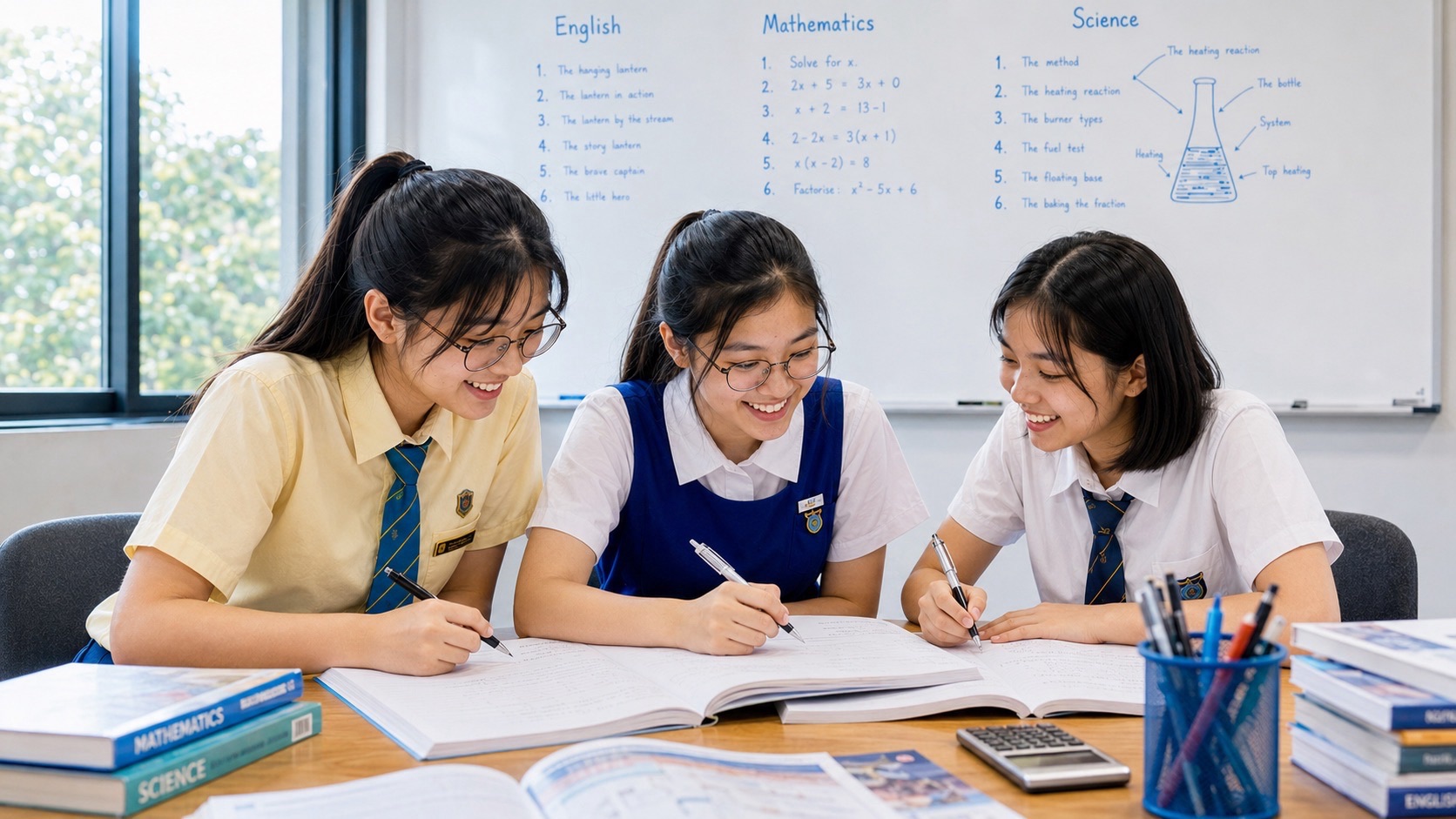
If your child enters Secondary 1 through PSLE Posting Group 2 (PG2) in 2027, use their first Geography, History or Literature in English assignment to see what kind of help they need. Read the original question, the child’s answer and the teacher’s feedback together. A child who can identify a fact may still need help explaining what it shows. A child with a sensible interpretation may need help choosing the line or data point that supports it. Correct one part, then try a new example before deciding whether to ask for more support.
Check the subject names, levels and assessment arrangements in the posted school’s materials. Under Full Subject-Based Banding, G2 and G3 Humanities at lower secondary include Geography, History and Literature in English. Schools provide their own teaching sequence, texts, task instructions and feedback. The SEC syllabus published for candidates sitting the national examination in 2027 serves a different purpose from your child’s Secondary 1 school plan. The practice tasks below are original examples you can use alongside the work your child brings home. Humanities under Full Subject-Based Banding · 2027 SEC syllabuses for examination candidates
- Read the question before discussing the grade. Find out what the instruction asked your child to do and what evidence it gave them.
- Repair one step at a time. In Geography, check the map key, directions, numbers and units. In History, distinguish what a source says from what it can support. In Literature, explain how particular words create an impression.
- Test the repair on fresh work. A second answer done independently gives you better evidence than a polished copy of the first one.
- Speak to the school about a repeat difficulty. Bring two marked examples and ask which skill to practise, how to use the school’s materials and when to check progress again.
- Keep first-term support specific. The question now is how your child can improve their current work. A possible subject-level review uses a separate school process.
Contents
- Read the first feedback with the question in view
- Geography practice with a map and a small dataset
- History practice with two sources and one question
- Literature practice with a short passage and an inference
- Help your child choose evidence that actually answers the task
- Turn one marked assignment into a short practice plan
- Know when to ask the school for help
Read the first feedback with the question in view
Three papers can carry the same phrase, “Explain further”, and call for three different repairs. In Geography the child might have supplied a number without comparing it with another site. In History they might have recognised a source writer’s opinion without showing why that writer could hold it. In Literature they might have used a word such as “sad” without connecting the feeling to the words in the passage. Read the prompt and the answer before deciding what the teacher’s note means.
Place the question, answer and feedback side by side. Ask your child to say what they were trying to do in their own words. In the first minute, listen for the part of the answer that already works. This could be as simple as finding the right row in a table or reading the speaker’s anxiety correctly. Next locate the gap. If the child cannot tell what an instruction asks, rewrite the instruction together before working on the answer. If they understand the task but cannot point to evidence, give them time to find one precise detail.
Let the child make the correction. You might ask “Which part of the picture shows that?” or “What else on the page makes that explanation plausible?” A child who chooses the evidence has to work out which details matter. A child who transcribes an adult’s answer gets a cleaner page and less practice making the decision. The correction can be short. One accurate comparison and a proper explanation may tell you more about the gap than a full rewrite in a notebook.
Check which school document you are looking at
A school may share a term plan, a topic outline, an assessment notice or a marked assignment. The term plan tells you when a subject is taught. The assessment notice tells you what will be checked and when. The assignment shows the kind of response that your child was actually asked to produce. The sequence, prescribed books, order of assessment and available practice can differ by school. Check the title and date of the material before acting on a copy in a parent group chat.
For example, a school may teach poetry early and cover its prose text later, or schedule skills and texts in a different order. Yishun Secondary publishes its own Secondary 1 G2 and G3 Literature outline, which illustrates how a school presents the texts and tasks for its pupils. Use that kind of document as a model for finding the equivalent at your child’s school. Wait for the posted school’s booklist before buying a text. Example of a school’s English and Literature outlines · PG2 guide to Secondary 1 books and costs
MOE reports that mid-year examinations were removed across secondary levels by 2025. A school’s remaining assessment schedule and the format of any weighted assignment still need to be checked with the school. When a child says “We have a test,” ask them to find the school instruction. The child may be referring to a class task, a weighted assessment, the deadline for a project or an assessment at another point in the year. The preparation depends on the actual task. MOE information on assessment changes
Notice which part of the work is difficult
Separate difficulty finding information, difficulty explaining it, and difficulty finishing independently. A child may know why a historical detail matters when talking with a parent. Writing it in class is harder if they cannot remember how to start a sentence. Another child may write quickly and miss which group the question is asking about. Those children need different practice. Ask the child to talk through the first ten seconds of their answer. Where did their eyes go? What did they read? Which part did they skip because it seemed unfamiliar?
It can help to cue the next step and observe what happens. If you say “Read the headings from left to right”, does the pupil suddenly compare the correct data? If so, the cue identifies a routine they can practise. If they still do not understand the heading, teach the word or unit first. Use a new question to check that the student can manage without your prompt. That is what the child has to do once they are writing in class.
Geography practice with a map and a small dataset
The lower-secondary G2 and G3 Geography syllabus develops geographical inquiry and uses ideas including space, place, environment and scale. When your child comes home with a map, graph or fieldwork table, ask which kind of evidence the question needs. A map helps a student work out where something occurs or how places connect. A table can help the student compare records. Explaining a pattern may require a link between both kinds of evidence and whatever the class has learnt about the topic. Lower Secondary G2 and G3 Geography syllabus
Read a fictional neighbourhood map
Imagine a square plan of Maple Landing, a fictional neighbourhood. North is at the top. Its middle point is a footbridge. A school entrance is one grid square east of the bridge. A bus stop is one grid square south of the bridge. A sports court is one grid square west of the bridge. A small garden is one grid square north of the bridge. Each square on the plan represents 100 metres along the paths. On the map, covered paths join the bus stop to the bridge and the bridge to the school entrance. The garden and court paths are open to the sky. For this exercise the marked paths are the only routes between those locations.
Here is the same layout as a grid, with north at the top. Read the path and shelter descriptions above to work out which connections count.
| West column | Centre column | East column |
|---|---|---|
| Empty | Garden | Empty |
| Sports court | Footbridge | School entrance |
| Empty | Bus stop | Empty |
A grid like this records relative positions. It leaves the reader to consult the path description for an exact walking route. If your child is drawing the grid, write north beside the top edge and mark the paths separately from the positions. A dot can tell us where a place is. A line can tell us which connection the map describes. Children sometimes draw a new line between two dots because it makes the journey look shorter. The question asks them to use the marked paths, so an answer has to follow the connections that are given.
Ask your child three questions. Which direction is the sports court from the bridge? How far is the shelter route from the bus stop to the school entrance? A family suggests that a pupil should wait at the garden after school because the garden route is covered. What does the plan allow you to say about the claim?
The sports court is west of the bridge. To travel from the stop to the school entrance by the marked paths, go one square north to the bridge, then one square east to the school. The distance along those paths is 100 plus 100 metres, or 200 metres. The route to the garden from the bridge is shown as open to the sky. The plan therefore does not support the claim that the whole garden route is covered. It does not tell you whether there is a covered seat inside the garden, because that detail is not described. This last distinction is useful. A student can say that a particular claim goes beyond the evidence without making a new claim about a part of the site the map does not describe.
A common error is to give the apparent straight-line distance from the bus stop to the entrance. Ask your child to trace the route with a finger and say where the turn occurs. If the child gets the number right but omits “metres”, circle “100 metres” in the question and ask them to put the unit into the sentence. For direction, make sure they know which place they are standing at. The court is west of the bridge, while the bridge is east of the court. A correct direction for the opposite journey is still an answer to a different question.
Compare measurements without guessing the cause
In a fictional investigation at Maple Landing, students measured air temperature next to three paths at 1 pm on Monday and 1 pm on Tuesday. They took one reading at each site on each day. The sports court path, which was open with very little shade, recorded 34°C on Monday and 33°C on Tuesday. The sheltered path near the school recorded 31°C on Monday and 31°C on Tuesday. The garden path, where there were some trees, recorded 32°C on Monday and 31°C on Tuesday.
Ask the child to compare the sports court and the sheltered path across the two days. A strong short answer is, “The sports court path was warmer on both days. It was 3°C warmer on Monday and 2°C warmer on Tuesday.” If the question asks the child to describe a pattern, this answer gives the comparison and supports it with the size of the differences. If the child just writes “the court is hot”, ask how you could tell that a comparison had been made and whether it was true for both days.
Now ask whether these readings prove that shelter caused the difference. A measured difference is consistent with an effect from shade, but these observations are too limited to isolate the cause. There may be differences between the sites in surface, wind or exposure. The students took one reading at each site on only two days. A useful next step would be to repeat the measurements at similar times over more days, check how the equipment is used and compare places that are similar in other ways. Suggest one change appropriate to the question and explain what that would help control or reveal.
Here are the original measurements for checking the comparison.
| Site | Monday at 1 pm | Tuesday at 1 pm |
|---|---|---|
| Sports court path | 34°C | 33°C |
| Sheltered school path | 31°C | 31°C |
| Garden path | 32°C | 31°C |
Try reading the data in both directions. To check change at a single site, keep the row fixed and move from Monday to Tuesday. To compare two places on one day, stay in that day’s column and move between rows. For example, the garden path was 1°C cooler on Tuesday than on Monday, while on Monday it was 2°C cooler than the sports court path. Both claims use the same number from the garden, but they answer different questions. Adding the place and day to the first sentence can make it easier to see which comparison the student actually made.
A useful student answer might say, “The readings suggest the open sports court was warmer at that time. We could compare a shaded and unshaded part of the same kind of path, with readings taken at the same time on more days. This would make differences in surface and timing less likely to explain the result.” The value is in identifying an uncertainty that matters and explaining the proposed improvement. Phrases such as “make it more fair” or “do more tests” become useful when the student specifies which part of the method needs attention.
Change the question after the repair
Give a fresh comparison. On Monday the garden path was 32°C and the sheltered path was 31°C. On Tuesday both were 31°C. Ask whether the garden path was always warmer. A pupil who checks both days will say that it was 1°C warmer on Monday, while the two sites had the same recorded temperature on Tuesday. Notice whether your child remembered the rule “compare the two rows on both days” even after the names and pattern changed.
Follow with a question about improving a map. Suppose the pupils want to advise a class about where there is shelter during the walk. The original map shows covered paths and open paths. Ask what else the pupils could record if they wanted to discuss the experience of walking in a storm. Possible useful details include breaks between shelters, whether water collects on a part of the footpath and which route is actually open at the time pupils use it. The map should record what has been observed and make it possible for another pupil to follow the route. This is an exercise on evidence, without any need to send a child out in a storm or to identify a real school route.
Contents · Previous chapter · Next chapter
History practice with two sources and one question
The lower-secondary G2 and G3 History syllabus includes historical inquiry and historical investigation. Students are asked to develop accounts of the past using evidence, with attention to what sources can show. At home, practise separating two questions. What does the source directly say? What can I infer from it about the question I was asked? A student can provide an accurate quotation and still need to explain the inference that connects it to the task. Lower Secondary G2 and G3 History syllabus
Read two invented sources about a market move
These sources and the locations are fictional. They are meant to practise handling evidence.
Source A is a notice put up by an invented market committee two days before a move in 1966. It says, “The new shed has wider passages and numbered stalls. Shoppers should follow the signs from River Road when business resumes on Monday.”
Source B is an entry in the diary of a fictional fruit seller written on the first Monday after the move. It says, “I found my new stall before seven, with more room than I used to have. By ten I had sold only two baskets. Several of my regular customers told me later they had waited at the old gate.”
Ask your child, “What can you infer from Source B about the fruit seller’s experience on opening day?” An answer could say, “The move brought a practical benefit and also seems to have disrupted trade for the seller. The seller says there was ‘more room than I used to have’, which shows one improvement inside the market. The seller had sold ‘only two baskets’ by ten and says some regular customers waited at the old gate. Taken together, those details suggest the change created difficulty for the seller and at least some customers that morning.” The answer responds to the seller’s experience and explains what each detail adds.
If the child says the whole market lost business, ask whether the writer counted sales everywhere. The diary gives an account from one person. It supports an inference about that seller and people they spoke to. We have no figures for the other stalls or for longer-term sales. The child can improve an answer by making the claim specific enough for the evidence. Using a narrower scope is usually a sign that the student has understood the source.
Compare a stated plan with someone’s experience
Ask whether Source B proves Source A was false. The notice says there will be wider passages and numbered stalls and tells shoppers the route. The diary says the fruit seller found the stall early and had more room. That is compatible with at least part of the committee’s claim about the new site. Some customers still waited at the old gate. The diary suggests the directions did not reach or guide those people, or that they still went to the old gate for another reason. It gives useful evidence of a problem for those customers. It does not establish that no signs were posted.
This is also a chance to discuss when each source was made. The committee issued instructions before the opening, so it can provide evidence of what it intended and told shoppers. The diary was written on opening day by someone who used the new site, so it gives an immediate account of one experience. The type and date of each source are useful when explaining what evidence each offers. A student who says only “A has bias” has missed the question. Ask how the notice’s purpose affects what it can tell you, and which other source would help check the result.
For additional evidence, propose a second seller’s diary, photographs showing arrows and entrances on the day, or opening-week sales records across several stalls. Each source helps with a different question. Sales records might help show whether slow buying was widespread. A dated photograph might show signs, from one particular angle, at a particular moment. A map of the old entrances and new route might help explain where the confusion occurred. The student should say which question their chosen source can answer.
Try a fresh source without repeating the same words
Invent a third source. A resident writes to the committee three days after the move that the signs were clear once they reached River Road, but a usual shortcut through a lane ended in a locked gate. Ask whether this provides an additional reason why some shoppers might have been delayed. An answer can connect the blocked shortcut to a longer or less familiar trip for shoppers who usually used that route. It should say that this is one resident’s experience and that it does not tell us which way every customer came.
After your child finishes, read the answer aloud. Look for a claim, a detail and an explanation of why the detail supports the claim. Ask whether the conclusion reaches beyond the people and days the source describes. The goal is for the pupil to make those checks independently. In a school historical investigation, use the teacher’s question, instructions about recording sources and requirements for the class submission.
Contents · Previous chapter · Next chapter
Literature practice with a short passage and an inference
Secondary 1 Literature can ask a student to interpret the choices a writer makes in a passage, poem or play. Some children are able to retell the scene and are still learning how to talk about the effect of individual words. Others spot a striking image and lose sight of the question it should help answer. Start with the actual class materials. A short original passage is useful for practising the steps without assuming that every school uses the same text or first-term assessment. Example of a Secondary 1 G2 and G3 Literature outline
Look closely at a moment in a fictional story
Read this original passage about a pupil called Leena. The sentence spacing here is just for at-home reading.
Leena stood at the door of the music room with a blue folder pressed against her chest. From inside she heard a chair scrape and someone laugh. She took one step towards the stairs. Then she turned back and smoothed the corner of a sheet that had been sticking out of the folder.
“I’m here for the practice,” she said when the door opened. The first two words came out so softly that the pupil at the door leaned closer. Leena lifted the folder a little. “I brought my part.”
The pupil moved a chair so she could sit near the front. Leena chose the empty one nearest the door. She laid the folder on her knees rather than on the music stand and opened it one careful page at a time.
Ask your child what impression the passage gives of Leena as she arrives. Give them time to reread the parts where her actions change. One answer is that Leena seems nervous, but wants to join and has prepared. Taking a step towards the stairs suggests she considers leaving. Turning back and saying she has brought her part show that she makes herself go ahead. She presents a quiet, hesitant approach rather than showing her nervousness through an explicit statement. A pupil may read the moment differently enough to use other details. Ask how the words allow their interpretation.
A fuller answer might focus on the folder. “The folder is ‘pressed against her chest’, which makes it seem as if Leena is holding on to something familiar while she waits. The fact that she ‘smoothed the corner’ of the paper suggests that she looks for a small action she can control before she speaks. Yet she brings her own part and opens it once she sits down, so her uneasiness goes together with willingness to participate.” The explanation links details to how the reader sees the child. It recognises both signs of hesitation and signs of commitment.
If your child says Leena was bullied, ask what the reader actually knows. There is laughter from inside. The passage leaves open why the other person laughed and whether it had anything to do with Leena. Leena may be worried about being noticed, or simply uncertain about joining a new group. The evidence supports a careful interpretation that she seems uncomfortable, and there is too little to say what caused it. This is an opportunity to show your child how qualified language can make their explanation stronger.
Explain why a changed detail matters
Try changing one line. Suppose the story now says that Leena “strode to the front and set her folder on the stand before anyone had found her a chair.” Ask how those new words change the impression. “Strode” suggests purposeful movement. Choosing the front and setting up before anyone prompts her suggest readiness to begin. These actions can make her seem more comfortable taking her place. If other clues expressing uncertainty remain in the story, the student could also discuss a change from earlier hesitation to greater resolve. The word change affects the reading because we can tell what actions are described, and students can explain how those actions differ from the earlier ones.
This kind of contrast helps pupils who remember what a word means but get stuck on “effect”. They can compare what they would picture if a different word were used. A pupil could say that “walked” would mainly tell the reader that Leena moved, whereas “strode” also suggests a more decisive manner. An effective response still returns to the actual question about how the character is presented. Knowing that a word is a verb can help the child discuss it clearly. The explanation of what it suggests is where much of the reading work happens.
Try a second small change. Replace “so softly that the pupil at the door leaned closer” with “clearly, so that the pupil waiting at the far end looked up.” Ask the child which action from the second person helps us hear the difference. In the original, someone close enough to open the door still has to lean in. In the new version, someone farther away hears and reacts. A pupil who notices the listener’s movement can explain more about the sound of Leena’s speech than one who retells only what she says.
Use a class text without writing the paragraph for the child
Ask the child to identify the line they want to discuss and explain what a reader might notice first. If they pick a very long quotation, ask which two or three words are essential to their explanation. Let them copy those words accurately and try a sentence of their own. Then check whether the inference matches what their evidence shows. A short quotation with a supported explanation gives you more to discuss than a full copied sentence followed by “this shows it very well”.
A pupil who says “she is nervous” may be able to speak a fuller explanation before putting it on paper. Let them say, “She almost went away, but she came back because she wanted to join in.” Then ask which actions support the first and second halves. The child may notice “one step towards the stairs” and “turned back”. Encourage them to use their own first explanation as a sentence starter. They can add or change the part that the chosen detail does not support.
A child may also struggle because some vocabulary is unfamiliar or because they missed who was speaking. Take time to resolve that literal reading. Underline the words around an unfamiliar line. Identify who speaks, who is being described and what has just happened. This early reading is worth doing even if the question later asks for an inference. A child can only explain the effect of a detail once they have understood its role in the passage.
Read a short poem with the same care
Here is a second original text. Read it twice, with a small pause after each sentence.
“The last bus turned the corner.
Its lights slid across our empty court.
In the dark, I bounced the ball once more.
This time I could hear the pine needles move.”
Suppose the question asks how the speaker’s surroundings change. The first two sentences draw attention to a bus passing and its moving light. Then the remaining scene is dark and the speaker bounces the ball once. The last detail, hearing pine needles, suggests the scene has become quiet enough for a small sound to stand out. A pupil might infer that the speaker is alone or almost alone by focusing on “our empty court”, while acknowledging that we cannot count everyone outside the court. The quiet could feel peaceful or lonely depending on how the pupil connects those details. A reasoned explanation is more valuable than a confident mood word with no explanation.
Check the child’s use of “dark”. If they say there is a power cut, ask where the poem establishes that. The bus light moves away and the court is dark when the speaker bounces the ball again. This is all the poem gives us about the light. If they say that the mood changes from active to still, ask them to explain the verbs. “Turned” and “slid” help us picture something moving through the scene, while “once more” narrows the repeated action to a single bounce in the darkness. A reader can use that progression to explain how the poem brings attention to smaller movements and sounds.
Balance practice across two tasks. For one task, your child can spend a little time discussing the evidence orally and write only a few sentences. For the next, let them work silently from the question to an answer. Reading aloud can be especially useful for hearing rhythm and shifts in a poem. It is also useful to see whether the student can make a comparable interpretation independently. Follow the school’s directions about class texts, annotations and what an assignment expects.
Contents · Previous chapter · Next chapter
Help your child choose evidence that actually answers the task
All three subjects use evidence, but the material and the question shape how it is used. In Geography, a student may compare two observations or interpret what is shown by a map. In History, they may explain what a source reveals about a person or event and examine the limits of that evidence. In Literature, they may show how language creates a particular effect in context. A short practice session is useful when the child can explain why a detail belongs in the answer.
Give your child three short prompts and ask which material they would consult first. “How much warmer was the open court on Monday?” requires checking the two Monday temperatures. “What did the committee tell shoppers to do?” requires reading the notice for its instruction. “How does the writer give the impression that Leena hesitates?” requires selecting an action from the passage and explaining the impression it creates. Draw the distinction between the response each prompt needs. A number with a unit is enough for part of the first prompt. The third needs a reading of a detail and a link to the impression.
Some children lose accuracy because they answer from memory. After a class discussion, they may remember the general idea and skip the underlying source. A useful challenge is to ask them to tap or underline the detail they would use. If they cannot find it, help them locate the part of the page to reread without choosing their final evidence. The child can then check whether they have reproduced the words, figures or map references accurately.
Practise what changes between a description and an explanation
Use “describe” and “explain” as working examples and follow the school’s definitions in its own materials. A description of the Maple Landing records says how the court and sheltered path compare. An explanation would explore an appropriate reason for the pattern or how the data support a conclusion, depending on the rest of the prompt. In History, a pupil might describe the two contrasting accounts, then explain what a writer’s position or purpose can tell us about their account. In Literature, the pupil may need to explain how an action helps the reader form an impression.
On a first attempt, your child may produce one good sentence and think that every answer is finished. Ask what the question requires. If a number is requested, one sentence may be right. If the reader needs to know how the detail supports the claim, another sentence may help. The eventual measure is the task, including any school directions about point value, expected detail and format. The length of a model answer from another school is a weak guide on its own.
A useful signal for parents is that an explanation can be read without the adult filling in an unstated middle step. “The fruit seller made only two sales, so the move was bad” needs clearer scope and evidence about the move. “The seller had sold only two baskets by ten and reports that regular customers went to the old gate, so the move seems to have disrupted access for some customers that morning” connects the details and defines the extent of the conclusion. The child can then check whether any words in the answer go further than the source allows.
Contents · Previous chapter · Next chapter
Turn one marked assignment into a short practice plan
Choose a page the child has already received back and identify the one change most likely to help. If the teacher has marked several features, find out which one is preventing the child from showing their understanding. A pupil who keeps choosing the wrong source may get more benefit from learning to match sources to questions than from correcting the neatness of an entire answer. A pupil who identifies the evidence accurately but leaves the explanation implicit needs a different first step.
A family might spend the first few minutes reading the prompt and identifying the evidence. The child then writes one repair, perhaps an added unit in a Geography comparison or a tighter explanation of a word in a Literature answer. Keep the original answer visible so the child can point out what changed. End with another small question built around a comparable skill. It helps to change the data, the source or the wording so that the pupil has to use the reasoning again. A useful session leaves enough energy for the rest of the evening.
Use two attempts to see whether the step is becoming independent
Suppose your child originally answered a map question about the direction from the bridge to the bus stop by giving the direction from the stop to the bridge. During the repair they can point to the bridge, name it as the starting point and trace the route south. Give a fresh prompt asking for the garden’s direction from the bridge and see whether they use the same routine without being reminded. If they answer north and can explain how they know, they have applied the method to new work. If they reverse the relationship again, they may benefit from starting by circling both locations and labelling “from” beside the first.
Another child might underline the words suggesting that Leena is unsure and give a sensible interpretation, but leave their written explanation at “She is nervous”. Offer a small question such as “What direction is she walking, and what does that suggest she is considering?” After they add a link from the stairs to the possibility of leaving, hand them the poem and ask for an explanation of the bus lights. Look for the same attempt to connect a detail and its effect. The result may be grammatically brief and still show that the child has done more thinking than before.
For History, keep the question scope visible. Read two new lines, such as a market worker saying one entrance was busy before lunch. Ask whether those lines prove every entrance was busy throughout the day. If your child can say why the place and time only support a narrower answer, they are using the same skill as in the earlier diary example. You can test this with oral responses before expecting a full written answer. Later, let the child practise the school’s own written format with a new page.
Keep a record that helps the next teacher conversation
One short note can record the question, the first difficulty, the support used and what happened on fresh work. For example, you could write, “She compared Monday’s readings but omitted Tuesday. After we reread ‘across both days’, she checked both columns on a new example.” This gives the family a better starting point next week. It can also show that your child already uses a skill independently if someone asks what support they need.
Avoid turning every lesson into a report. Choose one or two examples worth keeping. Let the child identify a piece of work that shows what they can do and a piece they want help with. If the first worksheet went badly and the next two went well, that may be enough evidence to continue normal class practice. If the same problem appears again, you can bring a small, clear set of observations to school.
Contents · Previous chapter · Next chapter
Know when to ask the school for help
A repeated difficulty can show up in the same subject, or in several subjects that require a similar step. A child who can explain a map, diary and story aloud but writes almost nothing may need help moving from spoken ideas to written responses. A child who does well with a story and cannot locate the exact values on a graph may need better methods for reading Geography evidence. The most useful school question describes the pattern you can see and asks for the next step in the current class.
Bring two examples, preferably questions marked by the subject teacher, and explain briefly what your child could do with and without help. Ask which skill would make the biggest difference, how the teacher expects a pupil to show it and which material the child should practise from. You can also ask how your child should raise questions during or after class. Use the communication channel set by the school. Give the teacher enough time to check the examples rather than asking them to respond to a conclusion you reached from one mark.
Ask for help with work the child is expected to do themselves
For a historical or geographical investigation, read the assignment rules with your child. Help them make time, check that they know the task and remind them to follow school instructions about source notes, group roles and any use of digital tools. Let the child collect and explain the evidence through the approved method. If they do not understand a source, direct them back to the teacher’s question or help them formulate a specific question to ask. A project assembled by an adult gives the teacher poor information about where the child needs support.
If the practical obstacle is that written instructions, reading access or group work consistently prevent your child from getting started, describe what happens to the school. For example, you might say that the child could do a comparative table after the instruction was divided into two steps, but could not tell which part to attempt first when given a whole page. Share relevant circumstances through the school’s established channel. Ask which support works in that classroom and what you can reinforce at home. The guide to accessibility and learning support explains how families can prepare for that conversation.
Keep subject-level questions for the relevant review
MOE’s Full Subject-Based Banding explains that eligible students can offer specific Humanities subjects at a more demanding level from Secondary 2. Schools communicate what they consider and when they do so. A first assignment gives useful information about present skills. The school’s review process needs evidence of what the pupil can manage across the work and the requirements it applies. If the family wants to understand a possible change, ask when the school reviews it and what evidence would be relevant while continuing to work on Geography, History or Literature at the current level. Example of a school’s Full Subject-Based Banding arrangements · PG2 guide to later subject-level review
A child does not need a discussion about changing level each time they find a new task hard. Help them identify what the task demands, make one correction and check that they can use it again. End with a sentence the child can say in class, such as “I found the two readings, but I’m unsure what conclusion they support.” A question that specific can move the next lesson forward.