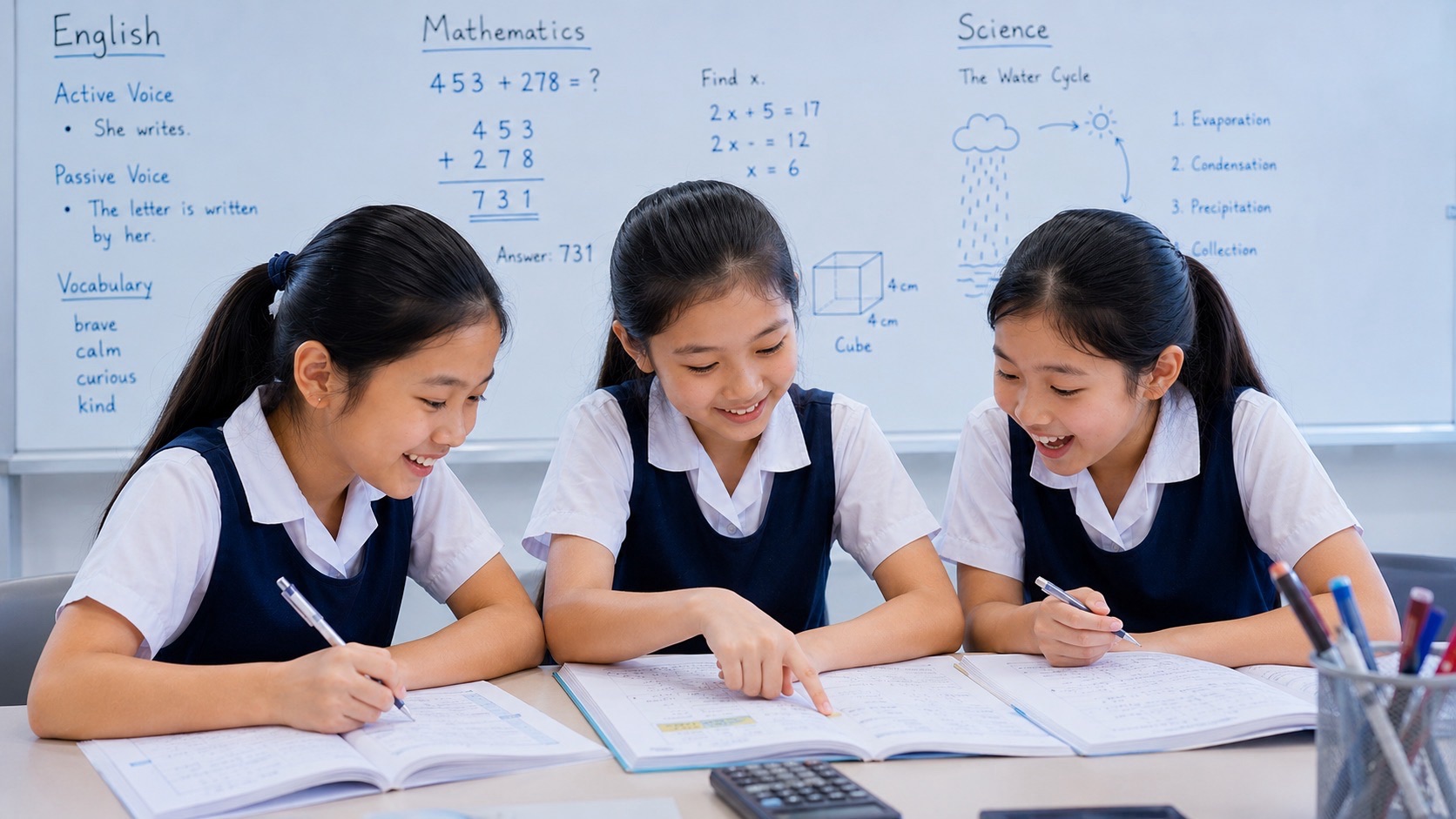
Primary 3 Science is not only about remembering facts. Children learn to observe, compare, classify and communicate what they find. A pupil may understand an activity but struggle to record the observation clearly in a table or labelled drawing. Parents can support this by helping children separate what they saw from what they think it means, use accurate labels and explain conclusions with evidence.
The MOE Primary Science syllabus emphasises scientific knowledge, practices and values. At P3, these habits can begin with simple, safe activities based on the topics taught in class. The school determines the expected recording format and level of detail. Parents should not turn every home activity into a formal laboratory report or introduce technical requirements beyond the pupil’s current level.
What parents should focus on
- State the question before beginning an observation or comparison.
- Record what is directly observed, not what is assumed.
- Use clear labels and consistent categories in tables and diagrams.
- Compare like with like and keep a simple test fair where possible.
- Separate observations, inferences and conclusions.
- Use evidence from the activity to support an explanation.
- Follow safety instructions and school guidance for practical work.
Why recording matters in Science
Recording helps pupils remember what happened and communicate findings to another person. A clear table can make comparisons easier, while a labelled drawing shows important features. The purpose is not to produce a decorative page but to preserve accurate information.
A pupil who cannot explain what was observed may find it difficult to justify a conclusion. Encourage the child to record the important features while the experience is fresh, using the format taught in class.
Observation and inference are different
An observation describes what is seen, heard or measured. An inference is a possible explanation based on what was observed. If a plant’s leaves are drooping, the drooping is an observation; suggesting that the plant needs water is an inference that may need further evidence.
Ask the pupil to begin with ‘I observed…’ and then ‘I think this may mean…’ This separates direct evidence from interpretation. Children should learn that an explanation can change when new evidence appears.
Make a simple results table
A table organises information into rows and columns. Each column should have a clear heading, and entries should be recorded consistently. If a pupil is comparing objects by whether a magnet attracts them, headings might identify the object and the observed result.
Use short labels that match the question. Avoid adding information that was not collected. A table should make the findings easy to read rather than contain guesses or unrelated details.
Draw and label observations
A scientific drawing should show relevant features clearly. Labels identify parts or properties so another person can understand the record. The drawing need not be artistic, but it should match what was observed and avoid adding imaginary details.
Ask the child what the reader needs to see. Keep the drawing large enough to label, use straight label lines where taught and follow the teacher’s requirements. If the subject changes over time, a sequence of dated drawings may be useful.
Keep a comparison fair
When an activity compares two conditions, change the factor being investigated and keep other relevant conditions the same where possible. This makes it easier to interpret why a result differs. At P3, introduce the idea simply and follow the teacher’s guidance about what should be controlled.
For example, when comparing whether different safe objects are attracted to a magnet, use the same magnet and bring it near each object in a similar way. Record what happens rather than changing the method between objects.
Use evidence to support a conclusion
A conclusion answers the investigation question using the results. If some objects are attracted to a magnet and others are not, the conclusion should state the pattern shown by the objects tested. It should not claim that all metals behave in the same way unless the evidence supports that wider claim.
Ask the pupil to point to the row, drawing or observation that supports the statement. This develops a habit of evidence-based reasoning and reduces unsupported generalisations.
Common recording errors
Children may use vague labels, omit units when measurements are required, mix observation and explanation or draw a result that differs from what happened. They may also write a conclusion that does not answer the question.
Review the work by asking: Can another person understand what was tested? Are the headings clear? Does the conclusion match the recorded results? Correct the most important issue and let the child revise.
A safe home Science routine
Choose activities that match current school topics and use ordinary, safe materials under adult supervision. State the question, make a simple prediction, observe, record and explain one result. Avoid heat, chemicals, sharp tools, electrical equipment or unknown substances unless a qualified adult and school-approved activity specifically require them.
For related P3 learning, see the main P3 Science guide, P3 inquiry and observation foundations and the P3 diversity and materials guide.
Frequently asked questions
Do P3 pupils need formal lab reports?
Follow the school’s task instructions. Short tables, drawings and explanations may be appropriate; do not impose advanced report formats unnecessarily.
What is the difference between observation and inference?
Observation records what was noticed; inference suggests an explanation based on evidence.
Why use a table?
A table organises results so that categories and comparisons are easy to understand.
Should I correct every detail in a drawing?
Focus on accurate features, useful labels and the recording expectations taught in class.
Can we do experiments at home?
Use only safe, age-appropriate activities with responsible adult supervision.
Official curriculum and related eduKate reading
See the MOE Primary Science Teaching and Learning Syllabus 2023. The 2023 syllabus was implemented progressively by cohort; the child’s school can confirm which version and sequence apply.
Continue with the P3 Mother Tongue parent guide, the P3 English preparation guide, the P3 reading habit guide, the wider vocabulary learning guide and the P3 Science preparation guide.
Keep practice short, purposeful and matched to the child’s current learning. P3 is a foundation year, not the PSLE examination year. Confidence grows when pupils understand, explain and use what they learn.