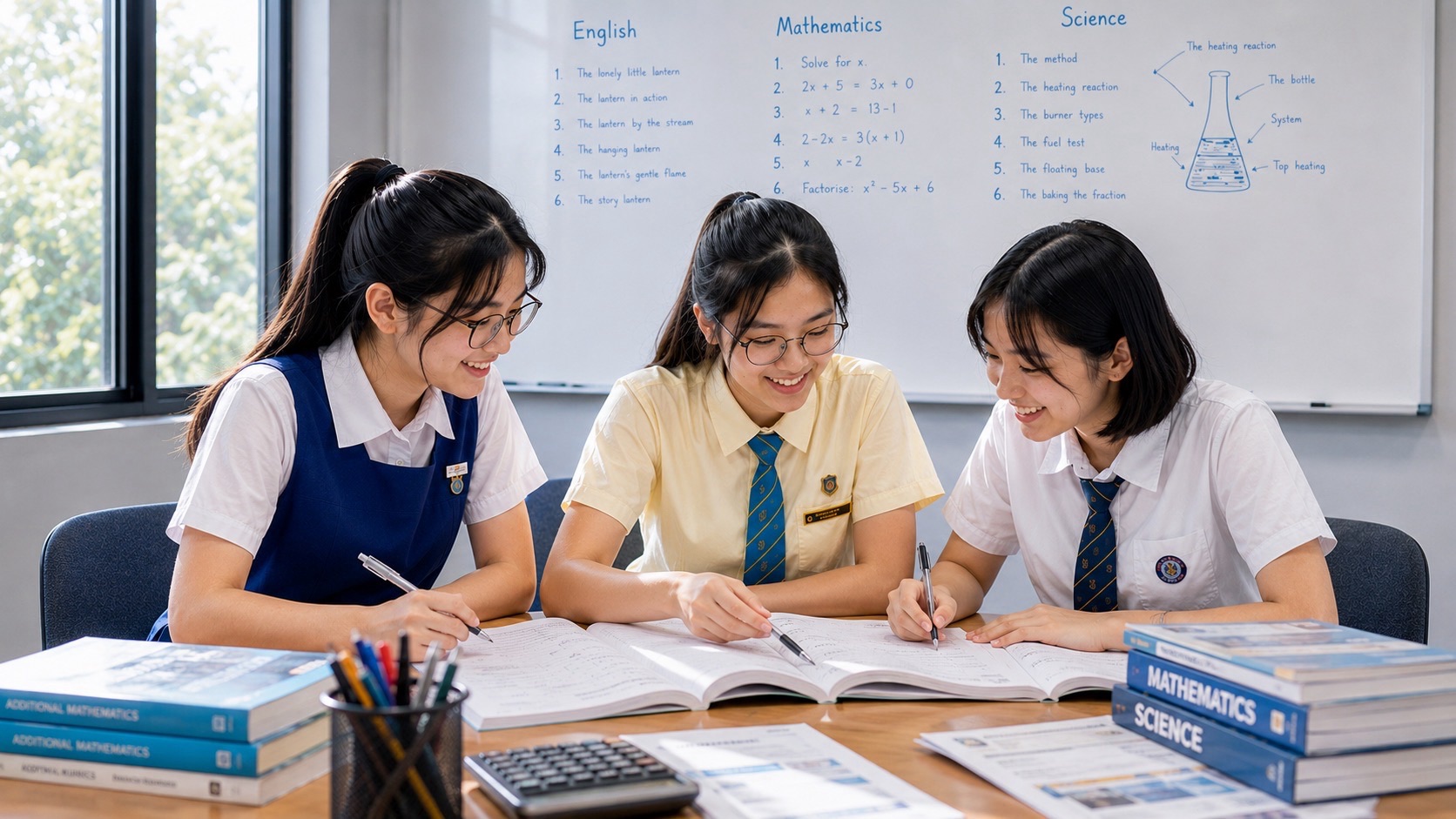
Peicai Secondary School is a co-educational government secondary school at 10 Serangoon Avenue 4, Singapore 556094, near Serangoon and Lorong Chuan. After your child receives the 2026 PSLE results at 11.00am on Tuesday, 24 November 2026, Peicai can be considered through the permitted Posting Group 3, 2 or 1. It is a mainstream Full Subject-Based Banding school, not a verified IP, IB Diploma or IGCSE option. Peicai’s Seek. Make. Advocate programme develops digital design and social problem-solving, while PinnaCle@Peicai provides separate, selected enrichment in English, Mathematics, Science and Sports.
The completed 2025 PSLE posting for 2026 Secondary 1 entry reported Peicai’s historical ranges as PG3 14–20, PG2 21–25 and PG1 26–30*. The asterisk means that PG1 vacancies remained in that earlier exercise; it is not proof that the last pupil scored exactly AL30 or a guarantee of 2027 admission. The earlier PinnaCle criteria for the 2026 intake also must not be automatically assumed for the 2027 cohort. Parents should check the actual Posting Group, relevant programme eligibility, academic strengths, family journey and other acceptable Serangoon schools before ranking six sincere choices.
Quick summary for parents
• Co-ed government school at 10 Serangoon Avenue 4, Singapore 556094.
• Historical 2025 PSLE / 2026 S1: PG3 14–20, PG2 21–25, PG1 26–30*.
• 30* reports leftover PG1 places in the previous exercise, not a confirmed last pupil’s AL or a future promise.
• Mainstream Full SBB / SEC; no verified IP, IB Diploma or IGCSE admissions programme.
• Seek. Make. Advocate ALP co-developed with SUTD: real-world design thinking, Micro:bit, AR, coding, collaboration and social issues.
• Leadership Through and For the Community LLP includes disability-awareness learning with SPD and age-appropriate student service.
• PinnaCle@Peicai offers selected English, Mathematics, Science and Sports enrichment; the 2026-intake PSLE subject AL3 rule needs a fresh 2027 check.
• Peicai in Serangoon is different from Pei Hwa Secondary in Fernvale; check exact school code and address.
Seek. Make. Advocate: the real purpose is a useful solution, not an impressive gadget
Peicai’s official Applied Learning Programme describes Seek. Make. Advocate, co-developed with the Singapore University of Technology and Design. The programme uses digital literacy, design thinking and project-based learning to address social issues. Pupils seek information about a real need, make prototypes using tools such as micro:bit and augmented reality, and advocate a reasoned solution to a relevant audience. This sequence is an important educational distinction. Technology is a means of understanding and responding to people’s experiences, not a way to avoid investigating whether a problem exists.
The 2026 programme distinguishes broad Tier 1 work from Tier 2 opportunities for selected projects. Tier 1 introduces coding, video editing, data analytics and collaboration around causes such as environmental care, disability inclusion and other community concerns. Selected groups may later present their prototypes to partners and explore implementation. Admission to Peicai does not mean immediate appointment to a particular project team or an external partner programme. Parents should ask what every Secondary 1 student actually receives and what further participation depends on interest, performance or availability.
A simple hypothetical example shows what good design education looks like. Suppose students notice that a school space is hard to navigate for people using mobility aids. They could begin by interviewing users respectfully, observing genuine barriers and researching accessible design principles. Only then might they propose a sign, a layout change or a digital direction tool. A project that looks impressive on a tablet but creates new difficulties would need revision. The point is to recognise that an elegant solution solves a problem for a person, not just a competition judge.
Design thinking can strengthen English, Mathematics and Science together
When pupils make an argument for a design, they have to write for an audience. They must explain what was observed, which evidence supports the proposed solution and what limitations remain. That is English comprehension, composition and oral presentation in a meaningful context. Mathematics may be needed to measure scale, calculate costs and interpret survey data. Science and Design & Technology may be needed to test materials or how a sensor responds. A strong Applied Learning Programme links these disciplines instead of merely requiring pupils to produce colourful PowerPoint slides.
Parents should ask how teachers evaluate the research and reasoning behind a prototype. Is each learner expected to understand the design, or can one technically skilled pupil do all the work while others present? Are students taught to handle unsuccessful tests honestly? Does a team reconsider its idea when community feedback indicates it will not work? These questions help a family distinguish real depth of learning from a project designed primarily for an exhibition photograph.
Digital citizenship is another concern. A pupil using AR, video recording or data collection must understand privacy, consent, source verification and respectful representation. An AI-generated summary may sound authoritative while omitting crucial facts. Peicai’s social-cause focus creates opportunities to teach careful verification and empathy. Families should ask what the school expects of students using external digital tools, which data should not be collected, and how students learn to cite sources. A technologically current school is one that teaches judgment as well as devices.
PinnaCle is not an admission route that every new pupil receives
The school’s PinnaCle talent programme develops selected students in English, Mathematics, Science and Sports. It offers deeper subject learning, workshops, research, competitions and leadership experiences. A child who enjoys writing or mathematics may reasonably value this opportunity. But the family must separate school admission through the S1 Posting Group from enrolment in a PinnaCle subject. A student who does not join PinnaCle still receives the mainstream school curriculum and can develop interests through classes and other activities.
Peicai’s published 2026 Secondary 1 PinnaCle eligibility notice says incoming 2026 students with a PSLE subject AL3 or better were offered direct admission in the corresponding subject programme, and that some pupils could be considered later based on school performance. Sports PinnaCle applications were separately described later in Secondary 1. The dates and criteria on that page apply explicitly to 2026 intake. Parents of the 2027 cohort should ask for updated rules before promising the same AL threshold or an automatic place. Do not copy the 2025 acceptance deadline as though it is a deadline in December 2026.
The PinnaCle programme can also be valuable for a pupil whose strongest subject differs from the overall PSLE score. A child with excellent English may benefit from deeper creative writing and public speaking even if their aggregate is less selective than a particular school’s PG3 endpoint. A mathematics-focused pupil may enjoy modelling and competitions, while a sport-focused pupil may value structured growth. But eligibility is based on the programme’s published criteria and school selection, not simply the parent’s enthusiasm. A child should still choose Peicai for its ordinary learning environment even if PinnaCle remains uncertain.
Leadership Through and For the Community: empathy requires listening
Peicai’s Learning for Life Programme is called Leadership Through and For the Community. Its published Secondary 1 experiences include learning with SPD about the challenges faced by people with disabilities in Singapore. This is important because inclusion is not just a statement of kindness; it requires understanding accessibility, communication, assumptions and the actual needs of people who may experience barriers. Parents should ask how students are guided to listen respectfully and how the programme protects the dignity of community partners.
The school’s developmental sequence introduces more student-led Values-in-Action experiences in later years, including greater responsibility for planning and advocacy. A student may learn to question a poorly designed public sign, test an accessible alternative or explain why an assumption about disability was mistaken. What matters is not how many service hours the pupil collects, but whether they genuinely understand the people their work is intended to help. Families should ask whether there are reflective discussions after projects and whether learners can admit that a good intention did not produce a good result.
A child who is not a confident speaker can contribute through patient research, careful interviewing, planning or design. Another who loves leading can learn to include quieter teammates. This is the practical promise of a strong community LLP: helping pupils act responsibly in different roles. A parent should not treat formal leadership positions as the only measure of success. A child who notices someone being excluded and helps respectfully may have demonstrated more genuine leadership than a student who simply carries a title.
What does 30* really mean at Peicai?
The historical Peicai PG1 range for 2026 entry ends at 30*. The asterisk indicates there were remaining vacancies in that category during the completed exercise. It does not establish that the actual last pupil admitted personally scored AL30, and it does not guarantee the school will have places left in 2027. A parent who sees 30* and tells a child the school is “certain” is making a promise the school has not made. Demand and preferences may change from one PSLE cohort to the next.
The correct table also has PG3 14–20 and PG2 21–25. A PG3-eligible pupil scoring AL20 is historically at one boundary; a PG2-eligible child at AL25 is at another. A child eligible for the PG1/PG2 option band cannot borrow PG1’s starred endpoint while selecting PG2 without considering the group-specific rules. The family should first select the group consistent with the actual result slip and educational readiness, and then assemble a whole six-school list using that group.
Serangoon and Lorong Chuan: the right school name and commute
Peicai is at 10 Serangoon Avenue 4 with transport connections in the Serangoon and Lorong Chuan area. A child from Kovan, Braddell, Serangoon Gardens or Ang Mo Kio South may experience a different morning journey from one starting in nearby Sengkang. Test the door-to-door journey at the actual reporting time and after CCA. A convenient station is helpful only if the walk, bus transfers and return route are realistic for a twelve-year-old with a heavier bag.
Local alternatives to investigate include Serangoon Secondary, Zhonghua Secondary, Bartley Secondary, St. Gabriel’s Secondary (boys only), and Presbyterian High School where the longer journey remains sensible. These schools have different historical cut-offs and values. A pupil interested in Peicai’s social technology programmes could also consider a school with robotics or community leadership, but similar programme words do not make all schools interchangeable. Compare the actual curriculum, student support, gender eligibility and selected Posting Group rather than assuming a geographic neighbour is a direct backup.
Do not confuse Peicai Secondary School in Serangoon with Pei Hwa Secondary School at Fernvale Link, Sengkang. Their names look similar when typed quickly, but they are different institutions, with different historical score bands and distinct technology programmes. The family should compare exact school names, addresses and option codes with the child before submitting. It would be a needless error to select the wrong school because a search result used abbreviated names.
Who is a good fit for Peicai?
Peicai may particularly suit a child who enjoys working with people, investigating problems, building a useful prototype, or exploring English, Mathematics, Science or sport through selected enrichment. The school-wide design curriculum should be relevant to beginners, while PinnaCle offers a separate possible route for pupils wanting deeper focus. Families who value a co-educational environment and a sustainable Serangoon journey may find it attractive. It is still essential to ask about core academic support and the normal Secondary 1 workload, not only the exciting project examples.
Peicai may be less suitable if a pupil wants a different academic programme, is deeply uncomfortable with the school culture or would face an exhausting journey. A family could also decide that another school offers a more reliable opportunity for a particular subject or CCA. These are reasonable choices. Rank Peicai when the child can explain a genuine reason for wanting it, and treat the 2025 PG scores and starred notation as evidence for planning, not as a verdict on the child’s ability or an admission guarantee.
Worked PSLE score examples for families considering Peicai Secondary School
Each case below illustrates the way to read the previous exercise’s completed outcome. It is not a calculation of the child’s current probability of admission. The historical 2025 PSLE cut-offs apply to students entering Secondary 1 in 2026; the new cohort’s outcome for January 2027 cannot be known before posting concludes. Parents must also check eligibility, current school programmes and any specific subject conditions. Use the result slip and MOE’s live portal rather than assuming a school can guarantee a seat at last year’s final score.
Example 1: AL17–19, PG3 eligible
The old PG3 endpoint was 20, so this is a numerical historical margin. If the child values digital design and local travel, Peicai may be an appealing option, but entry is not guaranteed.
A useful next move is to compare the exact available programme at Peicai Secondary School with at least two other school choices, using the correct Posting Group and actual estate commute. Ask whether the child genuinely likes the normal academic and CCA environment. If a conditional route, subject level or cut-off notation remains unclear, contact the school or MOE rather than drawing a definite conclusion. The family should be prepared to accept another school in its list, because a previous-year score cannot bind the 2027 exercise.
Example 2: AL20, PG3 eligible
The old PG3 endpoint was 20, a boundary rather than a secured place. Other suitable Serangoon schools should be on the shortlist.
A useful next move is to compare the exact available programme at Peicai Secondary School with at least two other school choices, using the correct Posting Group and actual estate commute. Ask whether the child genuinely likes the normal academic and CCA environment. If a conditional route, subject level or cut-off notation remains unclear, contact the school or MOE rather than drawing a definite conclusion. The family should be prepared to accept another school in its list, because a previous-year score cannot bind the 2027 exercise.
Example 3: AL21–22, PG2/PG3 option
The old PG2 endpoint was 25, while PG3 ended at 20. Select one group across all six choices and consider the intended subject levels.
A useful next move is to compare the exact available programme at Peicai Secondary School with at least two other school choices, using the correct Posting Group and actual estate commute. Ask whether the child genuinely likes the normal academic and CCA environment. If a conditional route, subject level or cut-off notation remains unclear, contact the school or MOE rather than drawing a definite conclusion. The family should be prepared to accept another school in its list, because a previous-year score cannot bind the 2027 exercise.
Example 4: AL25, PG1/PG2 option
Peicai’s earlier PG2 endpoint was 25 and PG1 ended at 30*. The two categories cannot be merged, and the starred PG1 result cannot guarantee entry.
A useful next move is to compare the exact available programme at Peicai Secondary School with at least two other school choices, using the correct Posting Group and actual estate commute. Ask whether the child genuinely likes the normal academic and CCA environment. If a conditional route, subject level or cut-off notation remains unclear, contact the school or MOE rather than drawing a definite conclusion. The family should be prepared to accept another school in its list, because a previous-year score cannot bind the 2027 exercise.
Example 5: AL27, PG1 eligible
The old PG1 entry displays 26–30* with remaining vacancies; it is encouraging historical context but not a promise that 2027 demand will match.
A useful next move is to compare the exact available programme at Peicai Secondary School with at least two other school choices, using the correct Posting Group and actual estate commute. Ask whether the child genuinely likes the normal academic and CCA environment. If a conditional route, subject level or cut-off notation remains unclear, contact the school or MOE rather than drawing a definite conclusion. The family should be prepared to accept another school in its list, because a previous-year score cannot bind the 2027 exercise.
Example 6: AL30, PG1 eligible under English and Mathematics conditions
The old 30* cannot be treated as an actual last-admitted pupil at AL30 or a guaranteed 2027 offer. Rank six schools the child would accept.
A useful next move is to compare the exact available programme at Peicai Secondary School with at least two other school choices, using the correct Posting Group and actual estate commute. Ask whether the child genuinely likes the normal academic and CCA environment. If a conditional route, subject level or cut-off notation remains unclear, contact the school or MOE rather than drawing a definite conclusion. The family should be prepared to accept another school in its list, because a previous-year score cannot bind the 2027 exercise.
Example 7: Strong Mathematics subject AL but different overall score
PinnaCle may be interesting, but the official AL3-or-better automatic subject offer described the 2026 intake. Confirm updated 2027 eligibility and the child’s real school admission first.
A useful next move is to compare the exact available programme at Peicai Secondary School with at least two other school choices, using the correct Posting Group and actual estate commute. Ask whether the child genuinely likes the normal academic and CCA environment. If a conditional route, subject level or cut-off notation remains unclear, contact the school or MOE rather than drawing a definite conclusion. The family should be prepared to accept another school in its list, because a previous-year score cannot bind the 2027 exercise.
Example 8: Pupil who loves designing devices but is shy socially
Seek. Make. Advocate can support group work, but ask how teachers help shy pupils participate and whether the pace and commute are suitable.
A useful next move is to compare the exact available programme at Peicai Secondary School with at least two other school choices, using the correct Posting Group and actual estate commute. Ask whether the child genuinely likes the normal academic and CCA environment. If a conditional route, subject level or cut-off notation remains unclear, contact the school or MOE rather than drawing a definite conclusion. The family should be prepared to accept another school in its list, because a previous-year score cannot bind the 2027 exercise.
Frequently asked parent questions about Peicai Secondary School
Is Peicai the same as Pei Hwa Secondary?
No. Peicai is at 10 Serangoon Avenue 4; Pei Hwa is in Fernvale, Sengkang.
Does Peicai offer IP, IB or IGCSE?
No such ordinary pathway is verified; it follows Full SBB and the SEC framework.
What were its historical posting ranges?
PG3 14–20, PG2 21–25 and PG1 26–30* for the 2025 PSLE cohort entering in 2026.
Does 30* guarantee my child’s place?
No. It denotes vacancies remaining in the prior PG1 exercise and cannot determine 2027 results.
What does Seek. Make. Advocate mean?
Students investigate needs, create digital or physical prototypes and advocate evidence-based responses to real-world social issues.
Who developed the ALP with Peicai?
The school says its research-backed programme was co-created with Singapore University of Technology and Design.
Is PinnaCle automatic for all students?
No. It is specialised talent development with criteria. The 2026 intake’s subject AL3 rule is not automatically a 2027 guarantee.
Does every student work with SPD?
The school describes Secondary 1 learning with SPD in the LLP; ask which activities the 2027 cohort will undertake and whether arrangements change.
The decision parents can make confidently
A parent can choose Peicai Secondary School confidently as a preferred school after checking the child’s route, interests, school environment and family journey; they cannot guarantee a 2027 place before the exercise completes. The appropriate question is whether this is a school the child would be happy and willing to attend, learn in and contribute to. A strong future may be built in many different schools, including those with less stringent historical cut-offs. Adults should avoid making a twelve-year-old feel their future is fixed by one point in an earlier cohort’s table.
On 24 November 2026, handle the result calmly; before 30 November, build and submit the six honest choices. Then move the family’s attention to the actual posting, the 2027 school day, positive relationships, and a sustainable rhythm of reading, study and rest. An education has many stages. The best school decision is one that gives this particular child room to grow at the next stage, rather than an argument won by an impressive-sounding school name.
The national 2026 PSLE results and school-choice timeline
MOE and the Singapore Examinations and Assessment Board confirmed on 17 November 2026 that the 2026 PSLE results are released on Tuesday, 24 November 2026 at 11.00am. Pupils receive the results through their own primary school’s arrangements. If a school candidate cannot return, a proxy may collect on their behalf by Thursday, 26 November. This specific later confirmation supersedes earlier articles repeating the tentative 24–25 November date window. Do not rely on an old school calendar when preparing the final secondary options.
The S1 Portal opens 11.30am on Tuesday 24 November and closes 4.30pm on Monday 30 November 2026. A parent signs in with Singpass to submit up to six ordered school choices. Only one parent is required to log in. If the family needs help, the student’s primary school should be contacted before the deadline rather than trying repeatedly in the final minutes. The Secondary 1 posting result is tentatively expected on Friday, 18 December 2026; MOE will confirm that date separately. Official details: MOE–SEAB results release and S1 Posting Exercise announcement.
The first conversation after a result is about the child, not a school ranking. Let the pupil see the official score, discuss how they feel and ask what they value in a secondary school. Some children want a shorter journey; others care deeply about art, sport, technology or school culture. Parents should add essential checks about curriculum, fees, special requirements and likely academic pace. A school-choice process works better when the child has a real voice and the adults maintain a sensible view of what is known and what remains uncertain.
The PSLE score and Posting Group: what actually determines the options?
The overall PSLE Score is a total of four subject Achievement Levels. A smaller total is a better numerical PSLE result. The eligible Posting Group is tied to that total and any relevant subject conditions. Posting Groups are primarily for initial S1 admissions, while G1, G2 and G3 refer to levels at which individual subjects are studied under Full Subject-Based Banding. A child with strong Mathematics and weaker English may have different readiness needs in the two subjects, which should be addressed with subject-specific teaching rather than a label attached to the child.
- PSLE 4–20: generally eligible for Posting Group 3.
- PSLE 21–22: generally the PG2/PG3 option band.
- PSLE 23–24: generally Posting Group 2.
- PSLE 25: generally the PG1/PG2 option band.
- PSLE 26–30: PG1 when the specified English and Mathematics AL conditions are met.
- Foundation and exceptional score combinations: follow the actual PSLE result slip and MOE guidance rather than estimating eligibility from an incomplete table.
- IP and special admission programmes: separately identified options which should not be assumed from a general Posting Group label.
When a child is eligible for two Posting Groups, parents choose one for the ordinary six-school submission. They cannot casually select PG3 at one school and PG2 at another within the same option list. Read the current portal instructions and ask the primary school if it is not clear how the choice affects initial subject learning. A stronger course level can be appropriate where the learner is ready, but a decision made only to chase an attractive school name can leave the student facing a workload or route that does not suit their abilities.
Full SBB is not a permanent streaming label
Full Subject-Based Banding creates mixed form classes and subject-level flexibility. English, Mathematics, Science and Mother Tongue may be offered at G1, G2 or G3 levels according to current MOE and school rules. Pupils who demonstrate readiness may have options to study specific subjects at more demanding levels, while others may benefit from steady reinforcement before moving further. A child’s starting Posting Group does not set the permanent ceiling for every subject or every future course. Parents should ask schools how they review subject-level readiness and what support is given when a pupil finds one subject difficult.
For a 2027 Secondary 1 entrant, the mainstream national assessment pathway develops within the Singapore-Cambridge Secondary Education Certificate (SEC) framework, implemented from 2027 for the applicable cohorts. This replaces the previous separate N- and O-Level examination naming. A school page that still mentions O Levels may describe older cohorts, not a guarantee that the next S1 class will graduate under the old label. Ask about the relevant G-level subjects, later combinations and how the school prepares children for post-secondary options without making them choose a lifetime career at age twelve.
The International Baccalaureate (IB) Diploma and IGCSE are not synonyms for IP or SEC. An Integrated Programme is a specific six-year route at designated Singapore schools; some lead to A Levels and others to the IB Diploma. IGCSE is a distinct qualification and often belongs to other curricula. The Peicai Secondary School pathway verified here is mainstream PG3, PG2 and PG1 under Full SBB, with a distinctive digital-design ALP and selected PinnaCle talent opportunities; no verified IP, IB Diploma or IGCSE route. Do not assign an IP/IB/IGCSE label simply because a generic school-choice article uses those keywords. Parents should evaluate the real programme the child can enter, not an acronym the school never claimed.
Why a previous Cut-Off Point is evidence, not an admission promise
The school-specific historical range for Peicai Secondary School is PG3 14–20; PG2 21–25; PG1 26–30* for the 2025 PSLE cohort entering in 2026. These figures describe the 2025 PSLE cohort admitted into Secondary 1 in 2026, not the new cohort’s final 2027 cut-offs. A cut-off point is a completed result after applicants’ scores, school preferences, available vacancies and posting conditions have been applied. It is not a minimum pass mark selected in advance. The old range can help families make a realistic list but cannot calculate the exact probability of a 2027 place.
When comparing ordinary ranges, a pupil whose total is numerically smaller than the previous endpoint has a stronger historical margin; one equal to the endpoint is at the prior boundary; one numerically greater faces a reach by that reference. Each description carries uncertainty. A child might have a strong academic result yet be beyond a selective school’s previous cut-off, or have a score within another school’s previous intake range and still face current-year competition. The child’s value and learning potential do not depend on being above or below one particular school boundary.
The correct row is essential. An eligible PG2 pupil cannot borrow a PG3 last-posted score, nor can a PG1 student assume that the old PG2 range applies. If a published range has affiliation or a Higher Chinese annotation, read the specific meaning instead of treating it as an automatic benefit for everyone. Some schools show an upper endpoint such as 30* because vacancies remained; that does not guarantee future vacancies or mean the final pupil actually scored 30. Families should verify the route and footnote in MOE SchoolFinder before placing it on the list.
Six schools, ranked honestly, with two or three sensible historical margins
The 17 November MOE–SEAB announcement encourages families to include at least two or three schools with historical cut-offs less stringent than the child’s PSLE Score. Because smaller AL totals are better, that generally means a numerically higher previous last-posted score for the same relevant route. If a child has AL16, a school whose earlier PG3 endpoint was 19 or 20 might be a more comfortable historical comparison than a school whose endpoint was 12. This is a way to balance risk, not a label of school quality or an admission guarantee.
Rank the six schools in the actual order the child and family would prefer, not merely by which has the lowest old cut-off. MOE’s posting framework includes priority and tie-breaks governed by its current rules, including citizenship, choice ranking and balloting when required. An acceptable school with a less stringent historical score should still be somewhere the child would genuinely want to attend. A list with six difficult schools and no realistic fallback may result in the pupil receiving a school outside the six choices. Conversely, a “safe” school the family would refuse is not a useful sixth option.
A short comparison sheet is sufficient. Write one row for each of the six options: the full school name, exact pathway, historic score and year, current eligibility, reason the child likes the school, actual journey, subject and CCA fit, school culture, special conditions, and any unresolved questions. Use official school codes when names are similar. Include alternatives from nearby estates only after testing eligibility and route. This is more valuable than a twenty-column ranking of rumours. The goal is a household decision everyone understands well enough to accept.
What parents should learn from the school’s distinctive programme
An Applied Learning Programme (ALP), a Learning for Life Programme (LLP), a DSA talent area and a CCA are not automatically the same thing. A school may offer a broad ALP experience to all pupils and a deeper selected or optional opportunity for interested students. The presence of a successful project on a school website does not promise that every new S1 pupil will join that project. Ask what is compulsory, what is available by choice, what requires selection and what happens later in Secondary 3. A truthful guide makes these differences explicit.
Ask to see an ordinary pupil’s learning rather than only a prize-winning team’s work. What does the student actually have to explain? How does a teacher correct a misunderstanding? What happens if a group prototype fails, a written answer is unclear or a CCA audition is unsuccessful? Strong education produces a response to difficulty, not just a beautiful showcase. A child who is willing to try again with useful feedback can grow in many different schools. Parents should weigh that support as much as a reputation or historical cut-off.
A programme may sound impressive while still creating extra travel or timetable demands. For a pupil who likes Art, Sport or digital design, check whether after-school activities end late and how much practice is expected. For a pupil needing stronger academic basics, ask how teachers coordinate foundational subjects and provide consultations. Do not tell a child that attending a school with a strong robotics or Art programme will automatically secure an advanced competition place, professional qualification or a preferred tertiary course years later.
Test the estate commute as a normal weekday routine
Families considering Peicai Secondary School may live in Serangoon, Lorong Chuan, Serangoon Central, Braddell, Ang Mo Kio South, Kovan and nearby north-east estates, but the relevant school gate is at 10 Serangoon Avenue 4, Singapore 556094. A journey that takes twenty minutes during a quiet weekend may take longer when students and workers travel at the same time. Consider bus waiting, train and LRT transfers, unsheltered walking paths, road crossings and the journey home after CCAs. A younger teen carrying books and equipment may experience a route differently from a parent travelling without a bag. If possible, rehearse both a morning arrival and a late return.
Time and cost influence how well a child can participate. A closer school may give the child more sleep, time for homework, exercise and family conversation. A farther school may still be worthwhile for a strongly preferred programme or supportive environment if the journey is sustainable. No public chart can determine that for every block in the estate. Parents should test real door-to-door travel and discuss the arrangements for emergencies or late dismissal. Home distance is a practical quality-of-life factor, not an assumed Primary 1-style distance priority in secondary posting.
A calendar for the week after PSLE results
Tuesday, 24 November: receive results at 11.00am according to the primary school’s instructions. Read the total score, subject results and Posting Group options. Check any DSA allocation or special condition. At 11.30am the portal becomes available, but there is no requirement to submit immediately. Speak with the child about priorities, choose an appropriate initial list and note the schools needing further research. A calm discussion is more useful than deciding on the first school mentioned by relatives.
Wednesday and Thursday, 25–26 November: compare the official SchoolFinder profiles and school sites. Confirm the relevant historical rows, programmes, entry conditions and school addresses. If needed, follow the proxy collection arrangement by Thursday 26 November. Where a pupil can choose between Posting Groups, ask the primary school about the educational implications before finalising the six choices. Avoid mistaking an older school newsletter or an unofficial cut-off chart for an admissions guarantee.
Friday to Sunday, 27–29 November: visit any remaining open houses or inspect virtual and online school resources. Test routes. Contact a school about a genuine unresolved question rather than calling merely to ask whether a score “guarantees” entry. Make a final list of six schools the child would accept. Include at least two or three with more comfortable historical margins. Double-check that each listed school has the programme the child is actually eligible to enter, rather than an invented IP or IB option.
Monday, 30 November: submit school choices before 4.30pm. Check the selected Posting Group, six schools, ordering and parent contact details. Save the portal acknowledgement. If the household cannot log in or needs assistance, contact the primary school well before the deadline. Once choices are confirmed, stop spending the holiday refreshing unverified predictions. The posting result is tentatively due on 18 December, and families should wait for the official confirmation and actual allocation.
After posting: prepare the learner, not a second PSLE season
Once the child is posted, follow the actual school’s 2027 Secondary 1 orientation and registration instructions. Verify reporting location, textbook list for the correct subject levels, uniform, device arrangements, financial assistance and CCA registration before buying items. An older 2026 booklist or orientation letter may not apply. Schools can change vendors, times and programme arrangements. A family should keep a central record of official communications and know whom to contact if the pupil needs learning, emotional or practical support.
The transition into secondary subjects matters, but a December holiday should not be converted into an endless worksheet marathon. Identify one or two foundations to strengthen. In Mathematics, practise explaining negative numbers, simple expressions and the logic of equations. In English, read a passage and distinguish evidence from opinion. In Science, describe an observation carefully and avoid claiming a cause without an adequate comparison. In Mother Tongue, build steady reading and vocabulary habits. A small number of well-chosen exercises with feedback can be more useful than many pages completed without understanding.
A parent can use eduKate’s Depth–Load–Transfer check: Does the child understand why a method works? Can they sustain the workload without sacrificing sleep? Can they use the idea in an unfamiliar problem? If depth fails, teach a smaller example and ask the child to explain it back. If load fails, reduce the amount and distribute it over several days. If transfer fails, vary the task and ask which principle remains the same. These repairs help children with different initial Posting Groups without stereotyping their ability.
School belonging also begins outside examination preparation. Help the child practise an independent morning route, organising a school bag, asking a teacher a clear question, and meeting a new classmate. Ask what they look forward to and what makes them nervous. A learner who knows where to seek help may adjust better than one pressured to appear confident at every moment. Parents should be ready to update their support after the actual school experience begins, rather than assuming the PSLE total tells them everything they need to know.
A final parent checklist
- Read the official 2026 PSLE result slip and identify eligible Posting Group or special pathway.
- Compare Peicai Secondary School only with its PG3 14–20; PG2 21–25; PG1 26–30* for the 2025 PSLE cohort entering in 2026 historical range, with the year label clearly attached.
- Confirm whether the school offers the exact course, not a guessed IP, IB or IGCSE option.
- Distinguish school-wide ALP/LLP activities from elective, selected and DSA enrichment.
- Check academic support, G-level subject options, CCAs, teacher communication and student wellbeing.
- Measure the journey to 10 Serangoon Avenue 4, Singapore 556094 during the morning and a late after-school period.
- Include two or three less-stringent prior-year COP choices that the child actually wants to attend.
- Rank six genuine preferences under one selected eligible Posting Group and submit by 30 November, 4.30pm.
- Follow MOE’s DSA commitment rules where an allocation was already confirmed, and do not treat DSA as a new post-results application.
- After posting, use the school’s current 2027 orientation, book and device instructions rather than an older cohort’s list.
Official sources and related eduKate articles
- MOE–SEAB 17 November 2026: results, deadlines, safer-school guidance.
- MOE S1 Posting portal and rules and MOE SchoolFinder.
- MOE Full SBB and PSLE explainer.
- Peicai Secondary School official website, including programme and contact information.
- eduKate existing parent school profile: Peicai Secondary School.
- eduKate 2027 parent school finder by PSLE score AL4–32.
- eduKate Clementi reference layout and learning framework.
- Official Seek. Make. Advocate ALP.
- Official Community Learning LLP.
- PinnaCle@Peicai talent development programme.
- Published PinnaCle eligibility for the 2026 intake.
- Peicai official contact information.
- eduKate Peicai vs Pei Hwa Secondary comparison.
- eduKate Peicai vs Serangoon Secondary.