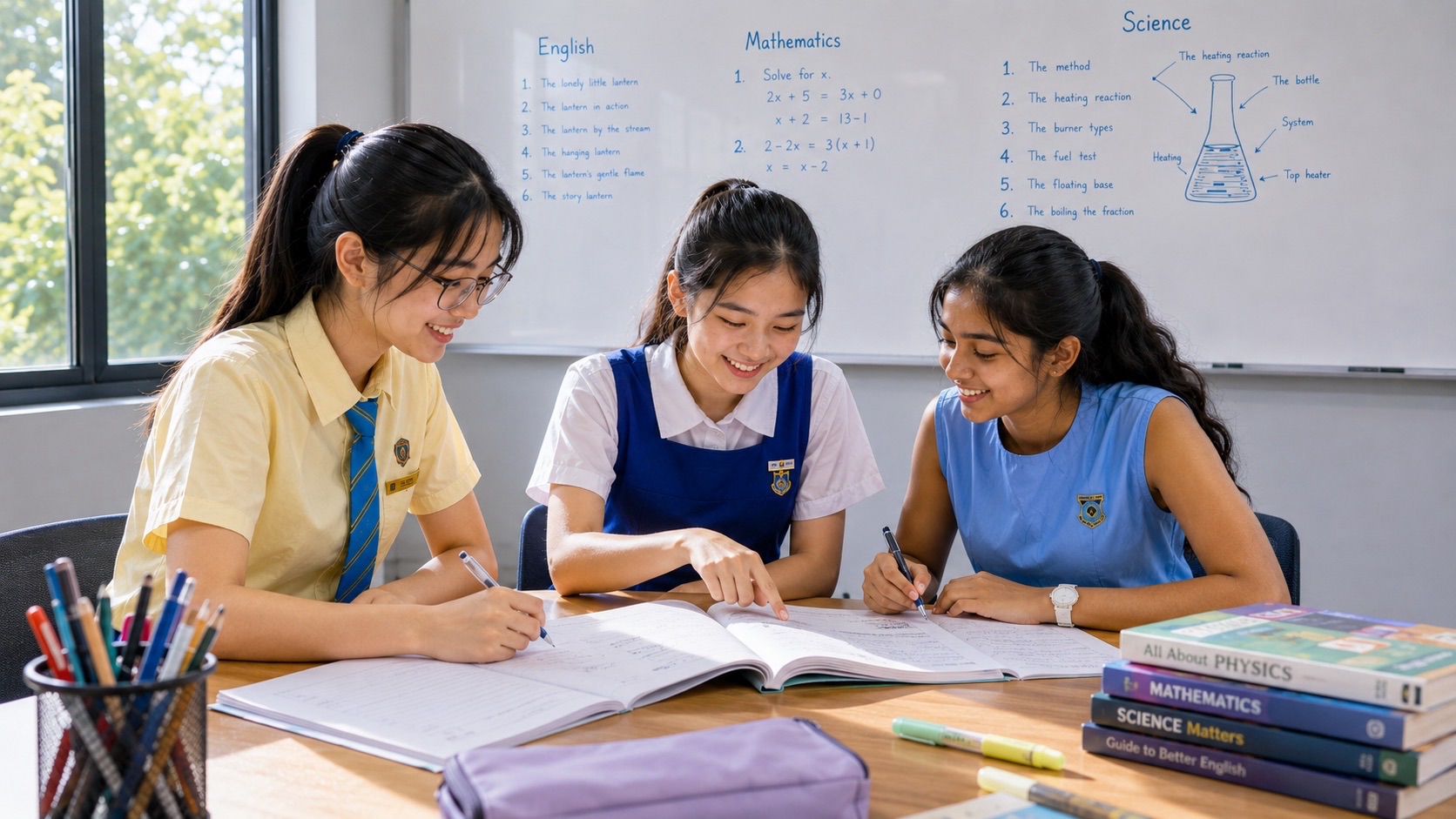
Greendale Secondary School versus Hougang Secondary School after the PSLE results on Tuesday, 24 November 2026 at 11.00am: these are different current national secondary schools with distinct campuses, not an IP, IB Diploma or IGCSE admissions route. Greendale Secondary School is at 51 Edgedale Plains, Singapore 828866; its completed 2026 S1 intake from PSLE 2025 recorded PG3 AL11–16, PG2 AL21–23, PG1 AL25–27. Hougang Secondary School is at 2 Hougang Street 93, Singapore 534256, with historical PG3 AL14–20, PG2 AL21–24, PG1 AL25–27. These are previous-year score ranges, not guarantees for January 2027. Parents must use the child’s actual eligible PG3, PG2 or PG1 option and any genuine affiliation category.
Check which school the child can reach comfortably and would genuinely want to attend. Greendale Secondary School offers Design, Technology and Engineering ALP and Outdoor Adventure Education LLP, whereas Hougang Secondary School offers HS Innovates, For Life! STEM ALP and Make the Difference Community Youth Leadership LLP. Compare ordinary English, Maths and Science teaching, class support, school ethos, CCAs and the journey after late activities. On 24 November at 11.30am, the MOE S1 Portal opens for eligible national choices; it closes at 4.30pm on Monday, 30 November 2026. Families should rank six real acceptable schools, with two or three historically less stringent prior cutoffs than the child’s score where possible, instead of mistaking an old boundary for a guaranteed admission.
Quick summary for parents
• Greendale Secondary School: 51 Edgedale Plains, Singapore 828866; 2026 S1 historical scores PG3 AL11–16, PG2 AL21–23, PG1 AL25–27.
• Hougang Secondary School: 2 Hougang Street 93, Singapore 534256; 2026 S1 historical scores PG3 AL14–20, PG2 AL21–24, PG1 AL25–27.
• Greendale Secondary School programmes: Design, Technology and Engineering ALP and Outdoor Adventure Education LLP.
• Hougang Secondary School programmes: HS Innovates, For Life! STEM ALP and Make the Difference Community Youth Leadership LLP.
• Real admissions route: national PG3, PG2 or PG1 with appropriate G-level teaching; verify affiliation where relevant, not IP/IB/IGCSE.
• Earlier cutoffs may change and do not guarantee 2027 school places.
• Results 24 November 2026 at 11am; school choices end 30 November at 4.30pm.
• Parent action: assess learning support, eligibility, school culture, CCA, travel and six genuine preferences.
18 November 2026 Verified Parent Comparison Desk
The official 17 November SEAB and MOE release confirms the PSLE results at 11.00am on Tuesday, 24 November, S1 submission from 11.30am that day to 4.30pm on Monday, 30 November, and a tentative S1 posting result on 18 December. SEAB states that schools’ cutoffs can vary by a few points from year to year, so these older score rows support a considered shortlist rather than a prediction. Check the actual eligible Posting Group from the child’s result, then the specific previous-year category in MOE SchoolFinder. The school that best supports the child’s interests and wellbeing should be preferred for real reasons, not simply because it had a lower historical AL endpoint.
PG3 AL17–20: the former cohort placed the schools differently
For the intake entering in 2026, Greendale’s PG3 last-posted figure was AL16 and Hougang Secondary’s was AL20. A PG3 pupil at AL18 might reasonably treat Hougang as within the previous range, while Greendale would have been numerically more demanding in that completed allocation. At AL20, Hougang itself is on the old boundary rather than a guaranteed 2027 placement. The child may be attracted to Greendale’s Design, Technology and Engineering projects even if the old number is tighter; there is nothing wrong with a genuine ambitious preference. But the family needs two or three acceptable schools with historically less stringent previous cutoffs among six where possible. School popularity and demand shift, so a four-point historical difference is not an immutable selection rule or proof of educational quality. It should inform risk without dominating the child’s preferences.
PG2 AL24 and PG1 AL27: compare the same route
Greendale’s previous PG2 last-posted figure was AL23, and Hougang’s was AL24; both ended at AL27 in PG1. A family with a PG2-eligible child at AL24 may see Hougang as a realistic investigation based on prior results but should recognise Greendale’s stricter former boundary. At AL27 with confirmed PG1 eligibility, both schools are at an earlier endpoint, not guaranteed places. Children who have an option band at AL21–22 or AL25 should understand which group they are selecting, since initial subject levels and the relevant previous result rows differ. Families should also investigate whether the school offers appropriate G1/G2/G3 subject teaching and opportunities to study a stronger subject at a higher level when formal criteria are met. A pupil’s capabilities differ by subject, and a single aggregate cannot substitute for an actual transition plan.
Greendale’s DTE course develops design, code and build skills
Greendale’s 2026 official ALP guide states that Secondary 1 pupils learn basic Arduino microcontroller work, lighting LEDs, activating buzzers, controlling motors and working with hydroponics monitoring. They also encounter computer-aided design and rapid prototyping. At Secondary 2 the programme develops wireless control and design thinking for community challenges. This is a real, structured technology experience rather than merely a claim that the school loves innovation. Parents should ask what pupils do with a failed first prototype: do they identify why it did not work, revise it and describe the change? A child who enjoys making things may find such experience motivating. But its selected competitions, overseas STEM trips and specialist extensions cannot be promised to everyone. The receiving school should also explain how algebra, Science and academic writing are taught alongside the ALP.
Hougang’s Code for Fun and AI for Fun have a different progression
Hougang Secondary’s STEM ALP is ‘HS Innovates, For Life!’ and its current programme description includes Code for Fun, Design Thinking and engineering-focused learning at Secondary 1, with AI for Fun and innovation projects at Secondary 2. In a school-choice discussion, the parent can ask how these tasks become opportunities to apply fractions, measurement, reasoning and clear communication, rather than treat computing as a subject disconnected from academic fundamentals. At a suitable level, a pupil could use a block-coding exercise to test a sequence, then explain what variable needed correction. Ask which experiences reach all pupils and which leadership or advanced innovation opportunities are selected. The child might be more excited by community-focused design at Hougang or Greendale’s equipment-oriented engineering, but that should be decided by concrete classroom examples rather than by counting how many times a prospectus mentions AI.
Outdoor Adventure and Make the Difference can help different learners thrive
Greendale uses Outdoor Adventure Education to develop teamwork, resilience, perseverance and a willingness to try unfamiliar challenges. Hougang’s Make the Difference LLP focuses on responsibility and community youth leadership. Both can build character, but they do so through different settings. A pupil who enjoys supervised outdoor challenges may find Greendale engaging; another may value leading a community contribution or planning service work with peers at Hougang. Parents should ask how the opportunities include beginners or quiet students rather than only those already confident. Some DSA talent areas and selected leadership positions are not automatic benefits for all Secondary 1 pupils. The real measure is whether a child learns to cooperate, reflect and seek help in a safe environment. Educational fit includes belonging and support, not simply the title of a signature programme.
The Punggol and Hougang routes are not equally local to every family
Greendale is at 51 Edgedale Plains in Punggol, whereas Hougang Secondary is at 2 Hougang Street 93. For a household in Punggol, Greendale may have a direct LRT or bus approach; a household nearer Buangkok and Hougang Avenue 9 may find Hougang simpler. A parent should test a school-morning route at the actual arrival time and the return journey after a CCA, including walking in rain. A child interested in Greendale’s outdoor activities might need additional time for trips or camps; a student taking part in Hougang leadership might have late meetings. The family’s six-choice list should contain schools a child can attend consistently without becoming chronically tired. A strong ALP does not erase the burden of a very long home-to-school journey.
Two other questions to ask both schools during results week
Ask first how the school supports a Secondary 1 pupil who has strong ideas but struggles to explain a Mathematics solution or a Science observation accurately. Does a teacher show an example, diagnose the misconception, provide meaningful feedback and check that the pupil can apply the same skill to an unfamiliar question? Ask second how the student settles in socially and participates in a chosen CCA without sacrificing too much sleep or homework time. A signature ALP or LLP may motivate the child, but the ordinary curriculum, friendships and school journey will recur throughout the four-year experience. Neither a school open house nor a previous COP proves that this particular pupil will thrive; use both school visits and candid discussions with the child.
Depth, Load and Transfer: an eduKate shortlist check
For each shortlist candidate, rate three dimensions from zero to five using concrete evidence. Depth asks whether the child is likely to understand and explain concepts, not merely repeat worked answers. Load asks whether study expectations, transport time, co-curricular commitments and the family schedule are sustainable. Transfer asks whether learning carries to a new problem or situation; for example, applying Science evidence in a project or adapting clear explanations for a different audience. If one area is weak, ask what realistic support or adjustment might repair it. A school with a strong brand but an exhausting journey may be less suitable than one that gives the pupil more room to practise, reflect and rest. These scores are a decision aid, not a clinical assessment or an alternative admission measure.
How to finish the six-school list responsibly
Begin by noting the child’s four subject ALs, total score, officially eligible Posting Group and any legitimate affiliation or DSA outcome. Check each named school’s full school code, former 2026 S1 last-posted score for the chosen category and location. Place the preferred school first if the family would genuinely choose it over the others; choosing an ambitious option is fine when the other options are balanced. Include two or three schools whose earlier cutoffs were less stringent than the child’s PSLE score when possible and verify that even the sixth school is acceptable. If the family also investigates a direct-admission private or international institution, that separate application does not automatically extend or cancel the national S1 deadline. Submit with the parent’s Singpass before the stated closing time and retain the portal confirmation.
Official sources and eduKate ecosystem context
- SEAB confirmed 2026 PSLE results and Secondary 1 choice window
- MOE Secondary 1 Posting Portal and deadlines
- MOE SchoolFinder for current admission routes and historic ranges
- MOE Posting Groups and Full Subject-Based Banding
- Greendale Secondary School official website
- Hougang Secondary School official website
- Greendale Secondary School official school-specific programme or update
- Hougang Secondary School official school-specific programme or update
- eduKateSingapore existing Greendale Secondary School parent guide
- eduKateSingapore existing Hougang Secondary School parent guide
- eduKateSingapore complete 2027 AL4–32 school finder
- eduKateSG immutable Clementi Secondary 1 reference
Editorial check: 18 November 2026. The 2026 entry ranges cited here are from the 2025 PSLE cohort. No 2027 admission threshold is promised before the new posting exercise is complete. Confirm current school conditions through official sources.
1. STEM is a common theme, but the schools do not teach it identically
Both schools describe Science, Technology, Engineering and Mathematics as a way to engage pupils in solving problems. That overlap may cause parents to assume the programmes are interchangeable, but their current descriptions show different sequences and contexts. Greendale foregrounds design, coding and building through electronics, prototyping and physical systems. Hougang combines structured Code for Fun and Design Thinking with later AI and selected projects addressing community needs.
Parents should ask each school what every new Secondary 1 pupil does during a normal lesson and how beginner confidence is built. The goal is not to choose the school with the longest technology list; it is to find the place where the particular teenager will learn to explain, test and improve ideas.
2. Punggol and Hougang are different daily routes
Greendale’s Edgedale Plains campus is in Punggol, whereas Hougang Secondary’s campus is on Hougang Street 93. Their locations serve different parts of the north-east. A family living in Punggol may prefer Greendale for transport, while one near Hougang or Buangkok may find Hougang Secondary more manageable. Exact travel times depend on home location, public transport transfers, crossing points and school gates.
Draw both routes at the actual school-reporting time and include a later return after CCA. Some journeys appear short on an uncongested map yet take much longer when the child must walk, wait for a bus or change trains. Geography is part of school fit because it shapes sleep, meals and opportunities to participate in activities.
3. Greendale’s PG3 endpoint was 16 in the last completed intake
For the 2026 entry cohort, Greendale’s historical PG3 range was 11–16. An eligible PG3 pupil scoring 15 has a numerically encouraging previous reference, while a child scoring 17 was beyond the former endpoint. Neither number is a fixed admissions threshold for the 2027 cohort; applicant preferences and places can change.
A family drawn to Greendale’s DTE and outdoor learning can keep a genuinely ambitious preference while preparing other schools with reasonable historical headroom. The parent should not promise a place simply because the child equals the old cutoff or assume a different outcome means failure.
4. Hougang Secondary’s PG3 endpoint was 20
Hougang Secondary’s previous PG3 range was 14–20. A PG3 child scoring 18 or 19 was within the historical reported range for Hougang but beyond Greendale’s endpoint of 16. This difference is useful when planning a shortlist, but does not mean Hougang is academically weaker or that admission there is guaranteed. Historical cutoffs reflect demand and available places.
If the child is excited by Hougang’s innovation and leadership culture, it can be a sound first preference independent of the previous endpoint. A good parent guide respects each school’s educational value and the pupil’s actual needs rather than turning cutoffs into an informal ranking of teachers.
5. PG2 differs by one point, while PG1 was identical
Greendale’s completed 2026 PG2 range was 21–23, compared with Hougang Secondary’s 21–24. For PG1, both recorded 25–27. A PG2 pupil scoring 24 had a previous endpoint match at Hougang but was numerically beyond Greendale’s old PG2 endpoint. A PG1 child scoring 26 can use the same historical endpoint at both schools as one part of an informed comparison.
The admissions lines should always be labelled by the child’s actual Posting Group. Under Full Subject-Based Banding, individual subjects can be taken at different G-levels where criteria allow, so the school needs to develop pupils with mixed strengths. A shared PG1 cutoff is not evidence that the teaching experience is identical.
6. Greendale’s Design, Code and Build starts with physical systems
Greendale’s 2026 ALP page explains Design, Technology and Engineering through designing, coding and constructing real-world solutions. It describes Arduino-based learning and engineering tasks that connect technology with daily life. A simple physical system can help a pupil see a variable, programmed decision or sensor input produce an observable result.
Ask what happens when a child’s first device fails. Is the pupil guided to isolate one cause and record a test, or merely given the correct instructions to copy? The deeper educational outcome is the ability to reason about an unfamiliar problem. A working machine without an explanation should not be treated as proof of learning.
7. Design Thinking requires understanding people, not just devices
Greendale’s ALP describes using the Design Thinking Process to develop empathy, creativity, critical thinking and problem-solving. A child may learn to define a difficulty experienced by other people before choosing an engineering response. That is an important balance: technology can be impressive but ineffective if it solves the wrong problem.
Ask for a representative group assignment and how pupils obtained feedback from possible users. Did the class change a design when someone found it awkward or impractical? Such questions show whether the programme develops judgement rather than simply teaching pupils to use tools.
8. Advanced Greendale technology opportunities have separate selection rules
Greendale’s DSA Design, Technology and Engineering page describes robotics, industry visits and other enrichment for successful applicants, subject to the specified selection and continuing commitment. That is different from the general ALP. A normally posted pupil cannot assume they receive the same DSA-associated activities or an automatic place in the Robotics Club.
Parents should ask which work all pupils encounter, how the club recruits new students and whether beginners can try. If the child’s whole school choice depends on a specialist activity, verify access before ranking. A robust preference remains attractive through normal academic lessons and school culture even if a team place is unavailable.
9. Hougang Secondary’s Sec 1 Code for Fun explicitly reaches all pupils
Hougang’s August 2026 ALP page states that all Secondary 1 pupils learn coding foundations through Code for Fun, using block-based programming to develop computational thinking. This is a concrete accessibility detail: a beginner does not need to arrive with advanced programming certificates to encounter the introductory learning.
Ask what the child should be able to explain afterwards. Can the pupil predict an output, recognise an error and modify an instruction without guessing? Parents should avoid treating the availability of devices or software as the goal. The learning value lies in logic, exploration and careful explanation.
10. Hougang’s Year 1 Innovation Cohort Programme uses five design stages
Hougang describes a structured Secondary 1 Design Thinking experience: empathising with users, defining the problem, generating ideas, prototyping and testing. It culminates in a Young Innovators’ Fair where outstanding groups may receive recognition. The cohort programme is wider than the final showcase, so being part of ordinary design learning does not guarantee a presentation or prize in the selected fair.
Ask how teachers assess students who are not among the outstanding projects. A pupil can make important progress by listening to users or revising an ineffective prototype. A school should teach the reasoning that makes a design useful, not turn every group assignment into a race for medals.
11. Hougang’s AI for Fun extends the sequence in Secondary 2
The school states that Secondary 2 pupils explore artificial intelligence and Internet of Things devices through AI for Fun, connecting software and hardware to smart solutions. An example might involve automation or responding to sensor information. A teenager should also learn that an AI result can be wrong or biased and that personal data requires care.
Parents can ask how pupils test the output and explain what evidence supports the decision. An entertaining demonstration does not replace the ability to reason independently. A child who enjoyed block coding in Secondary 1 may be ready for a more challenging question about reliability and ethics the following year.
12. Hougang’s selected STEM Leaders do more than general classes
Hougang’s 2026 programme page lists STEM Leaders and activities such as Science Centre engineering challenges, sustainable hydroponics work and selected community innovation projects. These opportunities can provide meaningful stretch, but the schoolwide curriculum does not automatically place every pupil in those groups. Some activities are explicitly described as selected cohorts.
Ask the school how new students can develop an interest over time and what selection, training or timetable commitments may apply. A child should be able to explore scientific curiosity through ordinary classes even if no special programme place is awarded.
13. Sustainability at Hougang uses actual growing systems
The official ALP describes hydroponics and Autopots experiences in which participating STEM Leaders learn about planting, maintaining, harvesting and sharing produce. It connects environmental stewardship with community communication. The activities demonstrate a hands-on direction, but should not be interpreted as a promise that every new pupil performs an identical gardening project.
Parents can ask how students measure success, estimate resources consumed and evaluate whether a particular urban-farming method solves a real problem. Good STEM education encourages students to check the entire system rather than assume that anything labelled green is automatically sustainable.
14. Greendale’s outdoor LLP differs from Hougang’s service LLP
Greendale uses Outdoor Adventure Education for character development through physical challenge, teamwork and judgement. Hougang’s Make the Difference LLP uses community youth leadership and service, guided by GREAT values: Gratitude, Respect, Empathy, Adaptability and Trustworthiness. Both can nurture responsibility, but the situations in which pupils practise it differ.
A student who gains confidence through outdoor tasks may enjoy Greendale, while one who likes community projects may respond to Hougang’s approach. Yet a child can value both sport and service, so parents should not treat the distinction as a rigid personality test. Ask what the regular cohort experiences and what requires special selection.
15. Greendale’s outdoor programme includes safety and graduated challenge
Greendale’s LLP describes experiences involving outdoor skills such as kayaking, climbing and orienteering. Such activities can teach students to prepare carefully, cooperate and adapt when something unfamiliar happens. They require appropriate supervision and may have medical, safety or activity-specific conditions. Parents should not assume all children undertake advanced certification in the same way.
A pupil who is uneasy with water or heights may still benefit from suitably supported challenges. Ask how the school introduces new skills, how it helps nervous beginners and whom to contact about individual access needs. Character education should develop confidence with care, not use risk as a measure of worth.
16. The Greendale 2026 DSA Outdoor Adventure route has defined commitments
Greendale’s DSA overview identifies Outdoor Adventure as one of its 2026 talent areas, alongside DTE and Leadership. The school expects successful DSA pupils to honour their commitments over Years 1–4. This is not equivalent to an ordinary pupil trying an outdoor activity in school or choosing a CCA after posting.
By November 2026, the standard DSA application window for the 2027 intake had already closed. Parents should not present a new DSA offer as a possibility simply because the child likes rock climbing after seeing a school video. The correct ordinary S1 process remains relevant for those without accepted allocations.
17. Hougang’s GREAT values are described in its updated 2026 LLP
Hougang’s August 2026 LLP page uses the GREAT values and a three-E framework: Enriching Minds, Engaging Hands and Encouraging Hearts. It describes progressive community leadership, from taking action in Secondary 1 to raising awareness, advocacy and broader community building in later years. Some older school-history pages use historic values wording, so families should refer to the updated programme when asking about current expectations.
Ask teachers how pupils learn to understand an issue before acting and how they reflect on a failed service initiative. A quiet child may contribute through planning or listening, while a confident speaker may need to improve empathy. A leadership programme is meaningful when it improves everyday decisions, not only when it awards badges.
18. A PG3 child with Score 17 has a different historical admissions picture
A pupil eligible for PG3 with Score 17 was numerically beyond Greendale’s previous endpoint of 16 but within Hougang Secondary’s earlier range ending at 20. A family that prefers Greendale may still choose to list it ambitiously, provided the rest of the list offers suitable alternatives. One past cutoff cannot determine the next cohort’s places or competition.
Ask whether the child truly prefers Greendale’s maker and outdoor experiences, or whether Hougang’s innovation and community-learning environment is more appealing. The correct choice is not automatically the school with the more competitive old cutoff. It is the best sustainable fit within an honest admissions plan.
19. The schools’ 2026 open-house information has different dates and purposes
Greendale’s official Open House occurred on 14 November 2026, from 9 am to 1 pm. By 18 November, that is a past event. A family who missed it can still use the school’s current website or contact staff for information. Hougang Secondary has its own publications, and parents should not assume Greendale’s date or programme applies to another school.
Open houses showcase programmes but do not create normal S1 posting priority. Ask for ordinary classroom examples, how beginners are helped and how CCAs are allocated. The most useful school tour produces practical answers rather than just impressive photographs.
20. A child may like coding at both schools yet prefer a different daily environment
A pupil with a strong interest in technology could find both Greendale’s Design, Code and Build and Hougang’s Code for Fun appealing. Their eventual preference may depend on teachers, friends, academic support, CCA options, safety, school values or transport. A child who is reluctant to join outdoor activities may want a candid discussion about Greendale’s LLP, while one who is uncertain about community service may wish to understand Hougang’s approach.
Let the student explain what excites and worries them without assuming that every interest will remain fixed. Parents can provide accurate admissions and logistics information while respecting the teenager’s own voice. A good school decision concerns the whole educational setting, not only the ALP title.
21. Historical cut-offs need both examination year and intake year
The reported ranges concern pupils who took PSLE in 2025 and entered Secondary 1 in 2026. They are not a score threshold set before the 2027 application period. The final last-posted score for a new cohort depends on students’ preferences, vacancies and tie-breaking. A lower PSLE total is stronger, but historical school ranges do not measure every future opportunity.
Parents should label the year beside every school table and verify the official SchoolFinder profile. Websites that omit the year can accidentally mix different admission cohorts.
22. A posting result is not a permanent judgement on a child
A child who scores above the previous endpoint of a favourite school may still be a capable, curious learner. A school with a higher last-posted score may provide excellent teaching for a particular pupil. Parents should not use old cut-offs to assign status to the teenager or compare the worth of future classmates.
The useful question is which school provides appropriate challenge, constructive feedback, friendships and opportunities to develop strengths. An honest score comparison should reduce uncertainty, not introduce stigma.
23. Full Subject-Based Banding allows subject-specific progress
Posting Groups are used for admission and most starting subject levels, while individual subjects may be offered at G1, G2 or G3 when criteria apply. A student can be strong in Science and need support with English, or have the reverse pattern. The overall PSLE result does not freeze every subject level indefinitely.
Ask how Greendale and Hougang explain subject-level options and how teachers help pupils build foundations. A good school can stretch the learner in one subject while supporting another.
24. Some boundary scores allow a valid group choice
Under MOE’s framework, eligible pupils scoring 21, 22 or 25 may receive a choice between Posting Groups. The actual option form governs the route, and the selected group applies to school preferences. Parents cannot compare Greendale’s PG3 figure with Hougang’s PG2 line merely to create a more attractive result.
Discuss academic readiness with primary-school staff and compare the correct historical line at each school. A good group choice balances learning demands and available school options.
25. Use all six choices responsibly
The standard S1 Posting process offers six ranked school choices. An ambitious first preference can be reasonable, but the family should also select other schools with suitable programmes, manageable transport and realistic historical headroom. The final positions should not be institutions the teenager has never investigated or would refuse to attend.
For each school, record the actual code and one genuine reason the child might enjoy it. This turns a ranking list into a carefully considered plan for several possible results.
26. Choice order matters when scores tie
When pupils with the same PSLE Score compete for final vacancies, MOE uses relevant tie-breakers including citizenship and school-choice order, followed by balloting where needed. A family should rank schools in genuine preference order rather than copy a supposed secret technique from a forum.
The old cutoff is one input; it does not determine the next year’s competition. Parents should remain flexible and supportive whichever school is eventually allocated.
27. English and Mathematics support both ALPs
Coding, prototyping, robotics and community innovation depend on reading instructions, understanding variables, measuring and explaining a design. A child can enjoy practical work while still needing explicit help with algebra or coherent writing. A strong ALP should reinforce those foundations rather than distract from them.
Ask both schools how teachers diagnose misunderstanding and give useful feedback. A pupil who can explain why a system behaved unexpectedly is developing transferable reasoning. That matters more than finishing a demonstration without comprehension.
28. Subject combinations and specialist Computing need verification
Hougang’s site advertises Computing at upper secondary, while Greendale has technology-related development pathways. A school offering a subject does not mean every pupil can take it at every G-level or combine it freely with other electives. Prerequisites and timetables matter.
At age twelve, the family should prioritise strong lower-secondary foundations and current subject guidance. Ask when upper-secondary decisions are made and how the schools support pupils who develop new interests.
29. The SEC is not an examination taken immediately in Secondary 1
The Singapore-Cambridge Secondary Education Certificate begins from 2027 for the relevant graduating cohorts. A child who starts Secondary 1 in 2027 will not take that national examination in the first school year. Full Subject-Based Banding and the contemporary G-level syllabuses should be understood using current MOE and SEAB guidance.
Parents should avoid planning a pupil’s entire post-secondary destination from the PSLE result. Secondary school offers time to improve, discover strengths and take more informed subject decisions later.
30. CCA allocation is a separate process
A child may want a robotics CCA, outdoor group, performing arts or sport, but these activities can have trials, capacity limits, equipment and time requirements. A schoolwide ALP does not guarantee membership of a particular club. The family should confirm beginner access and how new pupils express preferences.
A pupil should still enjoy the receiving school if a first-choice CCA is unavailable. Belonging, friendships and opportunities to explore other interests matter alongside specialisation.
31. The first month needs a plan for wellbeing and support
New Secondary 1 pupils may feel uncertain about teachers, faster lessons, homework and friendships. Ask how form teachers and pastoral staff respond to a child who is overwhelmed, misses assignments or feels isolated. A school’s values are best demonstrated through its normal response to difficulty.
For individual medical, sensory, educational or mobility needs, contact the relevant school privately to ask about actual arrangements. A broad programme description cannot confirm an appropriate plan for every pupil.
32. The commute after CCA is as important as the morning trip
Greendale’s Punggol campus and Hougang’s Street 93 campus may have very different travel times depending on the home. A family should test a weekday morning and the latest realistic return after CCA, including transfers, walking and the child’s safety.
A school with attractive enrichment is harder to enjoy if the pupil spends excessive time commuting or regularly loses sleep. Choosing a slightly closer school can be an educationally sound decision when both offer suitable learning environments.
33. Fees and supplies should be based on current notices
Both are government secondary schools, but families may still incur costs for textbooks, uniforms, devices, meals, transport and some activities. MOE financial assistance or school-level support may be available depending on eligibility. Parents should ask directly rather than assume the family cannot obtain help.
Wait for the actual posting and subject-level confirmation before buying a school-specific booklist. A calm financial and administrative transition helps the child begin confidently.
34. Selected advanced STEM activities should not dominate the decision
Hougang’s STEM Leaders and industry or community projects can offer stretch to selected pupils. Greendale’s DSA and Robotics Club experiences can also be attractive. Yet a programme shown on the website does not confer automatic entry to all advanced experiences.
Ask what every Secondary 1 pupil can do and how specialised programmes are allocated. A child should still value the normal teachers, subjects, school values and CCAs if a particular competition place is not offered.
35. Do not compare schools only on one open-house performance
An impressive robot, outdoor expedition film or community-innovation showcase may inspire curiosity, but a pupil spends most days in ordinary classrooms. Ask how teachers explain difficult concepts, whether students can ask questions and what happens when a group project fails.
The parent’s task is to distinguish a school with consistently suitable learning from one moment of polished presentation. A child should be invited to share their own impressions and concerns without being expected to forecast admission outcomes.
36. Final parent judgement: two versions of applied STEM and character growth
Greendale may suit a pupil who enjoys design, code, build and outdoor challenge in Punggol. Hougang Secondary may suit one drawn to design-thinking, AI, community innovation and GREAT values, especially where its location supports an easier routine. Both schools offer national subjects and broader experiences beyond their distinctive programmes.
Use the child’s actual Posting Group, previous score data, normal academic support, school culture, CCAs and realistic travel to decide the genuine preference order. Six acceptable choices form a stronger plan than treating one past cutoff as certain.
Frequently asked questions: Greendale versus Hougang Secondary
Are Greendale and Hougang Secondary the same school?
No. Greendale is in Punggol at 51 Edgedale Plains; Hougang Secondary is at 2 Hougang Street 93.
What were Greendale’s 2026 entry ranges?
PG3 11–16, PG2 21–23 and PG1 25–27 from the 2025 PSLE.
What were Hougang Secondary’s 2026 entry ranges?
PG3 14–20, PG2 21–24 and PG1 25–27.
Which was historically more accessible at PG3 Score 18?
Hougang’s prior PG3 endpoint of 20 included the score; Greendale’s was 16. No 2027 result is guaranteed.
Which school offers Design, Code and Build?
Greendale Secondary through its Design, Technology and Engineering ALP.
Which school offers Code for Fun in Secondary 1?
Hougang Secondary’s HS Innovates, For Life! ALP.
Which school teaches AI for Fun in Secondary 2?
Hougang Secondary’s ALP describes this sequence.
Which school has Outdoor Adventure Education?
Greendale Secondary’s Learning for Life Programme.
What are Hougang Secondary’s GREAT values?
Gratitude, Respect, Empathy, Adaptability and Trustworthiness.
Does a normal school place include DSA robotics or outdoor adventure benefits?
No. DSA placements have separate selection and commitments.
Has Greendale’s 14 November 2026 Open House already taken place?
Yes. Parents researching after that date should ask for current school materials or visit opportunities.
How should parents rank the two?
By the pupil’s actual eligibility and genuine fit, comparing school learning, support, location, CCAs and six acceptable choices.
School sources and 2026 intake data limitations
Independent eduKate Singapore parent comparison prepared 18 November 2026. Every numerical range describes the completed 2026 Secondary 1 intake based on PSLE 2025; no 2027 cutoff can be promised. Programmes, CCAs, subject offerings, fees, event dates and support should be checked with the current schools and MOE. Neither institution has endorsed this article.
- Greendale 2026 school ALP: Design, Technology and Engineering
- Greendale 2026 Outdoor Adventure LLP
- Greendale current DSA areas and commitments
- Greendale 2026 school leaders’ message
- Greendale 14 November 2026 Open House notice
- Hougang HS Innovates, For Life! ALP, August 2026
- Hougang Make the Difference LLP, August 2026
- MOE SchoolFinder
- MOE Secondary 1 Posting instructions
- 2026 intake score ranges based on 2025 PSLE
- eduKate Greendale full parent guide
- eduKate Hougang Secondary full parent guide
Final family decision
Both Greendale and Hougang Secondary offer meaningful STEM experiences, but one centres more explicitly on designing and building within an outdoor-adventure culture, while the other combines design thinking and AI with community leadership. A teenager’s ordinary classroom life, support, interests, school journey and friendships matter more than a single year’s cutoff. Confirm the correct Posting Group, then rank six genuine and acceptable secondary-school choices.