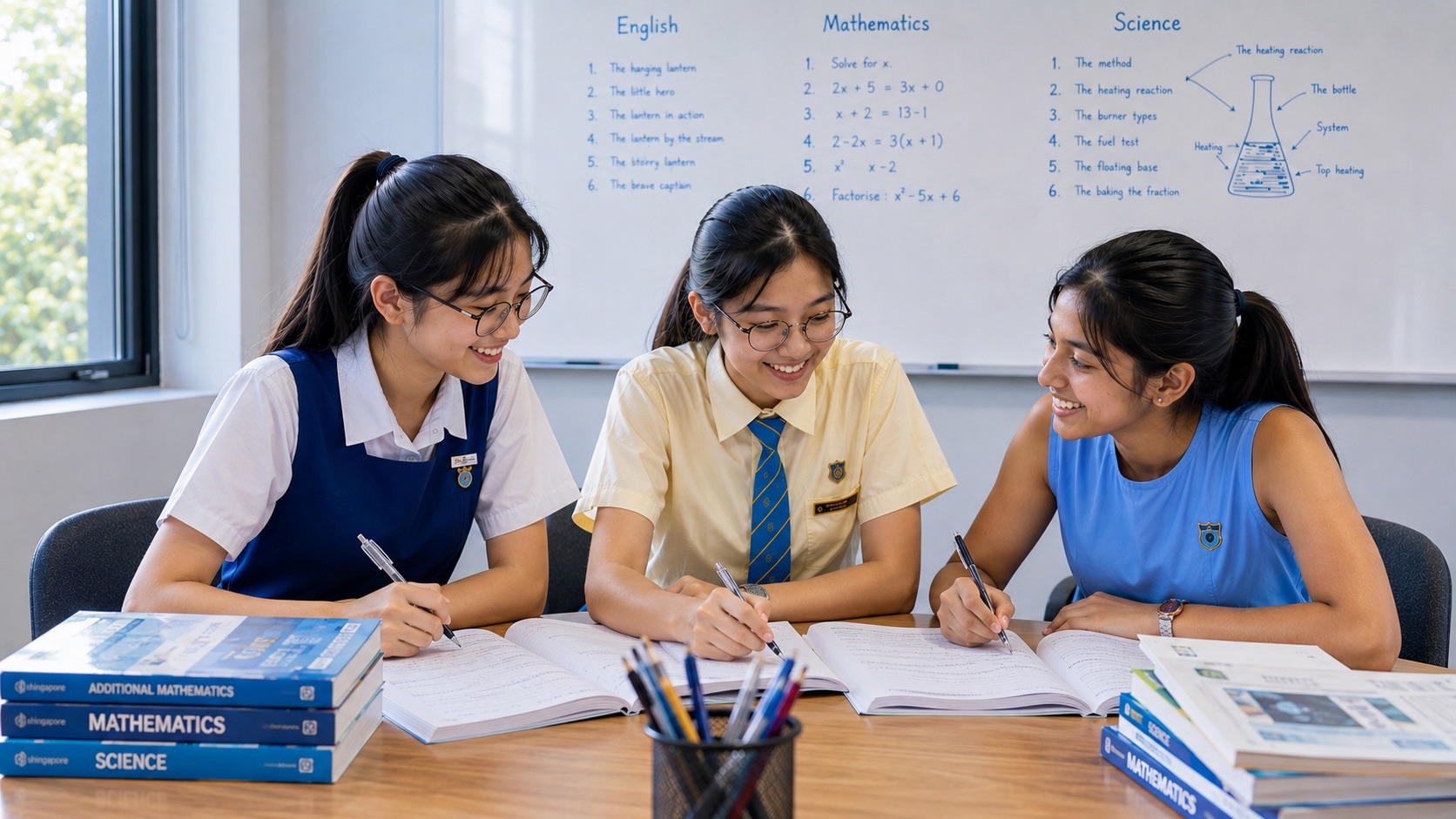
Northbrooks Secondary School is a government, co-educational school at 585 Yishun Ring Road in Yishun. For families collecting the 2026 PSLE results at 11.00am on Tuesday, 24 November 2026, Northbrooks can be considered through the child’s eligible Posting Group 3, 2 or 1. Its distinctive Aerospace Applied Learning Programme introduces aviation-related STEM, while its A.C.E. Outdoor Education programme develops Adventure, Character and Environmental awareness. It is a mainstream Full Subject-Based Banding school, not an Integrated Programme, IB or IGCSE school. The family should investigate ordinary lessons, CCAs and the daily Yishun journey, not only attractive aviation photographs.
For the 2025 PSLE cohort entering Secondary 1 in 2026, Northbrooks recorded historical non-affiliated ranges of PG3 15–22, PG2 22–25 and PG1 25–27. These are previous posting outcomes, not predetermined admission thresholds for the 2027 intake. A PG3 pupil at AL22 or a PG1 pupil at AL27 is comparing with a historical boundary and cannot assume a guaranteed place. The correct group, interests in Aerospace and Outdoor Education, suitability of the school day and alternative Yishun schools should all guide the six preferences submitted by 30 November.
Quick summary for parents
• Co-educational government school at 585 Yishun Ring Road; check the precise home-to-school route.
• 2025 PSLE/2026 S1 historical non-affiliated: PG3 AL15–22; PG2 AL22–25; PG1 AL25–27.
• Mainstream Full SBB and eventual SEC; not a verified IP, IB Diploma or IGCSE provider.
• Tier 1 Aerospace ALP serves all lower-secondary pupils through STEM and aviation themes.
• Tier 2 opportunities include selected Youth Flying Club, aerospace modules, competitions and advanced enrichment.
• A.C.E. LLP develops outdoor skills, resilience and environmental awareness; selection differs for demanding activities.
• 2026 DSA talent areas included Aerospace and Outdoor Adventure, but the DSA application closed months before PSLE results.
• Compare Northland, Naval Base, Yishun Secondary, Yishun Town and other eligible Yishun schools by the actual PG.
Should Northbrooks be on the shortlist? Start with the child’s actual interests
Northbrooks is distinctive because of its aviation-oriented Applied Learning Programme, but aviation should not be used as a shortcut for judging the school’s entire academic environment. A child will still have to read demanding English passages, learn algebra, explain Science and Humanities ideas and adjust to a longer timetable. A pupil who finds flight engineering fascinating might welcome the extra purpose that Aerospace gives to Mathematics. A different pupil may appreciate a nearby school, supportive form teachers or sport more than aviation. Parents should ask what a normal Secondary 1 day includes before deciding that the school’s best-known programme must be the child’s identity for four years.
The school’s official ALP describes Tier 1 for all lower-secondary students and more advanced Tier 2 experiences for pupils with greater inclination and relevant selection. This is reassuring for families with children who have never visited a flying club or used aeronautical equipment: the foundation is meant to introduce learning rather than test previous access to expensive hobbies. Ask whether the pupil will learn about forces, design, aerodynamics, flight systems or other aerospace concepts through classroom activities, and how teachers check understanding. The particular modules and learning journeys may change by cohort, so ask for the incoming 2027 Secondary 1 plan.
What an Aerospace ALP should teach beyond enthusiasm for planes
Aerospace provides a concrete context for concepts that otherwise appear abstract. A model glider can prompt questions about lift, drag, mass, balance, air resistance and the interaction between a design and its environment. A mathematically minded child might measure distances or calculate averages. A child stronger in writing could record how one design differs from another and explain the evidence. What matters is not whether a glider looks exciting but whether pupils learn to identify a variable, test it consistently and revise an assumption. That is the scientific method translated into something visible.
Suppose two paper gliders travel different distances. An unhelpful explanation says the heavier one always falls faster. A better investigation changes one feature while keeping the launch height and force as consistent as possible. Pupils record repeated trials and distinguish an observed result from a claimed universal law. This exercise is illustrative rather than an assertion about the exact 2027 school lesson, but it shows why aerospace learning can deepen transfer from Mathematics and Science. When a prototype performs unpredictably, the child can learn to ask whether the test was fair and what evidence would settle the question.
The school’s Aerospace pages mention partnerships with the Civil Aviation Authority of Singapore, Republic Polytechnic, Temasek Polytechnic and industry-linked organisations. These can provide opportunities for industry awareness and realistic applied learning. They do not guarantee a diploma, internship, work placement, pilot licence or a specific career at the age of thirteen. The child should explore what interests them: aircraft design, maintenance, safety, computing, communication, weather, logistics or flight itself. Educational curiosity is a good reason to attend a programme; an imagined guaranteed aviation career is not.
Tier 2, Youth Flying Club and DSA are three different things
Northbrooks places the Youth Flying Club, more demanding elective or Advanced Elective Modules, inter-class competitions and further enrichment among its Tier 2 aerospace opportunities. Parents should ask about the level when pupils can join, prerequisites, available places, costs if any, time after school and student conduct expectations. Being admitted into the school is not the same as being selected into the Youth Flying Club. Even pupils with strong interests might choose a different CCA, and that does not mean they have wasted the core Aerospace programme.
In the 2026 DSA-Sec exercise, Northbrooks listed Aerospace among its talent areas and other options including Outdoor Adventure, Basketball, Floorball for boys, Badminton, Guzheng, Modern Dance, Concert Band and Leadership. This is useful evidence about the school’s opportunities, but the 2026 national DSA application ran from 6 May to 2 June and selections occurred earlier in the year. An ordinary S1 pupil cannot begin that same DSA process on 24 November merely by asking an Aerospace teacher. A DSA-allocated pupil must honour the stated commitment; an ordinary posted pupil can investigate later CCA selection under school rules.
A parent might be attracted by international exchange photographs or a mission programme. Those experiences should be treated as examples of what selected pupils have done, not a promise of travel for every child. Travel depends on eligibility, cost, safety, current programme planning and sometimes age or academic readiness. Ask instead what every first-year child learns without needing to win a place in a prestigious external event. A good foundational school can be valuable even when most students never go on an overseas trip.
A.C.E. Outdoor Education has a purpose separate from Aerospace
The school’s A.C.E. framework stands for Adventure, Character and Environment. It includes learning about outdoor living, environmental care, resilience and responsible decision-making. The 2026 school materials describe progression through levels of challenge and various experiences including orienteering, climbing or abseiling under suitable arrangements, and school camps. A family should investigate how students are guided to participate safely, who supervises activities and how the school supports a pupil with medical needs or significant anxiety about heights or overnight camps. Outdoor Education should build confidence, not humiliate pupils for lacking prior experience.
Learning to navigate provides a practical example. A student has to interpret a map, judge a direction, estimate distance, discuss the group’s plan and recognise when it is time to ask an adult for help. The result is not only physical achievement: it requires Mathematics, spatial reasoning, communication and reflection. A student who is quick and sporty may learn to slow down for teammates. Another whose physical confidence is lower might contribute by reading the map carefully. Ask how teachers measure growth in teamwork and judgment rather than only finishing time.
Children who enjoy nature may welcome outdoor environmental learning; others may be more concerned about safety, insects, weather or being away from home. Those concerns can be discussed respectfully. Ask which activities are compulsory, what reasonable accommodations exist and whether protective equipment is supplied. A family should not promise a child that all outdoor activities are easy, but neither should it describe the school’s programme as dangerous without understanding the supervision. An honest school choice assesses the actual programme and the child’s readiness.
School support and time management are as important as the two programmes
Northbrooks publishes information about academic coaching and the ability to approach teachers for consultations. Its FAQ also discusses normal reporting arrangements and CCA selection, though the 2027 timetable should be confirmed after posting. This is useful because a child excited by Aerospace might still struggle with secondary algebra or extended writing. Parents should ask how teachers identify those gaps early, when consultations are available and whether CCA schedules conflict with remediation. A positive programme needs a manageable academic foundation if the learner is to participate without becoming exhausted.
A new pupil may initially know the names of several aero concepts but struggle to form equations. The family can support learning by asking the child to explain one concept accurately, work through a small calculation and revisit it after a few days. If the child is not confident reading instructions, that skill needs explicit teaching. Good school support recognises a specific problem rather than concluding that an entire child is unsuitable for a subject. Parents can ask how Full SBB enables different G-level subjects and how subject teachers coordinate when strengths vary.
Northbrooks versus Northland: similar Yishun geography, different educational identities
Northbrooks Secondary and Northland Secondary are both in the Yishun area, but they are separate schools with different addresses and programmes. Northbrooks focuses its ALP on Aerospace and its LLP on outdoor learning. Northland’s ALP explores ElderTech for older people, while its LLP uses sport for character development. An interested pupil may prefer either, or might value a different local school. Do not paste Northland’s previous cut-offs into a Northbrooks entry, and do not assume both schools offer the same STEM content because the names begin with “North”.
Further Yishun comparisons include Naval Base Secondary, Yishun Secondary, Yishun Town Secondary, Orchid Park Secondary and Ahmad Ibrahim Secondary, matched to the child’s actual Posting Group. Each offers a different combination of CCA, subject support and distinctive programmes. A school with a numerically less stringent historical range can still be a desirable first choice if the child connects with its learning environment and transport is easier. Explore more than one school rather than assuming the child must attend the school with the tightest prior PG3 score.
The school is at 585 Yishun Ring Road. Families coming from Yishun Ring Road, Khatib, Canberra or northern Yishun can face different bus and walking connections. A route that looks short when viewed at midday may involve more waiting during school start or at late dismissal. Test the journey with the child on a weekday and check how they will return after a CCA. A child keen on both aviation and sport needs a timetable that includes sleep, meals and study, not simply a list of programmes that sound impressive.
Who may be happiest at Northbrooks?
Northbrooks may fit a pupil who likes hands-on Science and Mathematics, wants to learn how aerospace ideas are applied, welcomes outdoor challenges and can sustain the Yishun commute. It may also fit an uncertain student who wants to explore STEM through an accessible introduction rather than specialise immediately. Parents should check whether the school culture is supportive and whether the child sees real opportunities to make friends, ask questions and grow through mistakes.
The school may be less suitable when the family selects it only for the promise of a selective flying opportunity, the child is very uncomfortable with the environment, or the journey and CCA routine would be exhausting. Another school may offer stronger personal fit even if its previous admission point was less selective. A realistic six-choice list respects these differences and protects the child from the idea that missing a particular school proves a limit to future education.
Worked score situations to avoid an avoidable posting mistake
Each of the following examples illustrates how the family might interpret a past result. They are not predictions or a promise that a place is available. Compare the actual 2026 PSLE result, permitted Posting Group, citizenship and any relevant special conditions with the correct historical row. The new 2027 last-posted score can be known only after the exercise concludes. The child’s interests, core academic readiness, transport and acceptance of alternative schools remain essential.
Case 1: AL18–20, PG3 eligible
The prior PG3 range ended at 22, so there is historical numerical margin. This supports considering Northbrooks without ensuring an offer. The child should still want its programmes and daily routine.
The family should now check whether the child would genuinely choose Northbrooks Secondary School over other eligible schools, not simply whether the historical comparison sounds promising. Record two realistic alternatives, their correctly labelled Posting Group scores and the real journey from home. If an entitlement or school programme remains uncertain, ask the primary school or the official secondary school before 30 November. This converts a vague hope into a usable decision without pretending the result of a future allocation is already known.
Case 2: AL22 with PG2/PG3 eligibility
The previous PG3 and PG2 ranges both included 22; they remain separate routes. Choosing one eligible Posting Group applies across all six schools, not school by school.
The family should now check whether the child would genuinely choose Northbrooks Secondary School over other eligible schools, not simply whether the historical comparison sounds promising. Record two realistic alternatives, their correctly labelled Posting Group scores and the real journey from home. If an entitlement or school programme remains uncertain, ask the primary school or the official secondary school before 30 November. This converts a vague hope into a usable decision without pretending the result of a future allocation is already known.
Case 3: AL23–24, PG2 eligible
Northbrooks previously posted pupils through PG2 22–25. The total may be historically relevant, but entry in 2027 remains contingent on new applications and tie-breaks.
The family should now check whether the child would genuinely choose Northbrooks Secondary School over other eligible schools, not simply whether the historical comparison sounds promising. Record two realistic alternatives, their correctly labelled Posting Group scores and the real journey from home. If an entitlement or school programme remains uncertain, ask the primary school or the official secondary school before 30 November. This converts a vague hope into a usable decision without pretending the result of a future allocation is already known.
Case 4: AL25 with PG1/PG2 eligibility
The prior PG2 endpoint was 25 and PG1 included 25–27. The group choice changes initial subject expectations, so the family should decide using the whole list.
The family should now check whether the child would genuinely choose Northbrooks Secondary School over other eligible schools, not simply whether the historical comparison sounds promising. Record two realistic alternatives, their correctly labelled Posting Group scores and the real journey from home. If an entitlement or school programme remains uncertain, ask the primary school or the official secondary school before 30 November. This converts a vague hope into a usable decision without pretending the result of a future allocation is already known.
Case 5: AL27, PG1 eligible
The previous PG1 endpoint was 27; this is a boundary, not a guarantee. Include other acceptable schools and verify conditions on the result slip.
The family should now check whether the child would genuinely choose Northbrooks Secondary School over other eligible schools, not simply whether the historical comparison sounds promising. Record two realistic alternatives, their correctly labelled Posting Group scores and the real journey from home. If an entitlement or school programme remains uncertain, ask the primary school or the official secondary school before 30 November. This converts a vague hope into a usable decision without pretending the result of a future allocation is already known.
Case 6: AL28 or 29, PG1 eligible
Northbrooks’ prior PG1 endpoint was 27. A family should not treat a generic PG1 label as assured admission to every PG1 school. Find suitable alternatives.
The family should now check whether the child would genuinely choose Northbrooks Secondary School over other eligible schools, not simply whether the historical comparison sounds promising. Record two realistic alternatives, their correctly labelled Posting Group scores and the real journey from home. If an entitlement or school programme remains uncertain, ask the primary school or the official secondary school before 30 November. This converts a vague hope into a usable decision without pretending the result of a future allocation is already known.
Case 7: Child keen on aviation but not admitted through DSA
Ordinary S1 posting and selected Aerospace experiences remain separate from the earlier DSA process. Ask about access to the broad ALP and CCA selection after posting.
The family should now check whether the child would genuinely choose Northbrooks Secondary School over other eligible schools, not simply whether the historical comparison sounds promising. Record two realistic alternatives, their correctly labelled Posting Group scores and the real journey from home. If an entitlement or school programme remains uncertain, ask the primary school or the official secondary school before 30 November. This converts a vague hope into a usable decision without pretending the result of a future allocation is already known.
Case 8: Child anxious about outdoor activities
Seek clear school explanations about supervised activities, medical accommodations and skill progression; outdoor education need not mean identical challenges for every learner.
The family should now check whether the child would genuinely choose Northbrooks Secondary School over other eligible schools, not simply whether the historical comparison sounds promising. Record two realistic alternatives, their correctly labelled Posting Group scores and the real journey from home. If an entitlement or school programme remains uncertain, ask the primary school or the official secondary school before 30 November. This converts a vague hope into a usable decision without pretending the result of a future allocation is already known.
Frequently asked parent questions
What is the school address?
585 Yishun Ring Road, in northern Singapore’s Yishun estate; confirm the school’s current official postal record.
Is Northbrooks an IP/IB/IGCSE school?
No such ordinary route is verified; it offers mainstream PG3, PG2 and PG1 and the applicable national curriculum.
What were the previous PG cut-offs?
For PSLE 2025 leading to S1 2026: PG3 22, PG2 25, PG1 27; all historical.
Does everybody join the Youth Flying Club?
No. Tier 1 Aerospace is broad, whereas clubs and advanced opportunities have different entry criteria.
Can a pupil start DSA after results?
No. The 2026 DSA-Sec application ended in June; follow ordinary posting unless already allocated through DSA.
Does Outdoor Education require already being sporty?
The LLP is developmental, with broad learning and increasing challenges. Ask about appropriate safety supervision and adaptations.
How is Northbrooks different from Northland?
Northbrooks emphasises Aerospace and A.C.E. outdoor learning; Northland’s distinct programmes are ElderTech and Game for Life.
Is a score at the previous COP a secure place?
No. The current exercise’s applicants, vacancies and tie-breakers may differ.
The final decision belongs to a real family and a real learner
A family can place Northbrooks Secondary School on the list when the child has a relevant entry route, the normal lessons and programmes are appealing and the commute and school culture look sustainable. The historical AL figures are a guide to previous admissions competition, not an assessment of the child’s worth or a binding 2027 offer. Another eligible school may offer a better fit even if its previous cut-off was less stringent. Parents should not use a single examination score to tell a child that a particular school determines their entire future.
Complete the six-choice discussion calmly between 24 and 30 November 2026. Verify exact school names and admission routes, rank genuine preferences and include options with historical margin. Once posted, shift attention to the actual school’s 2027 start, appropriate academic support, friendships, rest and a manageable study routine. Education continues beyond one result and one school-choice exercise.
Confirmed national dates for PSLE results and Secondary 1 school choice
The MOE–SEAB joint release dated 17 November 2026 confirms that the 2026 PSLE results will be released on Tuesday, 24 November 2026 at 11.00am. Primary schools will tell pupils how to collect their results. If a school candidate cannot attend, they can appoint a proxy to collect on their behalf by Thursday, 26 November under the official arrangements. Some older examination calendars mention a tentative 24–25 November window. The 17 November announcement is the later, specific confirmation and should be used in parent planning and article dates.
The online S1 Portal opens at 11.30am on Tuesday, 24 November and closes at 4.30pm on Monday, 30 November 2026. A parent logs in using Singpass to submit the options; only one parent is required. If the family has a technical or school-choice concern, contact the child’s primary school while the submission window is open, not in the final minute. The posting result is tentatively expected on Friday, 18 December 2026, and MOE will separately confirm the final release arrangements.
A child should have time to understand the result before ranking six schools. Let the pupil express feelings without turning the morning into a public comparison with classmates, cousins or siblings. Read the entire result slip, note the actual Posting Group option and any special instructions, and establish what the child genuinely values in school. The family’s task is to weigh eligibility, school culture, academic needs, activities, distance and support; none of these is decided solely by the number printed as the PSLE total.
How PSLE AL totals connect to PG1, PG2 and PG3
Singapore’s PSLE Achievement Level total is the sum of four examinable subject ALs. Lower totals indicate stronger numerical examination performance. The S1 Posting Group is the initial admissions route, not a permanent judgement of a child’s intelligence, strengths or potential. Individual academic subjects may be studied at G1, G2 or G3 levels under Full Subject-Based Banding according to eligibility and school arrangements. A child can be relatively strong in Mathematics yet need more support with English writing; a different pupil may read confidently but require longer to learn algebra.
- PSLE Score 4–20: generally eligible for PG3.
- PSLE Score 21–22: generally eligible to choose PG2 or PG3.
- PSLE Score 23–24: generally PG2.
- PSLE Score 25: generally eligible to choose PG1 or PG2.
- PSLE Score 26–30: PG1 eligibility subject to the specified English and Mathematics AL conditions.
- Foundation-subject and exceptional combinations: use the actual MOE result slip and guidance, not an incomplete online chart.
- IP and other special routes: separately identified programmes and admission processes, not implied by a general PG3 label.
If the pupil can select between two Posting Groups, the family selects one eligible group for the ordinary six-choice S1 submission. It cannot simply use PG3 for one school and PG2 for another within the same application. The selection affects the group-specific school ranges and the initial educational route. Parents should ask the primary school for help if the child has very different strengths between subjects or if the two offered groups create a difficult choice. Choosing solely to pursue an old school cut-off without considering curriculum readiness can create unnecessary stress.
Do not mistake PG, G-level subjects, SEC, IP, IB and IGCSE
Under Full SBB, pupils may belong to mixed form classes while academic subjects are taught at relevant levels. Their eventual national assessment for mainstream secondary education follows the Singapore-Cambridge Secondary Education Certificate (SEC), introduced from 2027 in place of separate N- and O-Level examinations. A family whose child enters Secondary 1 in January 2027 should ask about the school’s subject-level support and later subject combinations, rather than assume a legacy O-Level label is the permanent name of the child’s final qualification.
An Integrated Programme is a separately identified six-year pathway at named Singapore schools. Some culminate in A Levels and others in the IB Diploma, which is a different qualification. IGCSE is another assessment system, commonly used in some international education settings. These words should not be placed next to a school name as though the school offers every route. The checked school programme for Northbrooks Secondary School is PG3, PG2 and PG1 mainstream Full Subject-Based Banding admission routes, with Aerospace ALP, A.C.E. Outdoor Education LLP and the SEC national qualification pathway; no verified IP, IB Diploma or IGCSE route. School-specific enrichment, whether aviation, art, media or technology, does not itself change the national qualification or create an unlisted IP course.
Read the 2025 PSLE range as an outcome, not a 2027 promise
The historical 2025 PSLE score ranges for the 2026 Secondary 1 intake at Northbrooks Secondary School were PG3 15–22, PG2 22–25 and PG1 25–27. They are records of a completed posting exercise. The 2026 PSLE cohort’s final 2027 cut-offs will emerge only after the new exercise has been completed. An old range can help a household make a sensible comparison, but it cannot reveal a fixed pass mark selected in advance or guarantee that every pupil with the same score will enter. Demand, applicant preferences, vacancies, citizenship and the official tie-break procedures can change the outcome.
For a given school and Posting Group, a pupil whose score is numerically smaller than the earlier last-admitted score has some historical margin. A score equal to that endpoint is a boundary case, not a certainty. A numerically higher score is a reach by the earlier record, even when the child remains eligible for that Posting Group generally. These terms describe planning risk, not the child’s educational value. There is no justified way to calculate a precise probability for 2027 solely from one past range or to promise a seat because a school is close to the family’s home.
Some schools display letters showing Higher Chinese grades at a published SAP boundary; some display a star such as 30* where a relevant group retained unfilled places. A Higher Chinese letter is not a fifth AL and should not be added to the overall score, and a starred 30 does not mean the last admitted pupil actually had AL30. These annotations apply to the specific school and group concerned. Families should keep them visible in their comparison table and not transfer a figure from an unrelated admission pathway.
Use all six preferences with a responsible balance of ambition and margin
The 17 November MOE–SEAB announcement advises families to include at least two or three schools with previous cut-off points less stringent than the child’s score among the six choices. Because a lower PSLE AL total is stronger, this typically means a previous COP with a higher numerical AL total for the same eligible route. It is not a judgment that these schools offer inferior teaching. A school with a broader historical entry range may be the child’s favourite because of its actual programmes or location. The aim is to reduce the risk that all six choices turn out to be too selective.
Rank the six schools in the order of genuine preference. In relevant tie situations, MOE applies citizenship and choice order before computerised balloting under the rules. The family should not put a school it would dislike above one it truly prefers purely to make a spreadsheet look safe. Conversely, six aspirational schools with no acceptable less-stringent alternatives can leave the child exposed to posting outside the chosen list. The useful strategy is to combine a sincere priority order with several schools that have a reasonable historical margin and genuinely positive educational fit.
A simple six-row worksheet can hold the decision. Record each school’s full official name and the correct option code, the child’s eligible group, the previous cohort’s score range, the reason the pupil wants it, the actual route to the school gate, available subjects and CCAs, costs, student support and any special conditions. Do not leave a row filled only with a school name and a cut-off. The child should be able to imagine attending every listed school if posted there. A fallback the child would reject is not a genuine fallback.
The commute, family timetable and everyday school culture
Families in Yishun North, Yishun Ring Road, Yishun Central, Khatib, Canberra and nearby Sembawang estates may find Northbrooks Secondary School worth considering, but the school’s address is 585 Yishun Ring Road, Singapore 768692. Broad estate names do not determine a particular child’s door-to-door journey. Test a weekday morning route and a late return after CCA, allowing for train and bus waits, walking, rain, traffic and school-bag weight. A school within the same planning area can still be a difficult trip from a particular block. A school across an estate boundary may be reachable on one direct service. Use the actual journey as evidence, not a general impression of distance.
A long commute consumes the time a pupil needs for reading, rest, meals and friendships. Parents should also consider working hours, siblings and who can reach the school if the child becomes unwell. A more selective school with a draining journey may be a poorer daily fit than a nearby school with strong teaching and suitable opportunities. On the other hand, a child with a meaningful interest in a particular programme may reasonably accept a longer commute if it remains safe and manageable. The trade-off should be deliberate rather than hidden by a prestige argument.
School values need practical testing. Ask how new students make friends, whom they can approach when anxious, how teachers respond to academic mistakes and how bullying or conflicts are handled. A pupil who feels safe asking for help is more likely to repair a misunderstanding early. The school environment matters more than the number of awards displayed in a corridor. Look for evidence of routine support for ordinary students rather than assuming an impressive open-house presentation describes the full school week.
Programme access: distinguish everyone, interested pupils and selected talent
A school may advertise a highly impressive project, performance or competition win. Parents should ask whether it was experienced by the whole cohort, an elective group, a CCA team, a successful DSA applicant or a small number of selected students. These are different offers. A child’s school posting does not by itself guarantee an audition success, overseas exchange, specialised Art route, advanced STEM module or membership of a named club. A genuine school fit should remain attractive even if the pupil does not enter the most selective enrichment programme.
Ask what a normal first-year student will actually learn, how teachers support beginners and which additional opportunities can be joined later. A child may want to try something without having years of private training. Good teaching helps pupils develop from that starting point; it does not make access to expensive outside lessons a hidden prerequisite for ordinary curriculum participation. Likewise, a talented pupil deserves appropriate challenges, but not a timetable so full of enrichment that sleep and schoolwork are compromised.
The family’s day-by-day plan from 24 to 30 November
Tuesday, 24 November: collect the result through the primary school at 11.00am and read the actual eligibility and any DSA allocation. The portal opens at 11.30am, but the family does not need to submit immediately. Speak with the child, begin a genuine shortlist and note any programme or route that needs checking. DSA is an earlier admission exercise; students successfully allocated through it must follow the relevant binding commitment instead of assuming they can restart school choice after PSLE.
Wednesday and Thursday, 25–26 November: check MOE SchoolFinder, schools’ official sites and dated reference guides. Use the proxy arrangement by Thursday if the pupil cannot collect the result personally. Ask the primary school for advice about choosing between eligible Posting Groups and confirm any unusual subject or language condition. Verify exact school addresses and names. A school that was once at another campus or has a deceptively similar name must not be selected from an old map or misunderstood abbreviation.
Friday to Sunday, 27–29 November: attend any remaining school events if available, or inspect current virtual school resources. Test the commute and evaluate programmes and CCA eligibility. Make a six-school list with at least two or three acceptable options showing a less stringent previous COP. Rank in true preference order. Include only schools where the child would be willing to study, rather than filling the last choice with a random institution from a cut-off list.
Monday, 30 November: submit the final option form through the portal before 4.30pm, check the one selected Posting Group and all six school codes, and save the acknowledgement. Contact the primary school in advance if a technical or eligibility problem remains. The posting result is tentatively expected on 18 December 2026; rely on MOE’s later confirmation and actual results, not speculation about hidden cut-offs. The best use of the intervening time is to support the child’s recovery and preparation for the next school year.
After posting: prepare for Secondary 1 with Depth, Load and Transfer
Once the actual secondary school is known, read its 2027 Secondary 1 orientation, registration, booklist, uniform, device and CCA instructions. A 2026 booklist may refer to a different cohort or subject level. Avoid buying unnecessary or incorrect materials before the school confirms the child’s actual G-levels. Check financial assistance where needed and plan the child’s daily journey. An orientation meeting is a good opportunity to ask teachers how to communicate concerns early.
Academic readiness can be developed without turning the December break into a second PSLE. A child entering Secondary 1 may need to adjust to algebraic letters, negative numbers, longer explanations, scientific evidence and new subject vocabulary. Identify one or two actual gaps instead of assigning endless worksheets across all subjects. Ask the child to explain why a calculation works, check the solution, and try an unfamiliar example. Reading a short nonfiction passage and discussing what the evidence supports can also help prepare for English, Science and Humanities.
The eduKate Depth–Load–Transfer approach offers a practical test: Depth means understanding the idea beyond memorised steps; Load means being able to practise consistently without destroying sleep or motivation; Transfer means applying the idea in a changed problem. If depth fails, return to an atomic explanation and have the child teach it back. If load fails, shorten and spread the task. If transfer fails, change the question and discuss what remains invariant. This gives parents a useful method for supporting growth regardless of which school the pupil is posted to.
Sources and connected eduKate routes
- Official MOE–SEAB 17 November 2026 release for results day, the posting window and the two-to-three less-stringent school advice.
- MOE S1 Posting and MOE SchoolFinder for live programme options, score ranges and current posting rules.
- MOE PSLE/Full SBB guide for the distinction between Posting Groups and G-level subjects.
- Northbrooks Secondary School official school website for accurate programmes, admissions details and contact.
- eduKate previous school-specific parent guide with additional researched background.
- eduKate 2027 score-by-school finder, AL4–32 for comparisons and nearby estate options.
- eduKate immutable Clementi editorial reference for the parent-first explanation structure.
- Official Aerospace ALP and its Tier 1/2 distinction.
- Official A.C.E. Outdoor Education and its three-tier structure.
- 2026 DSA talent areas, commitments and application dates.
- Northbrooks FAQ: reporting and learning support.
- eduKate Northern Yishun and Khatib school choice guide.