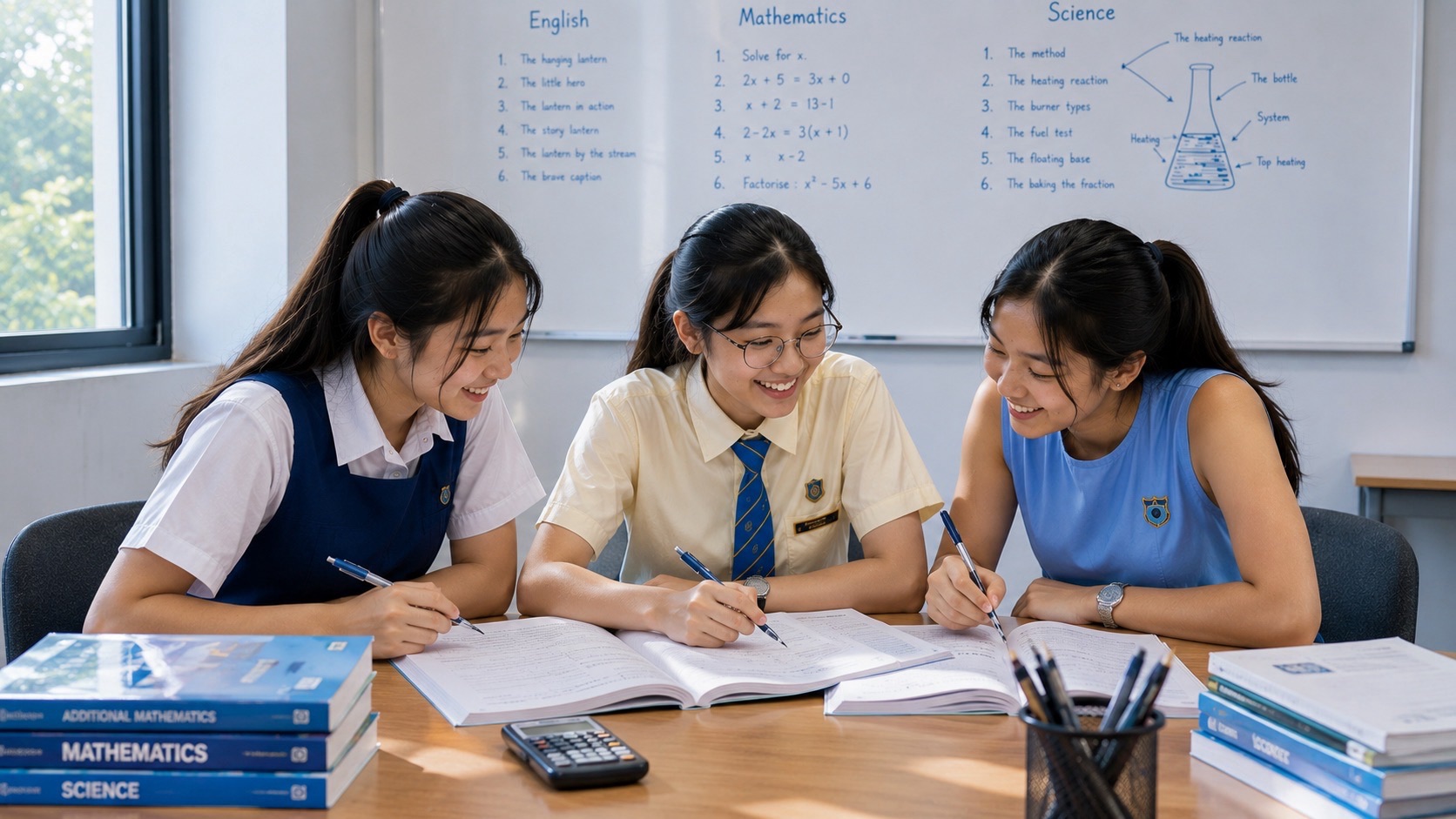
I am in Secondary 1 and want to prepare for G1 Science end-of-year examinations, especially practical and investigation questions. Science is not only remembering definitions. Students need to observe carefully, ask testable questions, plan a fair investigation, handle simple equipment safely, record measurements and explain what the evidence supports. Begin with the experiments, concepts and practical skills that the school has actually taught. The lower-secondary G1 Science syllabus places emphasis on scientific practices and laboratory awareness, but the Sec 1 EOY task and any practical component are determined by the school.
Parents can help by asking the child to explain what is being changed, what is being measured and what should be kept the same. Encourage accurate tables, labelled diagrams, sensible units and conclusions that refer to the results. Do not conduct unsupervised experiments involving heat, chemicals, electrical equipment, glassware or biological samples at home. A safe kitchen observation or simple non-hazardous investigation may support curiosity, but school laboratory procedures must be learnt under teacher supervision.
- Use the school’s exact Sec 1 Science topic list and practical instructions before revising.
- Understand the question, identify variables and explain how to make a test fair.
- Practise observation, measurement, tables, graphs, patterns and evidence-based conclusions.
- Use correct units, labels and clear descriptions; distinguish observation from inference.
- Learn laboratory safety and follow teacher supervision; do not improvise risky home experiments.
- Keep the 2027 SEC G1 Science syllabus K123 distinct from the current school’s Sec 1 EOY assessment.
Start with the exact Sec 1 scope, not a guessed SEC paper
SEAB lists G1 Science as K123 in the 2027 school-candidate SEC subject list. MOE’s lower-secondary G1 Science syllabus describes the learning direction and scientific practices that support the subject. These official documents explain the broader curriculum and later national subject, but they do not specify every school’s Secondary 1 EOY coverage or practical arrangement.
Ask the Science teacher which modules and experiments have been covered, which apparatus students have used, whether the assessment includes practical skills or written interpretation of experimental results, and what safety rules are expected. Some school assessments may test investigation planning and data interpretation in a written paper; others may include school-based practical work. Do not assume the national SEC practical paper is the same as a Sec 1 class assessment.
The MOE syllabus emphasises active learning, hands-on experiences and the development of scientific practices. Its G1 Science classroom guidance includes laboratory measurements and procedures, posing questions, designing investigations, conducting experiments, analysing data and communicating explanations. This is a sound basis for preparation, provided students practise only skills covered in their class programme.
Science begins with a question that can be investigated
A useful scientific question is specific enough to explore through observation or measurement. ‘Does sunlight affect plants?’ is broad. A more focused question might ask how changing the duration of light affects a defined plant measure over a stated period, provided the class is studying that relationship and the setup is safe.
Students should distinguish a question from an explanation. A question asks what they want to find out. A hypothesis or prediction proposes what may happen and gives a reason. The prediction should be testable; it should not be presented as a fact before evidence is collected.
Identify the factor being investigated and the outcome to be measured. If a student changes several factors at once, it becomes difficult to know which factor explains the result. A good investigation is designed so that the evidence can answer the original question.
Parents can practise this reasoning with everyday observations such as how quickly ice melts in different safe conditions. Do not use a potentially hazardous setup or treat a casual observation as a controlled scientific experiment. The child should be able to state what was observed and what additional control would be needed.
Variables and fair testing
An independent variable is the factor deliberately changed. A dependent variable is the outcome measured or observed. Control variables are the conditions kept the same so that the comparison is fair. Students should use the terms exactly as taught and be able to identify them in a simple experiment.
A fair test does not mean that every aspect of an experiment is identical. It means the relevant conditions are controlled while the factor being investigated is changed. If a test compares how different surfaces affect friction, the load and method of measurement may need to be kept consistent, depending on the classroom design.
Students should explain why a control variable matters. Saying ‘keep the same amount’ is incomplete unless they identify what amount and why it affects the comparison. A useful answer connects the control to the reliability of the conclusion.
Repeat readings may help identify variation. If the results differ, students should not automatically delete an inconvenient result. They should check the procedure, consider possible sources of variation and follow the teacher’s method for recording and analysing data.
Measurement and laboratory procedure
Measurement is more than reading a scale. Students should know the instrument, the unit and the appropriate precision expected from the scale. A ruler, measuring cylinder, thermometer or balance has a specific purpose. The student should choose the instrument that matches the quantity being measured.
Read scales at eye level where appropriate and avoid parallax error. Record the value with the correct unit. If the instrument has marked divisions, do not report a level of precision that it cannot support. A number without a unit may be incomplete because the reader cannot tell what is being measured.
Repeat measurements may help reduce random variation and support a more reliable estimate. Students should follow the teacher’s instructions about the number of readings, whether to calculate an average and how to report anomalous results. Do not invent repeat readings to make a table look neat.
Laboratory safety includes listening to instructions, wearing the required protective equipment, handling apparatus carefully, keeping the workspace orderly and reporting spills or breakages. Students should never taste chemicals, smell substances directly or perform an unfamiliar procedure without teacher permission.
Tables, graphs and data interpretation
A results table should make the data easy to read. Put a clear heading on each column, include units in the headings and arrange readings consistently. Record observations promptly and accurately. Do not round values unnecessarily before the analysis, because early rounding can hide a pattern.
Choose a graph that suits the data and the question. A line graph may show change across a continuous variable; a bar graph may compare categories. Follow the class’s instructions on axes, scales, labels and plotting. A graph without units or a clear scale is difficult to interpret.
Look for patterns before making a conclusion. Does the measured outcome increase, decrease, remain similar or vary without a clear pattern? Refer to specific values where useful. Avoid describing a trend that the data do not show.
The student should distinguish a result from an explanation. ‘The temperature increased by 4 degrees’ reports a result. Explaining why that happened requires scientific reasoning linked to the variables and concepts taught. The data alone may not prove every possible cause.
Observations, inferences and conclusions
An observation records what is seen, heard, measured or otherwise detected using the method. An inference is an interpretation that may explain the observation. For example, ‘the liquid became cloudy’ is an observation; ‘a new substance formed’ is an inference that may need further evidence.
Conclusions should answer the investigation question and refer to the data. A vague statement such as ‘the experiment worked’ does not describe the pattern. A stronger conclusion states what relationship was observed and supports it with a relevant result.
Students should avoid claiming that a result proves more than the investigation tested. If only one sample was tested, do not generalise to every possible sample without support. A careful conclusion recognises the conditions and limits of the experiment.
Parents can ask: What did you observe? What do you think it means? Which result supports that interpretation? What else would you need to know? These questions help the student reason without requiring the parent to teach every science topic.
Explaining scientific concepts with evidence
Science answers often require both correct knowledge and an explanation of how that knowledge applies. The student should identify the relevant concept, describe the process and connect it to the observation or question. A definition copied from notes may not answer an application question unless the learner explains the link.
Use cause-and-effect language carefully. ‘Because’ should introduce a genuine explanation. If a question asks why a result changes, the student should explain the process in terms of the taught concept rather than repeat the result in different words.
Diagrams can support explanations. Label the parts clearly, include arrows where direction matters and avoid decorative details that do not help the answer. Follow the teacher’s conventions for drawing and labelling scientific diagrams.
When the student is unsure, return to the relevant lesson demonstration or class notes. Build one explanation in plain language and then add the accurate scientific terms. This is more effective than memorising a long paragraph that the child cannot adapt.
Practical skills and the written paper
A written examination can test practical understanding even when students are not physically carrying out an experiment. They may need to identify a suitable apparatus, interpret a method, spot an unfair test, read a table or explain a result. The student should practise reading diagrams and procedures as well as recalling facts.
A practical assessment, where used by the school, may observe safe handling, accuracy, following steps and recording results. Students should know the teacher’s instructions for equipment and lab conduct. Parents should not attempt to reproduce a school practical assessment at home.
When a student reads a method, ask them to explain the purpose of each step. Why is a variable kept constant? Why is a particular instrument used? What observation is being recorded? Understanding the purpose makes it easier to recognise errors and apply the method to a new question.
If the teacher gives a practical checklist, practise the sequence mentally and discuss safety points. Do not add procedures or apparatus from internet videos unless the teacher has approved them. Science equipment and procedures can look similar while having different safety requirements.
Building a science vocabulary that is usable
Scientific vocabulary should be learned with a concept and an example. A student may memorise ‘independent variable’ but still be unable to identify it in an investigation. Add a simple example to each term and ask the child to apply the term to a different experiment.
Keep pairs of commonly confused terms side by side, such as observation and inference or mass and weight where taught. The student should explain the difference in their own words. Use the definitions and examples adopted by the school.
Vocabulary practice can be short. Read a term, explain it without notes, apply it to a class example and revisit it after a gap. Avoid copying a large glossary with no retrieval or application.
Precise language helps students avoid overclaiming. Use ‘suggests’, ‘shows under these conditions’ or ‘is consistent with’ where suitable, rather than saying that one limited result proves a universal rule.
A six-week preparation plan
The six-week plan should be adjusted to the school’s topic list and practical schedule. It is a way to organise revision, not an official MOE timetable. Practical safety and teacher instructions take priority over any home exercise.
A short cycle can include recalling one concept, interpreting one piece of data, explaining one investigation decision and correcting one mistake. Rotate these tasks so that the student practises both scientific knowledge and scientific thinking.
Week 1 — Map the topics and practical experiences
Collect the teacher’s scope, notes, practical worksheets and corrected work. List the experiments completed in class. Identify which difficulty appears most often: concepts, variables, measurement, graphing, explanation or safety.
End this stage with one independent demonstration. Ask the student to explain the method or choice without reading a model answer. If they need repeated prompting, reduce the task and reteach the first missing step before adding more practice.
Week 2 — Practise investigation planning
Use a school example to identify the question, independent variable, dependent variable and control variables. Ask the student to explain why the test is fair.
End this stage with one independent demonstration. Ask the student to explain the method or choice without reading a model answer. If they need repeated prompting, reduce the task and reteach the first missing step before adding more practice.
Week 3 — Review measurement and results
Practise reading tables, scales, units and simple data displays from class materials. Check whether the student can state an observation without adding an unsupported explanation.
End this stage with one independent demonstration. Ask the student to explain the method or choice without reading a model answer. If they need repeated prompting, reduce the task and reteach the first missing step before adding more practice.
Week 4 — Draw a conclusion from evidence
Use a results table or graph and write a conclusion that answers the question and refers to data. Add one limitation or improvement only if the task asks for it or the teacher has taught it.
End this stage with one independent demonstration. Ask the student to explain the method or choice without reading a model answer. If they need repeated prompting, reduce the task and reteach the first missing step before adding more practice.
Week 5 — Mixed science practice
Combine a few concept questions with practical planning and data interpretation. Mark the first point of error and practise a new example.
End this stage with one independent demonstration. Ask the student to explain the method or choice without reading a model answer. If they need repeated prompting, reduce the task and reteach the first missing step before adding more practice.
Week 6 — Safety, recall and rest
Review teacher feedback, laboratory procedures and key vocabulary. Prepare any required materials and rest. Do not practise unfamiliar or risky experiments at home.
End this stage with one independent demonstration. Ask the student to explain the method or choice without reading a model answer. If they need repeated prompting, reduce the task and reteach the first missing step before adding more practice.
Four worked situations for parents and students
The examples below are practice situations, not predictions of the school’s EOY questions. Use the class’s actual vocabulary and content. The purpose is to practise thinking and explanation, not memorise a model response.
A fair test about dissolving
A class compares how quickly a substance dissolves in water at different temperatures. Ask what is changed, what is measured and what should remain constant. The student should explain why the amount of water and substance may matter to a fair comparison.
Follow up by changing one detail. Ask whether the answer or strategy should change and why. This transfer check helps the student move beyond memorising one example.
A measurement that seems inconsistent
Three readings differ. The learner checks the instrument scale, method and units, then follows the teacher’s instructions about repeats or averages. They should not discard a result simply because it does not match their expectation.
Follow up by changing one detail. Ask whether the answer or strategy should change and why. This transfer check helps the student move beyond memorising one example.
A graph with no units
A student draws a graph but omits units on an axis. Ask what quantity is represented and how a reader can interpret the values. Add the correct labels and explain why they are necessary.
Follow up by changing one detail. Ask whether the answer or strategy should change and why. This transfer check helps the student move beyond memorising one example.
A conclusion that overstates the data
A small investigation records one result under a limited condition. The student concludes that the same outcome will always occur. Ask what the experiment actually tested and how the wording can be made more accurate.
Follow up by changing one detail. Ask whether the answer or strategy should change and why. This transfer check helps the student move beyond memorising one example.
Common mistakes that can be corrected
Use these checks when reviewing practical or investigation work:
- Confusing the factor changed with the outcome measured.
- Failing to state which conditions are kept constant and why.
- Recording values without units or suitable precision.
- Drawing a graph without labels, units or an appropriate scale.
- Mixing observations with assumptions about causes.
- Writing a conclusion that does not answer the question or refer to results.
- Changing several variables at once in a fair test.
- Carrying out unfamiliar experiments without teacher approval or supervision.
Anxiety, motivation and the parent’s role
Science can feel difficult when students believe every result must match an expected answer. Explain that investigations involve uncertainty and that an unexpected observation is information to examine, not a reason to panic. Encourage the child to describe what happened accurately before deciding why.
HealthHub’s exam-stress guidance and MindSG parent resources encourage realistic preparation, listening and healthy routines. If the child is worried about practical work, ask whether the concern is understanding the procedure, handling equipment, remembering steps or fear of making a mistake. A calm explanation and a smaller practice task can help.
If anxiety persists or affects sleep, attendance or daily functioning, speak with the form teacher or school counsellor and seek appropriate support. Never encourage a student to hide a safety concern or continue an experiment that they do not understand.
Responding to falling behind, maintaining and progressing
Falling behind: Revisit the underlying science idea and one simple observation. Teach the difference between a question, variable, result and conclusion before asking for a complex investigation response.
Maintaining: The student knows the concepts but needs more accurate data handling or explanations. Use short practice with tables, graphs, units and evidence-based conclusions.
Progressing: The student can plan and interpret taught investigations independently. Offer a new age-appropriate context and ask the learner to identify limitations without making unsupported claims.
Questions parents frequently ask
Does every Sec 1 G1 Science student sit a national practical paper?
The national SEC practical arrangements are for the relevant graduating cohort. A Sec 1 EOY practical or written assessment is determined by the school. Confirm the current assessment format with the teacher.
What does the G1 Science syllabus emphasise?
MOE’s lower-secondary G1 Science syllabus includes scientific practices such as posing questions, designing investigations, conducting experiments, analysing data and communicating explanations.
Should we do experiments at home?
Only simple, safe activities with appropriate adult oversight. Do not use chemicals, heat, electricity, glassware or biological materials in an improvised experiment.
What is the difference between observation and inference?
An observation records what is seen or measured. An inference interprets what the observation may mean and needs supporting evidence.
How can my child improve investigation questions?
Make the question specific and identify a factor that can be changed and an outcome that can be measured or observed.
How important are units?
Units tell the reader what quantity is recorded. They should be included as required by the instrument, table and question.
Should we memorise practical procedures?
Understand the purpose and safety of each step. Follow the exact procedure taught by the teacher and avoid importing unfamiliar methods.
What is the best last-week revision?
Review the actual topics, experiment worksheets, safety instructions and data-interpretation skills already taught.
Official references and eduKate learning routes
The MOE Lower Secondary G1 Science syllabus describes scientific practices, laboratory measurement and investigation learning. Use it as curriculum context, not as a substitute for the teacher’s Sec 1 assessment notice.
SEAB’s 2027 G1 school-candidate directory identifies Science as K123 for the later SEC. The existing Sec 1 G1 Science parent guide covers broader subject preparation.
For the PSLE-to-secondary transition, see the PG1 foundations guide.
A useful closing question after each practice session is: ‘What can you now explain or do independently that was difficult earlier?’ A specific answer shows progress. If the student cannot answer, identify the missing link and choose one manageable next step. Secondary 1 EOY preparation should build confidence and independent learning habits, not turn one school assessment into a verdict on the child’s ability or future.
Planning an investigation before touching the apparatus
Before beginning a practical task, the student should understand the question and the method. Read the instructions from beginning to end, identify the measurements required and check what apparatus is provided. Predict which step may need care, such as reading a scale, timing an event or keeping a condition constant. The purpose of planning is not to guess the expected result. It is to make sure the procedure can answer the question safely and fairly. Students should not omit a step because it seems repetitive. If an instruction is unclear, pause and ask the teacher rather than improvising. This habit protects both the quality of the data and the student’s safety.
Reliability, accuracy and fair comparisons
These terms are related but not identical. A measurement is accurate when it is close to the true or accepted value. Repeated measurements that are close to one another are consistent, though they may still share a systematic error. A fair comparison controls relevant conditions so that the effect of the changed factor can be examined. Use the exact vocabulary taught in the school course. Students should be able to explain what makes a set of results more trustworthy, such as appropriate apparatus, consistent procedure, repeated readings where required and careful recording. Avoid claiming that repeating an experiment automatically removes every source of error.
Sources of error and sensible improvements
When results vary from expectations, consider which step could have affected the reading. Was the scale read at an angle? Was the starting point inconsistent? Did the apparatus move? Was the time measured in the same way? An improvement should address a specific limitation. ‘Be more careful’ is too vague. A better suggestion identifies a change, such as using a more suitable measuring instrument or keeping the same timing method, where appropriate. Students should not list generic improvements that do not relate to the investigation. The proposed improvement must be feasible and safe, and it should explain how it would make the data more useful.
Why practical vocabulary must be connected to action
Words such as apparatus, variable, measurement, observation, inference, repeat, control and conclusion describe stages or decisions in scientific work. Students remember them better when they connect each term to an action they have performed. For example, a control variable is not merely a definition to copy; it is a condition deliberately kept the same so a comparison is meaningful. A conclusion is not simply the final sentence; it answers the question using the results. Ask the student to give one classroom example for each important term. This makes vocabulary more usable in written questions and in the laboratory.